
Exchange, Prices, and Production in Hyper-Inflation
VIII. Price Movements and Foreign Trade
CHAPTER VIII
PRICE MOVEMENTS AND FOREIGN TRADE
§ STIMULUS TO EXPORTS AND RETARDATION OF IMPORTS
THE persistently low relative value of the mark in the foreign exchange markets put a premium on exports and discouraged imports. The depreciation in the exchange value of the mark relative to its domestic purchasing power was, indeed, the measure of the motivation necessary to procure equilibrium in international debits and credits. It has been shown in the preceding chapter that the mark prices of German imports were high relative to the mark prices of practically all other commodities, and this of course tended to reduce the volume of imports. But the prices of German imports were lower than the general level of prices abroad. The domestic prices of German exports were therefore far beneath the foreign price level. Exports were, in consequence, greatly stimulated. The discrepancy between the German and foreign price levels is reflected in the relationship between the purchasing power par of the mark and actual exchange rates, and the strength of the stimulus to export, and of the retardation of import, is measured by the fluctuations in this relationship. It will be the object of this chapter to examine the response of exports and imports to this varying stimulus. Before proceeding to this examination however it will be necessary to take note of some complicating circumstances.
§ FOREIGN TRADE CONTROL
The situation under which exports sold at low and imports at high prices, measured in any currency whatever, though delightful to the heart of a protectionist, was very costly to the country. It meant that the Germans were paying a very heavy real price in terms of effort expended in producing exports for the comparatively small addition to their real incomes which an equivalent value of imports afforded. Though the full implications of the dissociation of internal and external price levels were not generally apprehended till the collapse of the currency was well under way the draining of the country of goods was obvious enough as early as 1919 and 1920.
The regulations in control of foreign trade, designed to prevent this drain, have been severely criticized by economists on the ground that they perpetuated the condition they were designed to combat. It is frequently alleged that, had exports been freely permitted, they would have so increased in volume, by reason of the low price in foreign currencies at which they could be bought, as to have readily provided the amount of foreign exchange necessary to meet the German requirements for external means of payment. The sale of goods at slaughter prices would then have ceased. The discrepancy between export and import prices would have been but a passing phase, the necessary mechanism for producing equilibrium.
This argument, normally valid, does not hold for Germany under post-war conditions. The Reparations Commission had fixed the total of German indebtedness on reparation account at 132,000,000,000 gold marks. Aside from the possibility of foreign borrowing or the sale of capital assets, both of which were practically precluded, Germany could not have secured the exchange requisite even for the service on this debt without developing an excess of commodity exports of nearly 7,000,000,000 gold marks. Even if it be assumed that the Allies never really hoped to receive sums of any such magnitude there would, nevertheless, have been no stopping short of this point so long as fair progress toward it was being made. The very fact of success would have prevented that reduction in the burdens which failure made imperative. Whatever might ultimately have been feasible there can be no question that an excess of commodity exports of 7,000,000,000 gold marks annually went far beyond any possibility of attainment at the time.1 The utmost freedom of export could therefore not have prevented, as a persistent phenomenon, the depression of the exchange value of the mark below its internal purchasing power. It is quite possible, moreover, that with freedom of export, goods would have been sold at such prices as would yield less foreign exchange than a smaller volume sold under restrictions as to price. If this had been the case the exchange value of the mark would have sunk even farther below purchasing power par than it actually did. Whether or not a larger aggregate of foreign exchange would have issued from a non-interventionist policy there is no doubt that the physical volume of export would have been increased. Such increase would have gone into the insatiable maw of reparations and the German economy would have been exhausted of all transportable commodities. Control of exports probably reduced the volume of goods sent out to meet reparations claims but even the Reparations Commission apparently did not regard this as a deviation from the policy of fulfilment. It was perhaps, indeed, indispensable to German self-preservation.
Ideally conceived for the purpose of most effectively securing the largest excess of foreign exchange above the requirements of the domestic economy the system of foreign trade control would have centered round the following practices:
(a) Limitation of imports to necessary foodstuffs and raw materials of industry. In order to make this really effective in increasing the ratio of exports to imports a system of internal taxation practically confiscating incomes above a certain low minimum would have been necessary. Otherwise, domestic demand would simply have turned from imports to substitutes therefor produced at home, and would thus have reduced the total of goods available for export in approximately the same degree as imports were restricted. If such taxation had been put into effect import prohibitions might even have been superfluous.
(b) Insistence that exporters should charge what the traffic, in competition with the outside world, would bear. It seems strange that it should be necessary to force sellers to charge higher prices, but the fact is clear that, in the case of non-standardized commodities, the tendency toward equalization of prizes in different markets operates very slowly indeed, and that, when constant alterations in the exchange relation of one currency against another are in process, it scarcely operates at all or else is overwhelmed by the play of more potent forces. In some instances very low real prices will be paid by foreign buyers because of the fact that contracts have been made in the depreciating currency while payment is not effected until that currency has greatly sunk in value. But, more typically, sellers in the country where inflation is under way proceed more or less by rule of thumb and ask a price which merely covers their low and lagging costs of production plus the usual percentage profit. Instead of exploiting the market they permit the market to exploit them.
(c) Heavy taxation of exports so that the difference between costs of production (including a normal profit) and the much higher selling price consequent upon the dislocation of the exchanges should enure to the state rather than to the producer who happens to be engaged in making exportable wares. A still more thoroughgoing procedure would be for an organization in control of foreign trade, taking over the sale abroad of all exports, to pay to the exporters merely the domestic price of their commodities while using only part of the exchange proceeds of foreign sales to finance necessary imports. The sale of these imports at home could be made to yield sufficient sums to cover the prices paid to exporters for their wares.
The actual control of foreign trade instituted in Germany did not seek these aims at all purely. It has, indeed, often been asserted that the real object of the Germans in setting up the machinery of regulation was to obstruct, rather than further, the payment of reparations. This question it would be futile to discuss. The fact is that, whether the Germans wished to promote the policy of fulfilment or that of obstruction, it was in any case illogical to restrict the volume both of imports and exports. If the aim were to build up an excess of foreign exchange for reparations purposes it would have been appropriate to restrict non-essential imports and to encourage the sale of such a volume of potential exports as would give the maximum total return in foreign exchange. On the other hand, if the foreign trade regulations were designed to prevent reparations payments, imports should have been encouraged and exports restricted. The actual policy, whatever its motivation, was a compromise between conflicting purposes. Imports were curtailed, the consumption of the home population was reduced and larger payments to foreigners made possible, while, at the same time, exports were controlled to prevent those payments being so great as to reduce the German populace to destitution.
§ EFFECT OF PRICE-FIXING ACTIVITIES
There are no statistics reliable enough to permit conclusions as to the actual prices realized on the various types of export. It was comparatively easy for the Boards of Foreign Trade Control to establish export prices approximately at the world level for raw and semi-finished materials of standard type.2 But experience goes to show that the play of competition would in any event have soon brought such prices to the producers if export had been free.3 On the other hand, in the case of manufactured goods incapable of standardization, where competition is not nearly so effective, the Boards were not very successful in securing world prices. Such goods were persistently sold at far below their real competitive value. This would have occurred on a still more extravagant scale, however, if export had been free. Certain practices of the Boards of Control nevertheless wiped out much of the benefit which those Boards might here have conferred upon the German economy. Though they did succeed in setting some limits on the drain of goods at bargain prices, yet, on the exports which actually took place, the national gain was small or non-existent. One of the most vicious of their practices was the discrimination between countries the currencies of which were not at all or not greatly depreciated and those where the exchange was, at the moment, in worse or in not much better plight than the mark. The assumption was that the nationals of countries with greatly depreciated currencies could not afford to pay as much as those where exchange stood high. This was, of course, wrong in theory and it resulted not only in the Germans making a present of part of the purchase price to buyers in countries the exchange of which was low but also depressed the price obtainable in other countries. It led, moreover, to a costly roundabout trade wherein the original buyers resold their cheaply purchased goods in the best markets available. A policy of this sort inevitably led to an increase in the proportion of sales at low prices to countries with highly depreciated currencies and to a decrease in the share of German exports directly taken, at higher prices, by the rest of the world.
Pressure was early brought to bear by the government and Reichsbank to have exports invoiced in foreign currencies but such action was not made imperative and was at times strongly opposed by the exporters on the ground that it made sales more difficult. If all foreign trade had been carried on in foreign currencies, fluctuations in the exchange value of the mark would, in themselves, have had no bearing on the national economy and certain losses which actually occurred would have been precluded. But this would not have prevented and, so far as it was in operation, did not prevent exports being sold at very low prices relative to what had to be paid for imported goods. Invoicing in foreign currencies obviated losses on exchange fluctuations after the invoice was made but had, of course, no effect on the tendency to quote low gold prices corresponding with the low internal cost of production in gold. On any sharp rise in foreign exchange not immediately accompanied by a proportionate rise in the internal price level it was possible to sell goods abroad at not only an apparent, but a real, profit to the enterpriser, though at a rate which was most disadvantageous to the national economy. The difference which then tended to develop between the foreign and domestic price of any given commodity might, on a sale being made, accrue either to the foreign buyer or to the domestic seller according to the price charged on export. Whether the buyer or seller secured the lion’s share, or if the difference were split, one would expect a sizable increase in the physical volume of export. If the foreign buyer obtained the whole difference between foreign and domestic price he would be most eager to purchase, if the domestic seller could retain the bulk of it he would force his export sales, if both obtained a part both would be more than ready for the transaction. A fall in foreign exchange, on the other hand, would limit the gains of all parties to a German export or even make trade impossible.
The arbitrary fixing of export prices neutralized to some extent the effect of the spread between exchange rates and domestic purchasing power. Though the seller was even more eager the buyer’s enthusiasm was somewhat checked. According to the measure of control exerted exchange rate movements were of less or greater significance to the buyer of German exports. If the execution of the control had been perfect, neither changes in exchange rates nor in German internal prices would have altered the price (in foreign exchange) which the foreign buyer must pay for German goods. There is no evidence, however, that the Boards of Foreign Trade Control, on goods which, as regards volume, were freely exportable, ever set prices at levels which would make sales difficult. Compromise was the general rule. The domestic prices were raised to foreign buyers, sometimes by 200% to 300%, but even so were kept substantially below the cost in foreign markets of similar commodities. Adjustments to fluctuating exchange rates were slow, and the foreign currency price of German exports therefore fell whenever the exchange value of the mark declined, in the same manner, if not in the same degree, as would have been the case if there had been no control at all. On the other hand, export prices were never reduced below those prevailing on the domestic market. They thus became higher, automatically, whenever the domestic purchasing power of the mark declined in comparison with its external value. In spite of the control, one might therefore expect a considerable measure of correlation between the volume of exports and the variations in the ratio of the internal to the external value of the mark. Since no attempt was made to control import prices the inverse correlation for the volume of imports should be even more marked, though this too would be affected by absolute restrictions on import and by other causes to which reference will later be made.
§ MEASURES OF THE RESPONSE OF IMPORTS AND EXPORTS TO THE PRICE SITUATION
It will be remembered that the ratio of the internal to the external value of the mark, which is the measure of the stimulus to exports and the drag on imports, is found in the percentage relationship between the purchasing power par of the mark and actual exchange rates. The volume of exports would be expected to show a direct correlation with the movement of this relationship and the volume of imports an inverse correlation.
Official statistics on the values of imports and exports are either not available at all in the period under review or they are thoroughly unreliable.4 Fairly reliable figures by weight, however, are at hand. For some of the purposes at hand figures by weight are in any case preferable to those of value. The idea is to discover the response in the physical volume of exports and imports to changes in price. Figures of total values would but obscure the facts since, with a change in physical trade in strict inverse proportion to price variations, total values would remain constant and would, in every case, tend to vary less than prices. It would not do, however, to take the weight of exports or imports as a whole and contrast one period with another. Changes in the export or import of a few heavy commodities, particularly coal and iron ore, can revolutionize the statistics of total weight of trade without greatly affecting the value figures. The transfer to other flags of coal and iron ore deposits after the war, and reparations deliveries of coal (which do not appear in the official export figures and which were compensated from time to time by the import of foreign coal), shifted an enormous tonnage from the export to the import side. The same result followed the occupation of the Ruhr. There was naturally some effect on values, but a comparison of total weights would, nevertheless, wildly distort the value situation.5 But if, instead of the total weight of exports and imports, the weights are taken by classes of commodities, this difficulty of comparison will largely disappear. Statistics of this type are available only from May 1921 onward and the examination here to be made can not begin earlier than that date.
§ TREND OF IMPORTS AND EXPORTS
The index of the ratio of the internal to the external value of the mark was far above 100% during the whole of the inflationary period. Prior to the investigation of the correlation of exports and imports with fluctuations in this index it will therefore be worth while to observe their response to its general status. The fact that the internal value of the mark was consistently high (relatively low prices in the domestic market) would lead us to expect of imports a falling, and of exports a rising, trend.
In order to test this thesis, the movement, by weight, of each of the principal classes of German exports and imports not subject to special influences, as, for instance, coal, was plotted month by month as a percentage of the average export or import of the commodity in question over the whole period of post-war inflation for which statistics are available.6 In the German schedule the groupings are such as, in some cases, to cover in the same classification a number of commodities some of which are imports and others exports. Thus raw cotton is grouped with cotton textiles, silk with silk textiles, copper with copper manufactures. In six cases, therefore, a given classification appears among both exports and imports. It is, however, by no means impossible to have an increased export of finished goods with a diminished import of the raw materials from which such finished goods are made, or vice versa. There is no necessary confusion in setting a given classification on both export and import sides. The comparison is not between exports and imports in any given month but between either of these in one month and in another.
Charts, drawn in the manner just described, furnished substantial corroboration of theoretical expectation. The results were :
Imports
The following classes of imports show a visible downward trend :
1A. Agricultural products
1C. Animals and animal products
2B. Ores, matrix, and ashes
2D. Mineral oils and certain other fossil raw materials
3. Prepared wax, solid acid fats, paraffin and similar candle materials, lighting material, wax products, soaps and other products of fats, oils, or wax
4C. Varnishes and lacquers
4E. Artificial fertilizers
5A. Silk, silk yarns, and products thereof
5B. Wool and other animal fibres, except horsehair, and products thereof
6A. Leather.
This group of commodities consists, in the main, of consumption goods or of raw materials of industry some of which are produced within
CHART XXIV
RELATIVE MONTHLY VOLUME OF IMPORT OF CERTAIN CLASSES OF COMMODITIES WITH A DOWNWARD TREND; MAY 1921-DECEMBER 1923
(Average May 1921-December 1923 = 100)
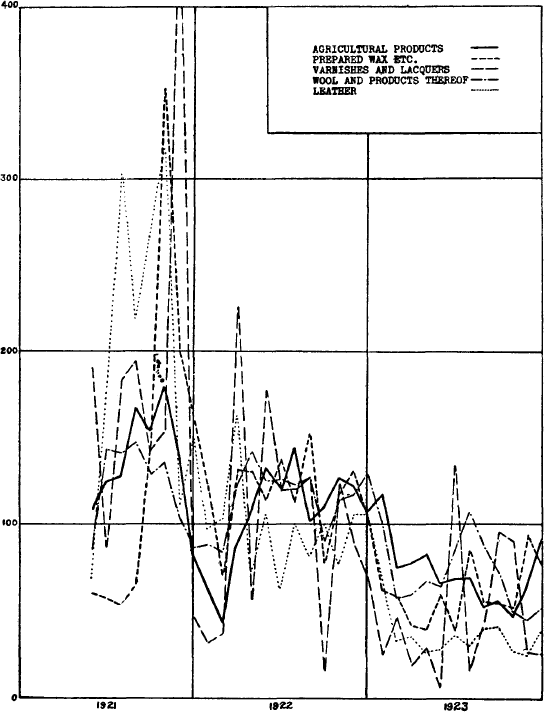
Germany as well as imported. Imports of such goods were readily susceptible to price changes. Consumption within Germany was either reduced absolutely or provided in larger measure by domestic producers or both. Chart XXIV showing the import of agricultural products, of prepared wax etc., of varnishes and lacquers, of wool and products thereof, and of leather, presents typical classifications in this group.
The following classes of imports show no visible trend, up or down :
1D. Products of industries associated with agriculture
1E. Food products not elsewhere specified
2A. Earths and stones
5C. Cotton, cotton yarns, and products thereof
17E. Tin, tin alloys, and products thereof
17F. Nickel, nickel alloys, and products thereof
17G. Copper, copper alloys, and products thereof.
CHART XXV
RELATIVE MONTHLY VOLUME OF IMPORT OF CERTAIN CLASSES OF COMMODITIES WITH NO DECIDED TREND IN EITHER DIRECTION; MAY 1921-DECEMBER 1923
(Average May 1921-December 1923 = 100)
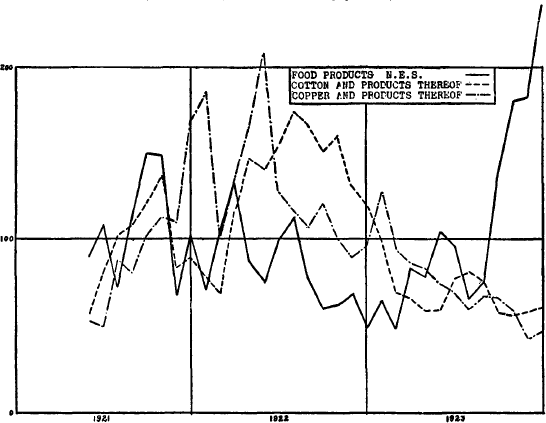
Many of these products are raw materials of industry not capable of being produced in Germany in any volume. A decline in such imports must have been accompanied by a falling off in exports of the finished products in the production of which these materials were used unless domestic consumption of the finished materials were cut still more heavily. Domestic consumption was cut, but the stimulus to export arising from the difference between the internal and external value of the mark was, in the case of these raw materials, sufficient to balance any general tendency toward a reduction of imports. Even though the mark cost of import of the raw materials was relatively very high it could be reimbursed through the sale of exports manufactured from these raw materials at correspondingly high mark prices. The relatively low cost of fabrication tended to give an adequate impetus. The upward march of exports of finished goods involving the use of many of these materials, as well as of those involving the use of raw materials the import of which fell off, will appear in the discussion of export trends. Chart XXV showing imports of food products not elsewhere specified, of cotton and products thereof, and of copper and copper alloys, will give an idea of the movement in this group of commodities in which no trend in either direction appears.
CHART XXVI
RELATIVE MONTHLY VOLUME OF IMPORT OF CERTAIN CLASSES OF COMMODITIES WITH AN UPWARD TREND; MAY 1921-DECEMBER 1923
(Average May 1921-December 1923 = 100)
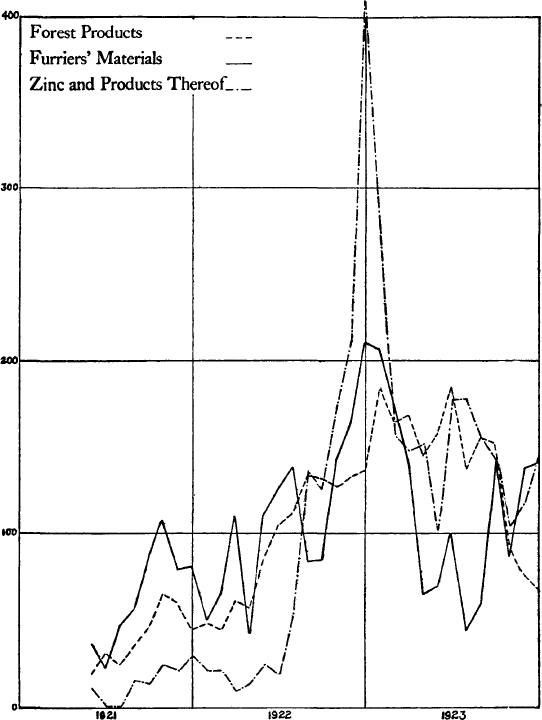
Three classes of imports have an upward trend, viz.:
1B. Forest products
6C. Furs and furriers’ materials
17D. Zinc, zinc alloys, and products thereof.
These also are raw materials of industry the import of which was affected by the possibility of export of the finished goods into which they enter. The increased import of furs (mainly skins) is reflected in an enlarged export of articles manufactured therefrom (see infra, this page) but, owing to the variety of their uses, it is impossible to say whether the same is true of forest products and zinc and its alloys or not. Chart XXVI depicts the trend of the classifications in this group.
Exports
The following classes of exports show a visible upward trend :
4A. Chemical elements, acids, salts and other chemical compounds 4E. Artificial fertilizers
4F. Explosives, ammunition, and combustibles
4G. Chemical and pharmaceutical products not elsewhere specified
5A. Silk, silk yarns, and products thereof
5B. Wool, wool yarns, and products thereof
5C. Cotton, cotton yarns, and products thereof
5J. Artificial flowers, umbrellas and parasols, shoes made of woven or felt materials
6C. Furs and furriers’ materials
7A. Soft rubber goods
7B. Hard rubber and hard rubber goods
11. Paper, cardboard, and manufactures thereof
15. Glass and glass products
17G. Copper and copper manufactures
19B. Clocks
19C. & D. Clay instruments, toys.
CHART XXVII
RELATIVE MONTHLY VOLUME OF EXPORT OF CERTAIN CLASSES OF COMMODITIES WITH AN UPWARD TREND; MAY 1921 - DECEMBER 1923
(Average May 1921-DECEMBER 1923 = 100)
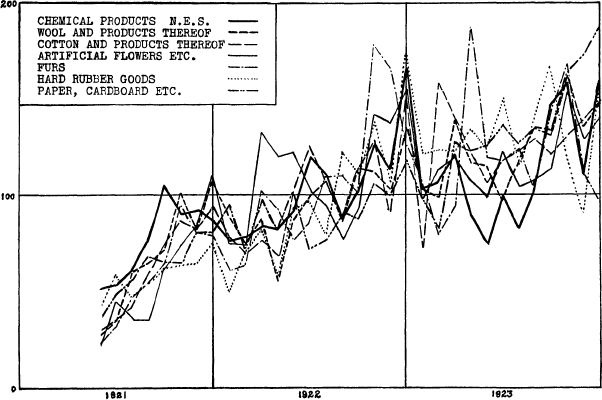
This group, with some notable exceptions, is comprised of commodities capable of some measure of standardization and not highly wrought. They are typically the semi-manufactured “raw material” of other industries. Buying of such commodities is on a basis of strict price comparison. Industries using these materials must purchase in the cheapest market or be put out of business by their competitors. Sales therefore respond readily to lowered prices; there is no cake of custom to be broken through. Though the domestic prices of these commodities were not nearly as far below world levels as was true of more highly wrought products, exports grew in volume while, as will presently appear, those of some finished commodities with a larger price differential remained stationary. Representative classifications in the group of exports with a rising trend are shown in Chart XXVII and include chemicals not elsewhere specified, wool and products thereof, cotton and products thereof, artificial flowers, etc., furs, hard rubber goods, and paper, cardboard, and manufactures thereof.
The following classes of exports show no visible trend, up or down:
4B. Dyes and dyestuffs
5H. Clothes, clothing accessories, and other sewn textile or felt products
6B. Leather goods
9. Brooms, brushes, screens
12. Books, pictures and paintings.
14. Pottery
17A. Iron and iron ores
17B. Aluminum and aluminum ores
18A. Machines
18B. Electro-technical products
18C. Vehicles
19A. Firearms.
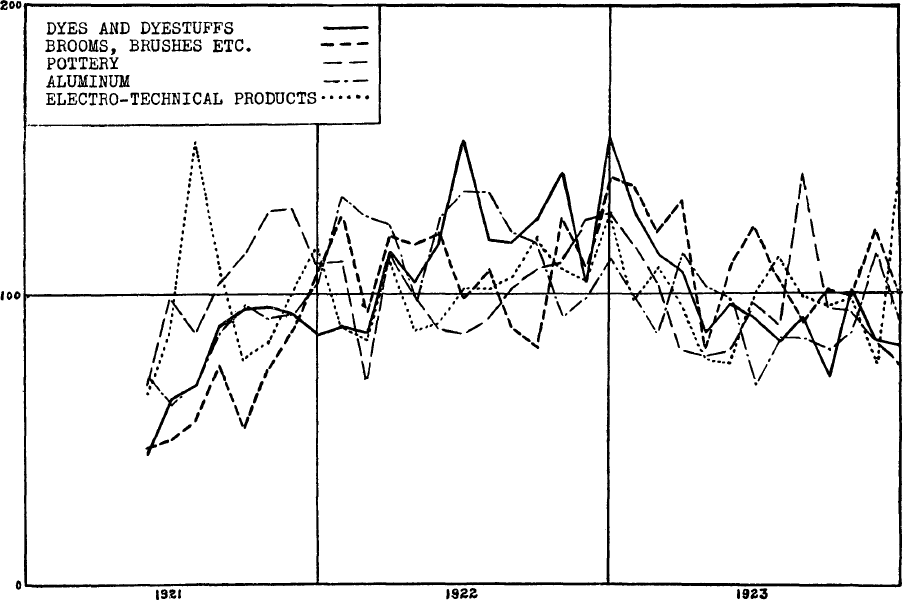
For some of these commodities special reasons account for the failure of exports to expand. German dyes and dyestuffs, for instance, met the strongest sort of resistance in important foreign markets. High protective duties were thrown round competing concerns in other countries which, during the war, had been specially fostered by the governments concerned. Dyestuffs and explosives are to some extent symbiotic industries and, for military reasons, the outside world was not disposed to concede to the Germans the dominance in dyestuffs which had been characteristic of the pre-war period. As for iron and iron ores it has already been pointed out that under the changed political conditions and the loss of German resources the tendency was for home production to be inadequate to the supply of the domestic market. Many of the other groups comprise commodities incapable of accurate grading and standardization. For such articles the taste and habits of the buyer play an important part and sales can therefore not be rapidly expanded even when prices are far below those prevailing in other countries for goods of no better quality. It is possible also that the swarm of “tourists” seeking bargains in Germany at this time bought up a great part of the supplies of articles of this sort and that these exports escaped inclusion in the official statistics. Chart XXVIII showing exports of dyes, of brooms, brushes, etc., of pottery, of aluminum, and of electro-technical products gives a picture of typical classifications of exports showing no trend in either direction.
CHART XXVIII
RELATIVE MONTHLY VOLUME OF EXPORT OF CERTAIN CLASSES OF COMMODITIES WITH NO DECIDED TREND IN EITHER DIRECTION; MAY 1921-DECEMBER 1923
(Average May 1921-December 1923 = 100)
Not a single class of exports shows any visible downward trend so far as weight is concerned. Statistics on vehicles are given by number as well as by weight, however, and the number of vehicles exported tended slightly downward.
In summary it may fairly be said that, as regards trends, there was a marked response on the part of both imports and exports to the relatively low external value of the mark. Ten classes of imports show a downward trend and, at most, one class of exports. On the other hand sixteen classes of exports show an upward trend and only three classes of imports. In these three, as also in the seven classes of imports which remained substantially stable in volume, the explanation of the trend counter to, or at least not in the direction of, the reduction to be expected seems to lie in the expansion of exports in the manufacture of which these imports were necessary. There was thus a relative contraction of all imports. Of the twelve classes of exports in which, so far as the official statistics show, there was no growth, some were of a type in which “invisible” export would be prominent7 so that the actual response on the part of exports was probably somewhat greater than appears on the face of the figures.
§ ELASTICITY OF DEMAND FOR IMPORTS AND EXPORTS
The marked decline in the volume of imports and the marked increase in the volume of exports, taken as a whole, disposes rather thoroughly of the contention that, unless a very long time is given for adjustment, inelasticity is a normal feature of the international trade of a country like Germany. The period covered was only of two and a half years’ duration but a rather remarkable degree of elasticity appears. It might, of course, be alleged that the shift which actually occurred could not have been permanently maintained, but of this there is no evidence. The augmentation of the physical volume of exports relative to that of imports does not, it is true, imply a similar change in values. On the contrary, the causal factor in the shift, high prices of imports and low prices of exports, means that total values would inevitably alter less than volume. It is conceivable that total values might not alter at all or even that they might change in the direction opposite to that of the figures of physical volume. But this is very far from being probable. The prices of imports, measured in gold, were not changing very greatly at this time and those exports which grew in volume were principally commodities the mark prices of which were fairly quickly adjusted to something approaching equivalence with the gold price of similar commodities produced abroad. On other exports prices were at least partially adjusted by the Boards of Foreign Trade Control. The fact that the volume of exports rose in response to the low exchange value of the mark somewhat more readily than imports fell off shows, however, that such restrictions on exports as were imposed by these Boards did not seriously inhibit the influence of the discrepancy between domestic and foreign prices.
§ CORRELATION OF VOLUME OF IMPORTS AND EXPORTS WITH FLUCTUATIONS IN PRICE MOVEMENTS
So much for the trends over the whole period of high inflation. Let us now look at the response of imports and exports to fluctuations in the ratio of the internal value of the mark to its external purchasing power. These fluctuations were large and frequent. If imports and exports were at all prompt in their response to sudden price changes they should show some point-to-point correlation with the price-ratio curve. It should be noted, however, that, whether or not they responded promptly, a lag of indeterminate length would tend to appear for both imports and exports. The actual passage of goods over the frontier takes place some time after the orders for those goods have been given and it is the orders, if anything, which would tend to correlate with the movement of prices. Most of the imports (largely foodstuffs and industrial raw materials) would probably be in existence at the time they were ordered and would be supplied out of the world stocks of these commodities. Insofar as this was true the delay in crossing the German borders would depend upon the time required for transport. While some of the exports could be supplied out of German stocks it would be necessary, in many cases, to wait for output. The period between the receipt of the order and the delivery of the goods would perhaps, therefore, average as long as in the case of imports. In both cases it would vary according to the nature of the commodity. Nor would the lag be constant with respect to all the increments of any one class of goods. With imports derived from diverse sources, widely separated geographically, some parts of the supply ordered at any given moment would arrive at German ports much earlier than others. Similarly, with exports, the time between order and delivery would be very different for different producers. This being so the actual imports and exports for any given month would include goods bought and sold at widely differing mark prices.
The actual receipt and delivery of goods at the German frontier in any given month would thus not accurately register the volume of orders in that or any preceding thirty-day period. But it may perhaps be assumed that the effect of suddenly and greatly altered prices should appear in the volume figures of both imports and exports within a month (or at most two months) of the price variation. This is long enough to permit the transfer from one country to another of goods already in being and it is probable that sales from stock would ordinarily dominate such fluctuations in imports and exports as were due to sudden price alterations. In any event the assumption of a longer period of lag would confuse rather than clarify the real situation. With the price curve fluctuating widely within short periods the longer the lag for which allowance is made the greater is the danger of having the sluggish effects of one price variation overwhelmed in the immediate effects of a counter movement. In the comparison of import and export fluctuations with the changes in the ratio of internal to external purchasing power of the mark a lag of one month, for both imports and exports, has therefore been assumed throughout. Where, however, a longer lag would give a better fit to the curves that fact has been indicated or will be obvious in the charts later to be presented.
It is clear that, when the movement in the ratio of internal to external purchasing power proceeded in the same direction for more than one month, such part of the total import or export of any given commodity as was tardy in its response would, in the later phase of such a movement, tend cumulatively to reinforce the statistical effects produced by such part as responded quickly, while, with every change of direction in the price ratio curve, it would tend to neutralize them. A greater measure of response to the broad swings in the ratio than to choppy fluctuations, however sharp the latter may be, is therefore to be expected.
It should also be noted that many imports and exports show a decided seasonal character and their month-to-month variations on this account might easily outweigh any putative response to price changes. In view of the highly unstable general situation and the short period for which figures were available it was not practicable, however, to take seasonal changes into account.
Innumerable other factors affect the monthly volume of all, or any single one, of the imports or exports. Such factors are: transport facilities, number of working days, strikes, stocks on hand, changes in style, weather, and what not, and all these may obscure such response to price changes as would otherwise be evident. But there was a more general cause, inherent in a change in the price ratio itself, which tended to prevent any nice converse movement in imports and exports when the ratio of internal to external purchasing power altered. It has already been pointed out that, where exportable goods are fabricated from imported raw materials, an expansion or contraction in foreign orders for such goods, consequent upon a relative rise or fall in the internal as compared with the external value of the currency, would lead to a synchronous expansion or contraction of the imported raw materials. The general tendency in the price situation toward opposite movements in imports and exports would, in consequence, not always hold for this group of products. Just as in the study of general trends exports showed a better response to the price situation than did imports, with the worst correlation among imports in the raw material group, so, in a study of month-to-month fluctuations, similar reactions may be expected.
In view of the many extraneous causes persistently operating it is not surprising to find that in no class either of imports or exports is there any exact month-by-month correlation with the internal-external purchasing power ratio curve. Correlation coefficients were computed (Pearson’s method) for the classes of imports and exports which, on inspection, seemed to promise the best results, but the degree of correlation indicated was of no significance whatever.8 It would be wrong to conclude, however, that there was no substantial and ready response to price variations, or that foreign trade was inelastic in its short-time movements. A much better test of the matter is furnished by noting the correlation of fluctuations in imports and exports with major movements in the ratio of internal to external purchasing power. In the period for which figures of imports and exports are available there are six such major movements (excluding the last, in November 1923, when de facto stabilization had been accomplished). The low points were in the summer of 1921, in the late spring and early summer of 1922, and in the spring of 1923. The high points were in the late fall of 1921, in the late fall and winter of 1922-1923, (this movement is of the saw-tooth type and sub-divisible into three sizable peaks and troughs) and in the summer of 1923.
Inspection of all the charts prepared gave a much better impression of the real response to price changes than could possibly be obtained from ostensibly more precise statistical calculation. Though the import and export curves show every conceivable variety of fluctuation, and are far from any nice inverse and direct response even to the major movements in the price index, there can be no doubt whatever of the difference in the character of the correlation. Insofar as there is any correlation of classes of imports with the price ratio index it is inverse and insofar as there is any correlation of classes of exports it is direct.
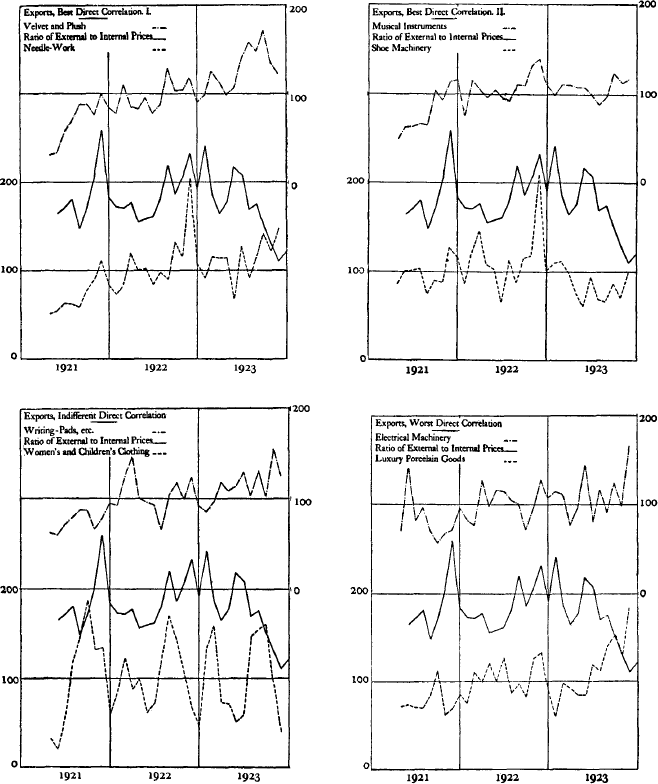
Certain charts have been selected and are here reproduced in Charts XXIX and XXX to show the best, indifferent, and worst inverse and direct correlations for imports and exports respectively. In all cases the export or import curves are shown with a one month’s lag relative to the price ratio curve.
The results of the examination of all the charted curves may be summarized as follows:
Imports
The classes of imports showing, on inspection only, some inverse correlation with the major movements of the price ratio index are:
1A. Agricultural products
1C. Animals and animal products
1D. Products of industries associated with agriculture
1E. Food products not elsewhere specified
4E. Artificial fertilizers
5A. Silk, silk yarns, and products thereof
5B. Wool and other animal fibers and products thereof
5C. Cotton, cotton yarns, and products thereof
17E. Tin and tin alloys
17G Copper and copper alloys.
As is to be expected the correlations of consumers’ goods are better than those of such raw materials of industry as are worked up into exportable products. With the exception of coal, which for special reasons given above was not studied, and iron ore, all of the ten most important German imports9 fall within these classifications. Many other commodities just below the first ten also come within their scope. The only even moderately important class of imports, aside from iron ore, which shows no inverse correlation with the peaks and troughs of the price ratio curve is that of forest products. It is possible that the building which was undertaken to guard against loss of profits was partly responsible for this—or perhaps it was the increased use of paper necessitated by inflation!
CHART XXIX
SELECTED CHARTS SHOWING THE BEST, INDIFFERENT, AND WORST INVERSE CORRELATIONS OF THE RELATIVE MONTHLY VOLUME OF IMPORT OF CERTAIN CLASSES OF COMMODITIES WITH THE PRICE RATIO INDEX; MAY 1921-DECEMBER 1923
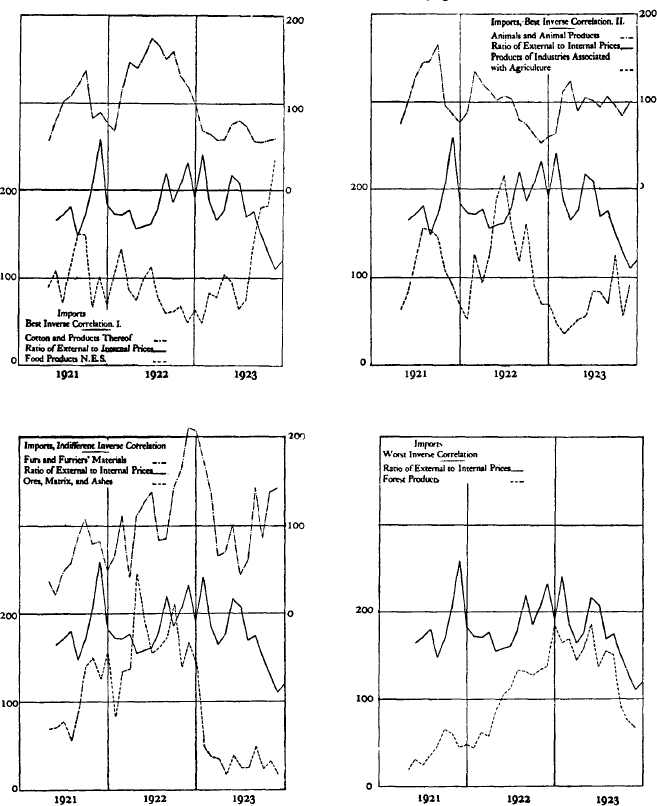
The fact that all of the more important classes of imports rose and fell in volume as their mark prices substantially declined or advanced in relation to the cost of domestic commodities, and that the fluctuations in volume of imports were, typically, at least as great as the fluctuations in relative prices, would go to show not only an immediate elasticity in the demand for all imports but an elasticity greater than unity. The total foreign exchange cost of the imports brought in when the prices to Germans were relatively high would therefore tend to be less than the total foreign exchange cost of the imports brought in when the prices to Germans were relatively low. So far as commodity trade on the import side was concerned there was thus a prompt calling of forces into play in correction of deviations of exchange rates from the internal purchasing power of the mark. Even those classes of imports which were necessary in the fabrication of customary exports responded to price changes in the same manner, though not to the same degree, as other imports, so that any expansion or contraction of exports fabricated therefrom, as the foreign exchange price of those exports fell or rose, must have been compensated by changes in domestic consumption rather than in total output.
Exports
The classes of exports showing, on inspection only, some direct correlation with the major movements of the price ratio index are:
5A. Silk, silk yarns, and products thereof
5B. Wool, wool yarns, and products thereof
5C. Cotton, cotton yarns, and products thereof
5H. Clothes, clothing accessories, etc.
6B. Leather goods
7A. Soft rubber goods
7B. Hard rubber goods
9. Brooms, brushes, etc.
12. Books, pictures, and paintings
14. Clay products
17A. Iron, iron alloys, and products thereof
17G. Copper, copper alloys, and products thereof
18A. Machinery
18B. Electro-technical products
18C. Vehicles
19B. Clocks.
The most important German exports not included in the above list are coal and dyestuffs. Coal, it will be remembered, was not included in the commodities studied, and dyestuffs were subject to special influences already commented upon. The response of exports as a whole to fluctuations in the price ratio curve was, therefore, prompt.
CHART XXX
SELECTED CHARTS SHOWING THE BEST, INDIFFERENT, AND WORST DIRECT CORRELATIONS OF THE RELATIVE MONTHLY VOLUME OF EXPORT OF CERTAIN CLASSES OF COMMODITIES WITH THE PRICE RATIO INDEX; MAY 1921-DECEMBER 1923
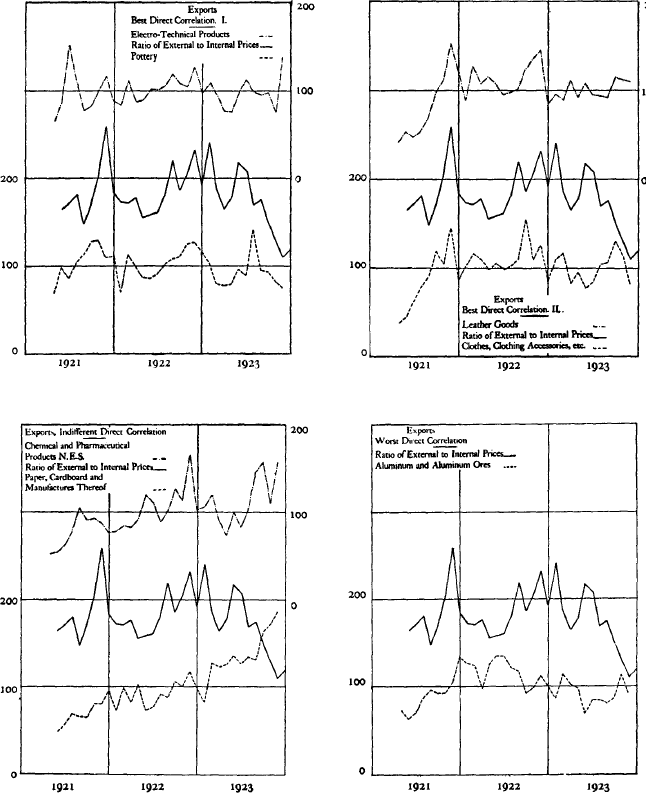
The range of the fluctuations in exports was, however, somewhat less pronounced than with imports. Imports were drawn from the whole world and available stocks were therefore greater than with exports, the source of which was restricted. The bulk of the adjustment was thus thrust upon imports. Exports were nevertheless by no means inelastic; there was nothing remotely approximating a fixed foreign demand for German goods taken as a whole, nor even for any fairly comprehensive category of them.
§ APPARENT ANOMALIES
There is a fairly general tendency for each of the import and export curves to reach its trough and peak respectively in response to the November 1922 rise in the purchasing power ratio index10 though this rise is the middle of three culminating points in a general upward swing.11 If the thesis that the effects of a long general movement in one direction would tend to be cumulative is correct it would seem that the greatest degree of correlation should occur at the final culminating point. At this point, January 1923, there is, in fact, almost no correlation. The explanation, so far as exports are concerned, is not far to seek. This final peak in the ratio index was the result of the rise in foreign exchange attendant upon the invasion of the Ruhr. The paralyzing effect of the occupation made increased exports impossible. The foreign demand was no doubt present but the supply was so reduced that domestic needs were preemptive. For imports the case is not so clear.
For some reason the response to the November 1921 peak in the purchasing power ratio occurred, in many cases, in January 1922, that is, with a two months’, rather than a one month’s, lag. A number of the curves do respond within a month, but the one month’s lag is not nearly so universal as is true of the peak in November 1922.12 The explanation probably lies in the shape of the respective peaks. The 1921 peak was the culmination of an upward movement of only three months’ duration while that of November 1922 topped an upward swing which, with one break, covered seven months. The cumulative effect of many long as well as shorter lags would thus be present in the latter case within a month of the change in the direction of the purchasing power ratio but in the former case it would not appear so soon.
The high points in November 1921 and November 1922 are the most significant of all the fluctuations. At the low points of the price ratio curve, all of which were well above purchasing power parity, the advantage to foreigners in making purchases in Germany, and the difficulty to Germans in making purchases abroad, while much less than at the high points, was still great. The consequent, already noted, upward trend in exports and downward trend in imports tends to reduce the month-to-month correlation of export and import curves (from which the trend has not been eliminated13) with the downward movements in the purchasing power ratio index which, in themselves, would lead to fluctuations in the direction opposite to the trends. The degree of correlation with the low points of that curve is therefore likely to be less than with the high. The high points in 1923 are of less significance, for exports at any rate, than those in 1921 and 1922 owing to the disturbance to production all over Germany entailed by the decline in industrial activity in the Ruhr, a factor entirely distinct from the price fluctuations.
§ TABULATION OF CORRELATIONS
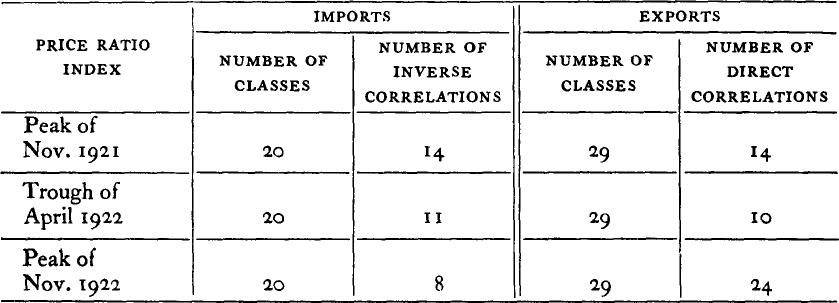
Taking the peaks in the price ratio curve in November 1921 and November 1922 and the low point between them, April 1922, as the dates at which the maximum response in imports and exports might reasonably be expected, the number of cases in which, within two months, there was a marked inverse movement of imports and a marked parallel movement of exports have been tabulated. It was by no means easy to decide whether the apparent correlation was or was not real, rather than accidental, and the results given in Table XXI may therefore be distorted by personal bias.14 As detached an attitude as possible was taken but a critic disposed to question the whole notion of correlation between the phenomena under review would no doubt reach very different conclusions. The results, for whatever they may be worth, are as given in Table XXI on the next page.
Since, in addition to inappropriate movements, the failure of any curve to show the appropriate correlative movement in a marked degree was sufficient to lead to its omission from the tabulation, this evidence of a quick response of classes of imports and exports to changes in the price ratio is by no means unconvincing. There were many neutral movements in the curves but almost none that were perverse.
Table XXI
RESPONSE OF IMPORTS AND EXPORTS, BY CLASSES, TO MAJOR MOVEMENTS IN THE PRICE RATIO INDEX
§ THE MOVEMENT OF INDIVIDUAL IMPORTS AND EXPORTS
The total weight of imports or exports in any given classification might of course remain relatively constant, or might move in a manner inappropriate to a synchronous movement in the price ratio curve, owing to the fact that, while most of the commodities in the classification reacted appropriately, certain heavy articles took a perverse course. In order to test the results so far reached from an examination of commodities by classes, a more or less random selection of individual commodities was made and the monthly deviations of imports and exports of these individual commodities from their average for the period were charted. The upshot of this procedure was not very different from that attained where the commodities were taken by classes. Out of nineteen commodities predominantly imported15 twelve show a downward trend throughout the period covered, six show no trend in either direction, and one shows an upward trend. Out of twenty-six commodities predominantly exported16 sixteen show an upward trend and ten no trend in either direction. None shows a downward trend.
In the matter of correlation of fluctuations in the movement of these individual imports and exports in response to broad movements of the price ratio curve ten of the nineteen import commodities and fourteen of the twenty-six export commodities show fair inverse and direct responses respectively, one month’s lag being taken for both categories. The remaining commodities in each category fail to show the appropriate correlation though there is, of course, no case where there is any decided correlation of an inappropriate character (inverse for exports and direct for imports). Charts XXXI and XXXII depict typical good, indifferent, and poor correlations.
§ TRENDS VS. SHORT-TIME CORRELATIONS
While it is apparent from these results, and from those derived through the investigation of the movement of commodities by classes, that there was a real and quick response of foreign trade in both the import and export categories to fluctuations in the price ratio index, the correlation is far from being as decisive as is the general trend of imports and exports whether taken by classes or as individual commodities. Several explanations may be offered:
(1) A productive organization working close to capacity cannot immediately change the nature and direction of its output. Any immediate alteration in trade currents must therefore take place within the scope of existing and accruing stocks. So far as exports are concerned the available stocks set an outer limit on immediate expansion though contraction of export might occur in any degree. The persistently favorable prices at which German goods could be procured by foreigners during practically the whole of the inflation period tended gradually to shift German production into export lines and the trend of exports thus corresponds with theoretical expectation more closely than does the month-to-month movement. As regards imports, the consideration just advanced applies with much less force, since the stocks of German import goods held throughout the world were presumably adequate to take care of any fluctuation in German demand.
(2) An upward movement in exchange rates making imports more expensive might temporarily increase demand for those imports through the fear of a still further decline in the external purchasing power of the mark. Falling foreign exchange rates, on the other hand, may have encouraged waiting for a still more favorable situation. This may in part account for certain fluctuations in some classes of imports in the direction contrary to that which price considerations would indicate as probable. The response of buyers of German exports to changing prices (in their own currency) may, furthermore, have been at times inappropriate insofar as there was a tendency to wait for still better bargains when prices were falling or to snap up goods on a rising market.
CHART XXXI
SELECTED CHARTS SHOWING THE BEST, INDIFFERENT, AND WORST INVERSE CORRELATIONS OF THE RELATIVE MONTHLY VOLUME OF IMPORT OF CERTAIN COMMODITIES WITH THE PRICE RATIO INDEX; MAY 1921-DECEMBER 1923
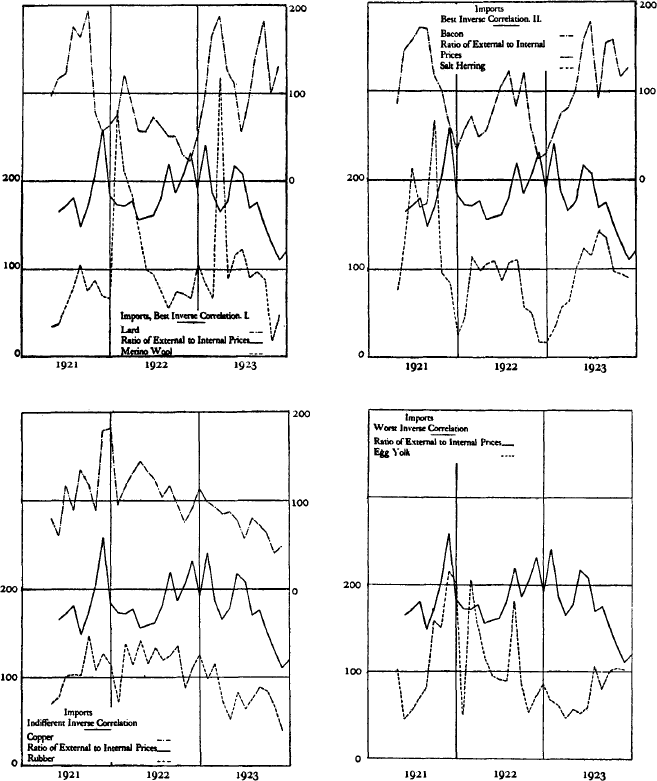
CHART XXXII
SELECTED CHARTS SHOWING THE BEST, INDIFFERENT, AND WORST DIRECT CORRELATIONS OF THE RELATIVE MONTHLY VOLUME OF EXPORT OF CERTAIN COMMODITIES WITH THE PRICE RATIO INDEX; MAY 1921-DECEMBER 1923
(3) The practice of invoicing some exports in foreign currencies, at prices substantially determined by sales possibilities in foreign markets, tended to nullify the effect of exchange rate fluctuations.
(4) Quick action by any of the Boards of Foreign Trade Control in response to movements in exchange rates would keep such movements from exerting a marked effect though it might not obviate the general tendency of the low external value of the mark toward an increase of the ratio of exports to imports. Partly as a result of the action of these Boards, and partly because of inability of German producers greatly to increase export, the opportunity open to foreigners of buying cheaply in Germany as mark exchange declined was sometimes more apparent than real. Complaints on the part of buyers of German exports with respect to the slowness of delivery of goods and other unsatisfactory features of their purchases were frequent. The Boards did not hesitate to alter contracts, and foreign buyers were as often repelled by the inconvenience of buying in Germany as they were attracted by the quoted prices.
Any temporary inelasticity in the demand for German imports or exports might also have prevented a quick adjustment to price changes. It cannot positively be asserted that such inelasticity of demand was not present, but the steady growth of exports relative to imports is evidence to the contrary, and this evidence is confirmed, so far as exports are concerned, by the complaints of slow deliveries of which mention has already been made. It would seem therefore that, in a country with a diversified trade, the exports and imports of a wide variety of commodities will rather readily expand or contract with any sizable shift in the relationship between import and export prices.
_______________
17 It should be noted that the total exports of Germany in the years in question did not amount to 7,000,000,000 gold marks and there was no excess of exports at all. The maximum reparations payment later made in any single year was 2,500,000,000 gold marks and part of this did not necessitate an international transfer of funds.
18 To a considerable degree the work of the Boards of Foreign Trade Control was facilitated, or rendered unnecessary, by the activities of cartels.
19 cf. Depreciated Exchange and International Trade, United States Tariff Com-mission, Government Printing Office, Washington, 1922, passim.
20 Thus in the introductions to Statistik des deutschen Reichs for 1920, 1921, and 1922, the value figures previously published in the Monatliche Nachweise are expressly repudiated. Even the figures by weight are at times inaccurate owing to: (1) the “Hole in the West” which was closed, however, in the spring of 1920, (2) the occupation of the Ruhr during 1923, (3) the prevalence of smuggling as the range of uncontrolled trade was narrowed, (4) the relative growth of “tourist’s” purchases which escaped the attention of the inspectors.
21 Thus, in 1913, coal alone formed almost 50% of the total weight of exports but only 5% of the value. In 1922 and 1923, on the other hand, exports of coal, aside from reparations, had become negligible, while, in some months of those years, imports of coal ran to more than 70% by weight of the total for all commodities. Between 1913 and 1922 the total weight of German exports sank by more than two-thirds, from 73.6 million tons to 21.9 million tons but of this decline the falling off in coal and coke exports accounted for 36.6 million tons. Excluding bar and other semi-manufactured iron products, the export of manufactured goods was only 14% less, by weight, in 1922 than in 1913.
22 In all, forty-three out of a total of sixty-six classifications were included. There is no reason to believe that the excluded twenty-three would have shown movements widely divergent from those included. The great majority of them were omitted simply because they were unimportant.
Source of data: Monatliche Nachweise über den auswärtigen Handel Deutschlands, Statistisches Reichsamt, Berlin, monthly. The figures and letters designating the several classes are those of the original data.
23 The term is here used to cover commodity exports taken out in the luggage of “tourists.”
24 —.243 for the imports (Class ID) and + .314 for the exports (Class 6B). Probable error ±.114 and ± .109 respectively.
25 Arranged in order of value in 1913.
26 Typically with a one month lag.
27 The statement is based on a study of all the curves charted. Most of these have not here been reproduced.
28 The period covered was so short and the factors affecting the volume of exports and imports varied so much from year to year that it seemed useless to attempt the elimination of trends.
29 A given import or export classification might, for instance, show a marked fluctuation in apparent response to one of the major movements in the price ratio curve but a still greater fluctuation somewhere else. The decision as to whether the correlating fluctuation was or was not a true response was necessarily arbitrary and was based on the general character of the curve concerned.
30 These commodities were: wheat, raw cotton, raw tobacco, coffee, rubber, beef, pork, ham, bacon, fresh herring, salt herring, lard, oleomargarin, butter, eggs, egg-yolk, wool, silk, copper.
31 These commodities were: silk lace goods, gimps, velvet and plush, cotton weaves, cotton gloves, stockings etc., women’s and children’s clothing, men’s and boys’ clothing, glazed cardboard etc., printing paper, note-books, books, sheet-music, maps, insulators, porcelain ornaments, sewing machines, printing presses, shoe machinery, dynamos, transformers etc., safety lamps etc., electric light bulbs, telephone and telegraph apparatus, motor vehicles, musical instruments.
- 1CLIFFE-LESLIE once remarked that in social matters the greatest scientific progress is made when economic disorders raise vexing questions as to their causes. In the study of social phenomena, disorder is, it is true, the sole substitute for the controlled experiments of the natural sciences. But it sometimes happens that, in the midst of disorder, events move so rapidly that we are not able properly to observe them; disorder may be excessive even to the most detached of scientists. The course of inflation in Germany in the first post-war quinquennium had so much of this character that it has seemed to many to be incapable of throwing any light upon monetary problems. This most striking of monetary experiences has, in consequence, evoked a minimum of scientific curiosity. In spite of the fact that statistics—those notes of process on which the social scientist must so heavily rely—were for some phenomena abandoned in Germany in this period and for others are open to grave objection on the score of accuracy, it has seemed to me that such an attitude implies an unwarranted surrender in the face of difficulties which might with perseverance be surmounted. This book is an attempt, therefore, to discover what actually happened in Germany and either to bring the observed phenomena within the fold of accepted theory or else so to modify that theory as to give it a more catholic character. The actual course of events during inflation has not merely an historical and scientific interest but is of considerable practical importance. Germany’s present position as a nation with heavy international obligations has led to apprehension, both within and without the Reich, as to the future in international finance. The fears of such German competition as may issue out of the debtor status may be dismissed as but thinly-veiled mercantilism but the question as to the possibility of ultimate transfer of the large sums involved in reparations and interest payments must, perhaps, be treated with more respect. The ability of the German economy to provide, within Germany, the funds required, is, on the other hand, no longer seriously doubted. It is hoped that the sequel will throw some light on the disappearance of the latter doubt as also on the prospect of future transfers undisturbed by any serious economic friction.
- 2in Germany. It is based very largely on official German statistics as published by the Statistische Reichsamt and the Institut für Konjunkturforschung. These statistics, for the period studied, are, no doubt, far from perfect, but nothing is gained by attempting to go behind them and there is no reason to suppose that such alternative sources as are available are at all superior. The hope is cherished, perhaps not without justification, that such errors as are involved do not vitiate the conclusions reached. The immense nominal magnitudes attained by all -monetary phenomena in Germany in the inflation-time tend to dwarf the influence of even very considerable imperfections in the statistics. I am far from supposing, nevertheless, that the results obtained are to be taken as clearly proven and I trust that the reader will be no more credulous. They are merely hypotheses
- 3The publications of the Statistische Reichsamt which have been principally used are : Statistisches Jahrbuch für das deutsche Reich, Statistik des deutschen Reichs, Wirtschaft und Statistik, Monatliche Nachweise über den auswärtigen Handel Deutschlands, Zahlen zur Geldentwertung in Deutschland 1914 bis 1923, and Germany’s Economy, Currency and Finance. Sparing use has been made of forms of statistics already available in these sources and, where tables are given in the text, they are, in nearly all cases, the result of computations from the original data.
- 4The cessation of war found Germany in a financial position not markedly inferior to that of most of the other countries involved in the struggle. The far-reaching alterations in the Reichsbankgesetz in 1914 had permitted the suspension of specie payments, had removed the tax on excess Reichsbank note issues, had permitted the Reichsbank to use discounted Treasury bills in lieu of commercial bills as the non-cash cover for Reichsbank notes, and had made Reichskassenscheine and Darlehns-kassenscheine available to meet the “cash” reserve requirements. (The distinction between cash and non-cash cover was abolished in 1921.) This war legislation paved the way for all the coming currency difficulties but it did not differ very greatly from that adopted at the same time in practically all the countries then engaged in hostilities, nor did inflation in Germany, up to the time of the Armistice, much surpass that of some of the principal Entente Allies. The total circulation (including coin other than Reichsbank reserves) in the middle of 1914 is estimated to have been approximately six billions of marks; at the end of 1918 it was something more than five times as much, 32,936,700,000 marks. The total monetary circulation in Great Britain was about £180,000,000 when war broke out while four and a half years later the total of outstanding notes was more than double that sum and stood at approximately £394,000,000. Bank deposits, which in England are a more important index of inflation, had grown in about the same proportion. The total circulation in France (excluding reserves of the Bank of France) in mid-1914 was something over 8,000,000,000 francs (6.5 billion francs in gold and silver, less 4 billion Bank of France reserves, plus 5.8 billion in notes of the Bank of France) while at the end of 1918 the note circulation of the Bank of France amouted to over 30,000,000,000 francs or not quite four times the total pre-war volume of currency. By this date all the gold formerly in circulation had of course disappeared.
- 5The cessation of war found Germany in a financial position not markedly inferior to that of most of the other countries involved in the struggle. The far-reaching alterations in the Reichsbankgesetz in 1914 had permitted the suspension of specie payments, had removed the tax on excess Reichsbank note issues, had permitted the Reichsbank to use discounted Treasury bills in lieu of commercial bills as the non-cash cover for Reichsbank notes, and had made Reichskassenscheine and Darlehns-kassenscheine available to meet the “cash” reserve requirements. (The distinction between cash and non-cash cover was abolished in 1921.) This war legislation paved the way for all the coming currency difficulties but it did not differ very greatly from that adopted at the same time in practically all the countries then engaged in hostilities, nor did inflation in Germany, up to the time of the Armistice, much surpass that of some of the principal Entente Allies. The total circulation (including coin other than Reichsbank reserves) in the middle of 1914 is estimated to have been approximately six billions of marks; at the end of 1918 it was something more than five times as much, 32,936,700,000 marks. The total monetary circulation in Great Britain was about £180,000,000 when war broke out while four and a half years later the total of outstanding notes was more than double that sum and stood at approximately £394,000,000. Bank deposits, which in England are a more important index of inflation, had grown in about the same proportion. The total circulation in France (excluding reserves of the Bank of France) in mid-1914 was something over 8,000,000,000 francs (6.5 billion francs in gold and silver, less 4 billion Bank of France reserves, plus 5.8 billion in notes of the Bank of France) while at the end of 1918 the note circulation of the Bank of France amouted to over 30,000,000,000 francs or not quite four times the total pre-war volume of currency. By this date all the gold formerly in circulation had of course disappeared.
- 6The cessation of war found Germany in a financial position not markedly inferior to that of most of the other countries involved in the struggle. The far-reaching alterations in the Reichsbankgesetz in 1914 had permitted the suspension of specie payments, had removed the tax on excess Reichsbank note issues, had permitted the Reichsbank to use discounted Treasury bills in lieu of commercial bills as the non-cash cover for Reichsbank notes, and had made Reichskassenscheine and Darlehns-kassenscheine available to meet the “cash” reserve requirements. (The distinction between cash and non-cash cover was abolished in 1921.) This war legislation paved the way for all the coming currency difficulties but it did not differ very greatly from that adopted at the same time in practically all the countries then engaged in hostilities, nor did inflation in Germany, up to the time of the Armistice, much surpass that of some of the principal Entente Allies. The total circulation (including coin other than Reichsbank reserves) in the middle of 1914 is estimated to have been approximately six billions of marks; at the end of 1918 it was something more than five times as much, 32,936,700,000 marks. The total monetary circulation in Great Britain was about £180,000,000 when war broke out while four and a half years later the total of outstanding notes was more than double that sum and stood at approximately £394,000,000. Bank deposits, which in England are a more important index of inflation, had grown in about the same proportion. The total circulation in France (excluding reserves of the Bank of France) in mid-1914 was something over 8,000,000,000 francs (6.5 billion francs in gold and silver, less 4 billion Bank of France reserves, plus 5.8 billion in notes of the Bank of France) while at the end of 1918 the note circulation of the Bank of France amouted to over 30,000,000,000 francs or not quite four times the total pre-war volume of currency. By this date all the gold formerly in circulation had of course disappeared.
- 7The cessation of war found Germany in a financial position not markedly inferior to that of most of the other countries involved in the struggle. The far-reaching alterations in the Reichsbankgesetz in 1914 had permitted the suspension of specie payments, had removed the tax on excess Reichsbank note issues, had permitted the Reichsbank to use discounted Treasury bills in lieu of commercial bills as the non-cash cover for Reichsbank notes, and had made Reichskassenscheine and Darlehns-kassenscheine available to meet the “cash” reserve requirements. (The distinction between cash and non-cash cover was abolished in 1921.) This war legislation paved the way for all the coming currency difficulties but it did not differ very greatly from that adopted at the same time in practically all the countries then engaged in hostilities, nor did inflation in Germany, up to the time of the Armistice, much surpass that of some of the principal Entente Allies. The total circulation (including coin other than Reichsbank reserves) in the middle of 1914 is estimated to have been approximately six billions of marks; at the end of 1918 it was something more than five times as much, 32,936,700,000 marks. The total monetary circulation in Great Britain was about £180,000,000 when war broke out while four and a half years later the total of outstanding notes was more than double that sum and stood at approximately £394,000,000. Bank deposits, which in England are a more important index of inflation, had grown in about the same proportion. The total circulation in France (excluding reserves of the Bank of France) in mid-1914 was something over 8,000,000,000 francs (6.5 billion francs in gold and silver, less 4 billion Bank of France reserves, plus 5.8 billion in notes of the Bank of France) while at the end of 1918 the note circulation of the Bank of France amouted to over 30,000,000,000 francs or not quite four times the total pre-war volume of currency. By this date all the gold formerly in circulation had of course disappeared.
- 8The cessation of war found Germany in a financial position not markedly inferior to that of most of the other countries involved in the struggle. The far-reaching alterations in the Reichsbankgesetz in 1914 had permitted the suspension of specie payments, had removed the tax on excess Reichsbank note issues, had permitted the Reichsbank to use discounted Treasury bills in lieu of commercial bills as the non-cash cover for Reichsbank notes, and had made Reichskassenscheine and Darlehns-kassenscheine available to meet the “cash” reserve requirements. (The distinction between cash and non-cash cover was abolished in 1921.) This war legislation paved the way for all the coming currency difficulties but it did not differ very greatly from that adopted at the same time in practically all the countries then engaged in hostilities, nor did inflation in Germany, up to the time of the Armistice, much surpass that of some of the principal Entente Allies. The total circulation (including coin other than Reichsbank reserves) in the middle of 1914 is estimated to have been approximately six billions of marks; at the end of 1918 it was something more than five times as much, 32,936,700,000 marks. The total monetary circulation in Great Britain was about £180,000,000 when war broke out while four and a half years later the total of outstanding notes was more than double that sum and stood at approximately £394,000,000. Bank deposits, which in England are a more important index of inflation, had grown in about the same proportion. The total circulation in France (excluding reserves of the Bank of France) in mid-1914 was something over 8,000,000,000 francs (6.5 billion francs in gold and silver, less 4 billion Bank of France reserves, plus 5.8 billion in notes of the Bank of France) while at the end of 1918 the note circulation of the Bank of France amouted to over 30,000,000,000 francs or not quite four times the total pre-war volume of currency. By this date all the gold formerly in circulation had of course disappeared.
- 9The cessation of war found Germany in a financial position not markedly inferior to that of most of the other countries involved in the struggle. The far-reaching alterations in the Reichsbankgesetz in 1914 had permitted the suspension of specie payments, had removed the tax on excess Reichsbank note issues, had permitted the Reichsbank to use discounted Treasury bills in lieu of commercial bills as the non-cash cover for Reichsbank notes, and had made Reichskassenscheine and Darlehns-kassenscheine available to meet the “cash” reserve requirements. (The distinction between cash and non-cash cover was abolished in 1921.) This war legislation paved the way for all the coming currency difficulties but it did not differ very greatly from that adopted at the same time in practically all the countries then engaged in hostilities, nor did inflation in Germany, up to the time of the Armistice, much surpass that of some of the principal Entente Allies. The total circulation (including coin other than Reichsbank reserves) in the middle of 1914 is estimated to have been approximately six billions of marks; at the end of 1918 it was something more than five times as much, 32,936,700,000 marks. The total monetary circulation in Great Britain was about £180,000,000 when war broke out while four and a half years later the total of outstanding notes was more than double that sum and stood at approximately £394,000,000. Bank deposits, which in England are a more important index of inflation, had grown in about the same proportion. The total circulation in France (excluding reserves of the Bank of France) in mid-1914 was something over 8,000,000,000 francs (6.5 billion francs in gold and silver, less 4 billion Bank of France reserves, plus 5.8 billion in notes of the Bank of France) while at the end of 1918 the note circulation of the Bank of France amouted to over 30,000,000,000 francs or not quite four times the total pre-war volume of currency. By this date all the gold formerly in circulation had of course disappeared.
- 10The cessation of war found Germany in a financial position not markedly inferior to that of most of the other countries involved in the struggle. The far-reaching alterations in the Reichsbankgesetz in 1914 had permitted the suspension of specie payments, had removed the tax on excess Reichsbank note issues, had permitted the Reichsbank to use discounted Treasury bills in lieu of commercial bills as the non-cash cover for Reichsbank notes, and had made Reichskassenscheine and Darlehns-kassenscheine available to meet the “cash” reserve requirements. (The distinction between cash and non-cash cover was abolished in 1921.) This war legislation paved the way for all the coming currency difficulties but it did not differ very greatly from that adopted at the same time in practically all the countries then engaged in hostilities, nor did inflation in Germany, up to the time of the Armistice, much surpass that of some of the principal Entente Allies. The total circulation (including coin other than Reichsbank reserves) in the middle of 1914 is estimated to have been approximately six billions of marks; at the end of 1918 it was something more than five times as much, 32,936,700,000 marks. The total monetary circulation in Great Britain was about £180,000,000 when war broke out while four and a half years later the total of outstanding notes was more than double that sum and stood at approximately £394,000,000. Bank deposits, which in England are a more important index of inflation, had grown in about the same proportion. The total circulation in France (excluding reserves of the Bank of France) in mid-1914 was something over 8,000,000,000 francs (6.5 billion francs in gold and silver, less 4 billion Bank of France reserves, plus 5.8 billion in notes of the Bank of France) while at the end of 1918 the note circulation of the Bank of France amouted to over 30,000,000,000 francs or not quite four times the total pre-war volume of currency. By this date all the gold formerly in circulation had of course disappeared.
- 11Wholesale prices in Germany, Great Britain and France at the end of 1918 were respectively 2.45, 2.30 and 3.53 times their pre-war height. In the United States they were just about twice their 1913 level.
- 12Wholesale prices in Germany, Great Britain and France at the end of 1918 were respectively 2.45, 2.30 and 3.53 times their pre-war height. In the United States they were just about twice their 1913 level.
- 131
- 14The occupation, by French and Belgian troops, took place in the early days of January 1923. The British government of the day adopted an attitude of passive disapproval and Italy, while assenting to the measures taken, refused to participate actively in the occupation.
- 15The exchange value of French currency, for instance, was brought very low when it became apparent that the French fise could not count on any large receipts from Germany.
- 16When the administration proposed a capital levy to meet the burdens imposed, the industrialists countered with the offer of a loan of one billion gold marks. But, as negotiations proceeded, the industrialists demanded a remission of future taxes and the turning over to them of the state railroads. The government properly refused and resorted to a forced loan which, however, yielded only 50 million gold marks.
- 17cf. Foreign Banking Systems, H. P. Willis and B. H. Beckhart, editors, Chap, VIII, “The Banking System of Germany,” Paul Quittner, Henry Holt and Company, New York, 1929, p. 632, where it is declared that it would be useless to try to connect the development of the German currency system from 1919 to 1923 with any theories of money.
- 18In the matter of mark exchange rates, for instance, sizable differences developed, in the later stages of inflation, between the Berlin and other markets. These were due to the obstruction of arbitrage transactions. At the time that this occurred, however, the Berlin rate was alone of much significance. The Berlin rates have therefore been used throughout. In the matter of prices the alternative sources are the indices of the Berliner Tageblatt, the Frankfurter Zeitung, and the Industrie- und Handelszeitung.
- 19The latter compilation was published in English, as well as in German, for use by the Committees of Experts of the Reparations Commission.
- 20Treasury notes, a fiduciary currency. These were, however, issued rather sparingly. The maximum issue was 356 million marks. Reichskassenscheine had been legal as cash cover in pre-war days but their issue had been closely restricted and few had been available. These Treasury notes are to be carefully distinguished from Treasury bills, a short-term security not used as money.
- 21A form of currency issued by officially established Loan Bureaus against the pledge of securities (or commodities) by borrowers other than the government and the larger banks and business concerns. During the war these notes formed an important share of the circulating medium but thereafter remained comparatively stable in absolute figures (7 to 14 billion marks) and were of constantly declining relative importance. They played but a slight ròle from 1921 onward.
- 22Germany’s Economic and Financial Situation, Statistisches Reichsamt, Zentralverlag G.m.b.H., Berlin, 1923, p. 28.
- 23Zahlen zur Geldentwertung in Deutschland 1914 bis 1923, Statistisches Reichsamt, Verlag von Reimar Hobbing, Berlin, 1925, p. 46.
- 24Committee on Currency and Foreign Exchanges After the War (Cunliffe Committee) First Interim Report, H. M. Stationery Office, London, 1924, p. 5.
- 25Total bank deposits, exclusive of those of small private banks, were £716 million on June 30, 1914, and £1361 million on June 30, 1919. European Currency and Finance, United States Senate Commission of Gold and Silver Inquiry, Serial 9, Vol. I, Government Printing Office, Washington, 1925, pp. 277, 278.
- 26ibid., Vol. I, pp. 308, 470.
- 27ibid., Vol. I, pp. 534. 477, 455.
- 28Of this amount approximately 97 billion marks had been obtained through long-term loans.
- 29The climax in the reparations conflict came with the invasion of the Ruhr, an action which had no support from some of the creditor Powers. Much as the invasion is to be regretted or condemned, however foolish it may have been as a method of collecting payment, and however evil its immediate results, it was the thunderclap that cleared the air. It showed the obdurate creditors how little could be obtained by a policy of force and, on the other hand, it brought such distress to Germany as to convince even the stoutest opponent of the policy of fulfilment (and they were many and powerful) that it was better to accept a moderated burden of payments which, in spite of strong convictions to the contrary, it might be possible for the country to carry, than to continue in an attitude of stubborn intransigence.
- 30When force had led to disaster, the repercussions of which affected the creditors as well as the debtors, the way was at last open to men of conciliatory spirit, and a solution of the problem, or at any rate a working compromise, could be reached. The invasion was a tragic but triumphant vindication of the policy of moderation, and it led to sympathetic, even if selfish, efforts on the part of the creditor Powers to rehabilitate the economy and finances of the Reich. Once order had been restored progress was possible.
- 31Inflation was therefore combated but half-heartedly at best. Though several of the administrations of the years 1920 to 1923 made valiant attempts to arrest its progress they could not summon the sustained powers necessary to success. All of their efforts came to naught, largely through the apathy or active opposition of powerful business groups who were disposed neither to aid their government in imposing regular taxation nor to cooperate with it in carrying out its obligations under the Treaty of Versailles. Whatever might have been possible to a government backed by a people determined to have no further traffic with inflation, the will to establish a stable standard was lacking until the drama had run its course. It may well be doubted whether a stable standard could in any case have been set up while immense reparations debts were plaguing the situation. But this must remain an open question. So long as wealth and income were being merely transferred by the decline in the value of the monetary unit and not, as a sum, diminished, so long as scapegoats could be found to assume the burdens and yield of their substance to those who knew how to profit from the situation, projects of reform were treated cavalierly. It was only when enterprisers, instead of surely profiting from inflation as they long did, were suddenly plunged into a sea of uncertainties, only when business activity passed from the stage of exhilaration to panic, only when resistance to a further assumption of losses on the part of the public at large became general, that influential opinion veered to a conviction of the necessity of restoring a stable standard. The pass to which matters had then come is shown in Table III.

