
Exchange, Prices, and Production in Hyper-Inflation
IV. Price and Exchange Rate Theory and the Facts in Germany
CHAPTER IV
PRICE AND EXCHANGE RATE THEORY AND THE FACTS IN GERMANY
§ ORTHODOX DOCTRINE
THE orthodox theory of the relation between changes in the volume of circulating medium, the general price level, and rates of exchange in a country on an inconvertible paper monetary standard may be stated in two propositions as follows :
(1) The relation is symmetrical. If the price level in other countries remains constant, the symmetry will be that of proportionality; if the price level in other countries alters, the proportionality between the volume of circulating medium and the domestic price level will be unaffected, but exchange rates will then be a function of two variables, that of the volume of circulating medium or domestic price level on the one hand, and that of the foreign price level on the other.
(2) The causal sequence runs from volume of circulating medium to prices to exchange rates.
This theory states tendencies only. It does not deny that in actual situations the symmetry which it asserts may be distorted. The relation between the volume of circulating medium and the price level is affected by changes in the velocity of monetary turnover, and by the total of transactions carried on with money, and the relation between domestic and foreign prices merely furnishes an approximate par of exchange from which the actual rates may at times deviate in considerable degree. But velocity of monetary turnover and the volume of transactions are comparatively stable factors and, though such changes as occur in them may be persistent, they are not likely to be large. Deviations of exchange rates from the norm, on the other hand, while frequently wide, carry their own corrective, and, whatever their temporary aberrations, continue to center about the purchasing power par established by current price levels in the countries involved. According to orthodox theory then, any departure from symmetry in the relation between money, prices, and exchange rates is likely to be inconsiderable or else an anomaly ever in process of elimination. Given the volume of circulating medium, or the general price level, or exchange rates, in a given country at two different and not very widely separated periods and the unknown items could be computed with substantial accuracy.1 It is no more than an application of the rule of three.
Changes in the price level are asserted to have no effect upon the velocity of monetary turnover or upon the total of transactions nor do they condition the volume of circulating medium. They are, in fact, but the passive resultant of these three independently determined factors and themselves initiate nothing. The velocity of monetary turnover and the volume of transactions are likewise unaffected by the amount of money in circulation, and the amount of money, in turn, is unaffected by its rate of turnover or by the volume of transactions. The mobile causal factor is the volume of circulating medium; the mobile resultant is prices. As for exchange rates, these are but the price of one currency in terms of another. Since the only use for a paper currency is to make purchases in the country of origin, its value, in a stable foreign currency, will obviously vary in proportion to its purchasing power, that is to say, in inverse ratio to the domestic price level. If, however, the unit of measurement, the foreign currency, is unstable in goods value, the exchange rate of the two currencies against one another at any time will tend to express their current respective purchasing powers. In either case price levels are cause and exchange rates effect. Fluctuations in exchange rates may alter individual prices but they can have no effect upon the general price level.
The monetary experience of many countries in the war and post-war period has shown that the theory just laid down, if valid at all, is much too rigidly formulated.2 Changes in the volume of circulating medium were frequently attended by changes in the price level and in exchange rates which, according to the theory, were by no means appropriate. Though the symmetry between price and exchange rate fluctuations was much closer than that between either of these and the volume of circulating medium there were cases in which it was far from ideal. Of the alleged chain of causation there was, in neither relationship, any obvious corroboration in the facts. The reaction, in some quarters, to these events, has been a more or less complete repudiation of the quantity theory, on which the supposed proportional relationship between volume of circulating medium and general prices rests, with an acceptance of the validity of the doctrine of purchasing power parity as an explanation of the relationship between prices and exchange rates, provided, however, that the causal sequence, prices to exchange rates, be not insisted upon. An attempt will presently be made to show that in neither of its phases is this reaction against classical doctrine fully justified. The topic will be dealt with under two general heads: (l) the relation of prices to the volume of circulating medium and (2) the relation of prices to exchange rates.
I. THE RELATION OF PRICES TO THE VOLUME OF CIRCULATING MEDIUM
§ VELOCITY OF CIRCULATION OF MONEY AS A FACTOR IN PRICES
It would be superfluous here to discuss the quantity theory as a general principle. Its adherents are by no means at one in their statement of what the theory is, and it has been noted that the version given above is, perhaps, extreme. The tendency to proportionality admits of great latitude in interpretation and some expositors of quantity theory doctrine are ready to abandon the notion of the complete passiveness of prices. When these concessions are made it is frequently difficult to distinguish a liberal quantity theorist from a moderate opponent. Both would at any rate agree that the “velocity of circulation” of money is the most important factor in the aberrations of prices from strict proportionality with changes in the volume of circulating medium. The most violent financial storms may sweep a country without greatly changing the output of commodities and, insofar as the volume of transactions carried on with money is conditioned by production, the range of variation of the volume of trade as a factor in the determination of the general price level is limited. It is true that volume of trade is but loosely tied to the total of production but possible downward changes in the volume of trade,3 as of production, if a modern society is to survive at all, are of a low order of magnitude as compared with the fluctuations which may occur in the rate of turnover of money. Where currency depreciation is extreme and progressive at a rapid rate, moreover, the changes in the volume of production and in the volume of trade are likely to move in opposite directions, production going down and trade per unit of production going up, under the influence of speculation. These counter movements tend to neutralize one another in their effect on prices. The failure of proportionate correspondence between the amount of money in circulation and the general price level must therefore be due, in the main, to shifts in the velocity of circulation of money.
Far from the comparative immobility which the quantity theory, in its rigid formulation, posits of monetary turnover, it has recently been asserted that the velocity of monetary circulation varies with the degree and rate of depreciation.4 On quantity theory principles the total value of the circulating medium in any country, measured in a stable unit, would tend to remain constant regardless of volume.5 But in many countries where post-war monetary depreciation was extreme, and specifically in Germany, the total gold value of the currency is supposed to have shown a tendency to vary inversely with its total volume. The inference from this is that velocity of circulation is indefinitely extensible and grows as inflation proceeds. On this view prices might rise indefinitely in something like the square of the rate of increase in the volume of circulating medium.
There is no doubt that great and rapid currency depreciation gives a tremendous shock to such long-established habits as are of significance in determining the rate of monetary turnover and that inertia is probably banished at an increasing rate according to the speed and scale of the depreciation. But while the assumption of stability in velocity of turnover is quite unwarranted it is equally wide of the mark to go to the other extreme and suppose that there are no limits on mobility at all. Even a casual investigation of German inflationary phenomena will show that while the gold value of the total circulation of inconvertible paper fell far during the course of inflation and, up to a certain point, dropped with accelerating speed as depreciation gathered momentum, it was nevertheless subject to check. The gold value of the total German note circulation, on the basis of purchasing power parities, is shown in Table XI and Chart V. That there was a limit on the decline in the total value of the currency is clearly shown by the figures of the table, and by the shape of the curve, in the final stage of inflation from the fall of 1922 till November 1923.
TABLE XI
GOLD VALUE OF TOTAL CIRCULATION IN GERMANY ON THE BASIS OF PURCHASING POWER PARITIES; 1918-1923
(Millions of dollars)6
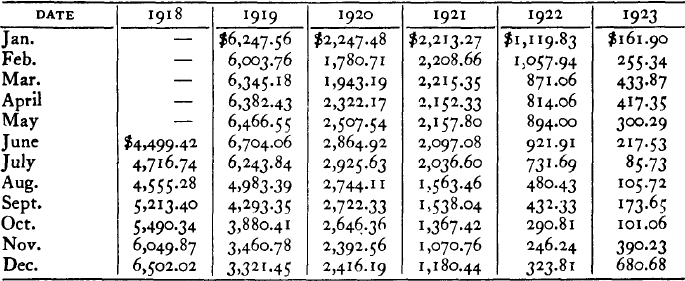
Sources of data: For total circulation in Germany: The Process of Inflation in France, James Harvey Rogers, Columbia University Press, New York, 1929, p. 143. This estimate includes all forms of authorized currency but not illegal emergency issues. For purchasing power parity: (l) European Currency and Finance, pp. 534-5; (2) Zahlen zur Geldentwertung in Deutschland 1914 bis 1923, p. 18. Beginning with January 1923 purchasing power parity was calculated for the end of each month (rather than as a monthly average) from the end-of-the-month figures of German wholesale prices. From January to June of that year the official price index was quoted every ten days and from July to December weekly. Except for those months when a quotation happened to fall on the last day of the month, the end-of-the-month figure was approximated by interpolation between the last quotation for one month and the first for the succeeding month. To obtain the purchasing power parity for the end of October, however, the price quotation of October 30 was used. The daily rate of increase in prices was then growing so rapidly that this quotation seems more appropriate than the figure obtained by interpolation between the quotations of October 30 and November 6.
The total monetary circulation in Germany in 1913 was approximately six billion marks, the equivalent at that time of about $1,430,000,000. Since gold is by no means a perfectly stable standard, and the goods value of gold fell between 1913 and 1920 by something more than half, a doubling of the gold value of the German paper money circulation might on this ground have been expected at this time. On the other hand the decline in German production and trade relative to 1913 would have had some tendency to lower the total gold value of the paper currency.7 Reference to Table XI will show that the gold value of the German currency in early 1919 was, in fact, more than four times as great as in the pre-war period.8 As a result of the German occupation, during the war, of Belgian, French, Russian, and Roumanian territory there had been a great increase in the area in which the mark circulated and it was thus possible to put out notes without a corresponding depreciation of their value. Even after the conclusion of peace the volume of mark notes in German territory—and this was the only significant thing for German internal prices—was much less than the total issue. This is by no means the sole reason for the high total value of the mark circulation in 1919—the tendency toward a reduced rate of monetary turnover being more important—but it was nevertheless a factor of some weight. The gold value of the total circulation began to drop in July 1919 but for two or more years thereafter it must have been in some measure supported by the export of marks attendant upon foreign purchases of currency and the consequent withdrawal of such marks from the area in which they could have had any direct effect upon German prices. The rapid fall in the total value of the circulation which occurred between July 1919 and February 1920 was therefore clearly due to an increase in the velocity of monetary turnover.9 There was a reversal of this tendency in March 1920 when the upward movement in foreign exchange rates and domestic prices was for the time being checked, and the gold value of the total circulation consequently rose. A renewed steady acceleration in the speed of monetary turnover set in in May 1921 as part of the phenomena initiated by the payment of cash reparations and, though a temporary halt occurred at the turn of the year 1921-1922 when the pressure of reparations was reduced, the total value of the circulation shrank rapidly till November 1922. At this point stubborn resistance to a further increase in the rate of monetary turnover developed and the figure for the gold value of the total circulation then attained took on something of the character of a norm. Abstraction having been made of the influence of factors in the monetary equation other than the volume of circulating medium and the rate of monetary turnover—and these other factors could have been of but slight relative importance—one may estimate, roughly, that the rate of monetary turnover at that time was some nine or ten times as great as that of the pre-war currency.10 This figure is not meant to be precise, since the factors which have been ignored as of minor significance11 would alter it somewhat on one side or the other, but it gives some idea of the by no means indefinitely elastic limits of the rate of monetary turnover even when all circumstances are conspiring to make it as high as possible. It is true that in some months of 1923 the total value of the circulation fell to 1/2 or 1/3 of that of November 1922 but there was always a rebound. The absolute minimum in the total value of the circulation, and presumably, the absolute maximum in the rate of monetary turnover, was reached in July 1923 when the gold value of the circulation was only about 1/17 of what it had been under the stable monetary conditions of a decade earlier. Allowing for changes in the value of gold this gives a rate of monetary turnover about twenty-five times as great as in 1913.12
CHART V
GOLD VALUE OF TOTAL CIRCULATION IN GERMANY (MILLIONS OF DOLLARS) ON THE BASIS OF PURCHASING POWER PARITIES; 1918-1923 (LOGARITHMIC AND ARITHMETIC SCALES)
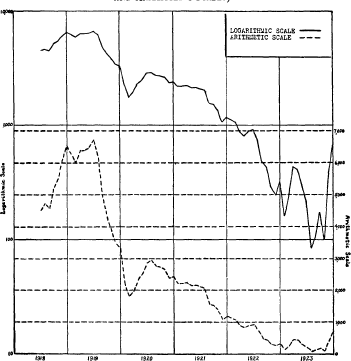
Table XII presents by months from June 1918 to December 1923 indices of wholesale prices, of the total volume of monetary circulation, and the resultant rough index of the rate of monetary turnover.13
§ LIMITS ON MOBILITY IN THE RATE OF MONETARY TURNOVER
The results depicted in Tables XI and XII and Chart V show a high degree of mobility in the speed at which money may circulate but they also suggest that there is a “ceiling” beyond which the rate of monetary turnover cannot be driven. One of the notable features of German inflationary experience was a recurring shortage of currency.14 In view of the colossal issues of notes this has its amusing aspect but it was a real and serious difficulty nevertheless. At the prices which had become current when such a shortage of currency occurred it was impossible to transact business. There was not money enough to go round.
TABLE XII
RELATION OF INDEX OF WHOLESALE PRICES TO INDEX OF TOTAL CIRCULATION AND RESULTING ROUGH INDEX OF RATE OF MONETARY TURNOVER; 1918-1923
Source of other data: Zahlen zur Geldentwertung in Deutschland 1914 bis 1923, passim.
Messengers had to wait in queues for hours at the Reichsbank branches in order to obtain sufficient money to meet the indispensable requirements of depositors. The printing presses were belching forth an unceasing stream of notes and were constantly enlarging the proportion of the larger to those of the smaller denominations but they could not keep up with the rise in prices. The most acute shortages of currency occurred in the fall of 1922 and in the summer of 1923.16 Reference to Table XII will show that these were the dates of the highest rates of monetary turnover. Prices were then rising precipitously and nobody imagined that they would cease to do so. There was thus the strongest sort of impulse to spend immediately and so to increase the rate of monetary turnover. But in 1922 the limit, for the time being, had been reached, and in 1923 something very close to the absolute maximum had been attained. Though the channels of trade were already choked with the mass of money that was being poured into them the volume of circulation was insufficient to meet requirements at the existing prices. But the money simply could not be made to move any faster. Unless more money were issued a fall in prices so sudden as completely to disrupt business was inevitable since the band of monetary elasticity had been stretched till it would stretch no more. More money was issued. The subsequent fall in the rate of monetary turnover has been construed as a temporary victory for the printing presses17 but there is surely no reason to suppose that still further issues of money would operate to diminish the rate of its turnover. The fact that, in August, September and November 1923, prices did not rise as fast as the rate of increase in the volume of money in circulation18 was certainly due to the circumstance that the “ceiling” in the rate of monetary turnover had been reached and that the height temporarily attained in July could not permanently be sustained.
§ NEW CONCEPT OF VELOCITY OF MONETARY TURNOVER
The phrase “velocity of circulation” is glibly employed in economic literature but the concept is vague. So far as velocity of circulation affects the price level, and this is the only sort of monetary velocity in which we are interested, none of the ordinarily accepted definitions seems apt. One such definition is “the ratio of money expended to the average money on hand.”19 This is unsatisfactory. With a given stock of money and a given population the average per capita amount of money on hand must be constant. But the amount expended may vary greatly and thus, according to this definition, affect velocity, though it may not exert any influence on prices. Suppose, for instance, that a group of men meet some Sunday evening to play poker. Each starts with an equal supply of poker chips of a fixed arbitrary value and, in the course of the evening, the men buy and sell these chips from one another as occasion requires. Coin is used for each transaction. When the evening’s play is over each man is, let us suppose, in the position in which he started. The amount of money expended has been greater than would have been the case if the game had never been played, the average money on hand has not changed, and the velocity of circulation of money must therefore, on the definition given above, have been increased. But the arbitrary price of poker chips will certainly not have altered and it can scarcely be maintained that the prices of other commodities will be affected as a result of the evening’s activities.
Whether the “person-turnover” or the “coin-transfer” method of calculating velocity of circulation is used makes no difference. The number of coins passing through each man’s hands is increased as compared with what would have happened if they had all spent the evening quietly at home, while the average amount held, by the group certainly and possibly by each man in it, has not changed. Similarly, as a result of the play, the average number of times that money has changed hands in a given period has been increased.
It may be objected that the reason why prices do not change in the case here considered is that the volume of trading is augmented pari passu with the increase in the velocity of circulation. This is true, but the contention completely undermines the concept of velocity of circulation of money as an independent causal factor in prices, since velocity of monetary circulation, as that term is ordinarily defined, is then, at least in part, dependent upon the volume of trading and increases only because of the expansion in business transacted. Such a concept of velocity is of little value in the explanation of prices since the ratio of money expended to the average money on hand, or the number of times money changes hands, in a given period, may or may not be of any influence on prices. Further than this, as we shall later see, a change in prices, or price quotations, may determine velocity as above defined.
It is doubtful, therefore, whether the phrase “velocity of circulation” can properly be employed to denote the essential feature of monetary turnover which is not how many times the money supply is used in a given period but how large a proportion of it is in process of transfer at the time of maximum demand. There are peak loads in the requirement for money, and prices will be conditioned by the proportion of the total money in circulation which can be mobilized for the peak volume of transfers as well as by the proportion of total business done at the peak. Let us suppose that our group of poker-players on breaking up on Sunday night agree to come together next morning and resume their game. They do so and play all day with the same result as on the previous evening. If they had not been playing with the money they took into the game they would, let us assume, have used it once during the day in the purchase of commodities. Since the money fails to be so used, general prices, other things being equal, will fall. Commodities may be retained by their possessors and prices may thus be temporarily sustained. But, since production continues, goods will pile up and, when the card players’ money eventually comes into the commodity market, the volume of goods will be expanded relatively to the money supply. In the absence of other changes they can be moved only at lower prices.
It is clear that the time when additional trading is carried on is a vital factor. If the same volume of trading is spread evenly over a given period prices will tend to be higher than with an uneven distribution of the volume of transactions. Suppose that, instead of playing cards, the group gathered together on Sunday night sell to one another commodities which would otherwise be sold on Monday. Suppose also that Sunday is a day of slack demand for money while on Monday the requirements are at their peak. On Monday there is the same amount of money available as would have been at hand in the absence of the Sunday activities but there are fewer commodities to be sold.20 Prices will therefore tend to rise.21
The proportion of the total money supply offered at any given moment normally tends, of course, to accommodate itself to the business activity of the moment and thus to prevent incessant price fluctuations. The share of the total circulation actually in process of transfer varies greatly from hour to hour, day to day, and season to season. But the share in motion at the time of the peak requirement for money represents a maximum, established partly by physical factors, partly by legal or customary limitations on bank reserves, and partly by considerations of prudence on the part of individuals, and this maximum is the decisive factor in the determination of prices so far as monetary turnover is concerned. The self-interest of individuals and banks will lead to the proportion of means of payment in motion at the moment of peak demand being a maximum for the existing circumstances.
With a given volume of circulating medium prices cannot rise above the level which will absorb all of the means of payment capable of being mobilized at the instant of the peak volume of trading but though they might rise when the peak is passed they will normally not do so. In an economy where hard money is the sole circulating medium a large part of the total money supply will tend to be held out of use in inter-peak periods. In an economy where bank credit plays a large role, either in the form of bank notes or of deposits subject to check, it is the credit, in the main, which is held out of use when the demand for circulating medium is slack.22 If the same proportion of the total available circulating medium were used at a moment of slack trading as at a preceding peak at which the maximum had been reached, if, in other words, the maximum became for the moment a norm, prices would rise. But unless the total volume of circulating medium were increased, or the previous maximum proportion in motion at a given moment were somehow raised, prices would fall with a crash when the next peak of monetary demand occurred. Under a monetary system in some measure conditioned by physical laws, such as is the gold standard, the circulating medium, even including credit, is not unlimited and the proportion of the total circulating medium which can be mobilized at a given moment does not change greatly. So far as money and monetary turnover determine prices the price level will therefore be set by the total volume of means of payment and by the proportion of this total which can be set in motion at the instant of greatest requirement for money. The price level so determined will tend to persist during off-peak periods.
§ VELOCITY OF MONETARY TURNOVER UNDER INCONVERTIBLE PAPER
With an inconvertible paper monetary standard the volume of circulating medium is quite unlimited and the indefinite rise in prices which this makes possible affects very greatly the proportion of the total volume of circulating medium that will at any moment be put in motion in the purchase of goods. The conditioning factor in this proportion is usually psychological though there is an absolute physical maximum. Several provisional psychological maxima may appear, dependent in each case upon law, custom, prudence, and the general social and economic conditions prevailing at the moment. No one of these several maxima is quite rigid. Each is clearly dependent on the will of individuals and on the strength of the forces leading to a decision to spend immediately or to refrain from so doing. As not all people will completely divest themselves of money, no matter what the strength of the impulse to do so may be, prices cannot rise to the level at which the total value of the transactions occurring at the moment of greatest trading would be equal to all the money in being at that time. The latter condition is, however, the absolute maximum of rate of monetary turnover.23 Transfer of money takes time, especially if a considerable distance separates the prospective payer at the moment he receives funds from the payee to whom he will later turn them over, and this fact limits the amount of money that can be brought to bear at a given instant. This limit would never in actual circumstances be attained. But something very close to it happened in Germany. The desire to keep a certain amount of money in reserve was replaced by a passion for spending in order to avoid loss of purchasing power and, at the peak of monetary transfers, a very large share of the existing supply of money was in motion from one holder to another. The daily total German wage bill can hardly have been short of the equivalent of $10,000,000 to $12,000,00024 and since practically all the workmen would simultaneously be in possession of their pay at the customary hour of payment, something like one-eighth (See Table XII) of the total money supply at certain times in the period of high inflation must have been required to cover merely this portion of the transactions occurring at that moment.
Yet such payments are ordinarily but a minor part of the total circulation of purchasing power.25
Not only was the proportion of the total volume of currency in motion at the time of maximum trading greatly increased during inflation but the trading peaks themselves were very much flattened. This was done by reducing the period between payments, particularly in the case of wages and salaries. When wage payments are shifted from a weekly to a daily basis the peak requirement for money for this purpose is cut to one-seventh of its former amount and this permits prices to rise much higher than would otherwise be possible.26 Thus, though the reason for reducing the period between payments was to prevent a too serious loss of the purchasing power of the mark while it was being earned, the result was merely to cause a still more rapid rise in prices.
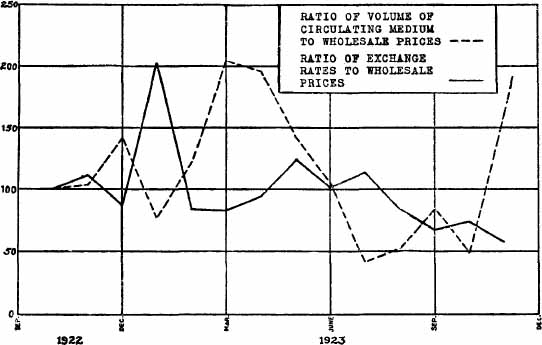
While, in the manner just described, the rate of monetary turnover in Germany was much increased, the symmetry between the volume of circulating medium, prices and exchange rates was reestablished in the final stages of inflation. The curve of monetary demand could at most be made flat,27 the proportion of the total monetary supply in actual transfer could at most be 100%, and, as these limits were approached, the increase in prices due to changes in the rate of monetary turnover began to slacken and finally to disappear. Chart VI shows the indices of volume of circulating medium and of exchange rates in percentage relationship to that of prices, with October 1922 taken as a base = 100 in each case. There is no tendency for any of the indices to outstrip the others in this last year and a quarter of inflation. Inability to increase the rate of monetary turnover expressed itself in the shortage of cash. In the very final stages of inflation note issues rose more rapidly than did the index of wholesale prices, in other words, the whole immense upward movement in prices at that time was attributable solely to increases in the volume of circulating medium.
CHART VI
INDICES OF VOLUME OF CIRCULATING MEDIUM AND OF EXCHANGE RATES IN PERCENTAGE RELATION TO THE INDEX OF WHOLESALE PRICES (OCTOBER 1922 = 100 IN EACH CASE); OCTOBER 1922-NOVEMBER 1923
That there is a real even if vague limit to the possible increase in the rate of monetary turnover may possibly be of comfort to some future officer of government whose attempt to put a stop to depreciation is temporarily frustrated by the failure of prices to respond to the cessation of further issues of notes or to their reduction.28 He has only to persevere, in the firm conviction that, in the end, prices must cease to rise; the rate of monetary turnover cannot expand indefinitely. If, indeed, there were no limit, it might be impossible ever to stabilize a currency where the psychological situation was unfavorable.
§ CAUSE AND EFFECT RELATIONSHIP BETWEEN VOLUME OF CIRCULATING MEDIUM AND PRICES
The relation of cause and effect in this matter, as in so many other of the phenomena of inflation, is difficult to establish. There tends to be interaction. A steady and rapid upward movement of prices impels holders of money to get rid of it more quickly and this in turn accelerates the upward swing of prices. This new rise in prices adds intensity to the impulse to spend and so the spiral goes. On the other hand, if the upward price movement is checked or reversed, the factors leading to this result tend to be reinforced by the desire to hold money rather than to spend it.29 So long as the rate of turnover of money is subject to psychological forces it is extremely mobile whenever the value of money is itself in flux, and this mobility increases the range of price fluctuations in both directions.
In such situations it seems casuistical to insist that prices are passive, a mere resultant of changes in other factors. Not only does a rise in prices affect the desire to spend money but, on an upward movement, it forces the present expenditure of a larger share of the total circulating medium than if the price level had remained stable. With a given volume of currency and a given trade the rate of monetary turnover must, it is true, have increased not later than the occurrence of an increased level of prices. The proximate cause of the advance in prices may thus be said to be the change in the rate of monetary turnover. But a rise in price quotations (which are by no means the same thing as prices since prices issue only out of realized transactions) may practically compel an augmentation in that rate. Certain expenditures are necessary if life is to be preserved and will be made regardless of how large a proportion of the current monetary holdings of an individual they may require. These expenditures having been made at the high quoted prices the rate of turnover of money is ipso facto enlarged.30 The sale of a portion of the available supply of commodities at prices which, at the old rate of turnover of money, it would have been impossible to obtain for the whole stock, thus so affects the rate of monetary turnover as to sustain the prices originally quoted and charged. Prices then more or less lift themselves by their own bootstraps and they stay high because they have gone up.
We may conclude that the rate of monetary turnover is determined, within certain bounds, solely by psychological attitudes and that these are affected by the course of prices. In the early stages of inflation there seems to be a tendency toward reduction in the share of the total currency supply which is in transfer at any given moment. This is no doubt due to the opportunity given to receivers of the enlarged flow of currency to withhold a larger share from circulation31 and to a certain inertia in price quotations. Balances in tills and in banks pile up until the wastefulness of this process, from the point of view of the individual, makes itself felt. This seems to have been the situation in Germany up to mid-1919.32 Presently, approximately the old proportion of the total of circulating medium is again put into motion. Prices rise, but confidence in the currency is not yet so undermined as to lead to a concerted movement toward the immediate use of all accruing funds. Something like the original rate of monetary turnover then again establishes itself. This phase is represented by the situation in Germany after relative stability in exchange rates and prices had been reached in 1920. It lasted till the beginning of cash reparations payments in mid-1921.33 But when the value of money continues to fall the desire to get rid of the money grows, and, once under way, proceeds at heightened speed so long as psychological factors are the dominating influence. Under conditions of rapid depreciation there is then small probability that the price level will vary in proportion to the volume of note issues until after the maximum rate of monetary turnover is reached. On the contrary, in the period immediately following the “break” in general confidence in the currency, the relation between changes in prices and in the volume of circulating medium is likely to approach more nearly a geometric than an arithmetic scale. This was the case in Germany from late 1921 till something approaching the maximum rate of turnover of money was reached in November 1922 and, in part, till the absolute “ceiling” was attained in July 1923.
While the cause and effect relationship of rate of monetary turnover and prices is one of interaction, and while prices therefore do not respond in nice symmetry with the volume of circulating medium, there can be no doubt that the ultimate causal sequence runs from volume of money to prices. This proposition was by no means generally conceded in Germany. The rise in German prices far beyond the measure of arithmetic proportionality with the increase in note issues gave rise to the belief that note issues had no effect on prices at all. Prices were supposed to be conditioned by exchange rates which fluctuated violently and apparently lawlessly. The conviction was therefore expressed, even by hitherto respectable figures in the field of finance, that note issues did not raise prices (which would go up anyway) but merely prevented a collapse of business. The same story is heard in every inflation, mild or extreme. Note issues, it is said, will take care of themselves. If they are not needed in business they will, it is alleged, be returned to the banks. Such sophistry takes no consideration of the fact that the “need” for notes is conditioned by the price level which the note issues themselves chiefly determine. The fact that the proportionate relationship between changes in the volume of circulating medium and in prices is frequently, or even normally, not preserved in periods of inflation, does not alter the fact that prices are fundamentally subordinate to the amount of currency in circulation. The connection may be slack but it is inevitable. Prices can never fail to be influenced by the volume of circulating medium though they may at the same time be influenced by other factors. Increases in the volume of circulating medium, on the other hand, at least in a régime of inconvertible paper, require an act of volition on the part of the issuing authorities34 and being thus subject to arbitrary determination can be an effect of nothing but the will of the issuing instance. The authorities may be impelled to issue notes as a result of any given price situation but since they cannot be compelled to do so prices can in no true sense be held to be a cause of note issues. The chain of causation clearly runs the other way.
§ GENERAL CONCLUSIONS ON THE RELATIONSHIP BETWEEN THE VOLUME OF CIRCULATING MEDIUM AND PRICES
While the facts are against the contention of rigid exponents of the quantity theory on both the main issues, that is, on the tendency toward proportionality between the volume of money and the general level of prices on the one hand, and on the passiveness of prices on the other, it is none the less true that the possible variations in any of the “other” factors involved in price determination are of minor importance beside the infinite expansibility of inconvertible paper currency issues. In the extreme stage of inflation prices therefore do tend to move in proportion to the volume of circulating medium. Under inconvertible paper monetary standards, moreover, the movement of prices can never be a true cause, even in part, of the volume of money in circulation and so, when the rate of monetary turnover has reached its maximum, prices become a passive resultant of other causes. As currency depreciation proceeds from the great to the colossal the postulates of the quantity theory therefore come substantially closer to fulfilment. Prices not only then tend to move proportionately with the volume of circulating medium but have no longer any automatic tendency to affect other factors in the price equation.35 The symmetry and sequence asserted in the quantity theory is at length practically attained.
II. THE RELATION OF PRICES TO EXCHANGE RATES
§ COMPARISON OF EUROPEAN INCONVERTIBLE PAPER CURRENCIES
Let us now turn our attention to the second phase of the alleged symmetry in monetary phenomena, that between the commodity price level and exchange rates. Investigation of price and exchange rate data in the period when inconvertible paper currencies were universal in Europe shows in most cases a rather close correspondence between actual exchange rates and the theoretical pars based on relative prices.36
Table XIII and Charts VII, VIII, IX present for twelve European countries, by months from 1919 to 1923, the percentage relationship between purchasing power pars and actual exchange rates against the dollar. The countries are ranged in order according to the average cost of foreign exchange relative to purchasing power pars.37 At 100%, any
Table XIII
PURCHASING POWER PARS OF TWELVE EUROPEAN INCONVERTIBLE PAPER CURRENCIES EXPRESSED AS PERCENTAGES OF THE EXCHANGE RATE OF EACH OF THE CURRENCIES AGAINST THE DOLLAR; 1919-192338
CHART VII
PURCHASING POWER PARS OF THE CURRENCIES OF SWEDEN, SWITZERLAND, SPAIN, NORWAY, AND THE NETHERLANDS, EXPRESSED AS PERCENTAGES OF DOLLAR EXCHANGE RATES; 1919-1923
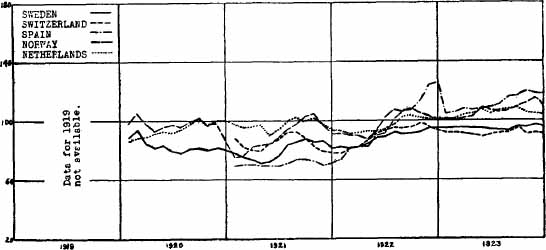
CHART VIII
PURCHASING POWER PARS OF THE CURRENCIES OF CZECHO-SLOVAKIA, GREAT BRITAIN, AND DENMARK, EXPRESSED AS PERCENTAGES OF DOLLAR EXCHANGE RATES; 1919-1923
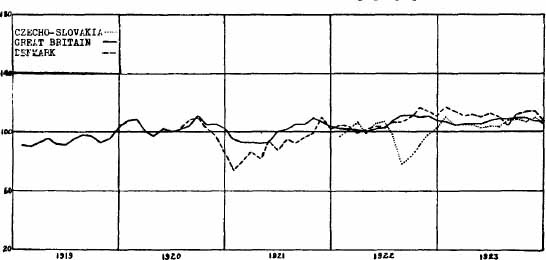
one of the currencies concerned would have the same value in exchange against the dollar as in the purchase of goods in its domestic market; at less than 100%, the exchange value would be high as compared with domestic purchasing power; at more than 100%, the exchange value would be relatively low. If we exclude Germany, the clustering around the 100% figure is marked and aberrations were apparently self corrective. But Germany is in a class by itself. The internal value of the mark in comparison with its exchange value was much higher than in the case of any other currency, or, to put it from the other point of view, its exchange value was much lower relative to domestic purchasing power. Nor is there any tendency toward the elimination of the discrepancy such as appears in the case of all the other currencies.40
CHART IX
PURCHASING POWER PARS OF THE CURRENCIES OF BELGIUM, FRANCE, ITALY, AND GERMANY, EXPRESSED AS PERCENTAGES OF DOLLAR EXCHANGE RATES; 1919-1923
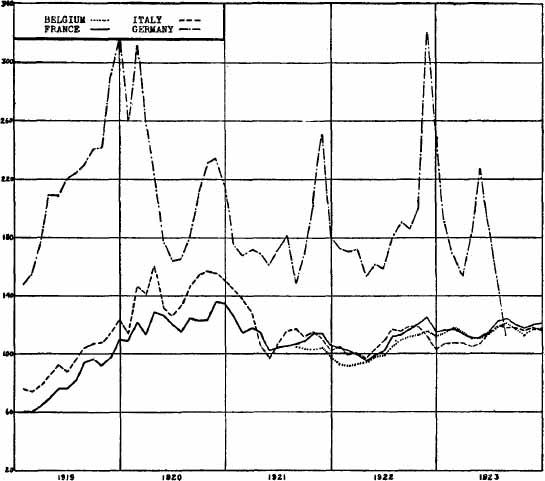
Countries which were neutral during the war, Sweden, Switzerland, Spain, Norway, and the Netherlands, show dollar exchange rates low relative to internal price levels, that is to say the dollar was worth less in each of these currencies than respective domestic purchasing powers would seem to warrant. In the case of Sweden, Switzerland, and Spain the difference was considerable while for Norway and the Netherlands it was slight. In the next group come Czecho-Slovakia, a succession state, Great Britain, the first of the great warring powers, and Denmark, another neutral. With these three the adjustment was close but dollar exchange cost on the average a trifle more than purchasing power par. With Belgium and France average dollar exchange rates were 8% higher than the theoretical par and in the case of Italy the percentage ran as high as 15. With Germany, however, dollar exchange cost consistently from 1 1/2 to 3 times the purchasing power par, the average agio was 85%, and fluctuations above this average, showing a relatively high cost of dollar exchange, were of much greater range than those below.
§ INTERPRETATION OF THE DATA
Not only is there a marked correlation between political status in respect to the war and the cost of dollar exchange relative to home prices but there is also a fairly close correspondence between absolute depreciation and relatively high cost of foreign exchange. Absolute depreciation in Spain and Norway was greater than in Great Britain but, aside from this, the order of arrangement according to the cost of foreign exchange relative to internal prices is also substantially the order of absolute currency depreciation.
Conceding, for the moment, the causal sequence from prices to exchange rates it would seem that current exchange rates were dominantly influenced by the current domestic purchasing power of the currencies concerned but that the following factors were also of importance:
(1) Shift in international economic position. Under gold-standard conditions an access of international liabilities, or a diminution of international assets, is normally accompanied by a relative fall in prices in the country affected and a consequent increase in the export-import ratio in adjustment to the changed situation. Under inconvertible paper currencies this adjustment tends to be accomplished through the foreign exchanges. Instead of the home exchange remaining stable while domestic prices fall, as happens under the gold standard, equilibrium in international transactions tends to be preserved by a falling exchange value of the currency while domestic prices remain stable or else rise less than in proportion to the increased cost of foreign exchange. The domestic purchasing power of the currency will then show a high ratio to its exchange value and this will encourage exports and retard imports. Those countries which during the war added to their international liabilities, or suffered a detraction from their international assets, will normally therefore appear in Table XIII with a ratio of the domestic to the foreign value of their currencies above those which improved their international economic position by the acquisition of securities, or other rights, giving them claims on future incomes which, in the postwar period, became current income. The neutral countries in general improved their international economic position during the war while the position of the warring countries, whether victors or vanquished, underwent a retrogression. Of the principal warring countries concerned Great Britain probably suffered the least relative loss in this respect.41 The relative improvement in the international economic position of the neutrals may explain the higher relative exchange values of their currencies. The acquisition of large gold reserves by the neutral nations in the course of the war was also of some significance since the sale of these reserves made it possible to sustain exchange rates for a considerable period above their “par” position. But these are, nevertheless, causes of the second order of magnitude and would not account for such great divergencies from purchasing power par as appear in the case of German exchange.
(2) Probable future movements in exchange rates. The possible rise in foreign exchange rates against an inconvertible paper currency (fall of the domestic exchange) is infinite, the possible fall (rise in domestic exchange) is ordinarily limited to the difference between the existing rate and the old gold par.42 This fact is probably of some weight in de-pressing the current exchange value of currencies whose future is unfavorable or obscure (and so in raising the ratio of domestic to foreign value), though it would not be much of a bearish factor where, on other grounds, improvement was probable. The actual trend of foreign exchange, whether down or up, and the financial status of the paper issuing government is no doubt of great influence. Investment and speculative demand for a paper exchange at any given rate will be more or less keen according to its future prospects. The exchanges of France, Italy, and Belgium throughout and beyond the period of German inflation, and preeminently the exchange of Germany itself, would suffer from this cause; those of the neutral countries would benefit. The prospect of improvement in the exchange value of the latter currencies as a result of a favorable situation politically, including sound public finance, would no doubt have a bullish tendency sufficiently strong to outweigh any general bearish influence issuing out of the fact that the value of a paper currency can always fall farther than it can rise. The shift of the ratio, in the case of Spain, from below to considerably above the base line was no doubt due to the failure to realize the possibility of an early return to the gold standard and to the increasing uncertainty as to the future of the peseta. The high ratio of internal to external value of the French and Italian currencies in 1920 is also perhaps solely attributable to this cause. Up to 1919 the franc and the lira had been pegged in New York. When the pegging was withdrawn both currencies rapidly declined in terms of the dollar. Uncertainty as to how far this movement would go would seem to have been the primary cause for the depression of their exchange relative to their domestic value.
(3) Constant pressure on exchange rates arising from recurring fixed liabilities. This was of preeminent importance in the case of Germany owing to reparation demands and is to be regarded as the chief factor in the relatively high ratio of the domestic to the exchange value of the mark through 1921 and 1922.
(4) Panic. The desire to exchange an inconvertible currency against foreign money, at any price whatever, in order to avoid persistent shrinkage in both its external and internal value may be the dominant element in depressing the exchange value of the currency concerned and so in raising the ratio of internal to external purchasing power. But this is nevertheless not as important a factor as is sometimes supposed. It depends on where the panic originates. If it originates at home the general fear is likely to express itself in rising internal prices43 as well as in rising foreign exchange rates and the price increase may readily outstrip the movement of exchange. On the other hand, if it originates abroad, foreign exchange rates will almost certainly rise higher than the domestic price level. From January 1920 till January 1922, with one slight and one considerable exception, the ratio of internal to external purchasing power of the German mark, as shown by the monthly averages, followed the movement of exchange rates but from January 1922 onward no such tendency is apparent. Foreigners lost confidence in the mark sooner than did the Germans. When foreigners alone had lost confidence the mark price of foreign currencies rose (a fall in mark ex-change) but internal prices were not greatly affected. Similarly, whenever foreign confidence was partially restored, the mark price of foreign currencies fell but internal prices remained relatively unchanged. The ratio of exchange rates to internal purchasing power was therefore dominated up to 1922 by the absolute movements in exchange. But when the Germans themselves lost confidence in their currency both prices and exchange rates were affected. Though exchange rates rose, prices frequently rose in greater degree, and the ratio of the domestic to the exchange value of the mark then declined. The flight from the mark thus did not tend to lower the exchange value of the German currency relative to its domestic purchasing power, a fact which has already been commented upon.
(5) The absence of free commercial intercourse. Control of imports and exports, especially the latter, may affect the relation between the exchange and the domestic value of a currency by inhibiting, in whole or in part, its use in foreign transactions. Unless this control is complete, however, as in Russia, the influence on the ratio is not likely to be great. In spite of respectable authority to the contrary the writer is of the opinion that it played no considerable part in the German ratio.
In addition to the factors just enumerated, special causes, affecting one country or another, may cause deviations of actual exchange rates from computed purchasing power pars. All such pars are measured from the relationship of prices and exchange rates in a prior year taken as a base.44 The relationship in the base year may have been somewhat abnormal and, if so, apparent aberrations in later years may be due to this fact. Price indices, moreover, are merely approximations and vary in some measure according to their composition. The computation of the purchasing power par is thus subject to a margin of error. Further than this, changes in productive methods, or in the international demand for goods, may cause shifts in the price relationship between those commodities which in a given country are the object only of domestic trade and those which cross its borders. This would lead to shifts in exchange rates relative to internal prices. But all such factors sink in importance on a general view covering many countries. They could at most account for minor deviations. Operative, no doubt, to a greater or less extent in the case of all the currencies above listed they would, nevertheless, be unlikely to change very greatly the order in which those currencies appear even if they could be accurately estimated. They are of no significance whatever in the major distinction between the German currency and all the others. Properly to account for this requires an analysis of exchange markets in general and of the market for German exchange in the inflation period in particular. To this subject it seems best to devote a separate chapter.
_______________
45 For exchange rates the price level in other countries would also be required.
46 It is doubtful whether any proponent would be as uncompromising in his exposition of the theory as is here suggested. Professor Irving Fisher, the stoutest champion of a strict construction of the quantity theory, admits that in periods of transition the postulates are not to be taken absolutely, and Professor Gustav Cassel, the most loyal adherent to a rigid purchasing power parity conception of exchange rates, recognizes circumstances under which deviations would occur. Other prominent advocates of the quantity theory, such as Professor E. W. Kemmerer, and of the doctrine of purchasing power parity, such as Professor A. C. Pigou, are much more liberal in their admissions.
47 It is the downward changes in trade which are alone significant in explanation of depreciation in the value of a currency relative to increases in its volume.
48 cf. Memorandum on Currency and Central Banks 1913-1923, League of Nations Publications, Geneva, 1924, p. 19.
49 Since, with the comparative stability of factors other than money, the value of a unit of the money would move in inverse proportion to changes in total volume.
50 This table is computed by multiplying the total monetary circulation in Germany by the purchasing power par of the mark with the dollar (the dollar value of the mark as determined by the respective purchasing powers of the two currency units each in its own country).
51 This is because mark prices would tend to be increased more than in proportion to the augmentation of the currency and rising mark prices would tend to lower the value of the mark in terms of gold. The smaller territory in 1920 would also be of some import.
52 In the pre-war period it was about 6000 millions of marks; in June 1919 it was 6700 millions of dollars.
53 Changes in the volume of production, trade, credit, number of workers engaged in earning occupations, and the like, no doubt played some part. But they would in some degree tend to cancel one another and were in any case of minor relative importance.
54 The total gold value of the currency in November 1922 was about 1/6 that of 1913. Since, in 1922, gold was worth about 2/3 its 1913 value the total value of the currency, measured in a stable standard, was thus about 1/9 of the pre-war value. In other words the rate of monetary turnover had been multiplied approximately nine times.
55 Their calculation could at best be but very rough and it seemed advisable to omit them altogether.
56 In 1923 the calculation is affected by the fact that two types of money then in circulation to a large but unknown amount, viz. foreign currency and illegal emergency mark note issues, are not included in the computation. The failure to do so leads to an undervaluation of the total money supply and consequently to an overestimate of the rate of monetary turnover.
57 All factors in the monetary equation except volume of money, its rate of turnover, and prices, are again excluded. Though the excluded factors, if measurable and included, would affect the rate of monetary turnover in varying degree throughout the period under review the greatest deviation from the figures of monetary turnover given in the table would probably be in the year 1923 when production was low. The figures given for monetary turnover in that year are probably higher than was actually the case, not only for the reason given in the preceding note but also because the height of prices, one of the two principal factors in determining the figure for monetary turnover here given, was occasioned in part by the low volume of production.
58 A similar phenomenon has been noted in many other cases of currency depreciation. See, for example, Foreign Banking Systems, H. P. Willis and B. H. Beckhart, Ed., Chap, xiii, The Banking System of Russia, S. S. Katzenellenbaum, p. 905. Even in the relatively mild inflation of our own greenback period a recurring shortage of currency made its appearance.
59 The index of circulation is the same as that used in Table XI.
60 Beginning with January 1923 the figures for the wholesale price index are determined in the manner described in the note to Table XI.
61 cf. (1) Die Wirtschaftskurve, Heft III, Frankfurter Societäts Druckerei, G.m.b.H., Frankfurt-am-Main, August 1922, p. 3. (2) Berliner Tageblatt, Berlin, February 3, 1923. (3) Manchester Guardian Commercial, Reconstruction Supplement, Article by Dr. Hjalmar Schacht on Discount Policy of the Reichsbank, Section XI, Manchester, December 7, 1922, p. 69. (4) Economic Review, Vol. VIII, No. 6, London, August 10, 1923, p. 115.
62 The printing presses were, on this view, supposed to have turned notes out so fast that the notes did not have time to fall, in value per unit, proportionately to the increase in their total amount. The rate of depreciation of the currency unit in October renders this view somewhat ridiculous.
63 See infra, Chart VI.
64 See Purchasing Power of Money, Irving Fisher, The Macmillan Co., New York, 1920, p. 352. It is not clear whether Fisher himself approves this definition.
65 There may be the same absolute volume of commodities but there will be fewer commodities in the hands of people anxious to turn them into money.
66 The poker-game illustration was originally chosen simply because the effect, if any, on prices was more clearly brought out. The volume of transactions, whatever their character, may change in any degree without affecting prices provided the volume of trading at the peak is not altered. On the other hand, the volume of transactions may show no change but prices will vary according as a larger or smaller share of the total occurs at the peak.
67 In the United States the larger adjustments take place through extensions or contractions of Federal Reserve credit while day-to-day variations are effected through a more or less active use of cash by individuals or business concerns and through fluctuations in the commercial banks’ volume of loans and discounts.
68 The frequency with which the peaks are reached is, of course, of great significance. The maximum here indicated would perhaps be but momentary. If this level is maintained, and transactions so spaced as to reduce the volume’ of trading at the peaks and increase it in the troughs, prices might be driven still higher. On this point see infra, p. 112.
69 This estimate makes allowance for the low money value of a given real wage at this time.
70 cf. Business Cycles: The Problem and Its Setting, Wesley C. Mitchell, National Bureau of Economic Research, Inc., New York, 1927, p. 140. In the United States the payments of money incomes (of all sorts), to individuals, amounts to about 1/10 of the aggregate volume of payments, op. cit., p. 149.
71 Every flattening of the curve of monetary requirements has this effect. Prices under gold standard conditions, for instance, may, at certain periods of peak demand for money, be kept from falling not only by increasing the rate of monetary turnover but by shifting part of the transactions to off-peak periods.
72 In practice, of course, this could never fully be achieved since it would involve an exactly equal volume of monetary transactions every minute of the day and night, week in and week out.
73 This situation occurred in Czecho-Slovakia in 1920. cf. La Déflation en pratique, Charles Rist, Marcel Giard, Paris, 1924, p. 87.
74 A quick drop in the rate of monetary turnover occurred in practically every case of stabilization effected in post-war depreciated currencies and required additional issues of notes to prevent the stabilization from turning into a sharp appreciation of the currency.
75 The fact that rising prices may automatically increase the rate of monetary turnover, instead of vice versa, was pointed out to me by one of my students, Mr. A. J. Duncan.
76 cf. Russian Currency and Banking, 1914-1924, S. S. Katzenellenbaum, P. S. King & Son, Ltd., London, 1925; p. 76. Katzenellenbaum notes a breaking point at which the tendency to hoard is suddenly changed to a tendency to spend. cf. also Monetary Reform, J. M. Keynes, Harcourt, Brace and Company, New York, 1924, pp. 50 ff., where it is pointed out that the public is so accustomed to thinking of money as the ultimate standard that, when prices begin to rise, they believe that the rise must be temporary and hoard money by postponing purchases. Sooner or later, however, the second phase sets in and money, instead of being hoarded, is spent much more freely than would be the case under a stable standard.
77 See Table XI. For an interesting discussion of changes in the total value of an inconvertible paper currency, based on the Revolutionary currency in the United States, cf. Credit, Currency, and Banking; Considerations on the Currency and Banking System of the United States, Albert Gallatin, Carey and Lea, Philadelphia, 1831, pp. 26 ff.
78 The matter is somewhat complicated by the fact that a greater or smaller mass of the currency may have been exported and may at any time be brought back, but this does not seriously affect the proposition here laid down.
79 This, indeed, is more truly the case under paper than under gold standards. Under the gold standard, rising prices (a falling value of gold) check gold mining operations and, by so diminishing the supply of money, put limitations upon their own advance. Of even greater significance is the tendency toward a greater use of gold in the arts as its value falls. How much monetary gold is melted down under these circumstances cannot be known, but it is, perhaps, a very considerable amount. Under paper standards there are no such automatic checks on the tendency of prices to vary directly (though for a considerable period not proportionately) with the volume of the money material.
80 if in one country prices have risen to, let us say, three times their former level while in another they have not changed, the theoretical par of exchange is the old par (expressed in terms of the number of units of the now depreciated currency formerly exchangeable against one unit of the other) multiplied by 3. If in one country they have tripled and in another doubled, the theoretical par is the old par multiplied by 3/2. This ratio between the internal purchasing powers of two currency units gives their purchasing power par rate of exchange.
81 The table shows nothing as to the absolute values of the several currencies nor as to such changes in absolute value as were continuously taking place. Whatever the absolute values, and however they might be changing, the ratio would be 100% so long as domestic prices and exchange rates moved in perfect correspondence.
82 Purchasing power parity for each currency is derived as follows: Bureau of Labor Statistics index number of wholesale prices in the United States multiplied by 1913 par of exchange and divided by foreign index of wholesale prices. The par of exchange, and the actual exchange rates necessary for the computation, were in every case used in the form of quotation: number of American cents per unit of the foreign currency. New York rates were used for all currencies.
83 From September 1923 till the end of inflation German exchange rates were nominal only.
Source of data: European Currency and Finance, Serial 9, Volumes I and II, passim.
84 In Russia and Poland similar phenomena may have occurred but the data are inadequate to permit of assured conclusions.
85 Excepting, of course, the United States, the currency of which is used as a measuring rod throughout. So far as the United States improved its relative international economic position during the war the dollar would tend to be high in terms of foreign currencies.
86 if the import of gold is refused, as in Sweden during the war, the exchange rate against a gold currency may rise above the former gold par. This is a very unusual situation which did not apply in the post-war period.
87 Unless the limit on the rate of monetary turnover has already been reached.
88 In practice, from a time when gold standards were mutually in operation. Purchasing power pars, moreover, as ordinarily computed, involve prices some of which are, in part, a function of exchange rates. Strictly interpreted then, prices of non-internationally traded commodities only should be included in the indices on which purchasing power pars are based. Even so purchasing power pars represent the theoretically proper (i.e. equilibrium) exchange rate only on the assumption that the sole change in conditions, as compared with the base year, has been in the monetary factor.
- 1cf. Foreign Banking Systems, H. P. Willis and B. H. Beckhart, editors, Chap, VIII, “The Banking System of Germany,” Paul Quittner, Henry Holt and Company, New York, 1929, p. 632, where it is declared that it would be useless to try to connect the development of the German currency system from 1919 to 1923 with any theories of money.
- 2In the matter of mark exchange rates, for instance, sizable differences developed, in the later stages of inflation, between the Berlin and other markets. These were due to the obstruction of arbitrage transactions. At the time that this occurred, however, the Berlin rate was alone of much significance. The Berlin rates have therefore been used throughout. In the matter of prices the alternative sources are the indices of the Berliner Tageblatt, the Frankfurter Zeitung, and the Industrie- und Handelszeitung.
- 3The latter compilation was published in English, as well as in German, for use by the Committees of Experts of the Reparations Commission.
- 4Treasury notes, a fiduciary currency. These were, however, issued rather sparingly. The maximum issue was 356 million marks. Reichskassenscheine had been legal as cash cover in pre-war days but their issue had been closely restricted and few had been available. These Treasury notes are to be carefully distinguished from Treasury bills, a short-term security not used as money.
- 5A form of currency issued by officially established Loan Bureaus against the pledge of securities (or commodities) by borrowers other than the government and the larger banks and business concerns. During the war these notes formed an important share of the circulating medium but thereafter remained comparatively stable in absolute figures (7 to 14 billion marks) and were of constantly declining relative importance. They played but a slight ròle from 1921 onward.
- 6Germany’s Economic and Financial Situation, Statistisches Reichsamt, Zentralverlag G.m.b.H., Berlin, 1923, p. 28.
- 7Zahlen zur Geldentwertung in Deutschland 1914 bis 1923, Statistisches Reichsamt, Verlag von Reimar Hobbing, Berlin, 1925, p. 46.
- 8Committee on Currency and Foreign Exchanges After the War (Cunliffe Committee) First Interim Report, H. M. Stationery Office, London, 1924, p. 5.
- 9Total bank deposits, exclusive of those of small private banks, were £716 million on June 30, 1914, and £1361 million on June 30, 1919. European Currency and Finance, United States Senate Commission of Gold and Silver Inquiry, Serial 9, Vol. I, Government Printing Office, Washington, 1925, pp. 277, 278.
- 10ibid., Vol. I, pp. 308, 470.
- 11ibid., Vol. I, pp. 534. 477, 455.
- 12Of this amount approximately 97 billion marks had been obtained through long-term loans.
- 13The climax in the reparations conflict came with the invasion of the Ruhr, an action which had no support from some of the creditor Powers. Much as the invasion is to be regretted or condemned, however foolish it may have been as a method of collecting payment, and however evil its immediate results, it was the thunderclap that cleared the air. It showed the obdurate creditors how little could be obtained by a policy of force and, on the other hand, it brought such distress to Germany as to convince even the stoutest opponent of the policy of fulfilment (and they were many and powerful) that it was better to accept a moderated burden of payments which, in spite of strong convictions to the contrary, it might be possible for the country to carry, than to continue in an attitude of stubborn intransigence.
- 14When force had led to disaster, the repercussions of which affected the creditors as well as the debtors, the way was at last open to men of conciliatory spirit, and a solution of the problem, or at any rate a working compromise, could be reached. The invasion was a tragic but triumphant vindication of the policy of moderation, and it led to sympathetic, even if selfish, efforts on the part of the creditor Powers to rehabilitate the economy and finances of the Reich. Once order had been restored progress was possible.
- 15Inflation was therefore combated but half-heartedly at best. Though several of the administrations of the years 1920 to 1923 made valiant attempts to arrest its progress they could not summon the sustained powers necessary to success. All of their efforts came to naught, largely through the apathy or active opposition of powerful business groups who were disposed neither to aid their government in imposing regular taxation nor to cooperate with it in carrying out its obligations under the Treaty of Versailles. Whatever might have been possible to a government backed by a people determined to have no further traffic with inflation, the will to establish a stable standard was lacking until the drama had run its course. It may well be doubted whether a stable standard could in any case have been set up while immense reparations debts were plaguing the situation. But this must remain an open question. So long as wealth and income were being merely transferred by the decline in the value of the monetary unit and not, as a sum, diminished, so long as scapegoats could be found to assume the burdens and yield of their substance to those who knew how to profit from the situation, projects of reform were treated cavalierly. It was only when enterprisers, instead of surely profiting from inflation as they long did, were suddenly plunged into a sea of uncertainties, only when business activity passed from the stage of exhilaration to panic, only when resistance to a further assumption of losses on the part of the public at large became general, that influential opinion veered to a conviction of the necessity of restoring a stable standard. The pass to which matters had then come is shown in Table III.
- 16The successful introduction of the rentenmark in November 1923, a currency without gold backing and, indeed, nothing more than a new tenor of inconvertible paper, with the monetary stabilization thus effected, has been hailed as a miracle. It was certainly a remarkable achievement and bears strong witness to the steadfastness of the German character. The time was ripe but extremely unpropitious. The people had lost all confidence in their currency and in the possibility of its reform. Foreign troops were in possession of their chief industrial districts and the coercive measures adopted by the occupying powers had paralyzed the industrial life of the country. The masses of the urban population were living from hand to mouth, nay, had nothing in their hands but worthless bits of paper which the farmers would no longer accept in exchange for grain. Food riots were general. Political dissolution was in imminent prospect and armed revolt had already raised its head. Affairs were indeed so black that it is clear, in retrospect, that they actually facilitated the reform by imbuing the people with the resolution of despair. The conduct of currency matters was given to Dr. Hjalmar Schacht who possessed the temperament necessary to the situation. His powers were presently enlarged by his election to the Presidency of the Reichsbank. The former President Havenstein had died on the very day that conversion of the old currency into the new was under-taken, a demise which cannot be thought of as other than opportune.
- 17The successful introduction of the rentenmark in November 1923, a currency without gold backing and, indeed, nothing more than a new tenor of inconvertible paper, with the monetary stabilization thus effected, has been hailed as a miracle. It was certainly a remarkable achievement and bears strong witness to the steadfastness of the German character. The time was ripe but extremely unpropitious. The people had lost all confidence in their currency and in the possibility of its reform. Foreign troops were in possession of their chief industrial districts and the coercive measures adopted by the occupying powers had paralyzed the industrial life of the country. The masses of the urban population were living from hand to mouth, nay, had nothing in their hands but worthless bits of paper which the farmers would no longer accept in exchange for grain. Food riots were general. Political dissolution was in imminent prospect and armed revolt had already raised its head. Affairs were indeed so black that it is clear, in retrospect, that they actually facilitated the reform by imbuing the people with the resolution of despair. The conduct of currency matters was given to Dr. Hjalmar Schacht who possessed the temperament necessary to the situation. His powers were presently enlarged by his election to the Presidency of the Reichsbank. The former President Havenstein had died on the very day that conversion of the old currency into the new was under-taken, a demise which cannot be thought of as other than opportune.
- 18The history of reparations till the adoption of the Dawes Plan in 1924 is an almost incredible tale of stupid persecution. The confusion of counsels and the vacillation in action which prevailed among the creditor Powers until the adoption of the Dawes Plan, the bickering and endless negotiation, the frustration of all attempts at compromise, were fatal to an orderly process of payments on the part of Germany even if payments in the amount demanded had, at the time, been practicable. The Allies began by demanding the impossible and they capriciously imposed sanctions when the impossible was not performed. Pending final determination of claims, the Versailles Treaty, effective January 10, 1920, required the Germans to deliver bonds as an instalment on their total debt to the value of 100 billion gold marks. Of this amount 20 billion were to mature on May l, 1921. Prior to that date the Reparations Commission was to fix the total of Germany’s obligations and, on the total so fixed, interest was to run at 5%. The Commission did not hand down its decision till April 27, 1921, when the debt was set at 132 billion gold marks. Meanwhile Germany had been making large payments in kind, the value of which was estimated by the Commission at 2.6 billion gold marks and by the Germans at several times that amount, but these were declared to have been inadequate to meet the costs of the armies of occupation. Though, in addition to the enormous levy on existing wealth under the Armistice and Treaty, the Germans had now for nearly two years been making large deliveries out of current production, they were held not only to have failed to pay any reparations at all, but to be steadily incurring still greater capital obligations through the accumulation of unpaid interest charges.
- 19The history of reparations till the adoption of the Dawes Plan in 1924 is an almost incredible tale of stupid persecution. The confusion of counsels and the vacillation in action which prevailed among the creditor Powers until the adoption of the Dawes Plan, the bickering and endless negotiation, the frustration of all attempts at compromise, were fatal to an orderly process of payments on the part of Germany even if payments in the amount demanded had, at the time, been practicable. The Allies began by demanding the impossible and they capriciously imposed sanctions when the impossible was not performed. Pending final determination of claims, the Versailles Treaty, effective January 10, 1920, required the Germans to deliver bonds as an instalment on their total debt to the value of 100 billion gold marks. Of this amount 20 billion were to mature on May l, 1921. Prior to that date the Reparations Commission was to fix the total of Germany’s obligations and, on the total so fixed, interest was to run at 5%. The Commission did not hand down its decision till April 27, 1921, when the debt was set at 132 billion gold marks. Meanwhile Germany had been making large payments in kind, the value of which was estimated by the Commission at 2.6 billion gold marks and by the Germans at several times that amount, but these were declared to have been inadequate to meet the costs of the armies of occupation. Though, in addition to the enormous levy on existing wealth under the Armistice and Treaty, the Germans had now for nearly two years been making large deliveries out of current production, they were held not only to have failed to pay any reparations at all, but to be steadily incurring still greater capital obligations through the accumulation of unpaid interest charges.
- 20The history of reparations till the adoption of the Dawes Plan in 1924 is an almost incredible tale of stupid persecution. The confusion of counsels and the vacillation in action which prevailed among the creditor Powers until the adoption of the Dawes Plan, the bickering and endless negotiation, the frustration of all attempts at compromise, were fatal to an orderly process of payments on the part of Germany even if payments in the amount demanded had, at the time, been practicable. The Allies began by demanding the impossible and they capriciously imposed sanctions when the impossible was not performed. Pending final determination of claims, the Versailles Treaty, effective January 10, 1920, required the Germans to deliver bonds as an instalment on their total debt to the value of 100 billion gold marks. Of this amount 20 billion were to mature on May l, 1921. Prior to that date the Reparations Commission was to fix the total of Germany’s obligations and, on the total so fixed, interest was to run at 5%. The Commission did not hand down its decision till April 27, 1921, when the debt was set at 132 billion gold marks. Meanwhile Germany had been making large payments in kind, the value of which was estimated by the Commission at 2.6 billion gold marks and by the Germans at several times that amount, but these were declared to have been inadequate to meet the costs of the armies of occupation. Though, in addition to the enormous levy on existing wealth under the Armistice and Treaty, the Germans had now for nearly two years been making large deliveries out of current production, they were held not only to have failed to pay any reparations at all, but to be steadily incurring still greater capital obligations through the accumulation of unpaid interest charges.
- 21Under Dr. Schacht’s firm grip it was but a short time before financial order was restored. The permanent success of Schacht’s measures was assured through the work of Chancellor Stresemann and Finance Minister Luther. The government balanced its budget, reparations were presently put upon a practicable basis with the adoption of the Dawes Plan in 1924, and German finances were once again given a solid footing.
- 22All this time cash reparations had been in abyance. Several conferences had been held, to some of which German representatives had been summoned and to others not, but, aside from the determination of the distribution of the payments when received, and demands for a series of annuities graduated steeply to 6 billion gold marks yearly, nothing decisive was done until the London Conference of March 1921. The Germans proposed at this meeting that they should assume a capital liability of 50 billion gold marks. Their offer was scornfully rejected, the Allies proceeded to occupy Düsseldorf, Duisburg and Ruhrort, to set up a customs barrier between the occupied and unoccupied parts of Germany, to sequestrate customs receipts on the Western frontier, and to enact Reparation Recovery Acts under which a large part of the value of their imports from Germany were retained for reparations purposes. The Reparations Commission followed this up with new demands which the Germans felt it impossible to meet. They again offered, however, to undertake an obligation of a capital sum of 50 billion gold marks and to pay annuities upon it up to a total of 200 billion. Though this is a much larger sum than will ever be paid under the arrangement now in operation, and was probably more than the Allies even then ever expected to receive, it was contumaciously spurned, on the ground, apparently, that Germans bearing gifts were to be suspected beyond measure. On May 5, 1921, a schedule of payments, drawn up at London by the Supreme Council of the Allies, required the delivery of bonds to the value of the gold mark total of the debt as set by the Reparations Commission, ordered annual payments of two billion gold marks plus 26% of German exports, and demanded the immediate delivery of one billion gold marks in cash.
- 23Just at this point the German government had brought its tax revenues into some semblance of equivalence with outlays, foreign exchange rates had shown no rising trend for more than a year, domestic prices had been steady, and the circulation of Reichsbank notes, while increasing, had not risen consistently or at a very rapid rate. Under threat of further sanctions the Germans paid in May (1921) 150 million gold marks in cash (foreign exchange). Drafts on the Treasury maturing within three months and guaranteed by the German banks were tendered, and accepted, for the remaining 850 millions immediately payable. The purchase of foreign bills with which to cover these drafts drove the exchange value of the mark steadily downward. At the end of August 400 million gold marks were still unpaid but a six-weeks covering credit was arranged in Holland and England. The repayment of this loan extended the pressure on mark exchange into October. The index of the monthly average of dollar exchange rates (number of paper marks to the dollar equivalent of one gold mark) rose from 14.8 in May to 62.6 in November, the index of wholesale prices (1913 = 1) from 13.1 to 34.1, and the ratio of the monthly increase in the floating debt to all other state revenue from 50% to 155%.
- 24The Reichsbank held gold reserves much more than adequate to cover this obligation.
- 25The justification alleged for this action was that the Germans had voluntarily defaulted in making the full timber deliveries required of them.
- 26The reparations demands might, however, have caused a fall in the exchange value of the mark regardless of its value in the domestic markets.
- 27See An Economist’s Protest, Edwin Cannan, P. S. King & Son, Ltd., London, 1927, P. 393.
- 28In order to prevent Communistic disorder relief had to be given to the unemployed and subsidies provided for the import of such foodstuffs as could, at whatever price, be obtained. A large part of the gold reserve of the Reichsbank was devoted to the procuring of food imports.
- 29This increase was equivalent to about $2,000,000,000 according to the average of wholesale prices for the year.
- 30Except in a limited measure the taxing power had been reserved to the constituent States.
- 31Before the war the federal government had had but the rudiments of a fiscal administration. All taxes were handled by the fiscal organization in the several States. Direct taxes were, in principle, confined to the States while indirect taxes were left to the central government. In the later years of the war, however, an excess profits tax had been levied by the federal government in addition to new and increased indirect taxes. Such a tax might come under the German concept of indirect taxes.
- 32As passed, the latter tax, instead of being a single contribution as originally intended, was distributed over a considerable period.
- 33As passed, the latter tax, instead of being a single contribution as originally intended, was distributed over a considerable period.
- 34When prices were rapidly rising goods might be sold for more than they had cost (in monetary terms) but for less than the sum at which they could be replaced. If so an accounting profit was actually a real loss.
- 35The system and the personnel were new and had no precedents on which to build.
- 36cf. Germany’s Economy, Currency and Finance, p. 96. Paper marks are con-verted according to the index of cost of living which is the most representative index for expenditures other than those arising under the Treaty of Versailles.
- 37It reappeared, however, as inflation advanced.
- 38Gold mark values are obtained by converting paper mark figures according to the index of wholesale prices. Government expenditures were partly determined by exchange rates (cash reparations), partly by wholesale prices (reparations in kind and other purchases of commodities), and partly by the cost of living (wages and salaries). An official investigation showed, however, that the gold value of expenditures of the several sorts, when measured by the appropriate index, corresponded closely, at this period, with the gold value of the total paper mark expenditures converted according to the index of wholesale prices, cf. Germany’s Economy, Currency and Finance, p. 95.
- 39The facts are that neither in gold mark values nor in the purchasing power of paper marks did revenues continue to advance. The appended Chart II shows the matter clearly. By the middle of 1921 the tax reforms of 1919-1920 had produced their maximum effect but it was far short of the requirements of the Reich and a further twist of the screw of taxation was obviously necessary. But tax revision takes time. A greatly extended and intensified tax program was adopted in the spring of 1922 and tax revenues once again, for a month or so, approached the level of expenditures. But it was then too late. The approach to a balance had been achieved only through a partial moratorium on reparations and the threatening attitude of the principal creditors left no hope of a permanent alleviation on this score. Moreover the last bulwark against currency collapse was crumbling. The people at home began to lose all confidence in their money. Exchange rates, prices, and governmental expenses soared, but tax revenues, while increasing in paper mark totals, lagged hopelessly behind. Finally, in late 1923, taxes covered only 1% to 2% of expenditures and many taxes did not yield the cost of collection.
- 40The marked influence of exchange rate fluctuations on the condition of the German fise will be apparent when it is noted that from April 1920 to May 1921 foreign exchange showed no upward tendency, that from June to November the dollar was five times multiplied in mark value, that from December 1921 to June 1922 a second period of relative stability in exchange intervened, and that from July 1922 onward the upward march, or flight, of exchange rates was practically continuous.
- 41This table is an average of three sets of figures calculated on the cost of living index, wholesale price index, and dollar index, respectively. The original figures are given in millions and tenths of millions of gold marks. Since they run to the first decimal place only, slight discrepancies occur between the totals and the sums of the individual items when the average of the three sets is taken. The decimal place has been omitted in the above table and minor corrections made in order to secure consistent totals. The balancing of the original tables leaves something to be desired and some small adjustments were necessary on this account.
- 42cf. infra, Chart VI. The relative rise appears in the decline in the index of foreign exchange rates relative to that of wholesale prices.
- 43Inflation was, of course, a concealed method of taxation. It has been stated, with apparent accuracy, that the German government would actually have been better off if it had given up ordinary tax collection altogether. Taxes, as a whole, cost more to collect than they brought in. The issues of fiat money would therefore have been smaller if the whole of the ordinary taxing machinery had been discarded.
- 44
- 45CLIFFE-LESLIE once remarked that in social matters the greatest scientific progress is made when economic disorders raise vexing questions as to their causes. In the study of social phenomena, disorder is, it is true, the sole substitute for the controlled experiments of the natural sciences. But it sometimes happens that, in the midst of disorder, events move so rapidly that we are not able properly to observe them; disorder may be excessive even to the most detached of scientists. The course of inflation in Germany in the first post-war quinquennium had so much of this character that it has seemed to many to be incapable of throwing any light upon monetary problems. This most striking of monetary experiences has, in consequence, evoked a minimum of scientific curiosity. In spite of the fact that statistics—those notes of process on which the social scientist must so heavily rely—were for some phenomena abandoned in Germany in this period and for others are open to grave objection on the score of accuracy, it has seemed to me that such an attitude implies an unwarranted surrender in the face of difficulties which might with perseverance be surmounted. This book is an attempt, therefore, to discover what actually happened in Germany and either to bring the observed phenomena within the fold of accepted theory or else so to modify that theory as to give it a more catholic character. The actual course of events during inflation has not merely an historical and scientific interest but is of considerable practical importance. Germany’s present position as a nation with heavy international obligations has led to apprehension, both within and without the Reich, as to the future in international finance. The fears of such German competition as may issue out of the debtor status may be dismissed as but thinly-veiled mercantilism but the question as to the possibility of ultimate transfer of the large sums involved in reparations and interest payments must, perhaps, be treated with more respect. The ability of the German economy to provide, within Germany, the funds required, is, on the other hand, no longer seriously doubted. It is hoped that the sequel will throw some light on the disappearance of the latter doubt as also on the prospect of future transfers undisturbed by any serious economic friction.
- 46in Germany. It is based very largely on official German statistics as published by the Statistische Reichsamt and the Institut für Konjunkturforschung. These statistics, for the period studied, are, no doubt, far from perfect, but nothing is gained by attempting to go behind them and there is no reason to suppose that such alternative sources as are available are at all superior. The hope is cherished, perhaps not without justification, that such errors as are involved do not vitiate the conclusions reached. The immense nominal magnitudes attained by all -monetary phenomena in Germany in the inflation-time tend to dwarf the influence of even very considerable imperfections in the statistics. I am far from supposing, nevertheless, that the results obtained are to be taken as clearly proven and I trust that the reader will be no more credulous. They are merely hypotheses
- 47The publications of the Statistische Reichsamt which have been principally used are : Statistisches Jahrbuch für das deutsche Reich, Statistik des deutschen Reichs, Wirtschaft und Statistik, Monatliche Nachweise über den auswärtigen Handel Deutschlands, Zahlen zur Geldentwertung in Deutschland 1914 bis 1923, and Germany’s Economy, Currency and Finance. Sparing use has been made of forms of statistics already available in these sources and, where tables are given in the text, they are, in nearly all cases, the result of computations from the original data.
- 48The cessation of war found Germany in a financial position not markedly inferior to that of most of the other countries involved in the struggle. The far-reaching alterations in the Reichsbankgesetz in 1914 had permitted the suspension of specie payments, had removed the tax on excess Reichsbank note issues, had permitted the Reichsbank to use discounted Treasury bills in lieu of commercial bills as the non-cash cover for Reichsbank notes, and had made Reichskassenscheine and Darlehns-kassenscheine available to meet the “cash” reserve requirements. (The distinction between cash and non-cash cover was abolished in 1921.) This war legislation paved the way for all the coming currency difficulties but it did not differ very greatly from that adopted at the same time in practically all the countries then engaged in hostilities, nor did inflation in Germany, up to the time of the Armistice, much surpass that of some of the principal Entente Allies. The total circulation (including coin other than Reichsbank reserves) in the middle of 1914 is estimated to have been approximately six billions of marks; at the end of 1918 it was something more than five times as much, 32,936,700,000 marks. The total monetary circulation in Great Britain was about £180,000,000 when war broke out while four and a half years later the total of outstanding notes was more than double that sum and stood at approximately £394,000,000. Bank deposits, which in England are a more important index of inflation, had grown in about the same proportion. The total circulation in France (excluding reserves of the Bank of France) in mid-1914 was something over 8,000,000,000 francs (6.5 billion francs in gold and silver, less 4 billion Bank of France reserves, plus 5.8 billion in notes of the Bank of France) while at the end of 1918 the note circulation of the Bank of France amouted to over 30,000,000,000 francs or not quite four times the total pre-war volume of currency. By this date all the gold formerly in circulation had of course disappeared.
- 49The cessation of war found Germany in a financial position not markedly inferior to that of most of the other countries involved in the struggle. The far-reaching alterations in the Reichsbankgesetz in 1914 had permitted the suspension of specie payments, had removed the tax on excess Reichsbank note issues, had permitted the Reichsbank to use discounted Treasury bills in lieu of commercial bills as the non-cash cover for Reichsbank notes, and had made Reichskassenscheine and Darlehns-kassenscheine available to meet the “cash” reserve requirements. (The distinction between cash and non-cash cover was abolished in 1921.) This war legislation paved the way for all the coming currency difficulties but it did not differ very greatly from that adopted at the same time in practically all the countries then engaged in hostilities, nor did inflation in Germany, up to the time of the Armistice, much surpass that of some of the principal Entente Allies. The total circulation (including coin other than Reichsbank reserves) in the middle of 1914 is estimated to have been approximately six billions of marks; at the end of 1918 it was something more than five times as much, 32,936,700,000 marks. The total monetary circulation in Great Britain was about £180,000,000 when war broke out while four and a half years later the total of outstanding notes was more than double that sum and stood at approximately £394,000,000. Bank deposits, which in England are a more important index of inflation, had grown in about the same proportion. The total circulation in France (excluding reserves of the Bank of France) in mid-1914 was something over 8,000,000,000 francs (6.5 billion francs in gold and silver, less 4 billion Bank of France reserves, plus 5.8 billion in notes of the Bank of France) while at the end of 1918 the note circulation of the Bank of France amouted to over 30,000,000,000 francs or not quite four times the total pre-war volume of currency. By this date all the gold formerly in circulation had of course disappeared.
- 50The cessation of war found Germany in a financial position not markedly inferior to that of most of the other countries involved in the struggle. The far-reaching alterations in the Reichsbankgesetz in 1914 had permitted the suspension of specie payments, had removed the tax on excess Reichsbank note issues, had permitted the Reichsbank to use discounted Treasury bills in lieu of commercial bills as the non-cash cover for Reichsbank notes, and had made Reichskassenscheine and Darlehns-kassenscheine available to meet the “cash” reserve requirements. (The distinction between cash and non-cash cover was abolished in 1921.) This war legislation paved the way for all the coming currency difficulties but it did not differ very greatly from that adopted at the same time in practically all the countries then engaged in hostilities, nor did inflation in Germany, up to the time of the Armistice, much surpass that of some of the principal Entente Allies. The total circulation (including coin other than Reichsbank reserves) in the middle of 1914 is estimated to have been approximately six billions of marks; at the end of 1918 it was something more than five times as much, 32,936,700,000 marks. The total monetary circulation in Great Britain was about £180,000,000 when war broke out while four and a half years later the total of outstanding notes was more than double that sum and stood at approximately £394,000,000. Bank deposits, which in England are a more important index of inflation, had grown in about the same proportion. The total circulation in France (excluding reserves of the Bank of France) in mid-1914 was something over 8,000,000,000 francs (6.5 billion francs in gold and silver, less 4 billion Bank of France reserves, plus 5.8 billion in notes of the Bank of France) while at the end of 1918 the note circulation of the Bank of France amouted to over 30,000,000,000 francs or not quite four times the total pre-war volume of currency. By this date all the gold formerly in circulation had of course disappeared.
- 51The cessation of war found Germany in a financial position not markedly inferior to that of most of the other countries involved in the struggle. The far-reaching alterations in the Reichsbankgesetz in 1914 had permitted the suspension of specie payments, had removed the tax on excess Reichsbank note issues, had permitted the Reichsbank to use discounted Treasury bills in lieu of commercial bills as the non-cash cover for Reichsbank notes, and had made Reichskassenscheine and Darlehns-kassenscheine available to meet the “cash” reserve requirements. (The distinction between cash and non-cash cover was abolished in 1921.) This war legislation paved the way for all the coming currency difficulties but it did not differ very greatly from that adopted at the same time in practically all the countries then engaged in hostilities, nor did inflation in Germany, up to the time of the Armistice, much surpass that of some of the principal Entente Allies. The total circulation (including coin other than Reichsbank reserves) in the middle of 1914 is estimated to have been approximately six billions of marks; at the end of 1918 it was something more than five times as much, 32,936,700,000 marks. The total monetary circulation in Great Britain was about £180,000,000 when war broke out while four and a half years later the total of outstanding notes was more than double that sum and stood at approximately £394,000,000. Bank deposits, which in England are a more important index of inflation, had grown in about the same proportion. The total circulation in France (excluding reserves of the Bank of France) in mid-1914 was something over 8,000,000,000 francs (6.5 billion francs in gold and silver, less 4 billion Bank of France reserves, plus 5.8 billion in notes of the Bank of France) while at the end of 1918 the note circulation of the Bank of France amouted to over 30,000,000,000 francs or not quite four times the total pre-war volume of currency. By this date all the gold formerly in circulation had of course disappeared.
- 52The cessation of war found Germany in a financial position not markedly inferior to that of most of the other countries involved in the struggle. The far-reaching alterations in the Reichsbankgesetz in 1914 had permitted the suspension of specie payments, had removed the tax on excess Reichsbank note issues, had permitted the Reichsbank to use discounted Treasury bills in lieu of commercial bills as the non-cash cover for Reichsbank notes, and had made Reichskassenscheine and Darlehns-kassenscheine available to meet the “cash” reserve requirements. (The distinction between cash and non-cash cover was abolished in 1921.) This war legislation paved the way for all the coming currency difficulties but it did not differ very greatly from that adopted at the same time in practically all the countries then engaged in hostilities, nor did inflation in Germany, up to the time of the Armistice, much surpass that of some of the principal Entente Allies. The total circulation (including coin other than Reichsbank reserves) in the middle of 1914 is estimated to have been approximately six billions of marks; at the end of 1918 it was something more than five times as much, 32,936,700,000 marks. The total monetary circulation in Great Britain was about £180,000,000 when war broke out while four and a half years later the total of outstanding notes was more than double that sum and stood at approximately £394,000,000. Bank deposits, which in England are a more important index of inflation, had grown in about the same proportion. The total circulation in France (excluding reserves of the Bank of France) in mid-1914 was something over 8,000,000,000 francs (6.5 billion francs in gold and silver, less 4 billion Bank of France reserves, plus 5.8 billion in notes of the Bank of France) while at the end of 1918 the note circulation of the Bank of France amouted to over 30,000,000,000 francs or not quite four times the total pre-war volume of currency. By this date all the gold formerly in circulation had of course disappeared.
- 53The cessation of war found Germany in a financial position not markedly inferior to that of most of the other countries involved in the struggle. The far-reaching alterations in the Reichsbankgesetz in 1914 had permitted the suspension of specie payments, had removed the tax on excess Reichsbank note issues, had permitted the Reichsbank to use discounted Treasury bills in lieu of commercial bills as the non-cash cover for Reichsbank notes, and had made Reichskassenscheine and Darlehns-kassenscheine available to meet the “cash” reserve requirements. (The distinction between cash and non-cash cover was abolished in 1921.) This war legislation paved the way for all the coming currency difficulties but it did not differ very greatly from that adopted at the same time in practically all the countries then engaged in hostilities, nor did inflation in Germany, up to the time of the Armistice, much surpass that of some of the principal Entente Allies. The total circulation (including coin other than Reichsbank reserves) in the middle of 1914 is estimated to have been approximately six billions of marks; at the end of 1918 it was something more than five times as much, 32,936,700,000 marks. The total monetary circulation in Great Britain was about £180,000,000 when war broke out while four and a half years later the total of outstanding notes was more than double that sum and stood at approximately £394,000,000. Bank deposits, which in England are a more important index of inflation, had grown in about the same proportion. The total circulation in France (excluding reserves of the Bank of France) in mid-1914 was something over 8,000,000,000 francs (6.5 billion francs in gold and silver, less 4 billion Bank of France reserves, plus 5.8 billion in notes of the Bank of France) while at the end of 1918 the note circulation of the Bank of France amouted to over 30,000,000,000 francs or not quite four times the total pre-war volume of currency. By this date all the gold formerly in circulation had of course disappeared.
- 54The cessation of war found Germany in a financial position not markedly inferior to that of most of the other countries involved in the struggle. The far-reaching alterations in the Reichsbankgesetz in 1914 had permitted the suspension of specie payments, had removed the tax on excess Reichsbank note issues, had permitted the Reichsbank to use discounted Treasury bills in lieu of commercial bills as the non-cash cover for Reichsbank notes, and had made Reichskassenscheine and Darlehns-kassenscheine available to meet the “cash” reserve requirements. (The distinction between cash and non-cash cover was abolished in 1921.) This war legislation paved the way for all the coming currency difficulties but it did not differ very greatly from that adopted at the same time in practically all the countries then engaged in hostilities, nor did inflation in Germany, up to the time of the Armistice, much surpass that of some of the principal Entente Allies. The total circulation (including coin other than Reichsbank reserves) in the middle of 1914 is estimated to have been approximately six billions of marks; at the end of 1918 it was something more than five times as much, 32,936,700,000 marks. The total monetary circulation in Great Britain was about £180,000,000 when war broke out while four and a half years later the total of outstanding notes was more than double that sum and stood at approximately £394,000,000. Bank deposits, which in England are a more important index of inflation, had grown in about the same proportion. The total circulation in France (excluding reserves of the Bank of France) in mid-1914 was something over 8,000,000,000 francs (6.5 billion francs in gold and silver, less 4 billion Bank of France reserves, plus 5.8 billion in notes of the Bank of France) while at the end of 1918 the note circulation of the Bank of France amouted to over 30,000,000,000 francs or not quite four times the total pre-war volume of currency. By this date all the gold formerly in circulation had of course disappeared.
- 55Wholesale prices in Germany, Great Britain and France at the end of 1918 were respectively 2.45, 2.30 and 3.53 times their pre-war height. In the United States they were just about twice their 1913 level.
- 561
- 57The occupation, by French and Belgian troops, took place in the early days of January 1923. The British government of the day adopted an attitude of passive disapproval and Italy, while assenting to the measures taken, refused to participate actively in the occupation.
- 58The exchange value of French currency, for instance, was brought very low when it became apparent that the French fise could not count on any large receipts from Germany.
- 59When the administration proposed a capital levy to meet the burdens imposed, the industrialists countered with the offer of a loan of one billion gold marks. But, as negotiations proceeded, the industrialists demanded a remission of future taxes and the turning over to them of the state railroads. The government properly refused and resorted to a forced loan which, however, yielded only 50 million gold marks.
- 60When the administration proposed a capital levy to meet the burdens imposed, the industrialists countered with the offer of a loan of one billion gold marks. But, as negotiations proceeded, the industrialists demanded a remission of future taxes and the turning over to them of the state railroads. The government properly refused and resorted to a forced loan which, however, yielded only 50 million gold marks.
- 61The reform was carried out without foreign assistance of any sort. Rather was there covert opposition from certain powerful foreign groups who would have welcomed the threatened political, as well as financial, dissolution of the Reich.
- 62Dr. Schacht has written an excellent account of the reform in his Stabilization of the Mark, George Allen and Unwin Ltd., London, 1927.
- 63
- 64Though practically all of the various administrations in Germany up to the invasion of the Ruhr made sincere efforts to satisfy the claims of the victors, a measure of persecution may have been necessary to break down the overt or covert resistance of financially powerful Germans in private life. The defiance offered the Allies by men like Hugo Stinnes greatly increased the suspicion and hostility toward the Germans, as a people, and was a fateful error. But though persecution may have been necessary to the securing of such reparations as the Germans could pay, if they would, the stupid malice of certain Allied politicians was heartrending. Much of it was due to the still ardent passions of war, either in the breasts of the politicians themselves or in those of their constituents, but a great deal must be attributed to sheer ineptitude. For a time it seemed as if reparation demands were being used merely as a weapon to bring about the disintegration of the Reich. But, if this purpose was ever held, the double-edged character of the sword soon became apparent. For years thereafter the policy was simply one of vacillation. The Bourbons were of the same mind as ever but they had somewhat lost in influence. Liberals grew stronger as time went on but for long the issue hung in the balance. Either party might attain a superiority and temporarily dominate the situation but the final adoption of a policy of moderation was not attained till the “spirited” group had had their fling in the Ruhr.
- 65This sum is almost half the estimated total wealth of Germany in 1913. The maximum payments under the Dawes Plan were about one-third of the interest on this sum and even these have now been recognized by the creditors to have been excessive.
- 66Shortly after the inauguration of the reform Stresemann was followed by Marx as Chancellor, but Stresemann remained in the Cabinet.
- 67In exchange for the 100 billion originally delivered.
- 68Revenues, apart from borrowing, then covered about 60% of expenditures including payments under the Treaty of Versailles. By the end of the year they covered only about 28%.
- 69Cash reparations actually paid no longer played a dominating rôle in inflation though the then hopeless prospect of a relaxation of the Allied demands, and the general expectation of the imposition of further sanctions, were potent influences. On July 12, 1922, Germany applied for a complete lifting of all further obligations for that year and stated that the desperate position of the fise would make it impossible to meet the Allied demands for a further period of two years or more. After weeks of bickering among the creditors, during which Germany was held to the schedule earlier laid down, matters reached an impasse at the end of August. The deadlock was finally broken when the Belgians, who were to receive the balance of the 1922 payments, agreed to accept six months’ Treasury bills (payable in gold and guaranteed by the Reichsbank) in lieu of immediate cash. The respite thus gained by the Germans was of no avail. The toboggan of currency depreciation was then travelling much too rapidly to be checked by any such puny means and, before the notes fell due, the occupation of the Ruhr pushed it over the precipice. Except to take up the bills given to Belgium in the preceding summer, no cash reparations were paid in 1923 and though, on the invasion of the Ruhr, reparations in kind were suspended toward the occupying Powers only, that action was generalized in August. After the collapse of the attempt to support mark exchange in the first four months of the invasion, and of a second similar, but much feebler, essay in July, the era of astronomic monetary magnitudes began. Prices, exchange rates, and the volume of circulating medium vied with one another in daily and hourly upward leaps. The Reichsbank was finally reduced to making apologies for its inability to provide for a weekly output of more than several billion (or trillion) of marks of the required denomination and to an expression of its hope that this situation would be quickly remedied by an improvement in the speed of the printing presses! The printing presses did their bit. By the end of inflation the daily output of currency was over 400,000,000,000,000,000 marks. But, strange as it may seem, this did not effect the expected cure!
- 70Cash reparations actually paid no longer played a dominating rôle in inflation though the then hopeless prospect of a relaxation of the Allied demands, and the general expectation of the imposition of further sanctions, were potent influences. On July 12, 1922, Germany applied for a complete lifting of all further obligations for that year and stated that the desperate position of the fise would make it impossible to meet the Allied demands for a further period of two years or more. After weeks of bickering among the creditors, during which Germany was held to the schedule earlier laid down, matters reached an impasse at the end of August. The deadlock was finally broken when the Belgians, who were to receive the balance of the 1922 payments, agreed to accept six months’ Treasury bills (payable in gold and guaranteed by the Reichsbank) in lieu of immediate cash. The respite thus gained by the Germans was of no avail. The toboggan of currency depreciation was then travelling much too rapidly to be checked by any such puny means and, before the notes fell due, the occupation of the Ruhr pushed it over the precipice. Except to take up the bills given to Belgium in the preceding summer, no cash reparations were paid in 1923 and though, on the invasion of the Ruhr, reparations in kind were suspended toward the occupying Powers only, that action was generalized in August. After the collapse of the attempt to support mark exchange in the first four months of the invasion, and of a second similar, but much feebler, essay in July, the era of astronomic monetary magnitudes began. Prices, exchange rates, and the volume of circulating medium vied with one another in daily and hourly upward leaps. The Reichsbank was finally reduced to making apologies for its inability to provide for a weekly output of more than several billion (or trillion) of marks of the required denomination and to an expression of its hope that this situation would be quickly remedied by an improvement in the speed of the printing presses! The printing presses did their bit. By the end of inflation the daily output of currency was over 400,000,000,000,000,000 marks. But, strange as it may seem, this did not effect the expected cure!
- 71Though the war, and the peace, dealt heavy blows to the German economy and though poverty was for some years inevitable, the losses in domestic income like those in territory, natural resources, and property, furnish no adequate explanation of the collapse of the internal value of the currency. Not even state bankruptcy is, in itself, a sufficient cause. “The existence of ‘budgetary equilibrium’ is not necessary [to stability of the currency]. ... An absolutely bankrupt State can have a perfectly good currency without a trace of inflation.” But this possibility can be realized only by the outright repudiation of state obligations. The consequences of such repudiation must always be weighed against the dangers involved in meeting the situation by the issue of fiat money. In the case of Germany, repudiation of recurring reparations obligations would have meant an early application of military sanctions by the victor Powers and complete loss of German sovereignty. Few would deny that to keep things going even temporarily, by inflation of the currency, was the lesser of the evil courses open to the German government and people.
- 72Though the war, and the peace, dealt heavy blows to the German economy and though poverty was for some years inevitable, the losses in domestic income like those in territory, natural resources, and property, furnish no adequate explanation of the collapse of the internal value of the currency. Not even state bankruptcy is, in itself, a sufficient cause. “The existence of ‘budgetary equilibrium’ is not necessary [to stability of the currency]. ... An absolutely bankrupt State can have a perfectly good currency without a trace of inflation.” But this possibility can be realized only by the outright repudiation of state obligations. The consequences of such repudiation must always be weighed against the dangers involved in meeting the situation by the issue of fiat money. In the case of Germany, repudiation of recurring reparations obligations would have meant an early application of military sanctions by the victor Powers and complete loss of German sovereignty. Few would deny that to keep things going even temporarily, by inflation of the currency, was the lesser of the evil courses open to the German government and people.
- 73State bankruptcy lay on the knees of the gods. To repair the ravages of war and to restore order in public finance it was urgently necessary that all remaining economic resources should be carefully husbanded and that the fise should be replenished with revenues derived entirely from taxation. But, along with peace, revolution was ushered into Germany and the energies of the people were wasted in internal conflict. The struggle for control of the new republic not only prevented remedial measures in public finance but enormously increased the existing difficulties. The continuation of the war blockade till after the signing of the Peace of Versailles, June 28, 1919, further augmented the troubles of the government, for though circuses were denied, the people had to be supplied with bread.
- 74In the course of the year 1919 the outstanding volume of discounted Treasury bills rose from 55 to 86 billion marks, the index of the cost of dollar exchange from 1.97 to 11.94 (1913=1) and the index of wholesale prices from 2.45 to 8.03 (1913=1). The increase in the currency from 33 to 50 billion marks was comparatively slight, showing that, in spite of the disturbances, the public or commercial banks were buying the discounted Treasury bills from the Reichsbank. This buying was especially marked after the internal political situation had somewhat cleared but the sale of government securities was perforce confined to short-term issues since the future was too obscure to permit the flotation of bonds.
- 75The administration was far from dilatory and the reform of the finances was attacked with vigor at the earliest practicable moment. The old central government had always been without direct taxing powers and the new did not for some time acquire any greater authority. The constitution, adopted at Weimar August 11, 1919, gave to the Reich the right of legislation over the revenues to be devoted, in whole or in part, to its own purposes but it was not until December 13, 1919, that a federal tax administration could be provided for. Meanwhile, customs duties had been put on a gold basis, an extraordinary single levy had been imposed on corporations, and a heavy tax laid on war profits. Before the year was out legislation establishing a turnover tax had been passed and a special capital levy, the Reichsnotopfer, or National Emergency Contribution, had been ordered. Under the leadership of Finance Minister Erzberger the whole taxing system was revised in March 1920, control of taxation was largely transferred from the States to the federal government, and new impositions were laid on corporations and on the yield of capital. Few sources of revenue remained unexplored and the rates imposed were heavy. But the government was running a losing race with inflation. Its efforts to balance its budget were unsuccessful, the deficiency was made up by short-term loans necessitating constant new issues of currency, and the resulting depreciation depressed revenues still further. Classes of property easy to tax and capable in normal times of providing large revenues were falling rapidly in real value. This was true of all securities yielding a fixed monetary return and also of rentals. The latter were practically confiscated by inflation and by housing legislation felt to be socially indispensable. The depreciation of the currency led to a proper resistance to the taxation of such paper mark incomes as were wholly illusory but the resentment against injustice was perverted to secure unwarranted exemptions. The resulting complexity of the tax structure, the administration of which was necessarily inefficient, still further reduced the revenues. The greatest source of loss, however, lay in the fact that, between the period for which a tax was levied and the dates of assessment and collection, a decline in the value of the currency might wipe out all but a small portion of the purchasing power of the sum received.
- 76The administration was far from dilatory and the reform of the finances was attacked with vigor at the earliest practicable moment. The old central government had always been without direct taxing powers and the new did not for some time acquire any greater authority. The constitution, adopted at Weimar August 11, 1919, gave to the Reich the right of legislation over the revenues to be devoted, in whole or in part, to its own purposes but it was not until December 13, 1919, that a federal tax administration could be provided for. Meanwhile, customs duties had been put on a gold basis, an extraordinary single levy had been imposed on corporations, and a heavy tax laid on war profits. Before the year was out legislation establishing a turnover tax had been passed and a special capital levy, the Reichsnotopfer, or National Emergency Contribution, had been ordered. Under the leadership of Finance Minister Erzberger the whole taxing system was revised in March 1920, control of taxation was largely transferred from the States to the federal government, and new impositions were laid on corporations and on the yield of capital. Few sources of revenue remained unexplored and the rates imposed were heavy. But the government was running a losing race with inflation. Its efforts to balance its budget were unsuccessful, the deficiency was made up by short-term loans necessitating constant new issues of currency, and the resulting depreciation depressed revenues still further. Classes of property easy to tax and capable in normal times of providing large revenues were falling rapidly in real value. This was true of all securities yielding a fixed monetary return and also of rentals. The latter were practically confiscated by inflation and by housing legislation felt to be socially indispensable. The depreciation of the currency led to a proper resistance to the taxation of such paper mark incomes as were wholly illusory but the resentment against injustice was perverted to secure unwarranted exemptions. The resulting complexity of the tax structure, the administration of which was necessarily inefficient, still further reduced the revenues. The greatest source of loss, however, lay in the fact that, between the period for which a tax was levied and the dates of assessment and collection, a decline in the value of the currency might wipe out all but a small portion of the purchasing power of the sum received.
- 77The administration was far from dilatory and the reform of the finances was attacked with vigor at the earliest practicable moment. The old central government had always been without direct taxing powers and the new did not for some time acquire any greater authority. The constitution, adopted at Weimar August 11, 1919, gave to the Reich the right of legislation over the revenues to be devoted, in whole or in part, to its own purposes but it was not until December 13, 1919, that a federal tax administration could be provided for. Meanwhile, customs duties had been put on a gold basis, an extraordinary single levy had been imposed on corporations, and a heavy tax laid on war profits. Before the year was out legislation establishing a turnover tax had been passed and a special capital levy, the Reichsnotopfer, or National Emergency Contribution, had been ordered. Under the leadership of Finance Minister Erzberger the whole taxing system was revised in March 1920, control of taxation was largely transferred from the States to the federal government, and new impositions were laid on corporations and on the yield of capital. Few sources of revenue remained unexplored and the rates imposed were heavy. But the government was running a losing race with inflation. Its efforts to balance its budget were unsuccessful, the deficiency was made up by short-term loans necessitating constant new issues of currency, and the resulting depreciation depressed revenues still further. Classes of property easy to tax and capable in normal times of providing large revenues were falling rapidly in real value. This was true of all securities yielding a fixed monetary return and also of rentals. The latter were practically confiscated by inflation and by housing legislation felt to be socially indispensable. The depreciation of the currency led to a proper resistance to the taxation of such paper mark incomes as were wholly illusory but the resentment against injustice was perverted to secure unwarranted exemptions. The resulting complexity of the tax structure, the administration of which was necessarily inefficient, still further reduced the revenues. The greatest source of loss, however, lay in the fact that, between the period for which a tax was levied and the dates of assessment and collection, a decline in the value of the currency might wipe out all but a small portion of the purchasing power of the sum received.
- 78The administration was far from dilatory and the reform of the finances was attacked with vigor at the earliest practicable moment. The old central government had always been without direct taxing powers and the new did not for some time acquire any greater authority. The constitution, adopted at Weimar August 11, 1919, gave to the Reich the right of legislation over the revenues to be devoted, in whole or in part, to its own purposes but it was not until December 13, 1919, that a federal tax administration could be provided for. Meanwhile, customs duties had been put on a gold basis, an extraordinary single levy had been imposed on corporations, and a heavy tax laid on war profits. Before the year was out legislation establishing a turnover tax had been passed and a special capital levy, the Reichsnotopfer, or National Emergency Contribution, had been ordered. Under the leadership of Finance Minister Erzberger the whole taxing system was revised in March 1920, control of taxation was largely transferred from the States to the federal government, and new impositions were laid on corporations and on the yield of capital. Few sources of revenue remained unexplored and the rates imposed were heavy. But the government was running a losing race with inflation. Its efforts to balance its budget were unsuccessful, the deficiency was made up by short-term loans necessitating constant new issues of currency, and the resulting depreciation depressed revenues still further. Classes of property easy to tax and capable in normal times of providing large revenues were falling rapidly in real value. This was true of all securities yielding a fixed monetary return and also of rentals. The latter were practically confiscated by inflation and by housing legislation felt to be socially indispensable. The depreciation of the currency led to a proper resistance to the taxation of such paper mark incomes as were wholly illusory but the resentment against injustice was perverted to secure unwarranted exemptions. The resulting complexity of the tax structure, the administration of which was necessarily inefficient, still further reduced the revenues. The greatest source of loss, however, lay in the fact that, between the period for which a tax was levied and the dates of assessment and collection, a decline in the value of the currency might wipe out all but a small portion of the purchasing power of the sum received.
- 79The administration was far from dilatory and the reform of the finances was attacked with vigor at the earliest practicable moment. The old central government had always been without direct taxing powers and the new did not for some time acquire any greater authority. The constitution, adopted at Weimar August 11, 1919, gave to the Reich the right of legislation over the revenues to be devoted, in whole or in part, to its own purposes but it was not until December 13, 1919, that a federal tax administration could be provided for. Meanwhile, customs duties had been put on a gold basis, an extraordinary single levy had been imposed on corporations, and a heavy tax laid on war profits. Before the year was out legislation establishing a turnover tax had been passed and a special capital levy, the Reichsnotopfer, or National Emergency Contribution, had been ordered. Under the leadership of Finance Minister Erzberger the whole taxing system was revised in March 1920, control of taxation was largely transferred from the States to the federal government, and new impositions were laid on corporations and on the yield of capital. Few sources of revenue remained unexplored and the rates imposed were heavy. But the government was running a losing race with inflation. Its efforts to balance its budget were unsuccessful, the deficiency was made up by short-term loans necessitating constant new issues of currency, and the resulting depreciation depressed revenues still further. Classes of property easy to tax and capable in normal times of providing large revenues were falling rapidly in real value. This was true of all securities yielding a fixed monetary return and also of rentals. The latter were practically confiscated by inflation and by housing legislation felt to be socially indispensable. The depreciation of the currency led to a proper resistance to the taxation of such paper mark incomes as were wholly illusory but the resentment against injustice was perverted to secure unwarranted exemptions. The resulting complexity of the tax structure, the administration of which was necessarily inefficient, still further reduced the revenues. The greatest source of loss, however, lay in the fact that, between the period for which a tax was levied and the dates of assessment and collection, a decline in the value of the currency might wipe out all but a small portion of the purchasing power of the sum received.
- 80There is, however, every reason to believe that, apart from the recurring impositions of the Treaty of Versailles, a budgetary balance would have been achieved and inflation checked. Tax revenues in 1920 yielded the equivalent of 4090 millions of gold marks and in the following year 5235 millions. Expenditures in 1921, exclusive of the deficit of the state railways and payments under the Treaty of Versailles, were equal to 5738 million gold marks. The railway deficit was eliminated in the following year. Leaving it out of account, the ratio of taxes to outlays for domestic purposes in 1921 was 91.2%, an achievement which compared very favorably with that of most of the victor nations. The expenditures under the treaty, however, were themselves approximately equal to all other expenditures combined, and therefore to the total yield from taxes. Unless the improvement in the finances should proceed steadily forward the handwriting on the wall was clear and startling.
- 81There is, however, every reason to believe that, apart from the recurring impositions of the Treaty of Versailles, a budgetary balance would have been achieved and inflation checked. Tax revenues in 1920 yielded the equivalent of 4090 millions of gold marks and in the following year 5235 millions. Expenditures in 1921, exclusive of the deficit of the state railways and payments under the Treaty of Versailles, were equal to 5738 million gold marks. The railway deficit was eliminated in the following year. Leaving it out of account, the ratio of taxes to outlays for domestic purposes in 1921 was 91.2%, an achievement which compared very favorably with that of most of the victor nations. The expenditures under the treaty, however, were themselves approximately equal to all other expenditures combined, and therefore to the total yield from taxes. Unless the improvement in the finances should proceed steadily forward the handwriting on the wall was clear and startling.
- 82The facts are that neither in gold mark values nor in the purchasing power of paper marks did revenues continue to advance. The appended Chart II shows the matter clearly. By the middle of 1921 the tax reforms of 1919-1920 had produced their maximum effect but it was far short of the requirements of the Reich and a further twist of the screw of taxation was obviously necessary. But tax revision takes time. A greatly extended and intensified tax program was adopted in the spring of 1922 and tax revenues once again, for a month or so, approached the level of expenditures. But it was then too late. The approach to a balance had been achieved only through a partial moratorium on reparations and the threatening attitude of the principal creditors left no hope of a permanent alleviation on this score. Moreover the last bulwark against currency collapse was crumbling. The people at home began to lose all confidence in their money. Exchange rates, prices, and governmental expenses soared, but tax revenues, while increasing in paper mark totals, lagged hopelessly behind. Finally, in late 1923, taxes covered only 1% to 2% of expenditures and many taxes did not yield the cost of collection.
- 83Adjustment of yields was attempted for the different taxes through:
- 84Table IV presents, in gold marks, the revenue and expenditures of the Reich from 1920 to 1923 and Chart III shows the ratio of taxes to total revenues (or expenditures) compared with the monthly average index of exchange rates. The general inverse correlation between the movement of foreign exchange and the proportion of expenditures covered by taxation is clear except in the first half of 1922 when the revised and extended tax program raised the ratio of taxes to outlays in spite of the fact that exchange rates (and prices and wages) were rising at a rapid rate. The relative improvement in the Treasury’s position in April and May 1923 ensued upon a sharp drop in foreign exchange in February of that year and upon the stability which obtained till the middle of April, though this is largely obscured on the chart owing to the necessity of plotting exchange rates, at this period, on a diminishing logarithmic, rather than on an arithmetic, scale.
- 85REVENUE AND EXPENDITURE OF THE REICH; 1920-1923(Millions of gold marks)
- 86But whether the fall in the exchange value of the currency at any time was or was not greater than the decline in its domestic purchasing power, the result was merely to accentuate or mitigate the lag of revenues which was inherent in the depreciation itself. This is especially true of the period after the middle of 1922. For the year May 1921 to April 1922, a year of heavy cash payments on reparations account, the low relative value of the mark on the exchange markets was of great importance in determining the condition of the Treasury, but the mere fact of currency depreciation, regardless of the relation between the internal and external value of the monetary unit, was thereafter the sole significant factor. For the greater part of 1923 there was a steady rise in the relative value of the mark on the exchanges but this was of slight consequence since the government was then making no cash reparations payments and the precipitous fall in the absolute value of the currency, both within and without the country, led, in any case, to exiguous revenues in comparison with the enormous increase in outlays.
- 87Taxes on commodities tended to increase in paper mark totals as prices rose but, as the pace of depreciation waxed, even these were of little value by the time they accrued to the Treasury. The one gray spot on the otherwise immaculate blackness of the Treasury’s position from mid-1922 to the end of inflation came as a result of the temporary stabilization of exchange rates and prices in the spring of 1923. This result, achieved through intervention by the Reichsbank on the exchange market, cost the bank heavily and, in the existing state of government finance, it was a gesture only. It temporarily raised the ratio of revenues to expenditures but the marked increase in the latter, consequent upon the policy of passive resistance, would have led to another reversal even if the support of the mark had been maintained for much longer than in fact proved possible. From May onward the ratio of the monthly increase in the floating debt to state revenue from all other sources grew higher and higher. In the last half-year of inflation, only an insignificant fraction of expenditures was covered other than by the discount of Treasury bills and the ensuing emission of Reichsbank notes. In practical effect the government had ceased to collect ordinary taxes and was financing its activities all but solely through issues of fiat money.
- 88As of November 15.

