
Exchange, Prices, and Production in Hyper-Inflation
VI. Price and Exchange Rate Theory and the Facts in Germany (concluded)
CHAPTER VI
PRICE AND EXCHANGE RATE THEORY AND THE FACTS IN GERMANY (CONCLUDED)
SEQUENCE OF CHANGES IN THE VOLUME OF CIRCULATING MEDIUM AND IN THE DOMESTIC AND FOREIGN VALUE OF THE MARK
§ CHRONOLOGICAL SEQUENCE AND CAUSAL RELATIONSHIP
THAT the price level in Germany in the period of inflation rose much more than in proportion to the increase in the volume of circulating medium and that internal prices failed to keep pace with the mark cost of foreign goods has already been indicated. In the present chapter the movements of the indices of volume of circulating medium, of internal, and of external prices will be examined in detail especially in their chronological sequence. Such sequence as may appear will perhaps furnish some presumptive evidence of causal relationships but it cannot be conclusive. It may always be pertinently argued that any variation in the external or internal value of the mark was due to anticipated, but not yet realized, changes in the volume of circulating medium. The real chain of causation would then be the reverse of what appears on the face of the phenomena. A distinction should also be made between actual and necessary causation. A rise in internal prices or exchange rates may actually have induced an increase in the volume of circulating medium though it would not necessarily do so. Further, what might otherwise have been temporary changes in one of the indices the variations of which were fundamentally, but not immediately, consequent upon one of the others, may have been made permanent by an independent change in that other. The real causal sequence would then again be obscured. The actual course of the phenomena, however, is itself interesting, and, with reservations, may be made the basis of some inferences as to logical causation.
§ THE MEASUREMENT OF INFLATION
In measuring the degree of inflation of an inconvertible paper currency it has become customary to use, along with indices of the volume of circulating medium and of internal prices, an index of exchange rates.1 The two former indices proceed from an arbitrarily selected base year, usually the year prior to the inauguration of inconvertibility. The index of exchange rates, however, is quite generally based on the current price of the inconvertible paper in some other money. It is obvious that, since such an index has no fixed base whatever, it cannot properly, as a criterion of inflation, be compared with indices on a base fixed in a given year. From time to time the value of either or both of the currencies employed in the exchange comparison may rise or fall relative to their value in the year used as a base for the other indices and, if both change, the movement may be in the same or in opposite directions. If the changes were in the same direction, and of equal magnitude, the exchange relation between the currencies would tend to remain unaltered, if they were in the same direction, but of unequal magnitude, the exchange rate would tend to shift less than the alteration in the commodity value of the currency which showed the greater absolute movement, and, if they were in the opposite direction, the exchange rate would tend to shift more than the alteration in the commodity value of either. In none of these cases is the index of exchange rates directly comparable with that of prices or of the volume of circulating medium.
The difficulty noted in the foregoing paragraph has in this book been averted up to this point by comparing exchange rates not directly with prices but with purchasing power pars. In the computation of purchasing power pars price changes in both countries concerned are taken into consideration. But purchasing power pars are no more directly related to prices or volume of circulating medium in any given single country than are exchange rates. The very fact, indeed, that purchasing power pars are comparable with exchange rates precludes the possibility of their being directly compared with the other indices. Prices may be compared with volume of circulating medium, and purchasing power pars, which involve prices, may be compared with exchange rates, but a new index of external prices (a compound of exchange rates and foreign prices) is essential to a true comparison of volume of circulating medium with the domestic and external value of the currency unit.
The currency in which the exchange value of inconvertible paper is expressed is ordinarily based on gold. As compared with 1913 (the year usually selected as a base for measuring war and post-war paper money inflation), gold had, by 1920, fallen to less than half its 1913 value. It then rose rapidly till the beginning of 1922 when substantial stability of value was attained at approximately two-thirds of its 1913 status. It is clear that exchange rates in this period can be employed as a measure of inflation comparable with the index of internal prices, or with that of volume of circulating medium, only if these fluctuations in the value of gold are taken into consideration. To do so, an index of prices in the gold currency, measured from the same base year as is used for the index of prices in the paper money, must be multiplied by the current exchange rate. Three comparable indices covering a given time period are then obtained: ( 1 ) the volume of circulating medium relative to the volume in the base year, (2) the number of paper currency units requisite to purchase in the domestic market the quantum of goods which in the base year could have been purchased in that market with a single currency unit, (3) the number of the domestic paper currency units requisite to purchase in foreign markets the quantum of goods which in the base year could have been purchased in those markets with a single such currency unit.
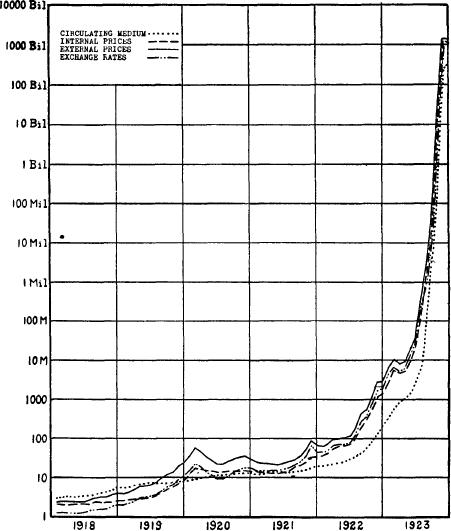
Table XIV and Charts X and XI show three such indices for the German currency, all based on the year 1913, and designated volume of circulating medium, internal prices, and external prices, respectively.2 Chart X covers the years 1918 to 1923 as a whole; Chart XI shows the years 1919 to 1923 broken up into three periods. Chart X and the third section of Chart XI are on a logarithmic scale, the only practicable means of graphically presenting the immense magnitudes involved. The volume of circulating medium index includes only money, not credit, and represents the number of times the volume of money in circulation at any given date exceeded that of 1913. The internal price index is based on the German index of wholesale prices, as published by the government statistical bureau, and represents for any given date the paper mark equivalent of one 1913 gold mark in the purchase of commodities within Germany. The external price index is computed from the Bureau of Labor Statistics index number of wholesale prices in the United States and from the dollar exchange rate in Berlin and represents, for any given date, the paper mark equivalent of one 1913 gold mark in the purchase of American commodities. The latter are assumed to be typical of foreign commodities in general. An index of actual exchange rates,3 and pre-armistice figures for all the indices, are given for comparative purposes. Attention will, however, be centered on the post-armistice period when inflation worked out its effects without the disturbing factor of controls instituted for war purposes.
TABLE XIV
INDEX NUMBERS OF THE VOLUME OF CIRCULATING MEDIUM OF INTERNAL AND EXTERNAL PRICES, AND OF EXCHANGE RATES; 1914–1923
CHART X
INDICES OF VOLUME OF CIRCULATING MEDIUM, OF INTERNAL AND EXTERNAL PRICES, AND OF EXCHANGE RATES; 1918-1923
§ COMPARISON OF INDICES
Relationship Between Volume of Circulating Medium and the Other Indices.
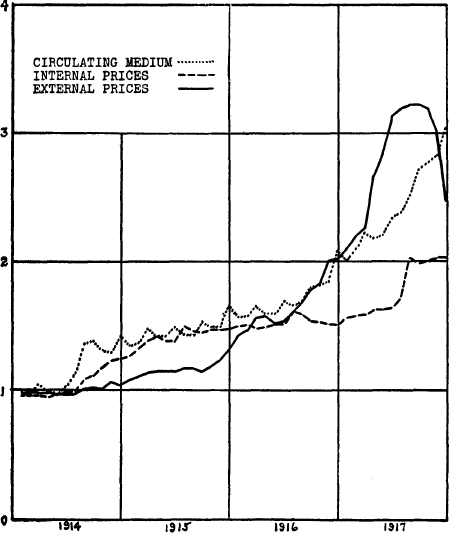
The most prominent feature of the pre-armistice period is the height of the index of the volume of circulating medium relative to either of the others. (See Chart XII.) The causes of the failure of this increase in the currency to stimulate corresponding price changes have already been set forth. The temporary bulge during 1917 in the index of external prices is of slight significance. The external purchasing power of the mark was a more or less arbitrary thing in war-time Germany. Foreign trade was greatly restricted by the enemy blockade and through the control of exports and imports by the German Government. The latter control proved at first not strict enough to prevent a disproportionate rise in foreign exchange but the increase in the index of external prices relative to the volume of circulating medium was soon brought to an end by an extension of the restrictive measures.4 It is interesting to note, however, that, from early 1916 onward, the external value of the German monetary unit was persistently less than its internal value (external prices were higher than internal). The contrary has been sometimes supposed to be the tendency in the early stages of inflation. The notion is based on a wrong interpretation not only of the German but of other monetary phenomena during the war and is due to the assumption that exchange rates serve as a measure of purchasing power comparable with the index of wholesale prices. The value of gold currencies in exchange for paper was, it is true, not very high in this period, but this was not surprising in view of the decline in the goods value of gold which was then everywhere taking place. Though the alteration in the dollar exchange rate was slight in relation to the rise in internal prices in Germany it was large in relation to the respective purchasing powers of the dollar and the mark.
CHART XI
INDICES OF VOLUME OF CIRCULATING MEDIUM, OF INTERNAL AND EXTERNAL PRICES, AND OF EXCHANGE RATES, BY PERIODS; 1919-1923
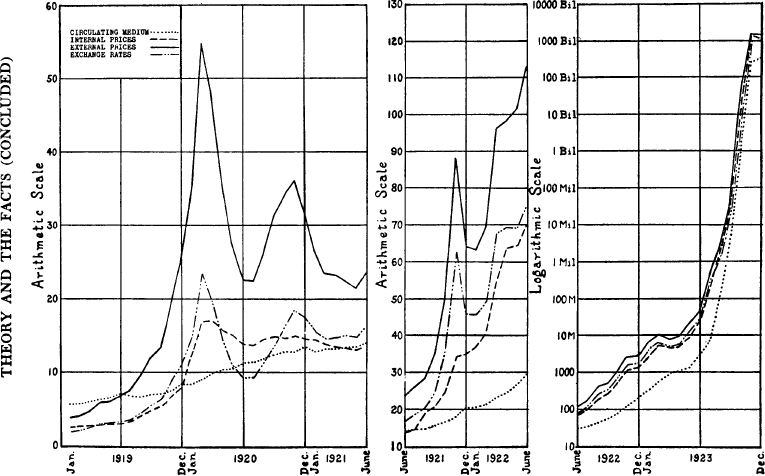
CHART XII
PRICE AND CIRCULATION INDICES IN THE WAR-PERIOD
Reference to Chart XI will show that, if the tendency to hoard was responsible for prices being low relative to the increase in the volume of money, a check in the tendency occurred as soon as the war was over. The index of external prices definitively took the lead in mid-1919 while the index of internal prices rose above that of the volume of circulating medium at the end of that year.5 The volume of circulating medium again caught up with internal prices in mid-1921 but thereafter lagged far in the rear. The acceleration in the rate of monetary turnover increased prices relative to the volume of circulating medium, the rising prices gave a further fillip to the rate of monetary turnover, this again affected prices, and so on. The index of the volume of circulating medium consequently fell a great, but eventually not increasing, distance behind that of internal and external prices. The discrepancy between the curves was, indeed, somewhat enlarged during the middle months of 1923 though the then almost vertical character of their movement obscures the situation. This deviation was perhaps due rather to the rise in prices consequent upon the drop in production in the Ruhr than to any increase in the rate of monetary turnover. The “ceiling” to the ascent of that rate had probably then been reached.
Relationship Between the Indices of Internal and External Prices.
There was clearly a much greater sympathy, at any rate till 1923, between the movement of the indices of external and internal prices than between either of these and the volume of circulating medium. The spread between internal and external paper mark prices was greatest, for the post-war period, in the spring and fall of 1920, in the fall of 1921, and in the fall of 1922.6 In all cases this was due to a relatively rapid rise in exchange rates. Objective and subjective factors were blended as causes but, on the whole, the objective seem to have been dominant. This is not to assert that subjective factors were not of the utmost importance in affecting both the external and internal purchasing power of the mark but that they were less influential than the objective in determining the relationship between these respective purchasing powers. This was the truer as inflation became extreme.
The 1920 Peak of External Prices.
The peak in external paper mark prices in the spring of 1920, the apex of an upward movement in both internal and external price curves, with the curve of external prices advancing at a more rapid rate, seems to have been due, first, to the shock to confidence arising from the loss of the war and the severe terms imposed by the Versailles Treaty and, second, to the rush of the German people for foreign commodities from which they had been so long excluded and access to which was not given till the lifting of the Allied blockade in June 1919. The then relative rise in external mark prices was thus due both to subjective and objective forces. The culminating point was reached when the world-wide postwar boom began to collapse and when, therefore, the German demand for foreign commodities, for purposes of industrial reconstruction as well as for direct consumption, began to fall off. The buying fever was suddenly checked in all parts of the world. Since the Germans had hitherto been buying foreign goods much in excess of foreign demand for German goods mark exchange tended to improve. Perhaps a not less important factor in the shift in the external value of the mark at this time was the failure of the Kapp rebellion to undermine the foundations of the new republic and the impression of political stability which this made on the outside world.7 Here again psychological and objective forces were mixed and the change in the reciprocal demand for exchange was due partly to absolute and partly to speculative requirements.
The “wave” in the curve of external prices from the summer of 1920 to the spring of 1921, a movement unaccompanied by any substantial change in the internal purchasing power of the mark, was initiated by the following factors: (1) The fall in prices in the United States which began in June 1920. This increased the commodity value of the dollar and so tended to raise its price in marks which were, at that time, relatively stable in purchasing power over domestic goods. It should be noted that while the index of external prices in marks came back in 1921 to about the position held in mid-1920 this is by no means true of the index of exchange rates. This means that the mark would buy as much in American goods at the later, as at the earlier, date but would buy fewer dollars. (2) The breakdown of the Spa Conference in July 1920 and the sudden darkening in the political situation thus occasioned. (3) Reaction from the downward movement in foreign exchange which had occurred in the forepart of 1920. This downward movement had, in accordance with the principles laid down in the preceding chapter, carried farther than the long time demand and supply schedules would warrant.
The declining phase of the 1920-1921 “wave” coincided with the gradual allaying of apprehension over external political affairs. The downward movement in the curve, as the upward, was no doubt accelerated by the shift in speculative positions on the exchange market and by the self-stimulating impulse which any movement of exchange may develop.
The 1921 Peak of External Prices.
The 1921 peak in external paper mark prices is almost solely attributable to the inauguration of cash reparations payments. The rise in exchange rates, and so in the index of external prices, was no doubt enhanced by the psychological reaction to the Allied demands, but sheer objective forces would seem to have been dominant. From the middle of May till the end of November heavy purchases of foreign exchange for reparations purposes (at first dollars only, later other currencies also) were, as we have seen, necessary, and during all this time dollar exchange rose fast. The rise in internal prices in August, however, was still more rapid and the spread between the indices was temporarily somewhat reduced. The German announcement to the Reparations Commission, on December 14, 1921, that postponement in payments was essential caused an upward flutter in foreign exchange but the movement was slight and ephemeral and does not show in the monthly average figures. The removal of the objective pressure on the exchange value of the mark, consequent upon the lifting of the burden of payments, much more than compensated the additional weight of psychological forces on the bear side. An absolute fall in foreign exchange (rise of the mark) soon set in and the gap between the curves of external and internal purchasing power was greatly narrowed. In this whole incident of cash reparations objective forces were clearly of primary import. The decision on the Upper Silesia boundary question,8 however, exerted some adverse effect on mark exchange through its influence on the psychology of buyers and sellers of marks.
The 1922 Peak of External Prices.
The widening of the gap between external and internal prices which occurred in the fall of 1922 was an aspect of that complete loss of confidence in the German currency which may be summed up in the phrase, “the flight from the mark.” But though the spread between the curves temporarily increased it was not long before it narrowed again. This may have been entirely due to the speed with which the volume of circulating medium and internal prices were then adjusted to any advance which might take place in exchange rates. But internal prices could advance so fast only if buyers paid what was asked for commodities rather than use their money to purchase foreign exchange. The government, it is true, laid restrictions on the right to buy foreign currencies but it is doubtful whether these had much effect. It simply was not good business to buy foreign exchange at a very high premium. Commodities in the domestic market, being relatively low in price, were likely to rise farther than foreign exchange and it was therefore more profitable to use mark funds for the purchase of such commodities than for the purchase of foreign currencies. After the panic demand, mainly supported by the then slender resources of the old well-to-do classes, had exhausted its influence, the buying and selling of exchange was almost entirely in the hands of business men who alone had any free funds. Cash reparations no longer played an important rôle in the absolute demand for exchange while the conditional demand was dependent on the alternative use for funds in current business transactions in the domestic market. By 1923 the great bulk of exchange business involving marks was carried on in Berlin between German entrepreneurs. The exporters of commodities had foreign exchange for sale and the importers did the buying. Purchases of currency by foreigners for “investment” had practically ceased and there were relatively few capital transactions of any kind. As matters came on to a strict business basis, principally confined to trade in merchandise, conditional demand, responsive to rate deviations from the current purchasing power par, began to play the dominating rôle. Imported merchandise could not be sold in large volume when, as a result of a relative advance in exchange rates, its price rose far above the prevailing level for other commodities. Exports, on the other hand, were so stimulated as to force up export commodity prices in the domestic market. Both phenomena operated to keep exchange rates, and so external mark prices, from advancing at a faster rate than prices of domestic goods. In November 1922 the external purchasing power of the mark had been little more than one-third that of the internal. The spread was narrowed in the succeeding months though from February to April 1923 this was in large part due to the intervention of the Reichsbank in support of mark exchange. In May there was a reaction but the external value fell only to about one-half of the internal. A renewed coalescence brought the two curves to approximate equality in August. It should of course be remembered that the value of the mark, both in internal and external purchases, was depreciating at this time at a terrific rate. But the depreciation in exchange value proceeded much less rapidly than did that in domestic purchasing power. Absolute demand for foreign exchange was then occasioned only by commodity imports which tended to fall off when foreign exchange was high, practically all German exports were invoiced in foreign currencies and thus neutralized any automatic tendency for exchange rate movements to add fuel to the original fire, and conditional demand was in the hands of close calculators. The situation was thus markedly different from that of a year or two previous and the curve of external prices lost its penchant for outstripping both the other indices.
§ CHRONOLOGICAL SEQUENCE OF MOVEMENTS IN THE INDICES
Thus far, attention has been directed to the height of the several indices at different stages in the inflation period and to the relative amplitude of their variations. But amplitude and sequence are, of course, entirely distinct concepts. While it is obvious that, if, at a given date, any one of the three indices which start from a common base has advanced beyond either of the others, it must have risen at a more rapid rate, it does not follow that it rose sooner, or that, having reached a certain position, a further upward or downward variation has preceded corresponding changes in the other curves. Precedence of movement is concealed in the charts shown above both by irregularities in the curves in the earlier years and by the smoothing out which occurs when the enormous figures of the later period are plotted logarithmically. Some statistical technique is necessary to establish the sequence of variation. The remainder of this chapter will therefore deal with statistical measurements of the timing, rather than with the amplitude, of the variations in the several curves.
A careful investigation of mark exchange rates on New York, of German wholesale prices, and of the volume of circulating medium in Germany, for the period 1918 to 1923, has been made by Professor James Harvey Rogers in connection with his study of French inflation.9 In this study the monthly deviations of each of the indices from its computed trend have been plotted and compared. While the curve of exchange rates and that of the index of external value of the mark are by no means the same thing, the time and direction of their movements will coincide whenever American prices remain stable at no matter what height. Substantial stability, following the war movement, was not attained in American prices until the spring of 1921 but, since the ratio of external to internal purchasing power of the mark consistently followed the movement of exchange rates until December of that year, Professor Rogers’ results may be taken with confidence as applicable throughout to external mark prices as well as to exchange rates. A glance at Chart X will show the high degree of correlation in the movement of the two indices concerned.10
Professor Rogers’ charts of the cycles of deviation from their respective trends of the curves of volume of circulating medium and of prices in one comparison, and of prices and exchange rates in another, are here reproduced as Charts XIII and XIV. His conclusions, based on statistical calculations as well as on the charts, and somewhat modified in wording, may be stated under the three following headings :
I. Comparison between the movements of wholesale prices and the volume of circulating medium.
There was a general tendency for movements in the volume of circulating medium to lag behind those in wholesale prices by approximately two months but this lag was greatly reduced during the middle months of 1921 and from the middle of 1922 onward. In the final months of inflation the lag disappeared altogether and was perhaps replaced by a converse lag of price movements behind those of circulation. No positive assertion that the latter was the case may, however, be made.
CHART XIII
CYCLES IN THE MOVEMENTS OF INTERNAL PRICES AND IN THE VOLUME OF CIRCULATING MEDIUM; 1918-1923
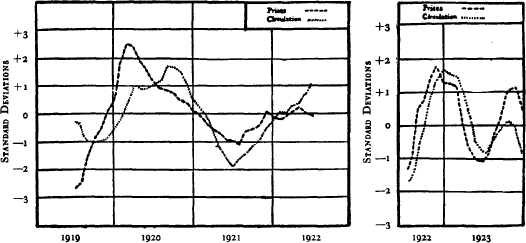
Reproduced from The Process of Inflation in France with the permission of J. L. Rogers and Columbia University Press.
CHART XIV
CYCLES IN THE MOVEMENTS OF EXCHANGE RATES AND INTERNAL PRICES; 1918-1923
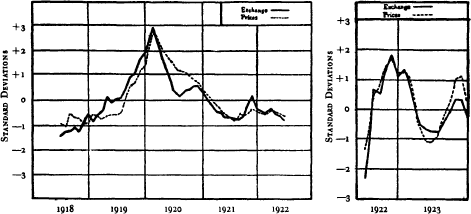
Reproduced from The Process of Inflation in France with the permission of J. L. Rogers and Columbia University Press.
II. Comparison between the movements of exchange rates and wholesale prices.
From June 1918 to July 1920 there was a tendency for movements in wholesale prices to lag behind those in exchange rates by a month or a little more, while from July 1920 to the end of the inflation period, November 1923, the movement of the two series was approximately simultaneous. There is a faint suggestion in the statistics, however, that exchange rate movements tended to lag behind those of prices by an interval of less than a month in the period August 1920 to June 1922.
III. General interrelations of the phenomena.
Adjustments were slow in the period of relatively moderate, but extremely rapid in the period of hyper-inflation. In the final stages all lags were largely or completely eliminated.
With these conclusions of Professor Rogers the present writer is in complete agreement.
§ INTERPRETATION OF THE SEQUENCE OF MOVEMENT
While there is conclusive evidence that the movements of internal prices at times preceded those in the volume of circulating medium there is no absolute assurance that the reverse situation ever occurred. Similarly there is conclusive evidence that exchange rate movements at times preceded those of prices without any certainty that the contrary was ever true. The approximate simultaneity of movement in all three curves which marked the final period of inflation may have been due entirely to a growing mobility in internal prices and in the volume of circulating medium. Any precedence that, up to this time, may have occurred in the movements of internal prices over those in the volume of circulating medium, and in the movements of exchange rates over those of internal prices, may then have continued but have been rendered statistically indiscernible by the rapidity with which adjustment was then taking place. It is certain that in the final months of inflation internal price quotations were made daily, or even more frequently, on the basis of the current exchange rate, and that notes were issued recklessly in response to business “needs.” A real but very short lag would then completely disappear in figures based on monthly averages. But though this is a feasible explanation it is more probably true that the unproved suggestion, in the statistics, of a lag of the movements of internal prices behind those in the volume of circulating medium in the latter months of 1923, and in the movements of exchange rates behind those of internal prices in the period August 1920 to June 1922, was an actuality.
Precedence of Movements in the Volume of Circulating Medium over those in Prices in 1923 and the Reduction of the Lag in 1921 and 1922.
The implication in the statistics of the tendency for changes in the volume of circulating medium to take place in advance of those in prices in the final months of the inflation period supports the concept of a “ceiling” to the possibility of ascent in the rate of monetary turnover. When that ceiling was reached, upward price movements were dependent on prior increases in the volume of means of payment. The reduction of the lag in the movements of the volume of circulating medium in the summer of 1921 and from the middle of 1922 onward was probably due to the weakening of resistance to new emissions of notes for private as well as for governmental purposes. The assertion here made is based on the assumption that the stimulus toward borrowing from the Reichsbank as the facilities for doing so increased, and as the discrepancy between the cost of loans and the benefits therefrom grew greater and greater, speeded the process of adjustment of the lagging volume of notes.
Precedence of Price Movements over those in Exchange Rates in the Period 1920 to 1922.
The year August 1920 to July 1921 was one of comparative stability in all the indices of German inflation. In times of this character such movements of internal prices as occur tend to dominate those of exchange rates. There was, at this date, no persistent unconditional demand for foreign exchange on the part of the Germans, since cash reparations were not yet being paid, and speculative fishers were quiescent in waters which were not greatly troubled.11 The potential independence of exchange rates was therefore not realized. A rise in German prices would tend to lower the ratio of exports to imports and to reduce the supply of foreign exchange relatively to demand while a fall in German prices would have the opposite effect. Exchange rates would thus move in dependence on prices. The relation between French prices and foreign exchange rates shows the same tendency in the period 1919-1922 the last three years of which were years of comparative monetary stability, while from 1923 to 1926, when both exchange rates and internal prices in France were rapidly rising, the precedence of the movement in exchange rates is clear. The latter period, one of disturbance, corresponds in general with the status of German monetary affairs from the end of the war to mid-1920, while the former period, one of stability, is analogous to the German situation of mid-1920 to mid-1921.
It is harder to explain the apparent continuation in the precedence of the movements of German internal prices over those of exchange rates up to June 1922. This was by no means a quiet period. It will be remembered that both exchange rates and internal prices rose rapidly after the middle of 1921 and that, until December of that year, the advance of exchange rates far outstripped that of prices. But the figures intimate, nevertheless, that the movements of exchange rates did not precede those of prices at this time. It may well have been that the issues of marks, made for the purpose of purchasing the foreign exchange requisite for reparations,12 reacted on prices, either directly or by anticipation, almost immediately, and so brought about substantial simultaneity in the movements of the price and exchange rate indices. But, if the apparent precedence of price movements was real, one can only suppose that, so far as reparations affected the situation, anticipations of their baneful influence on Reich finances and on note issues led to such an increase in the rate of monetary turnover as to raise prices sooner than the actual purchase of exchange exerted its influence upon the rates. It is, however, not impossible that the most valid explanation of all is simply that the seeming precedence of price movements in this period is an illusion arising from an imperfect price index.13
Sequence of Price and Exchange Rate Movements in 1923.
The approximate coincidence of fluctuations in exchange rates and in internal prices in the final year and a half of inflation may have been due not only to the already suggested progressive rapidity of adjustment of all the indices to one another but to the fact that subjective forces originating within a country in which all monetary phenomena are in a state of flux do not tend to act upon exchange rates in advance of their impact on prices but affect both simultaneously.14
§ SUMMARY OF SEQUENCES
In general it may be said that the proximate, though not the ultimate, chain of causation, up to August 1920 at least, and perhaps at other times, ran from exchange rates to prices to volume of circulating medium rather than in the reverse direction. The independent character of exchange rate movements in certain circumstances is clearly indicated. The movements of exchange rates appear at times to have affected prices, first, by changing the rate of monetary turnover, and second, by leading, almost inevitably, to new issues of notes. The movements of prices also affected note issues. There was causal interaction among all three sets of phenomena. But, while internal price movements were ultimately, though very loosely, dependent on note issues (the tie being closer toward the climax of inflation), exchange rates maintained their potential independence to the end. There is, however, no clear case for the contention that changes in exchange rates were steadily an even proximate determinant of internal prices. If they had been, prices of imports would have shown changes consistently in advance of those in domestic commodities. The succeeding chapter will make clear that, if there was any such tendency, it was weak. On the other hand, there is next to no evidence that the movement in the prices of domestic commodities ever preceded that in the prices of imports. So far as domestic prices determined exchange rates, therefore, the influence exerted must have been merely toward the establishment of some sort of norm. The fluctuations of exchange rates about such a presumptive norm were entirely free and very wide.
So far as the theory set forth in the preceding chapters departs from orthodoxy it has, in the main, been inductively derived from the facts which the present chapter has developed. Those facts may not therefore be regarded as verification of the theory. It would seem that such verification may come, if at all, only should the peculiar features of the German situation be, at some later date, repeated.
_______________
15 The figures of volume of circulating medium and of exchange rates may be absolutes rather than indices. This does not affect the validity of anything hereafter said.
16 Table XIV shows only yearly averages from 1914 to 1918, but the monthly average has been plotted on Charts X and XII.
17 The relationship between the exchange rate index and the index of external purchasing power does not alter when the American price level was stable. From early 1921 onward the two curves are substantially parallel since, after that date, the goods value of the dollar moved within narrow limits.
18 Volume of circulating medium includes the following: Reichsbank notes, notes of the four other banks with issuing powers, Treasury notes, Loan Bureau notes, and coin. The base is the estimated average for 1913.
19 This index is the general wholesale price index for Germany compiled by the Statistische Reichsamt.
20 This index of external purchasing power is computed by multiplying the index of exchange rates (number of paper marks to dollar equivalent of one gold mark) by the index of wholesale prices in the United States (Bureau of Labor Statistics index number on a 1913 base).
21 Exchange rates against the dollar, as quoted on the Berlin market, relative to 4.198 as 1 (par of gold exchange).
22 For 1923 the index of the volume of circulating medium is computed from figures given in The Process of Inflation in France 1914-1927, James Harvey Rogers, New York, Columbia University Press, 1929, p. 143. In addition to the components given in note 4 these totals include authorized ordinary emergency money for all months of 1923, railroad paper mark emergency money for the months September-December, and, for the months October-December, the following types of stabilized currency converted into paper marks: Rentenmarks, gold loan notes, railroad stable-value emergency money, and gold loan stable-value emergency money. The value of the metal coins in circulation is lacking for the months October-December 1922, January-March 1923, and September-December 1923. On account of the great magnitude of total circulation, however, and the practical complete disappearance of coins, accuracy of the data is not impaired.
23 These figures for volume of circulation may not always correspond exactly with the dates in the first column since they are all end-of-the-month figures; they have, however, been placed opposite the latest date in each month. Source of data: Zahlen zur Geldentwertung in Deutschland 1914 bis 1923, passim.
24 Dealings in foreign exchange, moreover, were centralized and the mark was supported, in certain foreign exchange markets, by the Reichsbank.
25 A rise in the indices (which show the number of paper marks equivalent to one 1913 gold mark in internal and external markets respectively) means, of course, a fall in the purchasing power of the paper mark.
26 This latter movement does not show up so clearly on the chart as do the earlier movements owing to the fact that the third section of Chart XI is on a logarithmic and the first two sections on an arithmetic scale.
27 The Kapp Putsch was an abortive attempt by reactionary elements to regain control of German affairs.
28 The Upper Silesia boundary question had been left by the Peace of Versailles for later settlement pending a plebiscite. Though the plebiscite as a whole went in favor of the Germans, the League of Nations, to which the matter had been referred, drew the line in accordance with the vote by localities. The result was to give to Poland by far the larger part of the industrial area of the district. The decision was handed down on October 12, 1921.
29 cf. The Process of Inflation in France, 1914-1927, Columbia University Press, New York, 1929, Chap. vii. Professor Rogers and the Columbia University Press have graciously permitted me to reproduce the charts from his book and to summarize briefly the results of his study.
30 In order, however, to make assurance doubly sure, cycles of deviation from straight-line secular trends fitted to second logarithms were plotted both for exchange rates and for external prices and were found to correspond almost exactly.
31 This does not mean that there was no speculation but that there was no rush from one side of the market to the other and no great increase in the number of buyers or sellers.
32 The lag in circulation was greatly reduced during the latter part of 1921.
33 The sharp rise in the price index for August 1921, due almost entirely to the great increase in one group, food grains and potatoes, presents an exaggerated picture of the change in the general price level at this time.
34 See page 125.
- 1CLIFFE-LESLIE once remarked that in social matters the greatest scientific progress is made when economic disorders raise vexing questions as to their causes. In the study of social phenomena, disorder is, it is true, the sole substitute for the controlled experiments of the natural sciences. But it sometimes happens that, in the midst of disorder, events move so rapidly that we are not able properly to observe them; disorder may be excessive even to the most detached of scientists. The course of inflation in Germany in the first post-war quinquennium had so much of this character that it has seemed to many to be incapable of throwing any light upon monetary problems. This most striking of monetary experiences has, in consequence, evoked a minimum of scientific curiosity. In spite of the fact that statistics—those notes of process on which the social scientist must so heavily rely—were for some phenomena abandoned in Germany in this period and for others are open to grave objection on the score of accuracy, it has seemed to me that such an attitude implies an unwarranted surrender in the face of difficulties which might with perseverance be surmounted. This book is an attempt, therefore, to discover what actually happened in Germany and either to bring the observed phenomena within the fold of accepted theory or else so to modify that theory as to give it a more catholic character. The actual course of events during inflation has not merely an historical and scientific interest but is of considerable practical importance. Germany’s present position as a nation with heavy international obligations has led to apprehension, both within and without the Reich, as to the future in international finance. The fears of such German competition as may issue out of the debtor status may be dismissed as but thinly-veiled mercantilism but the question as to the possibility of ultimate transfer of the large sums involved in reparations and interest payments must, perhaps, be treated with more respect. The ability of the German economy to provide, within Germany, the funds required, is, on the other hand, no longer seriously doubted. It is hoped that the sequel will throw some light on the disappearance of the latter doubt as also on the prospect of future transfers undisturbed by any serious economic friction.
- 2in Germany. It is based very largely on official German statistics as published by the Statistische Reichsamt and the Institut für Konjunkturforschung. These statistics, for the period studied, are, no doubt, far from perfect, but nothing is gained by attempting to go behind them and there is no reason to suppose that such alternative sources as are available are at all superior. The hope is cherished, perhaps not without justification, that such errors as are involved do not vitiate the conclusions reached. The immense nominal magnitudes attained by all -monetary phenomena in Germany in the inflation-time tend to dwarf the influence of even very considerable imperfections in the statistics. I am far from supposing, nevertheless, that the results obtained are to be taken as clearly proven and I trust that the reader will be no more credulous. They are merely hypotheses
- 3The publications of the Statistische Reichsamt which have been principally used are : Statistisches Jahrbuch für das deutsche Reich, Statistik des deutschen Reichs, Wirtschaft und Statistik, Monatliche Nachweise über den auswärtigen Handel Deutschlands, Zahlen zur Geldentwertung in Deutschland 1914 bis 1923, and Germany’s Economy, Currency and Finance. Sparing use has been made of forms of statistics already available in these sources and, where tables are given in the text, they are, in nearly all cases, the result of computations from the original data.
- 4The cessation of war found Germany in a financial position not markedly inferior to that of most of the other countries involved in the struggle. The far-reaching alterations in the Reichsbankgesetz in 1914 had permitted the suspension of specie payments, had removed the tax on excess Reichsbank note issues, had permitted the Reichsbank to use discounted Treasury bills in lieu of commercial bills as the non-cash cover for Reichsbank notes, and had made Reichskassenscheine and Darlehns-kassenscheine available to meet the “cash” reserve requirements. (The distinction between cash and non-cash cover was abolished in 1921.) This war legislation paved the way for all the coming currency difficulties but it did not differ very greatly from that adopted at the same time in practically all the countries then engaged in hostilities, nor did inflation in Germany, up to the time of the Armistice, much surpass that of some of the principal Entente Allies. The total circulation (including coin other than Reichsbank reserves) in the middle of 1914 is estimated to have been approximately six billions of marks; at the end of 1918 it was something more than five times as much, 32,936,700,000 marks. The total monetary circulation in Great Britain was about £180,000,000 when war broke out while four and a half years later the total of outstanding notes was more than double that sum and stood at approximately £394,000,000. Bank deposits, which in England are a more important index of inflation, had grown in about the same proportion. The total circulation in France (excluding reserves of the Bank of France) in mid-1914 was something over 8,000,000,000 francs (6.5 billion francs in gold and silver, less 4 billion Bank of France reserves, plus 5.8 billion in notes of the Bank of France) while at the end of 1918 the note circulation of the Bank of France amouted to over 30,000,000,000 francs or not quite four times the total pre-war volume of currency. By this date all the gold formerly in circulation had of course disappeared.
- 5Wholesale prices in Germany, Great Britain and France at the end of 1918 were respectively 2.45, 2.30 and 3.53 times their pre-war height. In the United States they were just about twice their 1913 level.
- 61
- 7The occupation, by French and Belgian troops, took place in the early days of January 1923. The British government of the day adopted an attitude of passive disapproval and Italy, while assenting to the measures taken, refused to participate actively in the occupation.
- 8The exchange value of French currency, for instance, was brought very low when it became apparent that the French fise could not count on any large receipts from Germany.
- 9When the administration proposed a capital levy to meet the burdens imposed, the industrialists countered with the offer of a loan of one billion gold marks. But, as negotiations proceeded, the industrialists demanded a remission of future taxes and the turning over to them of the state railroads. The government properly refused and resorted to a forced loan which, however, yielded only 50 million gold marks.
- 10The provisions for redemption in “rentenbank certificates” and the mortgage cover provided had, as all students of monetary phenomena will recognize, but a psychological value. The success of the rentenmark was due entirely to the rigid limitations on issue.
- 11The reform was carried out without foreign assistance of any sort. Rather was there covert opposition from certain powerful foreign groups who would have welcomed the threatened political, as well as financial, dissolution of the Reich.
- 12Dr. Schacht has written an excellent account of the reform in his Stabilization of the Mark, George Allen and Unwin Ltd., London, 1927.
- 13
- 14Though practically all of the various administrations in Germany up to the invasion of the Ruhr made sincere efforts to satisfy the claims of the victors, a measure of persecution may have been necessary to break down the overt or covert resistance of financially powerful Germans in private life. The defiance offered the Allies by men like Hugo Stinnes greatly increased the suspicion and hostility toward the Germans, as a people, and was a fateful error. But though persecution may have been necessary to the securing of such reparations as the Germans could pay, if they would, the stupid malice of certain Allied politicians was heartrending. Much of it was due to the still ardent passions of war, either in the breasts of the politicians themselves or in those of their constituents, but a great deal must be attributed to sheer ineptitude. For a time it seemed as if reparation demands were being used merely as a weapon to bring about the disintegration of the Reich. But, if this purpose was ever held, the double-edged character of the sword soon became apparent. For years thereafter the policy was simply one of vacillation. The Bourbons were of the same mind as ever but they had somewhat lost in influence. Liberals grew stronger as time went on but for long the issue hung in the balance. Either party might attain a superiority and temporarily dominate the situation but the final adoption of a policy of moderation was not attained till the “spirited” group had had their fling in the Ruhr.
- 15cf. Foreign Banking Systems, H. P. Willis and B. H. Beckhart, editors, Chap, VIII, “The Banking System of Germany,” Paul Quittner, Henry Holt and Company, New York, 1929, p. 632, where it is declared that it would be useless to try to connect the development of the German currency system from 1919 to 1923 with any theories of money.
- 16In the matter of mark exchange rates, for instance, sizable differences developed, in the later stages of inflation, between the Berlin and other markets. These were due to the obstruction of arbitrage transactions. At the time that this occurred, however, the Berlin rate was alone of much significance. The Berlin rates have therefore been used throughout. In the matter of prices the alternative sources are the indices of the Berliner Tageblatt, the Frankfurter Zeitung, and the Industrie- und Handelszeitung.
- 17The latter compilation was published in English, as well as in German, for use by the Committees of Experts of the Reparations Commission.
- 18The cessation of war found Germany in a financial position not markedly inferior to that of most of the other countries involved in the struggle. The far-reaching alterations in the Reichsbankgesetz in 1914 had permitted the suspension of specie payments, had removed the tax on excess Reichsbank note issues, had permitted the Reichsbank to use discounted Treasury bills in lieu of commercial bills as the non-cash cover for Reichsbank notes, and had made Reichskassenscheine and Darlehns-kassenscheine available to meet the “cash” reserve requirements. (The distinction between cash and non-cash cover was abolished in 1921.) This war legislation paved the way for all the coming currency difficulties but it did not differ very greatly from that adopted at the same time in practically all the countries then engaged in hostilities, nor did inflation in Germany, up to the time of the Armistice, much surpass that of some of the principal Entente Allies. The total circulation (including coin other than Reichsbank reserves) in the middle of 1914 is estimated to have been approximately six billions of marks; at the end of 1918 it was something more than five times as much, 32,936,700,000 marks. The total monetary circulation in Great Britain was about £180,000,000 when war broke out while four and a half years later the total of outstanding notes was more than double that sum and stood at approximately £394,000,000. Bank deposits, which in England are a more important index of inflation, had grown in about the same proportion. The total circulation in France (excluding reserves of the Bank of France) in mid-1914 was something over 8,000,000,000 francs (6.5 billion francs in gold and silver, less 4 billion Bank of France reserves, plus 5.8 billion in notes of the Bank of France) while at the end of 1918 the note circulation of the Bank of France amouted to over 30,000,000,000 francs or not quite four times the total pre-war volume of currency. By this date all the gold formerly in circulation had of course disappeared.
- 19The cessation of war found Germany in a financial position not markedly inferior to that of most of the other countries involved in the struggle. The far-reaching alterations in the Reichsbankgesetz in 1914 had permitted the suspension of specie payments, had removed the tax on excess Reichsbank note issues, had permitted the Reichsbank to use discounted Treasury bills in lieu of commercial bills as the non-cash cover for Reichsbank notes, and had made Reichskassenscheine and Darlehns-kassenscheine available to meet the “cash” reserve requirements. (The distinction between cash and non-cash cover was abolished in 1921.) This war legislation paved the way for all the coming currency difficulties but it did not differ very greatly from that adopted at the same time in practically all the countries then engaged in hostilities, nor did inflation in Germany, up to the time of the Armistice, much surpass that of some of the principal Entente Allies. The total circulation (including coin other than Reichsbank reserves) in the middle of 1914 is estimated to have been approximately six billions of marks; at the end of 1918 it was something more than five times as much, 32,936,700,000 marks. The total monetary circulation in Great Britain was about £180,000,000 when war broke out while four and a half years later the total of outstanding notes was more than double that sum and stood at approximately £394,000,000. Bank deposits, which in England are a more important index of inflation, had grown in about the same proportion. The total circulation in France (excluding reserves of the Bank of France) in mid-1914 was something over 8,000,000,000 francs (6.5 billion francs in gold and silver, less 4 billion Bank of France reserves, plus 5.8 billion in notes of the Bank of France) while at the end of 1918 the note circulation of the Bank of France amouted to over 30,000,000,000 francs or not quite four times the total pre-war volume of currency. By this date all the gold formerly in circulation had of course disappeared.
- 20The cessation of war found Germany in a financial position not markedly inferior to that of most of the other countries involved in the struggle. The far-reaching alterations in the Reichsbankgesetz in 1914 had permitted the suspension of specie payments, had removed the tax on excess Reichsbank note issues, had permitted the Reichsbank to use discounted Treasury bills in lieu of commercial bills as the non-cash cover for Reichsbank notes, and had made Reichskassenscheine and Darlehns-kassenscheine available to meet the “cash” reserve requirements. (The distinction between cash and non-cash cover was abolished in 1921.) This war legislation paved the way for all the coming currency difficulties but it did not differ very greatly from that adopted at the same time in practically all the countries then engaged in hostilities, nor did inflation in Germany, up to the time of the Armistice, much surpass that of some of the principal Entente Allies. The total circulation (including coin other than Reichsbank reserves) in the middle of 1914 is estimated to have been approximately six billions of marks; at the end of 1918 it was something more than five times as much, 32,936,700,000 marks. The total monetary circulation in Great Britain was about £180,000,000 when war broke out while four and a half years later the total of outstanding notes was more than double that sum and stood at approximately £394,000,000. Bank deposits, which in England are a more important index of inflation, had grown in about the same proportion. The total circulation in France (excluding reserves of the Bank of France) in mid-1914 was something over 8,000,000,000 francs (6.5 billion francs in gold and silver, less 4 billion Bank of France reserves, plus 5.8 billion in notes of the Bank of France) while at the end of 1918 the note circulation of the Bank of France amouted to over 30,000,000,000 francs or not quite four times the total pre-war volume of currency. By this date all the gold formerly in circulation had of course disappeared.
- 21The cessation of war found Germany in a financial position not markedly inferior to that of most of the other countries involved in the struggle. The far-reaching alterations in the Reichsbankgesetz in 1914 had permitted the suspension of specie payments, had removed the tax on excess Reichsbank note issues, had permitted the Reichsbank to use discounted Treasury bills in lieu of commercial bills as the non-cash cover for Reichsbank notes, and had made Reichskassenscheine and Darlehns-kassenscheine available to meet the “cash” reserve requirements. (The distinction between cash and non-cash cover was abolished in 1921.) This war legislation paved the way for all the coming currency difficulties but it did not differ very greatly from that adopted at the same time in practically all the countries then engaged in hostilities, nor did inflation in Germany, up to the time of the Armistice, much surpass that of some of the principal Entente Allies. The total circulation (including coin other than Reichsbank reserves) in the middle of 1914 is estimated to have been approximately six billions of marks; at the end of 1918 it was something more than five times as much, 32,936,700,000 marks. The total monetary circulation in Great Britain was about £180,000,000 when war broke out while four and a half years later the total of outstanding notes was more than double that sum and stood at approximately £394,000,000. Bank deposits, which in England are a more important index of inflation, had grown in about the same proportion. The total circulation in France (excluding reserves of the Bank of France) in mid-1914 was something over 8,000,000,000 francs (6.5 billion francs in gold and silver, less 4 billion Bank of France reserves, plus 5.8 billion in notes of the Bank of France) while at the end of 1918 the note circulation of the Bank of France amouted to over 30,000,000,000 francs or not quite four times the total pre-war volume of currency. By this date all the gold formerly in circulation had of course disappeared.
- 22The cessation of war found Germany in a financial position not markedly inferior to that of most of the other countries involved in the struggle. The far-reaching alterations in the Reichsbankgesetz in 1914 had permitted the suspension of specie payments, had removed the tax on excess Reichsbank note issues, had permitted the Reichsbank to use discounted Treasury bills in lieu of commercial bills as the non-cash cover for Reichsbank notes, and had made Reichskassenscheine and Darlehns-kassenscheine available to meet the “cash” reserve requirements. (The distinction between cash and non-cash cover was abolished in 1921.) This war legislation paved the way for all the coming currency difficulties but it did not differ very greatly from that adopted at the same time in practically all the countries then engaged in hostilities, nor did inflation in Germany, up to the time of the Armistice, much surpass that of some of the principal Entente Allies. The total circulation (including coin other than Reichsbank reserves) in the middle of 1914 is estimated to have been approximately six billions of marks; at the end of 1918 it was something more than five times as much, 32,936,700,000 marks. The total monetary circulation in Great Britain was about £180,000,000 when war broke out while four and a half years later the total of outstanding notes was more than double that sum and stood at approximately £394,000,000. Bank deposits, which in England are a more important index of inflation, had grown in about the same proportion. The total circulation in France (excluding reserves of the Bank of France) in mid-1914 was something over 8,000,000,000 francs (6.5 billion francs in gold and silver, less 4 billion Bank of France reserves, plus 5.8 billion in notes of the Bank of France) while at the end of 1918 the note circulation of the Bank of France amouted to over 30,000,000,000 francs or not quite four times the total pre-war volume of currency. By this date all the gold formerly in circulation had of course disappeared.
- 23The cessation of war found Germany in a financial position not markedly inferior to that of most of the other countries involved in the struggle. The far-reaching alterations in the Reichsbankgesetz in 1914 had permitted the suspension of specie payments, had removed the tax on excess Reichsbank note issues, had permitted the Reichsbank to use discounted Treasury bills in lieu of commercial bills as the non-cash cover for Reichsbank notes, and had made Reichskassenscheine and Darlehns-kassenscheine available to meet the “cash” reserve requirements. (The distinction between cash and non-cash cover was abolished in 1921.) This war legislation paved the way for all the coming currency difficulties but it did not differ very greatly from that adopted at the same time in practically all the countries then engaged in hostilities, nor did inflation in Germany, up to the time of the Armistice, much surpass that of some of the principal Entente Allies. The total circulation (including coin other than Reichsbank reserves) in the middle of 1914 is estimated to have been approximately six billions of marks; at the end of 1918 it was something more than five times as much, 32,936,700,000 marks. The total monetary circulation in Great Britain was about £180,000,000 when war broke out while four and a half years later the total of outstanding notes was more than double that sum and stood at approximately £394,000,000. Bank deposits, which in England are a more important index of inflation, had grown in about the same proportion. The total circulation in France (excluding reserves of the Bank of France) in mid-1914 was something over 8,000,000,000 francs (6.5 billion francs in gold and silver, less 4 billion Bank of France reserves, plus 5.8 billion in notes of the Bank of France) while at the end of 1918 the note circulation of the Bank of France amouted to over 30,000,000,000 francs or not quite four times the total pre-war volume of currency. By this date all the gold formerly in circulation had of course disappeared.
- 24ibid., Vol. I, pp. 308, 470.
- 25ibid., Vol. I, pp. 534. 477, 455.
- 26Of this amount approximately 97 billion marks had been obtained through long-term loans.
- 27The climax in the reparations conflict came with the invasion of the Ruhr, an action which had no support from some of the creditor Powers. Much as the invasion is to be regretted or condemned, however foolish it may have been as a method of collecting payment, and however evil its immediate results, it was the thunderclap that cleared the air. It showed the obdurate creditors how little could be obtained by a policy of force and, on the other hand, it brought such distress to Germany as to convince even the stoutest opponent of the policy of fulfilment (and they were many and powerful) that it was better to accept a moderated burden of payments which, in spite of strong convictions to the contrary, it might be possible for the country to carry, than to continue in an attitude of stubborn intransigence.
- 28When force had led to disaster, the repercussions of which affected the creditors as well as the debtors, the way was at last open to men of conciliatory spirit, and a solution of the problem, or at any rate a working compromise, could be reached. The invasion was a tragic but triumphant vindication of the policy of moderation, and it led to sympathetic, even if selfish, efforts on the part of the creditor Powers to rehabilitate the economy and finances of the Reich. Once order had been restored progress was possible.
- 29Inflation was therefore combated but half-heartedly at best. Though several of the administrations of the years 1920 to 1923 made valiant attempts to arrest its progress they could not summon the sustained powers necessary to success. All of their efforts came to naught, largely through the apathy or active opposition of powerful business groups who were disposed neither to aid their government in imposing regular taxation nor to cooperate with it in carrying out its obligations under the Treaty of Versailles. Whatever might have been possible to a government backed by a people determined to have no further traffic with inflation, the will to establish a stable standard was lacking until the drama had run its course. It may well be doubted whether a stable standard could in any case have been set up while immense reparations debts were plaguing the situation. But this must remain an open question. So long as wealth and income were being merely transferred by the decline in the value of the monetary unit and not, as a sum, diminished, so long as scapegoats could be found to assume the burdens and yield of their substance to those who knew how to profit from the situation, projects of reform were treated cavalierly. It was only when enterprisers, instead of surely profiting from inflation as they long did, were suddenly plunged into a sea of uncertainties, only when business activity passed from the stage of exhilaration to panic, only when resistance to a further assumption of losses on the part of the public at large became general, that influential opinion veered to a conviction of the necessity of restoring a stable standard. The pass to which matters had then come is shown in Table III.
- 30The successful introduction of the rentenmark in November 1923, a currency without gold backing and, indeed, nothing more than a new tenor of inconvertible paper, with the monetary stabilization thus effected, has been hailed as a miracle. It was certainly a remarkable achievement and bears strong witness to the steadfastness of the German character. The time was ripe but extremely unpropitious. The people had lost all confidence in their currency and in the possibility of its reform. Foreign troops were in possession of their chief industrial districts and the coercive measures adopted by the occupying powers had paralyzed the industrial life of the country. The masses of the urban population were living from hand to mouth, nay, had nothing in their hands but worthless bits of paper which the farmers would no longer accept in exchange for grain. Food riots were general. Political dissolution was in imminent prospect and armed revolt had already raised its head. Affairs were indeed so black that it is clear, in retrospect, that they actually facilitated the reform by imbuing the people with the resolution of despair. The conduct of currency matters was given to Dr. Hjalmar Schacht who possessed the temperament necessary to the situation. His powers were presently enlarged by his election to the Presidency of the Reichsbank. The former President Havenstein had died on the very day that conversion of the old currency into the new was under-taken, a demise which cannot be thought of as other than opportune.
- 31The successful introduction of the rentenmark in November 1923, a currency without gold backing and, indeed, nothing more than a new tenor of inconvertible paper, with the monetary stabilization thus effected, has been hailed as a miracle. It was certainly a remarkable achievement and bears strong witness to the steadfastness of the German character. The time was ripe but extremely unpropitious. The people had lost all confidence in their currency and in the possibility of its reform. Foreign troops were in possession of their chief industrial districts and the coercive measures adopted by the occupying powers had paralyzed the industrial life of the country. The masses of the urban population were living from hand to mouth, nay, had nothing in their hands but worthless bits of paper which the farmers would no longer accept in exchange for grain. Food riots were general. Political dissolution was in imminent prospect and armed revolt had already raised its head. Affairs were indeed so black that it is clear, in retrospect, that they actually facilitated the reform by imbuing the people with the resolution of despair. The conduct of currency matters was given to Dr. Hjalmar Schacht who possessed the temperament necessary to the situation. His powers were presently enlarged by his election to the Presidency of the Reichsbank. The former President Havenstein had died on the very day that conversion of the old currency into the new was under-taken, a demise which cannot be thought of as other than opportune.
- 32The successful introduction of the rentenmark in November 1923, a currency without gold backing and, indeed, nothing more than a new tenor of inconvertible paper, with the monetary stabilization thus effected, has been hailed as a miracle. It was certainly a remarkable achievement and bears strong witness to the steadfastness of the German character. The time was ripe but extremely unpropitious. The people had lost all confidence in their currency and in the possibility of its reform. Foreign troops were in possession of their chief industrial districts and the coercive measures adopted by the occupying powers had paralyzed the industrial life of the country. The masses of the urban population were living from hand to mouth, nay, had nothing in their hands but worthless bits of paper which the farmers would no longer accept in exchange for grain. Food riots were general. Political dissolution was in imminent prospect and armed revolt had already raised its head. Affairs were indeed so black that it is clear, in retrospect, that they actually facilitated the reform by imbuing the people with the resolution of despair. The conduct of currency matters was given to Dr. Hjalmar Schacht who possessed the temperament necessary to the situation. His powers were presently enlarged by his election to the Presidency of the Reichsbank. The former President Havenstein had died on the very day that conversion of the old currency into the new was under-taken, a demise which cannot be thought of as other than opportune.
- 33The history of reparations till the adoption of the Dawes Plan in 1924 is an almost incredible tale of stupid persecution. The confusion of counsels and the vacillation in action which prevailed among the creditor Powers until the adoption of the Dawes Plan, the bickering and endless negotiation, the frustration of all attempts at compromise, were fatal to an orderly process of payments on the part of Germany even if payments in the amount demanded had, at the time, been practicable. The Allies began by demanding the impossible and they capriciously imposed sanctions when the impossible was not performed. Pending final determination of claims, the Versailles Treaty, effective January 10, 1920, required the Germans to deliver bonds as an instalment on their total debt to the value of 100 billion gold marks. Of this amount 20 billion were to mature on May l, 1921. Prior to that date the Reparations Commission was to fix the total of Germany’s obligations and, on the total so fixed, interest was to run at 5%. The Commission did not hand down its decision till April 27, 1921, when the debt was set at 132 billion gold marks. Meanwhile Germany had been making large payments in kind, the value of which was estimated by the Commission at 2.6 billion gold marks and by the Germans at several times that amount, but these were declared to have been inadequate to meet the costs of the armies of occupation. Though, in addition to the enormous levy on existing wealth under the Armistice and Treaty, the Germans had now for nearly two years been making large deliveries out of current production, they were held not only to have failed to pay any reparations at all, but to be steadily incurring still greater capital obligations through the accumulation of unpaid interest charges.
- 34The history of reparations till the adoption of the Dawes Plan in 1924 is an almost incredible tale of stupid persecution. The confusion of counsels and the vacillation in action which prevailed among the creditor Powers until the adoption of the Dawes Plan, the bickering and endless negotiation, the frustration of all attempts at compromise, were fatal to an orderly process of payments on the part of Germany even if payments in the amount demanded had, at the time, been practicable. The Allies began by demanding the impossible and they capriciously imposed sanctions when the impossible was not performed. Pending final determination of claims, the Versailles Treaty, effective January 10, 1920, required the Germans to deliver bonds as an instalment on their total debt to the value of 100 billion gold marks. Of this amount 20 billion were to mature on May l, 1921. Prior to that date the Reparations Commission was to fix the total of Germany’s obligations and, on the total so fixed, interest was to run at 5%. The Commission did not hand down its decision till April 27, 1921, when the debt was set at 132 billion gold marks. Meanwhile Germany had been making large payments in kind, the value of which was estimated by the Commission at 2.6 billion gold marks and by the Germans at several times that amount, but these were declared to have been inadequate to meet the costs of the armies of occupation. Though, in addition to the enormous levy on existing wealth under the Armistice and Treaty, the Germans had now for nearly two years been making large deliveries out of current production, they were held not only to have failed to pay any reparations at all, but to be steadily incurring still greater capital obligations through the accumulation of unpaid interest charges.

