
Banking and the Business Cycle
VIII. Banking Policy and the Price Level
It was suggested in Chapter II how the War-time disruption of orderly economic activity eventuated in the loss of the industrial balance necessary to the smooth functioning of our national economy. The assertion was there made that the root causes of the recent depression go back to the War—that the War may be considered the remote cause of the depression. It was also brought out in Chapter II and amplified in Chapter V that, working in conjunction with the dislocations caused by the War, the effects of the inauguration of the Federal Reserve System had much to do with bringing about the chaos that prevailed after 1929; and the operation of our central banking system during the post-War years has been designated the proximate cause of the depression.
MISLEADING BEHAVIOB OF POST-WAR PRICE LEVEL
Among the numerous dislocations engendered by the War, one in particular is deserving of special consideration at this stage of the analysis. Its bearing upon post-War banking policy, and hence upon post-War economic life and upon the depression itself, is of fundamental importance. Reference is had to the behavior, or course, of the price level during the post-War period. It was the one factor which, conceivably more than any other, served to lead astray nearly all prognosticators of the course of economic events during the period leading up to the crash, and after 1929 it was one of the outstanding features of the downward trend of economic activity. The behavior of the price level from 1922 to 1929 also serves to show the fallaciousness of the cruder form of monetary explanation of the business cycle, as, in the view of the adherents of that theory, depression will not ensue if the price level is stable. And the futility of price level stabilization as a goal of credit policy is evidenced by the fact that the end-result of what was probably the greatest price-stabilization experiment in history proved to be, simply, the greatest and worst depression.
There is little question but that the Federal Reserve Board was quite successful in its “management” of the price level, just as there is but little doubt that the depression, in final analysis, was the price paid for that experimentation. Departing from the exposition of a generalized theory of cycles and confining the argument for the present to an analysis of the causes of the recent depression, the price-level-stabilization policies of the Federal Reserve System loom large in the causal category, if indeed they do not occupy first rank in the list of causes serving to explain the great débâcle. Almost all post-War banking developments were conditioned and influenced by Federal Reserve policy aiming at stabilization of the price level. In the light of the events of recent economic history, therefore, and the relation of those events preceding the onset of depression to the ensuing decline, one of the most important single aspects of the American economic situation would appear to have been the course of prices from 1922 onward. The bank credit inflation examined in Chapter V, the distortion of the structure of production made possible by that bank credit expansion described in Chapter VI, and the stock market boom and crash dealt with in Chapter VII, all had their origin in the price-stabilization policy, or managed currency experiment, of the Federal Reserve Board during the years leading up to the depression.
UNJUSTIFIED CRITICISM OF FEDERAL RESERVE BOARD
A disclaimer is entered before proceeding further, however, that this is not merely an attempt to find a scapegoat for the troubles of the last few years. It has been popular to charge the Federal Reserve Board with responsibility for the depression (even by some of the Board’s own members), but it appears that much of the criticism leveled against the Board has been motivated largely by unreasoning emotion rather than by calm objective analysis. Lest the following paragraphs should improperly be construed as a general attempt at castigation of the Board, it is urged on the contrary that our purpose is here only to review and to appraise dispassionately the Board’s policies and activities in connection with the price situation and its intimate relation to the depression. It is believed, however, that the conclusion is inescapable that the interference on the part of the Board with the “normal” course of economic events in pursuing a policy of price stabilization contributed potently to the generation of the depression. Much of the criticism directed at the Board by others has had to do only with its policy toward the stock market, and particularly its action in 1929; the special concern here is rather with earlier years, and with the relation of Federal Reserve policy to the whole post-War economic situation, of which the stock market situation in 1929 was but one of several results.
STABLE PRICE LEVEL AND—ENSUING DEPRESSION!
The depression has been explained thus far as the outcome of a central banking inflation, with that inflation translated into a disequilibrium between investment and saving. Supplementing the inflationistic bias inherent in central banking, as an explanation of the course of inflation during the decade of the ‘twenties, are measures adopted by the Federal Reserve Board under the delusions of the desirability and the practicability of a stable price level.
So far as is known to the writers, Professor J. M. Clark was the first to point out that even1 “* * * under perfectly steady prices there would still be great booms and depressions in the capital-making industries, and resulting booms and depressions in industry at large.” It was the proof of this observation of Clark’s as exemplified in the last cycle which was one of the outstanding features that differentiated it from previous ones. Although prices were not perfectly steady, it is true, they were relatively stable for a period of time longer than any prior period involving comparable conditions. Yet depression ensued, in the face of what the advocates of the older form of monetary theory of the business cycle regarded as the sine qua non of freedom from depression. Why depression could occur in spite of relative stability of the price level has been set forth in Chapters VI and VII where it was shown that the all-important factor is the way in which increased credit (in the form of producers’ credits) enters the economic system and engenders alteration in the structure of production. The relationship of Federal Reserve policy to the stabilized price level, however, is deserving of special consideration. It is necessary at this stage, in other words, to integrate the argument of the preceding chapters with the part played by Federal Reserve injections of credit into the system in the endeavor to bolster the price level.
DID FEDERAL RESERVE BOARD DELIBERATELY ATTEMPT PRICE STABILIZATION?
On first thought, it may not appear an easy task to assess a deliberate policy of price stabilization against the Federal Reserve Board. Most of the Board members have denied the existence of any conscious policy aimed at stabilization, and some have asserted that it was not in their power to stabilize prices, even had they wished to do so. Over against these declarations may be set Professor Commons’ observation that the Reserve authorities are prone to belittle their influence on prices.2 This is understandable, in view of the political implications such an admission would carry with it. However, in answer to the question propounded to him at the Stabilization Hearings in 1927:3 “Do you think that the Federal Reserve Board could, as a matter of fact, stabilize the price level to a greater extent than they have in the past, by giving greater expansion to market operations and restriction or extension of credit facilities?” Governor Strong of the New York Federal Reserve Bank replied, “I personally think that the administration of the Federal Reserve System since the reaction of 1921 has been just as nearly directed as reasonable human wisdom could direct it toward that very object.” Five years previously, in 1922, Pierre Jay, also of the New York Federal Reserve Bank, had stated that4 “the movements of prices would indicate whether the volume of credit was inconsistent with production.” George W. Norris, Governor of the Philadelphia Bank, agreed that the Federal Reserve Board authorities5 “as a body have followed the policy as far as it lay within their power under the existing law, of stabilizing credits to the extent that stabilization of credits might have influenced prices.”
A number of authorities on monetary matters whose opinions should be entitled to weight are inclined to recognize price stabilization as one of the objectives of Federal Reserve policy during the years following 1922. Keynes states that6 “The successful management of the dollar by the Federal Reserve Board from 1923 to 1928 * * * was a triumph for the view that currency management is feasible, * * *.” D.H. Robertson remarks that7 “* * * a monetary policy consciously aimed at keeping the general price level approximately stable * * * has apparently been followed with some success by the Federal Reserve Board in the United States since 1922.” Of the possibility of stabilizing prices, Joseph Stagg Lawrence says, 8 “It not only can be done but has been done.”
The intention here is not to attempt to develop at length the argument that the Reserve Board members were consciously endeavoring solely to stabilize prices. The significant point is that they were endeavoring to “control” the banking and credit situation. As Governor Norris points out, they were embarking upon a conscious policy of “management.” Since this policy was directed toward the control of credits, and since its incidence was largely upon the prevailing domestic situation, it eventuated in the maintenance of a stable price level, as it was virtually certain to do in view of the lengths to which the control activities extended and the conscious or unconscious stabilization bias of the majority of the members of the Board.
That the Board (and the System) was taking unto itself responsibility for management and control does not seem to admit of much doubt. The economic life of the United States for the six years following was to be largely directed and shaped (far more so than was then realized) in accordance with the pronunciamento of the now famous Tenth Annual Report of the Federal Reserve Board (1923), described by Edie as perhaps the most important document of its kind since the publication in England of the Bullion Report in 1810.9 The statement of policy there set forth, and reiterated later at various times by members of the Board in their public utterances and to a lesser extent in subsequent Annual Reports of the Board, would almost certainly seem to point to the movement of the price level as a determining influence in the shaping of the control policies of the Board. In a retrospective view, it would seem that such indeed must have been the dominant influence. The very existence of the stable price level which persisted as long as it did, considered in conjunction with the available statistical evidence on Federal Reserve credit operations, would seem well-nigh conclusive proof of that contention. In other words, it is the writers’ opinion that we witnessed from 1922 to 1929 the world’s greatest laboratory experiment with a “managed currency” within the gold standard, involving stabilization of the price level. And, to repeat, the view is advanced that the greater part of our recent troubles was the outcome of that stabilization experiment.
CURRENCY MANAGEMENT DIFFICULT—BUT NOT NEW
Yet there is nothing genuinely new in currency management as such. Nor is there any direct quarrel with a program of control. The critical point at issue has to do with the choice of objectives and the extent of the control activities; the later part of the present chapter will be devoted to setting forth the writers’ views on credit policy, and it will there be shown that the very existence of any such policy necessarily involves management and control. The gold standard prior to the War was a managed standard. That it can be managed with considerable success is attested by the fact that England was able to maintain satisfactorily her position as “banker for the world” on the very slender gold she then possessed (the gold reserve of the Bank of England prior to 1913, according to Sir George Paish, never having exceeded $50,000,00010). When the hegemony of world finance passed to the United States during and after the War, and with it the responsibility for international monetary management, there were only a few nations remaining on the gold standard, and the inexperienced or incapable hands in this country essayed to manage a purely domestic gold standard, apparently with but scant regard for the international aspects of the situation. Yet, as will be shown later, this domestic management procedure subsequently had unfortunate international repercussions.
REDISCOUNT RATE CHANGES AND OPEN-MAEKET OPERATIONS AS INSTRUMENTS OF CONTROL
Two changes relating to the tools of management were instituted in the United States during this period, altering the American procedure in some respects from the pre-War system of management in England. One was the less positive use made of rediscount rate changes as a tool of central bank management, and the other was the more positive and extensive use made of open-market operations. Open-market operations had never played a particularly conspicuous rôle in the policies of the Bank of England, short of panic conditions, before the War; the main reliance was placed upon alterations in the rediscount rate. In the experience of this country with a central banking system, the emphasis has been reversed. Comparatively less use has been made of rate changes, and open-market operations have been the chief instrument of Federal Reserve control operations. Explanation may possibly lie in the fact that almost from the inception of the Reserve System the rediscount rate ruled below the market rate, and thus never attained the effectiveness it enjoyed in England, where the rediscount rate has been traditionally above the market rate; perhaps it was because open-market operations, utilized widely during the period of War financing, represented a seemingly more delicate instrument for experimentation, but one no less effective in the control of the market.11
The Reserve Banks can become a positive factor in the money market on their own initiative by influencing the reserve balances of the member banks through open-market operations. In order that an expansion of reserves may follow from a reduction in the rediscount rate, on the contrary, the member banks must aid in the process; they are under no compulsion to increase their reserves by rediscounting merely because the rate is low. Open-market (purchase) operations do force an expansion of reserves, whether or no, and it ordinarily follows that the member banks will expand credit on the basis of these “costless” reserves induced by Federal Reserve action. By embarking upon the initial open-market operations of 1922, the importance and efficacy of which are stressed in the 1923 Report, the Board committed itself to a policy of control which continued on into 1928. Even at that later date, unfortunately, the Board refused to recognize its responsibility for the situation which it had created and adopted a “do-nothing” policy for a time sufficiently long to permit a run-away situation to develop.
The Federal Reserve System, in other words, entered upon an active policy of positive control. Banking developments in this country from 1922 onward were almost entirely the consequence of Federal Reserve control operations. Dr. Miller’s characterization of the 1927 “boot-strap lifting” experiment as “one of the most costly errors committed by it or any other banking system in the last 75 years” applies with equal force to the experiments of 1922 and 1924.12 In the formulation and execution of an essentially inflationistic policy of control, the Board must be charged with a colossal error, the ultimate effect of which was, as Dr. Miller himself admits, the depression.
This, then, constitutes another important link in the chain of reasoning calculated to unravel the causes of the depression. The execution of the Board’s control operations involved inflationistic action if stabilization of the price level was to be achieved, in the sense that it artificially maintained that level and forestalled the inevitable and natural decline which otherwise would have accompanied the post-War expansion of production, and hence explains the bank credit inflation which resulted.
MOTIVATION OF ADOPTION OF PRICE-STABILIZATION POLICY
This leads to the question of the raison d’être of the Board’s action: i.e., What motivated the adoption of such a policy of control? The answer appears to be that the Board was convinced that the price level had fallen far enough after the severe break in 1920–1921, or had fallen to “normal,” and hence should be stabilized at that point. If this notion was held by the Board, it likewise helps to explain the underlying idea of the inflationistic bias. Normalcy, however, is at best an elusive concept, and one not subject to easy definition; nor is it a simple matter to state what constitutes a normal price level.
HISTORICAL ANALOGY PROMPTS SKEPTICISM AS TO FULLNESS OF POST-WAR PRICE RECESSION
It is the view of the writers, a post hoc view it is true, that the 1921–1922 level of prices still included some part of the rank growth of inflation fostered by ill-conceived war finance, and that a further price recession or deflation was in order before it could be said that a normal price situation had been attained after the War. What would have been a “normal” price level during those years is admittedly hard to say; notwithstanding, it is not reasonable to believe that the index of wholesale commodity prices would plunge 100 points in little over a year and then at once became stable at a point 50 per cent above the level prevailing in 1913.
The basis for this belief lies in historical analogy. After each of the three periods of great war-time inflation in this country—the War of 1812, the Civil War, and the World War—prices eventually fell to a point lower than they had stood at the beginning of the inflation. In view of the course of events in the first two instances, there was ample basis for skepticism that a price level 50 per cent higher than the pre-War level would become a new price norm after the late War. This is not to say that prices necessarily have to recede to their pre-war level following every such period of inflation; the fact remains, however, that they did do so in the preceding cases and hence might have been expected to do so again in this most recent case. And history did repeat itself. But not completely so, for in each of the two earlier periods the pre-war level was reached as the result of a gradual and fairly consistent decline spread over a considerable number of years, whereas in the later instance the price level was artificially stabilized for a time, following an initial drastic decline, and the remainder of the deflation to the 1913 level was postponed until after 1929, with now-familiar disastrous effects.13
If “management” was to be the function of the Reserve System—and, it is repeated, there is no complaint against management as such, but rather against the choice of ends and possibly the extent or degree of management—the Board might better have directed its management activities to preventing “natural” recession from degenerating into headlong deflation. By such a policy it might have been possible to delay the return to the pre-War level of prices (if that level ever did return) to some relatively distant future date. There is nothing inherently bad in a falling price level (in fact, there is much to commend it, as will be elaborated later in this chapter), provided the rate of decline is gradual.
Other aspects of the post-War situation also lead to the conclusion that the level of stabilized prices which prevailed from 1922 to 1929 was not a natural nor a normal one, and that the attempts at stabilization were in opposition to powerful influences working for a decline.
UNPRECEDENTED TECHNICAL PROGRESS INDICATED FALLING PRICES NORMAL
The fact that the period from 1922 to 1929 was one of rapid technical progress need hardly be amplified. As technical progress ordinarily and logically results in enlarged production, however, this development constituted a forceful factor operating to reduce prices. Additional purchasing power had to be injected into the system if the increased output of products was to be taken off the market and if, at the same time, a decline in the price level was to be avoided. But these injections of new credits served also to make more rigid the distorted, unbalanced, economic relationships that had been created during the War. An unbalanced cost-price relationship tended in effect to be solidified by the new emissions of credit. An excellent brief characterization of the situation is found in the following analysis by D. H. Robertson:14
The events of the last 18 months have confirmed rather than shaken me in the belief that the maintenance of an even rate of industrial progress, difficult in any case, will be rendered more difficult still if the world commits itself to the view that, however great the improvements in technical efficiency, prices ought never to fall. Looking back, it becomes, I think, more and more arguable that the great American “stabilisation” of 1922–1929 was really a vast attempt to de-stabilise the value of money in terms of human effort by means of a colossal programme of investment in buildings, motor car plants, etc., which succeeded for a surprisingly long period, but which no human ingenuity could have managed to direct indefinitely on sound and balanced lines. It becomes plainer, too, I think, that the disastrous slump in the prices of many foodstuffs and raw materials has been in part, at any rate, a nemesis for ill-considered efforts (greedy in the case of low-cost producers, pathetic and futile in the case of high cost ones) to hold up prices in the face of falling costs. If the business man’s psychology jibs at swallowing the moderate price falls dictated by increasing productivity, he renders himself more and not less liable to suffer the catastrophic price falls due to industrial dislocation and crisis—that is my case.
The Federal Reserve Board, then, in its control policies during this period, found itself opposed by two powerful forces operating in the direction of a decline in prices. On the one hand, there was an inescapable tendency toward further deflation to some point below the unnatural plateau of prices attained at the end of the War period; and, on the other hand, the improved technique in production, the application of science to business, which characterized the Second Industrial Revolution was a significant force working for lower prices. In order to effect a stabilization of the price level in the face of these two powerful counterweights it was necessary to force enormous quantities of bank credit into the economic system as an offsetting factor. On this point Robertson makes the further observation which follows:15
Suppose that in a community with a stable population there occurs a general increase in individual productivity. If the bank takes no action there will be a fall in the price level and an increase in the real value of the people’s money stocks. * * * By making additional loans of an appropriate pace, the bank can counteract the fall in the price level * * * what is true is that owing to the increase in productivity the bank has been able, without causing a rise in the price-level, to impose upon the public a quantity of Lacking [“forced saving”] whose imposition would have necessitated a rise in the price-level if there had been no increase of productivity.
PARALLELISM BETWEEN GROWTH OF BANK CREDIT AND PRODUCTIVITY
That the banking system operated directly to counteract the tendency toward a falling price level which should have been regarded as a logical consequence of the increasing productivity of the economic system during the period in question is suggested by an examination of the now-familiar figures for the rate of increase of bank credit and the most authoritative available figures for the rate of increase of productivity. As measured by the physical volume of output per wage-earner (the quotient of the total physical volume of production divided by the number of workers), productivity increased from 1919 to 1927 at the rate of 6.69 per cent per annum.16 This compares with an increase of bank credit from 1921 to 1929 at a rate slightly in excess of 6 per cent per annum. Although the data do not cover exactly the same years in the two cases, the figures may be considered sufficiently comparable. In other words, in order to offset an increasing productivity of a little more than 6 per cent per annum, the banks had to manufacture credit at approximately the same rate. The result was a comparatively stable price level. In this sense, the creation of bank credit at the rate indicated must be regarded as constituting inflation.17 It is probable, furthermore, that the actual increase of productivity would not have been so great had not the introduction and application of technological improvements been speeded up by the rapid growth of bank credit. That is to say, the expansion of bank credit operated to speed up the rate of improvement in productivity through the more rapid creation of improved capital equipment, thereby rendering technological advances effective more quickly. Yet the concurrent effect of increasing the amount of bank credit in circulation was to deprive the public of any immediate benefits of that improving productivity in the form of lower prices.
ABSENCE OF INVENTOKY INFLATION
An alteration in policy on the part of business men served to eliminate one possible source of demand for new credit that was much in evidence whenever easy credit conditions obtained before the War, that is, in the accumulation of stocks of goods in anticipation of a rise of prices. There was no marked increase in demand for goods in the form of expanding inventories, as had been characteristic of previous booms. Business men had learned a severe lesson during the 1920–1921 recession when they were caught with swollen inventories at inflated prices, and did not care to run the risk of another abrupt decline in prices—hence they were loath to accumulate large stocks of goods-on-hand. There appears to exist a direct relationship between commercial loans and inventories, since a large part of commercial loans ordinarily are used for the purpose of carrying stocks of finished goods and for materials-in-process. It has already been pointed out that commercial loans for all the member banks were remarkably steady from 1921 to 1929 (Table XIII); the table on page 189 shows that inventories were nearly stationary from 1924 on (figures for prior years not being available).18
TABLE XXIV
INVENTORIES, ALL REPORTING CORPORATIONS
(In Billions of Dollars)
| 1924 | 19.4 |
| 1925 | 19.6 |
| 1926 | 20.9 |
| 1927 | 21.0 |
| 1928 | 20.8 |
| 1929 | 21.0 |
Source: Currie, Lauchlin, “The Failure of Monetary Policy to Prevent the Depression of 1929–1932,”Journal Political Economy (April, 1934), Vol. XLII, No. 2, p. 163.
EFFECTS OF INFLATION BEST MEASURED WHERE USE OF CREDIT MOST ACTIVE
From yet another point of view, there may also be said to have been inflation during this period. Although wholesale commodity prices were relatively steady, prices in a more inclusive sense did rise. That is to say, the emissions of bank credit found expression in a rise of prices other than wholesale commodity prices, the index to which most persons are accustomed to refer when considering prices in relation to increased purchasing media. For “credit takes various directions, and the effects of inflation can only be measured best at those points in the business structure where the use of credit has been most active.”19 The “points” where credit played its most active part in affecting prices in the period from 1922 onward are those already referred to—real estate, stocks, and long-term investments. In addition, the new credit found an outlet in the payment of increased wages; for, despite the efforts of Congress to revamp economic theory by legislative fiat in the famous Section 7 of the Clayton Act to the effect that “the labor of a human being is not a commodity or article of commerce,” and in the now equally celebrated Section 7a of the National Industrial Recovery Act, wages nevertheless remain a price. Wage rates increased at the rate of 2.8 per cent per annum from 1922 to 1927, as compared with 0.5 per cent per annum from 1899 to 1921.20 And Carl Snyder’s Index of the General Price Level, composed of some eleven price series such as real estate prices, security prices, rents, and wage rates, in addition to wholesale prices, rose from 152 in 1922 to 183 in 1929 (on the basis of 1913 as 100), which is at a (compound) rate of 2.7 per cent per annum. If all prices are considered, then, it is clear that an inflationary price rise actually did occur in the period following 1922, despite the fact that wholesale commodity prices were relatively stable. Thus the ultimate effect of increasing emissions of bank credit resulting in approximate stabilization of the wholesale price level was to cause rising prices in unanticipated quarters.
WHY STABILIZATION OF PRICE LEVEL IS AN IMPROPER OBJECTIVE OF BANKING POLICY AND AN INADEQUATE GUIDE
This reverts the discussion to the point made in Chapter VI, that much hinges on how and where the new credit enters the system. When credit is generated through the sale of new bond issues to the banks by entrepreneurs who are engaged in producing new capital goods, it brings about an investment inflation, with the resulting boom characterized by expansion in the investment goods industries, and followed by the inevitable crisis and deflation when the issuance of new credits slackens or ceases. A stable general level of prices in itself means little; it is the disequilibria among particular paces induced by bank credit expansion (or contraction) that is of chief interest and importance for business cycle theory. Hayek is unquestionably right when he says that:21
General price changes are no essential feature of a monetary theory of the Trade Cycle; they are not only unessential, but they would be completely irrelevant if only they were completely “general”—that is, if they affected all prices at the same time and in the same proportion. The point of real interest to Trade Cycle theory is the existence of certain deviations in individual price-relations occurring because changes in the volume of money appear at certain individual points. * * * The nature of the changes in the composition of the existing stock of goods, which are affected through monetary changes, depends of course upon the point at which the money is injected into the economic system.
As long as particular prices persist in deviating from a stabilized level, and as long as the level of stabilization itself is made up of an average of fluctuating individual prices, stabilization of the price level is neither adequate nor proper as an objective of or guide for banking and credit policy.22 The principal shortcoming of price level stabilization as a primary goal of monetary policy is found in the fact that the “freezing” of any one set of prices tends to establish resistances to the readjustments that need to be made continually within the price system if that system is to be kept in balance in the face of a highly dynamic economic setting: stabilization of all prices is, of course, quite impossible in any nation other than one having a completely “frozen” economic structure. Nor is an unchanging price level any insurance against depression, as the events of recent monetary history have abundantly proved.
The wholesale price level, then, was artificially supported by the action of the Federal Reserve authorities, and to bring about this artificial support required the emission of an amount of credit vastly in excess of the needs of trade and industry. The new excess credit was in considerable measure directed into channels divorced from the normal non-speculative operations of production and commerce, and found expression in the rise of prices in the stock market, in the real estate market, and in wage rates. Federal Reserve control activities, primarily directed at stabilization of the price level, produced the speculative and investment booms, with the attendant disequilibrium between investment and saving, and therefore may be considered a generating cause of our recent plight. Investment inflation ended in depression.
ARTIFICIAL SUPPORT OF PRICE LEVEL RESULTED IN “RELATIVE” INFLATION
Finally, in yet one other sense there may be said to have been inflation during this period: there was an inflation relative to the price level which might have prevailed had there not been the managed expansion of credit. If the assumption set out earlier in this chapter, that the level of prices prevailing after the 1920–1921 deflation was still not a “normal” level and that a further down-trend of prices might have been expected, is correct, then it may be said that wholesale commodity prices stabilized at (approximately) the 1922 level represented an inflated price level relative to the normal trend of prices.23 In other words, it may be said that there was a “relative” price inflation, an inflation relative to what probably would have been the normal secular (downward) trend of prices in the absence of credit expansion. Chart VII depicts the course of prices following the three major periods of war inflation in our history, and is based upon an attempt to arrive at a mathematical formulation of the normal decline in prices which follows a war financed by inflationary measures. It shows clearly the gradual and fairly steady return to pre-war levels during the first two periods (the War of 1812 and the Civil War), as contrasted to what has here been characterized as an artificial support, or suspension, of the price level after the World War. The author of this chart states:24
CHART VII
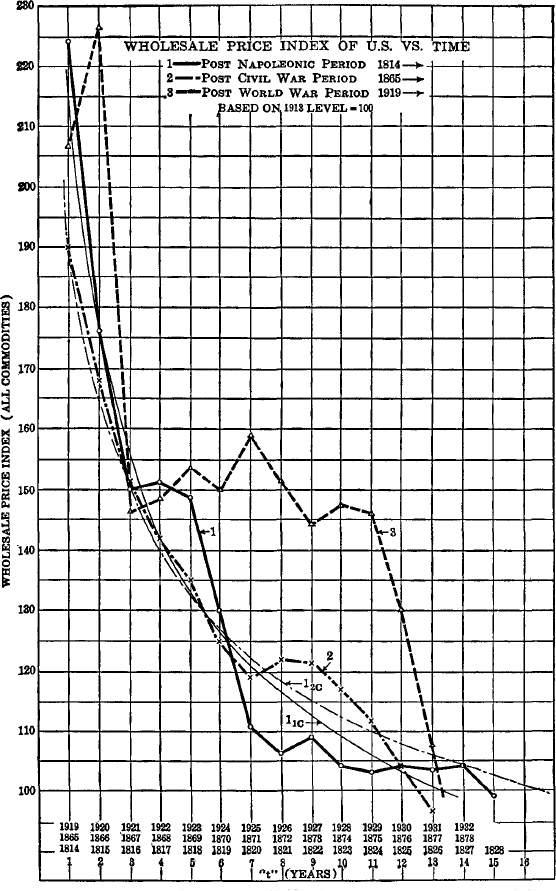
Source: The Annalist(August 26, 1932), Vol.40. No. 1023, P. 269. Reproduced by permission.
A comparison of the portion of the curve following 1818 in the first period and that following 1923 in the third period shows a very interesting variation. After the year 1818 there was first a sharp decline for two years followed by a very easy downward trend for the next eight years; whereas, after 1923 the index numbers first eased off very gradually for six years followed by a sharp decline in the last two years. In other words, the portions of the two curves discussed above, [i.e., in Chart VII] are in inverse relation to each other, and the area enclosed by the apparent parallelogram can very well represent a period of inflation. [Italics supplied.] The fact asserts itself that the longer the price level is held, the more violent the drop, and that the average time interval for the three periods approximates 13.6 years, compared to 13.7 calculated as a mean [theoretical] value from the first two recession periods.
BEARING OF CYCLE THEORY UPON CONTROL POLICY
The decisions of the Federal Reserve Board relative to these questions of policy necessarily must have been predicated upon some theory or theories of the business cycle. And had the Board subscribed to and recognized the importance of a really sound and comprehensive theory of the cycle it is possible that Federal Reserve policies would have been formulated along such different lines as largely to have outflanked the 1929 crash and the ensuing suffering and distress.
For no theory of credit control can be divorced successfully from a theory of the business cycle; and any policy of credit control will be influenced by the theory of the business cycle upon which it is based. This relationship between theory and policy is neatly stated by Hardy:25
No analysis of the business situation can be more adequate than is the theory of business fluctuations on which it is based. * * * If credit is to be regulated in accordance with the requirements of business stability, the administering authorities must have a sound and adequate knowledge of the conditions which foreshadow a business boom or a business collapse. They must understand the theory of the business cycle and be masters of the art of business forecasting. * * * The assumptions of the Tenth Annual Report are the assumptions of a certain type of cycle theory, which may be characterized briefly as the doctrine of over- and under-production. * * * The cause of the fluctuation is not necessarily to be found in the credit situation, but the credit system furnishes the key to its control. For, if the financing of a boom can be prevented, the conditions which engender the slump are avoided.
THEORETICAL FOUNDATIONS OF FEDERAL RESERVE POLICY
It appears, however, that the Board took cognizance not only of the “doctrine of over- and under-production” but also of the older form of monetary theory of the business cycle that assigns primary importance to the behavior of the price level. “The idea that this [Trade Cycle] theory must start from the wavelike fluctuations of the price-level, which are conditioned mainly by monetary causes; the rise, as well as the fall, of the price-level being brought about by particular new forces originating on the side of money”26 seems to have been at the bottom of the Board’s control policies. Perhaps it would be more accurate to say that the Board evidently had some regard for both doctrines when its management policies were taking form. At any rate, the inference seems clear that, in basing its control assumptions on a spurious theoretical foundation and by acting in accordance with those assumptions, the Board “produced” the investment boom and its inevitable deflation.
SOME INTERNATIONAL CONSEQUENCES OF “EASY MONEY” POLICY OF THE UNITED STATES
It was stated earlier in the present chapter that the Board’s policies also had international effects that were of far-reaching import. During the period of the ‘twenties when the United States was not only the most powerful commercial and industrial nation in the world, but also was in possession of the major portion of the stock of monetary gold of the world, our domestic developments and conditions were bound to influence the course of economic events in other countries.27 The Federal Reserve Board in its efforts to inflate purchasing power and to support the price level in this country helped indirectly, and no doubt unwittingly, to arrest the decline of prices in other important commercial nations and thereby served as a directing influence upon general economic conditions abroad.28
The credit inflation policies of the Federal Reserve Board, by flooding the local money markets with cheap Reserve credit, facilitated the successful flotation of huge foreign loans in the United States from 1922 to 1928. These foreign loans in turn stimulated an investment inflation abroad, notably in Germany and certain South American countries, similar to the investment inflation in this country. When the volume of foreign loan flotations in this country declined with the cessation of bank credit expansion during 1928 and 1929, the investment booms in the foreign countries came to an end, and with the decline in investment activity abroad prices in foreign countries began to fall rapidly. And when the stock market crash occurred shortly afterward in this country the attendant destruction of domestic purchasing power reacted on foreign countries in the form of a lessened volume of foreign trade.
As early as June, 1927, the effects of the Federal Reserve Board’s domestic credit policies upon the international situation were diagnosed by Professor Bertil Ohlin of Stockholm University as follows:29
The influx and efflux of gold in the United States has thus lost all influence upon the monetary purchasing power and the price level in that country. The question of granting credit is instead determined by what the Federal Reserve Board considers suitable from an economic point of view. This implies nothing less than a revolution in the monetary system not only of the United States but of all countries with a gold standard. The control of the development of the world price level has passed entirely into the hands of the Federal Reserve Board and Governors. * * * The post-war gold standard is * * * [a] kind of “managed currency,” in which the control is exercised by the Federal Reserve Board and the boards of the leading Federal Reserve Banks on the basis of considerations which have nothing to do with either gold cover or gold movements, but are dictated chiefly by the possibilities of keeping production going at full pressure.
To the extent that this viewpoint is defensible, it may be logically concluded that the control policies of the Federal Reserve Board were impregnated with responsibility not only for the recent upheavals in the United States, but also, indirectly, for certain aspects of the world-wide depression in trade and industry.30 The depression was more severe in this country largely because the impact of Federal Reserve control activities was more direct here, and because the inflation of bank credit was greater in the United States (after 1924, at least) than abroad.
Sight should not be lost of the fact, in assessing an appreciable measure of responsibility for recent conditions against the Federal Reserve Board, that the system of central banking constituted the medium through which such errors as were made by the Board were transmitted: responsibility for the depression does not rest solely upon the shoulders of the Board members. The depression was in a proximate sense a product of central bank credit expansion and was far more severe because of the introduction and operation of central banking in this country than it otherwise would have been. The Board’s part in the subsequent operation of that central banking system, however, cannot be passed over lightly.
CURRENCY MANAGEMENT THE OFFSPRING OF WAR FINANCE
As Colonel Ayres has said, it is not simply the fact of war itself which causes subsequent depression, but rather the fact that the price advance which accompanies a war financed by inflationistic measures determines the course of economic events in the post-war period.31 The heightened price level which was an aftermath of war financing made its influence felt upon all subsequent economic activity. Banking policy during the post-War years in this country was directed at stabilization of the price level; as there apparently was a persistent tendency for the price level to decline further from the abnormal height to which war financing had lifted it, in order to effect a temporary stabilization of the commodity price level it became necessary to force such large quantities of new credits into the system that inflation resulted in other important sectors of the price field. Hence this banking policy of “currency management,” of which the boom and the ensuing depression were direct consequences, may be said to have been sired by the inflated price level that was in turn the offspring of war finance.
POLICY OF STABILIZATION OF PRICE LEVEL TENDS TOWARD ITS OWN COLLAPSE
The statement has been made that there is nothing inherently objectionable about banking and credit control or management, as such, but that the authors were in disagreement with the objectives and extent of the control policies as exercised by the Federal Reserve Board during the period from 1922 to 1929. The endeavor has been to show that stabilization of the wholesale price level, or of any one price index, is not a proper objective of banking policy or of credit control, because aberrations continue to occur in the case of particular types of prices when any one index is sought to be stabilized. The remainder of the chapter will be devoted to a consideration of what is held to be a proper and desirable objective, goal, or guide for banking control activities.
Stability of the price level is no adequate safeguard against depression, it is contended, because any policy aimed at stabilizing a single index is bound to set up countervailing influences elsewhere in the economic system. Although the policy of stabilization may appear to be successful for a time, eventually it will break down, because there is no way of insuring that the agencies of control will be able to make their influence felt at precisely those “points” of strategic importance. As long as economic progress is maintained, resulting in increasing productivity and an expanding total output, there will be an ever-present force working for lower prices. Any amount of credit expansion which will offset that force will find outlets unevenly in sundry compartments of the economic structure; the new credit will have an effect upon the market rate of interest, upon the prices of capital goods, upon real estate, upon security prices, upon wages, or upon all of these, as happened during the late boom. A policy which seeks to direct credit influences at any single index, whether it be of prices, either wholesale or retail, or production, or incomes, in the interests of stabilization, will result in unexpected and unforeseen repercussions which may be expected to prove disastrous in the long run.32
Furthermore, the fruits of progress and the benefits of improved productivity in the form of lower prices for the products of industry tend to be denied to labor, and to the public in general, by a policy of stabilization, particularly of the commodity price level. Stabilization is, in fact, antithetical to progress; for progress connotes not only technical improvement, but also the diffusion among all classes of the benefits in the form of increased productivity that such improvement makes possible. Therefore it should not be an objective of banking policy to stabilize, or to “freeze,” the price level. Instead, the price level should be permitted to fall. In a progressive economy this downward tendency is “normal.”
Indeed, in a dynamic economy banking policy should not consciously be aimed at “freezing” anything. Any credit policy which has as its object the stabilization of any fluctuating index of economic conditions or economic activity necessarily involves increasing and decreasing the amount of outstanding credit in order to make that control effective. As the index sought to be stabilized rises, credit must be withdrawn; as the index shows a tendency to decline, new credit must be pumped out to forestall that threat. Yet not only is there no assurance that new credit (or the withdrawn credit) will affect only the index sought to be stabilized, but there is also no certainty that the timing of the control activities will be proper and well advised.
SUGGESTED GUIDE FOR CREDIT CONTROL
A sharply contrasting objective of banking policy, therefore, and the one here advocated, would be the control of the total amount of credit, such that the violent inflations and contractions of credit would be eliminated, or at least greatly mitigated, and without special regard for any one index of economic activity. The ideal aim of credit policy is, simply, that the rate of credit growth should be stabilized, so that the growth of credit proceeds at the same rate as the growth of population, in the vicinity of one per cent per annum for the United States. The rate of growth of population is undoubtedly the most constant of economic phenomena, one that is well known and predictable for a considerable number of years, and one whose secular trend is subject to verification every ten years by the census figures. As population increases, the amount of circulating media should increase pari-passu in order to accommodate in as frictionless a manner as possible the increase in total transactions engaged in by a growing number of people; thus, although the absolute amount of credit would be increasing, the amount relative to the population would not be. This would amount virtually to a constant money supply, and would approach the “neutral money” idea of Wicksell and Hayek; differentia exist between the concept of “neutral” money and the policy here advocated, however, which would consume too much space to point out in detail. All that is proposed here is that the total supply of credit be kept constant, subject to the one qualification of an increasing population; if population increases, credit should increase at the same rate; should the population become stabilized, the total amount of credit should remain unchanged.
Under such a credit policy money, or bank credit, would be able to perform effectively its proper function as a medium of exchange, but would no longer constitute an erratic, independent determinant of economic developments. It should mean the end of “forced saving,” and likewise of “windfall profits” in the sense employed by Keynes. Disequilibria between investment and saving would disappear, or else be of very short duration; the rate of progress of the economy would be determined exclusively by its rate of real saving. Indeed, the rate of progress itself should be more constant under such a policy, and the extent and rapidity of the changes in the structure of the productive process thereby considerably reduced; production would run more closely in accord with consumption. Adjustments among all the various economic phenomena should under such a stabilized rate of progress proceed more quickly and more surely; frictions and price rigidities should be overcome more readily, and therefore be less significant as disrupting influences.
OBJECTIVES OF POLICY OF STABILIZING RATE OF CREDIT GROWTH
The specific objectives of such a credit policy are two in number. The first objective is a substantial reduction in the severity and the extent of booms and depressions. If the boom can be prevented—and it cannot readily be seen how a system-wide boom can develop, if the principal contentions of the present analysis are correct, without the aid of rapidly expanding bank credit to create a disequilibrium between investment and saving—there will be no “stacking of the cards” in favor of a subsequent depression. No doubt we still would have some cyclical movement of business activity, but the cycles would be much less pronounced.
The second objective of this credit policy is a price level that would respond readily to increases in productivity resulting from technological advances. A price level changing only as a result of, and in consonance with, increased productivity should be a slowly falling one; and there is much to be said for a gradually declining price level.33 The rate of increase of the physical volume of production is a relatively constant economic phenomenon over long periods of time, barring periods of rapid emissions of bank credit and of deep depression. It is also an economic constant about which considerable knowledge now exists, and this knowledge is being extended each year.34 Almost fifty years ago Alfred Marshall advocated a gradually falling price level in his evidence before the Gold and Silver Commission Inquiry, from which the following excerpts are taken:35
* * * I think that one wants very much stronger statistical evidence than one has yet to prove that a fall of prices diminishes perceptibly and in the long run the total productiveness of industry. Supposing that it does not diminish considerably the total productiveness of industry, then its effect is, I think, on the whole good; because it certainly tends to cause a distribution of wealth better than that which we should otherwise have * * * when prices are falling, manufacturers are put on their mettle and exert themselves to the utmost to invent improved methods and to avail themselves of the improvements made by others * * * I doubt whether the influence exerted in this direction [in the direction of discouragement of enterprise by a slow and gradual fall] is very great. On the other hand, during such a fall a powerful friction tends to prevent money wages in most trades from falling as fast as prices; and this tends almost imperceptibly to establish a higher standard of living among the working classes, and to diminish the inequalities of wealth. * * * in fact I think it is not clearly established that a rise of prices is on the whole to be preferred to a fall.
Objections to Falling Price Level Examined
One objection to a falling price level which will immediately come to many minds is that large and undeserved benefits will accrue to the rentiers, the fixed-interest-receiving class, because when loans are repaid the lender will receive back a greater amount of purchasing power at the lower price level than he loaned at the former higher one. This will at the same time prove detrimental to the borrower, it is frequently argued, because he will have to pay back a greater amount of purchasing power than he borrowed; there is, in other words, an unearned increase in purchasing power for the lender which represents an equally undeserved hardship for the borrower. In answer to this objection it may be asserted that in the case of relatively short loans, five to ten years, say, the price-fall would not be great enough to result in any considerable advantaging of the lender or disadvantaging of the borrower; and in the case of longer-term loans, say forty to sixty years, the fall in the rate of interest which normally accompanies a secular fall in the price level will in large part offset any nominal improvement in the capitalist’s status. For a 6-per-cent loan repaid forty years in the future may have to be reinvested at 4 per cent, or even less. A sum of money loaned or invested in bonds, if substantial in amount, is ordinarily reinvested when repaid, rather than used subsequently for the purchase of consumption goods by the capitalist. Thus seeming gains and losses tend to cancel out in the long run; the seeming advantage accruing to the lender by virtue of the return of a larger amount of purchasing power is offset by the reduction in the interest rate if he reinvests, and the hardship on the borrower occasioned by the necessity of repaying in terms of more valuable dollars is counterbalanced by the more favorable terms on which he can obtain a new loan.
It is true that the interest payments during the years the bond is outstanding, if not reinvested, do represent an increase of purchasing power for the bondholder. But in this connection Sir Josiah Stamp points to a significant counter-consideration:36
What is desired is rather that the unit of purchasing power shall represent a consistent unit of human effort, and if that effort has more bountiful results, justice in distribution of the total product will be met if the proportions between people are not radically changed. In this sense it is not unfair that the bond holder who has lent the equivalent of two pairs of boots should receive when repaid forty years later, the equivalent of three pairs, if his claim on current production represents no higher proportion of the national product.
Yet at the same time that the price level was falling gradually in response to conditions of improving productivity, money wages would tend to remain stable. “For under such conditions, even though money wages are not reduced, a rising real wage-bill to employers does not mean a rising real labor-cost per unit of goods produced.”37 Stable money wages with increasing productivity would mean rising “real wages”; in this way the laboring classes would receive a constantly rising “real income,” and in a manner calculated to minimize labor disputes and industrial conflict. The benefits of the improved productivity would accrue directly to the laborer equally as much as to the capitalist, and inequalities of wealth and income, as Marshall suggests, would tend to be diminished. Furthermore, the increase in the real productivity of labor would in the long run be conducive to the shortening of hours of work, and this without the necessity of any legislative fiat promulgated with only scant regard for its implications and ultimate consequences. Labor would be enabled to obtain its fair share of an enlarging total product of industry; “real wages” would rise; and with rising real incomes would come a rise in the standard of living, including more leisure in which to enjoy the enhanced income.
Falling Prices Place Premium on Industrial Efficiency
Still a further benefit accruing to society as a whole from a gradually declining price level would be the more certain elimination of the unfit—only the most efficient entrepreneurs would be able to continue to produce with the price level falling, and the less efficient would more speedily be weeded out. The same might be true of some entire industries as well as of individual entrepreneurs. A premium would be placed upon industrial efficiency and rational management. “Pure” profits under such a situation would tend to approach the vanishing point. Even inefficient producers can make profits on a rising price level, which is one reason for the deep-rooted popular bias in favor of inflation. Rising prices and easy profits, however, generally stimulate the launching of new enterprises that are able to justify their existence only so long as prices continue to advance. The shrinking of business failures to a minimum at the same time that prices are rising is usually a storm signal for the economic system in the not-so-distant future. And the government is almost always, in the subsequent depression, importuned to “take care of” those rash adventurers who (with more credit than sense at their disposal) had rushed into those industries where soberer business judgment indicated the treading was not good.
STABILIZATION OF RATE OF CREDIT GROWTH WOULD TEND TOWARD EQUILIBRATION OF INVESTMENT AND SAVING
In support of a policy of credit control aimed at stabilizing nothing other than the rate of credit growth, additional arguments could be offered and further evidence adduced in favor of a gradually falling price level conditioned by technical advances and the resulting enhancement of productivity. Suffice it to emphasize in conclusion at this point, however, that the major benefit which should accrue from a banking policy directed toward stabilizing the per-capita rate of credit growth would be an equilibration of investment and saving, hence tending to eliminate, or at least to smooth, the business cycle. If the use of the banking machinery for the purpose of arbitrarily manufacturing new producers’ credits can be rigidly controlled, so that the rate of credit growth is kept both constant and slight, deviations of the market rate of interest should prove very small and of short duration: there should be a tendency toward an equilibration of the natural and the market rates of interest, thereby eliminating the one condition most potent in creating a disequilibrium of investment and saving. There should be a sufficiently prompt adjustment of the market rate to the natural rate so that any chance disequilibrium between the two would not persist long enough for appreciable disequilibrium between investment and saving to emerge. The rate of increase of investment would depend upon, and be directly limited by, the rate of saving; money (meaning bank money, or credit) would be used to facilitate the transformation of real savings into real capital equipment, and not to induce “forced saving.” If these disequilibria were cured, although wave-like movements of business activity might still persist, the amplitude of such movements should be severely reduced; the peaks and troughs of the waves need no longer be described as “booms” and “depressions”—there would be only self-correcting wavelets.
VELOCITY CHANGES AS A FACTOE AFFECTING BANK CEEDIT OR MANAGEMENT
One final possible objection remains to be touched upon. It is still contended by some that the velocity of circulation of credit is an independent force working for cyclical variations in trade and prices. We have already adverted to Carl Snyder’s studies showing that the rate of increase of trade over long periods of time is virtually a constant. And reference to Chart V will show that the velocity of circulation for cities outside of New York changes within rather narrow limits. It is Snyder’s further contention that velocity is also virtually a constant, at least in the absence of cyclical variations in trade.38 But Snyder holds, as do we also, that it is the wide variations in the volume of credit which produce the cyclical movements in business activity: if our contention that a constant credit supply would eliminate the disequilibrium between investment and saving is sound, then the swings in velocity would tend toward minima. For, as we have argued, if investment and saving are in equilibrium, then production and consumption, and all economic activity, will be in equilibrium. Under such conditions, there seems little reason to expect alterations in the velocity of circulation of an extent sufficiently appreciable to generate independent cyclical movements by themselves. Any changes in velocity which might develop would affect only trade, as such, and not constructional and investment activity. Velocity changes, it is here argued, originate in the violent swings in investment activity to which we have been accustomed in the past, and transmit themselves to trade and the consumers’ goods industries. Therefore, if this originating influence can be eliminated by bringing investment and saving into consonance with each other, the possibility of any wide swings in the velocity of circulation of credit should also be eliminated.
Conceding, however, that during the period when the credit control policy here being advocated is in process of realization there might be some rather marked changes in the velocity of circulation (particularly in consideration of the present low level of deposits turnover), there is no objection to attempts being made to mitigate any influence which velocity might exert in the direction of preventing the fulfillment of the objectives of that credit policy. As we have indicated, we are not opposed to the utilization of some degree of management within narrow limits. That the Federal Reserve Board will continue to employ discretion and judgment, in a word “management,” is to be expected. If it becomes necessary, in view of the judgment of the Board, to offset any seemingly independent cyclical influences produced by changes in the velocity of circulation of credit, then we feel that the Board should be free to exercise its own wisdom and discretion in attempting to correct this and other more or less similar disturbing influences. We believe, however, that such corrective action in the direction of expanding or contracting credit in order to offset velocity changes should at no time be extensive. Even small departures from a constant rate of credit growth should no doubt have rather rapid countervailing effects upon the velocity factor, and the more so as the policy of stabilization of the rate of credit growth becomes more effective in the future. It should not be necessary, in other words, to change the total supply of credit to the extent of 4,6, or 10 per cent within a given year to correct an antecedent change in velocity.
It may be inquired how such a banking policy could be realized in practice. The agency for control and the tools of administration of such control already exist. All that would be necessary would be the adoption of such a policy and adherence to it. Mistakes might be made in the early years of its application, but they should become progressively fewer and less serious. The Federal Reserve Board, with its control over member bank reserves through the rediscount rate and open-market operations, is already in large measure adequately implemented for the task of regulating the supply of credit; and with the control over member bank reserve ratios embodied in the Banking Act of 1935 a further instrument of control is made available to the Board, of which advantage has already been taken by the Board in increasing member bank reserve requirements on August 15, 1936.
39 The Economics of Overhead Costs (Chicago: University of Chicago Press, 1923), p. 406. And cf. Hayek, Monetary Theory and the Trade Cycle, p. 188: “It follows particularly from the point of view of the monetary theory of the Trade Cycle [here set out], that it is by no means justifiable to expect the total disappearance of cyclical fluctuations to accompany a stable price-level * * *”; and see Röpke, W., “Kredit und Konjunktur” (Jahrbücher für Nationalökonomie und Statistik, 3rd series, Vol. 69), p. 265, quoted by Hayek, ibid., p. 188: “* * * even if a stable price level could be successfully imposed on the capitalist economy the causes making for cyclical fluctuations would not be removed.”
40 Stabilization Hearings (69:1) (Washington: Government Printing Office, 1927), p. 307.
41 Ibid. (69:2), p. 550.
42 Proceedings, Federal Reserve Board, 1922, Part I, p. 103; quoted by Harris, Twenty Years of Federal Reserve Policy, Vol. I, p. 87.
43 Hearings on the Strong Bill, H. R. 7895 (Washington: Government Printing Office, 1927), p. 396.
44 A Treatise on Money, Vol. II, pp. 258–259.
45 Article on “The Trade Cycle,” Encyclopedia Brittanica, 14th ed., Vol. 22, p. 354.
46 The Stabilization of Prices (New York: The Macmillan Company, 1928), p. 125.
47 Reference in detail to aspects of the 1923 Report would consume too much space. It must be assumed that the reader is familiar, or at least acquainted, with that document. Brief reference should be made, however, to one or two significant statements therein, as well as to certain public statements of some of the Reserve officials to indicate the prevailing views entertained with respect to controlling credit conditions by the Reserve System. The tenor of the Tenth Annual Report may be gleaned from the following statements: “Under present conditions * * * discretion must inevitably play a larger role in central banking administration than in pre-war days” (p. 38), and, “The objective in Federal reserve discount policy is the constant exercise of a steadying influence on credit conditions” (p. 9). Dr. Miller of the Reserve Board made the statement (“Federal Reserve Discount Policy and the Diversion of Credit into Speculative Channels,” Trust Companies [November, 1925], Vol. XLI, No. 5, p. 590): “Almost from the day of their establishment, the Federal Reserve banks have had to form a larger conception of their functions in the country’s credit and economic system to steady credit conditions, to give at all times a firm basis of strength and health to the country’s credit organization so far as it lies in the power of the Federal Reserve, and through the wise and intelligent exercise of this function to give steadiness, stability and strength to underlying business conditions.” Dr. Burgess of the New York Bank in 1930 wrote (“Guides to Bank of Issue Policy,” Proceedings of the Academy of Political Science [January, 1930], Vol. XIII, No. 4, p. 511): “In fact, the history of Federal Reserve credit policy in recent years, as we look back on it, shows that the Federal Reserve System has in general exercised restraint at times of excess and has provided the stimulant of easy credit in times of deficiency.” It may be observed, parenthetically, that the policy of providing the stimulant has been followed more readily than that of exercising restraint.
48 See Sir George Paish, “Commercial Policy and the Gold Standard,” in Money and Credit in the Recovery Program, Proceedings of the Academy of Political Science (April, 1934), Vol. XVI, No. 1, p. 84.
49 Cf. Reed, H. L., Federal Reserve Policy, 1921-1930, pp. 7–8: “Rate changes are of a positive and emphatic nature * * * and they are not nearly so likely as open-market operations to signify merely cautious experimentation.”
50 Cf. Hayek, Monetary Theory and the Trade Cycle, p. 22: “It is probably to the experiment * * * that we owe the exceptional severity and duration of the depression. We must not forget that for the last six or eight years, monetary policy all over the world has followed the advice of the stabilizers.” Hayek was here referring to the 1927 “experiment”—the writers, as stated, are inclined to assess responsibility against all three experiments, those of 1922 and 1924 as well as that of 1927.
51 See below, p. 193 et seq.
52 “How Do We Want Gold to Behave?”, in The International Gold Problem (London: Humphrey Milford, 1932), p. 45. Publication of the Royal Institute of International Affairs.
53 Banking Policy and the Price Level, pp. 54–55. And cf. Hayek, Prices and Production, pp. 23–24: “Nevertheless, it is perfectly clear that, in order that the supply and demand for real capital should be equalised, the banks must not lend more or less than has been deposited with them as savings. And this means naturally that they must never change the amount of their circulation. At the same time, it is no less clear that, in order that the price level may remain unchanged, the amount of money in circulation must change as the volume of production increases or decreases. The banks could either keep the demand for real capital within the limits set by the supply of savings, or keep the price level steady; but they cannot perform both functions at once.”
54 Recent Economic Changes (New York: McGraw-Hill Book Company, 1929), Table 2, p. 101.
55 “It is true that our price level was comparatively steady from 1922 to 1929, but that fact is not proof that there was not some price inflation, relative to costs. It can be argued that but for credit expansion prices would have fallen, and that they should have done so. It was on such grounds that the Austrian economists predicted the depression.” Williams, J. H., in Gold and Monetary Stabilization, p. 149.
56 It should be noted that in 1924 the number of corporations reporting was 346,388, and in 1929, 398,815, which fact in itself would account for some part of the increase from 1924 to 1929.
57 Fraser, H. F., Great Britain and the Gold Standard (London: Macmillan & Company, 1933), p. 81.
58 Recent Economic Changes, pp. 632–633.
59 Monetary Theory and the Trade Cycle, pp. 123-124. Marshall had said somewhat the same thing in his Economics of Industry (London: Macmillan & Company, 1879), p. 156: “* * * a manufacturer * * * would not check his production on account of a fall in prices, if the fall affected all things equally * * *. If the price which he got for his goods had fallen by a quarter, and the prices which he had to pay for labour and raw material had also fallen by a quarter, the trade would be as profitable to him as before the fall. * * * The counters * * * would be less by one quarter, but they would purchase as much of the necessaries, comforts, and luxuries of life as they did before.”
60 “Thus a policy aiming at ultimate stability of the general price-level seems to be neither the ‘most natural’ nor the ‘most effective’ policy for the monetary authority to adopt.” Robertson, D. H., Banking Policy and the Price Level, p. 32. And, “Stable prices is a fetish,” Donald K. Kitchin, the London Times, June 20, 1933, p. xxiv.
61 For an expression of the view that a declining secular trend of prices was to be expected after the primary post-War deflation of 1920–1921, see John R. Commons’ article on “Price Stabilization” in the Encyclopedia of the Social Sciences, Vol. XII, p. 365.
62 Eade, Walter F., “Mathematical Analysis of Post-War Price Falls,” The Annalist (August 26, 1932), Vol. 40, No. 1023, p. 269. And compare the following: “It is safe to assert without qualification that the absolute level of commodity prices is not a reliable indication of the presence or absence of inflation. * * * To begin with, it is necessary to point out that the level of commodity prices is necessarily a relative matter. It is not enough to compare the absolute level of prices without taking into account the long-term trend, which is to say, the level which would exist in the absence of inflation. * * * With the foregoing in mind, the existence of stable commodity prices contemporaneously with marked inflation is readily explained. While prices have been stable or perhaps slowly declining into 1929 in absolute dollar units, they have quite probably been rising relatively to the price-level which would have existed in the absence of inflation.” Harwood, E. C, Cause and Control of the Business Cycle, pp. 79–83.
63 Credit Policies of the Federal Reserve System (Washington: The Brookings Institution, 1932), p. 87. See, also, Commons’ article on “Price Stabilization,” op. cit., supra, for a further expression of the view that no theory of price stabilization can be more adequate than the theory of the business cycle upon which it is predicated.
64 Hayek, F. A., Monetary Theory and the Trade Cycle, pp. 121–122.
65 “Our United States have become a prodigious power alike for production, for consumption, and in wealth and income of every sort. This is a commonplace; but it is still a little astounding to consider that we produce and consume almost as much of goods (and services) as all the rest of the commercial nations of the world put together. * * * It is therefore, our consumption, our buying, our prosperity, our financial conditions, which very largely determine not only our own economic and financial health, but also that of the whole world.” Carl Snyder, “Overproduction and Business Cycles,” Proceedings of the Institute of Finance (Occidental College, 2nd Session, 1931), p. 65.
66 “* * * our Federal Reserve Board is controlling the gold price level of the entire world.” Congressman Strong, in introducing his stabilization bill, H. R. 7895 (1927); and cf. Cassel, The Crisis in the World’s Monetary System, p. 13: “Thus the world’s monetary system had arrived at the rather peculiar situation that it was built on a common unit of value, the dollar, which, within wide limits, was determined arbitrarily by the American monetary authorities.”
67 Index, Svenska Handelsbanken (June, 1927), No. 18, pp. 7 and 9.
68 Cf. Carl Snyder, “Overproduction and Business Cycles,” Proceedings of the Academy of Political Science (June, 1931), Vol. XIV, No. 3, p. 338: “* * * I believe there is decisive evidence that it actually was conditions and disturbances in these United States which were largely responsible for this economic disaster [the world depression]. But these conditions appear to have been rather of a monetary and financial character—a saturnalia of speculation * * * “
69 See p. 36, supra.
70 “In a progressive economy, any attempt to stabilize the wholesale price-index number inevitably generates forces which must destroy stability.” Fisher, A. G. B., “Does an Increase in Volume of Production Call for a Corresponding Increase in Volume of Money?” American Economic Review (June, 1935), Vol. XXXV, No. 2, p. 210.
71 “In the opinion of the writer, there is no reason to suppose that absolute stability of the level of prices, whether wholesale or retail, should be the aim of currency policy. The tendency of increasing productivity should be in the direction of falling prices; and provided that prices do not fall at a rate greater than productivity increases, there is no reason to fear that industrial depression or unemployment will follow.” Gregory, T. E., article on “Money” in the Encyclopedia of the Social Sciences, Vol. X, p. 612; and see Hayek, Prices and Production, p. 89: “It would appear rather that the fall of prices proportionate to the increase in productivity, which necessarily follows when, the amount of money remaining the same, production increases, is not only entirely harmless, but is in fact the only means of avoiding misdirections of production.”
72 Mainly in consequence of the exceedingly valuable studies of Carl Snyder.
73 Alfred Marshall, Official Papers, p. 20 and pp. 91–92, and p. 19. And see the excellent article dealing with this whole subject by A. G. B. Fisher, op. cit.
74 Papers on Gold and the Price Level (London: P. S. King & Son, 1932), p. 30.
75 Robertson, D. H., “The Monetary Doctrines of Messrs. Foster and Catchings,” Quarterly Journal of Economics (May, 1929), Vol. XLIII, No. 3, p. 484. And see Hawtrey, R. G., Trade Depression and the Way Out (London: Longmans, Green & Co., 1933), p. 100: “To the argument that the collapse of the price level is not due to monetary causes, but is merely the natural consequence of the increased productivity made possible by technological progress, the answer is simple. In so far as the fall of prices is due to improved methods of production, no reduction of wages is required for the maintenance of equilibrium.”
76 Snyder, Carl, “The Problem of Monetary and Economic Stability,” Quarterly Journal of Economics (February, 1935), Vol. XLIX, No. 2, pp. 186–187, and 189: “Then in 1924 a renewed attempt [was made] at statistical proof of the Newcomb equation and a new formulation of that equation in the light of the newly found general synchronism of velocity and trade; that is, for ordinary times, at least, the equation of  , reduces to a simple equilibrium of M and P, allowing always for the very steady, secular or long-time growth of Trade * * * for if it be true that deposit velocity and trade activity tend generally to correspond (with some infrequent exceptions), then it is clear that neither the variations in velocity nor in trade activity are normally a factor in the determination of the price level. The only factors involved then would be the volume of the medium of exchange that is, in our day, so largely bank credit, and the long-time trend of trade growth.”
- 1Foreign Exchange Before, During, and After the War (London: Oxford University Press, 3rd ed., 1925), p. 9.
- 2Strategic Factors in Business Cycles (New York: National Bureau of Economic Research, 1934), p. 4.
- 3“The Problem of Business Cycles,” in the Skandinaviska Kreditaktiebolaget Quarterly Report, January, 1933, p. 3.
- 4Ibid., p. 3.
- 5Cassel, G., The Theory of Social Economy (New York: Harcourt, Brace & Co., 1932), p. 538.
- 6Strategic Factors in Business Cycles, p. 6.
- 7Journal of the Institute of Bankers (June, 1931), Vol. LII, Part VI, p. 236.
- 8“Depression has continued because there is no prospect of profitable investment. And why is there no prospect of profitable investment? Because costs, which by reason of the inflationary boom have become too high in relation to prices, have not been reduced.” Lionel Robbins, in Lloyds Bank Monthly Review (October, 1982), Vol. III (NS), No. 32, p. 432.
- 9“Loans and Taxes in War Finance,” American Economic Review Supplement (March, 1917), Vol. VII, No. 1, p. 200.
- 10Phillips, C. A., Bank Credit (New York: The Macmillan Company, 1920).
- 11“The view that bank deposits are potential currency is inapplicable to the deposits created in the Government’s War loan account.” Leffingwell, R. C. (Assistant Secretary of the Treasury during the War), “Treasury Methods of Financing the War in Relation to Inflation,” Proceedings of the Academy of Political Science (June, 1920), Vol. IX, No. 1, p. 32.
- 12Bankers and Credit, p. 48.
- 13Professor Jacob Hollander attributes priority to Professor A. C. Pigou (1915) and to Professor O. M. W. Sprague (1916); see his War Borrowing (New York: The Macmillan Company, 1919), pp. 157–158.
- 14War and Lombard Street (1914); Our Money and the State (1917); The Business of Finance (1918); War-Time Financial Problems (1919).
- 15Bankers and Credit, pp. 24–25.
- 16See Phillips, op. cit., Ch. III; and see Hayek, F. A., Monetary Theory and the Trade Cycle (New York: Harcourt, Brace & Co., 1932), Ch. IV.
- 17This is true as long as the amounts pass from bank to bank and are not withdrawn in cash and hoarded, or so long as they do not represent larger cash balances circulating in the hands of the public. But the above is intended to illustrate a principle rather than to arrive at a mathematical result. It seems hardly necessary to add that the process just described is the same as obtains when banks utilize excess reserves to grant loans to customers, instead of buying bonds, and as when banks buy bonds on the stock exchange, instead of subscribing to a new Government bond issue.
- 18“Since the outbreak of War it is the second procedure in the main which has been followed, the surplus cash having been used to subscribe for Treasury Bills and other Government securities. The money so subscribed has again been spent by the Government and returned in the manner above described to the bankers’ cash balances, the process being repeated again and again until each £10,000,000 originally advanced by the Bank of England has created new deposits representing new purchasing power to several times that amount.” First Interim Report of the Committee on Currency and Foreign Exchanges After the War (The Cunliffe Committee Report), Cmd. 9182 (1918), Paragraph 10, note.
- 19“* * * the fourth Liberty loan has been placed in a very large degree by the use of bank credit. Precisely how much such credit * * * is not yet certain * * *. In addition to this large use of direct bank credit is to be reckoned the fact that the bonds * * * have been taken by the banks as collateral to secure notes running for long periods * * *. These factors make not only for a serious condition of inflation but also for the maintenance and continuance of the inflation much longer than would otherwise be probable.” “Washington Notes” (unsigned), The Journal of Political Economy (December, 1918), Vol. XXVI, No. 10, pp. 977–978.
- 20Friday, David A., Profits, Wages, and Prices (New York: Harcourt, Brace and Howe, Inc., 1920), p. 133.
- 21See the Journal of the Royal Statistical Society (1931), Vol. XCIV, Part IV, p. 549.
- 22“Thus Europe raised our prices * * *.” Profits, Wages, and Prices, p. 139.
- 23“Unquestionably it was the impetus from Europe that started American prices on their upward course.” American Economic Review, Supplement (March, 1920), Vol. X, No. 1, p. 131.
- 24The average reserve requirements of all banks prior to the Federal Reserve Act are estimated to have been 21.09%; under the provisions of the original Act, 11.61%; and under the terms of the Amendment of June 21, 1917, 9.76%. See The Practical Operations of the Federal Reserve System, issued by the Federal Reserve Bank of Richmond, p. 243.
- 25Cf. the Report of the Committee on War Finance of the American Economic Association, The American Economic Review, Supplement No. 2 (March, 1919), Vol. IX, No. 1, pp. 96–97: “Recent improvements in our banking system, growing out of the establishment of the Federal Reserve System and its subsequent development, have made our reserve money * * * more efficient than it formerly was; in other words, have enabled a dollar in reserve to do more money work than before. This in effect is equivalent to increasing the supply of reserve money.” It has been calculated that if the requirements of the National Bank Act were in vogue December 31, 1924, member banks would have required $3, 200,000,000 more in reserves than they held to support the credit then outstanding (The Practical Operations of the Federal System, p. 238); and the Committee on Bank Reserves of the Federal Reserve System estimated that on the same basis in 1931 member banks would have needed $4, 400,000,000 of reserves instead of the $2, 900,000,000 actually held.
- 26Under the old system, when a bank’s reserve fell below the legal minimum it was prohibited by law from making additional loans; and if its reserve was exhausted it was declared insolvent. Under the new system, borrowing from the bankers’ bank is the equivalent of going into the reserve under the old system, but without any penalty; indeed, the process of borrowing serves to replenish, or add to, the borrowing bank’s reserve.
- 27It is also to be observed that henceforth the same twenty-nine-fold expansion is made possible in connection with each new influx of gold from abroad, whether the gold is deposited directly in the Federal Reserve Banks, or in commercial banks and by them redeposited in the Federal Reserve Banks.
- 28It should be stressed, once again, that this example demonstrates the possible maximum expansive power; that is, it is assumed that the entire excess reserve of the Federal Reserve Banks is employed for the purpose of supporting additional Federal Reserve Bank deposits, and hence creating additional reserve for the member banks. To the extent that this excess of 650 million dollars (assumed to be gold) is used to support issues of Federal Reserve notes, which cannot be counted as legal reserve by member banks, this expansive power is diminished. As a matter of fact, a substantial portion of the gold reserve of the Federal Reserve Banks has been used for this latter purpose.
- 29Keynes, J. M., Essays in Persuasion (London: Macmillan & Company, 1931), p. 77.
- 30Ibid., p. 78.
- 31London: J. M. Dent and Sons, Ltd., pp. 87–88.
- 32“Great wars are accompanied by prosperity and followed by depression. This is an ancient truth * * * but one which each new generation tends to forget.” Leonard P. Ayres, The Economics of Recovery (New York: The Macmillan Company, 1933), p. 15.
- 33“It is not the event of war * * * but rather the fact that great wars cause sudden and extreme advances in commodity prices. It is this sudden price advance which largely determines the nature and sequence of the business cycles of the following twenty years or so.” Ibid., p. 18.
- 34Economic Forecast and Reality, 1928-1932, p. 28.
- 35Alfred Marshall, Official Papers, p. 20 and pp. 91–92, and p. 19. And see the excellent article dealing with this whole subject by A. G. B. Fisher, op. cit.
- 36Papers on Gold and the Price Level (London: P. S. King & Son, 1932), p. 30.
- 37Robertson, D. H., “The Monetary Doctrines of Messrs. Foster and Catchings,” Quarterly Journal of Economics (May, 1929), Vol. XLIII, No. 3, p. 484. And see Hawtrey, R. G., Trade Depression and the Way Out (London: Longmans, Green & Co., 1933), p. 100: “To the argument that the collapse of the price level is not due to monetary causes, but is merely the natural consequence of the increased productivity made possible by technological progress, the answer is simple. In so far as the fall of prices is due to improved methods of production, no reduction of wages is required for the maintenance of equilibrium.”
- 38Snyder, Carl, “The Problem of Monetary and Economic Stability,” Quarterly Journal of Economics (February, 1935), Vol. XLIX, No. 2, pp. 186–187, and 189: “Then in 1924 a renewed attempt [was made] at statistical proof of the Newcomb equation and a new formulation of that equation in the light of the newly found general synchronism of velocity and trade; that is, for ordinary times, at least, the equation of , reduces to a simple equilibrium of M and P, allowing always for the very steady, secular or long-time growth of Trade * * * for if it be true that deposit velocity and trade activity tend generally to correspond (with some infrequent exceptions), then it is clear that neither the variations in velocity nor in trade activity are normally a factor in the determination of the price level. The only factors involved then would be the volume of the medium of exchange that is, in our day, so largely bank credit, and the long-time trend of trade growth.”
- 39In 1921, following the upheaval of prices which accompanied the primary post-War deflation, Professor T. E. Gregory, in writing on the situation then prevailing in the foreign exchanges, was moved to lament that:
- 40Thirteen years later, near the nadir of the Great Depression, Professor J. M. Clark wrote in like vein:
- 41Professor Gustav Cassel has said that “Our attention must now for a long time onwards be devoted towards a complete analysis of the upheaval now in progress.” The present study is directed to an inquiry into certain of the more fundamental aspects of major industrial fluctuations, and to the relationship of banking operations thereto, special reference being had throughout to the causes and relevant phases of the cycle beginning in the United States in 1922 and ending with the Great Depression. It is at the same time devoted to the formulation of a theory of business cycles—for “the present crisis is, in fact, a crisis also for the entire theory of business cycles.” The theory of business cycles here set forth, it is believed, is not only one which is applicable as a general explanation of depressions, but also one whose validity is particularly well illustrated by setting it against the background of the experience of the recent crisis. Accordingly, this theory of the cycle is correlated with the banking and financial situation in the United States during the post-War years into an explanation of the causes of the Great Depression.
- 42Professor Gustav Cassel has said that “Our attention must now for a long time onwards be devoted towards a complete analysis of the upheaval now in progress.” The present study is directed to an inquiry into certain of the more fundamental aspects of major industrial fluctuations, and to the relationship of banking operations thereto, special reference being had throughout to the causes and relevant phases of the cycle beginning in the United States in 1922 and ending with the Great Depression. It is at the same time devoted to the formulation of a theory of business cycles—for “the present crisis is, in fact, a crisis also for the entire theory of business cycles.” The theory of business cycles here set forth, it is believed, is not only one which is applicable as a general explanation of depressions, but also one whose validity is particularly well illustrated by setting it against the background of the experience of the recent crisis. Accordingly, this theory of the cycle is correlated with the banking and financial situation in the United States during the post-War years into an explanation of the causes of the Great Depression.
- 43“Causes” is used advisedly, it being “at once evident that no general or single theory is valid for so varying and varied a phenomenon as crisis.” And, as Professor Clark states, most “theoretical studies give us causes that are too few and too simple, such as over-production, under-consumption, over-saving, or failure to distribute to laborers their whole product or enough of the whole product of industry to enable them to buy the things they have produced.” The present apparent need is not for the propagating of novel theories, but rather for the orienting and synthesizing of extant knowledge.
- 44“Causes” is used advisedly, it being “at once evident that no general or single theory is valid for so varying and varied a phenomenon as crisis.” And, as Professor Clark states, most “theoretical studies give us causes that are too few and too simple, such as over-production, under-consumption, over-saving, or failure to distribute to laborers their whole product or enough of the whole product of industry to enable them to buy the things they have produced.” The present apparent need is not for the propagating of novel theories, but rather for the orienting and synthesizing of extant knowledge.
- 45As the depression has been denominated primarily a central banking phenomenon, it will also be desirable to attempt to unravel some of the changes caused in the structure, organization, and operation of the American banking system by the establishment of the central banking system represented by the Federal Reserve System. The special character of the depression is traced to the hyper-elasticity of the Federal Reserve System, and to the operation of that system as exemplified in the “managed currency” experiment of the Federal Reserve Board, working in opposition to what D. H. Robertson labels “the over-mastering tendency of prices to fall” after a war financed by inflationary measures. By virtue of that experiment, the Board succeeded in holding up the price level for a surprising length of time, but in so doing unwittingly aided in producing the boom and its consequent depression. The depression, in other words, was the price paid for the experimentation with currency management by the Federal Reserve Board during the period when the dislocations caused by war had not as yet been corrected and when the post-War deflation of prices had not been completed. Nor were the effects of this Federal Reserve Board action confined solely to the United States; the banking and industrial systems of leading commercial nations are interrelated so closely that the mistaken policy of one large central banking organization may be highly conducive to the precipitation of a world-wide depression.
- 46The boom is brought to an end, not only because of the restriction upon the supply of credit and purchasing power, but also because of the rise in the market rate of interest on new bond issues and other instruments of borrowing resulting from that restriction. Moreover, the realized rate of return on new capital development tends to fall in the later stages of a boom because of the fact that increases in wage rates gradually pare down the share going to capital. There ensues a general disequilibrium throughout the system, not only between wage rates and the cost of living, between costs and prices, and between production and consumption, but also a disequilibrium between investment and saving the reverse of that which prevails during the boom. As long as these general disequilibria persist, and as long as new investment in the sense of the production of new durable goods continues at a low ebb, depression continues.
- 47The World War was probably the worst-financed war in history from the viewpoint of sound fiscal policy. Less of the monetary costs of the War was financed by taxation and more by inflation of one form or another than any of the wars of the nineteenth century. Mr. Hartley Withers estimates that 17½ per cent of the cost of the War to England was covered by taxation, and Sir Josiah Stamp states that England’s showing in this respect was better than that of any other European belligerent. Elsewhere Stamp estimates that 63 per cent of the cost of the Napoleonic Wars to England was raised by taxation. The Report of the Committee on War Finance of the American Economic Association estimates the portion of World War costs covered by taxation in the United States at 25 per cent. As previously stated, all of the countries involved in the World War, with the exception of the United States, resorted to the age-old expedient of inflation of the note currency. But the United States, along with virtually all of the other nations, made use of that form of war financing which Mr. Withers denominates “quite the worst way of raising money for war or any other purpose” and which Professor 0. M. W. Sprague says is “the most potent single cause of the general advance in prices during periods of war,” namely, that of securing money from the banks either by issuing bonds directly to them for which they pay by creating new credits in favor of the Government, or by selling bonds to individuals who cover their subscriptions by borrowing from banks the credits that are newly created for this purpose. Such was the means by which the major portion of the monetary costs of the War was raised by all countries involved, and it is probably a safe assertion that it was employed on a more extensive scale than during any previous war. It is therefore desirable to inquire more fully into how the banking machinery was utilized to serve that end. In order to do so, however, it is necessary to set forth in some detail a particular point of banking theory which was neither understood nor recognized by writers on the subject until the period of War finance brought it into sharp relief.
- 48That banks “create” credit by granting loans has long been known and recognized. The precise nature of the process of creation of credit was not generally realized nor adequately analyzed, however, until after the termination of the World War. The correlative process of creation of bank credit, by means of purchases of investments on the part of the banks, is far from having universal recognition even today. It seems quite certain that some of those responsible for the way in which the War was financed in this country were not cognizant of the procedure by which it was done—they were, as Withers puts it, “making reckless use of a delicate machine which they did not understand and producing consequences which they neither foresaw nor recognized.”
- 49That banks “create” credit by granting loans has long been known and recognized. The precise nature of the process of creation of credit was not generally realized nor adequately analyzed, however, until after the termination of the World War. The correlative process of creation of bank credit, by means of purchases of investments on the part of the banks, is far from having universal recognition even today. It seems quite certain that some of those responsible for the way in which the War was financed in this country were not cognizant of the procedure by which it was done—they were, as Withers puts it, “making reckless use of a delicate machine which they did not understand and producing consequences which they neither foresaw nor recognized.”
- 50That banks “create” credit by granting loans has long been known and recognized. The precise nature of the process of creation of credit was not generally realized nor adequately analyzed, however, until after the termination of the World War. The correlative process of creation of bank credit, by means of purchases of investments on the part of the banks, is far from having universal recognition even today. It seems quite certain that some of those responsible for the way in which the War was financed in this country were not cognizant of the procedure by which it was done—they were, as Withers puts it, “making reckless use of a delicate machine which they did not understand and producing consequences which they neither foresaw nor recognized.”
- 51So far as is known to the writers, this process of the manufacture of credit on the part of the banks by purchasing investments was first discerned by Withers. In several books published during the War period he indicates an increasing understanding of it in connection with war finance. In his Bankers and Credit, however, published in 1924, he elaborates the theory most clearly, and it is appropriate to quote at some length from that work:
- 52So far as is known to the writers, this process of the manufacture of credit on the part of the banks by purchasing investments was first discerned by Withers. In several books published during the War period he indicates an increasing understanding of it in connection with war finance. In his Bankers and Credit, however, published in 1924, he elaborates the theory most clearly, and it is appropriate to quote at some length from that work:
- 53So far as is known to the writers, this process of the manufacture of credit on the part of the banks by purchasing investments was first discerned by Withers. In several books published during the War period he indicates an increasing understanding of it in connection with war finance. In his Bankers and Credit, however, published in 1924, he elaborates the theory most clearly, and it is appropriate to quote at some length from that work:
- 54The operation of the machinery of bankers’ banking made possible the creation of the greater portion of the credit by means of which both the United States and England financed the War. It was not the effect of such transactions as Withers describes that had the most significant influence upon prices in this country; rather, it was the superimposition of bankers’ banking upon the commercial banking structure that led to the compound creation of bank credit. For whenever bankers’ banking becomes operative, the inflationistic nature of commercial banking is greatly reinforced and accentuated. In the simplest possible illustration, in a banking system requiring a 10 per cent reserve against deposits, a bank having a reserve of one million dollars in excess of the required ratio may use that reserve to buy one million dollars worth of bonds, giving the Government deposit credit for that amount. As the Government draws checks against this deposit credit and pays them to government contractors, munitions makers, etc., and as they in turn deposit the checks in their (other) banks, the bank which originally bought the bonds tends to part company with cash—but that cash reappears as new, excess, reserve, for some other bank (or group of banks) in the system. The second bank in turn may now use 90 per cent of its new reserve to buy, let us say, $900,000 worth of bonds (it being required to set aside $100,000 to satisfy the requirement for a 10 per cent reserve against the deposit of the government contractors), and as the Government checks against the $900,000 deposit created in its favor in exchange for the bonds, the second bank (or group of banks) in turn tends to lose cash to a third bank (or group of banks) in the system. The third bank (or group of banks) may now use its new reserve of cash to buy $810,000 worth of bonds (90 per cent of $900,000 deposited with it) and to create $810,000 of Government deposits, and so the process is repeated again and again.
- 55As this is done, each bank in subscribing for bonds to the extent of 90 per cent of the amount deposited with it creates an equivalent increase in deposits either for itself or for other banks in the system, and it becomes clear that the original creation of credit ultimately makes possible manifold new deposits in the banking system. That is to say, the total credit created on the basis of the excess reserve originally utilized to buy bonds is not simply equal to the amount of that reserve, but is (for a system with a 10 per cent legal reserve ratio against deposits) roughly ten times that amount. The original one million dollars of excess reserve permits the creation of ten million dollars new deposits in the banking system. And to the extent that all banks in the system are possessed of excess reserves and use them simultaneously to buy bonds issued by the Government the expansion is more widespread and proceeds more rapidly. Thus it is seen that deposits are basically the offspring of loans and investments for the banking system as a whole.
- 56As this is done, each bank in subscribing for bonds to the extent of 90 per cent of the amount deposited with it creates an equivalent increase in deposits either for itself or for other banks in the system, and it becomes clear that the original creation of credit ultimately makes possible manifold new deposits in the banking system. That is to say, the total credit created on the basis of the excess reserve originally utilized to buy bonds is not simply equal to the amount of that reserve, but is (for a system with a 10 per cent legal reserve ratio against deposits) roughly ten times that amount. The original one million dollars of excess reserve permits the creation of ten million dollars new deposits in the banking system. And to the extent that all banks in the system are possessed of excess reserves and use them simultaneously to buy bonds issued by the Government the expansion is more widespread and proceeds more rapidly. Thus it is seen that deposits are basically the offspring of loans and investments for the banking system as a whole.
- 57The machinery of central banking was exploited indirectly to create credit with which to finance the War, moreover, when individuals subscribed to the bond issues and secured the funds with which to pay for the bonds by borrowing from the banks, pledging the bonds as collateral for the loans, provided the central banks were able and willing to make such advances to the local banks as would enable them to maintain adequate legal reserves. This process increased the deposits in the banking system as effectively as when the banks subscribed to the bond issues directly. It was encouraged and facilitated in the United States by the policies of the Treasury Department and the Federal Reserve Board, acting in cooperation under the leadership of Mr. William G. McAdoo in his dual rôle of Secretary of the Treasury and member of the Board. From this procedure, as in that first described, there ensued a great increase in purchasing power that was unaccompanied by an equal increase in production, and hence resulted in inflation.
- 58Dr. David Friday, in his book Profits, Wages, and Prices, professes not to understand this remarkable rise in the price level during the War period. Speaking of the American situation he says:
- 59Nevertheless, the thing is explainable according to the time-honored laws of economic theory; all that is necessary is to substitute bank credit for irredeemable paper. Bank credit in this day and age is more potent in determining the price level than are circulating notes, or irredeemable paper currency. As Mr. R. G. Hawtrey rightly points out, “It is not gold that controls money, but money that controls the value of gold. * * * Gold necessarily follows money; the idea that money follows gold is a fallacy.” Bank credit, as is generally known, now does 90 per cent or more of the money work of the country, and is the most important influence affecting the price level, and hence the value of money.
- 60Dr. Friday explains the rise in prices in this country as due to enlarged European demand for American goods for war purposes. Professor W. C. Mitchell states the same idea. It will be conceded that enhanced European demand had an appreciable tendency to raise prices in this country, but this alone is far from sufficient to explain the whole of the phenomenal increase. For it is significant that as late as September, 1915, after a year of European demand and after the influx of over three hundred million dollars in gold from abroad, the price level in this country still stood at 100 (with 1913 as the base year).
- 61Dr. Friday explains the rise in prices in this country as due to enlarged European demand for American goods for war purposes. Professor W. C. Mitchell states the same idea. It will be conceded that enhanced European demand had an appreciable tendency to raise prices in this country, but this alone is far from sufficient to explain the whole of the phenomenal increase. For it is significant that as late as September, 1915, after a year of European demand and after the influx of over three hundred million dollars in gold from abroad, the price level in this country still stood at 100 (with 1913 as the base year).
- 62In the first place, by the terms of the original Act the minimum average legal reserve requirements of member banks were reduced approximately 50 per cent from those prevailing under the old National Bank Act, thereby doubling possible credit in the banking system. A billion dollars in reserves which would support about five billion dollars of deposit credit under the terms of the National Bank Act could support about ten billion dollars of credit under the new reserve provisions of the Federal Reserve Act. Yet reserve requirements were further reduced after our entrance into the War by the Amendment of June 21, 1917, which also contained the highly important provision that from then on all lawful reserves of member banks should consist only of deposit credits on the books of the Federal Reserve Banks. The effect of this amendment, as well as the reduction of reserve requirements contained in the original Act, was to enhance the effective reserve base of the banking system, just as effectively as though gold reserves had been increased.
- 63In the first place, by the terms of the original Act the minimum average legal reserve requirements of member banks were reduced approximately 50 per cent from those prevailing under the old National Bank Act, thereby doubling possible credit in the banking system. A billion dollars in reserves which would support about five billion dollars of deposit credit under the terms of the National Bank Act could support about ten billion dollars of credit under the new reserve provisions of the Federal Reserve Act. Yet reserve requirements were further reduced after our entrance into the War by the Amendment of June 21, 1917, which also contained the highly important provision that from then on all lawful reserves of member banks should consist only of deposit credits on the books of the Federal Reserve Banks. The effect of this amendment, as well as the reduction of reserve requirements contained in the original Act, was to enhance the effective reserve base of the banking system, just as effectively as though gold reserves had been increased.
- 64Quite apart from the reduction in reserve requirements, however, a magnification of the reserve base came about simply as a result of the creation of a central banking system. This is because of the fact that a system of central banking operates to dilute cash, so that reserves in effect go further. In a system devoid of bankers’ banking, reserves consist of lawful money in the vaults of individual banks; in a system incorporating central banking, legal reserves for the member banks of the system exist simply as deposit liabilities of the bankers’ banks. When the Federal Reserve Act, and the amendment thereto of June 21, 1917, required the member banks to transfer their reserves to the Federal Reserve Banks they became reserves for the Reserve Banks, and the transfer gave rise to deposits to the credit of the member banks. These deposit liabilities owed the member banks by the Reserve Banks likewise assumed the rôle of reserves for the member banks. Against such deposits the Federal Reserve Banks were required to hold only a fractional reserve, amounting to but 35 per cent of the deposit liabilities. The difference of 65 per cent constituted free or excess reserves for the Reserve Banks, on the basis of which they could grant loans to the member banks, increasing the deposits of the latter with the Federal Reserve Banks. And as these increased deposits with the Federal Reserve Banks represented increased reserves for the member banks, the latter were able to increase their deposits by granting additional loans to their customers. Hence it is apparent that central banking is inherently inflationistic, at least during the period following its introduction, on account of the greater expansion of credit it makes possible on a given amount of reserves.
- 65Thus it is seen that, whereas the billion dollars in the vaults of the commercial banks supported a credit structure of 10 billion dollars (on the assumption of a 10 per cent reserve-deposit ratio), the same billion dollars may, as a result of the creation of the central banking system, support a credit structure of 29 billion dollars when transferred to the vaults of the Federal Reserve Banks. The superimposition of the system of central banking by and of itself thus virtually triples the possible expansive power of the banking system.
- 66This illustration assumes the existence of a 10 per cent reserve-deposit ratio for the commercial banking system. But it was not until the Federal Reserve Act came into effect that such an average reserve ratio legally obtained. The Federal Reserve Act increased the credit-creating possibilities of the commercial banking system in two distinct ways: it reduced average reserve requirements from about 20 per cent to about 10 per cent, thereby doubling the power of credit expansion, and it set up a system of central banking, which tripled this power. The real effect of the Federal Reserve Act, therefore, was to increase the credit expansion potentialities of the banking system not merely three-fold, but virtually six-fold. A billion dollars in reserves, which under the old system would support total deposits of five billion dollars, could under the new system theoretically support nearly six times that amount, or thirty billions. The full effect of the Federal Reserve Act was thus the same as though five billion dollars in new reserves had been acquired by the banking system.
- 67“Lenin is said to have declared that the best way to destroy the Capitalist System was to debauch the currency.” How close the capitalist system in America has come to destruction in consequence of the inflationary debauch of the currency indulged in during and since the War by the manufacture of deposit currency is as yet uncertain. For “it is a process that engages,” in the vivid language of Mr. J. M. Keynes, “all the hidden forces of economic law on the side of destruction, and does it in a manner which not one man in a million is able to diagnose.” The European countries achieved but little liquidation of credit during the 1920–1921 debacle, and several of them went on to further note currency inflation that reached astronomical heights. In the drastic, but brief, deflation of prices in 1920–1921 the United States did not complete the liquidation of inflated bank credit created during the War period: neither prices nor the structure of production and finance arrived at complete equilibrium relationships. The result was that the recovery following the immediate post-war depression rested on a foundation of prior inflation and upon a price level which could by no means be considered “normal.”
- 68“Lenin is said to have declared that the best way to destroy the Capitalist System was to debauch the currency.” How close the capitalist system in America has come to destruction in consequence of the inflationary debauch of the currency indulged in during and since the War by the manufacture of deposit currency is as yet uncertain. For “it is a process that engages,” in the vivid language of Mr. J. M. Keynes, “all the hidden forces of economic law on the side of destruction, and does it in a manner which not one man in a million is able to diagnose.” The European countries achieved but little liquidation of credit during the 1920–1921 debacle, and several of them went on to further note currency inflation that reached astronomical heights. In the drastic, but brief, deflation of prices in 1920–1921 the United States did not complete the liquidation of inflated bank credit created during the War period: neither prices nor the structure of production and finance arrived at complete equilibrium relationships. The result was that the recovery following the immediate post-war depression rested on a foundation of prior inflation and upon a price level which could by no means be considered “normal.”
- 69In a small volume published in 1916 entitled The Economy and Finance of the War, by Professor A. C. Pigou of Cambridge University, appears a significant passage:
- 70The origins of the Great Depression, then, go back to the War and the inflation produced by war financing, assisted in this country by the operations of the Federal Reserve System. Had the War not intervened, a depression of the character, severity, and duration of the recent one would not have ensued; once the War was undertaken, the depression became to a certain degree inevitable. At the same time, the pattern of the depression was shaped by Federal Reserve credit policy in the post-War years and by the secondary inflation of bank credit engendered by that policy. Federal Reserve policy, however, was undoubtedly conditioned by the disordered state of finance, production, and prices which the War left behind it—for as Stamp says, “most financial questions are affected by what has happened during the war, and what has happened in consequence since.” The chief evil legacy of the period of War finance was the inflated price level produced by the War inflation—for it was this inflated price level which was to influence all post-War banking and credit developments, and hence post-War economic events. During the years beginning with 1922 the Federal Reserve banking authorities embarked on a misguided attempt to prop up that price level artificially by a further inflation of bank credit, in consequence of which the War inflation was carried over to the depression which began in 1929. Hence the proximate cause of the depression was Federal Reserve banking policy following 1921 and the inflation of bank credit induced by that policy; the ultimate controlling influence was the War and the War-time inflation. Later chapters will deal with the way in which this post-War inflation, and the boom which resulted from that inflation, developed, and with the parts the banking system and banking policy played therein.
- 71The origins of the Great Depression, then, go back to the War and the inflation produced by war financing, assisted in this country by the operations of the Federal Reserve System. Had the War not intervened, a depression of the character, severity, and duration of the recent one would not have ensued; once the War was undertaken, the depression became to a certain degree inevitable. At the same time, the pattern of the depression was shaped by Federal Reserve credit policy in the post-War years and by the secondary inflation of bank credit engendered by that policy. Federal Reserve policy, however, was undoubtedly conditioned by the disordered state of finance, production, and prices which the War left behind it—for as Stamp says, “most financial questions are affected by what has happened during the war, and what has happened in consequence since.” The chief evil legacy of the period of War finance was the inflated price level produced by the War inflation—for it was this inflated price level which was to influence all post-War banking and credit developments, and hence post-War economic events. During the years beginning with 1922 the Federal Reserve banking authorities embarked on a misguided attempt to prop up that price level artificially by a further inflation of bank credit, in consequence of which the War inflation was carried over to the depression which began in 1929. Hence the proximate cause of the depression was Federal Reserve banking policy following 1921 and the inflation of bank credit induced by that policy; the ultimate controlling influence was the War and the War-time inflation. Later chapters will deal with the way in which this post-War inflation, and the boom which resulted from that inflation, developed, and with the parts the banking system and banking policy played therein.
- 72The foregoing analysis of the course of the business cycle, largely theoretical in nature as it is, not only fits the course of events in this country from 1922 to 1929, and after, but embodies, it is believed, the explanation of the fundamental causes of the depression. No attempt will be made to review further the innumerable historical details from which might be gathered much factual evidence in support of the theory. The purpose here is not so much to provide an historical picture of the development of the boom and the subsequent depression as to seek the deeper, underlying, and fundamental causes of the depression itself. The historical factual material was being carefully observed by students of cyclical patterns, but to little benefit, since most American observers were thoroughly misled by what actually occurred. It was the use of the theory on which the foregoing explanation is based, or one markedly similar, on the other hand, that enabled Hayek to predict in April of 1929 the approach of the crisis in this country, and Åkermann, with better timing even than Hayek, to write on the first day of October, 1929,
- 73The second objective of this credit policy is a price level that would respond readily to increases in productivity resulting from technological advances. A price level changing only as a result of, and in consonance with, increased productivity should be a slowly falling one; and there is much to be said for a gradually declining price level. The rate of increase of the physical volume of production is a relatively constant economic phenomenon over long periods of time, barring periods of rapid emissions of bank credit and of deep depression. It is also an economic constant about which considerable knowledge now exists, and this knowledge is being extended each year. Almost fifty years ago Alfred Marshall advocated a gradually falling price level in his evidence before the Gold and Silver Commission Inquiry, from which the following excerpts are taken:
- 74It is true that the interest payments during the years the bond is outstanding, if not reinvested, do represent an increase of purchasing power for the bondholder. But in this connection Sir Josiah Stamp points to a significant counter-consideration:
- 75Yet at the same time that the price level was falling gradually in response to conditions of improving productivity, money wages would tend to remain stable. “For under such conditions, even though money wages are not reduced, a rising real wage-bill to employers does not mean a rising real labor-cost per unit of goods produced.” Stable money wages with increasing productivity would mean rising “real wages”; in this way the laboring classes would receive a constantly rising “real income,” and in a manner calculated to minimize labor disputes and industrial conflict. The benefits of the improved productivity would accrue directly to the laborer equally as much as to the capitalist, and inequalities of wealth and income, as Marshall suggests, would tend to be diminished. Furthermore, the increase in the real productivity of labor would in the long run be conducive to the shortening of hours of work, and this without the necessity of any legislative fiat promulgated with only scant regard for its implications and ultimate consequences. Labor would be enabled to obtain its fair share of an enlarging total product of industry; “real wages” would rise; and with rising real incomes would come a rise in the standard of living, including more leisure in which to enjoy the enhanced income.
- 76One final possible objection remains to be touched upon. It is still contended by some that the velocity of circulation of credit is an independent force working for cyclical variations in trade and prices. We have already adverted to Carl Snyder’s studies showing that the rate of increase of trade over long periods of time is virtually a constant. And reference to Chart V will show that the velocity of circulation for cities outside of New York changes within rather narrow limits. It is Snyder’s further contention that velocity is also virtually a constant, at least in the absence of cyclical variations in trade. But Snyder holds, as do we also, that it is the wide variations in the volume of credit which produce the cyclical movements in business activity: if our contention that a constant credit supply would eliminate the disequilibrium between investment and saving is sound, then the swings in velocity would tend toward minima. For, as we have argued, if investment and saving are in equilibrium, then production and consumption, and all economic activity, will be in equilibrium. Under such conditions, there seems little reason to expect alterations in the velocity of circulation of an extent sufficiently appreciable to generate independent cyclical movements by themselves. Any changes in velocity which might develop would affect only trade, as such, and not constructional and investment activity. Velocity changes, it is here argued, originate in the violent swings in investment activity to which we have been accustomed in the past, and transmit themselves to trade and the consumers’ goods industries. Therefore, if this originating influence can be eliminated by bringing investment and saving into consonance with each other, the possibility of any wide swings in the velocity of circulation of credit should also be eliminated.

