
Banking and the Business Cycle
VI. The Fundamental Causes of the Great Depression
It has been asserted (Chapter IV) that fluctuations in the rate of creation of fixed capital are the dominant feature of the business cycle. It was also stated that the source of fluctuations in the rate of investment was the elasticity of the banking system, what Hawtrey labels “the inherent instability of credit.” A highly important result of an exceptional increase of investment is the misdirection of capital which characterizes a boom period, the setting of the stage for future depression. The present chapter, which is directed toward the task of developing a generalized theory of business cycles, as well as to an explanation of the causes of the Great Depression, centers the cycle in a disequilibrium between investment and saving, and sets forth the cause of that disequilibrium as residing in the capacity of the banking system to generate lending power at a rate in excess of the growth of voluntary saving.
DEVELOPMENTS IN BUSINESS CYCLE AND MONETARY THEORY
If the explanation of the causes of the depression and the theory of business cycles here set forth seem to follow closely those theories of the “Trade Cycle” advanced by Hayek and Keynes it is simply because the writers agree with Professors Hansen and Tout that the contributions of these men represent “the most signal recent developments of business cycle and monetary theory.”1 Developed on the Continent by members of the New School of Vienna, principally Mises, Hayek, and Haberler, on the foundations pointed out by the Swede, Knut Wicksell, this theory was also being formulated in the writings of D. H. Robertson and J. M. Keynes in England, largely independently of knowledge of the work of the Austrian writers. It is found most fully developed in Keynes’ Treatise on Money and in Hayek’s Monetary Theory and the Trade Cycle and his Prices and Production (which, as Hayek properly states, are to be considered as complementary expressions of his theory). Mention must also be made of Robertson’s concise, but difficult, Banking Policy and the Price Level (Keynes awards full credit to Robertson for influencing his own thinking along these lines), and of Mises’ Theory of Money and Credit.2
Although the attempt to resolve the problem of the business cycle in the divergences of investment and saving that are largely traceable to the operation of the banking system explains certain features of the last cycle for which the exclusively monetary forms of explanation are not adequate, not all of the refinements of Keynes’ and Hayek’s analyses are acceptable. And bearing in mind that the principal aim of the present work is an explanation of the depression, there are certain dissidences between the theory developed here and those of both of these men. The similarities will be apparent to readers at all conversant with their views, however, and the indebtedness of the authors will be obvious.
AN INTEGRATED EXPLANATION
Any attempted explanation of the recent depression in the United States should not only be concerned with its causes but should also seek to explain why it has been of such unprecedented amplitude. The theory here advanced departs from those of the above-mentioned writers principally in the greater emphasis it places upon the introduction and subsequent functioning of a system of central banking in the United States, and upon the banking and credit policies of the Federal Reserve Board as they found expression in the operation of that system. For the rôle played by the Federal Reserve System is at the heart of the explanation of the boom, as well as of the duration of the ensuing slump, and the policies of the Board as expressed in the System’s operation are intimately connected with that explanation.
From this standpoint, the theory here developed may be called a “central banking” explanation of the depression. The depth and duration of the depression are held to be the ineluctable consequences of the preceding boom. That boom could never have lasted as long as it did, nor could it have assumed the proportions it attained, under the old National Banking System. The boom and depression were therefore proximately caused by central bank credit expansion.
In its more general aspects, however, the explanation here given might perhaps best be described as an eclectic theory of the business cycle. For an attempt is made to relate the various “real” or structural aspects to those monetary phenomena which together form the cycle (money here being used in the wide sense to include bank credit, or what Robertson and Keynes call Bank Money). Further, a rapprochement of these two (the “structural” and the monetary) explanations with that known as the equilibrium view of business cycles is sought. The integration does not extend to the inclusion of those eleven factors which Professor Clark calls “strategic” ones, nor yet so far as Sir Josiah Stamp’s “eighteen valid, but not always universal, causes,” nor are many of Irving Fisher’s “nine main causes” incorporated. Rather, the concern here is with those consistently fundamental or basically causal factors, the monetary and the non-monetary phenomena. The non-monetary factors take their form principally in an expansion of the creation of real capital, or investment activity, and result in a loss of equilibrium, while the monetary factors serve to explain how the increase of investment which brings about the loss of equilibrium has its start. Indeed, the object is not so much to explain the influence of isolated factors as it is to integrate three separate or particularistic theories into one consistent explanation of the entire cycle of boom and depression.
DOMINATING EXPLANATORY CONSIDERATIONS
Briefly stated, the dominating argument of the present chapter is devoted to a consideration of the importance of investment3 in the modern exchange economy and its relation to the recent boom and depression; to the disequilibrium between the rate of capital creation (investment) and the rate of accumulation (voluntary saving); to the rôle of the rate of interest, as expressed both in the “natural” rate of interest and the “market” rate of interest, in contributing to the disequilibrium between investment and saving; to the part played by profits; to the general lack of equilibrium throughout the whole economic system precipitated by the disequilibrium between saving and investment, and the importance of this general loss of equilibrium in prolonging the depression; and to the rôle of the banking system in producing the fluctuations of the market rate of interest about the natural rate, making possible the creation of real capital in advance of the rate of voluntary saving, and thereby originating the disequilibrium in the first instance. Finally, the importance of the stock market crash of 1929 (both in its aspects as the immediately precipitating cause of the ensuing depression and in its effects as a factor contributing to the continuing stagnation), the significance of rigidities in the price-cost-wage structure, and the relation of the banking system’s difficulties after 1929 to the continuance of depression, are subjected to scrutiny and analysis.
COMPLEXITY OF PBESENT-DAY COMPETITIVE ECONOMIC ORDER
Many writers have emphasized the connections between the increasing severity of business cycles and the evolution of our modern competitive, free-enterprise, price-profitexchange economic order. With the growth of indirect exchange the pricing system has become more complicated, and division of labor has become more extensive. And concurrently with the increased division of labor, the Industrial Revolution introduced the roundabout, capitalistic, time-consuming process of production, which hit full stride in the last quarter of the nineteenth century. Division of labor necessarily implies a considerable time-interval between the first stages of production and the final emergence of consumable goods. And the growth of transportation facilities, by greatly broadening market areas, itself contributed to more intensive specialization and wider geographical division of labor.
INHERENT DISEQUILIBRATING FORCES
But this very complex organization of the modern competitive-exchange order contains certain inherent disequilibrating factors. Production being for the market, which is typically an impersonal and distant one—distant not only spatially but also in point of time—the entrepreneurs in a competitive-exchange economy cannot possibly have complete foreknowledge of the demand conditions for their products. Production, therefore, cannot possibly be adjusted perfectly to the demands of consumers; not only must each producer guess as best he can what and how much consumers desire, but he must also endeavor to adjust his plans to the actions of his competitors. Uncertainty is a necessary concomitant of the roundabout, time-consuming, capitalistic process of production. If production could always be exactly proportioned to consumption there would be but scant opportunity for dislocations to arise.
It is an empirically verifiable fact, however, that production does not run such an even course as consumption. And it is this very fact, coupled with the inherent “roundaboutness” of capitalistic production, tending to develop time lags between cause and effect, which is one of the contributing factors in the oscillatory swings of business which we have come to call the cycle. The time lags in themselves go a long way towards explaining this tendency to oscillation, or wave-like movements of the volume of production. The economic situation might be likened to that of a steam heating plant thermostatically controlled: this seems a more realistically comparable analogy in the realm of the physical than the frequently utilized illustration of the pendulum. Time lags do not play an important part in the behavior of a pendulum; although its swings are oscillatory, the arc is fixed, and the reversals are calculable and almost instantaneous. Not so in the case of the thermostat: as the temperature falls, and more fuel is added, the initial effect is simply to drive the temperature even lower by temporarily stifling the free-burning fire. As the new fuel eventually takes effect in the form of increased heat, however, a tendency to force the temperature upward to a greater degree than was intended becomes apparent, and the thermometer moves above the desired point of equilibrium.4
Oscillation Greatest in Capital Goods Industries
Now the chief industries in which the time lags are most apparent and those in which the tendency to oscillation is greatest are those which make the capitalistic process of production what it is—those which are engaged in adding to the stock of capital goods, to the creation of fresh “tools” of production, generally known as the instrumental or constructional industries, or producers’ goods industries. These are also the industries, it should be emphasized, which produce the lack of balance for the productive system during boom and depression. Indeed, it is scarcely too much to say that the fluctuations in the production of capital goods are the business cycle—they are at least the counterweight, the balance wheel, determinative of the fluctuations in the general volume of production.5
As early as 1872, Jevons pointed out that: “It [the cause of commercial fluctuations] seems to be in the varying proportion which the capital devoted to permanent and remote investment bears to that which is but temporarily invested soon to reproduce itself.”6 And an American business man and engineer long connected with the iron and steel and construction industries, George H. Hull, wrote in 1911, 7 “The difference between periods of prosperity and periods of depression is chiefly * * * a decrease in the rate of production of permanent wealth, such as buildings, railways, ships, goods, materials, etc.” Similar statements could be multiplied at length, 8 for it is now generally recognized by those properly conversant with the problem of business cycles that it is these fluctuations in the production of capital goods which constitute the chief characteristic of the modern business cycle. But to describe the most typical feature of the cycle does not in itself serve to explain the cause of the fluctuations. The aim here is to explain the interdependence of these various structural, or “real,” phenomena connected with the fluctuations in capital goods production with those monetary causative factors which are usually neglected by those writers who concentrate their attention upon the fluctuations in the production of producers’ goods, without endeavoring to analyze the causes of the fluctuations.
The technical fact, then, that the time lags just discussed are most pronounced in the producers’ goods industries helps explain the fundamental rhythmic character of the progress of the productive process. There is an obvious reason why this is so. The construction of plants and equipment for the purpose of manufacturing consumption goods is several steps farther away from the consumers’ demands than the processes of making those consumers’ goods, and is therefore more subject to miscalculations. Unfortunately, as Keynes points out, 9 the statistics on the production of new capital goods are incomplete. There are certain categories of producers’ goods that are sufficiently representative, however, for which the relevant statistics of production are comprehensive enough to be considered as indicative of major tendencies.
PRODUCTION OF IRON AND STEEL AS “TRADE” BAROMETERS
The production of pig iron, for instance, is a partial indicator of the production of fixed real capital, and pig iron production has been called “the barometer of trade” on account of its use in all types of construction activity and in the production of machinery. Cassel states of it that, 10 “When we consider all the uses of iron, we see clearly that it is not only unequivocally the most important material of fixed capital, but is so generally used as such that * * * the annual production of iron may therefore be taken as a measure of the annual production of fixed capital.” The following table gives the figures for the physical volume of pig iron production around the significant turning-points in the last three major depressions prior to the Great Depression.
TABLE XV
PRODUCTION OF PIG IRON AT VARIOUS DATES
(In Thousands of Long Tons)
| 1871—1,665 | 1891—8,280 | 1904—16,497 |
| 1872—2,549 | 1892—9,157 | 1905—22,992 |
| 1873—2,561 | 1893—7,125 | 1906—25,307 |
| 1874—2,401 | 1894—6,657 | 1907—25,781 |
| 1875—1,869 | 1895—5,329 | 1908—15,936 |
Source: Burns, A. R., Production Trends in the United States (New York: National Bureau of Economic Research, 1934), Table 44, p. 294.
TABLE XVI
PRODUCTION OF PIG IRON AND OF STEEL, 1919–1932
(In Thousands of Long Tons)
| YEAK | PIG IRON | STEEL |
| 1919 | 31,015 | 34,671 |
| 1920 | 36,926 | 42,133 |
| 1921 | 16,688 | 19,784 |
| 1922 | 27,220 | 35,671 |
| 1923 | 40,361 | 44,944 |
| 1924 | 31,406 | 37,932 |
| 1925 | 36,701 | 45,394 |
| 1926 | 39,373 | 48,296 |
| 1927 | 36,566 | 44,935 |
| 1928 | 38,156 | 51,544 |
| 1929 | 42,614 | 56,433 |
| 1930 | 31,752 | 40,699 |
| 1931 | 18,426 | 25,945 |
| 1932 | 8,781 | 13,681 |
Source: Burns, op. cit., p. 296.
The production of pig iron and of steel during more recent years, covering the period from 1919 and including two major depressions as well as two minor cyclical dips (1924 and 1927), is shown in Table XVI. The figures for the production of steel have been added because it has come to assume an even greater importance than pig iron in the production of capital goods. It will be readily apparent from an inspection of these tables that the output of pig iron and of steel reaches a peak just before the downturn of the cycle, and then declines drastically during the ensuing depression.
The distinguishing objective characteristic of boom periods, then, is an accelerated rate of growth of investment in fixed real capital. The boom of the ’twenties was marked by even greater investment activity than previous ones.11 The growth of steel production in the United States from 1921 to 1929 shows an annual average (arithmetic) increase of 35 per cent, which is considerably greater than Åkermann’s comparable figure for the rate of growth of world steel production.
CONSTRUCTIONAL ACTIVITY IN UNITED STATES DURING PRE-DEPRESSION PERIOD PRODIGIOUS
Of the absolute volume of fixed real capital produced during this period as represented by construction, Keynes has the following to say:12
Let us consider the United States first, because the United States has held throughout the key position. The investment activity in this country was something prodigious and incredible. In the four years 1925–1928 the total value of new construction in the United States amounted to some $38,000,000,000. This was—if you can credit it—at the average rate of $800,000,000 a month for forty-eight months consecutively.
This figure is virtually twice the supposed present value of all of the American railroads, and represents an amount in dollars almost half the market value of all the stocks listed on the New York Stock Exchange in 1929.
CHART II
Source: The Annalist (January 19, 1034), Vol. 43, No. 1096, p. 103. Reproduced by permission.
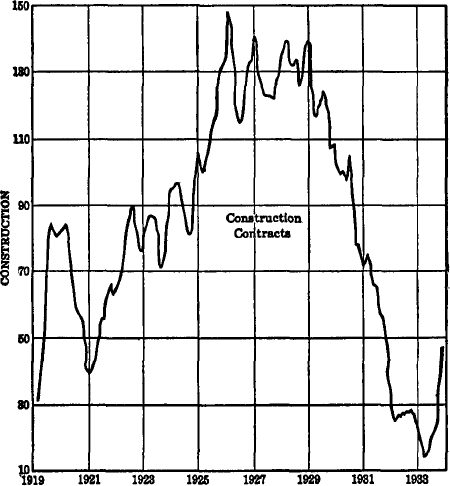
The behavior or course of construction activity (as represented by construction contracts awarded) during the recent boom and depression is shown in Chart II, using index numbers based upon monthly averages for 1923–1925 as 100. It may be observed that the index rose by more than 100 points from 1921 to 1926, and declined 120 points from 1929 to 1933.
PRODUCTION OF MACHINE TOOLS AN INDICATOR OF VARIATIONS IN PRODUCTION OF CAPITAL GOODS
The production of machine tools is another valuable indicator of the fluctuations in the production of capital goods. Machine tools represent what may almost be called capital in pure form, the real “produced means of production.” J. M. Clark in his Strategic Factors in Business Cycles says that the correlation of machine tool production with the business cycle is “virtually perfect” (p. 230); the League of Nations publication World Production and Prices, 1925–193213 states (p. 66): “The mechanical engineering industry of the United States has suffered more than that of any other country; and, further, it has suffered more than any other American industry.” The index of machine tool orders published in the Survey of Current Business14 (1922–1924 monthly average as a base of 100) declined from a high of 336 in February, 1929, to a low of 13 in February, 1933—a decline of 96 per cent.
Production of Consumption Goods Relatively Stable
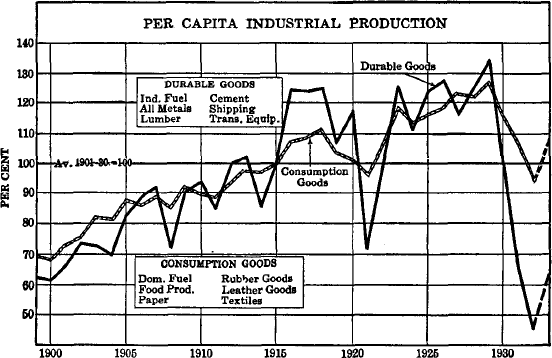
It is to be observed, furthermore, that the production of consumption goods is not subject to the violent fluctuations characterizing the production of capital goods. Consumption tends to be maintained relatively well even in severe depressions, at least as compared with the alterations in the production of capital goods. The conditions during the eight-year period, 1925–1932, with respect to the production of consumption goods and of goods constituting fixed real capital, or producers’ goods, are indicated in the following table.
TABLE XVII
COMPARATIVE PRODUCTION OF PRODUCERS’ AND CONSUMERS’ GOODS IN UNITED STATES
(1925–1929 average = 100)
| 1925 | 1926 | 1927 | 1928 | 1929 | 1930 | 1931 | 1932 | |
| Producers’ Goods | 93 | 99 | 92 | 104 | 113 | 83 | 54 | 29 |
| Consumers’ Goods | 97 | 97 | 102 | 100 | 104 | 88 | 89 | 82 |
Source: World Production and Prices, 1925–1932, p. 56.
The comparative behavior of production goods and consumption goods is shown graphically in Chart III, which also serves to portray what Pigou calls the “stair-step” movement of consumption goods. The output of producers’ goods was lower in 1932 than at any time during the present century, while the output of consumers’ goods declined in that year to a point only slightly below that prevailing in the 1920–1921 depression and but very slightly lower than the 1901–1930 average. Fluctuations in consumers’ goods production are obviously induced by fluctuations in producers’ goods production.
CHART III
Source: The Cleveland Trust Company Bulletin (August 15, 1933), Vol. 14, No. 8. Reproduced by permission.
DISPARITY BETWEEN INVESTMENT AND SAVING CAUSES CYCLICAL SWINGS IN BUSINESS ACTIVITY
Now, it can hardly be said with any great degree of conviction that the rate of increase of public saving is subject to such vacillations as are exhibited by the fluctuations of investment indicated by the above historical data on the rate of capital development, imperfect as the evidence may be. The habits of persons with respect to voluntary saving are relatively fixed and unchanging, except possibly over such long periods of time that they may be disregarded for the purposes of a discussion restricted to such a relatively short-run phenomenon as the business cycle. In an economy marked by a relatively uniform rate of progress, it may be assumed that the rate of public saving approximates fairly closely to that rate of progress: as Cassel states, 15 “in the uniformly progressive exchange economy, the total income as well as both its parts—consumption and capital accumulation—increases in the same percentage as the capital.”
If, then, there occur oscillations in the rate of capital accumulation which are not in consonance with the rate of saving (it is public or “real” saving that is now under consideration) it follows logically that it is the disequilibrium between investment and saving which causes the cyclical oscillations in business activity. If the rate of capital development always coincided with the rate of saving, it is hardly conceivable that business cycles of the character and severity to which we are accustomed would occur. A constant rate of capital formation and a constant rate of saving are mutually determinative of equilibrium—not only must there be, in a condition of equilibrium, a coincidence of the rate of capital accumulation and the rate of saving, but, when those conditions are present, equilibrium will result.
This, however, in no wise explains why and how disequilibrium between the rate of capital accumulation and the rate of saving may arise. It is therefore necessary to inquire into the genesis of such maladjustment.
GENESIS OF SAVING AND INVESTMENT DISPARITIES
An opening attack on the problem may be made by pointing out that, in a money economy or one predicated upon indirect exchange, the demand for and the supply of capital goods do not meet in their natural forms, but in the form of (demand for and supply of) money: the supply of loanable funds coming into the capital market and being converted into fixed capital equipment has its price expressed as a (money) rate of interest. The “money market,” very significantly elastic, is in many respects allied with the “capital market.” Hence disequilibrium between investment and saving is a characteristic of the money exchange economy.
OSCILLATION OF MARKET RATE OF INTEREST ABOUT NATURAL RATE SUPPLIES CONDITION FOR DIVERGENCE BETWEEN RATE OF INVESTMENT AND RATE OF SAVING
Underlying the disequilibrium between investment and saving is the disequilibrium between what has come to be called the “natural” rate of interest and the market rate—between the realizable rate of return on invested capital and the price paid for loanable funds as expressed in the market rate of interest.16 It should be stressed that the market rate of interest here under consideration is the long-term rate of interest, the rate for long-term capital (bonds), and not the short-term rate for commercial loans.17 The long-term market rate of interest is subject to inductive examination, and it is a well-known fact that it fluctuates rather rapidly, and within wide limits. It tends to oscillate, in other words, about the natural rate. This relationship between the two rates of interest, the natural rate and the market rate, may be stated in another way by saying that the two rates move in a reciprocal relationship to each other, the market rate standing above the natural rate at one phase of the business cycle and below the natural rate at another phase of the cycle.
Granting, then, the possibility of this divergence between the natural and the market rates of interest—deferring, temporarily, inquiry into the reason for, or the causation of, this possibility—it supplies the necessary and sufficient condition for the divergence between the rate of investment and the rate of saving. It contains the essence of the next link in the chain of causation, the possibility of the emergence of profit, and “profits are the mainspring of change in the existing economic order. Strictly, * * * we should say that it is the anticipated profit or loss on new business, rather than the actual profit or loss on business just concluded which is the mainspring of change.”18 If the market rate of interest is below the natural rate, if business men can make use of loanable funds at a cost which is less than the marginal rate of return to capital, there is a possibility of profit by using those loanable funds to make new investments. In such conditions business men will, and do, succumb to the lure of the anticipated profit and proceed to make new investments in the endeavor to make those prospective profits a realized certainty.19 That is to say, entrepreneurs will sell new bond issues on the capital market to secure the funds with which to finance the construction of new capital equipment when the market rate of interest falls below the natural rate.
But if these new bond issues met only the savings of the public coming onto the capital market in the form of real saved money income, such discrepancy between the market rate and the natural rate could hardly endure for long. The ability of the entrepreneurs to embark upon new investment activity would be strictly limited to the funds made available by savers. And the supply of savings seeking investment in the bond market being relatively fixed, the greater demand for these funds on the part of the entrepreneurs would rapidly cause the disparity between the market rate of interest and the natural rate to disappear—the market rate would be forced up equal to (or above) the natural rate so that the prospect of profit would cease.
Under the conditions contemplated by static equilibrium theory, no doubt this is what would obtain. In the static analysis, it is essential for the maintenance of equilibrium that investment equal saving, and so long as the supply of loanable funds coming on the capital market is limited to those sums saved by the public from current income this equilibrium would prevail (at least within relatively narrow limits). In our modern credit economy, however, banks have the ability to create purchasing power, i.e., loanable funds or “liquid capital,” that enables borrowing entrepreneurs to get command over labor and materials for the purpose of producing new capital equipment. Such funds (but for rising-price tendencies) serve no less effectively in this connection than an equal amount of “real” savings.
MANUFACTURE OF “BANK MONEY” CREATES DISPARITY BETWEEN MARKET AND NATURAL RATES OF INTEREST AND ALTERS STRUCTURE OF PRODUCTION
It is the process of creating credit on the part of the banks, then, that makes possible the violent fluctuations in the rate of investment. Not only does the action of the banks bring about the disparity between the market and natural rates of interest which introduces the initial prospects of profit, but by supplying entrepreneurs with funds in amount greater than the saved income of the public the banks help to produce an alteration of the structure of production20 and make possible, for a time, actual realized profits for certain classes of entrepreneurs.
When banks create credit and place it at the disposal of entrepreneurs who wish to use it for new capital development, the supply of loanable funds which is directed to the capital-producing industries is augmented. It was shown in Chapter II that by purchasing investments banks could create credit in much the same way as they do by granting direct loans or by discounting. This is the avenue by which newly created bank money enters the economic system upon the voluntary action of the banking system.21 That is to say, when the banks are confronted with a situation of mounting reserves and relatively slight demand for credit on the part of the business community, they actively create new credit in the system by adding to their investment portfolios.
The effect of these new purchases of investments, however, is not only to create new deposits in the system, but also to force up the price of bonds, or conversely, to lower the long-term market rate of interest.22 The purchase of investments by the banks represents new demand for bonds (new supply of capital funds) and operates as a marginal determining influence on bond prices, and hence upon the market rate of interest.23 This forcing down of the market rate of interest creates the disequilibrium between the existing natural rate of interest and the new market rate, and with the market rate below the natural rate, activity in the capital market is stimulated. Entrepreneurs and corporations become interested in taking advantage of the profit possibilities created by the disparity between the two rates of interest, and seek to embark upon new investment undertakings by floating bond issues at the attractive market rate. For even small divergences of the market rate of interest are alluring to entrepreneurs interested in new capital development, and serve to direct activity to hitherto unexploited fields of investment.24
If the banks exhibit willingness to absorb these new bond issues, they do so by placing in the hands of those entrepreneurs and corporations floating the bonds the additional fresh purchasing power with which to finance further capital developments. This may not be “real” savings in any sense, yet the funds placed at the disposal of the entrepreneurs represent as effective purchasing power as does an equal amount of funds diverted from the purchase of consumers’ goods to the purchase of bonds by real savers.25
PIVOTAL IMPORTANCE OF DEGREE OF STABILITY IN RATE OF INCREASE OF INVESTMENT
It is this creation of new purchasing power by the banking system in excess of the voluntary savings of the public which produces the disequilibrium between investment and saving and alters the whole structure of production. Investment in the sense of capital creation runs ahead of saving, which is to say that there results an increase in the rate of production of producers’ goods disproportionate to the rate of production of consumption goods. It is this disproportionality of the process of production, this alteration in the structure of production in the sense of a more rapidly increasing output of producers’ goods than of consumers’ goods, which characterizes the upswing of the cycle. For as Professors Hansen and Tout point out, 26 it is not the absolute amount of saving or of investment at one time or another which is of importance for business cycle theory, but rather the stability or lack of stability in the rate of investment. It is when the fluctuations in capital-creation activities become too great during a short-run period for the economic system to adjust itself to them with sufficient promptness, through its normal workings, that trouble results.
BANK CREDIT EXPANSION ACCELERATES RATE OF INVESTMENT INCREASE
Pronounced frictions are set up in the operation of the economic machinery when the rapidity of shift in the center of gravity of productive activity is excessive. Moreover, friction as a factor in economic dynamics occupies a much more disruptive rôle when violent shifts in production from consumers’ goods to producers’ goods and back again are concentrated within a short period of time than when such shifts in production are spread over a long period. Even though the shifts in the distribution of resources between the production of the different classes of goods (producers’ and consumers’) may in the longer period be of greater magnitude than during the shorter period, it is the violent changes during the short period that generate disequilibrium for the entire economic system. If an alteration of the structure of production in favor of a proportionally larger output of producers’ goods is extended over a considerable period of time (as a result of a slow but steady increase in the proportion of the national income that is saved) the economic system is able to adjust itself with a minimum of disturbance to such continuing incremental changes. It is signally important for business cycle analysis, in other words, that the rate of increase of investment during the upswing of the cycle is more rapid than would be possible without the intermediation of the banking system in the process. It is because the creation of new credits by the banking machinery speeds up this rate of investment increase during the short-run period, therefore, that we have cyclical upheavals in magnified measure.
CHART IV
Source: The Cleveland Trust Company Bulletin (October 15, 1932), Vol. 14, No. 10. Reproduced by permission.
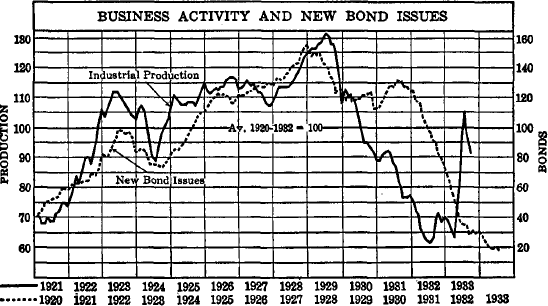
The connection between new capital flotations and productive activity is shown on the preceding chart. The index of new bond issues is moved up one year, so that the peak of new bond issues at the beginning of 1928 appears on the chart in the year 1929 for industrial production. The peak for new bond issues therefore came about 20 months before the break in industrial production. This is but natural, since considerable time elapses between the issuance of securities and the translation of their proceeds into productive activity. And if an inverted index of bond yields were superimposed on this chart, its highest point would coincide almost exactly (January, 1928) with the peak for new issues—new bond issues began to decline, in other words, when interest rates began to rise.
“CREATED” PURCHASING POWER ENHANCES PROFITS IN CIRCULAR FASHION
The disequilibrium between investment and saving set up by the banks in taking over new bond issues with created purchasing power has still other important influences. The process brings about an increase in the money income of the economic system, and for a time it increases the absolute amount of profits of the entrepreneurs.
The use of the newly created bank credit by bond-issuing corporations to finance new investment activity will increase the profits of those concerns to which the new money is turned over in exchange for materials, machinery, and other supplies and equipment. It will do so in one of two ways, or possibly both. The new monetary demand appearing in the market may force a rise in prices for materials, machinery, and equipment, thus enabling the selling corporations to reap profits because their costs do not rise as fast as the prices of their salable products; or, additional profits may arise, even with no increase in prices, simply because of the larger volume of orders that makes possible the renewed utilization of existing plants and equipment without a proportionate increase in costs.
Moreover, the increases in the rate of investment and in the rate of profits, originally set in motion by the banking system, are cumulative by virtue of this (absolute) increase of profits. For when business profits are increasing the total volume of saving tends to increase also, as it is customary for corporations to employ a large part of their profits in further plant extensions and purchases (or creation) of capital goods. Indeed, it is generally true that the bulk of savings comes from corporate saving. A circular process thus results: a widening circle of profits begets additional new investment activity, the latter in turn gives rise to yet larger profits and so on.
The stimulation of new investment activity by the action of the banking system, as well as the profits engendered thereby, have also the effect of increasing the incomes of the public, and this in turn tends to give an upward fillip to activity in the consumers’ goods industries. Some part of the new profits will be paid out in increased dividend disbursements, thus increasing the purchasing power of the stock-holding classes. The money incomes of the laborers will also be increased; this again may occur in one of two ways, or both. Either wage rates may be bid up, on the one hand, or men previously unemployed or limited to part-time employment may now find full-time employment, on the other hand. In both cases money incomes, and hence monetary purchasing power, will be greater than before.27 As the greater part of laborers’ incomes is spent on consumption goods there will therefore ensue a stimulation of the consumers’ goods industries. It is thus seen that the disequilibrium between investment and saving originally set in motion by the banking system has an inflationary influence on all phases of productive activity.
The origin of the excess reserves in the banks of the system (the member banks of the Federal Reserve System, primarily) which made possible the increased purchases of investments leading to the disequilibrium between the market and the natural rates of interest should be commented on at this point. It has already been shown (Chapters II and V) that the credit-creating activities of the Federal Reserve Banks led to an increase in the reserves of the member banks: by open-market purchases the Federal Reserve Banks induced new excess reserves in the commercial banking system. It has also been shown how the banks utilized these new reserves to expand credit on their own account by purchasing investments. By referring to Chart IV it may be seen that new bond issues increased most rapidly during those three years when the Federal Reserve Banks were actively engaging in open-market purchases. Hence the originating influence in the whole chain of causation leading to inflation was the policy of the Federal Reserve Banks in embarking upon Reserve-credit expansion. The creation of a central banking system introduced a markedly greater expansibility in the banking structure of the country, and the operation of this central banking system during the post-War period constitutes a sufficient explanation of the origin of the new credits.
EXAGGERATED CHARACTER OF RECENT CYCLE ATTRIBUTABLE TO CENTRAL BANKING OPERATION
Here, then, is the fundamental explanation of the recent credit cycle, and in large measure, of the alternations of boom and depression—the credit-creating capacity and activities of the central banking system, Mises’ “inflationistic ideology” of the central banks.28 Federal Reserve credit expansion serves to explain the origin of the excess reserves for the member banks of the system; the utilization of these excess reserves by the commercial banks to buy securities brings about a divergence of the market and natural rates of interest, thus creating the possibility of profit for entrepreneurs who undertake new capital development; stimulated by this prospect of profit, entrepreneurs bring out new bond issues to finance the new capital developments; and when these bonds are purchased by the banks new purchasing power is created which has the effect, not only of creating a disequilibrium between investment and saving, but also of causing the prospective profits to become realizable and at the same time of increasing the income of the public; and the actual realized profits in turn accelerate the rate of increase of investment.
It follows, then, that the height of the recent boom and the depth of the depression are fundamentally the outcome of Federal Reserve credit expansion. The recent cycle may therefore properly be designated a central banking phenomenon. The exaggerated character of the last boom and slump is understandable only in the light of the superimposition of a central banking system upon our former system. And an understanding of what was taking place in our banking system, largely as a consequence of the enactment of the Federal Reserve Act, is essential to an explanation of the causes of the depression. If the recent cycle has proved so puzzling to so many students of its devious course and manifold phases, it is because the full effects of the creation and operation of this central banking system upon the commercial banks have not been widely nor adequately understood; nor, furthermore, have the influences of the changing structure of the American banking system upon the structure of production been fully realized.
FOREGOING ANALYSIS COMPATIBLE WITH EXPLANATION OF EARLIER CYCLES
At this stage of the argument it may occur to the reader that since no central bank existed in this country prior to 1913, the above analysis is therefore inapplicable to former depressions. Before examining this possible objection, however, it may be well to repeat once again that we have never had a boom and a depression quite so extensive as the recent ones, and that the rôle played by the operation of our central banking system must be an integral part of any theory attempting to explain that boom and depression. The extent of a boom generated by commercial bank expansion (without the intermediation of the central banks in initiating the conditions for the boom) was certain to be limited by the reserves of the banks, reserves which under the old system were scarcely subject to replenishment; and had the last boom been less extensive it is hardly possible to conceive of the depression being so severe and so protracted.
Moreover, it is believed that the framework of the foregoing analysis is largely applicable to the depressions which occurred prior to the Federal Reserve System; only in matters of detail is it inadequate or out of focus when brought to bear upon earlier cycles. The banks in New York City occupied the rôle of central banks for the commercial banking system prior to 1913. During depression, excess reserves of the banks outside New York City were transferred to the banks in New York City where they would command an interest return; the New York banks, faced with mounting reserves which they naturally desired to put to earning use, in the absence of demand for commercial credit used the new reserves to purchase investments, forcing down the long-term market rate of interest, and thus a cycle was generated.29 The major variations between the patterns of the earlier cycles and that of the last cycle arise out of the fact that the New York banks were limited to the excess reserves deposited with them by the outside banks (subject to the qualification of accessions to their reserves from new gold inflows from abroad)—they could not “manufacture” reserves in quite the same way as could the Federal Reserve Banks, and hence former booms were not so pronounced.
THE IMMEDIATE, INCITING CAUSE OF DECLINE
In order to conclude this portion of the analysis, it remains but to inquire into what force or factor, operating as an immediate and inciting cause, stops the expansion, brings the boom period to an end, and initiates the decline. It is the cessation (or reduction) of the new “excess” flow of credit, brought about either by positive credit contraction or by a deceleration of its rate of growth. The slackening of the rate of credit growth (or the complete stoppage of the creation of new credits) is an effect of the stringency of bank reserves. And here again Federal Reserve policy played a dominating role in the latest cycle, for when the Federal Reserve Banks reversed their “easy money” policy in 1928 and 1929 the reserves of the member banks ceased to increase rapidly. As the banks no longer had expanding reserves to use for the purchase of investments, the withdrawal of this marginal determining influence on the price of bonds caused the long-term market rate of interest to rise. The effect was to bring about a convergence of the market and the natural rates of interest toward an equilibrium point, or, possibly, an actual rise of the market rate slightly above the natural rate, destroying the prospect of further profit from that quarter.30 A comparison of the rate of credit growth with the course of bond prices shows that bond prices began to decline (the market rate of interest began to rise) early in 1928, at the same time that the growth of credit began to slacken.31
BOTH MAEKET RATE AND NATURAL OR PRODUCTIVITY RATE OF INTEREST VARY TOWARD CONVERGENCE
The convergence of the two rates of interest and the dissipation of the possibility of profit from new investment activity does not come solely from a rise of the market rate, however. The realizable rate of return to capital at many investment margins tends to fall in the later stages of a boom at the same time (though perhaps not in the same degree) that the market rate is tending to rise. This is the effect of two causes that have been gathering momentum cumulatively, but independently of each other. The first cause is the increase in the costs involved in the production of capital goods: as the costs of labor and materials advance, it follows that more dollars (liquid loanable funds) are required in order to produce a given item of physical capital than were necessary at an earlier stage of the cycle. In other words, a larger investment of liquid capital must be made in order to create (or buy) capital equipment of given technical capacity, and, if prices of finished products fail to advance equally with costs, the ratio of return to investment is progressively reduced.
The second cause is simply the operation of the principle of diminishing returns at numerous investment margins. Carried along on a wave of unquestioning optimism, many entrepreneurs blithely enter into further new investment commitments without adequate regard for the effects either of their own activities or of like actions on the part of other concerns in the same industry. So long as the market rate of interest is even slightly less than the rate of return (per dollar of cost) realized currently on new capital equipment, the situation constitutes an invitation to still further creation of capital goods, for men are ever prone to regard existing conditions as permanent. There appear to be opportunities for continued profits in the future in the further creation of new capital equipment, and these seeming opportunities could actually be realized if existing price relationships were to continue; yet the very entrepreneurial actions that are inspired by such a situation operate to destroy these price relationships. Thus, opportunities for profits (not profits, it should be emphasized, but opportunities for profits) are vitiated and rendered spurious, but so quietly and so imperceptibly that many entrepreneurs and investors are wholly unaware of what is taking place until the critical point is definitely passed. This results in “over-investment” at many investment margins—that is, in many industries the total stock of capital equipment is augmented so greatly that the realizable productivity or rate of return per unit of physical capital is appreciably reduced.
The movements of the two interest rates in opposite directions, then—the discontinuance of the growth of credit raising the market rate on the one hand, and the reduction of the natural or productivity rate on the other hand—operate to bring the rates back together or to destroy the divergence between them that formerly was favorable to new capital development. Practically, however, the market rate of interest is subject to wider fluctuations, and more rapid ones, than is the natural rate. And it follows, therefore, that the slackening of the rate of credit growth is the more drastic influence in ending the boom.
THAT NATURAL RATE OF INTEREST VARIES IS PECULIARLY IMPORTANT
Yet what is sought to be emphasized is the fact that both rates tend to fluctuate. This is of importance in understanding why depression, once under way, persists, for if the natural rate were always a fixity the cycle would become the purely monetary phenomenon that Mr. Hawtrey insists it is and might easily be cured by purely monetary means. All that would be necessary to restore the profitableness of new investment would be to lower the market rate by appropriate bank action, and revival would proceed apace. It is not so simple as this, however, for as D. H. Robertson points out, 32
While there is always some rate of money interest which will check an eager borrower, there may be no rate of money interest in excess of zero which will stimulate an unwilling one. Secondly, * * * the assumption * * * that the total magnitude of the money supply lies entirely within the discretion of the banking-system and not at all within that of the public, seems to have only limited validity for such periods.
The convergence of the two rates of interest destroys the profit prospects which obtained when the market rate was below the natural rate. This leads to a slackening of new investment activity. And when investment ceases to increase at the old rate or actually begins to decline, the disequilibrium between investment and saving which characterized the boom period comes to an end. Investment declines to an equilibrium with saving or, as is usually the case, falls below it.
The decline in investment activity means that the period of positive realized profits is at an end. An alteration in the structure of production the reverse of that which obtains during a boom sets in: the production of producers’ goods declines more rapidly than does the production of consumers’ goods. The unemployment that prevails in the durable goods industries makes its influence felt throughout the whole process of production and over the whole system of interdependent prices. In short, depression is in full progress.33
This is not to imply that all that would be necessary for continued prosperity would be an avoidance of the cessation of the increase of credit—conscious efforts aimed at prolonging the increase in credit might indeed prolong the boom, but by so doing would almost certainly induce increasing maladjustments in production which would prolong the eventual depression, whether initiated by monetary or non-monetary influences.
The point to be emphasized is that it is usually the cessation of the excess flow of credit which brings about the disequilibrium between saving and investment that leads to depression. It is not intended to indicate, however, that there need be an immediate relation between the slowing down of credit increase, the decline in investment activity, and the onset of depression; other influences may be at work, as will be pointed out in Chapter VII, to prolong the boom, for a time, beyond the beginning of the decline in investment activity. Nevertheless, it is this pattern which almost invariably prevails. How long the boom may proceed after the onset of a positive decline in the durable goods industries is simply a question of the comparative strength of these other influences.
SOUND THEORY ESSENTIAL TO ACCURATE FORECASTING
The foregoing analysis of the course of the business cycle, largely theoretical in nature as it is, not only fits the course of events in this country from 1922 to 1929, and after, but embodies, it is believed, the explanation of the fundamental causes of the depression. No attempt will be made to review further the innumerable historical details from which might be gathered much factual evidence in support of the theory. The purpose here is not so much to provide an historical picture of the development of the boom and the subsequent depression as to seek the deeper, underlying, and fundamental causes of the depression itself. The historical factual material was being carefully observed by students of cyclical patterns, but to little benefit, since most American observers were thoroughly misled by what actually occurred. It was the use of the theory on which the foregoing explanation is based, or one markedly similar, on the other hand, that enabled Hayek to predict in April of 1929 the approach of the crisis in this country, and Åkermann, with better timing even than Hayek, to write on the first day of October, 1929, 34
* * * American economic life is now about to enter upon the final phase of a boom period that began already in the middle of 1921. * * * American monetary policy * * * can hardly be said during these years to have favored the tranquil course of industrial expansion. Under direct or indirect American monetary influences savings capital has been attracted to speculative investments, which are now beginning to prove unprofitable.
Sound theory of the cycle is prerequisite to accurate forecasting alike in the realm of business and the domain of economics.
REECENT CYCLE THEORIES DIVERSELY DEFICIENT
Most American observers who were concerned with the structural view of business cycles were unable fully to appreciate the monetary aspects of the situation; those who were advocates of the purely monetary theory were so obsessed with the stable-price-level complex that they were unable properly to assess the importance of the underlying structural phenomena which were developing. The price stabilization complex common to most of the older monetary explanations of the business cycle is itself sufficient to warrant their rejection as something less than comprehensive theories of the cycle. The movement of wholesale prices occupies a central rôle in the usual monetary theory, and this concentration of attention upon the superficial phenomena of changes in the value of money has militated against an understanding of the channels through which newly created credit entered the economic system and of the effect of this new credit upon the structure of production. Further, there are certain aspects of the recent situation which render the usual monetary theory practically useless as an explanation of the late boom and depression; commodity prices as measured by the wholesale price index in this country were remarkably stable from 1922 to 1929, as is well known, so that one point definitely established by the monetary experimentation involved is that stability of the price level is a doubtful safeguard against depression. Nevertheless, the fact that those descriptive studies of the cycle which emphasize the inordinate increase of fixed capital during a boom fail to take account of the originating influence of credit expansion detracts from the importance of the non-monetary explanation as a generalized theory of business cycles. An attempt has been made in the above explanation to bridge the gap between the monetary and the non-monetary theories: to describe the structural changes which characterize the cycle, and to explain their origin.
The equilibrium theory has not as yet been set forth; the integration of the third view of the cycle with the two foregoing into a single whole has not yet been accomplished. The following chapter, which may be considered a continuation of the present one, will essay that task; it is also concerned with the explanation of the duration of the depression, and with the relation thereto of the stock market crash of 1929.
35 “Investment and Saving in Business Cycle Theory,” Econometrica (April, 1933), Vol. I, No. 2, p. 119.
36Keynes has a succinct statement of his theory in his chapter, “An Economic Analysis of Unemployment,” in Unemployment as a World Problem. Other brief expositions of virtually the same theory as that advanced here are to be found in Lionel Robbins’ The Great Depression, Chapter III, and his article “Consumption and the Trade Cycle,” op. cit.; in Professor H. F. Fraser’s Great Britain and the Gold Standard, Chapter V; Professor Haberler’s chapter, “Money and the Business Cycle,” in Gold and Monetary Stabilization; and E. F. M. Durbin’s chapter in What Everybody Wants to Know About Money, edited by G. D. H. Cole. E. C. Harwood’s Cause and Control of the Business Cycle makes use of the same idea as applied to the American post-War banking situation. H. G. Moulton’s “Commercial Banking and Capital Formation” in the Journal of Political Economy, Vol. XXVI, Nos. 5, 6, 7, and 9, is probably the first attempt by an American economist to formulate a similar theory—even though Moulton has apparently departed somewhat from his former position in his recent book, The Formation of Capital. An excellent critique of the theories of Keynes and Hayek is that of Professors Hansen and Tout in Econometrica, op. cit.
37The term “Investment” is used herein to mean the positive act of converting loanable funds that come onto the capital market, arising in the first instance either as “true” savings out of money incomes or as “created” bank credit, into tangible capital equipment or real physical capital. Savings are usually used by investors to buy bonds (or stocks), and the proceeds of these bond sales are used to finance the construction of new building, the purchase of new machinery, etc. The term investment is used throughout to mean the latter process, rather than that of the savers when they “invest” their saved money income by purchasing bond and stock issues.
38 The authors are indebted to Professor F. H. Knight for the suggestion of this analogy.
39 “The tendency to intensified fluctuations of derived demand, including the demand for * * * durable consumers’ goods, as well as producers’ goods, is of basic importance * * *. If it could be controlled in all its manifestations, the primary result would be a great stabilization of the average rate of productive activity by cutting off those fluctuations of production which exceed the fluctuations of consumers’ current expenditures. As a secondary result, consumers’ expenditures would themselves be made far more stable than they now are. Thus the effects of stabilization would be cumulative, and the back of the business cycle would be broken.” Clark, J. M., Strategic Factors in Business Cycles, p. 191.
40 Jevons, W. Stanley, Investigations in Currency and Finance (London: Macmillan & Company, 1872), 1884 edition, pp. 27, 28.
41 Industrial Depressions (New York: Frederick A. Stokes & Co., 1911), p. 27.
42 Cf., for example, the following random selections: “We may now define, with precision, * * * a period of boom is one of special increase in the production of fixed capital; a period of decline or a depression is one in which this production falls below the point it had previously reached” (Cassel, The Theory of Social Economy, p. 550); “The most characteristic feature of a modern industrial boom is the utilization of an abnormally large proportion both of the past accumulations of consumable goods and of the current production of consumers’ goods to elicit the production, not of other consumable goods, but of construction goods” (Robertson, D. H., A Study of Industrial Fluctuations, London: P. S. King & Son, 1915, p. 157); “For, while a diagram showing the output of the instrumental industries would be a curve with large rises and large falls, one showing the output of consumers’ industries would consist of rises interspersed with horizontal movements, like the outline of a flight of stairs” (Pigou, A. C., Industrial Fluctuations, London: Macmillan & Co., 1929, 2nd ed., p. 18).
43 “There is no single set of figures which measures accurately what should be capable of quite precise measurement—namely, the rate at which the community is adding to its investment in Fixed Capital.” A Treatise on Money, Vol. II, p. 97.
44 The Theory of Social Economy, p. 548.
45Cf. Åkermann, Economic Forecast and Reality, 1928–1932, p. 3: “It should be stressed that the recent boom period probably more than any previous one was marked by an intensive and accelerated production of fresh capital goods, and that the creation of means of production and other fixed real capital had never before shown such rapid expansion. To substantiate this assertion we shall confine ourselves to referring the reader to the following table showing the average growth of the world’s production of pig-iron up to the turn of the century—and steel—after the turn of the century—during the different boom periods. The increase is calculated from the year when the depression was most pronounced to the year when the boom was at its height.
AVERAGE ANNUAL PERCENTAGE GROWTH
| 1858/1864..........6.9 | 1885/1890........ 8.1 | 1908/1913........16.8 |
| 1865/1873..........7.5 | 1893/1900........ 9.1 | 1914/1917........13.6 |
| 1876/1883..........8.1 | 1900/1907........12.3 | 1921/1929........21.0” |
46 “An Economic Analysis of Unemployment,” in Unemployment as a World Problem, pp. 5–6.
47 Geneva: League of Nations, 1933.
48 June, 1929, No. 94, p. 26, and Vol. 13, No. 4, p. 48.
49 The Theory of Social Economy, p. 62.
50 The conception of the “natural” rate of interest has been the subject of much controversy, ridiculed by Gregory as a “stalking ghost,” and as Hardy points out, “impervious to inductive proof or disproof” (“Savings, Investment, and the Control of the Business Cycle,” Journal of Political Economy [June, 1931], Vol. 39, No. 3, p. 390). But whether subject to precise measurement or not, the idea of a “natural” rate of interest (or some equivalent term) nevertheless has a useful significance. The “natural” rate of interest might be defined as the marginal “yield” rate of interest—the currently realizable yield on capital at new investment margins, for, as Marshall says, “the rate of interest applies strictly to new investments only” (Principles, p. 592). Marshall seems to have had something in mind akin to a “natural” rate of interest when he speaks of “the general rate of interest”—” the phrase ‘the general rate of interest’ applies in strictness only to the anticipated net earnings from new investments of free capital” (ibid., p. 553). Alternatively, the “natural” rate might be designated the “real” marginal productivity of capital—even though not subject to statistical proof it can hardly be denied that there is a productivity rate which measures the currently realizable return to capital. Professor Knight’s definition that interest is “the ratio between perpetual annual income and the cost of income-yielding goods at the margin of growth” (Encyc. Social Sciences, Vol. VIII, p. 135), is similar to the use of the term here. Keynes’ definition that “the natural rate of interest is the rate at which saving and investment are exactly balanced” (Treatise on Money, Vol. I, p. 155) is also similar, but involves somewhat different placement of emphasis; the authors hold that saving and investment are balanced when the “natural” rate and the market rate are in equilibrium (as does Keynes himself elsewhere in his Treatise). If only those sums coming on to the capital market as supply of loanable funds represented the real savings of the public, the market rate and the “natural” rate would not long diverge from one another; for “the margin of growth” is conditioned by the rate of accumulation of free capital seeking investment. Furthermore, inability to measure the “natural” rate ought not to occasion either regret nor anxiety; indeed, the very idea of inductive measurement is foreign to the concept of such a rate. For the “natural” rate of interest is simply an abstraction, a concept that is indispensable if certain types of equilibrium adjustment within the economic system are to be defined with any degree of precision. Thus regarded, it is apparent that the “natural” rate is closely akin to the “equilibrium price” that is so familiar as an analytical tool in present-day neo-classical economics.
51 It is on this point, it seems, that Keynes makes a fundamental error in placing what measure of emphasis he does on the influence of the short-term market rate of interest in the business cycle, by not recognizing that the growth of working capital is a function of what he himself considers the basic factor, the growth in investment capital. Increased working capital, represented by short-term commercial loans, is itself an outgrowth of the enhanced activity engendered by the increased investment activity, and the short-term rate of interest is a function of the long-term rate, not the reverse. In his evidence before the Royal Commission on Gold and Silver Inquiry (which Keynes himself edited in publishing Marshall’s Official Papers, and therefore should have been familiar with), Marshall had stated that “the average rate of discount is determined by the average level of interest in my opinion,” and “my position is that the mean rate of discount is governed by the mean rate of interest for long loans” (Official Papers, p. 51).
52 Keynes, J. M., A Treatise on Money, Vol. I, pp. 140 and 159.
53 “* * * the attractiveness of investment depends on the prospective income which the entrepreneur anticipates from current investment relatively to the rate of interest which he has to pay in order to be able to finance its production * * *.” Ibid., Vol. I, p. 154.
54 The term “structure of production” is by no means used here as synonymous with the Hayekian sense of that term, to mean an elongation of the vertical structure of production. It is in his use of that notion that Hayek’s theory is untenable, in the writers’ opinion, or at least the use of the concept “elongation of the structure of production” is unnecessary to the main parts of Hayek’s thesis. The term “structure of production” does have a useful significance, however, when confined to mean the proportion between producers’ goods production and consumers’ goods production—between consumption and investment. An alteration of that proportion in favor of the increased production of producers’ goods brings about a disproportionality of the whole productive process, which is itself the seat of the trouble. Hereafter, therefore, the use of the term “structure of production” will be considered as referring to this proportion between the production of capital goods and consumption goods.
55 Malthus, T. R. (in the Edinburgh Review [February, 1811], Vol. XVII, No. XXXIV, pp. 363-365) said that none of the writers he was acquainted with “* * * has ever seemed sufficiently aware of the influence which a different distribution of the circulating medium of the country must have on those accumulations which are destined to facilitate future production,” and further, “the question of how far, and in what manner, an increase of currency tends to increase capital appears to us so very important, as fully to warrant our attempt to explain it * * *. It is not the quantity of the circulating medium which produces the effects here described, but the different distribution of it * * * on every fresh issue of notes * * * a larger proportion falls into the hands of those who consume and produce, and a smaller proportion into the hands of those who only consume. * * * an increased issue of notes tends to increase the national capital, and by an almost, though not strictly necessary consequence, to lower the rate of interest.”
56Cf. Keynes, A Treatise on Money, Vol. II, p. 358: “* * * the purchase and sale of securities by the banks for their own account have been the dominating factor in determining the turning-points in the price level of bonds.” And cf. Riefler, W. W., Money Rates and Money Markets in the United States (New York: Harper & Brothers, 1930), p. 119: “Through their own purchases and sales of investments, therefore, commercial banks have exercised a marked pressure on the market for bonds and contributed to a considerable extent to the agreement in relative movements between bond yields and short-term money rates.” And see Steiner, W. H., Money and Banking (New York: Henry Holt & Co., 1933), p. 859: “Long-term investment credit impinges upon short-term commercial credit at several points. In time of depression, banks tend to use surplus reserves to purchase bonds. This tends to raise bond prices and make long-term financing more attractive. It also creates deposit currency which tends in part to offset the decline in the velocity of circulation that occurs at such times and in part to enable borrowers to retire their debts to the banks.”
57 “For the value of a security is determined, not by the terms on which one could expect to purchase the whole block of the outstanding interest but by the small fringe which is the subject of actual dealing;—just as current new investment is only a small fringe on the edge of the totality of existing investment.” Keynes, A Treatise on Money, Vol. II, p. 361.
58 “On this point, Wicksell was very explicit, pointing out that the rate of investment is capable of being affected by small changes in the rate of interest, e.g., ¼ per cent, which could not be supposed to affect the mind of the speculator.” Ibid., Vol. I, pp. 198-199.
59 “The elasticity of credit undoubtedly facilitates and speeds the process of capital accumulation by enabling business men to secure and spend at any time larger amounts of capital funds than have been furnished for the purpose by prior Savings. * * * They [the banks] do have power to create additional purchasing power in the form of bank deposits placed at the disposal of borrowers. This purchasing power does not come out of anyone’s prior abstinence; but it initiates * * * an increase in production, with the result that increases of capital goods do not require equivalent prior sacrifices in consumption.” Clark, J. M., Strategic Factors in Business Cycles, p. 192 and note, pp. 192-193.
60 “Investment and Saving in Business Cycle Theory,” op. cit., p. 119.
61 “As the system actually operates, spending more on one thing is quite likely to mean spending more on other things also, and vice versa. This is by reason of the combined action of two basic causes. One is an elastic credit system, which makes it possible to spend more for one thing without at the same time spending less for something else. The other is the fact that setting more people at work making any one thing gives them more spending power to use in buying other things so that the result is not less demand for other things, nor even the same amount as before, but actually more. If more is spent for capital equipment, more will also be spent for consumers’ goods, not in spite of increased capital expenditures but because of them.” Clark, J. M., Strategic Factors in Business Cycles, p. 139.
62 Hayek criticizes Mises’ explanation of the origin of the new credits as emanating from this “inflationistc ideology” of the central banking system—see his Monetary Theory and the Trade Cycle, especially pp. 145 and 150. But Hayek’s claims for his “perfectly endogenous” theory are unconvincing to the writers for the very simple reason that his explanation of how the banking system creates credit (perfectly valid except for this one point) when a “certain amount of cash is newly deposited” never satisfactorily explains where the newly deposited cash comes from!
63 See Allyn A. Young’s An Analysis of Banking Statistics for the United State (Cambridge: Harvard University Press, 1028).
64 Cf. Henry Thornton in his An Enquiry into the Nature and Effects of the Paper Credit of Great Britain (London: Knight and Compton, 1802), pp. 261-262: “As soon, however, as the circulating medium ceases to encrease, the extra profit is at an end * * *.” And see Hayek, Monetary Theory and the Trade Cycle, p. 176: “* * * in order to bring it [the crisis] about * * * it is quite enough that the banks should cease to expand the volume of credit; and sooner or later this must happen. Only so long as the volume of circulating media is increasing can the money rate of interest be kept below the equilibrium rate; once it has ceased to increase, the money rate must, despite the increased total volume in circulation, rise again to its natural level and thus render unprofitable (temporarily, at least) those investments which were created with the aid of additional credit.”
65 As a matter of fact, banks early in 1928 not only ceased to make new investment purchases but also sold bonds in order to finance speculation in stocks.
66 Banking Policy and the Price Level, p. 81.
67 “The whole matter may be summed up by Baying that a boom is generated when investment exceeds saving and a slump is generated when saving exceeds investment.” Keynes, J. M., “An Economic Analysis of Unemployment,” op. cit., p. 21.
68 Economic Forecast and Reality, 1928-1932, p. 28.
- 1Foreign Exchange Before, During, and After the War (London: Oxford University Press, 3rd ed., 1925), p. 9.
- 2Strategic Factors in Business Cycles (New York: National Bureau of Economic Research, 1934), p. 4.
- 3“The Problem of Business Cycles,” in the Skandinaviska Kreditaktiebolaget Quarterly Report, January, 1933, p. 3.
- 4Ibid., p. 3.
- 5Cassel, G., The Theory of Social Economy (New York: Harcourt, Brace & Co., 1932), p. 538.
- 6Strategic Factors in Business Cycles, p. 6.
- 7Journal of the Institute of Bankers (June, 1931), Vol. LII, Part VI, p. 236.
- 8“Depression has continued because there is no prospect of profitable investment. And why is there no prospect of profitable investment? Because costs, which by reason of the inflationary boom have become too high in relation to prices, have not been reduced.” Lionel Robbins, in Lloyds Bank Monthly Review (October, 1982), Vol. III (NS), No. 32, p. 432.
- 9“Loans and Taxes in War Finance,” American Economic Review Supplement (March, 1917), Vol. VII, No. 1, p. 200.
- 10Phillips, C. A., Bank Credit (New York: The Macmillan Company, 1920).
- 11“The view that bank deposits are potential currency is inapplicable to the deposits created in the Government’s War loan account.” Leffingwell, R. C. (Assistant Secretary of the Treasury during the War), “Treasury Methods of Financing the War in Relation to Inflation,” Proceedings of the Academy of Political Science (June, 1920), Vol. IX, No. 1, p. 32.
- 12Bankers and Credit, p. 48.
- 13Professor Jacob Hollander attributes priority to Professor A. C. Pigou (1915) and to Professor O. M. W. Sprague (1916); see his War Borrowing (New York: The Macmillan Company, 1919), pp. 157–158.
- 14War and Lombard Street (1914); Our Money and the State (1917); The Business of Finance (1918); War-Time Financial Problems (1919).
- 15Bankers and Credit, pp. 24–25.
- 16See Phillips, op. cit., Ch. III; and see Hayek, F. A., Monetary Theory and the Trade Cycle (New York: Harcourt, Brace & Co., 1932), Ch. IV.
- 17This is true as long as the amounts pass from bank to bank and are not withdrawn in cash and hoarded, or so long as they do not represent larger cash balances circulating in the hands of the public. But the above is intended to illustrate a principle rather than to arrive at a mathematical result. It seems hardly necessary to add that the process just described is the same as obtains when banks utilize excess reserves to grant loans to customers, instead of buying bonds, and as when banks buy bonds on the stock exchange, instead of subscribing to a new Government bond issue.
- 18“Since the outbreak of War it is the second procedure in the main which has been followed, the surplus cash having been used to subscribe for Treasury Bills and other Government securities. The money so subscribed has again been spent by the Government and returned in the manner above described to the bankers’ cash balances, the process being repeated again and again until each £10,000,000 originally advanced by the Bank of England has created new deposits representing new purchasing power to several times that amount.” First Interim Report of the Committee on Currency and Foreign Exchanges After the War (The Cunliffe Committee Report), Cmd. 9182 (1918), Paragraph 10, note.
- 19“* * * the fourth Liberty loan has been placed in a very large degree by the use of bank credit. Precisely how much such credit * * * is not yet certain * * *. In addition to this large use of direct bank credit is to be reckoned the fact that the bonds * * * have been taken by the banks as collateral to secure notes running for long periods * * *. These factors make not only for a serious condition of inflation but also for the maintenance and continuance of the inflation much longer than would otherwise be probable.” “Washington Notes” (unsigned), The Journal of Political Economy (December, 1918), Vol. XXVI, No. 10, pp. 977–978.
- 20Friday, David A., Profits, Wages, and Prices (New York: Harcourt, Brace and Howe, Inc., 1920), p. 133.
- 21See the Journal of the Royal Statistical Society (1931), Vol. XCIV, Part IV, p. 549.
- 22“Thus Europe raised our prices * * *.” Profits, Wages, and Prices, p. 139.
- 23“Unquestionably it was the impetus from Europe that started American prices on their upward course.” American Economic Review, Supplement (March, 1920), Vol. X, No. 1, p. 131.
- 24The average reserve requirements of all banks prior to the Federal Reserve Act are estimated to have been 21.09%; under the provisions of the original Act, 11.61%; and under the terms of the Amendment of June 21, 1917, 9.76%. See The Practical Operations of the Federal Reserve System, issued by the Federal Reserve Bank of Richmond, p. 243.
- 25Cf. the Report of the Committee on War Finance of the American Economic Association, The American Economic Review, Supplement No. 2 (March, 1919), Vol. IX, No. 1, pp. 96–97: “Recent improvements in our banking system, growing out of the establishment of the Federal Reserve System and its subsequent development, have made our reserve money * * * more efficient than it formerly was; in other words, have enabled a dollar in reserve to do more money work than before. This in effect is equivalent to increasing the supply of reserve money.” It has been calculated that if the requirements of the National Bank Act were in vogue December 31, 1924, member banks would have required $3, 200,000,000 more in reserves than they held to support the credit then outstanding (The Practical Operations of the Federal System, p. 238); and the Committee on Bank Reserves of the Federal Reserve System estimated that on the same basis in 1931 member banks would have needed $4, 400,000,000 of reserves instead of the $2, 900,000,000 actually held.
- 26Under the old system, when a bank’s reserve fell below the legal minimum it was prohibited by law from making additional loans; and if its reserve was exhausted it was declared insolvent. Under the new system, borrowing from the bankers’ bank is the equivalent of going into the reserve under the old system, but without any penalty; indeed, the process of borrowing serves to replenish, or add to, the borrowing bank’s reserve.
- 27It is also to be observed that henceforth the same twenty-nine-fold expansion is made possible in connection with each new influx of gold from abroad, whether the gold is deposited directly in the Federal Reserve Banks, or in commercial banks and by them redeposited in the Federal Reserve Banks.
- 28It should be stressed, once again, that this example demonstrates the possible maximum expansive power; that is, it is assumed that the entire excess reserve of the Federal Reserve Banks is employed for the purpose of supporting additional Federal Reserve Bank deposits, and hence creating additional reserve for the member banks. To the extent that this excess of 650 million dollars (assumed to be gold) is used to support issues of Federal Reserve notes, which cannot be counted as legal reserve by member banks, this expansive power is diminished. As a matter of fact, a substantial portion of the gold reserve of the Federal Reserve Banks has been used for this latter purpose.
- 29Keynes, J. M., Essays in Persuasion (London: Macmillan & Company, 1931), p. 77.
- 30Ibid., p. 78.
- 31London: J. M. Dent and Sons, Ltd., pp. 87–88.
- 32“Great wars are accompanied by prosperity and followed by depression. This is an ancient truth * * * but one which each new generation tends to forget.” Leonard P. Ayres, The Economics of Recovery (New York: The Macmillan Company, 1933), p. 15.
- 33“It is not the event of war * * * but rather the fact that great wars cause sudden and extreme advances in commodity prices. It is this sudden price advance which largely determines the nature and sequence of the business cycles of the following twenty years or so.” Ibid., p. 18.
- 34Economic Forecast and Reality, 1928-1932, p. 28.
- 35In 1921, following the upheaval of prices which accompanied the primary post-War deflation, Professor T. E. Gregory, in writing on the situation then prevailing in the foreign exchanges, was moved to lament that:
- 36Thirteen years later, near the nadir of the Great Depression, Professor J. M. Clark wrote in like vein:
- 37Professor Gustav Cassel has said that “Our attention must now for a long time onwards be devoted towards a complete analysis of the upheaval now in progress.” The present study is directed to an inquiry into certain of the more fundamental aspects of major industrial fluctuations, and to the relationship of banking operations thereto, special reference being had throughout to the causes and relevant phases of the cycle beginning in the United States in 1922 and ending with the Great Depression. It is at the same time devoted to the formulation of a theory of business cycles—for “the present crisis is, in fact, a crisis also for the entire theory of business cycles.” The theory of business cycles here set forth, it is believed, is not only one which is applicable as a general explanation of depressions, but also one whose validity is particularly well illustrated by setting it against the background of the experience of the recent crisis. Accordingly, this theory of the cycle is correlated with the banking and financial situation in the United States during the post-War years into an explanation of the causes of the Great Depression.
- 38Professor Gustav Cassel has said that “Our attention must now for a long time onwards be devoted towards a complete analysis of the upheaval now in progress.” The present study is directed to an inquiry into certain of the more fundamental aspects of major industrial fluctuations, and to the relationship of banking operations thereto, special reference being had throughout to the causes and relevant phases of the cycle beginning in the United States in 1922 and ending with the Great Depression. It is at the same time devoted to the formulation of a theory of business cycles—for “the present crisis is, in fact, a crisis also for the entire theory of business cycles.” The theory of business cycles here set forth, it is believed, is not only one which is applicable as a general explanation of depressions, but also one whose validity is particularly well illustrated by setting it against the background of the experience of the recent crisis. Accordingly, this theory of the cycle is correlated with the banking and financial situation in the United States during the post-War years into an explanation of the causes of the Great Depression.
- 39“Causes” is used advisedly, it being “at once evident that no general or single theory is valid for so varying and varied a phenomenon as crisis.” And, as Professor Clark states, most “theoretical studies give us causes that are too few and too simple, such as over-production, under-consumption, over-saving, or failure to distribute to laborers their whole product or enough of the whole product of industry to enable them to buy the things they have produced.” The present apparent need is not for the propagating of novel theories, but rather for the orienting and synthesizing of extant knowledge.
- 40“Causes” is used advisedly, it being “at once evident that no general or single theory is valid for so varying and varied a phenomenon as crisis.” And, as Professor Clark states, most “theoretical studies give us causes that are too few and too simple, such as over-production, under-consumption, over-saving, or failure to distribute to laborers their whole product or enough of the whole product of industry to enable them to buy the things they have produced.” The present apparent need is not for the propagating of novel theories, but rather for the orienting and synthesizing of extant knowledge.
- 41As the depression has been denominated primarily a central banking phenomenon, it will also be desirable to attempt to unravel some of the changes caused in the structure, organization, and operation of the American banking system by the establishment of the central banking system represented by the Federal Reserve System. The special character of the depression is traced to the hyper-elasticity of the Federal Reserve System, and to the operation of that system as exemplified in the “managed currency” experiment of the Federal Reserve Board, working in opposition to what D. H. Robertson labels “the over-mastering tendency of prices to fall” after a war financed by inflationary measures. By virtue of that experiment, the Board succeeded in holding up the price level for a surprising length of time, but in so doing unwittingly aided in producing the boom and its consequent depression. The depression, in other words, was the price paid for the experimentation with currency management by the Federal Reserve Board during the period when the dislocations caused by war had not as yet been corrected and when the post-War deflation of prices had not been completed. Nor were the effects of this Federal Reserve Board action confined solely to the United States; the banking and industrial systems of leading commercial nations are interrelated so closely that the mistaken policy of one large central banking organization may be highly conducive to the precipitation of a world-wide depression.
- 42The boom is brought to an end, not only because of the restriction upon the supply of credit and purchasing power, but also because of the rise in the market rate of interest on new bond issues and other instruments of borrowing resulting from that restriction. Moreover, the realized rate of return on new capital development tends to fall in the later stages of a boom because of the fact that increases in wage rates gradually pare down the share going to capital. There ensues a general disequilibrium throughout the system, not only between wage rates and the cost of living, between costs and prices, and between production and consumption, but also a disequilibrium between investment and saving the reverse of that which prevails during the boom. As long as these general disequilibria persist, and as long as new investment in the sense of the production of new durable goods continues at a low ebb, depression continues.
- 43The World War was probably the worst-financed war in history from the viewpoint of sound fiscal policy. Less of the monetary costs of the War was financed by taxation and more by inflation of one form or another than any of the wars of the nineteenth century. Mr. Hartley Withers estimates that 17½ per cent of the cost of the War to England was covered by taxation, and Sir Josiah Stamp states that England’s showing in this respect was better than that of any other European belligerent. Elsewhere Stamp estimates that 63 per cent of the cost of the Napoleonic Wars to England was raised by taxation. The Report of the Committee on War Finance of the American Economic Association estimates the portion of World War costs covered by taxation in the United States at 25 per cent. As previously stated, all of the countries involved in the World War, with the exception of the United States, resorted to the age-old expedient of inflation of the note currency. But the United States, along with virtually all of the other nations, made use of that form of war financing which Mr. Withers denominates “quite the worst way of raising money for war or any other purpose” and which Professor 0. M. W. Sprague says is “the most potent single cause of the general advance in prices during periods of war,” namely, that of securing money from the banks either by issuing bonds directly to them for which they pay by creating new credits in favor of the Government, or by selling bonds to individuals who cover their subscriptions by borrowing from banks the credits that are newly created for this purpose. Such was the means by which the major portion of the monetary costs of the War was raised by all countries involved, and it is probably a safe assertion that it was employed on a more extensive scale than during any previous war. It is therefore desirable to inquire more fully into how the banking machinery was utilized to serve that end. In order to do so, however, it is necessary to set forth in some detail a particular point of banking theory which was neither understood nor recognized by writers on the subject until the period of War finance brought it into sharp relief.
- 44That banks “create” credit by granting loans has long been known and recognized. The precise nature of the process of creation of credit was not generally realized nor adequately analyzed, however, until after the termination of the World War. The correlative process of creation of bank credit, by means of purchases of investments on the part of the banks, is far from having universal recognition even today. It seems quite certain that some of those responsible for the way in which the War was financed in this country were not cognizant of the procedure by which it was done—they were, as Withers puts it, “making reckless use of a delicate machine which they did not understand and producing consequences which they neither foresaw nor recognized.”
- 45That banks “create” credit by granting loans has long been known and recognized. The precise nature of the process of creation of credit was not generally realized nor adequately analyzed, however, until after the termination of the World War. The correlative process of creation of bank credit, by means of purchases of investments on the part of the banks, is far from having universal recognition even today. It seems quite certain that some of those responsible for the way in which the War was financed in this country were not cognizant of the procedure by which it was done—they were, as Withers puts it, “making reckless use of a delicate machine which they did not understand and producing consequences which they neither foresaw nor recognized.”
- 46That banks “create” credit by granting loans has long been known and recognized. The precise nature of the process of creation of credit was not generally realized nor adequately analyzed, however, until after the termination of the World War. The correlative process of creation of bank credit, by means of purchases of investments on the part of the banks, is far from having universal recognition even today. It seems quite certain that some of those responsible for the way in which the War was financed in this country were not cognizant of the procedure by which it was done—they were, as Withers puts it, “making reckless use of a delicate machine which they did not understand and producing consequences which they neither foresaw nor recognized.”
- 47So far as is known to the writers, this process of the manufacture of credit on the part of the banks by purchasing investments was first discerned by Withers. In several books published during the War period he indicates an increasing understanding of it in connection with war finance. In his Bankers and Credit, however, published in 1924, he elaborates the theory most clearly, and it is appropriate to quote at some length from that work:
- 48So far as is known to the writers, this process of the manufacture of credit on the part of the banks by purchasing investments was first discerned by Withers. In several books published during the War period he indicates an increasing understanding of it in connection with war finance. In his Bankers and Credit, however, published in 1924, he elaborates the theory most clearly, and it is appropriate to quote at some length from that work:
- 49So far as is known to the writers, this process of the manufacture of credit on the part of the banks by purchasing investments was first discerned by Withers. In several books published during the War period he indicates an increasing understanding of it in connection with war finance. In his Bankers and Credit, however, published in 1924, he elaborates the theory most clearly, and it is appropriate to quote at some length from that work:
- 50The operation of the machinery of bankers’ banking made possible the creation of the greater portion of the credit by means of which both the United States and England financed the War. It was not the effect of such transactions as Withers describes that had the most significant influence upon prices in this country; rather, it was the superimposition of bankers’ banking upon the commercial banking structure that led to the compound creation of bank credit. For whenever bankers’ banking becomes operative, the inflationistic nature of commercial banking is greatly reinforced and accentuated. In the simplest possible illustration, in a banking system requiring a 10 per cent reserve against deposits, a bank having a reserve of one million dollars in excess of the required ratio may use that reserve to buy one million dollars worth of bonds, giving the Government deposit credit for that amount. As the Government draws checks against this deposit credit and pays them to government contractors, munitions makers, etc., and as they in turn deposit the checks in their (other) banks, the bank which originally bought the bonds tends to part company with cash—but that cash reappears as new, excess, reserve, for some other bank (or group of banks) in the system. The second bank in turn may now use 90 per cent of its new reserve to buy, let us say, $900,000 worth of bonds (it being required to set aside $100,000 to satisfy the requirement for a 10 per cent reserve against the deposit of the government contractors), and as the Government checks against the $900,000 deposit created in its favor in exchange for the bonds, the second bank (or group of banks) in turn tends to lose cash to a third bank (or group of banks) in the system. The third bank (or group of banks) may now use its new reserve of cash to buy $810,000 worth of bonds (90 per cent of $900,000 deposited with it) and to create $810,000 of Government deposits, and so the process is repeated again and again.
- 51As this is done, each bank in subscribing for bonds to the extent of 90 per cent of the amount deposited with it creates an equivalent increase in deposits either for itself or for other banks in the system, and it becomes clear that the original creation of credit ultimately makes possible manifold new deposits in the banking system. That is to say, the total credit created on the basis of the excess reserve originally utilized to buy bonds is not simply equal to the amount of that reserve, but is (for a system with a 10 per cent legal reserve ratio against deposits) roughly ten times that amount. The original one million dollars of excess reserve permits the creation of ten million dollars new deposits in the banking system. And to the extent that all banks in the system are possessed of excess reserves and use them simultaneously to buy bonds issued by the Government the expansion is more widespread and proceeds more rapidly. Thus it is seen that deposits are basically the offspring of loans and investments for the banking system as a whole.
- 52As this is done, each bank in subscribing for bonds to the extent of 90 per cent of the amount deposited with it creates an equivalent increase in deposits either for itself or for other banks in the system, and it becomes clear that the original creation of credit ultimately makes possible manifold new deposits in the banking system. That is to say, the total credit created on the basis of the excess reserve originally utilized to buy bonds is not simply equal to the amount of that reserve, but is (for a system with a 10 per cent legal reserve ratio against deposits) roughly ten times that amount. The original one million dollars of excess reserve permits the creation of ten million dollars new deposits in the banking system. And to the extent that all banks in the system are possessed of excess reserves and use them simultaneously to buy bonds issued by the Government the expansion is more widespread and proceeds more rapidly. Thus it is seen that deposits are basically the offspring of loans and investments for the banking system as a whole.
- 53The machinery of central banking was exploited indirectly to create credit with which to finance the War, moreover, when individuals subscribed to the bond issues and secured the funds with which to pay for the bonds by borrowing from the banks, pledging the bonds as collateral for the loans, provided the central banks were able and willing to make such advances to the local banks as would enable them to maintain adequate legal reserves. This process increased the deposits in the banking system as effectively as when the banks subscribed to the bond issues directly. It was encouraged and facilitated in the United States by the policies of the Treasury Department and the Federal Reserve Board, acting in cooperation under the leadership of Mr. William G. McAdoo in his dual rôle of Secretary of the Treasury and member of the Board. From this procedure, as in that first described, there ensued a great increase in purchasing power that was unaccompanied by an equal increase in production, and hence resulted in inflation.
- 54Dr. David Friday, in his book Profits, Wages, and Prices, professes not to understand this remarkable rise in the price level during the War period. Speaking of the American situation he says:
- 55Nevertheless, the thing is explainable according to the time-honored laws of economic theory; all that is necessary is to substitute bank credit for irredeemable paper. Bank credit in this day and age is more potent in determining the price level than are circulating notes, or irredeemable paper currency. As Mr. R. G. Hawtrey rightly points out, “It is not gold that controls money, but money that controls the value of gold. * * * Gold necessarily follows money; the idea that money follows gold is a fallacy.” Bank credit, as is generally known, now does 90 per cent or more of the money work of the country, and is the most important influence affecting the price level, and hence the value of money.
- 56Dr. Friday explains the rise in prices in this country as due to enlarged European demand for American goods for war purposes. Professor W. C. Mitchell states the same idea. It will be conceded that enhanced European demand had an appreciable tendency to raise prices in this country, but this alone is far from sufficient to explain the whole of the phenomenal increase. For it is significant that as late as September, 1915, after a year of European demand and after the influx of over three hundred million dollars in gold from abroad, the price level in this country still stood at 100 (with 1913 as the base year).
- 57Dr. Friday explains the rise in prices in this country as due to enlarged European demand for American goods for war purposes. Professor W. C. Mitchell states the same idea. It will be conceded that enhanced European demand had an appreciable tendency to raise prices in this country, but this alone is far from sufficient to explain the whole of the phenomenal increase. For it is significant that as late as September, 1915, after a year of European demand and after the influx of over three hundred million dollars in gold from abroad, the price level in this country still stood at 100 (with 1913 as the base year).
- 58In the first place, by the terms of the original Act the minimum average legal reserve requirements of member banks were reduced approximately 50 per cent from those prevailing under the old National Bank Act, thereby doubling possible credit in the banking system. A billion dollars in reserves which would support about five billion dollars of deposit credit under the terms of the National Bank Act could support about ten billion dollars of credit under the new reserve provisions of the Federal Reserve Act. Yet reserve requirements were further reduced after our entrance into the War by the Amendment of June 21, 1917, which also contained the highly important provision that from then on all lawful reserves of member banks should consist only of deposit credits on the books of the Federal Reserve Banks. The effect of this amendment, as well as the reduction of reserve requirements contained in the original Act, was to enhance the effective reserve base of the banking system, just as effectively as though gold reserves had been increased.
- 59In the first place, by the terms of the original Act the minimum average legal reserve requirements of member banks were reduced approximately 50 per cent from those prevailing under the old National Bank Act, thereby doubling possible credit in the banking system. A billion dollars in reserves which would support about five billion dollars of deposit credit under the terms of the National Bank Act could support about ten billion dollars of credit under the new reserve provisions of the Federal Reserve Act. Yet reserve requirements were further reduced after our entrance into the War by the Amendment of June 21, 1917, which also contained the highly important provision that from then on all lawful reserves of member banks should consist only of deposit credits on the books of the Federal Reserve Banks. The effect of this amendment, as well as the reduction of reserve requirements contained in the original Act, was to enhance the effective reserve base of the banking system, just as effectively as though gold reserves had been increased.
- 60Quite apart from the reduction in reserve requirements, however, a magnification of the reserve base came about simply as a result of the creation of a central banking system. This is because of the fact that a system of central banking operates to dilute cash, so that reserves in effect go further. In a system devoid of bankers’ banking, reserves consist of lawful money in the vaults of individual banks; in a system incorporating central banking, legal reserves for the member banks of the system exist simply as deposit liabilities of the bankers’ banks. When the Federal Reserve Act, and the amendment thereto of June 21, 1917, required the member banks to transfer their reserves to the Federal Reserve Banks they became reserves for the Reserve Banks, and the transfer gave rise to deposits to the credit of the member banks. These deposit liabilities owed the member banks by the Reserve Banks likewise assumed the rôle of reserves for the member banks. Against such deposits the Federal Reserve Banks were required to hold only a fractional reserve, amounting to but 35 per cent of the deposit liabilities. The difference of 65 per cent constituted free or excess reserves for the Reserve Banks, on the basis of which they could grant loans to the member banks, increasing the deposits of the latter with the Federal Reserve Banks. And as these increased deposits with the Federal Reserve Banks represented increased reserves for the member banks, the latter were able to increase their deposits by granting additional loans to their customers. Hence it is apparent that central banking is inherently inflationistic, at least during the period following its introduction, on account of the greater expansion of credit it makes possible on a given amount of reserves.
- 61Thus it is seen that, whereas the billion dollars in the vaults of the commercial banks supported a credit structure of 10 billion dollars (on the assumption of a 10 per cent reserve-deposit ratio), the same billion dollars may, as a result of the creation of the central banking system, support a credit structure of 29 billion dollars when transferred to the vaults of the Federal Reserve Banks. The superimposition of the system of central banking by and of itself thus virtually triples the possible expansive power of the banking system.
- 62This illustration assumes the existence of a 10 per cent reserve-deposit ratio for the commercial banking system. But it was not until the Federal Reserve Act came into effect that such an average reserve ratio legally obtained. The Federal Reserve Act increased the credit-creating possibilities of the commercial banking system in two distinct ways: it reduced average reserve requirements from about 20 per cent to about 10 per cent, thereby doubling the power of credit expansion, and it set up a system of central banking, which tripled this power. The real effect of the Federal Reserve Act, therefore, was to increase the credit expansion potentialities of the banking system not merely three-fold, but virtually six-fold. A billion dollars in reserves, which under the old system would support total deposits of five billion dollars, could under the new system theoretically support nearly six times that amount, or thirty billions. The full effect of the Federal Reserve Act was thus the same as though five billion dollars in new reserves had been acquired by the banking system.
- 63“Lenin is said to have declared that the best way to destroy the Capitalist System was to debauch the currency.” How close the capitalist system in America has come to destruction in consequence of the inflationary debauch of the currency indulged in during and since the War by the manufacture of deposit currency is as yet uncertain. For “it is a process that engages,” in the vivid language of Mr. J. M. Keynes, “all the hidden forces of economic law on the side of destruction, and does it in a manner which not one man in a million is able to diagnose.” The European countries achieved but little liquidation of credit during the 1920–1921 debacle, and several of them went on to further note currency inflation that reached astronomical heights. In the drastic, but brief, deflation of prices in 1920–1921 the United States did not complete the liquidation of inflated bank credit created during the War period: neither prices nor the structure of production and finance arrived at complete equilibrium relationships. The result was that the recovery following the immediate post-war depression rested on a foundation of prior inflation and upon a price level which could by no means be considered “normal.”
- 64“Lenin is said to have declared that the best way to destroy the Capitalist System was to debauch the currency.” How close the capitalist system in America has come to destruction in consequence of the inflationary debauch of the currency indulged in during and since the War by the manufacture of deposit currency is as yet uncertain. For “it is a process that engages,” in the vivid language of Mr. J. M. Keynes, “all the hidden forces of economic law on the side of destruction, and does it in a manner which not one man in a million is able to diagnose.” The European countries achieved but little liquidation of credit during the 1920–1921 debacle, and several of them went on to further note currency inflation that reached astronomical heights. In the drastic, but brief, deflation of prices in 1920–1921 the United States did not complete the liquidation of inflated bank credit created during the War period: neither prices nor the structure of production and finance arrived at complete equilibrium relationships. The result was that the recovery following the immediate post-war depression rested on a foundation of prior inflation and upon a price level which could by no means be considered “normal.”
- 65In a small volume published in 1916 entitled The Economy and Finance of the War, by Professor A. C. Pigou of Cambridge University, appears a significant passage:
- 66The origins of the Great Depression, then, go back to the War and the inflation produced by war financing, assisted in this country by the operations of the Federal Reserve System. Had the War not intervened, a depression of the character, severity, and duration of the recent one would not have ensued; once the War was undertaken, the depression became to a certain degree inevitable. At the same time, the pattern of the depression was shaped by Federal Reserve credit policy in the post-War years and by the secondary inflation of bank credit engendered by that policy. Federal Reserve policy, however, was undoubtedly conditioned by the disordered state of finance, production, and prices which the War left behind it—for as Stamp says, “most financial questions are affected by what has happened during the war, and what has happened in consequence since.” The chief evil legacy of the period of War finance was the inflated price level produced by the War inflation—for it was this inflated price level which was to influence all post-War banking and credit developments, and hence post-War economic events. During the years beginning with 1922 the Federal Reserve banking authorities embarked on a misguided attempt to prop up that price level artificially by a further inflation of bank credit, in consequence of which the War inflation was carried over to the depression which began in 1929. Hence the proximate cause of the depression was Federal Reserve banking policy following 1921 and the inflation of bank credit induced by that policy; the ultimate controlling influence was the War and the War-time inflation. Later chapters will deal with the way in which this post-War inflation, and the boom which resulted from that inflation, developed, and with the parts the banking system and banking policy played therein.
- 67The origins of the Great Depression, then, go back to the War and the inflation produced by war financing, assisted in this country by the operations of the Federal Reserve System. Had the War not intervened, a depression of the character, severity, and duration of the recent one would not have ensued; once the War was undertaken, the depression became to a certain degree inevitable. At the same time, the pattern of the depression was shaped by Federal Reserve credit policy in the post-War years and by the secondary inflation of bank credit engendered by that policy. Federal Reserve policy, however, was undoubtedly conditioned by the disordered state of finance, production, and prices which the War left behind it—for as Stamp says, “most financial questions are affected by what has happened during the war, and what has happened in consequence since.” The chief evil legacy of the period of War finance was the inflated price level produced by the War inflation—for it was this inflated price level which was to influence all post-War banking and credit developments, and hence post-War economic events. During the years beginning with 1922 the Federal Reserve banking authorities embarked on a misguided attempt to prop up that price level artificially by a further inflation of bank credit, in consequence of which the War inflation was carried over to the depression which began in 1929. Hence the proximate cause of the depression was Federal Reserve banking policy following 1921 and the inflation of bank credit induced by that policy; the ultimate controlling influence was the War and the War-time inflation. Later chapters will deal with the way in which this post-War inflation, and the boom which resulted from that inflation, developed, and with the parts the banking system and banking policy played therein.
- 68The foregoing analysis of the course of the business cycle, largely theoretical in nature as it is, not only fits the course of events in this country from 1922 to 1929, and after, but embodies, it is believed, the explanation of the fundamental causes of the depression. No attempt will be made to review further the innumerable historical details from which might be gathered much factual evidence in support of the theory. The purpose here is not so much to provide an historical picture of the development of the boom and the subsequent depression as to seek the deeper, underlying, and fundamental causes of the depression itself. The historical factual material was being carefully observed by students of cyclical patterns, but to little benefit, since most American observers were thoroughly misled by what actually occurred. It was the use of the theory on which the foregoing explanation is based, or one markedly similar, on the other hand, that enabled Hayek to predict in April of 1929 the approach of the crisis in this country, and Åkermann, with better timing even than Hayek, to write on the first day of October, 1929,

