
Banking and the Business Cycle
V. Post-War Developments in American Banking
The banking crisis of March, 1933, marked the end of an epoch in American banking—a strange epoch, more puzzling in all of its ramifications than any previous period in American banking history. The beginning of this epoch dates from the passing of the Federal Reserve Act in 1913, its foundations were laid during the period of War inflation, but its most astonishing chapters were written during the approximate decade 1922-1932.
The present chapter does not attempt to deal with the details of the panic of 1933, which was merely the grand finale to this highly dramatic period; the crisis proper has been adequately treated by others in separate individual studies. It is important, however, to direct attention to some of the more significant changes in American banking which were developing principally from 1922 onward, setting the stage for the collapse of 1929, the great wave of bank failures from that date on through 1932, and the final crash in 1933. And for an understanding of the more immediate causes of the depression it is essential that the developments taking place in the American banking system be clearly in mind, as the changes occurring in the banking system were intimately connected with the structural changes in the economic system which led up to the depression. The central thesis here set forth is what may be termed a bank credit theory of the depression; the explanation of the depression is bottomed squarely on the inflation of bank credit which occurred between 1922 and 1929. The present chapter, therefore, depicts certain aspects of the banking and credit background of the recent structural changes in the economic system; the structural changes themselves produced by the operations of the banking system will be dealt with in the following chapter.
UNPRECEDENTED EXPANSION AND CONTRACTION OF CAPITAL CREDIT
The period under review was characterized principally by the greatest expansion and contraction of investment credit, i.e., capital credit, on record.1 The years 1922 to 1929 (inclusive) witnessed an expansion of credit in the form of loans and investments by the commercial banks of this country of almost 14 billion dollars, taking the form exclusively of an expansion of investment credit—principally investments in securities, increased loans on securities, and increased loans on real estate. From the end of 1929 to the end of 1932 there was witnessed a deflation of bank credit for the commercial banks of almost exactly the same amount (the extent of the deflation to the end of 1933 being even greater).2 Although the earlier years were not marked by an appreciable expansion of credit by the banks for commercial purposes, unfortunately those following 1929 were marked by a deflation of such credit relatively greater than the deflation of investment credit, with a resultant hampering of business activity because of the restrictions on commercial credit available to the business community.
FACTORS UNDERLYING CREDIT EXPANSION
This investment-credit expansion was attributable in large part to the growth of banking reserves beginning in 1922, aided by the influx of gold from abroad, but induced principally by the credit expansion activities of the Federal Reserve Banks. The increases in the gold stock were more in the nature of a permissive factor in the expansion of credit for the banking system, as the gold went principally to swell the reserves of the Federal Reserve Banks; it was the utilization of their surplus reserves by the Federal Reserve Banks to increase the reserves of the member banks which represented the initiating source of the expansion of credit. A second source of the inflation of bank credit was resident in the nature of central banking as such: the member banks were enabled to replenish, or to add to, their reserve balances by rediscounting with (borrowing from) the Federal Reserve Banks—an operation common to central banking, but impossible on a large scale under the old National Banking System. A third, and in certain respects an even more important, factor in the expansion of credit was the more effective use to which the reserves of the member banks were put, made possible by the progressive reduction of average reserve requirements as a result of the shift of demand deposits to the time deposits category; as “average” reserve requirements declined it was possible for the banks to continue expanding credit even without positive additions to their reserve balances. A final factor assisting in the expansion was the reduction in reserve requirements made by the Federal Reserve Act as originally passed and as later amended; it is obvious that a banking system with a reserve-deposit ratio in the neighborhood of 10 per cent can expand credit more rapidly and more extensively than one with a ratio of 20 per cent or more. It should be pointed out that the last three factors are important more as explanations of why the inflation was so prolonged and extensive, rather than primarily as originating factors; the primary initiating source of the expansion was the action of the Federal Reserve Banks in increasing the reserves of the member banks. In brief, then, the direct sources of the inflation are all traceable to provisions of the Federal Reserve Act, and more specifically, they are directly connected with the development and operation of the system of central banking created by that Act. None of the factors named above was in effect before 1913; and the inflation of 1922-1929, as we have known it, would not have been possible without the facilitating offices of the Federal Reserve System.
EFFECTS OF INVESTMENT CREDIT INFLATION
The immediate effects of this investment credit inflation were marked by important and interrelated changes in the character of bank loans and investment assets. There developed an indirectness in the processes of bank credit financing, bank credit entering into the channels of production and trade through operations in the securities and capital markets rather than in direct loans to business men to finance short-term transactions. The liquidity of banks declined in general to such an extent that they were ill-prepared to cope with the situation which arose when the stock market crash placed an unduly severe pressure on the banking structure. As a result of the plethora of bank credit funds and the utilization by banks of their excess reserves to swell their investment accounts, the long-term interest rate declined and it became increasingly profitable and popular to float new stock and bond issues. This favorable situation in the capital funds market was translated into a constructional boom of previously unheard-of dimensions; a real estate boom developed, first in Florida, but soon was transferred to the urban real estate market on a nation-wide scale; and, finally, the stock market became the recipient of the excessive credit expansion. These three booms—the constructional boom proper, the real estate booms, and the stock market hysteria—combined to produce structural changes in the economic system which were directly involved with the immediate origins of the depression. This trinity of booms contributed to sustain a seeming prosperity, the tragic speciousness of which was not widely apparent until after the bubble had burst. Hence the remote effect of the investment credit inflation was the depression, to be followed by the unprecedented bank failures terminating in the Banking Panic of 1933.3
THE EXTENT OF INFLATION
The growth of deposits for all the banks in the country from June, 1921, to December, 1929, was over 19 billion dollars. This is to be compared with 18.6 billion dollars in total deposits for all banks, in June, 1914. Thus the growth of bank credit during this brief period exceeded the growth of bank credit throughout the history of banking in this country up to 1914. This expansion, it is to be noted, occurred during a period of relative stability of prices, as measured by the wholesale commodity price indexes, and is therefore not strictly comparable to the War-time period of inflation and rising prices, when an increase of deposits of practically the same amount took place. During the War, inflationary developments followed a regular and more conventional spiral pattern; price increases were preceded and occasioned by additional issues of credit, and as prices rose it became necessary for business men to call into use ever-larger amounts of bank credit to carry their inventories at the inflated price level. In contrast, the peace-time inflation of the ’twenties involved an anomalous and more startling expansion of bank credit than occurred during the War.
The net demand deposits plus time deposits of the Reporting Member Banks rose from $13,256 million in December, 1921, to $21,131 million in October, 1929, an increase of about $8 billion, or approximately 60 per cent in eight years. The net demand and time deposits of all the member banks increased during the same period from $20,900 million to $32,269 million, or approximately 55 per cent. The net demand and time deposits of all the commercial banks of the country (excluding mutual and other savings banks, and private banks) expanded from $29,307 million to $42,580 million, an increase of 45 per cent. All of the banks of the country, as mentioned above, increased their deposits by over $19 billion, from $35,742 million June 30, 1921 (figures for all banks being unavailable December 31, 1921), to $55,289 million December 31, 1929, an increase of 55 per cent in this instance also. The (geometric) rate of increase per annum for the commercial banks was almost 5 per cent, for the member banks and for all banks almost 6 per cent, and for the Reporting Member Banks over 6 per cent.
Yet during the same period no such startling increase was occurring in the gold reserves of the Federal Reserve Banks. Although it is true that they did increase rather rapidly during the early years of this period, in October, 1929, the gold reserves were but $85 million greater than in December, 1921. Strictly speaking, it is the reserve balances of the member banks lodged with the Reserve Banks which represent the true basis of member bank credit expansion; nevertheless it is the gold reserves of the Federal Reserve Banks which constitute the ultimate reserve of the member banks. The extent of the inflation of bank credit in the System may therefore be measured by comparing the total net demand deposits plus the time deposits of the member banks with the gold reserves of the Reserve Banks, as is done in Table VII.
TABLE VII
GOLD AND DEPOSITS, ALL MEMBER BANKS, 1921–1929
(In Millions of Dollars)
| DECEMBER, 1921 | OCTOBER, 1929 | PER CENT CHANGE | |
| Federal Reserve Banks’ Gold Reserves | 2,875 | 2,960 | 3 |
Member Bank Net Demand plus Time Deposits |
20,900 |
32,269 |
54 |
| Ratio Deposits to Gold Reserves | 7 to 1 | 11 to 1 |
While the gold reserves of the Federal Reserve Banks increased 3 per cent from the end of 1921 to October, 1929, deposits increased 54 per cent. The credit structure in the member banks, which in 1922 was 7 times the gold reserves, had by 1929 been reared to 11 times the gold reserves; one dollar of gold in the Reserve Banks supported $7 of member bank deposits in 1921, but by 1929 there was $11 in deposits for each dollar in gold reserve.
Further, taking the reserve balances of the member banks with the Federal Reserve Banks as a more conclusive measure of the expansive possibilities of the member banks, it is found that the increase in total member bank credit from 1922 to 1929 was 16 times the increase in member bank reserves during this period. In other words, for each dollar added to member bank reserve balances, member bank credit increased 16 dollars.
The banking years from 1922 to 1929, then, were characterized by a great credit inflation—an absolute quantitative inflation viewed from any angle, and a relative inflation viewed with respect to the needs of trade and in consideration of the price level. The distinguishing characteristic of this bank credit inflation was that it represented an inflation of investment credit, as only a small part of the expansion was in the form of increased commercial credit.
THE INITIATING SOURCE OF THE INFLATION
The primary sources of this investment-credit expansion were first, the growth of banking reserves beginning in 1922, and secondly, the more effective or more “economical” uses to which those reserves were put. One reason for the increase in banking reserves was the influx of gold from abroad, and the passage of that gold through the high tension transformer of the bankers’ banking system of this country into a very much more “efficient” reserve base than a similar amount of gold would have constituted before 1914. Another highly important reason for the growth of reserves was the action of the Federal Reserve Banks in increasing the reserve balances of the member banks through the medium of open-market purchases. A further factor aiding in the increase of banking reserves was the action of the member banks in borrowing from the Reserve Banks. The member banks were enabled to make a more effective use of these increased reserves by virtue of a declining average reserve-deposit ratio, brought about by the relatively more rapid growth of time deposits compared to demand deposits, and were able to continue expanding credit even after reserve balances ceased to increase. And the reductions in legal reserve requirements wrought by the Federal Reserve Act and its amendment in 1917 made possible a greater expansion of credit on the basis of a given increase of reserves than would have been possible prior to 1914.
Operating in conjunction with all of these factors was a process through the medium of which the expansion of credit was facilitated—the purchases of investments on the part of the banks. The banks used their new reserves made available by Federal Reserve open-market action to purchase investments, thereby creating new deposits in the banking system. These new deposits took the form largely of time deposits, and hence reduced the average reserve-deposit ratio of the banking system, freeing reserves which in turn could be utilized in the purchase of more investments or to create new deposits by means of direct loan extensions.
All of these factors were acting and reacting upon each other in such a degree of interdependence and circularity of cause-and-effect relationships as to make it well nigh impossible to unravel all of their various ramifications while they were in progress. During one phase of the period the activity of one factor may have represented the dominant force working for the upward expansion of credit, and at another point in time a second factor may have occupied that rôle, but usually one was not making its effect fully felt without the assistance of others, and frequently all were working more or less in unison. There is but little difficulty, however, from an analysis of the statistical evidence and from their own public utterances, 4 in assessing primary responsibility for the expansion of credit upon the members of the Federal Reserve Board and upon the central banking system through which the Board’s experimentation found expression. Federal Reserve action was the underlying motivating force operating during this period, and tended to accentuate the action of the other forces at work. While all the factors mentioned are important as explaining the extent and duration of the credit expansion, nevertheless it should be borne in mind that the primary initiating source of the inflation was the open-market policy of the Federal Reserve Board, leading to an expansion of member bank reserve balances.
An increase in the gold reserves of the Reserve Banks would not have set in motion the chain of events working for inflation had not the Federal Reserve Board and the Federal Reserve Banks made use of the influx of gold to finance Reserve credit expansion. Gold in the vaults of the member banks does not count as legal reserve as defined by the Federal Reserve Act, and the greater portion of the gold received from abroad by the member banks in the early years of this period was paid into the Federal Reserve Banks by the member banks, not to increase member bank reserve balances with the Reserve Banks, but for the purpose of liquidating existing member bank indebtedness. Increases in the gold stocks of the Reserve Banks are only a permissive and facilitating factor in credit expansion for the member banks; unless the gold is used to increase member bank reserve balances in some way, there is no increased basis for member bank credit expansion. It is significant that the Federal Reserve Banks were possessed of ample surplus reserves to finance a considerable expansion of credit even before the new influx of gold began in the post-War period. Furthermore, gold continued to come in during the year 1923, yet member bank reserves and member bank credit did not increase appreciably in that year because it was a year of Federal Reserve credit contraction; also in 1927 gold flowed out in large quantities at a time when member bank reserves and member bank credit were expanding rapidly. It is conceded that to the extent that gold received from abroad was lodged in non-member bank vaults it did increase the ability of those banks to expand credit; however, by far the larger part of the total commercial bank credit expansion during this period was in the member banks, and it is with this expansion that we are principally concerned.
Nor would the central banking system, as an inanimate credit mechanism, by and of itself have produced the credit expansion had not the directing force of the Board impinged upon it. Nevertheless the machinery of the central banking system—the hyper-elasticity inherent in any central banking system—underlay the process of credit expansion. We could have had some sort of controlling body akin to the Federal Reserve Board under the National Banking System, but no errors of such a controlling body could conceivably have brought about so great an expansion as the recent one, witnessed under a system of central banking working in conjunction with the existing commercial banking system. It was the action of the Federal Reserve Banks in making available to the member banks an enlarged basis for credit expansion by increasing the reserves of the latter which must be regarded as the initiating force in the expansion of total bank credit; the open-market and rediscount rate5 policies of the Federal Reserve Board were the dominant factors in stimulating the expansion of credit.
OPEN-MARKET PURCHASES SIGNIFICANT
The fundamental index of credit-expansion ability for the banks in this country is the relationship between their reserves and their deposit liabilities.6 If the reserves of the member banks increase, these banks are in a position to increase their outstanding credit. Member bank reserves did increase during this period as a consequence of action taken by the Reserve authorities. During three different years—1922, 1924, and 1927—the Federal Reserve Banks embarked upon a policy of Reserve credit expansion.7 As Reserve Bank credit expanded through the medium of open-market purchases (chiefly Government bonds), member bank reserves were increased, and on the basis of the excess reserves thus created the member banks were enabled to expand their own credit. In addition to this means of inducing increases in member bank reserves, the Federal Reserve Banks extended the invitation to the member banks to assist in the expansion of Reserve credit by reducing rediscount rates to a point where it became profitable for the member banks to borrow from the Reserve Banks, and thereby replenish their reserves.
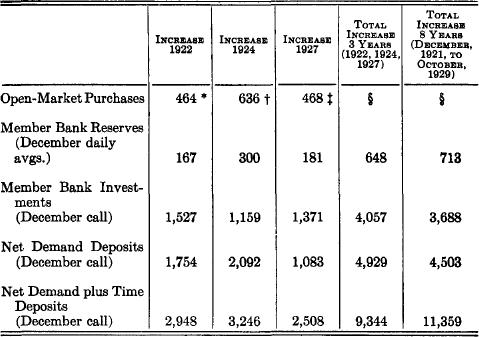
The table on page 90 shows the relations of Federal Reserve open-market purchases, increased reserves for the member banks, increased investment purchases, and increased deposits.
It is observable that 90 per cent of the increase in member bank reserves occurred in the three periods of Federal Reserve expansion, that all of the increases in investments and in net demand deposits were concentrated in those years, and that 80 per cent of the increase in total deposits coincided with Reserve credit expansion. Net demand deposits plus time deposits increased more in both 1922 and 1924, and in 1927 the increase was but slightly less, than the combined increase for all of the other five years of this period. The sequence of events leading to inflation clearly seems to have consisted of increased Federal Reserve open-market purchases, which resulted in increased member bank reserves; the new reserves were used by the member banks to add to their investment holdings, thus creating new deposits in the banking system.
What Dr. Miller describes as the condition in 1927, and the effect of the Reserve System’s activities in that year, is merely a repetition of the history of the expansions of 1922 and 1924. Business neither demanded nor needed additional credit for commercial purposes in those years. But as Miller says, banks are not in the habit of carrying uninvested idle reserves (or were not in those days, at least), and being faced with a condition of lack of demand for commercial loans on the part of the business community, the banks were virtually compelled to find an earning outlet for these accessions to their reserves by purchasing investments. But increased investment purchases, as pointed out in Chapter II, just as much as direct loan extensions, create increased deposits in the banking system. It was principally through the medium of increased purchases of investments that the original impetus to the upward expansion of credit came from the banks, rather than from requests of business men for increased commercial credit facilities.
TABLE VIII
OPEN-MARKET PURCHASES AND MEMBER BANK RESERVES, INVESTMENTS, AND DEPOSITS
(In Millions of Dollars)
* October 19, 1921, to June 17, 1922.
† September 29, 1923, to December 13, 1924.
‡ June 25, 1927, to December 17, 1927.
§ Not cumulated, because no progressive increase.
Following shortly upon the expansion of investment holdings in each of these three years, loans on securities, largely connected with stock market speculation, began to increase.8 Part of the increased deposits in 1922 came from increased loans on securities; this was even more true of those engendered during the 1924 expansion; and the greater portion of the increased deposits following upon the 1927 expansion came from this source.
The Board did not long persist in its policy of increasing Reserve credit during any single expansion period. Instead it actually reversed its policy in this respect, in each instance, and sought to reduce Federal Reserve credit by selling securities. It would be natural to expect that the contraction of Reserve credit would bring about a reduction of the reserve balances of the member banks (for the sale of securities by the Federal Reserve Banks operates to “mop up” member bank reserves, just as their purchase increases them) and thus force a contraction of total member bank credit. This is probably what would have happened had it not been for a set of developments9 taking place concurrently, that tended to nullify the attempts to effect a contraction of member bank reserve balances.
FACILITATING FACTORS IN THE INFLATION
Having considered the forces that initiated and generated the inflation, it will be in place to comment upon its long duration and the unprecedented height to which it attained.
There was no upward secular trend of Reserve credit outstanding during the period from 1922 to 1929; total Reserve Bank credit stood at $1,450 million in October, 1929, as against $1,548 million in December, 1921, and was, in fact, much larger in 1920 than in 1929 (a high of $3,522 million in October, 1920, and of $1,643 million in December, 1929, respectively). There was, however, an upward trend in member bank reserve balances, with total member bank reserves $713 million larger in October, 1929, than in December, 1921. Even this expansion of reserve balances does not serve fully to explain the 55 per cent increase in total credit, because member banks’ net demand deposits and time deposits increased 16 times as fast as did their reserves. This was perhaps the most unusual aspect of this most unusual period; the explanation of it contains the clue to the magnitude of the increase in bank credit.
One of the explanations for the rapid expansion of credit during the period under review was the reduction of legal reserve requirements for the member banks effected by the Federal Reserve Act. A banking system with an average reserve ratio of 10 per cent can maintain a total credit structure approximately double that when the reserve ratio is 20 per cent, and expansion on the basis of a given increase in reserves can proceed to twice the extent in the former case as in the latter. This in part explains why expansion was more extensive on the basis of an absolute increase in the volume of reserves than would have been possible under the National Bank Act; had the reserve requirements of the National Bank Act been retained in the Federal Reserve Act, the expansion of the ’twenties could not have been so pronounced. This does not, however, account fully for the magnitude of the inflation, nor does it in any sense explain the continued expansion of member bank reserves.
A more important reason for the prolongation of the expansion of member bank credit was the action of these banks in borrowing from the Federal Reserve Banks in order to replenish reserves. Federal Reserve policy was integrally connected with the process of member bank rediscounting. Each time that the Federal Reserve Banks embarked upon a policy of open-market purchases they also eased rediscount rates. Member bank borrowing did not follow promptly upon the reductions in the discount rate; indeed, the accessions to member bank balances were used in part to pay off existing indebtedness to the Reserve Banks. It was not until the Reserve Banks reversed their open-market policy and began to sell securities that rediscounting on the part of the member banks began to increase. A chart showing Reserve Bank open-market purchases and member bank borrowing would indicate an almost perfect inverse correlation between the two.
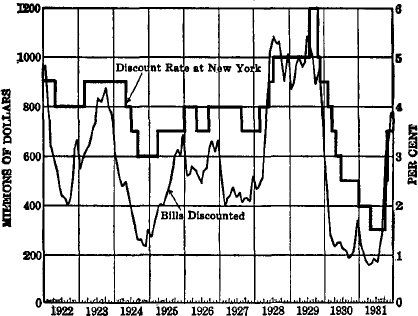
The sale of securities by the Reserve Banks normally has an effect opposite to that accompanying their purchase—it tends to contract member bank balances with the Federal Reserve Banks, and hence to reduce their reserves. Reversals in rate policy, however, did not coincide with the reversals in open-market policy; rediscount rate increases, forcing a diminution of rediscounting, came later in time than the sales of securities on the part of the Reserve Banks. Chart I on the following page depicts graphically the relations between Federal Reserve discount rate policy and member bank rediscounting activities.
Open-market purchases of securities ceased in June, 1922, but the rediscount rate was not raised until March, 1923. When the Reserve Banks began to sell securities following June, 1922, the member banks offset the contraction in reserve balances, which would otherwise have followed, by rediscounting with the Reserve Banks, and thus were able to maintain their total reserves virtually intact. Rediscounts increased from $396 million in August, 1922, to $873 million in October, 1923; reserve balances for the member banks stood at $1,820 million June 30, 1922, and were $1,839 million September 30, 1923. In December, 1924, the Reserve Banks again reversed their open-market policy of expansion, and again sold securities; as rediscount rates were low at that date, member bank rediscounting rose from $228 million in November, 1924, to $688 million in December, 1925, before the increased rediscount rate became an effective check upon member bank borrowing. Member bank reserves increased from $2,182 million in December, 1924, to $2, 219 million in December, 1925. And when the open-market policy of 1927 was reversed by the Reserve Banks in December of that year, rediscounting again increased, and continued into August of 1928 before successive rate increases checked it. It is true that rate increases in this last instance followed rather promptly on the reversal of open-market policy; but, as inflation and the stock market boom had by this time manifested unmistakable “runaway” tendencies, it was found that more drastic rate increases were necessary to discourage further member bank borrowing.
CHART I
REDISCOUNT RATE AND VOLUME OP REDISCOUNTING, 1922-31
Source: Hardy, C. O., Credit Policies of the Federal Reserve System (Washington: The Brookings Institution, 1932), p. 229. Reproduced by permission.
Thus, each time that the Reserve Banks sought to reverse their open-market policy of expansion by selling securities, that action was rendered ineffectual by rediscounting on the part of the member banks; the reserve balances which had been built up at the instance of Reserve Bank open-market purchases were maintained at approximately the same level by the member banks on their own initiative through the simple process of borrowing from the Federal Reserve Banks. But it should not be concluded that Federal Reserve policy aiming at credit contraction would have been ineffective in any event; had the Board and the Reserve Banks seen fit to act more vigorously and more resolutely—that is to say, had rate increases been more positive, and had they occurred simultaneously with the sales of securities—it is improbable that the situation would have gotten so far out of hand.
Rediscounting by the member banks served to replenish their reserves and operated to prolong and heighten the inflation. Each period of Federal Reserve open-market operations tended to lift member bank reserves to a new plateau, and the member banks in replenishing their reserves by borrowing were able to maintain their reserves at approximately that same level until the next period of open-market purchases came along. The successive periods of open-market purchases began in each instance from a higher plateau of absolute reserves, so that reserves were progressively pushed upward and there was therefore no necessity for member banks to make positive reductions in total bank credit outstanding.
DISPROPORTIONATE GROWTH OF TIME DEPOSITS RESULTED IN PROGRESSIVE DECLINE IN AVERAGE RESERVE-DEPOSIT RATIO
A factor of even greater importance than the two foregoing in explaining the continuation and the magnitude of the inflation was the conversion of demand deposits into time deposits, which brought about a progressive decline in the average reserve-deposit ratio for the banking system. It was the most deceptive of the factors at work, and went almost wholly unobserved at the time.10 It serves to explain why member bank credit continued to expand during periods when Federal Reserve action was seeking to effect credit contraction, and why total credit was expanding even when member bank reserves were not increasing. It is also the clue to the explanation of why total member bank credit could expand 16 times the increase in member bank reserves, and hence why credit expansion was so rapid and so pronounced during the periods of open-market purchases of securities.
The disproportionate growth of time deposits in the banking system beginning with 1922 was one of the most striking aspects of this whole period of credit growth.11 As time deposits comprised an ever-increasing proportion of total deposits, the average reserve ratio required against deposits declined. This is attributable to the fact that the legal reserve required to be maintained against time deposits in National Banks (and other member banks) was (at that time) only 3 per cent, whereas against demand deposits it ranged from 7 to 13 per cent according to the classification of the banks. A shift in the proportion between demand deposits and time deposits in favor of the latter reduces the average required reserve-deposit ratio, and hence frees reserves which may be used as the basis for further credit expansion. A declining average reserve ratio operates to increase the excess reserves in the banking system just as much as positive increases in reserves induced by Federal Reserve open-market purchases or member bank borrowings. As a result of the reduced reserve ratio, the banks were not only able to maintain the existing credit structure on the basis of a given absolute volume of reserves, but actually to increase total credit outstanding without any positive additions to that same volume of reserves.
The following table shows the comparative growth of net demand deposits and time deposits for the Reporting Member Banks from 1921 to 1929.
TABLE IX
REPORTING MEMBER BANKS, NET DEMAND AND TIME DEPOSITS
(In Millions of Dollars)
Monthly averages of weekly figures
| DECEMBER | NET DEMAND DEPOSITS | TIME DEPOSITS |
| 1921 | 10,247 | 3,009 |
| 1922 | 11,146 | 3,720 |
| 1923 | 11,127 | 4,083 |
| 1924 | 13,184 | 4,855 |
| 1925 | 13,173 | 5,357 |
| 1926 | 13,032 | 5,768 |
| 1927 | 13,872 | 6,419 |
| 1928 | 13,399 | 6,842 |
| 1929 (October) | 3,633 | 6,839 |
| Per Cent Increase | 33% | 127% |
From December, 1921, to October, 1929, the increase in net demand deposits in the Reporting Member Banks was roughly 33 per cent while the increase in their time deposits was 127 per cent, or an average annual percentage increase of time deposits four times that of demand deposits. The comparative growth of time deposits in the Reporting Member Banks of New York City was even more rapid, as shown in Table X.
TABLE X
REPORTING MEMBER BANKS IN NEW YORK CITY, NET DEMAND AND TIME DEPOSITS
(In Millions of Dollars)
Monthly averages of weekly figures
| DECEMBER | NET DEMAND DEPOSITS | TIME DEPOSITS |
| 1921 | 4,219 | 290 |
| 1922 | 4,325 | 539 |
| 1923 | 4,234 | 609 |
| 1924 | 5,372 | 814 |
| 1925 | 5,204 | 792 |
| 1926 | 5,094 | 902 |
| 1927 | 5,570 | 1,034 |
| 1928 | 5,305 | 1,198 |
| 1929 (October) | 5,561 | 1,258 |
| Per Cent Increase | 32% | 333% |
BANK CREDIT EXPANSION VERSUS DIRECT SAVING AS AFFECTING GROWTH OF TIME DEPOSITS
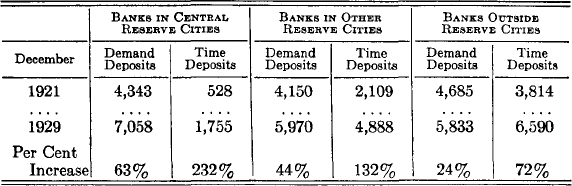
It seems highly probable that most of the growth of time deposits was a product of bank credit expansion, rather than of direct saving, as some observers have contended.12 Open-market operations are usually carried out in the larger cities. If there had been a general growth of saving throughout the country, it is to be supposed that the growth in time deposits in the smaller cities would have kept pace, at least to a considerable degree, with that in larger cities. The evidence of Table XI, however, is that the increase in time deposits was especially pronounced in those centers most affected by open-market operations of the Reserve Banks; the percentage increase for the banks in Central Reserve Cities (New York and Chicago) was thrice the increase for those outside Reserve Cities, and in absolute amount the growth of time deposits in Reserve Cities alone (63 in number in 1929) exceeded that for the country banks.
TABLE XI
NET DEMAND AND TIME DEPOSITS, ALL MEMBER BANKS
(In Millions of Dollars)
The most pronounced growth in time deposits, furthermore, coincided with the periods of rapid Reserve credit expansion. It may be observed from Table IX, above, that 55 per cent of the increase in time deposits for the Reporting Member Banks was concentrated in the three years 1922, 1924, and 1927. For the Reporting Member Banks in New York City, 64 per cent of the total increase in time deposits occurred in these three years. During the year 1922, time deposits in the Reporting Member Banks in New York City rose by 86 per cent, and in the following year only 13 per cent; in 1924, time deposits increased 34 per cent, and during 1925 there was an actual decrease of 3 per cent; time deposits increased rapidly again in 1927, with Reserve credit expansion, and slowed down in 1928 when that expansion ceased. What is true of New York holds also for Chicago, these being the two cities where the major portion of open-market operations are usually conducted.
Thus it is seen that the greatest growth of time deposits coincided in points of time with the Federal Reserve open-market purchases of securities, and that this growth of time deposits was in each instance relatively greater than the growth of demand deposits. Chronologically and causally, the order of developments was as follows: Federal Reserve open-market purchases resulted in expansion of member bank reserve balances; this served to instigate increased purchases of investments by the member banks; and the credit generated thereby took the form largely of time deposits. The Reserve Banks pumped credit into the money market, inducing increased reserves in the banking system; the banks used the new reserves to purchase investments (later, to make loans on securities) which created more deposits in the banking system, and the increased deposits, being unneeded by business men and corporations as demand deposits for current transactions, were shifted to time deposits which would draw interest. This greater relative growth of time deposits operated to reduce the average reserve-deposit ratio, hence freeing reserves which in turn could be used by the banks further to increase their investments and their loans on securities without any absolute increase in reserves.
PAYMENT OF INTEREST ON TIME DEPOSITS A FACTOR IN THEIR EXPANSION
It should be remarked at this point that another of the changes introduced by the Federal Reserve Act assisted in the greater relative growth of time deposits. The preference displayed by corporations and business men with idle bank balances on hand for having those balances in the form of time deposits was largely influenced by the interest to be earned on time deposits. It was mentioned in Chapter II that the Federal Reserve Act sanctioned the payment of interest on time deposits by member banks, making this privilege fully and legally available for the first time to the National Banks. Without this inducement to carry idle funds in the form of time deposits it is unlikely that such deposits would have increased so rapidly; and had they not done so, the reduction in the average reserve ratio which assisted so materially in the expansion of credit probably would not have been so extensive.
FEDERAL RESERVE BOARD COGNIZANT OF TIME DEPOSIT DEVELOPMENTS
That the Federal Reserve Board was fully aware of the existence and nature of these developments is evidenced by its Annual Report for 1927:
The continuous growth of time deposits in recent years at a rate more rapid than the growth in demand deposits has resulted in an increase in the proportion of the banks’ deposit liabilities that is represented by time deposits. This more rapid growth of time deposits, which require only 3 per cent reserve, has been an important factor in the past six years in enabling member banks to increase their loans and investments by $11,000,000,000 on the basis of $756,000,000 added to their reserve balances. This expansion during the past six years at the rate of $15 of credit to $1 of reserve has reduced the average required reserves * * *.
In its Annual Report for 1926 the Board had also called attention to this growth in time deposits, and the significance of that development for the reserve situation:
Another phase * * * in the operations of member banks arises from the fact, already mentioned, that time deposits have been increasing much more rapidly than demand deposits. Since legal reserve requirements against time deposits are 3 per cent, while against net demand deposits they range from 7 to 13, the increase in the proportion of time deposits has had the effect of decreasing the average amount of reserves * * *. This decline in ratio means that member banks were able to comply with legal reserve requirements with a considerably smaller amount of reserves than would have been necessary had the proportion of time to demand deposits remained unchanged or, to put it another way, to add a large amount to their loans and investments without a corresponding increase in their reserves. As a matter of fact, reserve balances of member banks have not increased since the end of 1924, while there has been since that time a growth of about $2,900,000,000 in the total amount of credit extended by these banks.
The core of the explanation, then, of why credit could expand at a rate faster than the expansion of reserve balances and why total outstanding credit reached such an altitude is found in the declining average reserve ratio of member banks. Considering the Reporting Member Banks alone, the reserve balances at the end of 1924 stood at $1,690 million and in June, 1929, they were $1,672 million—an actual decrease of $18 million—yet the loans and investments of the Reporting Member Banks expanded by the amazing total of $3,729 million between these dates!
THE PARADOX OF INCREASING MEMBER BANK CREDIT COMBINED WITH RISING RESERVE RATIO OF FEDERAL RESERVE BANKS
This factor also serves to explain the seemingly anomalous situation of increasing member bank credit at times when the reserve ratio of the Federal Reserve Banks was also increasing; a rising reserve ratio for the Reserve Banks would ordinarily indicate that Reserve Bank reserves were not being used to finance credit expansion. It was this condition of a rising reserve ratio for the Reserve Banks which confused European observers of the American gold and credit situation, and caused some of them to believe that the United States was “sterilizing” gold. Even such a careful student of banking and credit conditions as Cassel was led to the misstatement that13 “* * * in * * * the United States there was an aversion from using the fresh gold acquired for any such purpose [credit expansion], and to a large extent the gold was simply buried in the vaults of the Central Banks.” Far from lying buried and unused in the vaults of the Federal Reserve Banks, the gold was being used more effectively to finance a period of inflation than during any like peace-time period in history.14 A high, and at times rising, reserve ratio for the Federal Reserve Banks might suggest that the gold was lying idle in the vaults of the Reserve Banks; but the habit of European economists of looking at the central bank reserve ratio overlooks the essential importance in this country of the magnitude of the excess reserves of the member banks. Member bank credit increasing at a rate 16 times faster than the increase in members’ reserves, and gold reserves in 1929 less than 7 per cent of the total credit outstanding for all banks in the country, are facts incompatible with the idea of sterilization of gold.
It should now be apparent that the expansion of the ’twenties was almost exclusively an outgrowth of changes in our banking system introduced by the Federal Reserve Act. It is partly for this reason that the inflation is denominated a central banking phenomenon. But even the introduction of a central banking system would not have permitted so rapid and so extensive an expansion of credit without the concurrent changes in reserve requirements and those respecting time deposits. And at the same time it is improbable that the expansion would have gotten under way had it not been for the action of the central banking authorities in initiating the inflation.
THE NATURE OF THE INFLATION
The inflation of 1922–1929, the extent of which is set forth in the first section of this chapter, has been characterized as an “investment inflation,” or capital inflation. Banks during this period were tying up an increasing share of their resources in assets not readily liquidated; they were extending to business men and to industry, or through their banking operations they were enabling business men and industry to acquire, long-term or capital credit, with fixed assets of one character or another pledged as security. Further, the banks were becoming intimately entangled with the capital market by engaging in extensive security-market financing. The proportion of their assets which represented commercial credit in the strict sense progressively constituted a decreasing proportion of their total resources, while the proportion which went into investment or capital assets consistently increased, taking the form of loans on real estate, loans on securities (largely stock exchange lending), and outright purchases of investments. These faets are brought out in Table XII, which shows the percentage distribution of loans and investments for all member banks, and index numbers of these items computed on the basis of the figures for 1921 as 100.
TABLE XII
LOANS AND INVESTMENTS, ALL MEMBER BANKS, 1921, 1928, AND 1929
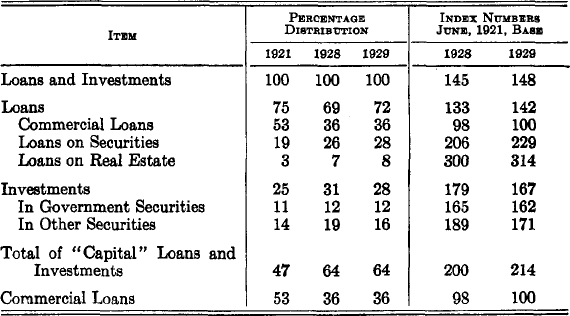
According to Table XII Loans declined from 75 per cent of Total Loans and Investments in 1921 to 69 per cent of the total in 1928; Commercial Loans declined from 53 per cent to 36 per cent, while Loans on Securities and Loans on Real Estate increased from 19 per cent to 26 per cent and from 3 to 7 per cent, respectively. Investments rose between the same dates from 25 per cent of Total Loans and Investments to 31 per cent, almost all of the increase being represented by Investments in corporate and other securities. Furthermore, although Loans on Securities and Loans on Real Estate are technically classified as loans, the actual character of many such assets was such as to cause them to stand in much the same relation to the process of inflation as did investments proper; the proceeds of a considerable portion of these loans, in other words, were used for purely “investment” purposes, rather than to expedite commercial and industrial activities. Investments increased 79 per cent between 1921 and 1928, while all Loans were increasing but 33 per cent and Commercial Loans were actually declining; there was a slight decrease in Investments from 1928 to 1929, apparently because banks sold their investment assets in order to increase their Loans on Securities and on Real Estate. It is also significant that the sale of these securities during 1928 and 1929 depressed the bond market in those years and caused a rise in the rate of interest on corporate securities.
A more complete presentation of the nature of the 1921–1929 inflation is found in Table XIII, submitted by Dr. Miller of the Reserve Board in his testimony before the Committee on the Hearings on the Operation of the Banking Systems (Part I, p. 138), and presumably accessible only to Reserve System officials prior to that time.
TABLE XIII
LOANS AND INVESTMENTS OF ALL MEMBER BANKS
(In Millions of Dollars)
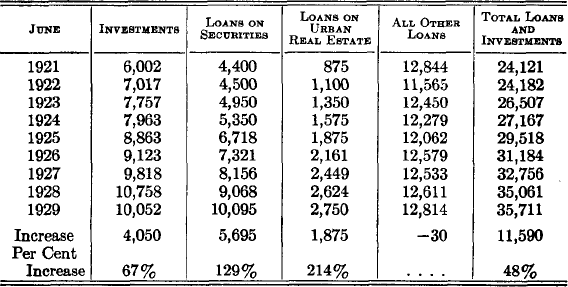
Commercial Loans Strikingly Stable
This table is deserving of careful examination. It is to be observed that total loans and investments for all member banks show an increase of $11,600 million during the eight-year period, all of which took the form of increases in investments, increases in loans on urban real estate, or increases in loans on securities. The commercial loans (“all other loans”) were actually less at the end of the period than at the beginning, and their stability throughout the period is worthy of notice. After the one rather sizable increase from 1922 to 1923, representing largely a recovery from the extremely drastic deflation of commercial credit during the 1920-1921 depression, commercial loans varied less than $400 million for the remainder of the period.
While the commercial loans were displaying this pronounced stability, the investments of the member banks were increasing by 67 per cent, their loans on securities were expanding by 129 per cent, and their loans on urban real estate were advancing by 214 per cent. The effects of this upward thrust of bank credit were first revealed through the medium of increased investments, but shortly afterward they became apparent in connection with the “loans on securities” category. It is not difficult to trace the real beginnings of the stock market boom to the expansion in loans on securities engendered by the Federal Reserve credit expansion of 1924, with such loans increasing 26 per cent between June, 1924, and June, 1925. Loans on securities were approximately two-thirds of the investments total at the beginning of the period, yet they exceeded the investments at the end of it. In 1921, loans on real estate were 3 per cent of total loans and investments, but in 1929 were 8 per cent, contributing almost one-sixth of the absolute increase in total loans and investments.
It is apparent that the indictment of the American banking system by the late Paul M. Warburg made before the National Monetary Commission and prior to the establishment of the Federal Reserve System, unfortunately still held good in 1929:15 “The European financial system is constructed upon discounts as its foundation; the American system is constructed upon bonds and stocks as its foundation.” Indeed, the above figures seem to indicate that the foundation had simply been considerably enlarged—and commensurately weakened—by the operations of the Federal Reserve System itself.
EFFECTS OF THE INFLATION
It is observable that the inflation of bank credit from 1922 to 1929 had three highly significant effects upon the banking and financial system and upon business. First, the liquidity of all banks declined, rendering the banking system particularly susceptible to the vagaries of an unstable stock market. Secondly, an abnormal “roundaboutness” developed in the way in which bank credit was extended to the business community by the banks. And thirdly, there was engendered a marked investment or capital boom, which sustained business activity at an artificial level and whose inherent instability was not easily recognizable.
Liquidity of Banks Impaired
The most striking aspect of the declining liquidity of the banking system had to do with the reduction in the proportion of commercial loans in bank portfolios. The discount foundation, slender enough at the outset, was further weakened during the course of this investment credit inflation. Commercial banks, in other words, were largely forsaking commercial banking operations in favor of dealings in credit extensions of a long-term or capital nature.
These departures from the tested tenets of sound banking were recognized as early as 1926 by the Federal Reserve Board in its Annual Report for that year (p. 10):
The changing character of the business of member banks in recent years has thus been characterized by an increased use of their resources in long-time investments and in loans not arising out of the current requirements of trade and industry * * *. This is a development which, though it may in some cases result in strengthening the position of individual member banks, represents a departure from the original conception of the Federal reserve banking system as of a cooperative undertaking among commercial banks engaged primarily in the financing of the current operations of productive industry and trade. As long-time trends these changes in the character of the business of the member banks are significant both because they tend to decrease the proportion of short-term, self-liquidating paper in the assets of member banks and because they result in relatively smaller reserve holdings against the deposits of these banks.
This decrease in the proportion of short-term, self-liquidating assets served to lessen the liquidity of the banks and to reduce their ability, both relatively and absolutely, to meet their deposit liabilities upon demand or short notice; at the same time the growth of assets of a long-term character made it increasingly difficult for the banks as a whole to realize upon those assets by conversion into cash if necessity for such action arose.
There is a vast difference between liquidity and “shiftability.” Liquidity denotes ability to realize direct amortization of the loan, the making of which gave rise initially to the asset in the bank’s portfolio; shiftability implies ability to obtain cash by transference of that asset to some other bank or person ready and able to take it over. But if all banks engage in a program of building up their investment assets at the expense of their self-liquidating assets, shiftability is found to be impaired, if at all attainable, should all banks later attempt to improve their cash positions by transferring their investment assets elsewhere. Outside of the banking system itself, there is usually an insufficiency of liquid resources in any nation to absorb a wholesale liquidation of investment assets, and when all banks are mutually embarrassed with a surplusage of investment assets, no place to shift such assets can be found. This was the situation that developed in the closing months of 1931 when the wave of bank failures made it imperative that banks improve their cash positions; their wholesale efforts to convert investment holdings into cash resulted in one of the most precipitate drops in bond prices on record.
Two Aspects of Liquidity
It is conceded that an argument of considerable plausibility can be offered in support of the thesis that there is no such thing as “liquidity” for the banking system in time of difficulty—even in the case of short-term, self-liquidating paper.16 The authors incline to the position, however, that the traditional principles of basing banking operations on short-term transactions in self-liquidating commercial paper are still largely valid and fundamentally sound. The views on banking liquidity of the late Professor J. Lawrence Laughlin, of the University of Chicago, may well be recalled:17
Here is the crux of the whole matter. * * * Short-term loans on salable goods on the way from the producer to the consumer are the most liquid loans a bank can make; for when sold the goods bring in the cash with which to meet the debt. * * * Therefore, the solvency of a bank is always tested by the character of the assets in its loan items; if of a high class and short-time they can be rediscounted for cash.
Two aspects of liquidity are brought out in this excerpt from Professor Laughlin: the one, that short-term or commercial loans are self-liquidating in character; the other, that they are rediscountable for cash. To provide adequate rediscount facilities was one of the principal objectives sought in the establishment of the Federal Reserve System, and rediscounting is one of the primary functions of all central banking systems. But apart from the rediscounting feature attaching to short-term loans, a commercial bank should be able readily to improve its reserve position by simply refusing to make new loans and calling for the repayment of outstanding loans as they mature.
The theory of the “self-liquidating” loan is that the transaction which presumably was facilitated by the original making of the loan should itself provide the funds with which to discharge the loan. In this way, a bank can speedily reduce its loans, and, as reduction of loans and reduction of deposits go hand in hand, it can improve its reserve-deposit ratio and hence its liquidity in a comparatively short space of time, even without resort to rediscounting, provided that a substantial portion of its loans are actually “self-liquidating” in character. And the rediscounting privilege is still available, in the event that it appears desirable to enhance the liquidity of the bank even more hastily.
It should be clearly understood that the above analysis relates principally to a well-managed commercial bank, and that its applicability to the commercial banking system is in some degree limited. Liquidity of the individual bank can bring liquidity to the system only in a restricted sense. It is apparent that simultaneous attempts to liquidate by all banks could hardly fail to bring economic activity to a virtual standstill; the effects of attempts to liquidate the entire banking system, if it could be done, would be even more disastrous than those which result from illiquidity of the units of that system. There is, nevertheless, a solid residuum of truth in the older doctrine that the banking system is less vulnerable and more stable if the individual banks are in a genuinely liquid condition. If the individual components of the banking system are liquid, there is much greater likelihood that an incipient banking crisis can be kept under control and prevented from spreading into a disastrous financial conflagration.
Decline in Ratio of Gold to Deposits Suggests Declining Liquidity
Aside from this decline in the liquidity of the banking system with regard to the character of the assets involved, the liquidity of the system declined in another respect during this period, that is, in the proportion of its ultimate reserves to deposit liabilities. The following table compares the deposits of all commercial banks with the gold reserves of the Federal Reserve Banks. While it is true that the gold reserves of the Federal Reserve Banks do not properly indicate the total reserves of all commercial banks, the overlapping and pyramiding of reserves which was one of the weaknesses of the National Banking System, in appreciable measure still obtains. The non-member commercial banks carry the greater part of their reserves as deposits with the member banks, just as the member banks carry all their (legal) reserves in the form of deposit balances with the Federal Reserve Banks, so that in effect the reserves of the Federal Reserve Banks constitute the ultimate reserves for the entire banking system.
Thus liquidity declined for the banking system by one-third, viewed from the standpoint of one interested in the proportion of ultimate reserves held against deposit liabilities. If a 10-per-cent reserve ratio is considered a satisfactory one for the safe conduct of banking operations and for proper liquidity, certainly a 7-per-cent ratio indicates an illiquid condition, since the ability of the banks to meet demands for cash is greatly impaired.
TABLE XIV
INDIVIDUAL DEPOSITS, ALL COMMERCIAL BANKS, AND GOLD RESERVES OF THE FEDERAL RESERVE BANKS
(In Millions of Dollars)
| JUNE | DEPOSITS | TOTAL GOLD RESERVES, FEDERAL RESERVE BANKS | RATIO OF GOLD TO DEPOSITS |
| 1922 | 29,867 | 3,022 | 10.1 |
| 1929 | 42,580 | 2,858 | 6.7 |
Credit Extension by Indirection
Intimately related to the declining liquidity of the banking system and to the decline in importance of commercial loans, there developed an increasing indirectness of the relationship between the banking process and the financing of production and trade. By using their growing reserves to purchase investments and to make loans on securities and on real estate, the banks were increasing the deposits of the system and hence were furnishing increasing amounts of credit to the business community; but in this way bank credit reached the processes of production and trade through the capital and securities markets, rather than through direct loans to business men to finance short-term commercial transactions. The decline in commercial loans cannot be charged entirely to the unwisdom of the bankers; part of this decline was due to decreased demands for credit on the part of business men actuated by a desire to get out of debt to the banks after their unpleasant experiences in the stringency of 1920-1921. Nevertheless, the indirect extensions of credit initiated by the action of the banks assisted in facilitating this debt-reduction policy.
The utilization of increased reserves to purchase investments forced down the long-term rate of interest so that corporations found it profitable to float bonds and stocks, using the proceeds to retire their bank loans.18 In absorbing these new issues the commercial banks were indirectly supplying additional bank credit funds to industry, but at the same time this very process operated to reduce their direct loans to business men and corporations. In the course of time, in fact, this increased flotation of corporate securities in an especially favorable capital market virtually surfeited some of the issuing corporations with liquid funds for which they found a profitable use in. the stock exchange call-loan market, adding new fuel to the already raging flames of stock market speculation. These call loans in the stock market made by corporations constituted a large part of the “loans by others” item appearing in the monthly statements of brokers’ loans.
An Inherently Instable Boom
The most important effect of the abnormally low interest rates and the inflation, as these were related to subsequent cyclical developments, was the stimulation of a marked boom in the construction of capital goods. By injecting new credits into the business situation via the securities and capital markets the banks financed a constructional boom of immense proportions, as well as a real estate boom.19 The early flotations of securities, as just mentioned, enabled corporations to retire much of their previously incurred indebtedness to banks. Additional issues of new securities were also absorbed by the banks, seemingly quite willingly and without misgivings; the continuation of this process served to depress further the long-term rate of interest and at the same time to generate new deposits. The proceeds of the later issues were used in a variety of ways. Industrial plant extensions, public utility construction, and increased and improved mechanization of industry were all financed thereby. Real estate bond issues were brought out on a scale unmatched in previous history. States and municipalities sold bonds to the banks and used the new credit to further street and highway construction, school building programs, water works, and other construction of a capital nature. Our export trade was stimulated by extensive over-seas lending, again assisted by the banks. Finally, the stock market received a new impetus from the abundant credit made available to it by the banks, beginning principally during the Reserve credit expansion of 1924 but with its most important developments proceeding from the 1927 expansion. All of these factors, plus the new use to which the superabundant credit was put in connection with the highly important matter of installment financing, helped to carry business activity on the false bottom of credit inflation long enough for the term “New Era” to become a byword; they all contributed to the prosperity of 1928 and 1929, the intrinsic weaknesses and spurious character of which were not widely recognized until the decline began in the autumn of 1929.
It was through these various booms of a capital nature that the “cheap credit” policy of this period found its chief outlets. The net effect of these influences was to produce an alteration in the structure of production; that is to say, there was a more than proportionate increase in the production of capital goods as compared with consumption goods. Investment (in the sense of the creation of real capital equipment) financed by bank credit was proceeding at a rate in advance of the accumulation of real savings. The disproportionate increase in investment activity and the stock market boom would not have developed had it not been for the aiding influences of the banking system; without the effects of this disequilibrium between investment and saving the declining liquidity of the banking system by itself probably would not have brought on utter collapse.
The relation of this disequilibrium between saving and investment to the depression is treated at length in the next chapter; the part played by the stock market collapse in contributing to the length of the depression is dealt with in Chapter VII.
20 “Investment inflation” and “investment credit” are used here in the sense employed by Professor F. A. Bradford in an article, “Social Aspects of Commercial Banking Theory,” American Economic Review (June, 1933), Vol. XXIII, No. 2, p. 217 ff., and by Professor E. C. Harwood in his book, Cause and Control of the Business Cycle (Boston: Financial Publishing Company, 1932).
21 The foregoing figures, as well as those presented in following pages, unless specifically cited, are taken from the Federal Reserve Bulletin and the Annual Reports of the Federal Reserve Board. To reduce the annotation, specific citations are dispensed with as much as possible.
22 The best treatments of the changing developments in American banking during this period are the study prepared for the National Industrial Conference Board by Professor Ralph A. Young of the University of Pennsylvania, entitled The Banking Situation in the United States (New York: National Industrial Conference Board, 1932), and The Banking Situation, by Professors Willis and Chapman (New York: Columbia University Press, 1935). In certain respects even more valuable, because in the nature of “spot” analyses, are the writings of Dr. B. M. Anderson, Jr., economist of the Chase National Bank. Much the same may be said of the work of Professor H. Parker Willis of Columbia University. In a whole series of articles beginning as early as 1923 Anderson repeatedly pointed out the evils attendant upon Federal Reserve credit expansion for the banking system as a whole, the most important of these being “Cheap Money, Gold, and Federal Reserve Bank Policy” (Chase Economic Bulletin, Vol. IV, No. 3), “Bank Money and the Capital Supply” (Ibid., Vol. VI, No. 3), and “Bank Expansion Versus Savings” (Ibid., Vol. VIII, No. 2); for others dealing with this same question, consult the bibliography at the end of this volume. Professor Willis, in his regular articles contributed to The Banker (London) and in two articles in The North American Review (“The Failure of the Federal Reserve System,” Vol. 227, No. 5, and “Who Caused the Panic of 1929?” Vol. 229, No. 2), displays his keen understanding of what was taking place. Those who complain that economists were not conversant with the nature of the developments of this period need only glance back at what was then being written by these two men. Their writings, and the study of Professor Young, have been drawn upon in the preparation of this chapter. For a foreign viewpoint, see R. W. Goldschmidt, The Changing Structure of American Banking (London: Routledge, 1934).
23 In support of this contention, the testimony of Dr. A. C. Miller of the Federal Reserve Board is of special interest: “In the year 1927, if the Committee will look at the curve [relating to Federal Reserve holdings of Government securities], you will note the pronounced increases in these holdings in the second half of the year. Coupled with heavy purchases of acceptances it was the greatest and boldest operation ever undertaken by the Federal Reserve System, and, in my judgment, resulted in one of the most costly errors committed by it or any other banking system in the last 75 years. I am inclined to think that a different policy would have left us with a different condition at this time. You notice that as the volume of these securities voluntarily purchased by the Federal Reserve increases; in other words, as the Federal Reserve puts money into the market, not because member banks asked for it by offering paper for rediscount, but in pursuance of an affirmative policy of our own which in effect said,
‘We shall not wait to be asked to provide increased money through rediscounts; we will operate upon our own responsibility and through our own instrumentality, to wit, the purchase of U. S. Government obligations—’
there followed an increase in the reserve balances of the member banks * * *. That [1927] was a time of business recession. Business could not use and was not asking for increased money at that time. But the banks do not want to and in fact do not carry uninvested moneys or idle reserves. Here, then, in 1927, came an accession to their reserves for which they had to find a use.” Hearings on the Operation of the National and Federal Reserve Banking Systems, pursuant to Senate Resolution 71, Part 1, p. 71. [Hereinafter referred to as Hearings on the Operation of the Banking Systems.] (Washington: Government Printing Office, 1931.)
24 See p. 89 and pp. 92 ff.
25 “In the Federal Reserve System, a buffer is created between the credit superstructure and the gold base, a buffer which is found in member bank reserve balances. These balances are the effective reserve base of the credit structure, and excessive fluctuations can and do take place in their volume, quite unlike the movements of the gold reserves of the country.” Edie, L. D., “The Future of the Gold Standard,” in Gold and Monetary Stabilization, p. 119.
26 “But in that period [1922–1929] there were three periods when the Federal reserve credit did increase, and that was when we were buying Government securities. From February to June, 1922 * * * from April to December, 1924, * * * and in 1927, the last quarter. * * *” Testimony of C. S. Hamlin of the Federal Reserve Board before the Senate Banking and Currency Committee, Hearings on the Operation of the Banking Systems, Part I, p. 165.
27 “Investments * * * began to increase in the late fall of 1921 and increased steadily after that time. * * * Loans secured by Government obligations and ‘all other loans’, which comprise the bulk of commercial loans, followed [declined] upon the same course both relatively and absolutely as total loans. But loans secured by stocks and bonds, which represent in part stock-exchange loans, * * * increased. * * * “Ninth Annual Report of the Federal Reserve Board (1922), p. 7.
28 See pp. 92-101, below.
29 Anderson and Willis, as mentioned, being conspicuous exceptions.
30 “The change noted in the composition of loans and investments of member banks has been accompanied by a corresponding change in the character of their deposits. Since 1922 net demand deposits of reporting member banks have increased 27 per cent, while their time deposits have increased 93 per cent, and the proportion of time deposits to the total of time and net demand deposits has increased from 23 to 31 per cent. * * * Looking at the developments in the condition of member banks as a whole in recent years, the outstanding changes have thus been in the direction of a larger proportion of long-term investments and of loans on securities and of a corresponding increase in the proportion of time deposits, as compared with deposits payable on demand.” Thirteenth Annual Report of the Federal Reserve Board (1926), p. 8.
31 The contrary view is advanced by W. Randolph Burgess, The Reserve Banks and the Money Market (New York: Harper & Brothers, 1927), pp. 37–38: “The writer’s tentative conclusion from these figures and other evidence is that time deposits in commercial banks are to a considerable extent genuine savings deposits * * *.” And see the article by Elmer Hartzell, “Time Deposits,” in the Harvard Business Review (October, 1934), Vol. XIII, No. 1.
32 The Crisis in the World’s Monetary System (Oxford: Oxford University Press, 1932), p. 71.
33 “We have made a more intensive utilization of gold than any other country except England.” John H. Williams, in Gold and Monetary Stabilization, p. 149.
34 Quoted by Phillips, C. A., Readings in Money and Banking (New York: The Macmillan Company, 1921), p. 707.
35 See especially the article by Professor Fritz Machlup, formerly of the University of Vienna, “The Liquidity of Short-term Capital,” Economica (August, 1932), Vol. XII, No. 37, pp. 271 ff.
36 Money, Credit and Prices (Chicago: The University of Chicago Press, 1931), Vol. II, p. 724.
37 “The decrease in commercial loans was due, in addition to the smaller volume of business activity, also to the fact that corporations floated securities at the prevailing low rates and used the proceeds to reduce their bank loans.” Fourteenth Annual Report of the Federal Reserve Board (1927), p.5.
38 “The growth in member bank credit * * * therefore * * * was not entirely in response to current requirements of trade and industry, but included an element of growth of credit for longer term purposes, and particularly for the financing of building operations and real-estate transactions.” Thirteenth Annual Report of the Federal Reserve Board (1926), p. 6.
- 1Foreign Exchange Before, During, and After the War (London: Oxford University Press, 3rd ed., 1925), p. 9.
- 2Strategic Factors in Business Cycles (New York: National Bureau of Economic Research, 1934), p. 4.
- 3“The Problem of Business Cycles,” in the Skandinaviska Kreditaktiebolaget Quarterly Report, January, 1933, p. 3.
- 4Ibid., p. 3.
- 5Cassel, G., The Theory of Social Economy (New York: Harcourt, Brace & Co., 1932), p. 538.
- 6Strategic Factors in Business Cycles, p. 6.
- 7Journal of the Institute of Bankers (June, 1931), Vol. LII, Part VI, p. 236.
- 8“Depression has continued because there is no prospect of profitable investment. And why is there no prospect of profitable investment? Because costs, which by reason of the inflationary boom have become too high in relation to prices, have not been reduced.” Lionel Robbins, in Lloyds Bank Monthly Review (October, 1982), Vol. III (NS), No. 32, p. 432.
- 9“Loans and Taxes in War Finance,” American Economic Review Supplement (March, 1917), Vol. VII, No. 1, p. 200.
- 10Phillips, C. A., Bank Credit (New York: The Macmillan Company, 1920).
- 11“The view that bank deposits are potential currency is inapplicable to the deposits created in the Government’s War loan account.” Leffingwell, R. C. (Assistant Secretary of the Treasury during the War), “Treasury Methods of Financing the War in Relation to Inflation,” Proceedings of the Academy of Political Science (June, 1920), Vol. IX, No. 1, p. 32.
- 12Bankers and Credit, p. 48.
- 13Professor Jacob Hollander attributes priority to Professor A. C. Pigou (1915) and to Professor O. M. W. Sprague (1916); see his War Borrowing (New York: The Macmillan Company, 1919), pp. 157–158.
- 14War and Lombard Street (1914); Our Money and the State (1917); The Business of Finance (1918); War-Time Financial Problems (1919).
- 15Bankers and Credit, pp. 24–25.
- 16See Phillips, op. cit., Ch. III; and see Hayek, F. A., Monetary Theory and the Trade Cycle (New York: Harcourt, Brace & Co., 1932), Ch. IV.
- 17This is true as long as the amounts pass from bank to bank and are not withdrawn in cash and hoarded, or so long as they do not represent larger cash balances circulating in the hands of the public. But the above is intended to illustrate a principle rather than to arrive at a mathematical result. It seems hardly necessary to add that the process just described is the same as obtains when banks utilize excess reserves to grant loans to customers, instead of buying bonds, and as when banks buy bonds on the stock exchange, instead of subscribing to a new Government bond issue.
- 18“Since the outbreak of War it is the second procedure in the main which has been followed, the surplus cash having been used to subscribe for Treasury Bills and other Government securities. The money so subscribed has again been spent by the Government and returned in the manner above described to the bankers’ cash balances, the process being repeated again and again until each £10,000,000 originally advanced by the Bank of England has created new deposits representing new purchasing power to several times that amount.” First Interim Report of the Committee on Currency and Foreign Exchanges After the War (The Cunliffe Committee Report), Cmd. 9182 (1918), Paragraph 10, note.
- 19“* * * the fourth Liberty loan has been placed in a very large degree by the use of bank credit. Precisely how much such credit * * * is not yet certain * * *. In addition to this large use of direct bank credit is to be reckoned the fact that the bonds * * * have been taken by the banks as collateral to secure notes running for long periods * * *. These factors make not only for a serious condition of inflation but also for the maintenance and continuance of the inflation much longer than would otherwise be probable.” “Washington Notes” (unsigned), The Journal of Political Economy (December, 1918), Vol. XXVI, No. 10, pp. 977–978.
- 20In 1921, following the upheaval of prices which accompanied the primary post-War deflation, Professor T. E. Gregory, in writing on the situation then prevailing in the foreign exchanges, was moved to lament that:
- 21Thirteen years later, near the nadir of the Great Depression, Professor J. M. Clark wrote in like vein:
- 22Professor Gustav Cassel has said that “Our attention must now for a long time onwards be devoted towards a complete analysis of the upheaval now in progress.” The present study is directed to an inquiry into certain of the more fundamental aspects of major industrial fluctuations, and to the relationship of banking operations thereto, special reference being had throughout to the causes and relevant phases of the cycle beginning in the United States in 1922 and ending with the Great Depression. It is at the same time devoted to the formulation of a theory of business cycles—for “the present crisis is, in fact, a crisis also for the entire theory of business cycles.” The theory of business cycles here set forth, it is believed, is not only one which is applicable as a general explanation of depressions, but also one whose validity is particularly well illustrated by setting it against the background of the experience of the recent crisis. Accordingly, this theory of the cycle is correlated with the banking and financial situation in the United States during the post-War years into an explanation of the causes of the Great Depression.
- 23Professor Gustav Cassel has said that “Our attention must now for a long time onwards be devoted towards a complete analysis of the upheaval now in progress.” The present study is directed to an inquiry into certain of the more fundamental aspects of major industrial fluctuations, and to the relationship of banking operations thereto, special reference being had throughout to the causes and relevant phases of the cycle beginning in the United States in 1922 and ending with the Great Depression. It is at the same time devoted to the formulation of a theory of business cycles—for “the present crisis is, in fact, a crisis also for the entire theory of business cycles.” The theory of business cycles here set forth, it is believed, is not only one which is applicable as a general explanation of depressions, but also one whose validity is particularly well illustrated by setting it against the background of the experience of the recent crisis. Accordingly, this theory of the cycle is correlated with the banking and financial situation in the United States during the post-War years into an explanation of the causes of the Great Depression.
- 24“Causes” is used advisedly, it being “at once evident that no general or single theory is valid for so varying and varied a phenomenon as crisis.” And, as Professor Clark states, most “theoretical studies give us causes that are too few and too simple, such as over-production, under-consumption, over-saving, or failure to distribute to laborers their whole product or enough of the whole product of industry to enable them to buy the things they have produced.” The present apparent need is not for the propagating of novel theories, but rather for the orienting and synthesizing of extant knowledge.
- 25“Causes” is used advisedly, it being “at once evident that no general or single theory is valid for so varying and varied a phenomenon as crisis.” And, as Professor Clark states, most “theoretical studies give us causes that are too few and too simple, such as over-production, under-consumption, over-saving, or failure to distribute to laborers their whole product or enough of the whole product of industry to enable them to buy the things they have produced.” The present apparent need is not for the propagating of novel theories, but rather for the orienting and synthesizing of extant knowledge.
- 26As the depression has been denominated primarily a central banking phenomenon, it will also be desirable to attempt to unravel some of the changes caused in the structure, organization, and operation of the American banking system by the establishment of the central banking system represented by the Federal Reserve System. The special character of the depression is traced to the hyper-elasticity of the Federal Reserve System, and to the operation of that system as exemplified in the “managed currency” experiment of the Federal Reserve Board, working in opposition to what D. H. Robertson labels “the over-mastering tendency of prices to fall” after a war financed by inflationary measures. By virtue of that experiment, the Board succeeded in holding up the price level for a surprising length of time, but in so doing unwittingly aided in producing the boom and its consequent depression. The depression, in other words, was the price paid for the experimentation with currency management by the Federal Reserve Board during the period when the dislocations caused by war had not as yet been corrected and when the post-War deflation of prices had not been completed. Nor were the effects of this Federal Reserve Board action confined solely to the United States; the banking and industrial systems of leading commercial nations are interrelated so closely that the mistaken policy of one large central banking organization may be highly conducive to the precipitation of a world-wide depression.
- 27The boom is brought to an end, not only because of the restriction upon the supply of credit and purchasing power, but also because of the rise in the market rate of interest on new bond issues and other instruments of borrowing resulting from that restriction. Moreover, the realized rate of return on new capital development tends to fall in the later stages of a boom because of the fact that increases in wage rates gradually pare down the share going to capital. There ensues a general disequilibrium throughout the system, not only between wage rates and the cost of living, between costs and prices, and between production and consumption, but also a disequilibrium between investment and saving the reverse of that which prevails during the boom. As long as these general disequilibria persist, and as long as new investment in the sense of the production of new durable goods continues at a low ebb, depression continues.
- 28The World War was probably the worst-financed war in history from the viewpoint of sound fiscal policy. Less of the monetary costs of the War was financed by taxation and more by inflation of one form or another than any of the wars of the nineteenth century. Mr. Hartley Withers estimates that 17½ per cent of the cost of the War to England was covered by taxation, and Sir Josiah Stamp states that England’s showing in this respect was better than that of any other European belligerent. Elsewhere Stamp estimates that 63 per cent of the cost of the Napoleonic Wars to England was raised by taxation. The Report of the Committee on War Finance of the American Economic Association estimates the portion of World War costs covered by taxation in the United States at 25 per cent. As previously stated, all of the countries involved in the World War, with the exception of the United States, resorted to the age-old expedient of inflation of the note currency. But the United States, along with virtually all of the other nations, made use of that form of war financing which Mr. Withers denominates “quite the worst way of raising money for war or any other purpose” and which Professor 0. M. W. Sprague says is “the most potent single cause of the general advance in prices during periods of war,” namely, that of securing money from the banks either by issuing bonds directly to them for which they pay by creating new credits in favor of the Government, or by selling bonds to individuals who cover their subscriptions by borrowing from banks the credits that are newly created for this purpose. Such was the means by which the major portion of the monetary costs of the War was raised by all countries involved, and it is probably a safe assertion that it was employed on a more extensive scale than during any previous war. It is therefore desirable to inquire more fully into how the banking machinery was utilized to serve that end. In order to do so, however, it is necessary to set forth in some detail a particular point of banking theory which was neither understood nor recognized by writers on the subject until the period of War finance brought it into sharp relief.
- 29That banks “create” credit by granting loans has long been known and recognized. The precise nature of the process of creation of credit was not generally realized nor adequately analyzed, however, until after the termination of the World War. The correlative process of creation of bank credit, by means of purchases of investments on the part of the banks, is far from having universal recognition even today. It seems quite certain that some of those responsible for the way in which the War was financed in this country were not cognizant of the procedure by which it was done—they were, as Withers puts it, “making reckless use of a delicate machine which they did not understand and producing consequences which they neither foresaw nor recognized.”
- 30That banks “create” credit by granting loans has long been known and recognized. The precise nature of the process of creation of credit was not generally realized nor adequately analyzed, however, until after the termination of the World War. The correlative process of creation of bank credit, by means of purchases of investments on the part of the banks, is far from having universal recognition even today. It seems quite certain that some of those responsible for the way in which the War was financed in this country were not cognizant of the procedure by which it was done—they were, as Withers puts it, “making reckless use of a delicate machine which they did not understand and producing consequences which they neither foresaw nor recognized.”
- 31That banks “create” credit by granting loans has long been known and recognized. The precise nature of the process of creation of credit was not generally realized nor adequately analyzed, however, until after the termination of the World War. The correlative process of creation of bank credit, by means of purchases of investments on the part of the banks, is far from having universal recognition even today. It seems quite certain that some of those responsible for the way in which the War was financed in this country were not cognizant of the procedure by which it was done—they were, as Withers puts it, “making reckless use of a delicate machine which they did not understand and producing consequences which they neither foresaw nor recognized.”
- 32So far as is known to the writers, this process of the manufacture of credit on the part of the banks by purchasing investments was first discerned by Withers. In several books published during the War period he indicates an increasing understanding of it in connection with war finance. In his Bankers and Credit, however, published in 1924, he elaborates the theory most clearly, and it is appropriate to quote at some length from that work:
- 33So far as is known to the writers, this process of the manufacture of credit on the part of the banks by purchasing investments was first discerned by Withers. In several books published during the War period he indicates an increasing understanding of it in connection with war finance. In his Bankers and Credit, however, published in 1924, he elaborates the theory most clearly, and it is appropriate to quote at some length from that work:
- 34So far as is known to the writers, this process of the manufacture of credit on the part of the banks by purchasing investments was first discerned by Withers. In several books published during the War period he indicates an increasing understanding of it in connection with war finance. In his Bankers and Credit, however, published in 1924, he elaborates the theory most clearly, and it is appropriate to quote at some length from that work:
- 35The operation of the machinery of bankers’ banking made possible the creation of the greater portion of the credit by means of which both the United States and England financed the War. It was not the effect of such transactions as Withers describes that had the most significant influence upon prices in this country; rather, it was the superimposition of bankers’ banking upon the commercial banking structure that led to the compound creation of bank credit. For whenever bankers’ banking becomes operative, the inflationistic nature of commercial banking is greatly reinforced and accentuated. In the simplest possible illustration, in a banking system requiring a 10 per cent reserve against deposits, a bank having a reserve of one million dollars in excess of the required ratio may use that reserve to buy one million dollars worth of bonds, giving the Government deposit credit for that amount. As the Government draws checks against this deposit credit and pays them to government contractors, munitions makers, etc., and as they in turn deposit the checks in their (other) banks, the bank which originally bought the bonds tends to part company with cash—but that cash reappears as new, excess, reserve, for some other bank (or group of banks) in the system. The second bank in turn may now use 90 per cent of its new reserve to buy, let us say, $900,000 worth of bonds (it being required to set aside $100,000 to satisfy the requirement for a 10 per cent reserve against the deposit of the government contractors), and as the Government checks against the $900,000 deposit created in its favor in exchange for the bonds, the second bank (or group of banks) in turn tends to lose cash to a third bank (or group of banks) in the system. The third bank (or group of banks) may now use its new reserve of cash to buy $810,000 worth of bonds (90 per cent of $900,000 deposited with it) and to create $810,000 of Government deposits, and so the process is repeated again and again.
- 36As this is done, each bank in subscribing for bonds to the extent of 90 per cent of the amount deposited with it creates an equivalent increase in deposits either for itself or for other banks in the system, and it becomes clear that the original creation of credit ultimately makes possible manifold new deposits in the banking system. That is to say, the total credit created on the basis of the excess reserve originally utilized to buy bonds is not simply equal to the amount of that reserve, but is (for a system with a 10 per cent legal reserve ratio against deposits) roughly ten times that amount. The original one million dollars of excess reserve permits the creation of ten million dollars new deposits in the banking system. And to the extent that all banks in the system are possessed of excess reserves and use them simultaneously to buy bonds issued by the Government the expansion is more widespread and proceeds more rapidly. Thus it is seen that deposits are basically the offspring of loans and investments for the banking system as a whole.
- 37As this is done, each bank in subscribing for bonds to the extent of 90 per cent of the amount deposited with it creates an equivalent increase in deposits either for itself or for other banks in the system, and it becomes clear that the original creation of credit ultimately makes possible manifold new deposits in the banking system. That is to say, the total credit created on the basis of the excess reserve originally utilized to buy bonds is not simply equal to the amount of that reserve, but is (for a system with a 10 per cent legal reserve ratio against deposits) roughly ten times that amount. The original one million dollars of excess reserve permits the creation of ten million dollars new deposits in the banking system. And to the extent that all banks in the system are possessed of excess reserves and use them simultaneously to buy bonds issued by the Government the expansion is more widespread and proceeds more rapidly. Thus it is seen that deposits are basically the offspring of loans and investments for the banking system as a whole.
- 38The machinery of central banking was exploited indirectly to create credit with which to finance the War, moreover, when individuals subscribed to the bond issues and secured the funds with which to pay for the bonds by borrowing from the banks, pledging the bonds as collateral for the loans, provided the central banks were able and willing to make such advances to the local banks as would enable them to maintain adequate legal reserves. This process increased the deposits in the banking system as effectively as when the banks subscribed to the bond issues directly. It was encouraged and facilitated in the United States by the policies of the Treasury Department and the Federal Reserve Board, acting in cooperation under the leadership of Mr. William G. McAdoo in his dual rôle of Secretary of the Treasury and member of the Board. From this procedure, as in that first described, there ensued a great increase in purchasing power that was unaccompanied by an equal increase in production, and hence resulted in inflation.

