
Banking and the Business Cycle
III. The Rôle of Gold
One of the necessary evils of a depression, it would seem, is the crop of erroneous explanations of it. Unfortunately, there is as yet no universally accepted explanation of the cause, or causes, of depression. It is common practice, therefore, for all sorts of persons, whether with or without qualifications, to try their hands at theorizing upon the origins of the depression. Unfortunately, too, it is the more erroneous ideas of the less properly qualified theorists which seem to gain the largest measure of popular credence, as against the more nearly “correct” views of the trained economists.
“POPULAR” EXPLANATIONS
The recent depression did not differ in this respect from previous ones. Rather, it was marked by the veritable flood of false economic theories and “popular” explanations which has poured forth since 1929, all tending to obscure and confuse the main issues so that calm and reasoned analysis was at a discount and progress toward a proper explanation retarded.
Such diagnoses, of course, are thoroughly misleading. And they are all the more so in that they commonly possess a certain degree of plausibility which seems to fit with what the public apparently feels is the cause of the trouble. They have in too many cases been appeals to emotion rather than reason. Unfortunately, too, they have been uttered in some instances by authorities whose dicta are frequently accepted as determinative of controversial questions; but, as Professor Lionel Robbins of the London School of Economics remarks of one of them, “the authority is weighty, but the argument is slender.”
One of the duties devolving upon economists is that of pointing out the errors in fallacious economic contentions, quite as much as the constructive task of formulating sound doctrine and setting forth correct exposition. In order to clear the ground before proceeding to a discussion of what are considered the major forces accounting for the Great Depression it is appropriate, therefore, to examine briefly a certain few of those theories which have succeeded in influencing popular belief as well as political action. This chapter and the succeeding one will be concerned with that inquiry. No attempt will be made to examine the validity of all of the many explanations of the depression which have been put forward: only those will be considered which are demonstrably erroneous yet have had an influence almost inversely proportional to their accuracy.
These theories tend to fall into two groups, or categories. On the one hand are those which hold that gold, according to one or another explanatory version of its causative character, is at the root of our difficulties. On the other hand are several theories which have as their central feature the contention that it is the maladjustments in income which produce depression, usually known as the underconsumption theory of the business cycle. This chapter will treat of those views which are inclined to blame the recent disaster upon gold or upon the gold standard; the next will deal with various forms of the underconsumption theory.
ERRONEOUS EXPLANATIONS OF DEPRESSION INDICT GOLD
Gold as the villain of the piece usually occupies a prominent rôle during depression. The same is true when a damaging decline in prices is in progress, whether or not accompanied by severe depression. As Professor Gregory points out, 1 “* * * the popularity of the gold standard from time to time is closely correlated to the tendency of the price level. Thus the movement of prices furnishes the most convenient guide to the movement of opinion.” It has frequently been asserted in certain quarters that the recent disaster was brought about by an insufficiency of gold to support the price level, or that it was the result of an inadequate rate of increase of the world’s monetary stock of gold. Otherwise stated, it is insisted that prices have necessarily fallen either because the gold supplies of the world at large are insufficient in the absolute sense, or because the per annum rate of increase in the world’s monetary gold stock has failed to keep pace with the rate of increase in the physical volume of production. Or, it is argued that maldistribution of the available supply of gold is responsible for the trouble. It is also asserted that the inherent nature of the gold standard itself is a necessary and sufficient explanation.
When the rise in prices began following 1896 with the fresh inflow of Alaskan gold, the increasing use of checks, and the growth of bank credit, it was hoped by many at the time that “the gold question” had been disposed of permanently. The Gold Standard Act of 1900 seemed to lend legislative sanction to that hope. Subsequent events, however, have proved this to be an illusion. The old arguments against the gold standard have been revived and embellished in the light of the remarkable transformation in banking and credit usages since 1896. Among those who have been prominent as latter-day critics of the gold standard may be mentioned, among others, Professor Cassel, Professor J. M. Keynes, and the late Joseph Kitchin abroad; and in this country, Professors Fisher and Rogers of Yale University, and Professors Warren and Pearson of the New York State College of Agriculture at Cornell University. In view of the extraordinary display of popular interest in and enthusiasm for Warren and Pearson’s recent treatises, Prices and Gold and Prices, Professor Warren’s erstwhile position of influence as President Roosevelt’s so-called monetary adviser, and the devaluation of the gold dollar (seemingly predicated upon a shortage-of-gold theory), it is especially appropriate to accord the Warren-Pearson theories critical consideration. This should not be construed as in any way minimizing the misleading influence of the work of others whose views are in part harmonious with and in part divergent from those of Warren and Pearson. The latter are selected simply because of their recent prominence and the political significance of the views they advocate: a comprehensive analysis of all related theories is too large a task to be essayed here.
CRITICAL EXAMINATION OF WARREN-PEARSON CONTENTIONS
One of the principal arguments of Professors Warren and Pearson is to the effect that, in order to insure stability of the price level, gold production should proceed at a compound rate of 3.15 per cent per annum.2 They argue that monetary gold stocks have not increased at this rate since 1915 and therefore prices have fallen. Thus, they state:3
From 1845–1849 to 1914, * * * the production of * * * commodities increased at a compound rate of 3.15 per cent per year. * * * When monetary stocks also increase at this same rate, the value of gold is stable. * * * In recent years, the world stocks of monetary gold have not been increasing as much as 3.15 per cent per year. * * * Some economists have been misled by making calculations on the rate of increase in gold production since 1922. This is doubly fallacious. It begins measurement from an abnormally low point, and would be incorrect in any event, for it is world monetary stocks of gold and not gold production that must increase at the same rate as other things in order to maintain stable prices. * * * Since 1915, world gold production has not increased fast enough to maintain a stable price level with a normal increase in business and normal demand for gold.
The fallacy of which Professors Warren and Pearson accuse “some economists” (of starting calculations from an abnormally low point in gold production) can be passed over lightly in view of their own assertion that gold production has not increased sufficiently since 1915 to maintain a stable price level, inasmuch as 1915 was the absolute peak year of gold production prior to 1932—a fact which they neglect to mention. This is a minor point, however, and its collapse by no means disposes of the argument that there has been a deficiency in the rate of output of monetary gold.
This view is further developed in an article by Professors Warren and Pearson appearing in the New York Times for July 23, 1933, the gist of which is as follows:
From 1914 to 1928, the world’s gold stocks increased 38 per cent, and the world’s production of basic commodities increased by exactly the same percentage. Therefore the world gold supply was just about adequate to support pre-war prices, provided all the world returned to the gold basis. But prices in England in 1928 were 45 per cent above pre-war, and in the United States 41 per cent above pre-war. At that time the countries of the world were trying to return to gold. France returned on June 25, 1928, and the gold panic was soon on.
There are, however, certain hard facts of recent monetary history which this theory of a scarcity of gold does not seem adequately to explain. It is therefore pertinent at this point to inquire more fully into the matter of the gold supply. The table on page 42 indicates the increases in the monetary gold stocks of the CENTRAL BANKS and TREASURIES of 48 countries, comprising practically all of the commercial countries of the world, at the end of each year from 1913 to 1932. The table also gives figures for gold production, net gains to the western world from China and India, net changes in the supply of new gold, net changes in the aggregate of monetary gold reserves, and the annual percentage change in the aggregate of monetary gold stocks. The non-monetary demand represented by net imports into China and India is also shown.
TABLE V
GOLD: SUPPLY, DEMAND, AND STOCKS
(In Millions of Dollars, 23.22 gr. fine gold)
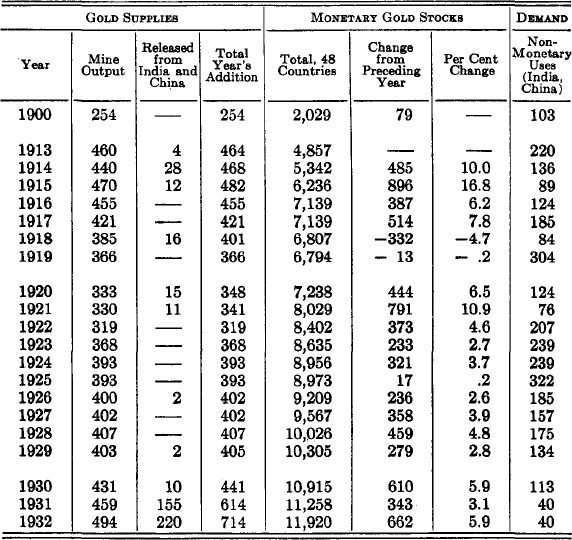
Source: National City Bank Letter, March, 1933, p. 43, and there credited to the Federal Reserve Bulletin and other sources.
It is to be noted that the above figures for the period beginning with 1913 are not for production of gold only, but include the net increases in bank reserves. They are thus not subject to deductions for non-monetary uses or absorption in hand-to-hand circulation and private hoards. Nor are they subject to the Warren-Pearson criticism of those calculations that neglect the total monetary stocks of gold—in fact, the table goes even farther than Professors Warren and Pearson seem willing to go, as will be shown shortly, in that it indicates the rate of increase in the reserves of central banks.
According to the table on page 42, the annual average increase in monetary gold stocks in central banks and governmental treasuries for the period 1900–1929 was 5.8 per cent; for the period 1913–1929, 4.8 per cent; and for 1929–1932, 5.0 per cent. For the decade of the ’twenties, the rate of increase was 4.27 per cent per annum, and for the period 1922–1929, it was 3.16 per cent per annum.
Inasmuch as the amount of the increase in monetary gold stocks as shown by the above table is about 88 per cent from 1914 to 1929, or more than double the 38 per cent indicated by Professors Warren and Pearson in the Times article quoted above, Mr. George E. Roberts of the National City Bank addressed an inquiry to Professor Pearson asking for an explanation of the discrepancy, to which Professor Pearson replied in part as follows:4
* * * Gold stocks in central banks increased more rapidly than world stocks. In 1914, the central banks held two-thirds of this gold, and in 1931 practically all of it. The additions to central bank stocks represent 82 per cent of the total produced in the period. The data we used indicate that additions represent 54.5 per cent. The gold outside the central banks cannot be ignored. It was used to transact business and therefore should be added to central bank reserves to get the total gold. The location of the gold is relatively unimportant. Cotton and wheat sell for ounces of gold, and in the long run it makes little difference where it is located. This is not disputing the general belief that gold is used more efficiently when in the banks than when in private hoards.
Professor Pearson’s contention that “cotton and wheat sell for ounces of gold” requires little comment. It clearly stamps him as one of the very few out-and-out present-day bullionists. But the notion that the location of the gold is relatively unimportant with respect to prices should not be allowed to pass unchallenged.
Importance of Location of Gold Is Pivotal
To arrive at their figure for total monetary gold for 1914 Professors Warren and Pearson add to the figure for the gold reserves of central banks and governments their own estimate of the amount of monetary gold outside of these banks and treasuries and outside of Asia. This estimated figure of $2,678 million added to the figure for the central banks and governmental treasuries gives them a total of $8,020 million for the world’s total monetary stock of gold for 1914, and it is with the use of this initial figure that their percentage increase of 54.5 per cent from 1914 to 1928 is derived. What Professor Pearson evidently means by saying that “the gold outside the central banks cannot be ignored” is that it should be added to the central bank reserves as though it were capable of performing the same amount of money work as would an equal amount of gold in central bank reserves. It is to be noted, however, that he admits he is not disputing the general belief to the contrary.
Here is the crux of the whole matter, and here is the major fallacy of the Warren-Pearson argument. It makes a tremendous difference whether the monetary gold stock of the world is in the hands of the public circulating as gold coin or is being hoarded, in India for instance (in either case unavailable both to central banks and for purposes of international trade), or whether it is in the vaults of the central banks serving as a reserve base making possible the creation of multiple deposit currency. There is today little disagreement among economists that deposit currency constitutes the most important medium of exchange of modern commercial countries, that it performs 90 per cent or more of the money work of the United States, and that it is upon the gold reserve in the central banks that deposit currency is ultimately bottomed. Gold coin in hand-to-hand use performs substantially the same function as an equal sum in bank checks, whereas gold held in bank reserves supports a manifold volume of bank credit subject to circulation by means of checks.
It has already been mentioned in Chapter II that prior to the establishment of the Federal Reserve System one dollar in reserve supported approximately five dollars in bank credit, or deposit currency, and that after the Federal Reserve System was inaugurated the same (gold) reserve could support at the maximum expansion a credit structure about six times as great. The extent to which the introduction of the Federal Reserve System effected an economy of reserves in the United States has also been shown (see pages 24–28). The establishment of a central banking system in a country where one did not exist before, in other words, brings about immediately an economy of gold, virtually doubling or even tripling the expansive power of the banking system on the basis of a given amount of reserves—or, putting it another way, it enables the maintenance of the same credit structure with only one-half or one-third the amount of gold reserve previously necessary. The gold released from serving as a reserve base under the old system now serves as a basis for future credit expansion just as would that much new gold secured from the mines. And to the extent that the central banks attract gold to their vaults which formerly circulated as gold coin, or to the extent that the central banks absorb a larger proportion of the mine output of gold than formerly, further economies in the use of gold are effected.
Changes of these types have been taking place extensively since 1914.5 The number of central banks in the world has increased markedly since that date. More and more, gold which formerly circulated as coin has become lodged in central bank vaults as reserves; and the central banks have been acquiring an ever-larger percentage of the mine output and of the world’s total monetary stock of gold. As Professor Pearson admits, the central banks held two-thirds of the monetary gold stocks in 1914, and in 1931 they held practically all of it (about 95 per cent). Newly produced gold went from the mines to the central banks in much larger proportions during the period following 1913 than before that date. In the twelve years ending with 1912 gold production amounted to $4,711 million and reporting bank reserves increased $2,222 million, or 47 per cent of the new production. In the twelve years ending with 1930 production of gold aggregated $4,531 million and the increase of bank reserves was $4,108 million, or 90 per cent of the new production. For the period from 1913 to 1932 production of gold amounted to $8,129 million and the net additions to central bank reserves were $7,063 million, or 86 per cent of the new production.6 The extent to which economies in the use of gold as bank reserves have proceeded since 1914 utterly destroys any validity which might otherwise have attached to the 3-per-cent estimate before that date. What is now important is the rate at which central banks acquire gold reserves, for it is on the basis of reserves in central banks that credit is created.
As shown by Table V, the average rate of increase in central bank gold reserves for the period 1922–1929 was 3.16 per cent per annum, the smallest rate of increase for any comparable period since 1913, yet one which satisfies the requirement of Professors Warren and Pearson that monetary gold stocks should increase at the rate of 3.15 per cent per annum. It is to be stressed, however, that these figures are for central bank reserves, and not all monetary gold stocks, including those which circulate as coin. The distinction is important because a rate of increase today of 3 per cent per annum for central bank gold reserves, because of the increased number of central banks and the absorption by them of a greater portion of the mine output of gold, is doubtless equal in effect on prices to a 10 per cent per annum increase in monetary gold stocks prior to 1914. The argument that monetary gold stocks should increase at approximately 3 per cent per annum is therefore entirely vitiated because of the superior credit expansion possibilities of gold in central banks as contrasted with gold in circulation as a medium of payment.
Since it is generally admitted that bank credit constitutes the most important medium of payment, the requirement of growth in the volume of media of payment consonant with the rate of increase of the physical volume of production and trade would be fully met if bank credit grew at the same rate as physical volume of trade. It follows, then, that if there is any validity in the 3-per-cent argument, a growth at that rate in the most important of the media of payment should suffice to accommodate a 3-per-cent rate of industrial expansion. It is therefore pertinent to note the rate of increase in bank credit since 1913.
The banking system of the United States was extended practically to its limit on the basis of its available reserves in that year. Following that date, in consequence of acquisitions of new gold reserves and the enhanced expansive powers of those reserves brought about by the establishment of the Federal Reserve System, the extension of credit proceeded at a dizzy pace. The deposits of all banks as of June 30,1914, amounted to $18,566 million, and at December 31,1929, they were $55,289 million, having increased by nearly 200 per cent. This represents a compound rate of increase for deposit credit of almost 7.5 per annum, from 1913 to 1929. Professors Warren and Pearson do not claim that there was any such increase in physical volume of production and trade, nor, therefore, that there was need for such an increase in the volume of the means of payment.
An analysis of the increase in deposits during this same period also throws interesting light upon credit expansion in member banks of the Federal Reserve System, contrasted with the same in non-member institutions. The deposits of non-member banks were $12,192 million on June 30, 1914, and by December 31, 1929, had increased to $21,420 million, a gain of 75 per cent. The deposits of the member banks were $6,374 million in 1914, and in 1929 they were $33,865 million, an increase of 430 per cent. It is thus apparent that greater credit expansibility was made available to member banks, as against non-members, by the creation of the Federal Reserve System. This comparison is subject to the strictures pointed out on pages 30–31, but a large part of the total increase in member bank deposits between 1914 and 1929 took place after 1921, and it was about this date that accessions to the Reserve System from the non-member ranks virtually ceased.
Bearing of Gold Exchange Standard
Other measures effecting economies of gold, in addition to those attributable to the expansion of central banking and a greater absorption of monetary gold stocks by central banks, were brought into being by a number of countries when they returned to the gold standard following the War. Chief among these, perhaps, was the adoption of what is known as the “gold exchange standard,” under which holdings of foreign exchange could serve as a currency base, side by side with gold.7 Thus, for example, holdings of sterling or dollar credits might be counted as a reserve by the Bank of France, or other central banks abroad. While it is believed that the gold exchange standard was itself productive of undesirable disequilibria in the money and capital markets of the world prior to 1929, and of disastrous results after the depression set in, nevertheless the practice of counting foreign exchange holdings as part of a central bank’s legal reserve constitutes a positive economy of gold. Such holdings, largely in the form of short-term claims on London and New York, are estimated to have been as high as two billion dollars prior to 1929, and to have had a practical significance nearly approximating that of an addition of two billion dollars in actual gold to central bank reserves during normal periods.8
Significance of Gold Bullion Standard
It is further to be remarked that several countries, in returning to the gold standard after the War, adopted what is known as the “gold bullion standard,” under which notes were not redeemable in gold coin as under the gold standard, but only in bars of gold bullion, and then only in large amounts. This also served to effect an economy of gold, in that it delimited the hand-to-hand circulation of gold. When in the normal course of trade gold coins found their way to the central banks, they were not reissued, but were melted into bars; as this procedure went on there was a constant contraction of gold coins in circulation. As these coins were melted into bullion, it was possible for the central banks to substitute for the gold in circulation deposit currency and notes to an amount many times that of the gold previously existing in the form of coins. This made possible an increase in the supply of the circulating media out of all proportion to the current production of gold, and accounts to a large extent for the increases in the gold reserves of the central banks, indicated in Table V, over and above the production of new gold from the mines. In other words, central banks not only took gold directly from the mines, but also added to their reserves most of the gold formerly circulating as coin.
Increasing Use of Checks Effects Gold Economy
Lastly, the increasing popularity of the use of checks in certain countries which before the War were accustomed principally to paper currency and coin operated to effect a further economy of gold. As the use of “check-money” becomes more widespread, the need for gold coins as a circulating medium of payment is lessened.
Cessation of Gold Production Would Have Resulted in No Shortage
All these measures—the extension of central banking, the adoption of the gold exchange and gold bullion standards, and the increasing popularity of checks—have resulted in such extensive economies of gold that the opinion may be hazarded that the world would not have suffered from a shortage of media of exchange had there been no gold produced from the mines after 1913, provided the monetary gold outside the central banks and treasuries in 1913 had all been transferred to the central bank vaults. Although at first blush this may appear as an exaggeration, a little reflection, it is believed, will prove its validity. Professor Pearson calculates the monetary gold outside the central banks in 1914 at $2,678 million. This amount of monetary gold performs no more money work than an equivalent amount of bank credit, or deposit currency (in fact, it is questionable whether it performs as much money work, because of its comparatively lower velocity of circulation). If this monetary gold were transferred to central bank vaults, a credit structure of approximately $75 billion might be erected upon the basis of this new gold reserve (if the central bank reserve ratio is 33 per cent and if the commercial banks’ reserve ratio is 10 per cent), which should adequately satisfy the requirement of circulating media increasing at a rate corresponding to the rate of increase of the physical volume of production. Furthermore, the significance of the approximate $2 billion of foreign exchange also serving as a reserve base should not be overlooked. All in all, it would appear that the argument that additions to the monetary gold stock of the world must proceed at a rate of 3 per cent per annum was definitely inapplicable to the 1913–1929 period.
Indeed, what would appear to be conclusive of this whole question of an asserted shortage of gold, and at the same time indicative of the way in which central banking has economized gold reserves in recent years, is the fact that there was an actual surplus of gold reserves in 1928, as shown by the following calculation of the League of Nations:9
The excess of gold reserves of 33% which, as explained above, is about the average cover * * * amounted at the end of 1928 to some $1,800 million. But fifteen countries hold over 90% of the gold reserves of the world [they are also the fifteen leading commercial nations of the world] and in these fifteen countries there was in 1928 a surplus of roughly $2,450 million. * * * The general conclusion to which these figures point is that * * * a theoretical surplus exists which about equals the amount of new gold likely to become available for monetary purposes during the next five years.
THE QUESTION OF MALDISTRIBUTION OF GOLD
The idea that maldistribution of the world’s gold supplies, with excessive concentration in the two countries, France and the United States, is the reason for the decline in prices, carries a greater degree of plausibility. This theory is advanced in the writings of Professor Cassel, as well as of a great many others. Thus, Cassel states:10
Indeed, the sudden breakdown of commodity prices can only be explained by two events on the monetary side that have come into the foreground since the middle of 1929. * * * The second factor which since the middle of 1929 has tended to reduce the world’s supply of means of payment is the very unequal distribution of gold caused by the tremendous gold imports into France and the United States.
Maldistribution Merely Symptomatic
Professor Cassel, it should be noted, refers principally to the maldistribution after 1929 and after the fall of prices had already set in. Such maldistribution of gold is viewed by the writers as symptom, not cause. It is the effect of a multitude of causes. Among these are war debts and reparations, national economic insecurity, and ill-considered political tinkering with the normal operation of international trade and the foreign exchange markets, to mention but a few such causes.11 Also, a large measure of responsibility for the seeming failure of the gold standard and for the maldistribution of gold must be assessed against the workings of the gold exchange standard after confidence had become unsettled. With large amounts of short-term capital in the form of foreign credits loose upon the world money markets, it was only natural for those countries having the largest foreign exchange holdings to wish to repatriate that capital in the form of gold when confidence was tottering.12 As France, for instance, sought to convert its holdings of foreign exchange into gold, the procedure effected a redistribution of gold and at the same time placed an unexpected strain upon the normal workings of the international gold standard proper. It must not be forgotten, however, that it was in 1931 and 1932 that most of this conversion of foreign credits into gold took place. The following comment of Dr. C. O. Hardy of the Brookings Institution goes to the heart of the question of maldistribution, it is believed:13
With regard to the maldistribution of gold, it is almost sufficient to point to the fact that prior to the crisis of 1929 there was no appearance of a shortage of bank credit in any country but England. * * * Maldistribution is one way of saying the distribution of gold is different from what it was before the war. But the distribution of wealth, the production of commodities, is also different.
It is quite true that the gold holdings of the Bank of France reached the enormous total of $3,218 millions in June, 1932. But this, it is to be emphasized, was long after the depression and the fall of prices had set in. The fact that the gold reserve of the Bank of France more than doubled from September, 1929, to June, 1932, might well be regarded as evidencing maldistribution as of the latter date, but it does not explain the start of the fall of prices in late 1929. The nationalistic hoarding of gold was a contributing factor in the precipitancy and persistency of that fall, once started, but it by no means follows, as Cassel and others contend, that the initiation of the price decline should be attributed largely to the pre-depression maldistribution of gold. For the fact remains that the most striking maldistribution of gold occurred after the decline in prices set in. And it appears more probable that the price situation itself brought about the alleged maldistribution, than does the converse argument.14
CONDITIONS REQUISITE TO SATISFACTORY OPERATION OF GOLD STANDARD
Finally, it is frequently contended that the gold standard, as such, is the root cause of the present difficulties, and that as long as we insist upon having a standard of payments tied to gold, just so long will we continue to subject ourselves to the disastrous aberrations of the price level attributable to the failings of the gold standard. The problem of an ideal monetary standard is beyond the scope of this volume. It may be remarked in passing, however, that certainly the gold standard is not infallible; no conceivable system which is subject to human administration is infallible. But it must be remembered that the rules of the gold standard game have been flagrantly violated, not only since the start of the depression but ever since 1914. The gold standard admittedly requires experienced and skilled control in order to insure its relatively smooth working. Certain other conditions also are necessary, including a plasticity of and a reasonable agreement between costs and prices, readiness to accept payment of international debts in goods and services, and international goodwill as opposed to competitive nationalism, for it is only when these conditions are met that an international gold standard can function at all. The fact that ten billion dollars in short-term international indebtedness are circulating in the money and capital markets of the world is proof of the lack both of economic security and of international goodwill. The existence of this amount of “homeless” funds is damaging to internal economies so long as they fail to be converted into long-term investments through the normal operations of the capital market, and is an ever-present threat to the proper functioning of the gold standard. When, therefore, it is alleged that the gold standard has broken down, it is well to remember that scarcely any of the conditions necessary for its proper functioning have been realized, and that given the facts as they exist, no system could have survived the series of economic earthquakes which have shaken the world in the past twenty years.15
It is clear, then, that neither scarcity of gold on an absolute scale, nor deficiency in the rate of increase in the monetary gold stocks of the world, nor excessive demand for gold in relation to its supply, nor the inherent nature of the gold standard as such can be charged with primary responsibility for throwing the economic machine into reverse gear.16 There is some measure of validity attaching to the view that the maldistribution of gold, after it was accomplished, was productive of evil results, but that suggests the need for analysis of those defects in the world’s economic system which brought about the maldistribution, rather than concentration of attention upon the maldistribution itself as a causal factor explaining the start of the price decline.
TOPPLING OF PRICES WAS LAST STAGE OF DECLINE FROM HEIGHTS OF WAR INFLATION
On the contrary, startling as it may appear to those who, without bothering to inquire into the facts, have found the necessary sacrificial offering in the gold situation, the view is held that one of the principal causes of the fall in prices has been an excess of gold17—excessive in view of the known economies in the use of gold as a basis for credit expansion—which permitted the erection of a superstructure of credit of such magnitude that when the rate of growth of that credit structure abated in 1928–1929, the fall in prices was the more precipitous. There is good evidence that the price decline starting in 1929 simply marks the culmination of a long period of inflation of bank credit based on gold beginning as early as 1897. Coupled with this is the fact that the Federal Reserve Board, by fostering credit inflation from 1922 to 1929 in an endeavor to sustain the price level, merely served to intensify the stresses and strains imposed upon the normal functionings of the gold standard by an inordinate bank credit inflation. When the Board reversed its “easy money” policy in 1929 and the bubble of inflation burst with the stock market fiasco, ample impetus was provided for a headlong descent, making up in the short space of four years for the artificial tamperings with the normal economic forces at work to overcome the tumorous growth of War-time inflation. The writers strongly incline to the view that the 1929-1932 fall in prices was simply the last stage of a decline from the giddy heights of the War inflation of bank credit and prices. Had not the Federal Reserve Board interfered, a slow downward movement of prices (of the type normally following a major war financed by inflationistic measures) doubtless would and should have continued beyond 1922. The Federal Reserve Board could have provided an immeasurable service by directing its control activities to an endeavor to break the rate of fall and prevent the deflation from becoming precipitate, instead of the disservice it did perform by endeavoring to stabilize the price level from 1922 to 1929. Bluntly, our present difficulties are viewed largely as the inevitable aftermath of the world’s greatest experiment with a “managed currency” within the gold standard, and, incidentally, should provide interesting material for consideration by those advocates of a managed currency which lacks the saving checks of a gold standard to bring to light excesses of zeal and errors of judgment.
18 The “Gold Supplement” of the London Times, June 20, 1933, p. vii.
19 Their theory that the explanation of prices and the price level is based upon the demand for and the supply of gold (perhaps their fundamental theory) is not dealt with here for the sake of brevity. To attempt to combat fully their many misstatements, inaccuracies, and inconsistencies would lead too far afield for the purpose at hand. If their argument with respect to the requisite increase in monetary gold stocks is successfully met in the following critical discussion, the idea of the demand for and the supply of gold determining the level of prices is also disposed of, as will be shown shortly. For a thorough-going and able, albeit somewhat scathing, critique of the Warren-Pearson fallacies in general, see Spahr, W. E., The Monetary Theories of Warren and Pearson (New York: Farrar & Rinehart, 1934); and see Hardy, C. O., The Warren-Pearson Price Theory (Washington: The Brookings Institution, 1935).
20 Warren, George F., and Pearson, Frank A., Prices (New York: John Wiley and Sons, Inc., 1933), pp. 100, 82, and 90.
21 See the National City Bank Letter, September, 1933, p. 135.
22 Cf. Dr. Melchior Palyi, “Some Problems of International Banking Policy,” in The International Gold Problem (London: Humphrey Milford, 1932), p. 116: “It is undoubted that, from the point of view of the business community, a better use of the existing gold supply is being made today than before the War.”
23 National City Bank Letter, March, 1933, p. 44.
24 See The Functioning of the Gold Standard, by Professor Feliks Mlynarski, A Memorandum Submitted to the Gold Delegation of the Financial Committee of the League of Nations (Geneva: League of Nations, Document No. F. 979, 1931), p. 51: “Foreign exchange as a component of the fundamental reserve * * * is as good as gold. * * * By including foreign exchange in its fundamental reserve, the Bank raises its reserve ratio against its liabilities and can increase the amount of credit * * *.”
25 “In the years 1924–1928 when the re-establishment of gold as an international standard was effected, a dozen countries or more increased their reserves of foreign exchange by some £120,000,000 in all. * * * This is exclusive of the Bank of France, which acquired no less than £250,000,000 of foreign exchange.” Hawtrey, R. G., The Art of Central Banking (London: Longmans, Green & Co., 1932), p. 248.
26 Interim Report of the Gold Delegation of the Financial Committee of the League of Nations (Geneva: League of Nations, Publs. 1930; II, 26), p. 17.
27 “Causes of the Fall of Prices,” the London Times, “Annual Financial and Commercial Review,” February 10, 1931, p. xxiv.
28 “But it must not be forgotten that this ‘maldistribution of gold’ was in itself a result of existing barriers, economic nationalism, war debts and reparations, and the load of debt contracted since the War.” Monetary Policy and the Depression, Publication of the Royal Institute of International Affairs (London: Humphrey Mil-ford, 1933), p. 14.
29 The amount of short-term capital in the form of foreign exchange holdings has been estimated at the staggering sum of 50 billion Swiss francs at the end of 1930. See the Second Annual Report of the Bank for International Settlements (Basle, 1932), p. 11.
30 “Gold and Credit,” The Annals of the American Academy of Political and Social Science (January, 1933), Vol. 165, p. 201.
31 “The movement of prices in different countries * * * helped to produce a maladjustment in the monetary systems of the world and in the distribution of gold. * * * In the last resort, international gold movements are due to the state of the balances of payments.” Course and Phases of the World Economic Depression (Boston: World Peace Foundation, 1931; A League of Nations publication), p. 96.
32 See Hartley Withers, “Causes of the Crisis, “the London Times, “ Annual Financial and Commercial Review,” February 9, 1932, p. xx: “Since the War the gold standard has never had a fair chance of serving the nations as the good and useful handmaid that she was before it—a fact to be remembered by the eager enthusiasts who have already decided that it must never be restored.” See also the Inaugural Address of the late Brig.-Gen. Sir Arthur Maxwell as President of the Institute of Bankers, Journal of the Institute of Bankers, 1931, p. 506: “The real complaint which might be made against the gold standard is not that it has worked badly but that it has worked too well and too accurately and brought to light too clearly the disturbances in international financial relations.” Further, see Professor Ralph A. Young, “The United States and Gold” The Annals of the American Academy of Political and Social Science (January, 1933), Vol. 165, p. 217.
33 “The dislocation of the monetary and credit system that is nowadays going on everywhere is not due—the fact cannot be repeated too often—to any inadequacy of the gold standard. The thing for which the monetary system of our time is chiefly blamed, the fall in prices during the last five years, is not the fault of the gold standard, but the inevitable and ineluctable consequence of the expansion of credit, which was bound to lead eventually to a collapse.” Ludwig von Mises, The Theory of Money and Credit (New York: Harcourt, Brace & Co., 1935), p. 20.
34 “I may be exaggerating, but it seems to me that from a certain angle we can just as well speak about the over-abundance of gold as the scarcity of gold.” Dr. Melchior Palyi, “Some Problems of International Banking Policy,” op. cit., p. 115.
- 1Foreign Exchange Before, During, and After the War (London: Oxford University Press, 3rd ed., 1925), p. 9.
- 2Strategic Factors in Business Cycles (New York: National Bureau of Economic Research, 1934), p. 4.
- 3“The Problem of Business Cycles,” in the Skandinaviska Kreditaktiebolaget Quarterly Report, January, 1933, p. 3.
- 4Ibid., p. 3.
- 5Cassel, G., The Theory of Social Economy (New York: Harcourt, Brace & Co., 1932), p. 538.
- 6Strategic Factors in Business Cycles, p. 6.
- 7Journal of the Institute of Bankers (June, 1931), Vol. LII, Part VI, p. 236.
- 8“Depression has continued because there is no prospect of profitable investment. And why is there no prospect of profitable investment? Because costs, which by reason of the inflationary boom have become too high in relation to prices, have not been reduced.” Lionel Robbins, in Lloyds Bank Monthly Review (October, 1982), Vol. III (NS), No. 32, p. 432.
- 9“Loans and Taxes in War Finance,” American Economic Review Supplement (March, 1917), Vol. VII, No. 1, p. 200.
- 10Phillips, C. A., Bank Credit (New York: The Macmillan Company, 1920).
- 11“The view that bank deposits are potential currency is inapplicable to the deposits created in the Government’s War loan account.” Leffingwell, R. C. (Assistant Secretary of the Treasury during the War), “Treasury Methods of Financing the War in Relation to Inflation,” Proceedings of the Academy of Political Science (June, 1920), Vol. IX, No. 1, p. 32.
- 12Bankers and Credit, p. 48.
- 13Professor Jacob Hollander attributes priority to Professor A. C. Pigou (1915) and to Professor O. M. W. Sprague (1916); see his War Borrowing (New York: The Macmillan Company, 1919), pp. 157–158.
- 14War and Lombard Street (1914); Our Money and the State (1917); The Business of Finance (1918); War-Time Financial Problems (1919).
- 15Bankers and Credit, pp. 24–25.
- 16See Phillips, op. cit., Ch. III; and see Hayek, F. A., Monetary Theory and the Trade Cycle (New York: Harcourt, Brace & Co., 1932), Ch. IV.
- 17This is true as long as the amounts pass from bank to bank and are not withdrawn in cash and hoarded, or so long as they do not represent larger cash balances circulating in the hands of the public. But the above is intended to illustrate a principle rather than to arrive at a mathematical result. It seems hardly necessary to add that the process just described is the same as obtains when banks utilize excess reserves to grant loans to customers, instead of buying bonds, and as when banks buy bonds on the stock exchange, instead of subscribing to a new Government bond issue.
- 18In 1921, following the upheaval of prices which accompanied the primary post-War deflation, Professor T. E. Gregory, in writing on the situation then prevailing in the foreign exchanges, was moved to lament that:
- 19Thirteen years later, near the nadir of the Great Depression, Professor J. M. Clark wrote in like vein:
- 20Professor Gustav Cassel has said that “Our attention must now for a long time onwards be devoted towards a complete analysis of the upheaval now in progress.” The present study is directed to an inquiry into certain of the more fundamental aspects of major industrial fluctuations, and to the relationship of banking operations thereto, special reference being had throughout to the causes and relevant phases of the cycle beginning in the United States in 1922 and ending with the Great Depression. It is at the same time devoted to the formulation of a theory of business cycles—for “the present crisis is, in fact, a crisis also for the entire theory of business cycles.” The theory of business cycles here set forth, it is believed, is not only one which is applicable as a general explanation of depressions, but also one whose validity is particularly well illustrated by setting it against the background of the experience of the recent crisis. Accordingly, this theory of the cycle is correlated with the banking and financial situation in the United States during the post-War years into an explanation of the causes of the Great Depression.
- 21Professor Gustav Cassel has said that “Our attention must now for a long time onwards be devoted towards a complete analysis of the upheaval now in progress.” The present study is directed to an inquiry into certain of the more fundamental aspects of major industrial fluctuations, and to the relationship of banking operations thereto, special reference being had throughout to the causes and relevant phases of the cycle beginning in the United States in 1922 and ending with the Great Depression. It is at the same time devoted to the formulation of a theory of business cycles—for “the present crisis is, in fact, a crisis also for the entire theory of business cycles.” The theory of business cycles here set forth, it is believed, is not only one which is applicable as a general explanation of depressions, but also one whose validity is particularly well illustrated by setting it against the background of the experience of the recent crisis. Accordingly, this theory of the cycle is correlated with the banking and financial situation in the United States during the post-War years into an explanation of the causes of the Great Depression.
- 22“Causes” is used advisedly, it being “at once evident that no general or single theory is valid for so varying and varied a phenomenon as crisis.” And, as Professor Clark states, most “theoretical studies give us causes that are too few and too simple, such as over-production, under-consumption, over-saving, or failure to distribute to laborers their whole product or enough of the whole product of industry to enable them to buy the things they have produced.” The present apparent need is not for the propagating of novel theories, but rather for the orienting and synthesizing of extant knowledge.
- 23“Causes” is used advisedly, it being “at once evident that no general or single theory is valid for so varying and varied a phenomenon as crisis.” And, as Professor Clark states, most “theoretical studies give us causes that are too few and too simple, such as over-production, under-consumption, over-saving, or failure to distribute to laborers their whole product or enough of the whole product of industry to enable them to buy the things they have produced.” The present apparent need is not for the propagating of novel theories, but rather for the orienting and synthesizing of extant knowledge.
- 24As the depression has been denominated primarily a central banking phenomenon, it will also be desirable to attempt to unravel some of the changes caused in the structure, organization, and operation of the American banking system by the establishment of the central banking system represented by the Federal Reserve System. The special character of the depression is traced to the hyper-elasticity of the Federal Reserve System, and to the operation of that system as exemplified in the “managed currency” experiment of the Federal Reserve Board, working in opposition to what D. H. Robertson labels “the over-mastering tendency of prices to fall” after a war financed by inflationary measures. By virtue of that experiment, the Board succeeded in holding up the price level for a surprising length of time, but in so doing unwittingly aided in producing the boom and its consequent depression. The depression, in other words, was the price paid for the experimentation with currency management by the Federal Reserve Board during the period when the dislocations caused by war had not as yet been corrected and when the post-War deflation of prices had not been completed. Nor were the effects of this Federal Reserve Board action confined solely to the United States; the banking and industrial systems of leading commercial nations are interrelated so closely that the mistaken policy of one large central banking organization may be highly conducive to the precipitation of a world-wide depression.
- 25The boom is brought to an end, not only because of the restriction upon the supply of credit and purchasing power, but also because of the rise in the market rate of interest on new bond issues and other instruments of borrowing resulting from that restriction. Moreover, the realized rate of return on new capital development tends to fall in the later stages of a boom because of the fact that increases in wage rates gradually pare down the share going to capital. There ensues a general disequilibrium throughout the system, not only between wage rates and the cost of living, between costs and prices, and between production and consumption, but also a disequilibrium between investment and saving the reverse of that which prevails during the boom. As long as these general disequilibria persist, and as long as new investment in the sense of the production of new durable goods continues at a low ebb, depression continues.
- 26The World War was probably the worst-financed war in history from the viewpoint of sound fiscal policy. Less of the monetary costs of the War was financed by taxation and more by inflation of one form or another than any of the wars of the nineteenth century. Mr. Hartley Withers estimates that 17½ per cent of the cost of the War to England was covered by taxation, and Sir Josiah Stamp states that England’s showing in this respect was better than that of any other European belligerent. Elsewhere Stamp estimates that 63 per cent of the cost of the Napoleonic Wars to England was raised by taxation. The Report of the Committee on War Finance of the American Economic Association estimates the portion of World War costs covered by taxation in the United States at 25 per cent. As previously stated, all of the countries involved in the World War, with the exception of the United States, resorted to the age-old expedient of inflation of the note currency. But the United States, along with virtually all of the other nations, made use of that form of war financing which Mr. Withers denominates “quite the worst way of raising money for war or any other purpose” and which Professor 0. M. W. Sprague says is “the most potent single cause of the general advance in prices during periods of war,” namely, that of securing money from the banks either by issuing bonds directly to them for which they pay by creating new credits in favor of the Government, or by selling bonds to individuals who cover their subscriptions by borrowing from banks the credits that are newly created for this purpose. Such was the means by which the major portion of the monetary costs of the War was raised by all countries involved, and it is probably a safe assertion that it was employed on a more extensive scale than during any previous war. It is therefore desirable to inquire more fully into how the banking machinery was utilized to serve that end. In order to do so, however, it is necessary to set forth in some detail a particular point of banking theory which was neither understood nor recognized by writers on the subject until the period of War finance brought it into sharp relief.
- 27That banks “create” credit by granting loans has long been known and recognized. The precise nature of the process of creation of credit was not generally realized nor adequately analyzed, however, until after the termination of the World War. The correlative process of creation of bank credit, by means of purchases of investments on the part of the banks, is far from having universal recognition even today. It seems quite certain that some of those responsible for the way in which the War was financed in this country were not cognizant of the procedure by which it was done—they were, as Withers puts it, “making reckless use of a delicate machine which they did not understand and producing consequences which they neither foresaw nor recognized.”
- 28That banks “create” credit by granting loans has long been known and recognized. The precise nature of the process of creation of credit was not generally realized nor adequately analyzed, however, until after the termination of the World War. The correlative process of creation of bank credit, by means of purchases of investments on the part of the banks, is far from having universal recognition even today. It seems quite certain that some of those responsible for the way in which the War was financed in this country were not cognizant of the procedure by which it was done—they were, as Withers puts it, “making reckless use of a delicate machine which they did not understand and producing consequences which they neither foresaw nor recognized.”
- 29That banks “create” credit by granting loans has long been known and recognized. The precise nature of the process of creation of credit was not generally realized nor adequately analyzed, however, until after the termination of the World War. The correlative process of creation of bank credit, by means of purchases of investments on the part of the banks, is far from having universal recognition even today. It seems quite certain that some of those responsible for the way in which the War was financed in this country were not cognizant of the procedure by which it was done—they were, as Withers puts it, “making reckless use of a delicate machine which they did not understand and producing consequences which they neither foresaw nor recognized.”
- 30So far as is known to the writers, this process of the manufacture of credit on the part of the banks by purchasing investments was first discerned by Withers. In several books published during the War period he indicates an increasing understanding of it in connection with war finance. In his Bankers and Credit, however, published in 1924, he elaborates the theory most clearly, and it is appropriate to quote at some length from that work:
- 31So far as is known to the writers, this process of the manufacture of credit on the part of the banks by purchasing investments was first discerned by Withers. In several books published during the War period he indicates an increasing understanding of it in connection with war finance. In his Bankers and Credit, however, published in 1924, he elaborates the theory most clearly, and it is appropriate to quote at some length from that work:
- 32So far as is known to the writers, this process of the manufacture of credit on the part of the banks by purchasing investments was first discerned by Withers. In several books published during the War period he indicates an increasing understanding of it in connection with war finance. In his Bankers and Credit, however, published in 1924, he elaborates the theory most clearly, and it is appropriate to quote at some length from that work:
- 33The operation of the machinery of bankers’ banking made possible the creation of the greater portion of the credit by means of which both the United States and England financed the War. It was not the effect of such transactions as Withers describes that had the most significant influence upon prices in this country; rather, it was the superimposition of bankers’ banking upon the commercial banking structure that led to the compound creation of bank credit. For whenever bankers’ banking becomes operative, the inflationistic nature of commercial banking is greatly reinforced and accentuated. In the simplest possible illustration, in a banking system requiring a 10 per cent reserve against deposits, a bank having a reserve of one million dollars in excess of the required ratio may use that reserve to buy one million dollars worth of bonds, giving the Government deposit credit for that amount. As the Government draws checks against this deposit credit and pays them to government contractors, munitions makers, etc., and as they in turn deposit the checks in their (other) banks, the bank which originally bought the bonds tends to part company with cash—but that cash reappears as new, excess, reserve, for some other bank (or group of banks) in the system. The second bank in turn may now use 90 per cent of its new reserve to buy, let us say, $900,000 worth of bonds (it being required to set aside $100,000 to satisfy the requirement for a 10 per cent reserve against the deposit of the government contractors), and as the Government checks against the $900,000 deposit created in its favor in exchange for the bonds, the second bank (or group of banks) in turn tends to lose cash to a third bank (or group of banks) in the system. The third bank (or group of banks) may now use its new reserve of cash to buy $810,000 worth of bonds (90 per cent of $900,000 deposited with it) and to create $810,000 of Government deposits, and so the process is repeated again and again.
- 34As this is done, each bank in subscribing for bonds to the extent of 90 per cent of the amount deposited with it creates an equivalent increase in deposits either for itself or for other banks in the system, and it becomes clear that the original creation of credit ultimately makes possible manifold new deposits in the banking system. That is to say, the total credit created on the basis of the excess reserve originally utilized to buy bonds is not simply equal to the amount of that reserve, but is (for a system with a 10 per cent legal reserve ratio against deposits) roughly ten times that amount. The original one million dollars of excess reserve permits the creation of ten million dollars new deposits in the banking system. And to the extent that all banks in the system are possessed of excess reserves and use them simultaneously to buy bonds issued by the Government the expansion is more widespread and proceeds more rapidly. Thus it is seen that deposits are basically the offspring of loans and investments for the banking system as a whole.

