
Banking and the Business Cycle
II. Generating The Great Depression
Two events occurred in 1914 that were to have profound influence upon subsequent economic developments in the United States. The first of these was external, the outbreak in Europe of the World War; the second was internal, the formal inauguration of the Federal Reserve System. Both were events propagative of an unprecedented orgy of inflation. The two, inextricably intertwined, brought about a great inflation of bank credit in connection with war finance, and both were productive of striking changes in the economic structure of the world during and after the War.
POINTS OF DEPARTURE
No attempt is made here to develop a full and considered estimate of the dislocations caused by the War upon all subsequent economic development. It is enough to indicate that the maladjustments and disturbances directly and indirectly chargeable to it have been enormous, not only in this country but all over the world. The War broke in upon the relatively smooth development of pre-War industry with the force of a revolution. It diverted industry and commerce into new, transient, war-time channels, from which it was necessary to withdraw resources in the following decade. It imposed upon the post-War economy the necessity of restoring the capital destroyed by the War and the task of satisfying the pent-up demand for certain types of goods whose production was restricted during the period of conflict. But the most serious economic dislocations that appeared after 1918 were those caused by the inflation which resulted from the methods by which the War was financed—an inflation which affected the whole structure of production, prices, wages, and debts. The inflated price level was a war heritage that was to prove largely determinative of subsequent banking and economic developments. To the effects of credit inflation based upon gold in this country were added those of the paper money inflations abroad, every belligerent nation (with the exception of the United States) having suspended the gold standard and having inflated its note currency at one time or another after 1914.
Closely connected with the process of war inflation in this country was the inauguration of the Federal Reserve System. The superimposition of this system of central banking (or bankers’ banking, as it is sometimes called) upon the banking system operative in the United States prior to 1914 served both to shape and to accelerate the course of inflation. It made possible the method of financing the War that was adopted in this country (without the necessity of suspending the gold standard), and it also assisted in making possible the financial assistance lent the Allied Powers after the United States entered the War.
The present study is concerned with banking operations and finance in relation to the Great Depression; its logical starting point is war finance and the inflation of bank credit and currency associated with the financing of the World War. For the roots of this depression, it is believed, are to be found principally in changes in the world economic system which developed during and after the World War as a result of the excesses of inflation engaged in during the struggle, an inflation which continued, in varying degrees in different countries, until the onset of the depression in 1929.1 The Great Depression, in other words, is viewed as the inevitable aftermath of the uncontrolled currency and bank credit inflation incident to the financing of the War, and the ill-considered efforts to counteract the normal tendency toward post-war deflation by the palliative of even more inflation. The economic system has a surprising capacity for overcoming the devastation caused by war, but if the dislocations wrought by war and war inflation are not promptly corrected, the inevitable consequence of those dislocations is disaster.
It is in order, therefore, to inquire briefly in the present chapter into the process of inflation as conditioned by war finance, and in this country by the introduction of the Federal Reserve System with its extraordinary capacity for credit expansion. The discussion is confined principally to the situation in the United States, as a discussion of war finance and the course of inflation in the other countries involved would extend beyond the scope of this volume.
INFLATION AND ITS CAUSES
The term “inflation” has long been the subject of interminable and diverse definition.2 In the view of the writers, inflation applies to a state of money, credit, and prices arising not only from excessive issues of paper money, but also from any increase in the effective supply of circulating media that outruns the rate of increase of the physical volume of production and trade, thus forcing a rise of prices. Inflation may be caused by an increasing supply of metallic money as well as by excessive supplies of paper money. In the modern world of finance, however, the most important single cause of inflation is the multiplication of bank credit by the banking machinery, resulting in an increase in the volume of purchasing power subject to check at a rate faster than the rate of increase in the volume of available goods.3 It is the latter form of inflation which will be discussed in the main here, as it was resorted to on an extensive scale by all countries participating in the War, and it was the predominant type of inflation in the case of the United States.
BANKING IN RELATION TO WAR FINANCE
The World War was probably the worst-financed war in history from the viewpoint of sound fiscal policy. Less of the monetary costs of the War was financed by taxation and more by inflation of one form or another than any of the wars of the nineteenth century. Mr. Hartley Withers estimates that 17½ per cent of the cost of the War to England was covered by taxation, 4 and Sir Josiah Stamp states that England’s showing in this respect was better than that of any other European belligerent.5 Elsewhere Stamp estimates that 63 per cent of the cost of the Napoleonic Wars to England was raised by taxation.6 The Report of the Committee on War Finance of the American Economic Association estimates the portion of World War costs covered by taxation in the United States at 25 per cent.7 As previously stated, all of the countries involved in the World War, with the exception of the United States, resorted to the age-old expedient of inflation of the note currency. But the United States, along with virtually all of the other nations, made use of that form of war financing which Mr. Withers denominates “quite the worst way of raising money for war or any other purpose”8 and which Professor 0. M. W. Sprague says is “the most potent single cause of the general advance in prices during periods of war,”9 namely, that of securing money from the banks either by issuing bonds directly to them for which they pay by creating new credits in favor of the Government, or by selling bonds to individuals who cover their subscriptions by borrowing from banks the credits that are newly created for this purpose. Such was the means by which the major portion of the monetary costs of the War was raised by all countries involved, and it is probably a safe assertion that it was employed on a more extensive scale than during any previous war. It is therefore desirable to inquire more fully into how the banking machinery was utilized to serve that end. In order to do so, however, it is necessary to set forth in some detail a particular point of banking theory which was neither understood nor recognized by writers on the subject until the period of War finance brought it into sharp relief.
UTILIZATION OF SURPLUS RESERVES THROUGH GOVERNMENT BORROWING PRODUCTIVE OF MANIFOLD DEPOSIT EXPANSION
This is the theory that by purchasing investments (bonds), banks create credit within the banking system quite as effectively as by granting loans to their customers. Not only because this process was used extensively in financing the War, but also because the theory of business cycles elaborated in Chapters VI and VII rests directly upon it, it is essential that it be understood at this point in order that there may be a clear grasp of much that follows.
That banks “create” credit by granting loans has long been known and recognized. The precise nature of the process of creation of credit was not generally realized nor adequately analyzed, however, until after the termination of the World War.10 The correlative process of creation of bank credit, by means of purchases of investments on the part of the banks, is far from having universal recognition even today. It seems quite certain that some of those responsible for the way in which the War was financed in this country were not cognizant of the procedure by which it was done11—they were, as Withers puts it, “making reckless use of a delicate machine which they did not understand and producing consequences which they neither foresaw nor recognized.”12
So far as is known to the writers, this process of the manufacture of credit on the part of the banks by purchasing investments was first discerned by Withers.13 In several books published during the War period he indicates an increasing understanding of it in connection with war finance.14 In his Bankers and Credit, however, published in 1924, he elaborates the theory most clearly, and it is appropriate to quote at some length from that work:15
* * * If a bank makes an investment by sending a broker into the Stock Exchange and buying, for example, £100,000 worth of Consols, it pays the seller £100,000 by a draft on its balance at the Bank of England. Its holding in cash is thus reduced by £100,000, its holding of investments is increased by the same amount, but the seller of the Consols pays into his own bank £100,000 of new credit, which has been created by the purchasing bank. The same thing happens when a bank, instead of buying securities on the Stock Exchange, invests by subscribing directly to a new issue made by the Government or any other borrower. * * * If the final receiver of the money borrowed or invested is a customer of the lending bank, then the lending bank will have increased its own deposits; its cash at the Bank of England will be unchanged, and its advances (or investments) and deposits will both be increased by the sum of the loan. It is thus of the utmost importance to remember * * * that whenever a bank makes an investment or a loan or discounts a bill it is increasing the deposits, either of itself or of some other bank. * * * By this process the banks create buying power or what may be called potential currency.
It will be observed that, although Withers refers in this discussion to the Bank of England (which is a central, or bankers’ bank) he is really describing a simple type of credit creation process that does not in any way involve central banking, as such. He is simply making the point that, if newly issued government bonds are purchased by (individual) banks, the immediate outcome of the process is the creation of new credit. His analysis is irrefragable, as far as it goes, but Withers here does not take account of the nature and significance of central banking in relation to the War-time inflation.
The operation of the machinery of bankers’ banking made possible the creation of the greater portion of the credit by means of which both the United States and England financed the War. It was not the effect of such transactions as Withers describes that had the most significant influence upon prices in this country; rather, it was the superimposition of bankers’ banking upon the commercial banking structure that led to the compound creation of bank credit. For whenever bankers’ banking becomes operative, the inflationistic nature of commercial banking is greatly reinforced and accentuated.16 In the simplest possible illustration, in a banking system requiring a 10 per cent reserve against deposits, a bank having a reserve of one million dollars in excess of the required ratio may use that reserve to buy one million dollars worth of bonds, giving the Government deposit credit for that amount. As the Government draws checks against this deposit credit and pays them to government contractors, munitions makers, etc., and as they in turn deposit the checks in their (other) banks, the bank which originally bought the bonds tends to part company with cash—but that cash reappears as new, excess, reserve, for some other bank (or group of banks) in the system. The second bank in turn may now use 90 per cent of its new reserve to buy, let us say, $900,000 worth of bonds (it being required to set aside $100,000 to satisfy the requirement for a 10 per cent reserve against the deposit of the government contractors), and as the Government checks against the $900,000 deposit created in its favor in exchange for the bonds, the second bank (or group of banks) in turn tends to lose cash to a third bank (or group of banks) in the system. The third bank (or group of banks) may now use its new reserve of cash to buy $810,000 worth of bonds (90 per cent of $900,000 deposited with it) and to create $810,000 of Government deposits, and so the process is repeated again and again.
As this is done, each bank in subscribing for bonds to the extent of 90 per cent of the amount deposited with it creates an equivalent increase in deposits either for itself or for other banks in the system, and it becomes clear that the original creation of credit ultimately makes possible manifold new deposits in the banking system. That is to say, the total credit created on the basis of the excess reserve originally utilized to buy bonds is not simply equal to the amount of that reserve, but is (for a system with a 10 per cent legal reserve ratio against deposits) roughly ten times that amount. The original one million dollars of excess reserve permits the creation of ten million dollars new deposits in the banking system.17 And to the extent that all banks in the system are possessed of excess reserves and use them simultaneously to buy bonds issued by the Government the expansion is more widespread and proceeds more rapidly. Thus it is seen that deposits are basically the offspring of loans and investments for the banking system as a whole.18
The machinery of central banking was exploited indirectly to create credit with which to finance the War, moreover, when individuals subscribed to the bond issues and secured the funds with which to pay for the bonds by borrowing from the banks, pledging the bonds as collateral for the loans, provided the central banks were able and willing to make such advances to the local banks as would enable them to maintain adequate legal reserves. This process increased the deposits in the banking system as effectively as when the banks subscribed to the bond issues directly. It was encouraged and facilitated in the United States by the policies of the Treasury Department and the Federal Reserve Board, acting in cooperation under the leadership of Mr. William G. McAdoo in his dual rôle of Secretary of the Treasury and member of the Board. From this procedure, as in that first described, there ensued a great increase in purchasing power that was unaccompanied by an equal increase in production, and hence resulted in inflation.19
EXTENT OF INFLATION
Such were the processes by which the major portion of the War inflation of bank credit took place; it remains to inquire into the extent of the inflation and this is set forth briefly in the following table:
TABLE I
LOANS, INVESTMENTS, AND DEPOSITS, ALL BANKS IN THE UNITED STATES, AND WHOLESALE COMMODITY PRICES, 1914–1920
(June figures)
| YEAR | LOANS AND INVESTMENTS (Millions) | DEPOSITS (Millions) | WHOLESALE PRICES (U.S.B.L. STAT.) 1913–100 |
| 1914 | $20,789 | $18,566 | 97 |
| 1915 | 21,466 | 19,131 | 99 |
| 1916 | 24,587 | 22,759 | 123 |
| 1917 | 28,287 | 26,352 | 185 |
| 1918 | 31,813 | 28,765 | 191 |
| 1919 | 36,570 | 33,603 | 203 |
| 1920 | 41,685 | 37,721 | 243 |
Sources: Banking figures, Tables 44 and 45, p. 111, Fifteenth Annual Report of the Federal Reserve Board; Wholesale Prices, U. S. Bureau of Labor Statistics.
Thus it will be seen that loans and investments more than doubled in the six-year period from 1914 to 1920. With that doubling went a like increase in deposits for the entire banking system in the United States, since deposits, as just pointed out, are created principally by loans and investments. The increase in deposits for this short period, in other words, was greater than the total increase in deposits during all the long preceding history of banking in the United States. The result was an enormous increase in the price level, as shown by the accompanying figures.
FORCES UNDERLYING INFLATION
Dr. David Friday, in his book Profits, Wages, and Prices, professes not to understand this remarkable rise in the price level during the War period. Speaking of the American situation he says:20
Those of us who opposed Mr. Bryan in 1896 in the belief that the maintenance of the gold standard would insure a stable price level are baffled by this unprecedented phenomenon. If we had abandoned the gold standard and gone to irredeemable paper, or even to a silver standard, the thing could be explained according to the respectable and time-honored laws of economic theory. But how the price level of a country can multiply by two and one-half while it remains on the gold standard is not easily explained.
Nevertheless, the thing is explainable according to the time-honored laws of economic theory; all that is necessary is to substitute bank credit for irredeemable paper. Bank credit in this day and age is more potent in determining the price level than are circulating notes, or irredeemable paper currency. As Mr. R. G. Hawtrey rightly points out, 21 “It is not gold that controls money, but money that controls the value of gold. * * * Gold necessarily follows money; the idea that money follows gold is a fallacy.” Bank credit, as is generally known, now does 90 per cent or more of the money work of the country, and is the most important influence affecting the price level, and hence the value of money.
Dr. Friday explains the rise in prices in this country as due to enlarged European demand for American goods for war purposes.22 Professor W. C. Mitchell states the same idea.23 It will be conceded that enhanced European demand had an appreciable tendency to raise prices in this country, but this alone is far from sufficient to explain the whole of the phenomenal increase. For it is significant that as late as September, 1915, after a year of European demand and after the influx of over three hundred million dollars in gold from abroad, the price level in this country still stood at 100 (with 1913 as the base year).
The primary explanation of how the price level could multiply two and one-half times during a five-year period while the United States remained on the gold standard is to be found, it is believed, in the superimposition of a system of central banking in the form of the Federal Reserve System upon the commercial banking organization of the United States. It was in the last third of the year 1915 that the sharp increase in Federal Reserve credit outstanding began, and it was with the increase in deposits in the latter part of the year that the real rise in prices started. It is not denied that a contributing cause of this price inflation was found in the huge quantities of gold that flowed into this country from Europe during the early years of the War. But in spite of these imports of gold, without the superimposition of this system of central banking, or bankers’ banking, upon the American banking system almost coincident with the outbreak of war, the inflation during the War could not have progressed to the heights it did, or at least would not have done so without suspension of the gold standard and resort to irredeemable paper money.
It is in the operations of the Federal Reserve System, then, that the major explanation of the War-time rise in prices lies. It has already been stated that the Federal Reserve Act wrought many important changes in the American banking system. So far-reaching were these changes in their effects, both during and after the War, that it is desirable at this point to consider certain of the more important ones in some detail. For these changes, together with the general operation of the Federal Reserve System during the War and post-War periods, point the way to the explanation of the Great Depression. What follows is by no means intended as a criticism of central banking or of the Federal Reserve System as such; rather, it is intended to be explanatory of the way in which setting up a system of central banking where one did not exist before made possible vast potentialities of credit expansion.
CREDIT “SLACK” IN THE UNITED STATES
The principal and immediate effect of the institution of this new system was to economize reserves—that is, to enable a given foundation of gold to support a much larger superstructure of credit than was previously possible. These new credit-creating possibilities were put to use rather promptly in financing the War. Instead of a long period of gradual growth before attaining the maximum expansion, the potentialities of the new system were utilized to the fullest extent by June, 1920, or within a period of five years. The European nations possessed of long-established central banking systems were forced to resort to irredeemable paper because of the fact that their systems had attained virtually maximum credit expansion during the period preceding the War; there was but little “slack” in the European central banking systems at the outbreak of hostilities. Under the spur of the policy of War finance pursued in this country, a comparable degree of expansion for the American system was compressed within half a decade. The result was a forcing process impinging upon a relatively stable pre-War price level, with the prompt and rapid rise in prices already indicated.
Had it not been for the creation of the Federal Reserve System, there would have been a limit to the expansion of bank credit during the War that would speedily have been reached—the ratio of reserves to deposit liabilities would have fallen to the legal minimum and prevented the further expansion of deposit credit, unless new reserves were acquired in some manner. The establishment of the Federal Reserve System, with its pooling and economizing of reserves, thus permitting a greater credit expansion on a given reserve base, had the practical effect of an acquisition of new reserves for the banking system. The credit-expansion powers of the available reserves were magnified several times by the provisions of the Federal Reserve Act.
REDUCTION OF RESERVE REQUIREMENTS AN INFLATIONISTS STEP
In the first place, by the terms of the original Act the minimum average legal reserve requirements of member banks were reduced approximately 50 per cent24 from those prevailing under the old National Bank Act, thereby doubling possible credit in the banking system. A billion dollars in reserves which would support about five billion dollars of deposit credit under the terms of the National Bank Act could support about ten billion dollars of credit under the new reserve provisions of the Federal Reserve Act. Yet reserve requirements were further reduced after our entrance into the War by the Amendment of June 21, 1917, which also contained the highly important provision that from then on all lawful reserves of member banks should consist only of deposit credits on the books of the Federal Reserve Banks. The effect of this amendment, as well as the reduction of reserve requirements contained in the original Act, was to enhance the effective reserve base of the banking system, just as effectively as though gold reserves had been increased.25
RESERVE BANKING INHERENTLY INFLATIONISTS
Quite apart from the reduction in reserve requirements, however, a magnification of the reserve base came about simply as a result of the creation of a central banking system. This is because of the fact that a system of central banking operates to dilute cash, so that reserves in effect go further. In a system devoid of bankers’ banking, reserves consist of lawful money in the vaults of individual banks; in a system incorporating central banking, legal reserves for the member banks of the system exist simply as deposit liabilities of the bankers’ banks. When the Federal Reserve Act, and the amendment thereto of June 21, 1917, required the member banks to transfer their reserves to the Federal Reserve Banks they became reserves for the Reserve Banks, and the transfer gave rise to deposits to the credit of the member banks. These deposit liabilities owed the member banks by the Reserve Banks likewise assumed the rôle of reserves for the member banks. Against such deposits the Federal Reserve Banks were required to hold only a fractional reserve, amounting to but 35 per cent of the deposit liabilities. The difference of 65 per cent constituted free or excess reserves for the Reserve Banks, on the basis of which they could grant loans to the member banks, increasing the deposits of the latter with the Federal Reserve Banks. And as these increased deposits with the Federal Reserve Banks represented increased reserves for the member banks, the latter were able to increase their deposits by granting additional loans to their customers.26 Hence it is apparent that central banking is inherently inflationistic, at least during the period following its introduction, on account of the greater expansion of credit it makes possible on a given amount of reserves.
Thus, if the commercial banks prior to the inauguration of a system of bankers’ banking are required to hold an average reserve, say, of 10 per cent against deposit liabilities, their deposits may be ten times that reserve, or, they may expand credit roughly on a ten-fold basis. With the reserves of the commercial banks transferred to the Federal Reserve Banks, and with the latter required to maintain a reserve of only 35 per cent against the deposit liabilities due to the member banks, credit expansion may, at its utmost, proceed to approximately thirty times the amount of the reserves. Thus it is seen, that the establishment of a central banking system magnified the former expansive power virtually three-fold, in addition to the doubled expansibility brought about by the reduction in reserve requirements contained in the Federal Reserve Act.
Let us analyze a concrete example. Suppose the total cash reserves of all commercial banks prior to the introduction of central banking amounted to one billion dollars; on the basis of these reserves, and with an assumed minimum reserve-deposit ratio of 10 per cent, the banking system could expand credit to the extent of 10 billion dollars. Now, suppose that the Federal Reserve System is established, and all reserves are transferred to the vaults of the new Reserve Banks, where they become deposits to the credit of (and at the same time are counted as the reserves for) the member banks. Against this billion dollars of deposits the Reserve Banks must maintain a minimum cash reserve of 35 per cent, or 350 million dollars. The remainder of the billion dollars of cash, 650 million dollars, becomes excess reserve for the Reserve Banks. On the basis of such excess reserve the Reserve Banks are able to increase their deposits, and hence the new reserves of the member banks, by the maximum amount of about 1.9 billion dollars. This they may do at the request of the member banks, by rediscounting for them eligible commercial paper, or by granting them direct loans, properly collateralled. The Reserve Banks may also expand deposits on their own initiative, through what are known as “open market operations”—the purchase of Government bonds and other specified securities in the “open market.” The purchase of these securities increases the reserves of the member banks by increasing their deposits with the Federal Reserve Banks, in much the same manner as that by which the member banks increase their own deposits to the credit of their customers when they buy bonds, described above.
If the entire proceeds of such loans (or such bond purchases) are left on deposit with the Reserve Banks by the member banks, the legal reserves of the latter are increased by that amount, 1.9 billion dollars. In other words, the Federal Reserve Banks now have 2.9 billion dollars in deposits to the credit of the member institutions (against which they have the one billion dollars as reserve, or a reserve ratio of 35 per cent), or, conversely, the member banks now have 2.9 billion dollars in legal reserves, on the basis of which it is possible for them to expand credit to a total amount of 29 billion dollars. By virtue of the possession of this new, added, reserve of 1.9 billion dollars—the existence of which is attributable directly and wholly to the establishment and operation of a system of bankers’ banks—the member banks can now add 19 billion dollars new credit to the antecedently existing 10 billion dollars.
Thus it is seen that, whereas the billion dollars in the vaults of the commercial banks supported a credit structure of 10 billion dollars (on the assumption of a 10 per cent reserve-deposit ratio), the same billion dollars may, as a result of the creation of the central banking system, support a credit structure of 29 billion dollars when transferred to the vaults of the Federal Reserve Banks. The superimposition of the system of central banking by and of itself thus virtually triples the possible expansive power of the banking system.27
This illustration assumes the existence of a 10 per cent reserve-deposit ratio for the commercial banking system. But it was not until the Federal Reserve Act came into effect that such an average reserve ratio legally obtained. The Federal Reserve Act increased the credit-creating possibilities of the commercial banking system in two distinct ways: it reduced average reserve requirements from about 20 per cent to about 10 per cent, thereby doubling the power of credit expansion, and it set up a system of central banking, which tripled this power. The real effect of the Federal Reserve Act, therefore, was to increase the credit expansion potentialities of the banking system not merely three-fold, but virtually six-fold. A billion dollars in reserves, which under the old system would support total deposits of five billion dollars, could under the new system theoretically support nearly six times that amount, or thirty billions.28 The full effect of the Federal Reserve Act was thus the same as though five billion dollars in new reserves had been acquired by the banking system.
ISSUE OF FEDERAL RESERVE NOTES FAVORED INFLATION
Not all of the gold which was transferred to the Federal Reserve Banks, however, was employed as reserve against the deposits of these banks. A portion of it was made to serve as security for the new Federal Reserve notes provided for by the Act, which required a legal minimum gold backing of 40 per cent. But the restraint on inflation that this procedure implies was offset in part by a related development.
In 1913 the most important single item of paper money in circulation was the gold certificate that was backed dollar for dollar by gold, and of which the circulation amounted to almost exactly one billion dollars. Even before the entrance of the United States into the War, the Federal Reserve Banks had adopted the policy of withholding gold certificates from circulation and issuing in their place Federal Reserve notes. This policy operated to increase further the “free” gold reserves of the Federal Reserve Banks, since for each dollar in gold notes there was released 60 cents in gold backing; that is to say, it put into circulation a form of paper money requiring a 40 per cent gold reserve in place of one requiring 100 per cent reserve. Obviously, such a policy was favorable to the cause of inflation, because it released from required reserve against monetary circulation gold which could serve as reserve against a much larger amount of paper money, or against deposits (reserves) to the credit of the member banks.
THE FEDEEAL RESERVE ACT AND TIME DEPOSITS
Two important changes with respect to time deposits which accompanied the introduction of the Federal Reserve System remain for comment. In the first place, the Reserve Act sanctioned the acceptance of, and payment of interest on, time deposits by National Banks (and other member banks), thus placing them in a position to compete with state banks and mutual savings banks for such deposits. Secondly, under the National Bank Act the same per cent of reserve had been required against all net deposits of a given bank; no distinction had been made between the reserve required against demand and against time deposits. Under the original Federal Reserve Act only 5 per cent reserve was required to be held against time deposits, and by the Amendment of June 21, 1917, this reserve was further reduced to the very modest figure of 3 per cent. The second of these measures was a further factor which operated to release reserves, or which permitted a reduction in “average reserve” requirements. These two changes in banking legislation assisted materially in producing significant changes in American banking during the post-War period (as will be shown in following chapters), and both are important among the causal factors producing the Great Depression.
UNEQUAL CREDIT EXPANSION OF MEMBER AND NON-MEMBER BANKS
It is of interest to examine the effects of this greater expansive power brought about by the Federal Reserve System during the six years immediately following its introduction. This may be done by comparing the relative credit extension of the member banks of the Federal Reserve System and of the banks outside the system, as shown in the following table.
TABLE II
ALL BANKS IN THE UNITED STATES—DEPOSITS OF MEMBER AND NON-MEMBER BANKS (EXCLUSIVE OF INTERBANK DEPOSITS), 1914–1920
(June figures—in Millions of Dollars)
| YEAR | ALL BANES | MEMBER BANKS | NON-MEMBER BANKS |
| 1914 | 18,566 | 6,374* | 12,192 |
| 1915 | 19,131 | 6,678 | 12,453 |
| 1916 | 22,759 | 8,395 | 14,364 |
| 1917 | 26,352 | 10,301 | 16,052 |
| 1918 | 28,765 | 15,670 | 13,095 |
| 1919 | 33,603 | 19,171 | 14,433 |
| 1920 | 37,721 | 21,915 | 15,805 |
Source: Fifteenth Annual Report of the Federal Reserve Board (1928), Table 45, p. 111.
* National Banks only.
It is seen that the deposits of all banks increased 100 per cent from 1914 to 1920, but that the deposits of the non-member banks increased by only 30 per cent, whereas the deposits of the member banks increased by almost 250 per cent. The deposits of the member banks constituted about one-third of all deposits in 1914, but in 1920 they represented almost 60 per cent. Of the total increase of over 19 billion dollars in deposits during this period, 80 per cent was accounted for by the member banks. It is to be recognized, of course, that the 1914 figure for the member banks is for National Banks only, the Federal Reserve System not starting operations until November of that year, yet virtually the same results are obtained if computations are made beginning with the figures for June, 1915. Also it is to be noted that some state banks entered the Federal Reserve System after 1914, resulting in a shift of deposits from the non-member banks to the member banks; the number of banks transferred at that time was comparatively small, however, and by no means adequate to account for the disparity in the rates of increase of deposits for the two classes of banks. Further, it is true that a few state banks with large deposits joined the ranks of the member banks after our entrance into the War, accounting in part for the absolute decrease in non-member bank deposits from 1917 to 1918, but this fact alone does not account for the relatively greater increase of member bank deposits as compared with the non-member totals.
The basic explanation of this disparity lies in the creation and operation of the Federal Reserve System. As the member banks reduced their reserve-deposit ratio by purchasing Government bonds or by financing the purchase of such bonds on the part of their customers, the banks could go to the Federal Reserve Banks and improve that ratio by replenishing their reserves. This they could do by rediscounting the notes of those customers whose bond purchases they were financing, or by direct loans collateralled by the Government bonds which they had themselves acquired. Again possessed of excess reserves, they could again purchase bonds for their own account or finance the purchase of them for their customers’ accounts. This process was repeated over and over, each time creating new deposits representing new purchasing power. These new reserves taking the form largely of deposits (credit) on the books of the Reserve Banks, rather than cash, there was not a widespread diffusion of reserves among all of the banks of the system as might have occurred during a period of pronounced credit expansion before 1914. The non-member banks, being denied the privilege of replenishing their reserves by borrowing from the Federal Reserve Banks, naturally were unable to increase their deposits so rapidly or so much as the member banks. The non-member banks could, it is true, increase their reserves by borrowing from the member banks in much the same fashion that the latter borrowed from the Reserve Banks, and thus expand credit; but non-member banks did not avail themselves of this privilege on any extensive scale.
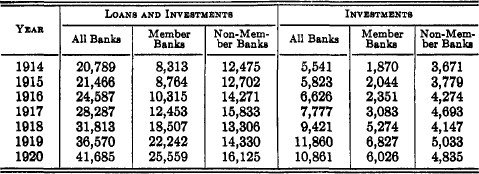
The table on page 32 summarizes the growth of loans and investments in the banking system, 1914–1920, and also reveals the dominant part played by the member banks in that growth. Considered in conjunction with Table II, it also indicates the fact that increases in deposits in the banking system as a whole follow upon (i.e., are the result of) increases in loans and investments.
Here again, it is to be observed that the greater part of the credit expansion during these years was contributed by the member banks. Although loans and investments of all banks increased by 100 per cent, those of the non-member banks show a growth of only 33 per cent, whereas the increase for the member banks was more than 200 per cent. The same is true with respect to investments, considered separately.
TABLE III
ALL BANKS IN THE UNITED STATES—LOANS AND INVESTMENTS OF MEMBER AND NON-MEMBER BANKS, 1914–1920
(June figures—in Millions of Dollars)
Source: Fifteenth Annual Report of Federal Reserve Board (1928), Table 44, p. 111.
One point of particular interest in this table is that the greater part of the increase in total bank credit was represented by loans, rather than by investments, the latter constituting only about one-fourth of the total increase between 1914 and 1920. Yet the expansion of loans, apparently, was initiated by the growth of investments; investments increased first, to be followed by increases in loans. A spiral of developments began with the huge issues of Government bonds, proceeded on rapidly to higher prices and an accelerated tempo of general business, and eventuated in the expansion of loans to provide the increased working capital for commerce and industry that was necessitated by the higher level of prices. What percentage of the increase in loans consisted initially of advances on Government securities for the purpose of covering individuals’ subscriptions for Liberty Bonds is not known, but loans of both types—those for the purposes just mentioned and loans to business men for the carrying of inventories at higher prices—together with the bond purchases, provided new credit which found its outlet in an enlarged money demand for commodities, resulting in forcing up the level of wholesale commodity prices. Hence the rise in the price level is ascribable primarily to the Government’s policy of war financing.
BANKS’ PURCHASE OF GOVERNMENT SECURITIES A POTENT CAUSE OF CREDIT EXPANSION
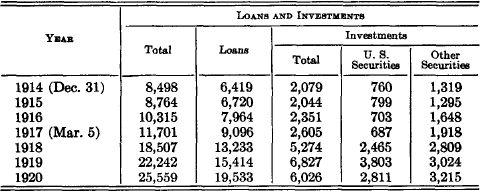
Table IV indicates strikingly the use to which the member banks were put in absorbing issues of Government bonds, thus creating more credit which circulated throughout the entire system.
TABLE IV
ALL MEMBER BANKS—LOANS AND INVESTMENTS, 1914–1920
(June figures, except as indicated—in Millions of Dollars)
Source: Fifteenth Annual Report of the Federal Reserve Board (1928), Table 48, p. 114.
While total investments were increasing 130 per cent from March, 1917 (just prior to the declaration of war in April), to June, 1920, investments in Government securities increased over 300 per cent, and investments in other securities increased but 67 per cent. While loans increased 70 per cent between March, 1917, and June, 1919, investments in Government securities increased 450 per cent during the same period. The growth of member banks’ holdings of Government securities during the year of the entrance of the United States into the War is strikingly apparent. The increase of almost seven billion dollars in total loans and investments in virtually the first War year indicates how the creation of credit by the purchase of Government securities led to a multiple expansion of loans and investments in the entire banking system.
POST-WAR PRICE LEVELS ABNORMAL
“Lenin is said to have declared that the best way to destroy the Capitalist System was to debauch the currency.”29 How close the capitalist system in America has come to destruction in consequence of the inflationary debauch of the currency indulged in during and since the War by the manufacture of deposit currency is as yet uncertain. For “it is a process that engages,” in the vivid language of Mr. J. M. Keynes, “all the hidden forces of economic law on the side of destruction, and does it in a manner which not one man in a million is able to diagnose.”30 The European countries achieved but little liquidation of credit during the 1920–1921 debacle, and several of them went on to further note currency inflation that reached astronomical heights. In the drastic, but brief, deflation of prices in 1920–1921 the United States did not complete the liquidation of inflated bank credit created during the War period: neither prices nor the structure of production and finance arrived at complete equilibrium relationships. The result was that the recovery following the immediate post-war depression rested on a foundation of prior inflation and upon a price level which could by no means be considered “normal.”
POST-WAR DEPRESSION INEVITABLE
In a small volume published in 1916 entitled The Economy and Finance of the War, by Professor A. C. Pigou of Cambridge University, appears a significant passage:31
* * * after the first few months of transition [after the end of the War], * * * it is practically certain that, to make good the havoc and the waste of war, there will be a strong industrial boom. This boom, if history is any guide, will generate in many minds an unreasoning sense of optimism leading to much wild investment. The result, some years afterwards, will be failures, crisis, and depression. If this danger is to be obviated or mitigated, it is imperative that the Government and the banks should so act as to restrain and keep within limits the initial peace boom.
The depression being dealt with here is that predicted by Professor Pigou in 1916. The only flaw in his remarkable prevision is that the “few years” extended to a decade; but he could not have foreseen, of course, that governments and banks, instead of restraining the investment boom and keeping it within limits, would aid and abet that boom by providing it with even more credit on which to feed.
PROXIMATE VERSUS ULTIMATE CAUSES OF THE GREAT DEPRESSION
The origins of the Great Depression, then, go back to the War and the inflation produced by war financing, assisted in this country by the operations of the Federal Reserve System. Had the War not intervened, a depression of the character, severity, and duration of the recent one would not have ensued; once the War was undertaken, the depression became to a certain degree inevitable.32 At the same time, the pattern of the depression was shaped by Federal Reserve credit policy in the post-War years and by the secondary inflation of bank credit engendered by that policy. Federal Reserve policy, however, was undoubtedly conditioned by the disordered state of finance, production, and prices which the War left behind it—for as Stamp says, “most financial questions are affected by what has happened during the war, and what has happened in consequence since.” The chief evil legacy of the period of War finance was the inflated price level produced by the War inflation—for it was this inflated price level which was to influence all post-War banking and credit developments, and hence post-War economic events.33 During the years beginning with 1922 the Federal Reserve banking authorities embarked on a misguided attempt to prop up that price level artificially by a further inflation of bank credit, in consequence of which the War inflation was carried over to the depression which began in 1929. Hence the proximate cause of the depression was Federal Reserve banking policy following 1921 and the inflation of bank credit induced by that policy; the ultimate controlling influence was the War and the War-time inflation. Later chapters will deal with the way in which this post-War inflation, and the boom which resulted from that inflation, developed, and with the parts the banking system and banking policy played therein.
34 Vide Sir Josiah Stamp, The Financial Aftermath of War (New York: Charles Scribner’s Sons, 1932), pp. 13–14: “If most political events today are economic, then we can also say that most economic questions are also financial. * * * If then most economic questions are financial, we can quite truly say today that most financial questions are affected by what happened during the war, and what has happened in consequence since.” And cf. Clark, J. M., Strategic Factors in Business Cycles, p. 116: “The current depression is * * * not unrelated to * * * the process of post-War reconstruction and the dislocated conditions of international finance and trade, which the War left behind it.”
35 So much so that one economist of note has been moved to remark that “there is obviously much to be said for abandoning the term inflation altogether, and so dispensing with the need for any definition.” Pigou, A. C., “Inflation,” Economic Journal (December, 1917), Vol. XXVII, No. 108, p. 490.
36 See the definition by Professor E. W. Kemmerer in the American Economic Review (June, 1918), Vol. VIII, No. 2, p. 247: “Without attempting to harmonize the various conflicting views, nor to give a precise and formal definition of inflation, we may note that there is one idea common to most uses of the word, namely the idea of a supply of circulating media in excess of trade needs. It is the idea of redundancy of money or circulating credit or both, a redundancy that results in rising prices * * *. More specifically, inflation occurs when at a given price level, a country’s circulating media—cash and deposit currency—increase relatively to trade needs.”
37 Bankers and Credit (London: Eveleigh Nash & Grayson, Ltd., 1924), p. 59.
38 Taxation During the War (London: Humphrey Milford, 1932), p. 133.
39 The Financial Aftermath of War, p. 41.
40 American Economic Review, Supplement No. 2 (March, 1919), Vol. IX, No. 1, p. 119.
41 Bankers and Credit, p. 42.
42 “Loans and Taxes in War Finance,” American Economic Review Supplement (March, 1917), Vol. VII, No. 1, p. 200.
43 Phillips, C. A., Bank Credit (New York: The Macmillan Company, 1920).
44 “The view that bank deposits are potential currency is inapplicable to the deposits created in the Government’s War loan account.” Leffingwell, R. C. (Assistant Secretary of the Treasury during the War), “Treasury Methods of Financing the War in Relation to Inflation,” Proceedings of the Academy of Political Science (June, 1920), Vol. IX, No. 1, p. 32.
45 Bankers and Credit, p. 48.
46 Professor Jacob Hollander attributes priority to Professor A. C. Pigou (1915) and to Professor O. M. W. Sprague (1916); see his War Borrowing (New York: The Macmillan Company, 1919), pp. 157–158.
47 War and Lombard Street (1914); Our Money and the State (1917); The Business of Finance (1918); War-Time Financial Problems (1919).
48 Bankers and Credit, pp. 24–25.
49 See Phillips, op. cit., Ch. III; and see Hayek, F. A., Monetary Theory and the Trade Cycle (New York: Harcourt, Brace & Co., 1932), Ch. IV.
50 This is true as long as the amounts pass from bank to bank and are not withdrawn in cash and hoarded, or so long as they do not represent larger cash balances circulating in the hands of the public. But the above is intended to illustrate a principle rather than to arrive at a mathematical result. It seems hardly necessary to add that the process just described is the same as obtains when banks utilize excess reserves to grant loans to customers, instead of buying bonds, and as when banks buy bonds on the stock exchange, instead of subscribing to a new Government bond issue.
51 “Since the outbreak of War it is the second procedure in the main which has been followed, the surplus cash having been used to subscribe for Treasury Bills and other Government securities. The money so subscribed has again been spent by the Government and returned in the manner above described to the bankers’ cash balances, the process being repeated again and again until each £10,000,000 originally advanced by the Bank of England has created new deposits representing new purchasing power to several times that amount.” First Interim Report of the Committee on Currency and Foreign Exchanges After the War (The Cunliffe Committee Report), Cmd. 9182 (1918), Paragraph 10, note.
52 “* * * the fourth Liberty loan has been placed in a very large degree by the use of bank credit. Precisely how much such credit * * * is not yet certain * * *. In addition to this large use of direct bank credit is to be reckoned the fact that the bonds * * * have been taken by the banks as collateral to secure notes running for long periods * * *. These factors make not only for a serious condition of inflation but also for the maintenance and continuance of the inflation much longer than would otherwise be probable.” “Washington Notes” (unsigned), The Journal of Political Economy (December, 1918), Vol. XXVI, No. 10, pp. 977–978.
53 Friday, David A., Profits, Wages, and Prices (New York: Harcourt, Brace and Howe, Inc., 1920), p. 133.
54 See the Journal of the Royal Statistical Society (1931), Vol. XCIV, Part IV, p. 549.
55 “Thus Europe raised our prices * * *.” Profits, Wages, and Prices, p. 139.
56 “Unquestionably it was the impetus from Europe that started American prices on their upward course.” American Economic Review, Supplement (March, 1920), Vol. X, No. 1, p. 131.
57 The average reserve requirements of all banks prior to the Federal Reserve Act are estimated to have been 21.09%; under the provisions of the original Act, 11.61%; and under the terms of the Amendment of June 21, 1917, 9.76%. See The Practical Operations of the Federal Reserve System, issued by the Federal Reserve Bank of Richmond, p. 243.
58 Cf. the Report of the Committee on War Finance of the American Economic Association, The American Economic Review, Supplement No. 2 (March, 1919), Vol. IX, No. 1, pp. 96–97: “Recent improvements in our banking system, growing out of the establishment of the Federal Reserve System and its subsequent development, have made our reserve money * * * more efficient than it formerly was; in other words, have enabled a dollar in reserve to do more money work than before. This in effect is equivalent to increasing the supply of reserve money.” It has been calculated that if the requirements of the National Bank Act were in vogue December 31, 1924, member banks would have required $3, 200,000,000 more in reserves than they held to support the credit then outstanding (The Practical Operations of the Federal System, p. 238); and the Committee on Bank Reserves of the Federal Reserve System estimated that on the same basis in 1931 member banks would have needed $4, 400,000,000 of reserves instead of the $2, 900,000,000 actually held.
59 Under the old system, when a bank’s reserve fell below the legal minimum it was prohibited by law from making additional loans; and if its reserve was exhausted it was declared insolvent. Under the new system, borrowing from the bankers’ bank is the equivalent of going into the reserve under the old system, but without any penalty; indeed, the process of borrowing serves to replenish, or add to, the borrowing bank’s reserve.
60 It is also to be observed that henceforth the same twenty-nine-fold expansion is made possible in connection with each new influx of gold from abroad, whether the gold is deposited directly in the Federal Reserve Banks, or in commercial banks and by them redeposited in the Federal Reserve Banks.
61 It should be stressed, once again, that this example demonstrates the possible maximum expansive power; that is, it is assumed that the entire excess reserve of the Federal Reserve Banks is employed for the purpose of supporting additional Federal Reserve Bank deposits, and hence creating additional reserve for the member banks. To the extent that this excess of 650 million dollars (assumed to be gold) is used to support issues of Federal Reserve notes, which cannot be counted as legal reserve by member banks, this expansive power is diminished. As a matter of fact, a substantial portion of the gold reserve of the Federal Reserve Banks has been used for this latter purpose.
One other, and minor, qualification or limiting factor should be noted. If the process of credit expansion induces an increase in prices, more cash will be needed for hand-to-hand circulation; provided such additional “pocket money” is obtained by drawing on banks’ reserves, to that extent the expansive power of the banking system is decreased.
62 Keynes, J. M., Essays in Persuasion (London: Macmillan & Company, 1931), p. 77.
63 Ibid., p. 78.
64 London: J. M. Dent and Sons, Ltd., pp. 87–88.
65 “Great wars are accompanied by prosperity and followed by depression. This is an ancient truth * * * but one which each new generation tends to forget.” Leonard P. Ayres, The Economics of Recovery (New York: The Macmillan Company, 1933), p. 15.
66 “It is not the event of war * * * but rather the fact that great wars cause sudden and extreme advances in commodity prices. It is this sudden price advance which largely determines the nature and sequence of the business cycles of the following twenty years or so.” Ibid., p. 18.
- 1Foreign Exchange Before, During, and After the War (London: Oxford University Press, 3rd ed., 1925), p. 9.
- 2Strategic Factors in Business Cycles (New York: National Bureau of Economic Research, 1934), p. 4.
- 3“The Problem of Business Cycles,” in the Skandinaviska Kreditaktiebolaget Quarterly Report, January, 1933, p. 3.
- 4Ibid., p. 3.
- 5Cassel, G., The Theory of Social Economy (New York: Harcourt, Brace & Co., 1932), p. 538.
- 6Strategic Factors in Business Cycles, p. 6.
- 7Journal of the Institute of Bankers (June, 1931), Vol. LII, Part VI, p. 236.
- 8“Depression has continued because there is no prospect of profitable investment. And why is there no prospect of profitable investment? Because costs, which by reason of the inflationary boom have become too high in relation to prices, have not been reduced.” Lionel Robbins, in Lloyds Bank Monthly Review (October, 1982), Vol. III (NS), No. 32, p. 432.
- 9“Loans and Taxes in War Finance,” American Economic Review Supplement (March, 1917), Vol. VII, No. 1, p. 200.
- 10Phillips, C. A., Bank Credit (New York: The Macmillan Company, 1920).
- 11“The view that bank deposits are potential currency is inapplicable to the deposits created in the Government’s War loan account.” Leffingwell, R. C. (Assistant Secretary of the Treasury during the War), “Treasury Methods of Financing the War in Relation to Inflation,” Proceedings of the Academy of Political Science (June, 1920), Vol. IX, No. 1, p. 32.
- 12Bankers and Credit, p. 48.
- 13Professor Jacob Hollander attributes priority to Professor A. C. Pigou (1915) and to Professor O. M. W. Sprague (1916); see his War Borrowing (New York: The Macmillan Company, 1919), pp. 157–158.
- 14War and Lombard Street (1914); Our Money and the State (1917); The Business of Finance (1918); War-Time Financial Problems (1919).
- 15Bankers and Credit, pp. 24–25.
- 16See Phillips, op. cit., Ch. III; and see Hayek, F. A., Monetary Theory and the Trade Cycle (New York: Harcourt, Brace & Co., 1932), Ch. IV.
- 17This is true as long as the amounts pass from bank to bank and are not withdrawn in cash and hoarded, or so long as they do not represent larger cash balances circulating in the hands of the public. But the above is intended to illustrate a principle rather than to arrive at a mathematical result. It seems hardly necessary to add that the process just described is the same as obtains when banks utilize excess reserves to grant loans to customers, instead of buying bonds, and as when banks buy bonds on the stock exchange, instead of subscribing to a new Government bond issue.
- 18“Since the outbreak of War it is the second procedure in the main which has been followed, the surplus cash having been used to subscribe for Treasury Bills and other Government securities. The money so subscribed has again been spent by the Government and returned in the manner above described to the bankers’ cash balances, the process being repeated again and again until each £10,000,000 originally advanced by the Bank of England has created new deposits representing new purchasing power to several times that amount.” First Interim Report of the Committee on Currency and Foreign Exchanges After the War (The Cunliffe Committee Report), Cmd. 9182 (1918), Paragraph 10, note.
- 19“* * * the fourth Liberty loan has been placed in a very large degree by the use of bank credit. Precisely how much such credit * * * is not yet certain * * *. In addition to this large use of direct bank credit is to be reckoned the fact that the bonds * * * have been taken by the banks as collateral to secure notes running for long periods * * *. These factors make not only for a serious condition of inflation but also for the maintenance and continuance of the inflation much longer than would otherwise be probable.” “Washington Notes” (unsigned), The Journal of Political Economy (December, 1918), Vol. XXVI, No. 10, pp. 977–978.
- 20Friday, David A., Profits, Wages, and Prices (New York: Harcourt, Brace and Howe, Inc., 1920), p. 133.
- 21See the Journal of the Royal Statistical Society (1931), Vol. XCIV, Part IV, p. 549.
- 22“Thus Europe raised our prices * * *.” Profits, Wages, and Prices, p. 139.
- 23“Unquestionably it was the impetus from Europe that started American prices on their upward course.” American Economic Review, Supplement (March, 1920), Vol. X, No. 1, p. 131.
- 24The average reserve requirements of all banks prior to the Federal Reserve Act are estimated to have been 21.09%; under the provisions of the original Act, 11.61%; and under the terms of the Amendment of June 21, 1917, 9.76%. See The Practical Operations of the Federal Reserve System, issued by the Federal Reserve Bank of Richmond, p. 243.
- 25Cf. the Report of the Committee on War Finance of the American Economic Association, The American Economic Review, Supplement No. 2 (March, 1919), Vol. IX, No. 1, pp. 96–97: “Recent improvements in our banking system, growing out of the establishment of the Federal Reserve System and its subsequent development, have made our reserve money * * * more efficient than it formerly was; in other words, have enabled a dollar in reserve to do more money work than before. This in effect is equivalent to increasing the supply of reserve money.” It has been calculated that if the requirements of the National Bank Act were in vogue December 31, 1924, member banks would have required $3, 200,000,000 more in reserves than they held to support the credit then outstanding (The Practical Operations of the Federal System, p. 238); and the Committee on Bank Reserves of the Federal Reserve System estimated that on the same basis in 1931 member banks would have needed $4, 400,000,000 of reserves instead of the $2, 900,000,000 actually held.
- 26Under the old system, when a bank’s reserve fell below the legal minimum it was prohibited by law from making additional loans; and if its reserve was exhausted it was declared insolvent. Under the new system, borrowing from the bankers’ bank is the equivalent of going into the reserve under the old system, but without any penalty; indeed, the process of borrowing serves to replenish, or add to, the borrowing bank’s reserve.
- 27It is also to be observed that henceforth the same twenty-nine-fold expansion is made possible in connection with each new influx of gold from abroad, whether the gold is deposited directly in the Federal Reserve Banks, or in commercial banks and by them redeposited in the Federal Reserve Banks.
- 28It should be stressed, once again, that this example demonstrates the possible maximum expansive power; that is, it is assumed that the entire excess reserve of the Federal Reserve Banks is employed for the purpose of supporting additional Federal Reserve Bank deposits, and hence creating additional reserve for the member banks. To the extent that this excess of 650 million dollars (assumed to be gold) is used to support issues of Federal Reserve notes, which cannot be counted as legal reserve by member banks, this expansive power is diminished. As a matter of fact, a substantial portion of the gold reserve of the Federal Reserve Banks has been used for this latter purpose.
- 29Keynes, J. M., Essays in Persuasion (London: Macmillan & Company, 1931), p. 77.
- 30Ibid., p. 78.
- 31London: J. M. Dent and Sons, Ltd., pp. 87–88.
- 32“Great wars are accompanied by prosperity and followed by depression. This is an ancient truth * * * but one which each new generation tends to forget.” Leonard P. Ayres, The Economics of Recovery (New York: The Macmillan Company, 1933), p. 15.
- 33“It is not the event of war * * * but rather the fact that great wars cause sudden and extreme advances in commodity prices. It is this sudden price advance which largely determines the nature and sequence of the business cycles of the following twenty years or so.” Ibid., p. 18.
- 34In 1921, following the upheaval of prices which accompanied the primary post-War deflation, Professor T. E. Gregory, in writing on the situation then prevailing in the foreign exchanges, was moved to lament that:
- 35Thirteen years later, near the nadir of the Great Depression, Professor J. M. Clark wrote in like vein:
- 36Professor Gustav Cassel has said that “Our attention must now for a long time onwards be devoted towards a complete analysis of the upheaval now in progress.” The present study is directed to an inquiry into certain of the more fundamental aspects of major industrial fluctuations, and to the relationship of banking operations thereto, special reference being had throughout to the causes and relevant phases of the cycle beginning in the United States in 1922 and ending with the Great Depression. It is at the same time devoted to the formulation of a theory of business cycles—for “the present crisis is, in fact, a crisis also for the entire theory of business cycles.” The theory of business cycles here set forth, it is believed, is not only one which is applicable as a general explanation of depressions, but also one whose validity is particularly well illustrated by setting it against the background of the experience of the recent crisis. Accordingly, this theory of the cycle is correlated with the banking and financial situation in the United States during the post-War years into an explanation of the causes of the Great Depression.
- 37Professor Gustav Cassel has said that “Our attention must now for a long time onwards be devoted towards a complete analysis of the upheaval now in progress.” The present study is directed to an inquiry into certain of the more fundamental aspects of major industrial fluctuations, and to the relationship of banking operations thereto, special reference being had throughout to the causes and relevant phases of the cycle beginning in the United States in 1922 and ending with the Great Depression. It is at the same time devoted to the formulation of a theory of business cycles—for “the present crisis is, in fact, a crisis also for the entire theory of business cycles.” The theory of business cycles here set forth, it is believed, is not only one which is applicable as a general explanation of depressions, but also one whose validity is particularly well illustrated by setting it against the background of the experience of the recent crisis. Accordingly, this theory of the cycle is correlated with the banking and financial situation in the United States during the post-War years into an explanation of the causes of the Great Depression.
- 38“Causes” is used advisedly, it being “at once evident that no general or single theory is valid for so varying and varied a phenomenon as crisis.” And, as Professor Clark states, most “theoretical studies give us causes that are too few and too simple, such as over-production, under-consumption, over-saving, or failure to distribute to laborers their whole product or enough of the whole product of industry to enable them to buy the things they have produced.” The present apparent need is not for the propagating of novel theories, but rather for the orienting and synthesizing of extant knowledge.
- 39“Causes” is used advisedly, it being “at once evident that no general or single theory is valid for so varying and varied a phenomenon as crisis.” And, as Professor Clark states, most “theoretical studies give us causes that are too few and too simple, such as over-production, under-consumption, over-saving, or failure to distribute to laborers their whole product or enough of the whole product of industry to enable them to buy the things they have produced.” The present apparent need is not for the propagating of novel theories, but rather for the orienting and synthesizing of extant knowledge.
- 40As the depression has been denominated primarily a central banking phenomenon, it will also be desirable to attempt to unravel some of the changes caused in the structure, organization, and operation of the American banking system by the establishment of the central banking system represented by the Federal Reserve System. The special character of the depression is traced to the hyper-elasticity of the Federal Reserve System, and to the operation of that system as exemplified in the “managed currency” experiment of the Federal Reserve Board, working in opposition to what D. H. Robertson labels “the over-mastering tendency of prices to fall” after a war financed by inflationary measures. By virtue of that experiment, the Board succeeded in holding up the price level for a surprising length of time, but in so doing unwittingly aided in producing the boom and its consequent depression. The depression, in other words, was the price paid for the experimentation with currency management by the Federal Reserve Board during the period when the dislocations caused by war had not as yet been corrected and when the post-War deflation of prices had not been completed. Nor were the effects of this Federal Reserve Board action confined solely to the United States; the banking and industrial systems of leading commercial nations are interrelated so closely that the mistaken policy of one large central banking organization may be highly conducive to the precipitation of a world-wide depression.
- 41The boom is brought to an end, not only because of the restriction upon the supply of credit and purchasing power, but also because of the rise in the market rate of interest on new bond issues and other instruments of borrowing resulting from that restriction. Moreover, the realized rate of return on new capital development tends to fall in the later stages of a boom because of the fact that increases in wage rates gradually pare down the share going to capital. There ensues a general disequilibrium throughout the system, not only between wage rates and the cost of living, between costs and prices, and between production and consumption, but also a disequilibrium between investment and saving the reverse of that which prevails during the boom. As long as these general disequilibria persist, and as long as new investment in the sense of the production of new durable goods continues at a low ebb, depression continues.
- 42The World War was probably the worst-financed war in history from the viewpoint of sound fiscal policy. Less of the monetary costs of the War was financed by taxation and more by inflation of one form or another than any of the wars of the nineteenth century. Mr. Hartley Withers estimates that 17½ per cent of the cost of the War to England was covered by taxation, and Sir Josiah Stamp states that England’s showing in this respect was better than that of any other European belligerent. Elsewhere Stamp estimates that 63 per cent of the cost of the Napoleonic Wars to England was raised by taxation. The Report of the Committee on War Finance of the American Economic Association estimates the portion of World War costs covered by taxation in the United States at 25 per cent. As previously stated, all of the countries involved in the World War, with the exception of the United States, resorted to the age-old expedient of inflation of the note currency. But the United States, along with virtually all of the other nations, made use of that form of war financing which Mr. Withers denominates “quite the worst way of raising money for war or any other purpose” and which Professor 0. M. W. Sprague says is “the most potent single cause of the general advance in prices during periods of war,” namely, that of securing money from the banks either by issuing bonds directly to them for which they pay by creating new credits in favor of the Government, or by selling bonds to individuals who cover their subscriptions by borrowing from banks the credits that are newly created for this purpose. Such was the means by which the major portion of the monetary costs of the War was raised by all countries involved, and it is probably a safe assertion that it was employed on a more extensive scale than during any previous war. It is therefore desirable to inquire more fully into how the banking machinery was utilized to serve that end. In order to do so, however, it is necessary to set forth in some detail a particular point of banking theory which was neither understood nor recognized by writers on the subject until the period of War finance brought it into sharp relief.
- 43That banks “create” credit by granting loans has long been known and recognized. The precise nature of the process of creation of credit was not generally realized nor adequately analyzed, however, until after the termination of the World War. The correlative process of creation of bank credit, by means of purchases of investments on the part of the banks, is far from having universal recognition even today. It seems quite certain that some of those responsible for the way in which the War was financed in this country were not cognizant of the procedure by which it was done—they were, as Withers puts it, “making reckless use of a delicate machine which they did not understand and producing consequences which they neither foresaw nor recognized.”
- 44That banks “create” credit by granting loans has long been known and recognized. The precise nature of the process of creation of credit was not generally realized nor adequately analyzed, however, until after the termination of the World War. The correlative process of creation of bank credit, by means of purchases of investments on the part of the banks, is far from having universal recognition even today. It seems quite certain that some of those responsible for the way in which the War was financed in this country were not cognizant of the procedure by which it was done—they were, as Withers puts it, “making reckless use of a delicate machine which they did not understand and producing consequences which they neither foresaw nor recognized.”
- 45That banks “create” credit by granting loans has long been known and recognized. The precise nature of the process of creation of credit was not generally realized nor adequately analyzed, however, until after the termination of the World War. The correlative process of creation of bank credit, by means of purchases of investments on the part of the banks, is far from having universal recognition even today. It seems quite certain that some of those responsible for the way in which the War was financed in this country were not cognizant of the procedure by which it was done—they were, as Withers puts it, “making reckless use of a delicate machine which they did not understand and producing consequences which they neither foresaw nor recognized.”
- 46So far as is known to the writers, this process of the manufacture of credit on the part of the banks by purchasing investments was first discerned by Withers. In several books published during the War period he indicates an increasing understanding of it in connection with war finance. In his Bankers and Credit, however, published in 1924, he elaborates the theory most clearly, and it is appropriate to quote at some length from that work:
- 47So far as is known to the writers, this process of the manufacture of credit on the part of the banks by purchasing investments was first discerned by Withers. In several books published during the War period he indicates an increasing understanding of it in connection with war finance. In his Bankers and Credit, however, published in 1924, he elaborates the theory most clearly, and it is appropriate to quote at some length from that work:
- 48So far as is known to the writers, this process of the manufacture of credit on the part of the banks by purchasing investments was first discerned by Withers. In several books published during the War period he indicates an increasing understanding of it in connection with war finance. In his Bankers and Credit, however, published in 1924, he elaborates the theory most clearly, and it is appropriate to quote at some length from that work:
- 49The operation of the machinery of bankers’ banking made possible the creation of the greater portion of the credit by means of which both the United States and England financed the War. It was not the effect of such transactions as Withers describes that had the most significant influence upon prices in this country; rather, it was the superimposition of bankers’ banking upon the commercial banking structure that led to the compound creation of bank credit. For whenever bankers’ banking becomes operative, the inflationistic nature of commercial banking is greatly reinforced and accentuated. In the simplest possible illustration, in a banking system requiring a 10 per cent reserve against deposits, a bank having a reserve of one million dollars in excess of the required ratio may use that reserve to buy one million dollars worth of bonds, giving the Government deposit credit for that amount. As the Government draws checks against this deposit credit and pays them to government contractors, munitions makers, etc., and as they in turn deposit the checks in their (other) banks, the bank which originally bought the bonds tends to part company with cash—but that cash reappears as new, excess, reserve, for some other bank (or group of banks) in the system. The second bank in turn may now use 90 per cent of its new reserve to buy, let us say, $900,000 worth of bonds (it being required to set aside $100,000 to satisfy the requirement for a 10 per cent reserve against the deposit of the government contractors), and as the Government checks against the $900,000 deposit created in its favor in exchange for the bonds, the second bank (or group of banks) in turn tends to lose cash to a third bank (or group of banks) in the system. The third bank (or group of banks) may now use its new reserve of cash to buy $810,000 worth of bonds (90 per cent of $900,000 deposited with it) and to create $810,000 of Government deposits, and so the process is repeated again and again.
- 50As this is done, each bank in subscribing for bonds to the extent of 90 per cent of the amount deposited with it creates an equivalent increase in deposits either for itself or for other banks in the system, and it becomes clear that the original creation of credit ultimately makes possible manifold new deposits in the banking system. That is to say, the total credit created on the basis of the excess reserve originally utilized to buy bonds is not simply equal to the amount of that reserve, but is (for a system with a 10 per cent legal reserve ratio against deposits) roughly ten times that amount. The original one million dollars of excess reserve permits the creation of ten million dollars new deposits in the banking system. And to the extent that all banks in the system are possessed of excess reserves and use them simultaneously to buy bonds issued by the Government the expansion is more widespread and proceeds more rapidly. Thus it is seen that deposits are basically the offspring of loans and investments for the banking system as a whole.
- 51As this is done, each bank in subscribing for bonds to the extent of 90 per cent of the amount deposited with it creates an equivalent increase in deposits either for itself or for other banks in the system, and it becomes clear that the original creation of credit ultimately makes possible manifold new deposits in the banking system. That is to say, the total credit created on the basis of the excess reserve originally utilized to buy bonds is not simply equal to the amount of that reserve, but is (for a system with a 10 per cent legal reserve ratio against deposits) roughly ten times that amount. The original one million dollars of excess reserve permits the creation of ten million dollars new deposits in the banking system. And to the extent that all banks in the system are possessed of excess reserves and use them simultaneously to buy bonds issued by the Government the expansion is more widespread and proceeds more rapidly. Thus it is seen that deposits are basically the offspring of loans and investments for the banking system as a whole.
- 52The machinery of central banking was exploited indirectly to create credit with which to finance the War, moreover, when individuals subscribed to the bond issues and secured the funds with which to pay for the bonds by borrowing from the banks, pledging the bonds as collateral for the loans, provided the central banks were able and willing to make such advances to the local banks as would enable them to maintain adequate legal reserves. This process increased the deposits in the banking system as effectively as when the banks subscribed to the bond issues directly. It was encouraged and facilitated in the United States by the policies of the Treasury Department and the Federal Reserve Board, acting in cooperation under the leadership of Mr. William G. McAdoo in his dual rôle of Secretary of the Treasury and member of the Board. From this procedure, as in that first described, there ensued a great increase in purchasing power that was unaccompanied by an equal increase in production, and hence resulted in inflation.
- 53Dr. David Friday, in his book Profits, Wages, and Prices, professes not to understand this remarkable rise in the price level during the War period. Speaking of the American situation he says:
- 54Nevertheless, the thing is explainable according to the time-honored laws of economic theory; all that is necessary is to substitute bank credit for irredeemable paper. Bank credit in this day and age is more potent in determining the price level than are circulating notes, or irredeemable paper currency. As Mr. R. G. Hawtrey rightly points out, “It is not gold that controls money, but money that controls the value of gold. * * * Gold necessarily follows money; the idea that money follows gold is a fallacy.” Bank credit, as is generally known, now does 90 per cent or more of the money work of the country, and is the most important influence affecting the price level, and hence the value of money.
- 55Dr. Friday explains the rise in prices in this country as due to enlarged European demand for American goods for war purposes. Professor W. C. Mitchell states the same idea. It will be conceded that enhanced European demand had an appreciable tendency to raise prices in this country, but this alone is far from sufficient to explain the whole of the phenomenal increase. For it is significant that as late as September, 1915, after a year of European demand and after the influx of over three hundred million dollars in gold from abroad, the price level in this country still stood at 100 (with 1913 as the base year).
- 56Dr. Friday explains the rise in prices in this country as due to enlarged European demand for American goods for war purposes. Professor W. C. Mitchell states the same idea. It will be conceded that enhanced European demand had an appreciable tendency to raise prices in this country, but this alone is far from sufficient to explain the whole of the phenomenal increase. For it is significant that as late as September, 1915, after a year of European demand and after the influx of over three hundred million dollars in gold from abroad, the price level in this country still stood at 100 (with 1913 as the base year).
- 57In the first place, by the terms of the original Act the minimum average legal reserve requirements of member banks were reduced approximately 50 per cent from those prevailing under the old National Bank Act, thereby doubling possible credit in the banking system. A billion dollars in reserves which would support about five billion dollars of deposit credit under the terms of the National Bank Act could support about ten billion dollars of credit under the new reserve provisions of the Federal Reserve Act. Yet reserve requirements were further reduced after our entrance into the War by the Amendment of June 21, 1917, which also contained the highly important provision that from then on all lawful reserves of member banks should consist only of deposit credits on the books of the Federal Reserve Banks. The effect of this amendment, as well as the reduction of reserve requirements contained in the original Act, was to enhance the effective reserve base of the banking system, just as effectively as though gold reserves had been increased.
- 58In the first place, by the terms of the original Act the minimum average legal reserve requirements of member banks were reduced approximately 50 per cent from those prevailing under the old National Bank Act, thereby doubling possible credit in the banking system. A billion dollars in reserves which would support about five billion dollars of deposit credit under the terms of the National Bank Act could support about ten billion dollars of credit under the new reserve provisions of the Federal Reserve Act. Yet reserve requirements were further reduced after our entrance into the War by the Amendment of June 21, 1917, which also contained the highly important provision that from then on all lawful reserves of member banks should consist only of deposit credits on the books of the Federal Reserve Banks. The effect of this amendment, as well as the reduction of reserve requirements contained in the original Act, was to enhance the effective reserve base of the banking system, just as effectively as though gold reserves had been increased.
- 59Quite apart from the reduction in reserve requirements, however, a magnification of the reserve base came about simply as a result of the creation of a central banking system. This is because of the fact that a system of central banking operates to dilute cash, so that reserves in effect go further. In a system devoid of bankers’ banking, reserves consist of lawful money in the vaults of individual banks; in a system incorporating central banking, legal reserves for the member banks of the system exist simply as deposit liabilities of the bankers’ banks. When the Federal Reserve Act, and the amendment thereto of June 21, 1917, required the member banks to transfer their reserves to the Federal Reserve Banks they became reserves for the Reserve Banks, and the transfer gave rise to deposits to the credit of the member banks. These deposit liabilities owed the member banks by the Reserve Banks likewise assumed the rôle of reserves for the member banks. Against such deposits the Federal Reserve Banks were required to hold only a fractional reserve, amounting to but 35 per cent of the deposit liabilities. The difference of 65 per cent constituted free or excess reserves for the Reserve Banks, on the basis of which they could grant loans to the member banks, increasing the deposits of the latter with the Federal Reserve Banks. And as these increased deposits with the Federal Reserve Banks represented increased reserves for the member banks, the latter were able to increase their deposits by granting additional loans to their customers. Hence it is apparent that central banking is inherently inflationistic, at least during the period following its introduction, on account of the greater expansion of credit it makes possible on a given amount of reserves.
- 60Thus it is seen that, whereas the billion dollars in the vaults of the commercial banks supported a credit structure of 10 billion dollars (on the assumption of a 10 per cent reserve-deposit ratio), the same billion dollars may, as a result of the creation of the central banking system, support a credit structure of 29 billion dollars when transferred to the vaults of the Federal Reserve Banks. The superimposition of the system of central banking by and of itself thus virtually triples the possible expansive power of the banking system.
- 61This illustration assumes the existence of a 10 per cent reserve-deposit ratio for the commercial banking system. But it was not until the Federal Reserve Act came into effect that such an average reserve ratio legally obtained. The Federal Reserve Act increased the credit-creating possibilities of the commercial banking system in two distinct ways: it reduced average reserve requirements from about 20 per cent to about 10 per cent, thereby doubling the power of credit expansion, and it set up a system of central banking, which tripled this power. The real effect of the Federal Reserve Act, therefore, was to increase the credit expansion potentialities of the banking system not merely three-fold, but virtually six-fold. A billion dollars in reserves, which under the old system would support total deposits of five billion dollars, could under the new system theoretically support nearly six times that amount, or thirty billions. The full effect of the Federal Reserve Act was thus the same as though five billion dollars in new reserves had been acquired by the banking system.
- 62“Lenin is said to have declared that the best way to destroy the Capitalist System was to debauch the currency.” How close the capitalist system in America has come to destruction in consequence of the inflationary debauch of the currency indulged in during and since the War by the manufacture of deposit currency is as yet uncertain. For “it is a process that engages,” in the vivid language of Mr. J. M. Keynes, “all the hidden forces of economic law on the side of destruction, and does it in a manner which not one man in a million is able to diagnose.” The European countries achieved but little liquidation of credit during the 1920–1921 debacle, and several of them went on to further note currency inflation that reached astronomical heights. In the drastic, but brief, deflation of prices in 1920–1921 the United States did not complete the liquidation of inflated bank credit created during the War period: neither prices nor the structure of production and finance arrived at complete equilibrium relationships. The result was that the recovery following the immediate post-war depression rested on a foundation of prior inflation and upon a price level which could by no means be considered “normal.”
- 63“Lenin is said to have declared that the best way to destroy the Capitalist System was to debauch the currency.” How close the capitalist system in America has come to destruction in consequence of the inflationary debauch of the currency indulged in during and since the War by the manufacture of deposit currency is as yet uncertain. For “it is a process that engages,” in the vivid language of Mr. J. M. Keynes, “all the hidden forces of economic law on the side of destruction, and does it in a manner which not one man in a million is able to diagnose.” The European countries achieved but little liquidation of credit during the 1920–1921 debacle, and several of them went on to further note currency inflation that reached astronomical heights. In the drastic, but brief, deflation of prices in 1920–1921 the United States did not complete the liquidation of inflated bank credit created during the War period: neither prices nor the structure of production and finance arrived at complete equilibrium relationships. The result was that the recovery following the immediate post-war depression rested on a foundation of prior inflation and upon a price level which could by no means be considered “normal.”
- 64In a small volume published in 1916 entitled The Economy and Finance of the War, by Professor A. C. Pigou of Cambridge University, appears a significant passage:
- 65The origins of the Great Depression, then, go back to the War and the inflation produced by war financing, assisted in this country by the operations of the Federal Reserve System. Had the War not intervened, a depression of the character, severity, and duration of the recent one would not have ensued; once the War was undertaken, the depression became to a certain degree inevitable. At the same time, the pattern of the depression was shaped by Federal Reserve credit policy in the post-War years and by the secondary inflation of bank credit engendered by that policy. Federal Reserve policy, however, was undoubtedly conditioned by the disordered state of finance, production, and prices which the War left behind it—for as Stamp says, “most financial questions are affected by what has happened during the war, and what has happened in consequence since.” The chief evil legacy of the period of War finance was the inflated price level produced by the War inflation—for it was this inflated price level which was to influence all post-War banking and credit developments, and hence post-War economic events. During the years beginning with 1922 the Federal Reserve banking authorities embarked on a misguided attempt to prop up that price level artificially by a further inflation of bank credit, in consequence of which the War inflation was carried over to the depression which began in 1929. Hence the proximate cause of the depression was Federal Reserve banking policy following 1921 and the inflation of bank credit induced by that policy; the ultimate controlling influence was the War and the War-time inflation. Later chapters will deal with the way in which this post-War inflation, and the boom which resulted from that inflation, developed, and with the parts the banking system and banking policy played therein.
- 66The origins of the Great Depression, then, go back to the War and the inflation produced by war financing, assisted in this country by the operations of the Federal Reserve System. Had the War not intervened, a depression of the character, severity, and duration of the recent one would not have ensued; once the War was undertaken, the depression became to a certain degree inevitable. At the same time, the pattern of the depression was shaped by Federal Reserve credit policy in the post-War years and by the secondary inflation of bank credit engendered by that policy. Federal Reserve policy, however, was undoubtedly conditioned by the disordered state of finance, production, and prices which the War left behind it—for as Stamp says, “most financial questions are affected by what has happened during the war, and what has happened in consequence since.” The chief evil legacy of the period of War finance was the inflated price level produced by the War inflation—for it was this inflated price level which was to influence all post-War banking and credit developments, and hence post-War economic events. During the years beginning with 1922 the Federal Reserve banking authorities embarked on a misguided attempt to prop up that price level artificially by a further inflation of bank credit, in consequence of which the War inflation was carried over to the depression which began in 1929. Hence the proximate cause of the depression was Federal Reserve banking policy following 1921 and the inflation of bank credit induced by that policy; the ultimate controlling influence was the War and the War-time inflation. Later chapters will deal with the way in which this post-War inflation, and the boom which resulted from that inflation, developed, and with the parts the banking system and banking policy played therein.

