
Banking and the Business Cycle
VII. The Fundamental Causes of the Great Depression (Continued)
The greater part of the discussion centering upon an analysis of the causes of the depression and the development of a theory of business cycles has up to the present been concerned principally with an analysis of the causes of the boom. Little attention has been devoted as yet to the course and nature of the depression proper, or even to the immediate cause of the onset of depression. The foregoing chapter dealt with two phases of the theory of business cycles here being advanced, but no attempt was there made to present the third and last phase. Endeavor will be made in the present chapter to complete the task—to accomplish a synthesis of the third widely held theory of the cycle, the equilibrium view, with the preceding two, the monetary and the structural theories. This requires some consideration of certain salient features of the depression itself; in particular it necessitates an inquiry into the causes of its unforeseen prolongation, inasmuch as the disequilibria to which attention is directed in the exposition of the equilibrium theory are intimately connected with the duration of the depression.
FORECASTERS LED INTO ERROR BY PREVIOUS CYCLE PATTERNS
No attempt will be made, however, to inquire minutely into either the history or all of the aspects of the depression. Analysis, as has been stated before, rather than description, is here the major aim. Nevertheless, some familiarity with conspicuous events of recent economic history is essential for an understanding of the severity and duration of the depression, as well as for the completion of an explanation of its causes. Almost all of the accepted signs that had marked the end of depression in the past were in evidence by the summer of 1931, misleading careful students of cycle theory and of older depression patterns to predict recovery in the near future; yet, actually the nadir of the depression was not reached until a year later, and after that eight more months passed before the final explosive collapse of the banking system occurred. It is likely that these prognosticators were led into error, in basing their forecasts on past cycle patterns, by neglecting to take adequate account (1) of the general disequilibria produced by the stock market crash, (2) of the disproportion between saving and investment in its effect upon the whole structure of production, and (3) of the banking situation, in contributing to the continuance of depression.
NEGLECTED FACTORS
In the first place, the depression was as exaggerated and as protracted as it was because the stock market crash itself was the most devastating one that the world had ever witnessed. This was partly because the prior period of stock market boom was the greatest ever experienced, and partly because the crash involved a larger number of people in its destructive effects than had any such previous disaster. Therefore it is desirable to examine into the rôle played by the stock market situation, not only in prolonging the depression, but also in prolonging and intensifying the boom prior to 1929.
In the second place, the alteration of the structure of production in the sense of a disproportionate decrease of investment activity was greater than in any previous depression; this fact in itself goes far toward explaining the unparalleled extent of the depression. The decline in the production of producers’ goods relative to the decline in the production of consumers’ goods was more pronounced than ever before, and its repercussions were felt throughout the whole productive process. Unemployment in the capital goods industries alone was greater than the total unemployment in all lines of industry in any depression prior to the recent one; this induced a widening circle of unemployment in other lines of industrial activity and resulted in wholesale loss of purchasing power.
And, in the third place, during no previous collapse was there such a complex entanglement of the banking system with the course of depression. It is scarcely to be denied that this was a factor which contributed, by the destruction of monetary purchasing power, to the length of the recent period of recession. Earlier depressions were usually marked only by a slackening of the rate of credit growth, or by actual declines of total bank credit of from 6 to 10 per cent; the decline in total credit outstanding during the recent years amounted to almost 40 per cent for the commercial banks of the country.
But underlying and supplementing all of these factors was a stubbornly persisting lack of equilibrium in the entire economic and price structure. The equilibrium theory is advanced by some as the sole explanation of the depression; the view is held by the authors, however, that this theory is not tenable as an exposition of the causes of the depression. Yet it does constitute a large part of the explanation why depression, once started, is as pertinacious as it is, and why industrial revival waits on the restoration of equilibrium conditions. Thus it is seen that this theory is merely one segment of the circle of explanation of the business cycle.
PERCUSSIVE CHARACTER OF STOCK MARKET CRASH
The stock market crash itself was the immediately precipitating cause of the depression. While it is true that the peak of constructional activity had definitely been passed, and that general industrial production was beginning to slacken by the time the stock market crash occurred, so that depression doubtless would have ensued eventually, the inevitable decline probably would have been more gradual had it not been for the detonation in Wall Street which rocked the entire industrial strata. Although on first thought it may appear to be incorrect to speak of an external event which marks the beginning of a decline as its “cause,” it is nevertheless accurate to say that the stock market crash initiated the depression. While it is the dynamite which “causes” the destruction following an explosion, it is the percussion cap which “causes” the explosion. The whole character of the ensuing depression was colored and shaped by what happened in Wall Street in October, 1929. The pattern of the depression might well have been radically different from what it actually was had it not been preceded by the stock market catastrophe; the decline probably would have been more gradual and hence less severe, and the shattered confidence and demoralized state of mind of the business community no doubt would have been largely lacking if the damaging psychological effects of the stock exchange disaster could have been averted.
The stock market situation had another and prior influence, however. It operated to prolong the boom prior to 1929 and, as the severity of a depression is a function of the extent of the prior boom (though not a precise mathematical one) it indirectly affected the length of the depression. It may be inquired, in view of the stress that has been placed upon the cessation of the increase in credit with its effect upon decreasing investment activity, why the depression did not start sooner than it did. The rate of credit growth began to slacken early in 1928. Total loans and investments of the member banks were greater in October, 1929, than in December, 1928, it is true, and the total for June, 1929, was above that of June, 1928; nonetheless, the rate of increase during this period was considerably smaller. Reference to Chart IV on page 136 will show that the flotations of new bond issues began to decline in January of 1928 at the same time that the long-term market rate of interest began to rise. Short-term commercial paper rates were also rising rapidly during most of 1928 and all of 1929. Why, then, in view of these usual indications of a reversal of a boom, did it not come to an end in 1928 instead of toward the end of 1929?
Stock Market Boom, with Its Fleeting Profits, Sustained Consumer Demand, Delayed and Intensified Disaster
Clearly the answer is that an industrial recession would have come about in 1928 had it not been, principally, for the stock market boom which was still in full swing, exercising temporarily a dominating influence over wide areas of the economic sphere. And directly connected with the stock market’s crescendo, the increased velocity of circulation of bank credit operated as a sustaining influence in prolonging the boom. The velocity of circulation of deposits, as computed by the New York Federal Reserve Bank, rose almost 50 per cent during 1928 and 1929. This increase was in the main a direct outcome of the enhanced activity in the stock market, but at the same time it served to cumulate that activity. For credit must always be considered, not alone as to its absolute amount, but also with respect to its velocity. That is to say, it is effective credit which is important, and effective credit is a product of amount and turnover. During the last stage of the boom the rate of increase in the amount of bank credit was declining, but an increase in the velocity of circulation served to more than offset the decline in credit growth, resulting in a steady expansion in the volume of effective credit. Thus the stock market boom, with its attendant but ephemeral profits, operated to sustain consumer demand even after investment activity began to slacken, so that the total volume of industrial production was for a time maintained at a relatively high level.
Stock Market Boom Stimulated by Rapid Retirement of Federal Debt and Mushroom Growth of Investment Trusts
The stock market boom was also stimulated by two minor contributing factors, the importance of which cannot be measured accurately. First, the retirement of the Federal debt at a rate of over $800,000,000 a year during this period tended to increase the volume of free funds seeking reinvestment. Debt reduction does not of itself increase the volume of loanable funds, of course, as the means for retiring the debt are raised by taxation—all that is really involved is a transfer of funds. Debt retirement, however, does serve to shift the demand for securities. As Government bonds were called and paid off, the proceeds were reinvested by the former bondholders, principally in stocks. Second, the striking growth of investment trusts which occurred during 1928 and 1929 helped to drive stock market prices still higher. The investment trusts in the main did not use their funds to acquire new issues of securities; rather they represented a new source of demand for issues outstanding, thereby further forcing up the prices of these old securities.
These new sources of demand for stocks aided in developing a market situation that was especially favorable to the flotation of new stock issues, as against new bond issues. As the price of stocks rose, the yield on stocks declined, so that it became profitable for many corporations to shift their new financing activities from bond issues to capital stock issues. This had the effect of offsetting the tendency toward a decline in total investment activity that normally results from a rising interest rate on long-term bond issues. The shift in popularity from financing through the medium of bond issues to that of stock flotations is indicated in the following table.
TABLE XVIII
NET NEW DOMESTIC CORPORATE FINANCING—REFUNDING EXCLUDED
(In Millions of Dollars)
| TYPE OF FINANCING | 1927 | % | 1928 | % | 1929 | % |
| Bonds and Notes | 2,962 | 63 | 2,175 | 41 | 1,874 | 23 |
| Short-term Obligations | 221 | 5 | 211 | 4 | 205 | 3 |
| Preferred Stocks | 874 | 19 | 1,149 | 21 | 1,517 | 19 |
| Common Stocks | 600 | 13 | 1,812 | 34 | 4,417 | 55 |
| Total | 4,657 | 100 | 5,347 | 100 | 8,013 | 100 |
Source: Commercial and Financial Chronicle (January 18, 1930), Vol. 130, No. 3369, p. 366.
Stock Prices in Relation to Corporate Earnings
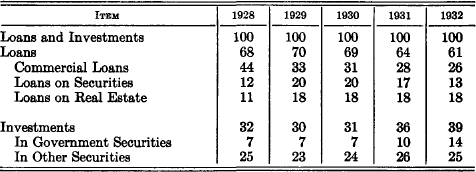
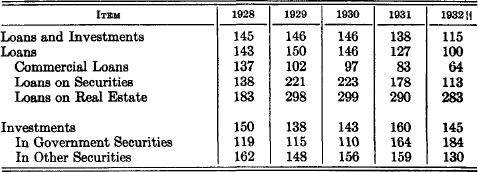
It has frequently been argued that the stock market boom was justified on the basis of rapidly rising corporate earnings. Some have contended that profits not only were large in absolute amount but that they were increasing at an accelerating rate, and that in view of this consideration the high-level stock prices represented simply the rational discounting of anticipated future earnings. On sober afterthought, however, it appears that the stock market boom was largely a product of bank credit expansion, a mad speculative frenzy which had no rationale whatever. The prices that were bid for stocks in 1929 in most cases could not have been offered without the aid of bank credit (in the form of brokers’ loans) to complete the transactions. Tables XXII and XXIII (appearing later in this chapter) show that from 1928 to 1929 Loans on Securities rose from 12 per cent of Total Loans and Investments of all banks in the country to 20 per cent, and that the index numbers of Loans on Securities rose from 138 in 1928 to 221 in 1929. Tables XIX and XX, showing the income of all manufacturing corporations filing tax returns with the Treasury Department, indicate that the idea of rapidly increasing corporate profits as the main cause for rapidly rising stock market prices is inadequate. Aggregate profits were large, it is true, and were rising during part of this period; but to attempt to explain the unprecedented increase in share prices solely on the basis of increasing corporate earnings is to neglect the fundamentally causal relationship between rapidly expanding bank credit and rapidly rising stock prices during this period. It is simply a fact that profits were not expanding at all commensurate with the rise in share prices.
TABLE XIX
INCOME OF ALL MANUFACTURING CORPORATIONS
Compiled from Statistics of Income, U. S. Treasury Department (In Millions of Dollars)
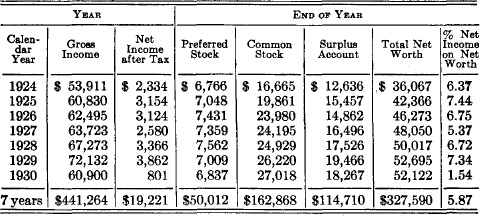
Note.—Capitalization figures not available prior to 1924.
Net income of these corporations for the 15 years from 1916 to 1930 constituted an average of but 5.05 per cent of sales; net income for the seven years from 1924 to 1930 represented a return on net worth of but 5.87 per cent. The profit on sales was higher in 1923 than in 1929, and the return on net worth was greater in 1925 than in 1929. It should be stressed that these figures are for all manufacturing corporations in the United States, including those corporations having no net income, and thus show the complete data with respect to earnings. It is of interest to note that even during the halcyon days of 1927-1929 deficits were larger than during any other three-year period from 1916 to 1930, if the depression years of 1921 and 1930 be left out of account. Professor Clark seems properly to have analyzed this situation with respect to prospective earnings when he says:1
CHART V
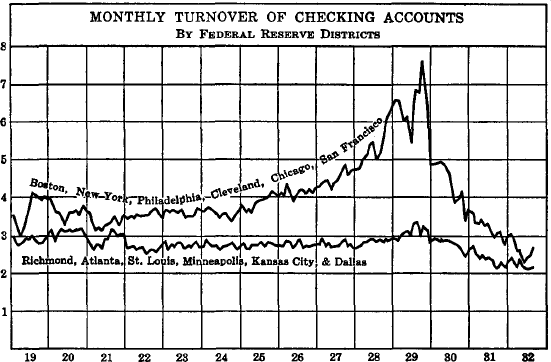
Source: Cleveland Trust Company Bulletin (October 15, 1932), Vol. 13, No. 10. Reproduced by permission.
Stock prices during the great boom were capitalizing not current earnings but future earnings of a sort which any systematic analysis should have revealed as beyond all human possibility. * * * What was happening was a relative shift of demand, in favor of speculative securities, out of all proportion to the magnitude of ordinary shifts of this sort, carrying values, relative to yields, to points far outside what could be called normal, unless on the basis of an expectation of future increases which no industrial system could maintain.
Colonel Ayres in his Cleveland Trust Company Bulletin has shown how the velocity of bank credit rose during the later years of the boom (and collapsed during the depression), as well as its connection with stock market speculation, by segregating velocities according to Federal Reserve districts. The monthly turnover of checking accounts according to Reserve districts is shown by the two curves on Chart V; the upper curve is for those districts in which are located  of the stock brokerage offices of the country. The comparative stability of the lower curve is marked; the fact that the pronounced rise in the upper curve began at the time that the stock market boom got well under way, in 1924, speaks for its own importance.
Bank Credit Directly Underlay Stock Market Advance
The significance of an increasing velocity of circulation of bank credit in stock exchange transactions is that it makes possible a cumulation of speculative profits, and as such profits are realized they may be used to enlarge consumptive expenditures. And, further, to the extent that bank credit is used to finance such speculative activities, realized profits therefrom tend to increase.
If an operator buys, for example, $100,000 worth of stocks with his own available resources (that is, without borrowing) and later sells out for a price of $200,000, a profit of $100,000 is realized. But if the second operator borrows $100,000 to complete the transaction at the price of $200,000, the $100,000 profit realized by the first operator is made possible only by virtue of the extension of $100,000 credit to the second operator. The $100,000 profit for Operator A is nonetheless that much new purchasing power, which he may use either for further speculative activities or spend for additional consumables. If the price of the stock should again double and Operator B sell to Operator C for $400,000, half of which Operator C borrows from his bank, then Operator B profits to the extent of $200,000 as a result of this further extension of credit. To the extent that such transactions become more frequent and additional bank credit is obtained to complete them, greater actual profits are realized and more purchasing power becomes available during a given time period for expenditure on consumption goods, or other purposes. It should be apparent that the higher prices for stocks during the boom, and the greater realized profits, were more strictly products of expanding bank credit and a higher velocity for that bank credit, than of any rational discounting of future corporate earning power. Working through the securities market, however, some part of the newly created credit increased consumer demand and thus had an effect upon productive activity.
As soon as the stock market boom collapsed in October, 1929, this artificial and short-lived element in consumer purchasing power evaporated. In this sense, the stock market crash may be considered the immediately generating cause of the ensuing depression. The saturnalia of stock exchange speculation sufficed to carry the New Era boom upward and onward for a time after investment activity began to flag; when the bubble burst, the flood-gates of depression were opened. In what is admittedly a retrospective view, the chief effect of the Federal Reserve expansion of 1927 was to inflate the stock market; little of the new credit found its outlet in commercial loans or investment activity. The Board’s expansion policy of 1927 therefore prolonged the boom and forced it to unprecedented heights. All signs seem to have pointed to the beginning of a natural decline early in 1927 which no doubt would have marked the end of the post-War period of expansion; had it not been for intervention by the Federal Reserve Board in that year, it is altogether probable that such a development would have occurred. And had the decline started from the lower level prevailing in 1927 the subsequent depression probably would have been neither so protracted nor so severe.2
CHRONOLOGICAL ASPECTS OF PRODUCTION DECLINE IN RELATION TO STOCK MARKET COLLAPSE
It has been argued by persons inclined to minimize the importance of the Wall Street collapse that production had reached its peak in May or June of 1929 and was already declining when the stock market crash occurred. It is true that the absolute peak of industrial production was reached earlier than October, 1929, but the amount of the decline from May (or June) to October was negligible compared with the precipitancy of decline after that date. The Annalist Index of Business Activity reached its high point of 110.1 in May of 1929, but in July still stood at 109.9 and by September had declined only to 107.3; by December, however, it had fallen to 92. The Federal Reserve Board’s Index of Industrial Production was 126 in June, and in September it stood at 122; by December, it had declined to 101. And to direct attention to a group of industries that constitute an extraordinarily sensitive industrial weather-vane, the index of machine tool production reached a peak of 336 in February, 1929, was at 334 in September of that year, but fell to 166 by December. As measured by these three indexes, therefore, the really significant decline in the volume of physical production came after the stock market collapse, rather than before it.
PROLONGED PROCESS OF INVESTMENT DEFLATION
The major effect of the stock market collapse may be said to have been an investment, or capital, deflation, just as the boom was an investment inflation. An investment deflation, or a deflation of capital values and capital assets, is a much more prolonged process than a commodity, or commercial credit, deflation. There was a serious deflation of commodity prices, it is true, but it would not have been so pronounced had there not been the accompanying investment deflation to aggravate it. The industrial system is able to adjust itself to, and to react from, a deflation of commercial credit and a decline in commodity prices much more rapidly and readily if these are not associated with any large deflation of investment credit and of capital values. The business depression of 1920-1921 was marked by one of the most drastic commodity liquidations on record, yet the entire process of readjustment consumed but about fifteen months. Although the 1920-1921 depression was one of our more severe ones, measured by the depth of the decline, it was not of long duration because of the fact that there had been no extensive expansion of investment credit and of investment activity accompanying the preceding commercial credit expansion.3
HOW SHRINKAGE IN SECURITY VALUES REPRESSED PRODUCTION ACTIVITY
The stock market crash provided the shock to confidence which definitely and dramatically started the depression on its downward course, revealing to most persons for the first time the inherent instability of the conditions which had prevailed for several years. The losses suffered in the stock market crash of 1929 affected a greater number of the American people than had any previous collapse; the savings of a lifetime were rudely swept away for great numbers of the rank and file, and many New Era millionaires saw their fortunes vanish almost overnight. If there is general public participation in a stock market boom, the losses from a deflation of that boom fall largely on individuals who are ill-prepared to stand heavy losses; the sharp reduction in consumer purchasing power necessitates a downward revision of the standard of living—for as Keynes remarks, 4 “the public cannot be expected to see their nominal wealth increase by $20,000,000,000 in six months and then lose $26,000,000,000 in three months, and to maintain precisely the same style of life during the second period as during the first.” In order to try to save what they had sunk in the stock market, individuals sought to meet the demands of their brokers for more margin, either out of current income which otherwise would have represented consumer purchasing power or out of existing unused savings. But as the decline proceeded, even the owners’ original equities (or “margins”) were wiped out and the potential purchasing power represented by such savings was swept away. Confronted with the loss of their back-logs of savings, the former speculators sought to retrench all along the line, and the fear of possible unemployment influenced many to refrain from making expenditures which they otherwise would have made. All of this meant a further reduction in retail sales, which soon exercised a further repressive effect on productive activity. Reduced production activity necessarily tended to result in unemployment and decreased demand, and the circle repeated itself in the well-known spiral of deflation.
SHAKEN CONFIDENCE REFLECTED IN DRASTICALLY CURTAILED CONSTRUCTION NOTABLY IN CAPITAL GOODS INDUSTRIES
The shock to confidence wrought by the stock market panic was promptly reflected in the capital market, and the volume of new issues shrank drastically. The new capital flotations in this country dropped 30 per cent from 1929 to 1930, and in the following year declined an additional 60 per cent. The total of corporate bond issues for the whole year 1932 was less than half the average monthly figure for 1929. This condition in the capital market was directly associated with a precipitate and extensive decline in the volume of construction and other new capital development. The structure of production was again altered, this time in the sense of a relatively greater decline in the production of producers’ goods than of consumers’ goods. Indeed, the decline in producers’ goods production relative to that of consumers’ goods was more severe during the recent depression than in any previous one. In other words, a disequilibrium between saving and investment occurred in a form exactly the reverse of that which prevailed during the boom—investment shrank faster than savings declined. After the rapid initial decline in the production of consumers’ goods, consumption was maintained at a relatively stable level from the middle of 1930 on, whereas the stream of current income going for saving was constantly dwindling and the rate of decline in investment activity was even more pronounced. Such savings as were being made were not utilized by the financial machine to further new investment activity, but were used largely to improve the liquid position of the banks by building up their impaired reserve ratios. The volume of new construction fell to a point lower than that prevailing during the 1920-1921 depression; the per-capita output of durable goods fell to the lowest point during the present century: the volume of pig iron production in 1932 was less than it was in 1892; and the output of steel in 1932 was the smallest of any year during this century—all of which spell deep and dire depression. For, as has been pointed out in Chapter VI, when investment increases during a boom it stimulates all the processes of production and results in realized profits; conversely, when investment activity declines rapidly during a depression its blighting effects are felt throughout the whole industrial system, and results in losses. When unemployment prevails in the durable goods industries it is well-nigh certain to be accompanied by reduced activity in the consumption goods industries.
Thus it is seen that the investment deflation which first began in the stock and capital markets was soon translated into an investment deflation in the capital goods industries themselves. So long as the decline in the output of producers’ goods continued it was to be expected that the depression would persist and deepen.
IMPACT ON INCOME
The quickest way to have broken the back of depression would have been to direct all possible efforts toward a revival of activity in the capital goods industries. This no doubt would have necessitated reductions in wage rates, at least in the capital goods industries, so that it would have been possible for profits to be made there, instead of the losses that were resulting. Instead, all efforts were directed toward bolstering up consumption, and the maintenance of wage rates was one of the expedients adopted in order to attain that end. The result was simply that, in trying to pay the existing rates of wages and to continue dividend disbursements, corporations and business enterprises generally sustained losses and were compelled to dip into their surpluses to meet their obligations. In making use of surpluses to maintain such current business spending as there was, past saved income was being drawn upon. Yet with losses general over all industry, it was inevitable that the volume of business payments should decline rapidly. This situation is brought out in the table on page 165, showing income produced and distributed for the country as a whole.
The facts of this table are shown graphically in the following chart, which also shows the distribution of the national income going to the various functional groups.
The following table and chart, it is believed, contain the essence of the explanation of the continuance of depression. The short-sighted policy of the Hoover Administration of seeking to maintain wage rates and consumption indicated lack of comprehension of the relations obtaining between wage rates and total wages, and between costs and prices, as determinative of levels of production and consumption; in all fairness, it should be added that the succeeding administration appears to be largely oblivious to the validity of the economic truism that production begets consumption, and that thus far the present Administration has shown but scant inclination to profit in any way from the errors of its predecessors. By consuming more than we have produced we have succeeded only in digging our way deeper into depression; we have tried to recover from depression by spending our way out of it rather than adopting the alternative procedure,—the one which has effected recovery from every past depression,—of saving our way out of it. By the policy of maintaining consumer purchasing power we have had to draw upon our store of past savings, and by so doing we have not only failed to keep up our accustomed rate of capital formation but have actually destroyed past accumulations by neglecting to provide for maintenance, depreciation, and obsolescence. Mr. George O. May, senior partner in the accounting firm of Price, Waterhouse & Company and a member of the Board of Directors of the National Bureau of Economic Research, emphasizes the fact that our policy of maintaining consumption has made use of past savings, as follows:5
TABLE XXI
NATIONAL INCOME, PAID OUT AND DISTRIBUTED
(In Millions of Dollars)

Source: Bulletin 49 of the National Bureau of Economic Research, January 26, 1934.
CHART VI
NATIONAL INCOME’
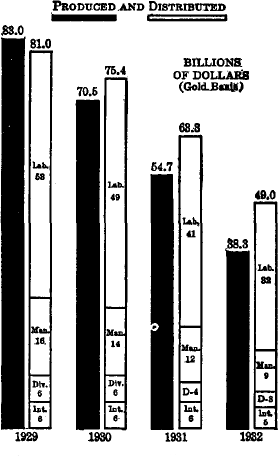
Source: Cleveland Trust Company Bulletin (February 15, 1934), Vol. 15, No. 2. Reproduced by permission.
It is apparent that a large part of the dividends and interest paid in these years were paid out of capital or out of corporate savings of prior years. It does not seem correct to describe such payments as “income paid out,” and the use of this term may have given rise to misconceptions. * * * What the property owners collectively received was largely, if not mainly, the result of their previous thrift—not a part of the current income flow for the depression years. A conclusion substantially different from that presented in Bulletin 49 is reached if the amount of income received by labor is compared with the total income produced for the years from 1929-1932. The figures taken from tables 1 and 2 in Bulletin 49 are as follows:
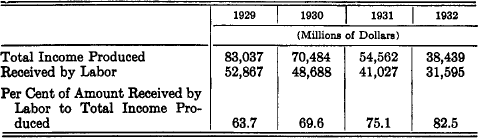
Mr. May might have added that although total income produced declined 54 per cent from 1929 to 1932, the income received by labor declined only 40 per cent. And here is a brief and conclusive answer to the whole question of the consequences of artificially maintained consumption—with labor receiving a greater percentage share of the total social product than at any time in recent history, the result was widespread unemployment and stagnation. The way out is via greater production, a larger total social product, and that necessarily follows upon a greater amount of saving being made and being converted into investment goods. For “saving,” in the sense of merely refraining from possible expenditures for consumers’ goods, is not in itself conducive to recovery; indeed, the kind of “thrift” that results only in the piling up of idle bank balances and the hoarding of currency in deposit boxes is strongly conducive to further disastrous deflation. The capitalistic system is “out of joint” either when savings decline sharply or when savings are made but are not converted shortly into capital goods (no less so than when the reverse relationship obtains) and the continuance of the latter condition has meant the continuance of depression.
ENTANGLEMENT OF BANKS WITH DEPEESSION
The depression had not proceeded far, however, before the banking system became involved in, and with, the processes of deflation. As shown in Chapter V, the banking system had by 1929 developed an illiquid condition which boded ill for the business community in general when the downward spiral should begin. Indeed, the efforts that were made to strengthen the position of the banking system after the decline set in were made in part at the expense of the business community, and in themselves served to hasten the general deflationary movement. When, in an attempt to improve their reserve positions, banks called their “demand” loans and refused to renew maturing commercial loans, much “distress” selling of goods and materials by debtor business concerns necessarily followed. And, as total deposits decrease when loans are paid off, this action on the part of the banks resulted in the destruction of a large amount of purchasing power within the economic system which unquestionably helped to make the decline in commodity prices more precipitate. In other words, there was added pressure placed on the commodity markets, operating to drive prices still lower, from two sources: first, business men were forced to sell their products in order to meet the demands of the banks for payment of their loans, thus increasing the supply of goods coming on the market during a given time-interval, and second, the repayment of loans, through checks drawn by the depositor-borrowers, involved the cancellation of deposits, thus decreasing the total demand in the form of available purchasing power. Total loans and investments in the commercial banks of the country stood at a lower figure at the end of 1932 than during the 1920-1921 depression; commercial loans of all banks in 1932 were less than half of what they had been in 1928, and were 36 per cent less than in 1922; all of the bank credit inflation of 1922 to 1929 was wiped out in the short space of the three years following 1929. Such a wholesale destruction of bank credit was bound to prolong and to intensify the ensuing period of recession.
Bank Failures Dealt Disruption
Furthermore, an extensive destruction of bank credit brought about largely by bank failures is more damaging than one induced by an orderly liquidation of outstanding bank loans. Business men can ordinarily lessen the disruptive effects of having their loans called for repayment if they have advance notice of that fact. Also, as a measure of economy during depression, they usually seek to reduce their bank indebtedness of their own accord. But when a wave of bank failures sweeps the country, as from 1929 to 1933, it affects most disastrously those who are unprepared to meet the situation. The resulting loss of both business funds and real savings, added to the extinguishment of “created” bank credit when loans were paid off, contributed still further to the stagnation of business activity and to the decline in commodity prices by reducing available purchasing power. There was a rapid deflation of commercial loans and of bank credit during the 1920-1921 depression, but it was not accompanied by widespread bank failures. The number of bank failures in the single year 1931, on the other hand, was greater than the total for all the years from 1900 to 1929, and more banks failed in the single month of October, 1931, than in the two years 1920–1921. A very large part of the annihilation of bank credit after 1929 came about in this way. No economic system could withstand such wholesale bank failures and such loss of monetary purchasing power without suffering continued prostration.
The two tables which follow serve to give an idea of what was happening in the banking situation during the course of the depression. It may be observed from Table XXII that in trying to improve their liquidity during the years 1930–1932 the banks increased their investments at the expense of their loans (except loans on real estate), it being considered at that time that investments represented a type of liquid assets which could be realized on at will. Investments constituted 30 per cent of all loans and investments in 1929, but rose to 39 per cent of the total by 1932, an increase of almost one-third. Commercial loans declined from 44 per cent of all loans and investments in 1928 to 26 per cent in 1932; in contrast, investments in Government securities, being looked upon as exceptionally liquid assets, doubled from 1929 to 1932.
TABLE XXII
PERCENTAGE DISTRIBUTION OF LOANS AND INVESTMENTS OF ALL BANKS, 1928–1932
(June for Each Year)
Source: Annual Reports of the Comptroller of the Currency.
TABLE XXIII
INDEX NUMBERS OF LOANS AND INVESTMENTS OF ALL BANKS, 1928–1932
(Base: June, 1922)
Source: Annual Reports of the Comptroller of the Currency.
Examination of the second table shows that in 1932 total loans and investments were still slightly above what they were in 1922, this being in consequence of the 45 per cent increase in Investments, the 13 per cent increase in Loans on Securities, and the 183 per cent increase in Real Estate Loans. Total Loans stood at the same figure in 1932 as in 1922, but commercial loans were less by 36 per cent. The marked percentage increase in the holdings of Government securities from 1930 to 1932 during the course of the banks’ struggle for improved liquidity and for survival should also be noted. It may be remarked further that the figures either for the member banks alone or for the commercial banks alone would show their total loans and investments (and total deposits) to have been less in 1932 than in 1922, as the above figures for “all banks” include the mutual savings banks; there were no failures among the mutual savings banks during the depression, and their loans and investments, and deposits, actually increased from 1929 to 1932.
THE EQUILIBRIUM THEORY OF THE BUSINESS CYCLE
It remains to complete the theoretical analysis of the business cycle, and of the causes of depression. All of the processes and factors described in the present chapter as being connected with the course of events since 1929—the stock market crash proper, the disproportionality in the structure of production, and the entanglement of the banking system with the several phases of the depression—may be said to have resulted in a general loss of equilibrium throughout the economic system. Thus attention is again focused on the third major division, the equilibrium view, of the eclectic or integrated theory here being developed. Perhaps the chief proponents in this country of the equilibrium theory of business cycles causation are Professor Sprague, 6 Dr. B. M. Anderson, Jr., 7 and Mr. George E. Roberts, 8 and in England, Professor Henry Clay9 (now economic consultant to the Bank of England). In the opinion of the writers, to repeat, the equilibrium theory is in and of itself neither a full and sufficient theory of business cycles nor a complete explanation of the causes of the depression. The equilibrium view has validity only as explaining the depression once it has set in—it is descriptive rather than analytical, as it does not show what caused, or started, the depression. And it sheds only faint light on the genesis of the boom which always precedes a depression.
An understanding of the significance of a lack of equilibrium throughout the entire economic system is indispensable, however, in explaining the depth and duration of the depression. The equilibrium view may be said to consist principally of the description of a series of unbalances. The stock market crash itself produced an unbalanced situation which quickly degenerated into depression; the lack of balance between production and consumption, and the disequilibrium between saving and investment, served not only to extend the depression but also to make it more malignant; and the loss of balance in the banking structure together with the consequent demolition of bank credit also aided in prolonging the depression and in making its destructive effects more pronounced. Of a somewhat different order than the special disequilibriums just mentioned, but of even greater fundamental importance, because it underlay and conditioned these others, was the unbalance found in connection with cost-price relationships, to be dealt with more fully in Chapter IX.
The loss of balance between agriculture and industry—the disparity between the prices the farmer received for the products he sold and the prices he had to pay for the goods he purchased—was another disequilibrating factor tending to prolong the depression, and one worthy of more extensive comment than space limitations permit here. The extent to which the situation had become unbalanced in this respect is indicated by the decline in the ratio of the prices received by the farmer to the prices paid by him from 99 in 1929 to 56 in 1932, and until this ratio was improved it could hardly be expected that lasting recovery would ensue. Nevertheless, it does not follow that recovery would automatically ensue upon restoration of parity in this ratio; other unbalances must also be corrected.
EQUILIBRIUM VIEW ESSENTIAL
The equilibrium view is an essential part of any cycle theory which essays comprehensiveness. And only a theory which achieves completeness can be accorded full validity as an explanation of the business cycle. Too many so-called theories of the business cycle are what properly should be called “depression” theories; they attempt to account for the beginnings of the decline, but fail to offer any adequate explanation either of the antecedent course of events or of the initiation of the succeeding cycle. Other theories seek to explain the origin of the boom, but stop with that; while still others are concerned to show the relation of the monetary origins of a boom to the subsequent effects upon the structure of production, but fail to carry the analysis on to the depression proper. So far as is known to the writers, no one theory heretofore advanced has attempted to explain why the cycle starts, what gives the boom its special character and driving force, why the boom comes to an end, why the depression persists and deepens, and what conditions are essential for the beginning of the next complete cycle.
The inclusion of the equilibrium theory is necessary to a complete explanation of the whole cycle of boom and depression. It is the third segment, the third phase, of a tripartite theory of the cycle and explanation of the recent depression. It does explain the persistence of depression, once under way. So long as unbalance goes uncorrected in the series of relationships just mentioned, recovery will not follow. The origin of the cycle may be said to lie in the elasticity of the banking machinery; and for the explanation of the recent cycle and recent depression it lay in the hyper-elasticity of the machinery of central banking. The monetary theory, in other words, explains why, in a condition of relative equilibrium, the cycle starts—the disequilibrium between the market rate of interest and the natural rate induced by the banking system provides the necessary and sufficient conditions for the upward swing of the cycle. The structural approach contains the essence of the explanation of the cause of the oscillations of production—the disequilibrium between investment and saving, the more rapid rate of increase of capital formation made possible by the banking process, is the boom. The equilibrium analysis suffices to explain how depression, once under way as a result of the cessation of the increases of bank credit and of investment, is largely a result of the general disequilibria produced during the prior boom period and continued for a time during the course of the depression. As long as these unbalances go uncorrected, depression persists, because the stage is not yet set for the revival of investment activity. All three approaches are necessary for a complete understanding of the full cycle; no one of them standing alone represents a fully developed theory. If any special merit attaches to the foregoing analysis, then, it consists in its fusion of all three of these theories into an integrated and sufficient explanation and analysis of the course and aspects of the recent boom and recent depression. The older monetary theory is not compatible with the actual course of recent economic events; the structural view alone affords no understanding of the originating monetary forces which set the boom in motion; yet, were it not for the persisting lack of equilibrium the depression could be cured by monetary measures, which the experience of the recent years has proved (if it has proved nothing else) cannot be done while disequilibrium prevails. The final chapter (Chapter IX) will attempt to show what conditions are necessary for the restoration of that equilibrium essential for recovery, and may for that reason be considered as representing the concluding portion of the theory of the business cycle here being enounced.
10 Clark, J. M., Strategic Factors in Business Cycles, p. 115.
11 “* * * Up to 1927 I should have expected that * * * the subsequent depression would be very mild. But, as is well known, in that year an entirely unprecedented action was taken by the American monetary authorities, * * * prolonging the boom for two years beyond what otherwise would have been its natural end. * * * It seems to me that these facts have had a far greater influence on the character of the depression than the developments up to 1927, which from all we know, might instead have led to a comparatively mild depression in and after 1927.” Hayek, F. A., “Capital and Industrial Fluctuations,” Econometrica (April, 1934), Vol. II, No. 2, p. 167.
12 “In the case of commercial credit deflation, * * * the economic indigestion is quickly cured. Excess goods are eliminated from the system, and, after a brief convalescence, normal functioning is again in order.” Bradford, F. A., Money (New York: Longmans, Green & Co., rev. ed., 1933), pp. 373, 374.
13 A Treatise on Money, Vol. II, p. 197.
14 National City Bank Letter, April, 1934, p. 34.
15 “Major and Minor Trade Fluctuations,” in the Journal of the Royal Statistical Society (1931), Vol. XCIV, Part IV, pp. 540–549.
16 “Equilibrium Creates Purchasing Power,” the Chase Economic Bulletin (June 12, 1931), Vol. XI, No. 3.
17 The National City Bank Letter, various monthly issues since 1929.
18 “Some Aspects of the World Depression,” Institute of Bankers Journal (December, 1931, January and February, 1932), Vol. 52, pp. 515–522; Vol. 53, pp. 5–28, and 91–108.
- 1Foreign Exchange Before, During, and After the War (London: Oxford University Press, 3rd ed., 1925), p. 9.
- 2Strategic Factors in Business Cycles (New York: National Bureau of Economic Research, 1934), p. 4.
- 3“The Problem of Business Cycles,” in the Skandinaviska Kreditaktiebolaget Quarterly Report, January, 1933, p. 3.
- 4Ibid., p. 3.
- 5Cassel, G., The Theory of Social Economy (New York: Harcourt, Brace & Co., 1932), p. 538.
- 6Strategic Factors in Business Cycles, p. 6.
- 7Journal of the Institute of Bankers (June, 1931), Vol. LII, Part VI, p. 236.
- 8“Depression has continued because there is no prospect of profitable investment. And why is there no prospect of profitable investment? Because costs, which by reason of the inflationary boom have become too high in relation to prices, have not been reduced.” Lionel Robbins, in Lloyds Bank Monthly Review (October, 1982), Vol. III (NS), No. 32, p. 432.
- 9“Loans and Taxes in War Finance,” American Economic Review Supplement (March, 1917), Vol. VII, No. 1, p. 200.
- 10In 1921, following the upheaval of prices which accompanied the primary post-War deflation, Professor T. E. Gregory, in writing on the situation then prevailing in the foreign exchanges, was moved to lament that:
- 11Thirteen years later, near the nadir of the Great Depression, Professor J. M. Clark wrote in like vein:
- 12Professor Gustav Cassel has said that “Our attention must now for a long time onwards be devoted towards a complete analysis of the upheaval now in progress.” The present study is directed to an inquiry into certain of the more fundamental aspects of major industrial fluctuations, and to the relationship of banking operations thereto, special reference being had throughout to the causes and relevant phases of the cycle beginning in the United States in 1922 and ending with the Great Depression. It is at the same time devoted to the formulation of a theory of business cycles—for “the present crisis is, in fact, a crisis also for the entire theory of business cycles.” The theory of business cycles here set forth, it is believed, is not only one which is applicable as a general explanation of depressions, but also one whose validity is particularly well illustrated by setting it against the background of the experience of the recent crisis. Accordingly, this theory of the cycle is correlated with the banking and financial situation in the United States during the post-War years into an explanation of the causes of the Great Depression.
- 13Professor Gustav Cassel has said that “Our attention must now for a long time onwards be devoted towards a complete analysis of the upheaval now in progress.” The present study is directed to an inquiry into certain of the more fundamental aspects of major industrial fluctuations, and to the relationship of banking operations thereto, special reference being had throughout to the causes and relevant phases of the cycle beginning in the United States in 1922 and ending with the Great Depression. It is at the same time devoted to the formulation of a theory of business cycles—for “the present crisis is, in fact, a crisis also for the entire theory of business cycles.” The theory of business cycles here set forth, it is believed, is not only one which is applicable as a general explanation of depressions, but also one whose validity is particularly well illustrated by setting it against the background of the experience of the recent crisis. Accordingly, this theory of the cycle is correlated with the banking and financial situation in the United States during the post-War years into an explanation of the causes of the Great Depression.
- 14“Causes” is used advisedly, it being “at once evident that no general or single theory is valid for so varying and varied a phenomenon as crisis.” And, as Professor Clark states, most “theoretical studies give us causes that are too few and too simple, such as over-production, under-consumption, over-saving, or failure to distribute to laborers their whole product or enough of the whole product of industry to enable them to buy the things they have produced.” The present apparent need is not for the propagating of novel theories, but rather for the orienting and synthesizing of extant knowledge.
- 15“Causes” is used advisedly, it being “at once evident that no general or single theory is valid for so varying and varied a phenomenon as crisis.” And, as Professor Clark states, most “theoretical studies give us causes that are too few and too simple, such as over-production, under-consumption, over-saving, or failure to distribute to laborers their whole product or enough of the whole product of industry to enable them to buy the things they have produced.” The present apparent need is not for the propagating of novel theories, but rather for the orienting and synthesizing of extant knowledge.
- 16As the depression has been denominated primarily a central banking phenomenon, it will also be desirable to attempt to unravel some of the changes caused in the structure, organization, and operation of the American banking system by the establishment of the central banking system represented by the Federal Reserve System. The special character of the depression is traced to the hyper-elasticity of the Federal Reserve System, and to the operation of that system as exemplified in the “managed currency” experiment of the Federal Reserve Board, working in opposition to what D. H. Robertson labels “the over-mastering tendency of prices to fall” after a war financed by inflationary measures. By virtue of that experiment, the Board succeeded in holding up the price level for a surprising length of time, but in so doing unwittingly aided in producing the boom and its consequent depression. The depression, in other words, was the price paid for the experimentation with currency management by the Federal Reserve Board during the period when the dislocations caused by war had not as yet been corrected and when the post-War deflation of prices had not been completed. Nor were the effects of this Federal Reserve Board action confined solely to the United States; the banking and industrial systems of leading commercial nations are interrelated so closely that the mistaken policy of one large central banking organization may be highly conducive to the precipitation of a world-wide depression.
- 17The boom is brought to an end, not only because of the restriction upon the supply of credit and purchasing power, but also because of the rise in the market rate of interest on new bond issues and other instruments of borrowing resulting from that restriction. Moreover, the realized rate of return on new capital development tends to fall in the later stages of a boom because of the fact that increases in wage rates gradually pare down the share going to capital. There ensues a general disequilibrium throughout the system, not only between wage rates and the cost of living, between costs and prices, and between production and consumption, but also a disequilibrium between investment and saving the reverse of that which prevails during the boom. As long as these general disequilibria persist, and as long as new investment in the sense of the production of new durable goods continues at a low ebb, depression continues.
- 18The World War was probably the worst-financed war in history from the viewpoint of sound fiscal policy. Less of the monetary costs of the War was financed by taxation and more by inflation of one form or another than any of the wars of the nineteenth century. Mr. Hartley Withers estimates that 17½ per cent of the cost of the War to England was covered by taxation, and Sir Josiah Stamp states that England’s showing in this respect was better than that of any other European belligerent. Elsewhere Stamp estimates that 63 per cent of the cost of the Napoleonic Wars to England was raised by taxation. The Report of the Committee on War Finance of the American Economic Association estimates the portion of World War costs covered by taxation in the United States at 25 per cent. As previously stated, all of the countries involved in the World War, with the exception of the United States, resorted to the age-old expedient of inflation of the note currency. But the United States, along with virtually all of the other nations, made use of that form of war financing which Mr. Withers denominates “quite the worst way of raising money for war or any other purpose” and which Professor 0. M. W. Sprague says is “the most potent single cause of the general advance in prices during periods of war,” namely, that of securing money from the banks either by issuing bonds directly to them for which they pay by creating new credits in favor of the Government, or by selling bonds to individuals who cover their subscriptions by borrowing from banks the credits that are newly created for this purpose. Such was the means by which the major portion of the monetary costs of the War was raised by all countries involved, and it is probably a safe assertion that it was employed on a more extensive scale than during any previous war. It is therefore desirable to inquire more fully into how the banking machinery was utilized to serve that end. In order to do so, however, it is necessary to set forth in some detail a particular point of banking theory which was neither understood nor recognized by writers on the subject until the period of War finance brought it into sharp relief.

