

Can you navigate booms and busts better than the Fed? The new “Federal Reserve Simulator” ($2.99 on Steam) gives you a shot.
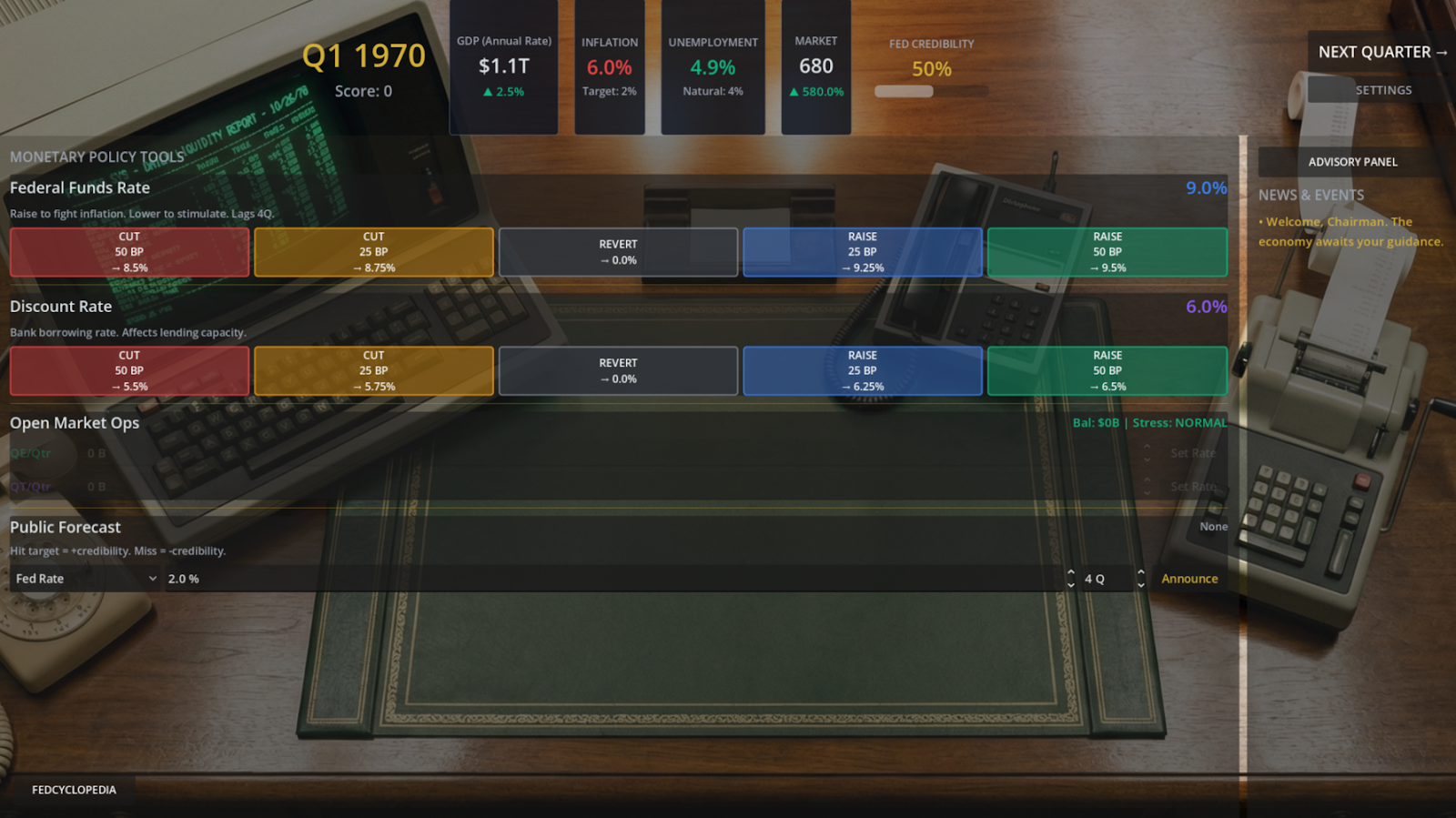
Gameplay is very simple. It’s turn-based and you only have a few policy levers to adjust. You are given a few data points on GDP, inflation, unemployment, the stock market, “Fed Credibility,” and the level of stress in the banking system. You also have a news panel with headlines. Each quarter, you make a decision on the federal funds rate, the discount rate, and open market operations. You can also make announcements about future outcomes—correct announcements help the Fed’s credibility while incorrect ones damage the Fed’s credibility. After making your choices, you advance to the next quarter and start again with fresh data.
Here’s what the user interface looks like, though the items on your desk change depending on the decade:
Your success depends on achieving the following goals:
- Keep inflation near 2% - Too high destroys purchasing power, too low risks deflation
- Keep unemployment around 4% - The natural rate that doesn’t cause inflation
- Maintain steady GDP growth – Avoid recessions and overheating
- Build Fed credibility – Accurate forecasts make your tools more effective
The game was designed by two brothers with degrees in economics, but the “Fedcyclopedia” within the game indicates that their education was thoroughly mainstream, citing John Maynard Keynes and the “need” for a central bank to mitigate business cycles and stabilize bank crises.
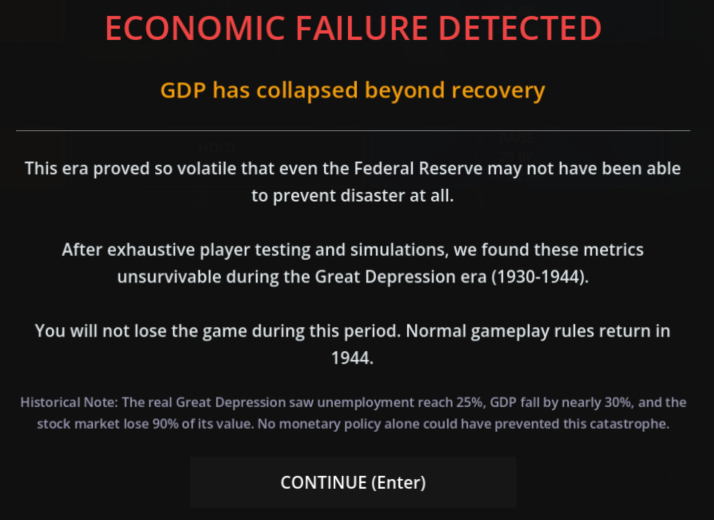
An unfortunate consequence of this is that the game is designed in such a way that certain economic events are bound to happen, no matter what choices you make as Fed chair in the years preceding them. No matter what a player does, for example, there will be a stock market crash in 1929 and a subsequent collapse in GDP and spike in unemployment. The game acknowledges this:
Fed Chair Jonathan Newman
I tried a few different strategies to beat this roadblock, but all failed. I even tried keeping interest rates extremely high during the 1920s, making correct announcements throughout the decade to boost the Fed’s credibility (so that my “rescue efforts” would be most effective), and then turning on the monetary firehose full blast in 1929 with interest rates at the zero lower bound, and I still got a Great Depression.
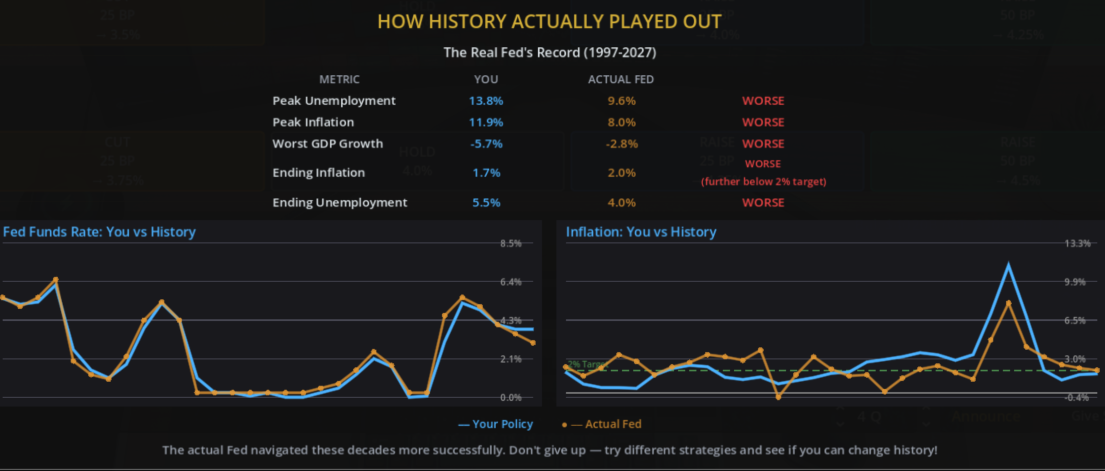
I did a few other experiments in other time periods. I tried to see what would happen if I copied actual Fed policy from the 1990s to the 2020s. I pulled up data from FRED on the FFR, the discount rate, and OMOs and plugged them into the game each quarter. Surprisingly, I did worse than the “actual Fed” from the game’s perspective even though I did what the actual Fed did!
What if the Fed did nothing over the same time period? I kept interest rates at their starting position and just advanced through the quarters, making no changes at all:
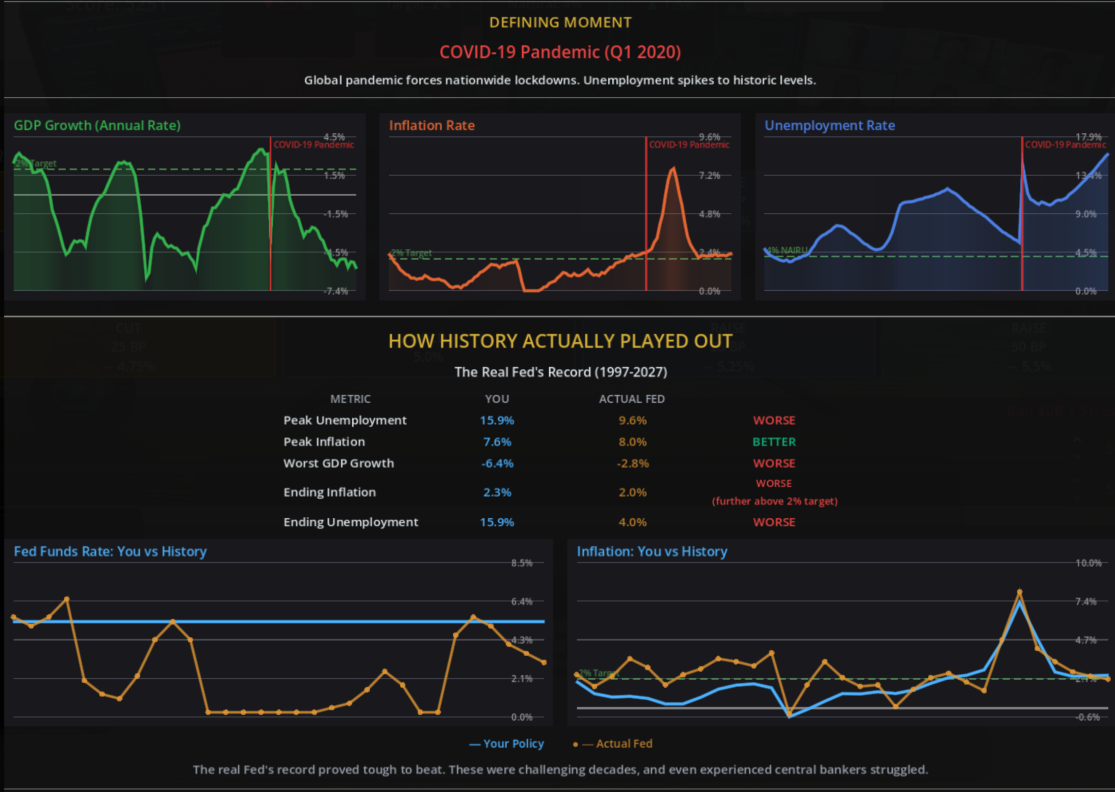
By doing nothing, I beat the Fed on peak inflation, but performed worse in all other areas. But if you look at how GDP, inflation, and unemployment changed when I did this experiment, you’ll notice how little effect the player has on these outcomes. This is strange for a game that is supposed to give players the feeling that they are in control of macroeconomic outcomes.
So, how do you beat the Fed? On my first playthrough, I chose the 1940-1970 time period and just sort of used my gut on interest rate changes, based on whether inflation or unemployment was further from target. I adopted the mainstream view of how to tinker with interest rates to nudge the economy in the “right” direction. This worked out well for me:
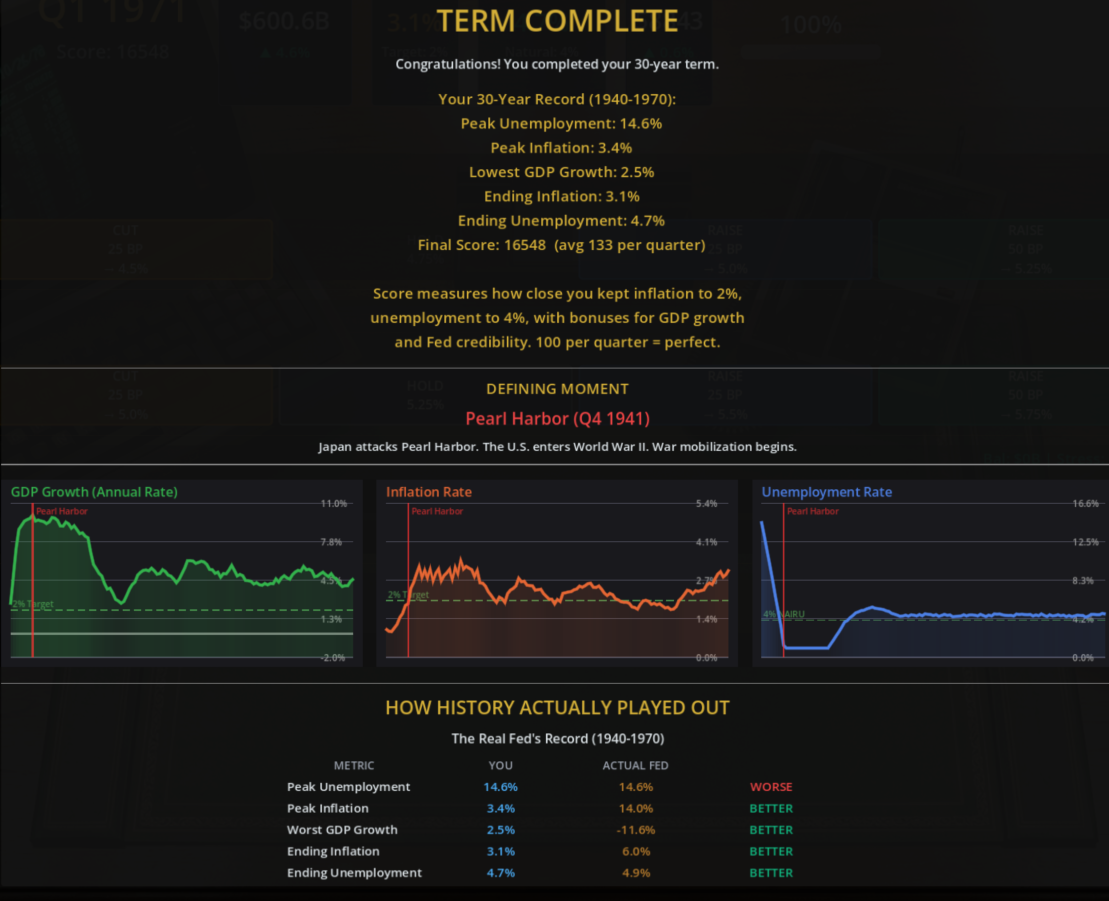
I beat the Fed on peak inflation, worst GDP growth, ending inflation, and ending unemployment, and I tied the Fed on peak unemployment. Not bad for a newbie. Not bad for somebody diametrically opposed to the mainstream view of central banking!
Verdict
It’s a fun idea for a game, but I definitely won’t be logging hundreds of hours on it like I have with the Age of Empires franchise since I was a kid. It doesn’t have any replayability because the same events happen no matter how you play. The best analogy I can think of is Disney World’s Tomorrowland Speedway: kids can “drive” and “steer” a car but it’s stuck to a center guide rail:

(Image source: https://disneyworld.disney.go.com/attractions/magic-kingdom/tomorrowland-speedway/)
For the same reason, those familiar with Austrian business cycle theory will be very disappointed. Recessions just come out of the blue and you are meant to respond to them, not prevent them. The game is very Keynesian (and monetarist, for that matter) in that regard. If you think, as I do, that Fed policy in the years leading up to some financial crisis and recession was what caused the financial crisis and recession, then you’ll find this game boring.
Another drawback is that the game does not provide any information about market interest rates, the banking system (except a vague stress level), government debts and deficits, or credit conditions like delinquency and default rates. You’re essentially just playing a blindfolded Phillips curve balancing act while external shocks mess with your balance. I think the game designers may have done this on purpose, out of some desire to get players to have more respect for Fed officials and the difficult job they have. As Rothbard would often say, “Yuck!”
Of course, the biggest drawback is that there is no “End the Fed” button. That would be a fun button to press (both in the simulation and in the real world). While playing, I kept thinking about the line from the 1983 movie WarGames: “A STRANGE GAME. THE ONLY WINNING MOVE IS NOT TO PLAY.”
Maybe I can vibecode a “How to End the Fed” game. The player would abolish the Fed, liquidate the Fed’s assets, and administer justice to those responsible for heinous crimes against humanity.

