

Originally, this article was intended to be an exploration as to how—after a period of initial patent monopoly and an all-too-brief episode of freer market competition—cronyism reestablished a telephone monopoly that would last for decades. While such an article is worthwhile and hopefully forthcoming, I was struck by the influence of one man’s leadership strategy as president of AT&T/the Bell System and how open he was about limiting competition in his industry, inviting regulation, and seeking a “middle ground” between a pure state-owned monopoly and true free market competition.
That man was Theodore N. Vail. This article largely presents Vail in his own words and seeks to demonstrate how transparent he was about inviting state intervention to move his industry toward monopoly.
By way of brief introduction, Vail joined the Bell enterprise in 1878 as general manager, helping build the young telephone industry. After leaving in 1887, he returned in 1907 as president of AT&T, where he pursued his vision of “One Policy, One System, Universal Service” and moved the Bell System toward consolidation and government regulation. He provides a quintessential illustration of political entrepreneurship and cronyism in the telephone industry.
Historian Burton Fulsom’s The Myth of the Robber Barons: A New Look at the Rise of Big Business in America makes the critical distinction between “political entrepreneurs” and “market entrepreneurs” (p. 1):
Those who tried to succeed in [business] through federal aid, pools, vote buying, or stock speculation we will classify as political entrepreneurs. Those who tried to succeed in [business] primarily by creating and marketing a superior product at a low cost we will classify as market entrepreneurs. (emphasis added)
Along similar lines, Patrick Newman defines cronyism in the following way, “government intervention that benefits special interests at the expense of the public interest.” This distinction is critical because it qualitatively differentiates those who succeed through the production-and-exchange mechanism and those who use the political means and cronyism to gain wealth at the expense of the public.
Theodore N. Vail: The Beginning of the End of Competition (1907–1913)
“Effective, aggressive competition, and regulation and control are inconsistent with each other, and cannot be had at the same time.” — Theodore N. Vail, AT&T’s 1910 Annual Report
On April 30, 1907, Vail rejoined AT&T as president, “marking the beginning of the end of telephone competition.” According to Adam D. Thierer in “Unnatural Monopoly: Critical Moments In the Development of The Bell System Monopoly,” “His return to the firm changed its fundamental focus from competition to consolidation.”
Rather than market competition, Vail’s most important goals as president of AT&T were “the elimination of competitors, the befriending of policymakers and regulators, and the expansion of telephone service to the general public.” Vail pushed for “One Policy, One System, Universal Service.” Of course, since this could not be achieved on a free market, or even on a hampered market that allowed a good degree of genuine competition, it had to be achieved by further state intervention.
As the above quote from Vail recognized, market competition and “regulation and control are inconsistent with each other, and cannot be had at the same time.” Obviously, Vail favored the latter. He went on to state further, “Control or regulation. . .means everything which is the opposite of and inconsistent with effective competition.” And, in 1917—after several successful efforts to limit competition through state intervention—Vail declared,
These two [competition and control/regulation] are absolutely inconsistent. If the public is getting the fullest advantage of control and regulation, no competition except destructive competition can exist. . . .
Under proper control and regulation, complete, соextensive competition could not exist.
What follows below are some selected quotes from Vail, in his own words and in context, that express his desire for government intervention and regulation into the telephone industry that would benefit AT&T. The interested reader should note Vail’s transparency.
Regarding his goal of a universal telephone system and in the context of some competition, Vail wrote in AT&T’s 1910 Annual Report,
It is not believed that this [a universal telephone system] can be accomplished by separately controlled or distinct systems nor that there can be competition in the accepted sense of competition.
It is believed that all this can be accomplished to the reasonable satisfaction of the public with its acquiescence, under such control and regulation as will afford the public much better service at less cost than any competition or government-owned monopoly could permanently afford and at the same time be self-sustaining.
Vail’s belief, as stated above, was that there should be neither pure market competition nor full state ownership but the soothing and seductive “middle” solution—regulated capitalism or a “mixed market.” Of course, this sounds reasonable to many people because they misunderstand or forget the nature of the state and also misunderstand the relationship between the state and big business. The key insight to understand is that state intervention—usually in the name of the “public good”—often purposely benefits big business at the expense of the consuming public.
Vail also openly expressed his desire for a monopoly under one system. He believed there would be two acceptable methods by which this could be accomplished:
This process of combination will continue until all telephone exchanges and lines will be merged either into one company owning and operating the whole system, or until a number of companies. . .[are] closely associated under the control of one central organization exercising all the functions of centralized general administration. But whatever may be the form of the operating organization, there is bound to be for legal purposes and the holding of franchises, some sort of subordinate state organization which will bring the business and property in each locality under the jurisdiction of the state in which it is situated and operated.
Vail opposed full nationalization, instead preferring cronyism. Over time, Vail’s wishes were largely granted by the state as AT&T entrenched a monopoly through politics. In 1910, Vail directly argued that regulated companies should be protected from competition. He wrote,
If there is to be state control and regulation, there should also be state protection—protection to a corporation striving to serve the whole community (some part of whose service must necessarily be unprofitable), from aggressive competition which covers only that part which is profitable.
Governmental control should protect the investor as well as the public. It should ensure to the public good service and fair rates. It should also ensure fair returns to the investor.
A public utility giving good service at fair rates should not be subject to competition at unfair rates.
Keeping track, state control and regulation should provide protection from “aggressive competition,” protect from the profit-and-loss test, assure “fair” returns to investors, and ensure that a firm offering its goods for “fair” rates should be protected from those who offer their services at “unfair” rates (i.e., lower prices). Of course, such high-minded rhetoric—“fair,” “striving to serve the whole community”—are arbitrary and simply prejudge the conclusion in favor of whatever AT&T, industry insiders, and government regulators decide.
However, Vail reassures us that he is not an enemy of all competition,
It is not that all competition should be suppressed, but that all competition should be regulated and controlled. That competition should be suppressed which arises out of the promotion of unnecessary duplication, which gives no additional facilities or service, which is in no sense either extension or improvement, which without initiative or enterprise tries to take advantage of the initiative and enterprise of others by sharing the profitable without assuming any of the burden of the unprofitable parts or which has only the selfishly speculative object of forcing a consolidation or purchase. (emphasis added)
Thus, instead of allowing entrepreneurs and consumers to freely interact and decide the landscape of the market based on what goods they produce and value, the extent of alternative competitors, market prices, and profit and loss, competition only ought to be allowed within the range that the state and key firms decide.
As opposed to a pure free market and state ownership, Vail argued that regulated capitalism would have all the benefits of both without the disadvantages of either.
When thoroughly understood it will be found that “control” will give more of the benefits and public advantages, which are expected to be obtained by state ownership, than could be obtained through such [private[ ownership, and will obtain them without the public burden of either the public office-holder or public debt or operating deficit. It is conceded that as a rule private management is better, more economical and more efficient than public management, and much more advanced and enterprising.
When through a wise and judicious state control and regulation all the advantages without any of the disadvantages of state ownership are secured, state ownership is doomed.
Apparently, according to Vail, there was nothing to fear, “The proper use of corporate organization or combination under proper regulation or control cannot be objected to.”
AT&T, Antitrust Danger, & the Kingsbury Commitment (1912–1913)
At first, to attempt to achieve his vision of a uniform system under AT&T, Vail began acquiring a number of independent competitors until such activity caught the attention of the federal government because of existing antitrust statutes. Michael K. Kellogg, John Thorne, and Peter W. Huber write in Federal Telecommunications Law (1999),
In 1912, fresh on the heels of its victory against Rockefeller, the U.S. Justice Department threatened to take on Vail. There followed a great deal of sound and fury, no doubt reflecting America’s traditional populist mistrust of monopoly. In the end, however, government officials would conclude that monopoly in communications was much more tolerable than monopoly in oil.
To avoid antitrust lawsuits, Vail orchestrated the Kingsburg Commitment in 1913 (a year with which readers are doubtless familiar for several other reasons). According to industry historian Gerald W. Brock in his book The Telecommunications Industry: The Dynamics of Market Structure (1981),
Rather than risk legal action that could be adverse to the system, the Bell system entered into negotiation with the attorney general and in December 1913 reached an agreement known as the Kingsbury Commitment.
Correctly assessing the precarious situation of AT&T, Vail tried another—more successful—strategy. The strategy that was reached was essentially an agreement between AT&T and the federal government. AT&T agreed to abandon further acquisitions, sell its Western Union holdings ($30 million), and permit independent telephone companies to interconnect with its system, while the government allowed AT&T to retain its increasingly-dominant position. For Vail, this was a far more favorable alternative to having the government dismantle the Bell System. It constrained AT&T’s expansion through acquisition but gave it something far more valuable—the government’s acceptance of AT&T’s dominant, regulated position in the telephone industry.
Figure #1—Percentage of Telephones Owned by Bell (1800–1920)
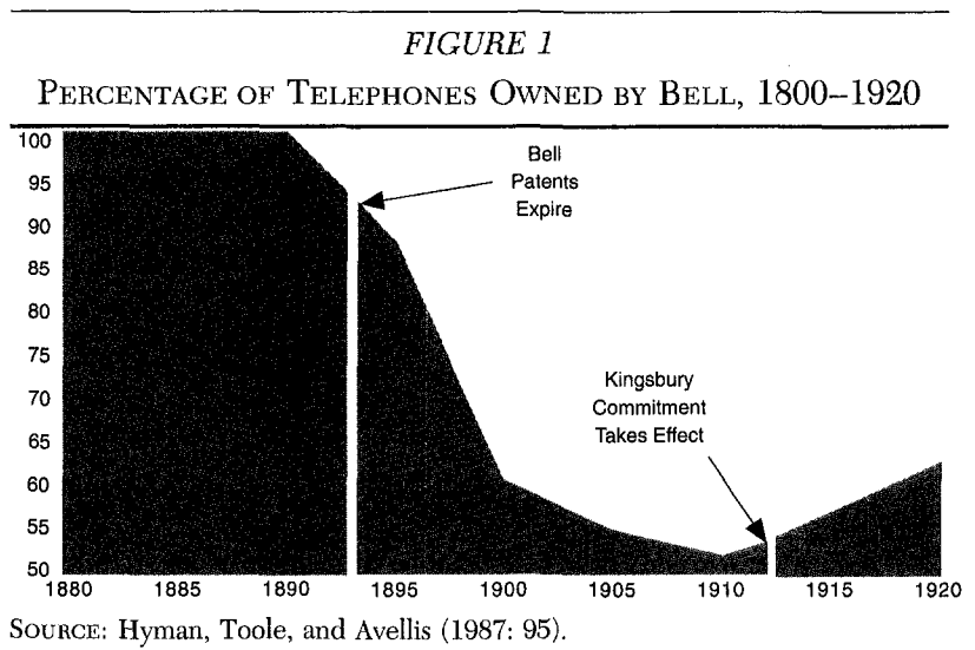
Richard Vietor writes in Contrived Competition: Regulation and Deregulation in America (1994, p. 172; also quoted in Thierer),
Vail chose at this time [i.e., around the time of the 1913 Kingsbury Commitment] to put AT&T squarely behind government regulation, as the quid pro quo for avoiding competition. This was the only politically acceptable way for AT&T to monopolize telephony. . . . It seemed a necessary trade-off for the attainment of universal service. (emphasis added)
This was precisely Vail’s strategy. Robert W. Garnet—author of The Telephone Enterprise: The Evolution of the Bell’s Horizontal Structure—writes (1985, p. 130; also quoted in Thierer),
Regulation played a crucial role in Vail’s plans. Astute enough to realize that the kind of system he proposed—universal integrated monopoly—would stand little chance of gaining public approval without some form of public control, he embraced state regulation. In doing so, he broke with the company’s long-standing opposition to what [AT&T] management had traditionally regarded as an unwarranted intrusion on its prerogatives. But after years of unfettered competition, during which the firm’s financial strengths had been sapped and its efforts to build an integrated system had been dangerously undermined, regulation became a much-preferred alternative. (emphasis added)
Conclusion
All this provides ample evidence of the cronyism and political entrepreneurship within the telephone industry. While speaking of banking in particular, Rothbard provides a simple and profound general insight which every student of economic and political history ought to remember,
Fortunately for the cartelists, a solution to this vexing problem lay at hand. Monopoly could be put over in the name of opposition to monopoly! In that way, using the rhetoric beloved by Americans, the form of the political economy could be maintained, while the content could be totally reversed. (emphasis in original)
This history also serves to confirm the key insight of Gabriel Kolko’s The Triumph of Conservatism, that—contrary to the popular historical narrative concerning the Progressive Era—certain key businesses often invited and helped shape regulations in order to achieve a cartel or a monopoly at the expense of the consuming public. Instead of the government and the consuming public teaming up against big business, the government and big business largely teamed against the consuming public. “Competition was unacceptable to many key business and financial interests,” writes Kolko, therefore, the power of the federal government had to be sought to establish monopoly. But don’t just take Kolko’s word for it, take that of Theodore N. Vail in 1917,
We have repeatedly and constantly contended that competition, so far as the public utilities are concerned, is costly, unsatisfactory, undependable. That as an incentive to development or improvement [competition] has passed its period of usefulness, if indeed it ever had any.
We have also contended with equal constancy, that with combination of like utilities under proper control and regulation the service to the public would be better, more progressive, efficient and economical than competitive service given by the separate systems.

