

A previous article introduced and addressed the role of patents, monopoly, and cronyism in the beginnings of the telephone industry. This article will seek to explore the brief and imperfect era of freer market competition that followed the end of key Bell patents in 1893 and 1894 (1894–1906). What we see in this episode is both the potential from entrepreneurship, markets, and competition and the overwhelming power of cronyism that combined state power and certain privileged business interests to re-form a telephone monopoly.
There is a common myth that “public utilities,” including the telephone, were so-called “natural monopolies,” that is,
. . .when production technology, such as relatively high fixed costs, causes long-run average total costs to decline as output expands. In such industries, the theory goes, a single producer will eventually be able to produce at a lower cost than any two other producers, thereby creating a “natural” monopoly. Higher prices will result if more than one producer supplies the market.
Many mistakenly assume that, on a free market, high barriers to entry and start-up costs so privilege the monopolistic incumbents that it would be virtually impossible for other firms to compete. In such an environment, competition is said to either be improbable or impossible, or—where competition could presumably exist—it is said to be inconvenient or duplicative. Hopefully the reader can see the question-begging in such claims and how the conclusion is presupposed against competition—there is either said to be no competition or there is said to be too much competition. Thus, the public goods argument for “public utilities” and the myth of “natural monopoly” combine to argue that the state ought to provide certain services to prevent market failure and monopoly.
This assumption is somewhat understandable because—given status quo bias—we are used to many utilities being provided by the state and assume that they can only be provided by the state and they have always been provided by the state. Leaving such utilities to the free market, it is argued, resulted in market failure and monopoly. But this is not true and never was true, either with the telephone or any other utilities. In fact, writes Rothbard,
. . .if we look at human history, we find that every good, without exception, that economists glibly term a “collective good” has actually been successfully supplied by the free market. (emphasis added)
The brief episode of limited competition in the early telephone industry shows competition was present despite Bell’s head start with a 17-year patent monopoly and other continuing state interventions, that the earlier and later telephone monopoly were anything but “natural,” and that government intervention was sought and needed to stifle competition and establish in the name of opposing monopoly. Further, exploring this historical territory allows us to imagine the possibilities of what could have been in a true free market.
“Natural Monopoly” and the Movement Toward Unacceptable Competition
Since the invention of the telephone, there was no natural monopoly. The state virtually created a telephone monopoly via the patent system. The expiration of Bell’s two fundamental telephone patents opened the door to a new era of competition. Bell’s first patent—issued in 1876—expired in March 1893, while the second—issued in 1877—expired in January 1894. Although the American Bell Telephone Company (ABTC) retained other patents—including Emil Berliner’s important transmitter patent, issued in 1891—the expiration of Bell’s foundational patents removed the principal legal barrier to competitors. Independent telephone companies consequently entered the market in large numbers, particularly in areas underserved by Bell, ushering in a period of intense competition that would last into the early twentieth century.
Regarding the public sentiment toward the patents and monopolized industry that stifled competition, James J. Storrow—a close adviser to the management of the American Bell Telephone Company—wrote to the president of Bell, John E. Hudson (November 17, 1891)
The Bell Company has had a monopoly more profitable and more controlling—and more generally hated—than any ever given by any patent.
Instead of free market capitalism leading to monopoly which had to be regulated by government, the story of the Progressive Era is the opposite—due to the inability to monopolize on the free market, many firms sought federal regulation to monopolize their industries and limit competition at the expense of the public and consumers. In The Triumph of Conservatism, Gabriel Kolko corrects the typical backwards narrative concerning the Progressive Era,
Despite the large number of mergers, and the growth in the absolute size of many corporations, the dominant tendency in the American economy at the beginning of this century was toward growing competition. Competition was unacceptable to many key business and financial interests, and the merger movement was to a large extent a reflection of voluntary, unsuccessful business efforts to bring irresistible competitive trends under control. . . . As new competitors sprang up, and as economic power was diffused throughout an expanding nation, it became apparent to many important businessmen that only the national government could rationalize the economy. . . . Ironically, contrary to the consensus of historians, it was not the existence of monopoly that caused the federal government to intervene in the economy, but the lack of it. (emphasis added)
Further, in “The Myth of Natural Monopoly,” Thomas DiLorenzo records (quoting several researchers) that competition did in fact exist among public utility companies, including telephone companies, despite government intervention to create monopolies and cronyism,
There is no evidence at all that at the outset of public utility regulation there existed any such phenomenon as a “natural monopoly.” As Harold Demsetz has pointed out:
Six electric light companies were organized in the one year of 1887 in New York City. Forty-five electric light enterprises had the legal right to operate in Chicago in 1907. Prior to 1895, Duluth, Minnesota, was served by five electric lighting companies, and Scranton, Pennsylvania, had four in 1906. . . . During the latter part of the nineteenth century, competition was the usual situation in the gas industry in this country. Before 1884, six competing companies were operating in New York City. . .competition was common and especially persistent in the telephone industry. . . Baltimore, Chicago, Cleveland, Columbus, Detroit, Kansas City, Minneapolis, Philadelphia, Pittsburgh, and St. Louis, among the larger cities, had at least two telephone services in 1905. (emphasis added)
Ironically, for generations, the telephone served as the quintessential example of a natural monopoly and market failure that required government regulation even though this was patently untrue. DiLorenzo declares, “The biggest myth of all in this regard is the notion that telephone service is a natural monopoly.” In reality, “there [was] nothing at all ‘natural’ about the telephone monopoly enjoyed by AT&T [a subsidiary of American Bell Telephone Company until 1899] for so many decades; it was purely a creation of government intervention.”
The Bell patent monopoly had given the Bell system and the Bell Telephone Company a key head start in terms of consolidation, accumulating resources, and market share. As mentioned above, the Bell patent monopoly, plus other issues, led to increasing unpopularity and prepared the market for greater competition. According to The History Of Computer Communications:
2.7 Vail Joins the Bell Telephone Company -- 1878-1887, Era of Competition 1894–1906,
Bell [Telephone Company] was easy to hate in a time when it was popular to hate Big Businesses. Bell’s unpopularity stemmed from the obscenely high prices they were thought to be charging, the marginal service they provided, and their unwillingness to expand telephone service to meet demand. . . . Poor service needed no proof, for everyone agreed it often bordered on barely working. And as for not extending service to the sparsely populated Western states, or to rural farm communities, Bell management believed that if expanded telephone service was not profitable from the start, then why incur the expenses. This almost customer be damned attitude reflected a corporate culture that treated the telephone as Bell’s to do with as pleased, including the right to earn a monopolist’s capital return.
The key moment for competition came in 1893 and 1894 when crucial patents expired. Although Bell had filed over 600 patent infringement suits to defend its 900+ patents during this period, it was not sufficient to stop new competition. Far from free market capitalism creating conditions for “natural monopoly” in telephone service, against which no competition would be feasible, market competition—though stifled—put pressure on the entrenched, legally-privileged telephone monopoly. According to Adam D. Thierer in “Unnatural Monopoly: Critical Moments In the Development of The Bell System Monopoly,” “The Bell monopoly was, at least temporarily, dead.”
Competitors Enter the Telephone Industry
There is much to be said about the impact of the entrance of some competition into the telephone industry, but a long story can be made short through a brief summary. According to industry historian Gerald W. Brock in his book The Telecommunications Industry: The Dynamics of Market Structure (1981),
After seventeen years of monopoly (1894), the United States had a limited telephone system of 270,000 phones concentrated in the centers of the cities, with service generally unavailable in the outlying areas. After thirteen years of competition, the United States had an extensive system of six million telephones, almost evenly divided between Bell and the independents, with service available practically anywhere in the country.
DiLorenzo writes, “Once AT&T’s initial patents expired in 1893, dozens of competitors sprung up.” From 1880 to 1895, average daily calls per 1,000 of population rose from only 4.8 to 37. After the 17-year patent monopoly expired, the period of competition saw daily calls per 1,000 people jump from 37 in 1895 to 391.4 in 1910. The number of telephones per 1,000 people also expanded rapidly—from only 1.1 in 1880 to 4.8 in 1895 to 82 by 1910 (see below).
Figure #1—Spread of Telephone Service (1880–1920)
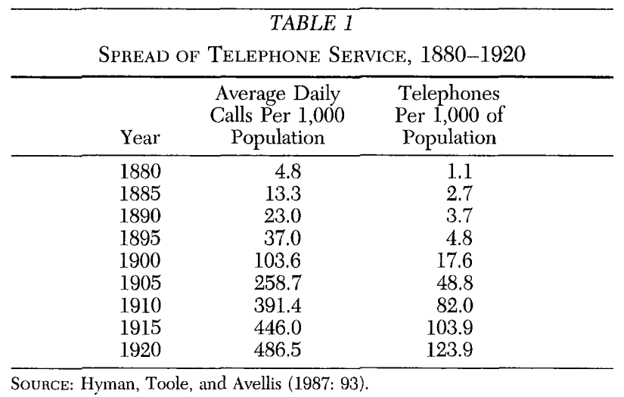
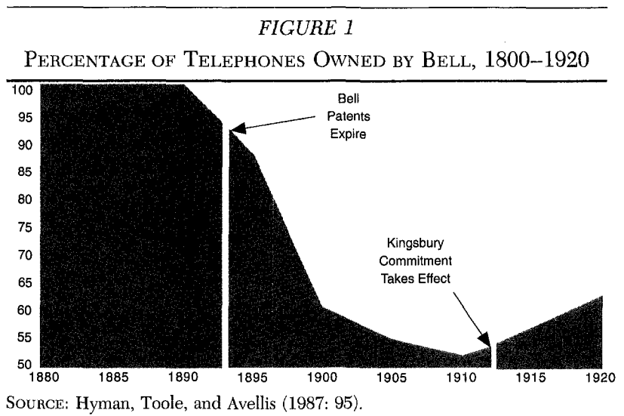
Figure #2—Percentage of Telephones Owned by Bell (1800–1920)
Even though the Bell Telephone Company had been given a head start by the monopoly, making competition more challenging, competitors were more than ready to compete against Bell. Writes Thierer,
Despite AT&T’s rapid rise to market dominance [then a subsidiary of American Bell Telephone Company until 1899], independent competitors began springing up shortly after the original patents expired in 1893 and 1894. These competitors grew by servicing areas not served by the Bell System, but then quickly began invading AT&T’s turf, especially areas where Bell service was poor.
In response to this new competition, the Bell company used its advantages to respond in four major ways—patents and suits, price cuts, adding long distance lines, and mergers. In other words, a mix of cronyism and market competition through improvement of service, innovation, and lowering prices. Thus, competition pushed Bell to improve also. These strategies “slowed its loss of market share but did not stop it.” Brock writes further,
New competitors continued to enter and existing competitors continued to expand throughout the period 1894–1907. The proportion of telephones controlled by the independents rose from 19 percent in 1897 to 44 percent in 1902, and then slowly increased to 49 percent in 1907. However, the market share figures indicate an overly pessimistic assessment of Bell’s market power in 1907. By 1907 entry was becoming more difficult. . .
Even by 1894, over 80 new independent competitors had already obtained 5 percent of the market share. By the turn of the century, the number of independent competitors had increased to over 3,000. Adding more detail, Brock explains,
The success of the first Bell challengers induced widespread entry in the years after the basic patents expired. Competitive systems were established at an interesting rate between 1895 and 1900. A total of 199 new commercial telephone systems were begun in 1895, 297 in 1896, 254 in 1897, 334 in 1898, 380 in 1899, and 508 in 1900. . . . By 1902 three thousand non-Bell commercial telephone systems had been established.
By 1898, the emergence of competition had produced a remarkable challenge to the Bell interests. Of the 1,157 larger urban centers in the country, 1,002 (87 percent) had telephone service: 414 were served exclusively by Bell, 451 had both a Bell company and a competing independent company, and 137 were served exclusively by an independent company. Thus, among urban centers with telephone service, 59 percent had either direct competition from an independent company or independent-only service. The independent companies also vastly outnumbered the Bell companies nationally: 3,123 independents compared with only 865 Bell companies, meaning that independents constituted approximately 78 percent of all telephone companies.
According to Brock, “By 1900 telephone competition was widespread.” And Garbiel Kolko explains,
The essential characteristic of the telephone industry in the first decade of this century [1900] was its competition and rapid change. And the industry, with its insecurity and unpredictability, serves as an additional example of the basic trend in the American economy at the beginning of this century away from centralization or monopoly.
In The New Telecommunications Industry: Evolution and Organization, Vol. 1, Public Utility Reports, Inc. (1987, p. 90; as quoted in Thierer), we read, “It seems competition helped to expand the market, bring down costs, and lower prices to consumers.”
Conclusion: The Move Back Toward Monopoly
These facts are significant because they demonstrate that, when competition was legally permitted—even within an environment already distorted by patents, licenses, and other political privileges—competitive pressure worked powerfully against monopoly. The telephone industry was plainly not a “natural monopoly” against which competitors were inherently incapable of competing; rather, the historical record demonstrates that competitors emerged in large numbers when legal barriers were removed. Whatever technological or economic advantages Bell possessed, maintaining an enduring monopoly required something more than voluntary consumer preference; it required legal privilege and the coercive power of the state to establish and preserve barriers to competition, ultimately imposing costs on consumers and the public.
Unfortunately, the era of imperfect competition was not to last forever or expand to true free market competition. Over time, further state interventions and cronyism would monopolize the telephone industry for generations. This monopolization would be impossible without the intervention of the state. Firms would invite federal regulation of business, fully aware that such regulation would both simultaneously shield them from competition, shift costs to consumers, and protect them from a hostile public.
In the telephone industry, monopoly would eventually be established through the combined efforts of AT&T and politicians who argued that there was too much competition—that competing telephone networks were “duplicative,” “destructive,” and “wasteful,” even though consumers evidently continued to patronize those competitors. By 1921, a House committee declared that “there is nothing to be gained by local competition in the telephone business.” At the same time, economists appeared before congressional committees to argue that telephony was a “natural monopoly.” In other words, there was supposedly both too much competition and not enough competition. The solution, therefore, was for the federal government to establish and regulate a telephone monopoly—ostensibly to save consumers from the supposed evils of a “natural” telephone monopoly with too many competing telephone companies.

