

In his writings, Milton Friedman blamed the Federal Reserve for causing the Great Depression of the 1930s. Friedman believed that the US central bank failed to inflate enough money into the banking system to prevent the collapse of the money supply and the economy. The money supply M1, which stood at $28.264 billion in October 1929, fell to $19.039 billion by April 1933—a decline of almost 33 percent.
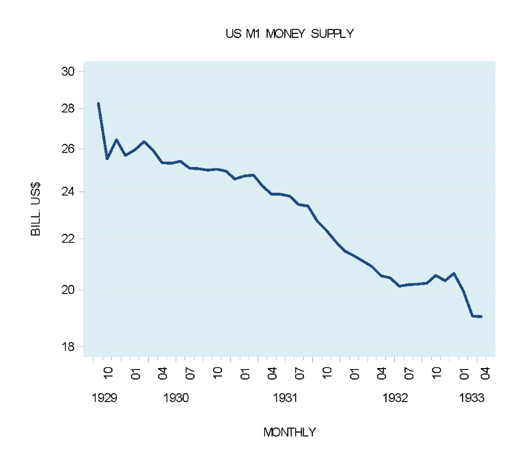
According to Friedman, because of the collapse in the money supply, economic growth followed suit. By July 1932 year-on-year industrial production fell by over 31 percent. Also, year-on-year the consumer price index (CPI) plunged. By October 1932, it fell by 10.7 percent.
After observing a large decline in the money supply, which was followed by a large decline in economic activity and prices, Friedman had concluded that the fall in the money supply was the key cause behind the Great Depression. However, observation is not explanation.
To explain what caused the Great Depression, one must identify the key driver of genuine and productive economic growth. The answer is that it is production and exchange, then voluntary saving that enables capital accumulation and investment and which sustains various stages of the structure of production through time.
An individual must consume to some extent. Goods, however, are often not readily available and have to be extracted from nature through production or traded in exchange. Without tools at his disposal, an individual could only secure very few goods from nature, a process that would be labor and time intensive.
Production must precede consumption. However, in order to progress, people must not only produce but must consume less than the full amount of their production, that is, they must save. In addition to enabling investment in capital goods, saving also supports people engaged in various stages of the structure of production through time. This can also be called a subsistence fund. In part, the state of this fund determines the quality and the quantity of various tools or capital goods that can be made.
Enhancement of the structure of production is what makes the increase in economic growth possible, all other things being equal. By producing, saving, and investing in capital goods, production is—if successful—made more productive and efficient. This allows greater production in quality and quantity, saves time, money, and resources, and enables further saving and capital investment. Hence, anything that weakens this process undermines the prospects for economic growth.
On this, Richard von Strigl wrote:
Let us assume that in some country production must be completely rebuilt. The only factors of production available to the population besides labourers are those factors of production provided by nature. Now, if production is to be carried out by a roundabout method, let us assume of one year’s duration, then it is self-evident that production can only begin if, in addition to these originary factors of production, a subsistence fund is available to the population which will secure their nourishment and any other needs for a period of one year. . . . The greater this fund, the longer is the roundabout factor of production that can be undertaken, and the greater the output will be.
Instead of failure to inflate, it was the expansionary monetary policies during the 1920s that distorted the structure of production and weakened the subsistence fund, setting in motion the Great Depression of the 1930s. At some periods during the 1920s monetary injections were large. For instance, the yearly growth rate of money supply M1 increased from -12.6 percent in September 1921 to 11 percent by January 1923. Then from -0.4 percent in February 1924 the yearly growth rate strengthened to 9.8 percent by February 1925. Such massive inflation and credit expansion amounted to a large exchange of nothing for something.
This resulted in the diversion of wealth from wealth-generators to various non-productive activities that emerged on the back of expansionary monetary policy. This resulted in the weakening of the subsistence fund and, this, in turn, resulted in the large economic slump.
The decline in the subsistence fund weakens the pace of economic activity. This weakens banks’ credit and inflationary credit, and this sets the decline in the money supply. Even if the central bank were to be successful in preventing the decline in the money supply, this could not have prevented the economic depression while the subsistence fund is declining.
Those commentators who are of the view that, by means of inflation, one can prevent economic depressions, hold that this will strengthen the aggregate demand. With the increase in the aggregate demand, it is held, the aggregate supply will follow. This is incorrect. One has to produce something useful first before demanding things. In other words, in order to facilitate exchange with others, there must be a valued production of goods and services that people want and are willing to trade for.
Without an expanding production, voluntary saving, and the subsistence fund that enables the enhancement of the infrastructure, it is not possible to increase the supply of goods and services and, in turn, the demand. The illusion that, through inflation, it is possible to keep the economy going gets shattered once distortions become evident and production, saving, genuine capital investment, and the subsistence fund begin to decline. Once this happens, the economy starts its downward plunge.
Even the most aggressive monetary pumping could not reverse the economic plunge. In fact, rather than reversing the plunge, an aggressive inflation will only further undermine genuine production, growth, saving, and capital investment, thereby further weakening the production structure and thus weakening the production of goods and services.
The problem is not simply a fall in demand or the need for money to stimulate demand. Money produces nothing, it is just the medium of exchange.
An examination of the historical data shows that, at the onset of the economic depression, the Fed was pursuing an expansionary monetary policy in its attempt to revive the economy. Monetary injections, as depicted by the Fed’s holdings of US government securities, increased from $165 million in October 1929 to $2,432 million by December 1932—an increase of 1,374 percent!
When the Fed buys assets, such as the government securities, it pays for these assets with inflated money. Moreover, the three-month Treasury bill rate fell from almost 1.50 percent in April 1931 to 0.4 percent by July 1931.
The sharp decline in the money supply during 1930 to 1933 is not indicative that the Federal Reserve did not try to pump money and credit. Instead, the decline in the money supply came because of the decline in the subsistence fund that led to the collapse in banks’ genuine credit and inflationary credit (i.e., credit that is unbacked by savings). With the decline in the subsistence fund, the performance of various activities starts to deteriorate. In response to this, banks curtail their lending, including their inflationary lending. After growing by 2.7 percent year-on-year in January 1930, bank loans had fallen by a massive 29 percent by March 1933.
When loaned money is fully backed by savings, on the day of the loan’s maturity it is returned to the bank, which returns the money to the original lender. In contrast, the inflationary credit returned to the bank on the maturity date results in the withdrawal of money from the economy (i.e., a decline in the money supply). The reason for this is that there is no original lender to whom money must be returned.
Contrary to much popular thinking, economic depressions are the result of expansionary monetary policies that distort the structure of production and undermine the subsistence fund. Countering an economic depression by means of monetary inflation and credit expansion only prolongs the economic misery. What is required is to curb the money supply. This would arrest the depletion of the subsistence fund thereby laying the foundation for an economic recovery.
At the Conference to Honor Milton Friedman’s 90th birthday a Fed Governor Bernanke promised Friedman that the Fed will not make the same mistake again,
Let me end my talk by abusing slightly my status as an official representative of the Federal Reserve. I would like to say to Milton and Anna: Regarding the Great Depression. You’re right, we did it. We’re very sorry. But thanks to you, we won’t do it again.
However, what Bernanke meant—following Friedman’s analysis—was that the Federal Reserve would not fail to inflate more. It seems that the Fed is likely to inflate the money supply aggressively on any sign of emerging price deflation. Many Fed policymakers are so confident that Milton Friedman’s prescription is the correct way to tackle an economic depression that they are not even ready to consider the possibility that this prescription may actually make things much worse.

