

As kids we may remember the old trope—often seen on TV or in movies—where a stronger kid would overpower a weaker kid and use the weaker kid’s hands and arms to hit him, asking mockingly, “Why are you hitting yourself?”
Most adults would recognize this as illegitimate for obvious reasons: though the weaker kid’s hands are literally hitting him, he is obviously being coerced against his will, such that the stronger kid is the aggressor. While most adults would pride themselves on the ability to distinguish between external coercion and self-inflicted punishment, they often fail this when it comes to the state. In fact, this is the very core of Thomas Hobbes’s social contract theory—since the state represents the people by social contract, whatever the state does to an individual, that individual has consensually done it to himself.
Thomas Hobbes and the State
Thomas Hobbes is often regarded as one of the intellectual founders of the modern, secular nation-state in his 1651 book Leviathan. In Creveld’s The Rise and Decline of the State (p. 179; also cited in Hoppe), it is argued,
Hobbes deserves the credit for inventing the “state”. . . as an abstract entity separate both from the sovereign (who is said to “carry” it) and the ruled, who, by means of a contract among themselves, transferred their rights to him. . . . Hobbes’s sovereign was much more powerful than. . .any Western ruler since late antiquity.
Space does not permit a full explication of Hobbes’s theory, however, both his theory of the state and its internal fatal flaw can be read elsewhere. Suffice it to say that Hobbes uniquely argued that, due to the insecurity caused by human nature, the institution of the state ought to have a monopoly of coercion and security provision over a specific geographic territory. Further, rather than appealing to divine right or tradition, Hobbes attempted to justify his state through appealing to reason and social contract.
Social contract theory is, fundamentally, the idea that political authority and the legitimacy of government derive from an agreement—whether explicit or implicit—among individuals to form a society and accept certain rules and governance structures. The crucial assumption is that citizens somehow consent to state rule through their continued presence and/or participation in society.
Rather than the naked fact of rule by coercion, modern states and most of their citizens—especially western ones—assume that the government provides certain crucial goods and services (e.g., security, national defense, public goods, etc.) and that the people assent to the government’s legitimacy and rule. In other words, the state and its actions are legitimate because people agree to its legitimacy and actions by social contract. Not only may the state exist and operate with absolute, unaccountable authority, according to Hobbes, but we actually agree to all of it.
Hobbes writes,
The finall Cause, End, or Designe of men, (who naturally love Liberty, and Dominion over others,) in the introduction of that restraint upon themselves, (in which wee see them live in Common-wealths,) is the foresight of their own preservation, and of a more contented life thereby; that is to say, of getting themselves out from that miserable condition of Warre, which is necessarily consequent. . .to the naturall Passions of men, when there is no visible Power to keep them in awe, and tye them by feare of punishment to the performance of their Covenants, and observation of these Lawes of Nature. . . (emphasis added)
According to Hobbes, “Hereby it is manifest, that during the time men live without a common Power to keep them all in awe, they are in that condition which is called Warre; and such a warre, as is of every man, against every man.” Therefore, following his reasoning, the state provides a common power to “keep them all in awe,” discouraging interpersonal crime and conflict through fear of punishment by the state.
Hobbes’s argument is that—due to the insecurity of the “state of nature” (absolute human freedom and autonomy prior to the state)—we agreed and consented to live in society with one another ruled by a state which could provide security through a legal monopoly on violence.
The frontispiece of Hobbes’s Leviathan is expressive of this concept:
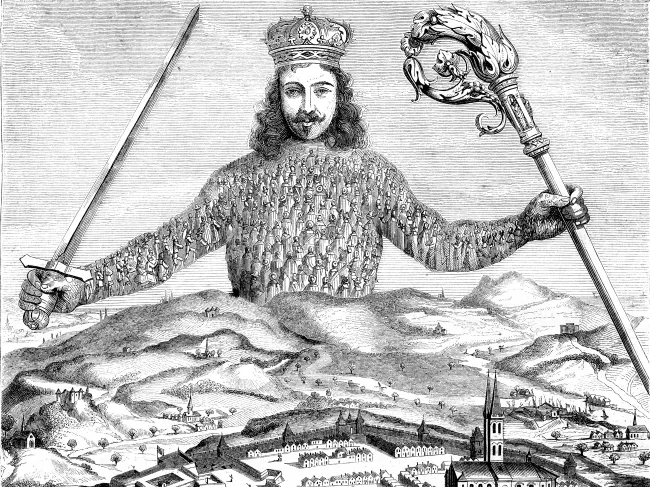
(Image Source: Adobe Stock)
Note that the image presents the commonwealth as one body of many individual members—the subjects—ruled over by a single head—the state. (An additional note, the Christocentric overtones might have been intentional.) Therefore, according to Hobbes, and others following his state paradigm, the state originally derived its authority from the people such that they consent to the state as the basis of society. The state is the representation of the people. “We” are the state and the state is “us.”
Below is a series of quotes from Thomas Hobbes, constructing his case for the theory of the modern state, taken from chapters 17 and 18 of his Leviathan. According to Hobbes, human nature, in its tendency toward criminality, requires a common power to keep it in check. Were this not the case, the state would be unnecessary:
For the Lawes of Nature (as Justice, Equity, Modesty, Mercy, and (in summe) Doing To Others, As Wee Would Be Done To,) if themselves, without the terrour of some Power, to cause them to be observed, are contrary to our naturall Passions, that carry us to Partiality, Pride, Revenge, and the like. And Covenants, without the Sword, are but Words, and of no strength to secure a man at all. . . .
For if we could suppose a great Multitude of men to consent in the observation of Justice, and other Lawes of Nature, without a common Power to keep them all in awe; we might as well suppose all Man-kind to do the same; and then there neither would be nor need to be any Civill Government, or Common-wealth at all; because there would be Peace without subjection.
Due to this condition in the “state of nature,” men institute common-wealths and agree and covenant together to surrender all power and authority to a state, however organized, and the elite or elites who run it. Crucially, in this surrender of power and authority to the state, the actions of the state elite are henceforth treated as the actions of “the People”:
A Common-wealth is said to be Instituted, when a Multitude of men do Agree, and Covenant, Every One With Every One, that to whatsoever Man, or Assembly Of Men, shall be given by the major part, the Right to Present the Person of them all, (that is to say, to be their Representative;) every one, as well he that Voted For It, as he that Voted Against It, shall Authorise all the Actions and Judgements, of that Man, or Assembly of men, in the same manner, as if they were his own, to the end, to live peaceably amongst themselves, and be protected against other men. (emphasis added)
All the authority the sovereign has comes from the original agreement by which people created the state and authorized that sovereign to act on their behalf. This is crucial to legitimize the actions of the state. Therefore, in Hobbes’s theory, all the actions of state elites are not only authorized and legitimate, but consensual.
From this Institution of a Common-wealth are derived all the Rights, and Facultyes of him, or them, on whom the Soveraigne Power is conferred by the consent of the People assembled.
Since the sovereign state is said to have received ultimate power and authority from “the consent of the People,” it is to be understood that the individuals under such a government have agreed to obey the government under any and all circumstances. Writes Hobbes,
First, because they Covenant, it is to be understood, they are not obliged by former Covenant to any thing repugnant hereunto. And Consequently they that have already Instituted a Common-wealth, being thereby bound by Covenant, to own the Actions, and Judgements of one, cannot lawfully make a new Covenant, amongst themselves, to be obedient to any other, in any thing whatsoever, without his permission. And therefore, they that are subjects to a Monarch, cannot without his leave cast off Monarchy, and return to the confusion of a disunited Multitude; nor transferre their Person from him that beareth it, to another Man, or other Assembly of men: for they are bound, every man to every man, to Own, and be reputed Author of all, that he that already is their Soveraigne, shall do, and judge fit to be done:. . . (emphasis added)
Next, it is to be understood that the so-called “social contract” is only one-way, that is, the people can violate it and be held accountable but the state cannot; the people are obligated, but the state is not. Interestingly, it is here that Hobbes admits that, for all his language of “consent” and “social contract,” he does not mean that the state elite actually obtains the consent of the people either individually or as a whole.
Secondly, Because the Right of bearing [representing] the Person of them all, is given to him they make Soveraigne, by Covenant onely of one to another, and not of him to any of them; there can happen no breach of Covenant on the part of the Soveraigne; and consequently none of his Subjects, by any pretence of forfeiture, can be freed from his Subjection. That he which is made Soveraigne maketh no Covenant with his Subjects beforehand, is manifest; because either he must make it with the whole multitude, as one party to the Covenant; or he must make a severall Covenant with every man. With the whole, as one party, it is impossible; because as yet they are not one Person: and if he make so many severall Covenants as there be men, those Covenants after he hath the Soveraignty are voyd, because what act soever can be pretended by any one of them for breach thereof, is the act both of himselfe, and of all the rest, because done in the Person, and by the Right of every one of them in particular. (emphasis added)
“Why Are You Hitting Yourself?”
Since the state claims that each person living under it is the original creator and authorizer of the state, the state cannot be said to do any injury or injustice; all the state’s actions are thereby legal and even sanctioned by the people. According to Hobbes’s argumentation here, since the state was brought about by the consent of the subjects and represents them, the state’s actions are the subject’s actions.
. . .because every Subject is by this Institution Author of all the Actions, and Judgements of the Soveraigne Instituted; it followes, that whatsoever [the state] doth, it can be no injury to any of his Subjects; nor ought he to be by any of them accused of Injustice.
. . .he that complaineth of injury from his Soveraigne, complaineth of that whereof he himselfe is Author; and therefore ought not to accuse any man but himselfe; no nor himselfe of injury; because to do injury to ones selfe, is impossible. It is true that they that have Soveraigne power, may commit Iniquity; but not Injustice, or Injury in the proper signification. (emphasis added)
To complain against the state’s actions, argues Hobbes, is to ultimately complain against yourself because you originally authorized the state and the state represents you! In fact, Hobbes blames the people for any untoward actions of the state. Since the state represents the people, if the state does wrong, it’s actually your fault since the state is you. Therefore, to attempt to punish any state elites is incoherent in Hobbes’s view.
Punishment and accountability are only one-way—the state may punish its subjects, but the subjects may not punish state elites. In fact, there is no way for the state elites to be held accountable,
. . .no man that hath Soveraigne power can justly be put to death, or otherwise in any manner by his Subjects punished. For seeing every Subject is author of the actions of his Soveraigne [the state]; he punisheth another, for the actions committed by himselfe. (emphasis added)

