

Austrian economics today often suffers from the fact that many people—including many professional economists—simply do not know about Austrian economics. Although this is the fate of many minority approaches in economics, it is interesting that Austrian economics struggles against the ignorance of so many economists, since so many foundational concepts in economics originated with the Austrian School. Even Friedrich Hayek—winner of the Nobel Memorial Prize in Economics—suffers from the fact that professional economists are sometimes unaware of the work that earned him that very Nobel Prize. How can such a thing happen?
Part of the reason is that there has been a substantial movement away from the study of the history of economic thought. Among what would often be considered the top five universities at which to study economics in the United States (Harvard, MIT, Stanford, UC Berkeley, and Chicago), only three offer any courses in the history of economic thought at the undergraduate level. Stanford and the University of Chicago do not offer undergraduate courses in this subdiscipline at all. Even among the three that do offer courses in the history of economic thought, there is some evidence that it is narrowly understood. At Harvard, the only course in the undergraduate catalog that appears to be in the history of economic thought is one titled “Keynes”—a title which suggests that the course is unlikely to provide a broad overview. At MIT, the course is titled “Classics of Economics” and is taught by a member of the history department who specializes in economic history.
To be fair, a course does not have to have “history of thought” in the title to cover some of this material—for example, at the University of Chicago, “history of thought” is one of the topics that the course catalog suggests will be covered in Principles of Macroeconomics. So, it may be that the history of thought receives more coverage than it first appears, as these topics are incorporated into other courses, particularly at the principles level. However, there is evidence that economics may be starting to move away from a theory-based introduction to economics altogether, based on developments at Harvard that have unfolded over the past few years.
At Harvard, there are two paths to being introduced to economics as a discipline. The first path is the traditional sequence from Principles of Microeconomics to Principles of Macroeconomics (EC 10). N. Gregory Mankiw of Harvard is well known for authoring the bestselling textbook for this course, and the course content is generally familiar to anyone with economics training. Microeconomics discusses concepts such as supply and demand, monopoly and competition, and policy issues such as price controls, taxation, and externalities. Macroeconomics discusses issues of macroeconomic measurement and offers a theoretical “neoclassical synthesis”—a dichotomy that favors Keynes in the short run and a more classical approach in the long run. Although Austrians would often find fault with these courses as they are typically taught, we can accept that they are taught, in some sense, in the tradition of Menger—emphasizing the underlying logic of choice and how it plays out under a set of ancillary assumptions.
The second path to learning economics at Harvard was introduced a few years ago with Raj Chetty’s course—now numbered EC 50—titled Using Big Data to Solve Economic and Social Problems. A course with this title could simply be a standard upper-level econometrics course renamed to appeal to current sensibilities. However, the course description makes it clear that it is intended for students who have never taken an economics course: “The course . . . does not require prior coursework in economics or statistics, making it suitable for students exploring economics for the first time, as well as for more advanced students” (Harvard University, n.d.). The course is also reported to be fairly light on theory—and to treat economics as “a kind of applied statistics, an attempt to use quantitative data to answer social questions” (Matthews 2019). Despite being quite new at the time, enrollment in Chetty’s course in 2019 was 375 students, not far behind the principles course’s 461. It seems unlikely that Chetty’s course offers much exposure to students in the history of thought.
So, why is this happening? Greg Mankiw provides some insight in a blog entry from 2006 in which he explains why he has never read Ludwig von Mises’s Human Action. Mankiw (2006) says, “Most economists at research universities focus their attention on recent work. Things written more than twenty or thirty years ago are usually assumed to be irrelevant, out-dated, or incorporated into more recent work.” Mankiw’s observation that attention is focused on recent work seems correct if one looks at citation patterns in mainstream economics journals. For example, in the April 2026 issue of the American Economic Review (AER), there are about 843 references (excluding references marked as “forthcoming” or references for which publication dates were not given—generally because they are data sources that update regularly, so only an “accessed” date was provided). The mean year of publication was 2013, and the median year was 2017. (The mean is somewhat skewed by the fact that one article cited Thorstein Veblen’s 1899 book The Theory of the Leisure Class.) A full 90 percent of the references are from 1999 or later, and 92 percent of references follow the “Mankiw rule” of being thirty years old or less.
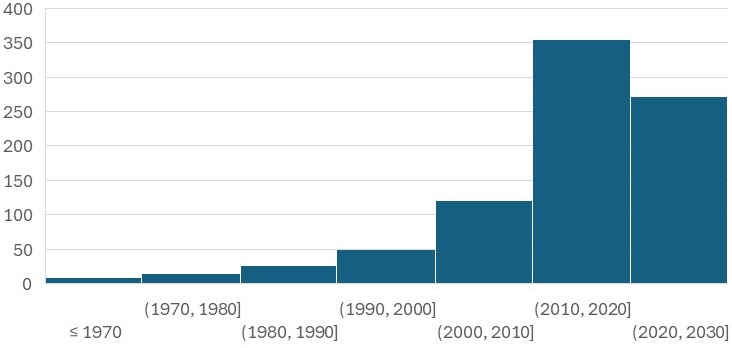 Figure 1. Distribution of AER references, April 2026
Putting this all together, there is today very little mainstream emphasis on the history of economic thought, either in teaching or in research. Two explanations seem likely. On the one hand, Mankiw’s suggestion that older insights are either outdated (particularly in the case of empirical research) or incorporated into more recent work offers a more optimistic interpretation. On the other hand, at least on the research side, there is a far more self-interested reason for this phenomenon. Journal editors and referees are far more likely to have published articles within the last thirty years than prior to that point. This results in two related phenomena. First, authors cite recent articles to increase the likelihood that they are citing potential referees, thereby increasing the probability of acceptance, since referees appreciate additional citations of their work. Second, referees recommend that citations to their own articles—which, again, are likely to be recent—be included in revisions. So, whether preemptively or responsively, authors have a clear incentive to include citations to recent work. Meanwhile, citing Adam Smith’s Wealth of Nations serves no such purpose.
Why should we be concerned about so little attention being paid to the history of economic thought? I suggest two main reasons. First, a lack of knowledge about the history of economic thought can create the impression that ideas are newer than they are, particularly among the public. Second, a lack of knowledge about the history of economic thought leaves economists unprepared for debates that tend to recur generation after generation.
A simple example of the first case is the Venus Project. This project was the brainchild of the late futurist Jacque Fresco, who designed blueprints based on a vision of a future society. This project was, for a time, associated with the Zeitgeist Movement, which acted as the activist wing of the Venus Project until the two parted ways. Although organizationally distinct, both shared a common vision of the future economy as a “resource-based economy” (as opposed to a profit-based economy). In a resource-based economy, no money, credits, or barter would be used. Rather, resources would be managed by engineers who would design systems based on productive efficiency, using as much automation as possible. The resulting abundance would make all exchange unnecessary. To those unfamiliar with the history of economic thought, this sounds like a new idea. After all, the technology and expertise needed to make this vision possible are clearly recent developments. However, someone more familiar with the history of economic thought will immediately recognize that this is simply a form of utopian socialism dressed in modern or futuristic clothing.
For the second example, we may look at recent debates about tariffs. In early 2025, the Trump administration announced widespread “reciprocal tariffs.” However, despite the language of reciprocity—which suggested that these tariffs might have a foundation in modern game theory or in Adam Smith’s notion that a skilled statesman could use tariffs as a bargaining tool to encourage the reduction of trade barriers—the formula used to calculate these tariffs was clearly mercantilist. Rather than being based on the level of tariffs imposed on the United States, they were based on the level required to eliminate country-level trade deficits—a clearly mercantilist concern. (This should not be surprising, since President Trump has declared that he considers trade deficits to be a “loss.”) Despite the fact that economists have generally opposed protectionist tariffs for the past 250 years, we still have not achieved broad enough acceptance of free trade to make tariffs like these politically untenable.
Put another way, the history of economic thought matters because the economic ideas adopted by the public shape policy, and economic policy matters. To better understand how economic thought progresses, let us consider how ideas are developed and make their way to the public.
Two (Not-Quite-Right) Models of the Intellectual Structure of Production
We can conceptualize the production and distribution of ideas through an “intellectual structure of production.” Following Roger Garrison’s formulation of the Hayekian triangle, we can imagine the production of ideas as following a process that can be visualized roughly as follows.
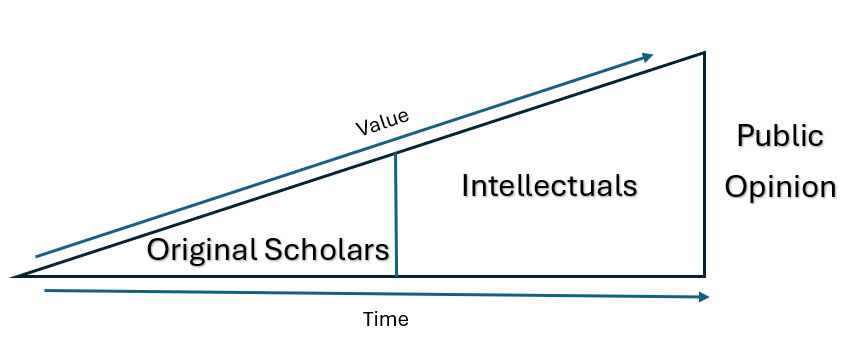 Figure 2. An intellectual Hayekian triangle
This production structure is based largely on the production structure that we imagine for a typical physical good—beginning with the production of raw materials, moving through manufacturing, then wholesale and retail distribution, and finally consumption of the good. By analogy, the “raw materials” in the intellectual structure of production are the original scholars—the experts in their fields. Their original contributions are then taken up by the intellectual class—a class that Hayek ([1949] 1960) describes as “second-hand dealers in ideas.” The intellectual class’s role in this structure of production is twofold. First, it undertakes the important task of translation. Original scholarship is generally not comprehensible outside a fairly narrow set of experts, so if that scholarship is going to have an impact on public opinion, it must be translated from the scientific jargon commonly used in journals into the more vernacular language of everyday speech. Second, the intellectual class performs the service of distribution—moving ideas out of academic journals (which are generally read only by experts) and into spaces where the public is more likely to encounter them: op-eds, blogs, YouTube videos, textbooks, sermons, and works of fiction. It is through this process that original scholarship moves, over time, into the realm of public opinion.
Unfortunately, this conceptualization—although it captures some important aspects of the process—is woefully incomplete. First, it misses the fact that scholarship often builds on other scholarship. Of course, this is not an objection only to this particular Hayekian triangle but to the original concept as well. After all, many of the capital goods used in the mining of iron are themselves made of steel, which requires iron. These “feedback loops” simply emphasize that the Hayekian triangle is, like any simple visualization of part of the economy, a simplification intended to capture specific aspects of the production process. The second omission is more serious: Intellectuals play an important role not only in the translation and dissemination of ideas but also in selecting which ideas are disseminated. This role will be key to understanding the progression of public opinion over time.
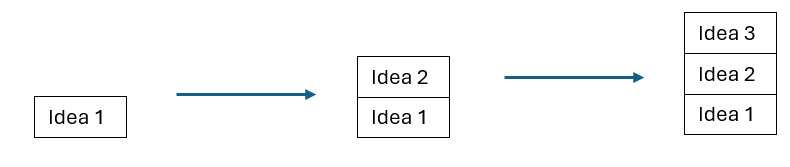 Figure 3. Progression of ideas
A second conceptualization builds on ideas presented by Young (2009) and developed by Engelhardt (2009). Young suggests that we can think of ideas as a form of intangible capital that fuels economic growth. As such, investment of time, energy, and resources in intangible capital leads to an increase in the stock of that capital. Apart from this effect, which is analogous to the accumulation of physical capital goods, intangible capital also has two traits that make it particularly useful in achieving long-run economic growth. First, intangible capital is nonrivalrous—that is, one person’s use does not diminish another’s use. On this point, Young emphasizes that we do not each have to make the investment required to develop an idea. Rather, one person or group can make the investment and, once the idea has been produced, it can be learned or copied cheaply by others. Second, intangible capital allows us to “stand on the shoulders of giants”—that is, old ideas can be used in the development of new ideas. One can invent a car without having to invent the wheel, since it was already invented in the past by someone else. Engelhardt (2009) adds an additional trait: nondepreciation. Observing that intangible capital, as described by Young, resembles Murray Rothbard’s “recipes” (2009), Engelhardt notes that part of what makes Young’s argument for secular growth work is that intangible capital does not require continuous reinvestment and replacement. As a result, intangible capital provides a permanent increase in material well-being.
This second conceptualization is, again, incomplete. It misses three important features. First, the progression of ideas is not purely additive. Some ideas are incorrect and must be discarded as ideas progress. Second, this conceptualization may do a reasonably good job of describing the progression of scholarship among experts, but it does not apply to those who are not experts in the field being described, since such nonexperts generally lack the foundational ideas on which later ideas must be built. Finally, and somewhat related to this second point, the progression of ideas among nonexperts as a class can be expected to exhibit some degree of depreciation for reasons that will be developed further.
Applied Expertise Versus Applied Public Opinion
The previous section raises an important distinction. Hayek (1945) is well known for the distinction he makes between general scientific knowledge and knowledge of the specific circumstances of time and place. In making this distinction, Hayek emphasizes that knowledge of scientific principles is insufficient to allow any central planner to “run” an economy, since the economy requires the use of knowledge about consumers’ specific preferences and the specific resources available. Here, I would like to make a different distinction based on how broadly knowledge must be shared for society to benefit from its progression. We will consider two categories: applied expertise and applied public opinion.
The defining characteristic of applied expertise is that the knowledge of experts is sufficient to drive social progress. In areas of applied expertise, the public does not have to possess the relevant knowledge to benefit from it. As a simple example, consider a GPS app on a smartphone. Few people could even state the scientific principles required for this technology to work. Even fewer understand it well enough to manufacture a phone capable of receiving GPS signals or to create an app capable of translating those signals into usable navigation instructions. However, ignorance of the underlying science does not prevent large numbers of people—the majority in most developed countries, I suspect—from benefiting from such apps. In fact, someone who is not only ignorant about the technology but actively mistaken about it can still enjoy its benefits. If I believe that my maps app works because invisible pixies in my phone listen to the World Song that flows along the earth’s ley lines, this belief (which I sincerely hope is not correct) would not prevent my app from working or me from benefiting from it. Even something as simple as the electricity that lights a modern office is understood only superficially by most people. Although many may be able to say that flipping a switch “closes a circuit,” which allows electricity to “flow” through a lightbulb, I suspect that for most people this level of understanding is similar to a magic spell dressed up in technological language. (“Flip the switch to close the circuit so that electricity will flow through the lightbulb” certainly sounds more scientific than “abracadabra.”) Because detailed knowledge is unnecessary for most people to benefit in areas of applied expertise, what matters most in these fields is the progression of expert knowledge.
In contrast, the defining characteristic of applied public opinion is that society can benefit from this knowledge only if the broader public possesses it. This does not mean that every individual must possess this knowledge, but it does require a substantially broader base of understanding than applied expertise. A corollary is that widespread misunderstanding in these areas will prevent society from benefiting from this knowledge. In short, experts are not enough. The clearest example is knowledge that informs policy in societies that operate largely on democratic principles, where the electoral process provides a direct channel through which public opinion influences policy. (Though, arguably, all societies are ultimately bound by public opinion—whether that opinion expresses itself through peaceful elections or violent revolutions.) In these fields, widespread ignorance or misunderstanding can prevent society from benefiting from true knowledge possessed by experts. For example, it does not matter if experts in environmental economics know that strong property rights are a viable strategy for protecting vulnerable species from extinction. If the public is convinced that treating such species as public property is a better strategy—and the state acts in accordance with public opinion—then the experts’ knowledge will provide no benefit. It is for this reason that Ludwig von Mises ([1949] 1998, 875) tells us, “Whether we like it or not, it is a fact that economics cannot remain an esoteric branch of knowledge accessible only to small groups of scholars and specialists. Economics deals with society’s fundamental problems; it concerns everyone and belongs to all. It is the main and proper study of every citizen.” In brief, insofar as economics informs us about the policies and social behaviors that will help us achieve our goals, it is essential that it be broadly understood.
This distinction emphasizes that each end of the intellectual structure of production has its own sphere of importance, which makes it all the more essential that we understand the progression of both expertise and public opinion if we want to understand how society can make the best use even of knowledge that Hayek would consider scientific.
The Progression of Applied Expertise
To understand the progression of applied expertise, we can begin with the model found in Young (2009), while incorporating a few small improvements. Among experts, ideas progress through two main paths: (1) discarding ideas that are incorrect and (2) discovering new, more general ideas of which currently held true ideas are special cases.
For example, when Newton’s first law declared that “an object in motion tends to remain in motion,” it explicitly rejected the Aristotelian idea that all physical equilibria involve objects at rest. At the same time, however, it incorporated Aristotelian observations by including the special case of motion where friction is a significant force opposing continued movement. Similarly, both quantum mechanics and general relativity incorporate Newtonian classical mechanics. Quantum mechanics, at large scales, behaves in ways consistent with Newtonian mechanics, and general relativity, under conditions of sufficiently low gravity and velocity, also approximates Newtonian mechanics. We can visualize these relationships with a diagram resembling a Venn diagram.
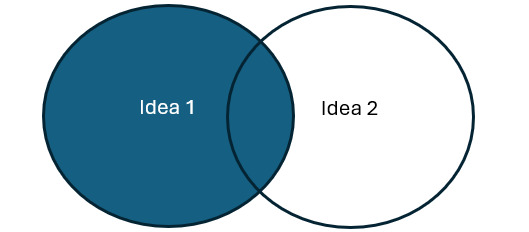 Figure 4. The relationship between old and new ideas
The overlapping portion represents the part of idea 1 that is incorporated into idea 2 as a special case. The remainder of idea 1 is discarded, while the remainder of idea 2 helps explain phenomena that were not adequately explained by idea 1. In this sense, there is a genuine “standing on the shoulders of giants” effect of the kind Young describes. Idea 2 builds on idea 1 by incorporating and generalizing what is true and discarding what is false.
Generally speaking, one would not expect ideas to be perfect—that is, complete and free from error. This approach helps explain how expertise progresses from one idea to another (one hopes better) idea. Insofar as ideas are becoming more valuable to society as a whole, this process should improve social well-being in areas of applied expertise, provided that it is allowed to continue and that there is a means through which this progression can be expressed in the physical structure of production.
For example, Einstein’s theories of relativity have a direct impact on the global positioning systems commonly used for navigation. Given the speed of travel and the different gravitational effects experienced by GPS satellites, corrections must be made based on his theory of relativity. Without it, GPS signals would experience about eleven kilometers of drift per day (Outreach of Application for Society working group 2022)—even a few seconds of drift would create noticeable problems for navigation. The combination of this theoretical scientific knowledge (expertise) with the tangible goods that put it to use (GPS satellites and receivers) allows billions of cell phone users around the world to benefit from reasonably reliable GPS navigation. Moreover, one can expect that markets will reflect applied expertise—after all, a GPS system that consistently provides accurate positioning will likely be valued more highly than one that drifts significantly from moment to moment.
Applied Public Opinion and the Hayekian Sieve
If one can expect the progression of applied expertise, thanks in part to market tests, to improve social well-being through the introduction of new knowledge which can be incorporated into new consumer and producer goods and production processes, why does public opinion so often seem “stuck,” or even cycle backward? Why are there significant disconnects between what experts in economics say they believe and what the general public believes—as documented, for example, by Caplan (2008)?
Public opinion progresses differently from expertise. The public typically does not receive knowledge directly from experts—and with good reason. The sheer volume of knowledge being created on a regular basis is overwhelming. As a simple example, even if we restrict ourselves to academic journals dedicated to business-related topics, there are more than 2,600 journals in the Australian Business Deans Council journal list for 2025. Even an expert in business would find it impossible to absorb all the information contained in these journals on a regular basis. Certainly, anyone who is not an expert would find the task even more impossible. In short, the sheer volume of information being produced necessitates some kind of filtering mechanism. Here we can reintroduce the Hayekian intellectual structure of production—but not in its “triangle” form. Rather, Hayek ([1949] 1960, 374) describes the role of intellectuals in the following way: “These intellectuals are the organs which modern society has developed for spreading knowledge and ideas, and it is their convictions and opinions which operate as the sieve through which all new conceptions must pass before they can reach the masses.”
This “Hayekian sieve” sorts through new ideas and determines what reaches the masses. So, if we want to understand the progression (or lack thereof) of public opinion, we need to examine the traits of the intellectual class, since these traits affect the ability of ideas to reach the masses and influence public opinion.
Hayek ([1949] 1960) argues that two key traits are necessary for someone to be part of the intellectual class. First, the intellectual must be able to speak and write about a wide variety of subjects. Second, the intellectual must be somewhat more aware of new developments than his audience. Without the ability to speak and write effectively, an aspiring intellectual will quickly find himself without an audience. Similarly, if an intellectual lacks greater awareness of new developments than his audience possesses, that audience will likely find his commentary of little value. When we consider the work of the intellectual class, we realize that it encompasses a significant number of professions. Certainly journalists (particularly science journalists) are part of this class, but it also includes teachers, authors of fiction, artists, clergy, bloggers, social media influencers, and experts speaking or writing outside their own areas of research (often including professors in their teaching role).
According to Hayek, the fact that intellectuals operate across multiple disciplines leads them to seek general principles on which they can construct broad narratives. These narratives then serve as the basis for the Hayekian sieve. Hayek ([1949] 1960) gives the following example: It is undoubtedly true that advances in science, technology, and engineering over the past two hundred years have significantly improved human well-being. Based on this observation, it can be tempting to conclude that engineering principles should also be applied to society and that such social engineering would result in similar benefits. A significant part of Hayek’s argument in “The Use of Knowledge in Society” (1945) was that the knowledge needed to “run society” differs fundamentally from the knowledge required to develop a new technology. As a result, this general observation about progress cannot be immediately applied to the social sciences.
This is just one example of how the process of generalization according to broad principles leads the intellectual class toward overgeneralization—to taking principles and trends that appear in one field and applying them to other fields, even when the underlying conditions that make these principles and trends successful in the original field do not exist in the field to which they are being applied. Thus, the intellectual class ends up propagating errors, causing public opinion to diverge from the genuine advances that occur at the level of expertise. (Here, we follow Hayek in assuming the best of the intellectual class’s motives—that is, that the intellectual class is not misleading the public deliberately. One would expect that an intellectual class that deliberately misleads the public would be even more likely to result in a misled public.)
Another, more straightforward, reason that public opinion often becomes disconnected from expertise and struggles to make progress is simply that people are mortal. The progress of knowledge depends on replacing conclusions based on erroneous intuition with conclusions based on reason and evidence. This means that the process of education is never complete—even if expertise completely stagnates. There is always a need to pass knowledge on to the next generation. Tradition may be expected to play some role here. However, although tradition may help prevent some degree of backsliding away from truths embodied in that tradition, it would also be expected to impede forward progress. In short, tradition acts as a form of friction on social knowledge—restraining both backward and forward movement. In other words, tradition affects speed, not direction.
So, why is there so little progress in areas of applied public opinion? In brief, public opinion is often standing on the shoulders of shrinking giants. What past generations have learned can be lost from one generation to the next through simple mortality. Tradition, in turn, helps preserve some of these truths, but it also prevents the correction of traditional errors. In addition, the public depends on the intellectual class to disseminate new knowledge, but that class often falls into error by misapplying general concepts across fields, further shrinking the contributions of the past. Put another way, Engelhardt’s claim that intangible capital is “nondepreciating” is not universally true. Intangible capital can, in fact, depreciate in ways that require continued investment to maintain it. Specifically, when society benefits only if the public broadly accepts a particular truth, continuous education of each generation is necessary to prevent already-discovered truths from being displaced by the errors of misleading intuition or by an overgeneralizing intellectual class. Put another way, the public must learn the history of economic thought—or at least its substance—because we must continuously relive the same debates.
A Way Forward
So, what can be done? I propose three main paths that can be pursued by different groups. There is evidence that Austrian economists already engage in at least some of these practices, so this discussion serves primarily as a reminder of their importance and as an encouragement to adopt them more broadly.
First, those who play a significant role in curriculum design can ensure that the history of economic thought is given its proper place. There is evidence that institutions of higher education where Austrian economics has had more influence place more emphasis on the history of economic thought than institutions that tend to rank at the top of most lists. Grove City College, for example, offers three courses on the history of economic thought—a two-course sequence (before and after the Marginalist Revolution) and one course specifically focused on Austrian economics. This means that Grove City College alone offers as many history of thought courses as Harvard, Stanford, Berkeley, MIT, and the University of Chicago combined. Hillsdale College has a two-course sequence in the history of economic thought that is required of all economics majors. George Mason University offers four courses on the history of economic thought—a two-course sequence on the work of Adam Smith, a course on Austrian economics, and a more general history of economic thought course. These efforts are praiseworthy and place economics students at these institutions in a position to address the errors in economic thinking into which each generation seems prone to fall.
Second, those involved in teaching economics should seek to incorporate the history of economic thought into courses that are not specifically devoted to it. Time constraints clearly prevent instructors from covering multiple centuries of economic thought for each idea covered, but ideas can often be taught effectively through contrasts with popular historical errors. Such contrasts often help clarify the truth. The law of diminishing marginal utility, for example, takes on deeper meaning when presented as a solution to the diamond-water paradox than when it is simply defended on logical grounds—or, worse, introduced merely as a mathematical assumption.
Finally, researchers should not hesitate to draw on the history of economic thought to provide a broader context for current work. As in many sciences, economics has its greatest social impacts in its application. For the reasons discussed in this article, however, the application of economics often depends on a public opinion that is slow to adopt—or actively resists adopting—economic ideas. For this reason, placing research within the broader context of historical debates in economics is useful.
Economic law is essential knowledge for all citizens. The public and policymakers may ignore its consequences when choosing what political path to follow, but once that path is chosen, the consequences will follow whether we like them or not. Informing the public about economic law is therefore a never-ending task, because each generation must learn the truth anew—and those who teach the truth must often struggle against an intellectual class that obscures or denies the truth. Fortunately, experts in economics do not have to rediscover the truth, but they must be aware of what has already been discovered and pass that knowledge on to the next generation.

