

According to the legacy media, the May employment numbers from the Bureau of Labor Statistics were a “blowout jobs report.” That is, according to CBS, the May report showed “resilience” in the job market, and the latest report “follows two months of strong payroll gains.” Yet, at the same time, the unemployment rate has not budged for three months, and remains at 4.3 percent. Moreover, the labor force participation rate remains near a five-year low. Over the past three months of these “strong payroll gains,” the number of full-time jobs has gone down, and total hires in May were down from a year earlier. To be fair, in May, for the first time in nine months, both the establishment survey and the household survey showed increases. That is, both the number of jobs (either full-time or part-time) and the number of employed persons actually went up. But, there is no indication that there is any change in the larger downward trend, and the job growth that does exist continues to largely be part-time positions. The total number of employed persons, according to the household survey is now down by 473,000 year over year, and down by 989,000 over the past six months.
Especially troubling is the fact that in May, for the second month in a row, price inflation increased more than wage growth, meaning real wages went down.
So, considering all this, the May report can be characterized in this way:
- Real wages falling
- Unemployment rate flat
- Total employed workers down by 473,000, year over year
- Full-time work falling
First, let’s look at a comparison between the household survey and the establishment survey. According to the BLS report, the establishment/payroll survey showed a month-over-month increase of 172,000 jobs. That’s “jobs” regardless of whether they are full time or part time. Meanwhile, the household survey—which is a survey of persons—showed an increase of 149,000 employed people, some of whom may have a part time jobs, or a mixture of full time and part time jobs. The payroll survey has now shown three months of increases in a row, but the household survey’s growth in May is the first time the household survey has shown an increase after four months of falling employment.
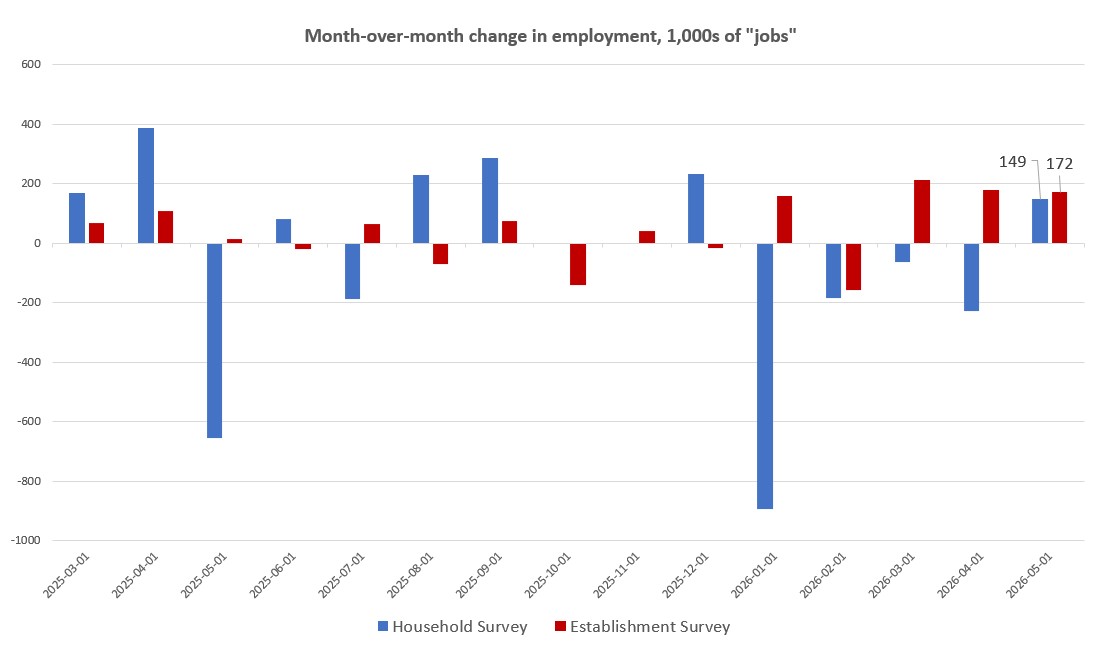
Moreover, if we look at growth since 2021, we see a sizable gap between the establishment survey and the household survey. Indeed, we find that total employed persons in the household survey has been trending downward since December of last year, with a decline of nearly a million employed workers during that time.
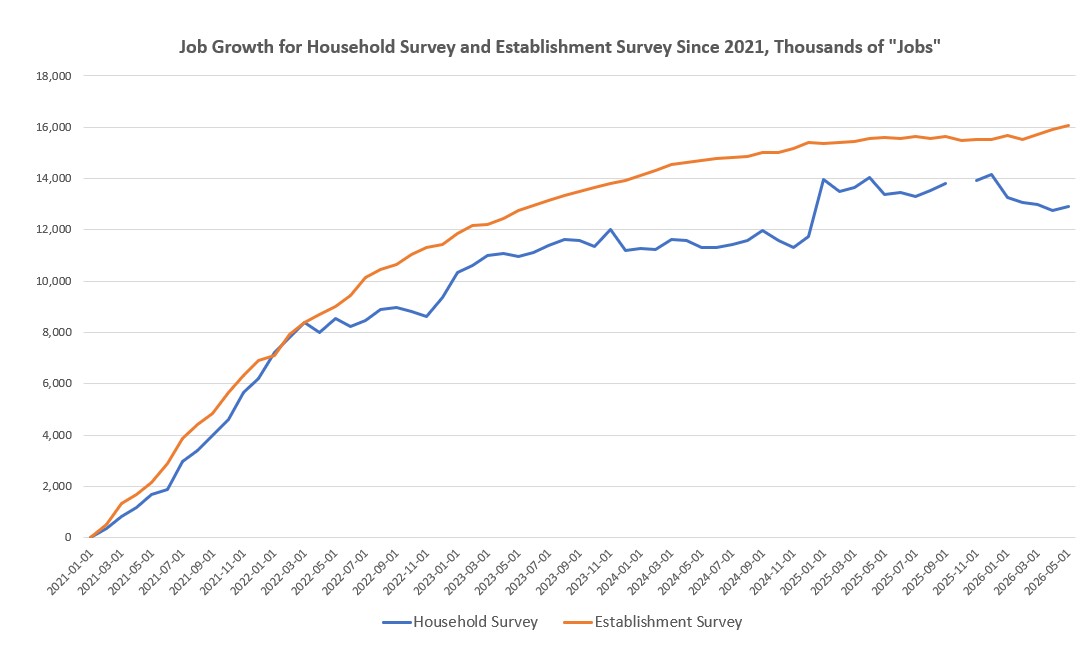
But how can this be happening if the establishment survey keeps showing increases? Part of it is surely due to the fact that these are two different surveys, and the establishment survey doesn’t tell us much about self-employment, very small businesses, or part time work. Workers are likely relying more on part-time work (holding down one or more jobs at a time) to make ends meet.
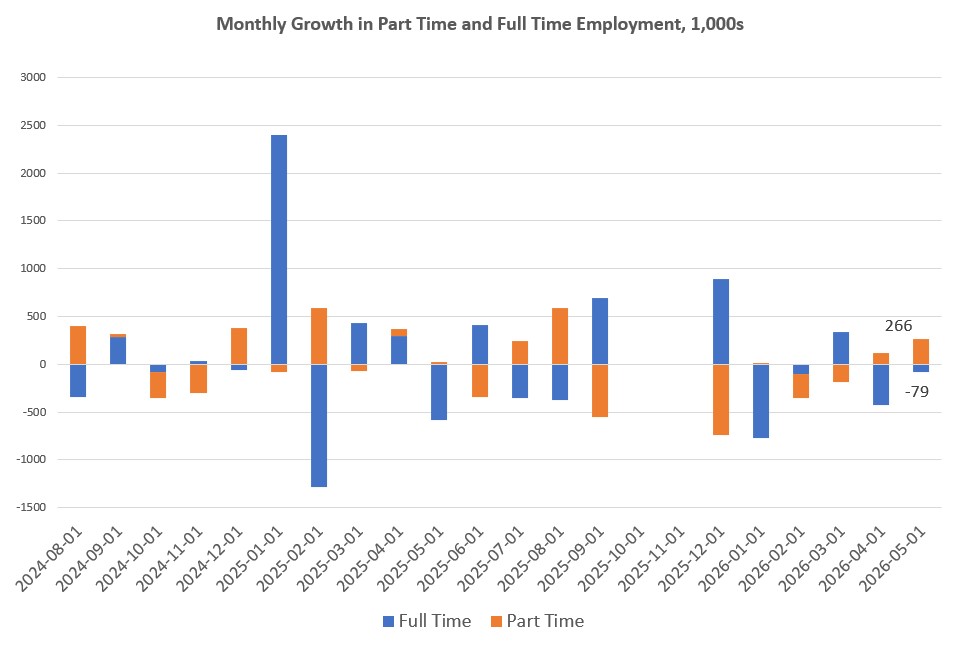
After all, the May report shows that full-time work fell, month over month, by 79,000 in May while part-time work increased by 266,000. Month-to-month, full-time work has increased in only two of the past six months.
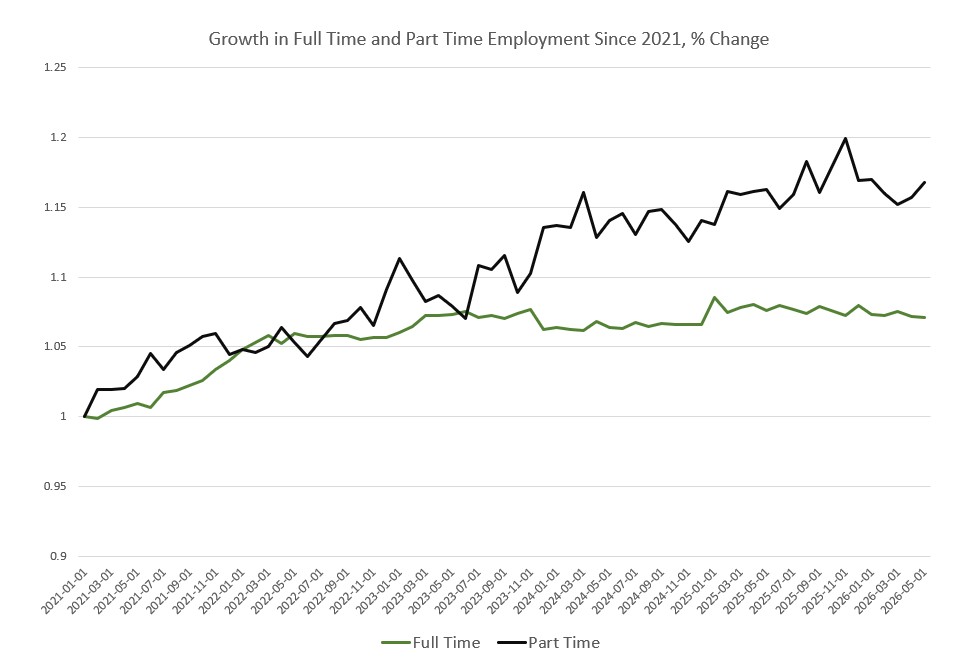
If we look at total growth in part-time versus full-time work since 2021, we find that full-time work has been essentially flat at 134 million for years. Specifically, full-time employment is still about equal to what it was as far back as early 2023. That is, total full-time employment was more than 134.4 million in May 2023. Three years later, total full-time employment has actually fallen by more than 200,000, down to 134.2 million. Since late 2025, the overall trend in full-time work has been slowly downward. On the other hand, growth in part-time work has been robust over the same period.
Finally, we must note that average hourly earnings actually fell in May, when adjusted for price inflation. (May CPI data was released last week.) Specifically, the hourly earnings average was $37.53 in May. That’s up from 29.92 during the start of 2021. But, if we adjust for price inflation (using the official non-core CPI data), we find that average earnings have actually fallen during that period, dropping to $29.51.
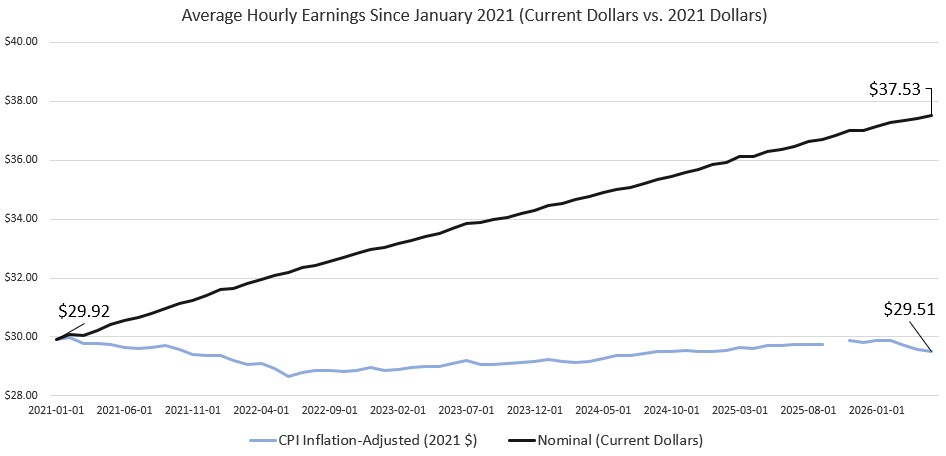
May was the second month in a row for falling real average earnings fell by $0.19 or 0.6 percent. The last time wages fell in real terms was during 25-month period of falling wages that ended in mid 2023.
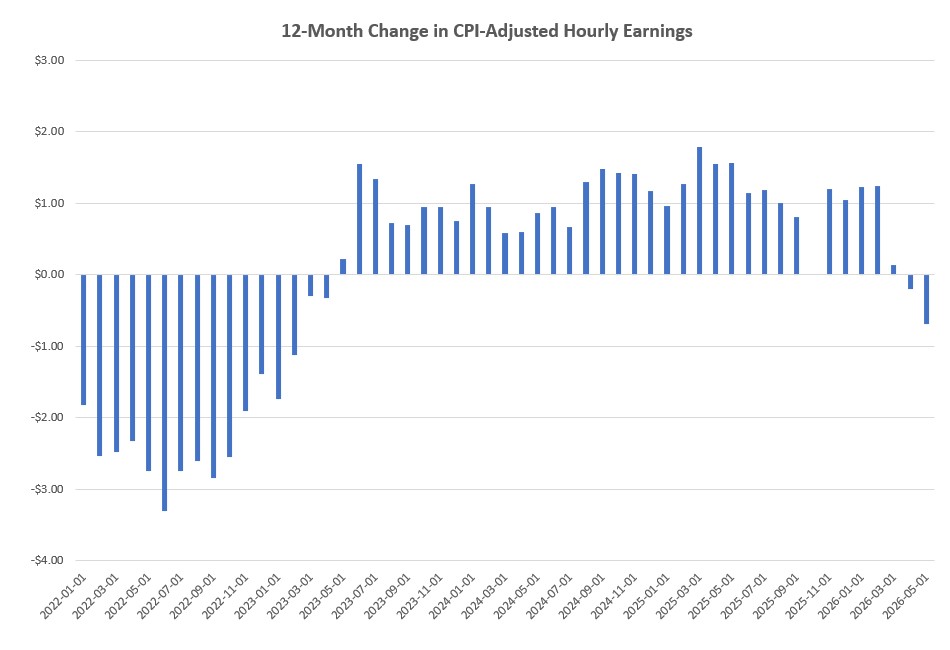
For many ordinary workers—many of which are stuck with part-time work and falling real wages—it’s hard to see how this is a “blowout” jobs report.

