

Fannie Mae and Freddie Mac (also known as “GSEs”) have released their August reports on their mortgage portfolios and mortgage delinquencies. Both Fannie and Freddie report that serious delinquencies in multifamily are rising to multiyear highs. Freddie Mac, in particular, shows delinquency rates at the highest level in more than twenty years.
(These numbers reflect the condition of mortgages in each agency’s portfolio, which are a major part of the overall mortgage market. Fannie and Freddie have expanded their multifamily activities aggressively in 2026 and are likely behind nearly half of newly originated apartment loans. Behind commercial banks and thrifts, “the Agency and GSE portfolios and mortgage-backed securities (MBS) hold the second-largest portion [of the multifamily market] accounting for roughly 23% of the total.”
For August, seriously delinquent multifamily mortgages (60+ days delinquent) at Fannie Mae fell to 0.57 percent. That’s down from July’s rate of 0.62 percent, and it was down from August 2025’s total of 0.68 percent. Nonetheless, Fannie’s delinquency rate has risen significantly since December 2022 when the rate was 0.24 percent.
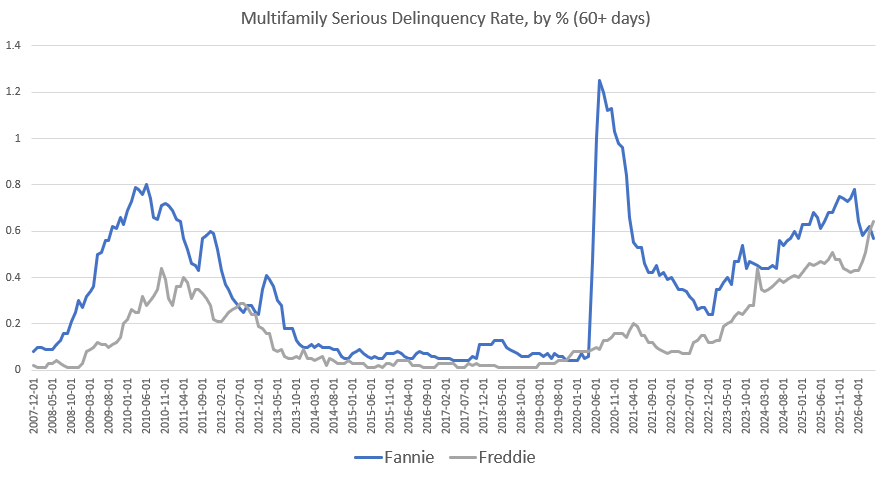
Freddie Mac’s delinquency report, on the other hand, shows delinquencies (60+ days delinquent) above the Great-Recession peak. During August, Freddie reported multifamily serious delinquency rate was 0.64 percent. That’s up from July 2026, which showed a delinquency rate of .6 percent. It is also up from August 2025’s rate of 0.48 percent. The Freddie Mac report shows delinquency rates heading upward consistently since February of this year.
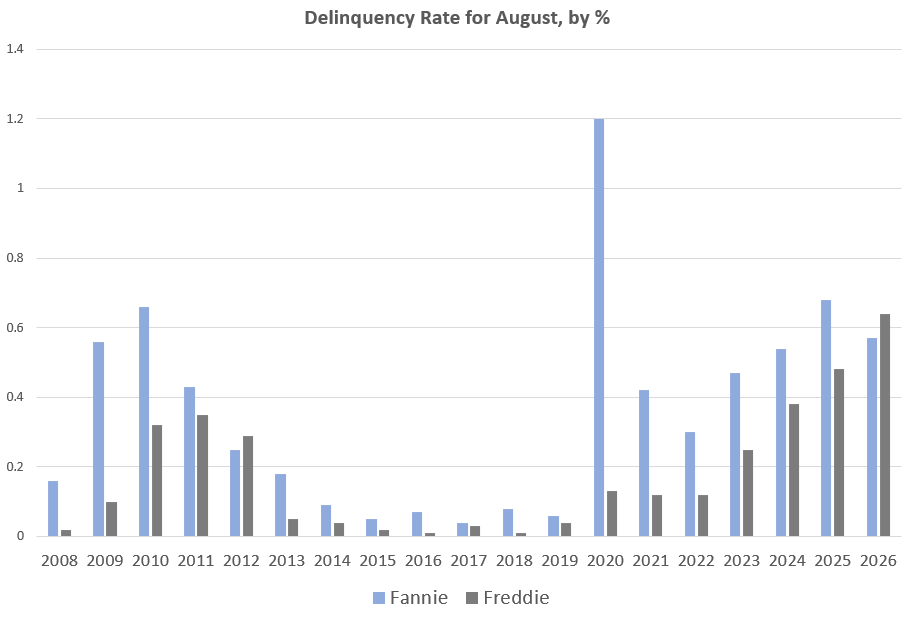
Comparing for August of each year, August 2026’s delinquency rate at Freddie exceeds that of August 2011, the previous peak year for delinquencies, when August delinquencies reached 0.35 percent. This is the highest in well over 20 years. At Fannie, August’s delinquency rate still remains below both the covid peak and the earlier 2010 peak.
In any case, delinquencies remain elevated for both Fannie and Freddie and this trend likely reflects slowing rent growth and waning demand for rentals as employment stagnates and the cost of living rises in areas outside housing. As Multifamily Dive reported this week:
The share of renters who had difficulty paying for housing jumped in 2025 and was concentrated among middle-income tenants, according to research from the Urban Institute released today. Tenants are increasingly struggling to afford both rent and utilities, as costs for essentials rise and U.S. households spend a growing share of their income on housing.
Overall, one in five renter households either paid rent late or missed a payment in 2025 — up from 16.5% in 2024 — marking the highest-ever percentage since the researchers began tracking the measure in 2017.
This trend is likely to persist into the present since BLS data shows that year-over-year inflation-adjusted hourly average earnings has been negative for the past five months. Moreover, landlords are hardly exempt from price inflation and they must continue to contend with rising prices in services and materials necessary for regular maintenance of multifamily units.
It is also getting more difficult for owners of troubled properties to refinance their way out of the problem. Interest rates have been heading up rapidly, the 10-year Treasury yield—the foundation of calculating real-estate-loan interest rates in many cases, has surged over the past week to over 5.2 percent. The 10-year was at 4.6 percent a month ago. (Not surprisingly, the average 30-year fixed single-family mortgage rate has also surged above 7.4 percent this week. Some observers are now suggesting the rate may rise to 8 percent by the end of the year.) This overall trend will make it much more difficult for many overextended multifamily owners to “extend and pretend” with new loans.

