
The Tragedy of the Euro
7. Differences in the Money Creation of the Fed and the ECB
Both the Fed and the ECB engage in the profitable business of monopolistic paper money production. They own the printing presses to produce dollars and Euros respectively. But in terms of its mission, the Fed is inherently more inflationary due to its dualistic tradition and mandate: to ensure price stability and growth on an equal footing. The ECB, in contrast, has a hierarchical objective: Achieve price stability first, and then support economic policies.1
When it comes to operational policies, there exist only slight differences between the two central banks. The Federal Reserve (Fed) has traditionally bought and sold government bonds in order to influence the money supply and the interest rate. Look at a simplified Federal Reserve balance sheet.
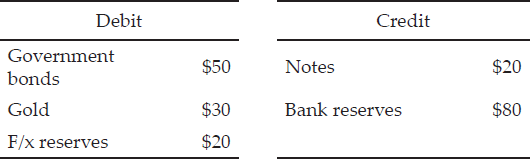
In this example the Federal Reserve has supplied a monetary base of one hundred dollars, consisting of twenty dollars in circulating bank notes and eighty dollars in form of deposits that banks hold at the Fed. Against these liabilities the Fed holds as assets fifty dollars in government bonds, thirty dollars in gold, and twenty dollars in foreign exchange reserves. On top of these reserves and notes, the fractional reserve banking system can expand the money supply by granting more loans or buying government bonds.
If the Fed wants to add bank reserves to the system it usually buys government bonds. Let us imagine that the Fed buys fifty dollars worth of government bonds from the banking system.
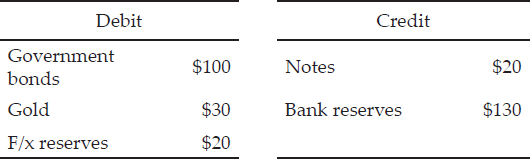
This implies an increase in government bonds to $100 on the asset side and of bank reserves to $130 on the liability side. The purchase of government bonds is called an open market operation. The Fed usually uses open market operations once a week to manipulate the federal fund rate, i.e., the interest rate for lending bank reserves overnight in the interbank market. When bank reserves increase, the federal fund rate tends to fall and vice versa. The focus on the federal funds target rate directs attention away from the underlying scheme, i.e., increases in the money supply in favor of the government and its friends. The initiative for changing the supply of base money is on part of the Fed.
Another way of increasing bank reserves is through lending to banks. This can be done, as in the case of the Fed, in the form of repurchase agreements (repos)—on the debit side of the balance sheet repurchase agreements increase, on the credit side bank reserves increase. In a repo, the borrower agrees to sell a security to a lender and agrees to buy it back in the future at a fixed price. The price difference is the interest paid. Fed repos are also a form of open market operation. They are done on a daily basis and have usually been of very short maturity (overnight).
In order to borrow through repos from the Fed, banks need to provide an underlying security, also called collateral. The collateral is like a guarantee for the Fed. If the bank cannot pay back the loan, the Fed still has the collateral to recover funds. The Fed has traditionally accepted US government bonds as an underlying asset in repurchase agreements. The Fed makes sure that there is a constant demand for government bonds; banks know they are accepted as collateral for loans. The scheme plays out like this: equipped with their privilege of holding only fractional reserves, banks create money out of thin air. With a part of the newly created money they purchase government bonds—because the Fed accepts these bonds as collateral or may buy them outright. As a consequence of the purchase of government bonds by the banking system, bond yields decrease. The government pays lower interest rates on its debts as a result.
Another form of lending is done through the so-called “discount window.” Here the initiative is on the part of banks. They may borrow overnight money through the discount window at an interest rate that is higher than the federal fund target rate. The discount window is an instrument for banks that are in need of funds and willing to pay a higher interest rate. In normal times, the discount window is not used by banks due to the penalty rate. And who uses the discount window is a matter of public knowledge, making it an unattractive alternative.
During the crisis of 2008, the Fed started other lending programmes with longer maturities that were directed at a broader range of entities (not only commercial banks) and accepted a broader range of collateral. The Fed also started to buy considerable amounts of agency debt and mortgage backed securities issued by Freddie Mac and Fannie Mae.
The ECB operates similarly to the Fed, while offering some peculiarities. The ECB uses three main instruments for its monetary policy (euphemism for money production): changes in minimum reserves, open market operations, and standing facilities. Banks must hold reserves in their accounts at the ECB based on their deposits. For €100 deposited by a customer, a bank must keep €2 at its account at the ECB; the bank may lend €98. By reducing (or increasing) the required minimum reserves banks must hold in their accounts at the ECB, banks may expand credits (or are forced to contract credits). However, this instrument is normally not touched and required reserves for demand deposits are held constant at two percent.
More relevant are open market operations and standing facilities (the marginal lending facility and the deposit facility). The difference between the two is that the initiative of open market operations is on the part of the ECB, while the initiative of standby facilities is on the part of the banks. Through the deposit facility, banks can deposit money overnight at the ECB, receiving interest. The rate of the deposit facility is the lower limit for interbank rates. No bank would accept a lower rate for funds in the interbank market because it can get the deposit facility rate at the ECB. In the marginal lending facility (similar to the discount window of the Fed), banks can borrow money from the ECB at penalty rates. Through the marginal lending facility, the ECB creates new base money only if it is asked for by banks. The marginal lending rate represents the upper limit for the interbank rate, as no bank would pay a higher rate than the one it pays for in the marginal lending facility.
The marginal lending facility comes with two further requirements for banks. First, banks may get money at the penalty rate through the marginal lending facility only if they provide sufficient collateral. The collateral has to be of certain quality. The quality is certified by three licensed, i.e., privileged rating agencies: Moody’s, Fitch, and Standard and Poor’s. If a bond is rated as risky and of low quality, the ECB will not accept it as collateral for its loans.
Second, a haircut (deduction from securities value) is applied in relation to the maturity and risk of the security (collateral). If a bank offers a bond worth €1000 as collateral, it will not be able to obtain a loan worth €1000, but a lower amount. The haircut serves as protection against potential losses. Imagine that the bank cannot pay back its loan and the ECB has to sell the bond to recover funds. In the meantime the value of the bond has fallen to €900. If no haircut had been applied, the ECB would suffer losses of €100. Losses are in principle not a problem for the ECB because it does not depend on the profit and loss motive. The ECB could continue to operate, since it can always just create money to pay its bills and lend to the banking system. However, central banks try to avoid losses as they reduce their equity. Losses might require strange accounting moves and reduce confidence in a currency. If the haircut is ten percent, the bank may get a loan of €900 against the bond of €1000. Unsurprisingly, haircuts for government bonds are lower than for other types of securities. This is another way of discretely favoring government finance with new money creation.
In contrast to the marginal lending facility, the initiative in open market operations is on the part of the ECB. There are basically two main ways to produce money through open market operations. First, the ECB purchases or sells securities outright. The outright purchase or sale is not the normal procedure for manipulating the money supply.
Normally, the ECB uses the second method and lends new money to banks via its lending facilities, which differ in purpose and term. There is the structural refinancing facility, the fine tuning facility (Does the term remind you of social engineering?), the long term refinancing facility and the main refinancing facility. In these facilities, securities are not purchased but used in reversed transactions: repos or collateralized loans. A collateralized loan is similar to a repo.
In a repo, the ECB buys a security with new money and sells it back at a higher price, the difference being the interest rate. It may buy a security at €1000 and sell it at €1010 in one year, implying an interest rate of one percent.
In a collateralized loan, however, the bank receives a loan of €1000, pledging the security as collateral and paying €10 interest. The difference between the repo and the collateralized loan is basically legal in nature. In the repo, the ownership of the collateral changes to the ECB, while in the collateralized loan, ownership stays with the borrowing bank that pledges it as collateral.
Week for week the ECB decides how much base money it wants to inject in the EMU. Maturities are normally of two weeks. The ECB basically auctions the money off via fixed or variable rate tender. In the fixed tender the interest rate is fixed by the ECB and the banks receive new money pro rata for their bids. In the variable rate tender, the banks bid for an amount of money and offer an interest rate. They are served in relation to their interest bids.
DIFFERENCES
One of the main differences between the ECB and the Fed is that the ECB has always accepted a broader range of collateral, making its policies more “flexible.” The Fed accepts or buys in its open market operations only AAA rated securities, namely treasuries, federal agency debt, or mortgage debt securities guaranteed by federal agencies.2 In the discount window, investment grade securities are accepted (rated BBB– and higher).3
The ECB has traditionally accepted a broader range of collateral in its open market operations. Beside government bonds, the ECB also accepts mortgage backed securities, covered bank loans, and other debt instruments that are at least rated with A–. This minimum rating was reduced as an emergency measure during the crisis to BBB–, and with the plan that it would expire after one year. Before the exception could expire, however, the measure was extended because Greece’s rating was in danger of falling too low. Finally, the exception was made for Greek bonds, which would be accepted irrespective of their rating.
Both central banks support government debt, but in different ways. While the Fed uses only government bonds or agency debt or securities guaranteed by agencies, fostering their demand, the ECB brings forward a bias for government debts by applying a lower haircut.
Another small difference between the Fed and the ECB lies in the way the money supply is altered, i.e., the way they produce new money. In their open market operations, the Fed prefers outright purchases of securities, whereas the ECB prefers reverse transactions.
Imagine that the Fed wants to increase bank reserves by $1000. It buys an additional $1000 worth of government bonds. Bank reserves are increased by $1000 as long as the Fed does not sell the bonds back to the banking system. The Fed receives the interest rates paid on the government bonds, remitting them back to the government in form of profit.
If the ECB has the aim of increasing the money supply by €1000, it auctions an additional €1000 in reverse transactions, accepting government bonds as collateral and applying haircuts. The ECB also receives interest payments on the loan. It remits these interest payments in form of profit to its member banks that send them along to their respective governments. When the loans come due, the ECB can roll-over the loan. In this case, the increase in bank reserves of €1000 is maintained. Government bonds are used de facto to create new money in both cases. The operation is undone when the Fed sells the government bond or when the ECB fails to roll over the loan to the banking system.
HOW THE ECB FINANCES GOVERNMENTS
When governments spend more than they receive in taxes, they issue bonds. In contrast to the FED, the ECB4 normally does not buy these bonds outright (this changed with the recent sovereign debt crisis).5 Imagine a bond worth €1000 with a maturity of 10 years is sold by a government. Banks will buy the bond, possibly by creating new money, because they know the ECB will accept the bond as collateral.
The ECB accepts the bond in a reverse transaction such as a collateralized loan with a maturity of one week (or one month), lending new money to the banks. After the week is up, the ECB will just renew the loan and accept the bond if it wants to maintain the money supply. The ECB may continue to do so for ten years. After ten years, the government will have to pay back the bond and will probably do so by issuing another bond, and so on. The government never has to pay its debt; it just issues new debt to pay the old one. But does the government at least pay the interest payments on the bond? The interest payments are paid to the ECB. As mentioned before, part of the interest payment flows back to the government as ECB profits are remitted according to the capital of the different national central banks. From there profits flow to the respective governments. What about the interest payments that aren’t flowing back, i.e., remitted back to the government in the form of profits? Don’t governments have to pay for those? Again, the government may just issue a new bond to pay for these expenditures. The banks buy the bond and the ECB accepts it as collateral. In this way, the ECB is able to finance the deficits of member states.
How is it possible, then, that Greece ran into refinancing problems? Greece had problems rolling over its debt. It was feared that the ECB would not accept Greek bonds anymore, and that the rating would fall below the minimum. Moreover, many market participants began to speculate that political problems caused by rising deficits and debts could end the monetization of Greek debts. At some point the German or other European governments would step in and demand that the ECB stop financing Greece’s growing debts and deficits. It was also feared that other countries would not bail Greece out with direct government loans. This kind of direct support runs counter to terms of the Treaty of Maastricht, not to mention the severe political difficulties that come along with trying to persuade the population.
Greece’s rescue, in the end, may not have been economically viable. The danger of default rose and interest rates for Greek bonds soared, leading to the sovereign debt crises.
_________________
6 A good comparison of the ECB and the Fed that also includes a breakdown of their organization can be found in Stephen G. Cecchetti and Róisín O’Sullivan, “The European Central Bank and the Federal Reserve,” Oxford Review of Economic Policy 19 (1, 2003): pp. 30–3.
7 See Federal Reserve, “The Federal Reserve System: Purposes and Functions,” 9th ed. (2005), http://www.federalreserve.gov, pp. 39–40.
8 Ibid., p. 50.
9 It would be more precise to state “Eurosystem” instead of “ECB.” The Eurosystem consists of the central banks of the member states plus the ECB. However, as the central banks of the member states only carry out the orders of the ECB within their respective countries, we usually simplify by using the term “ECB.”
10 See Rita Nazareth and Gavin Serkin, “Stocks, Commodities, Greek Bonds Rally on European Loan Package,” Bloomberg (May 10, 2010), http://noir.bloomberg.com.
- 1Roughly a year before starting to purchase government bonds, the ECB started to buy covered bonds issued by German banks. The purchases were progressive and reached €60 billion.
- 2Cash-online, “Forsa: Deutsche überwiegend gegen den Euro-Rettungsschirm.” News from June 7, 2010, http://www.cash-online.de.
- 3Shortnews.de, “Umfrage: Mehr als die Hälfte der Deutschen wollen die DM zurück haben.” News from June 29, 2010, http://shortnews.de.
- 4GRReporter, “The Social Tourism of Bankrupt Greece,” July 12, 2010, http://www.grreporter.info. In the summer of 2010, many Greek entrepreneurs did not want to serve clients participating in the state programme. The Greek government pays its bills six months late, if at all.
- 5D. Hoeren and O. Santen, “Griechenland-Pleite: Warum zahlen wir ihre Luxus-Renten mit Milliarden-Hilfe?” bild-online.de, April 27, 2010, http://bild.de.
- 6In reaction to the crisis, the political class has tried desperately to save the socialist project of a common fiat currency for Europe. They have been successful—at least for the time being. After intense negotiations, an unprecedented €750 billion “rescue parachute” has been created to support European governments and banks. At the same time, however, the ECB has started what many had regarded as unthinkable before: the outright purchase of government bonds, an action which undermines its credibility and independence. The public and market perception of the monetary setup of the European Monetary Union (EMU) will never be the same.
- 7Resistance to these unprecedented measures is on the rise, especially in countries with traditionally conservative monetary and budget policies. A poll in Germany showed that fifty-six percent of Germans were against the bailout fund.
- 8It is not surprising that the majority of Germans want to return to the Deutschmark. They seem to understand intuitively that they are at the losing end of a complex system. They see that they are saving and tightening their belts on a regular basis while other countries’ governments embark on wild spending sprees. A prime illustration is the “Tourism for All” programme in Greece: the poor receive government funds toward vacations. Even amid the crisis, the Greek government continues the programme, albeit reducing the number of subsidized vacation nights to two. The Greek government also upholds a more generous public pension system than Germany does. Greek workers get a pension of up to eighty percent of their average wages. German workers get only forty-six percent, a number that will fall to forty-two percent in the future. While Greeks get fourteen pension payments per year, Germans receive twelve.
- 9It is not surprising that the majority of Germans want to return to the Deutschmark. They seem to understand intuitively that they are at the losing end of a complex system. They see that they are saving and tightening their belts on a regular basis while other countries’ governments embark on wild spending sprees. A prime illustration is the “Tourism for All” programme in Greece: the poor receive government funds toward vacations. Even amid the crisis, the Greek government continues the programme, albeit reducing the number of subsidized vacation nights to two. The Greek government also upholds a more generous public pension system than Germany does. Greek workers get a pension of up to eighty percent of their average wages. German workers get only forty-six percent, a number that will fall to forty-two percent in the future. While Greeks get fourteen pension payments per year, Germans receive twelve.
- 10It is not surprising that the majority of Germans want to return to the Deutschmark. They seem to understand intuitively that they are at the losing end of a complex system. They see that they are saving and tightening their belts on a regular basis while other countries’ governments embark on wild spending sprees. A prime illustration is the “Tourism for All” programme in Greece: the poor receive government funds toward vacations. Even amid the crisis, the Greek government continues the programme, albeit reducing the number of subsidized vacation nights to two. The Greek government also upholds a more generous public pension system than Germany does. Greek workers get a pension of up to eighty percent of their average wages. German workers get only forty-six percent, a number that will fall to forty-two percent in the future. While Greeks get fourteen pension payments per year, Germans receive twelve.

