
The Tragedy of the Euro
4. Why High Inflation Countries Wanted the Euro
RIDDING EUROPE OF THE DEUTSCHMARK
Governments of Latin countries, and especially France, regarded the Euro as an efficient means of getting rid of the hated Deutschmark.1 Before the introduction of the Euro, the Deutschmark was a standard that laid bare the monetary mismanagement of irresponsible governments. While the Bundesbank inflated the money supply, it produced new money at a slower rate than the high inflation of—especially Southern European—countries, who used their central banks most generously to finance deficits. The exchange rate against the Deutschmark served citizens in those countries as a standard of comparison. Governments of high inflation countries feared the comparison with the Bundesbank. The Euro was a means to end the embarrassing comparisons and devaluations.
Governments of high inflation countries did not fear the newly established European Central Bank. While the new central bank would look like a copy of the Bundesbank from the outside, from the inside it could be put under political pressure and gradually become a central bank more like that of Latin central banks. Actually, Southern Europe has control over the ECB. The council of the ECB is composed of the directors of the ECB and the presidents of the national central banks. All have the same vote. Germany and Northern, hard currency countries such as the Netherlands, Luxembourg and Belgium hold the minority of votes against countries like Italy, Portugal, Greece, Spain, and France, whose governments are less averse to deficits. These Latin countries had strong labor unions and high debts making them inherently prone to inflation.
The Euro was advantageous to Latin countries in that its inflation could be conducted without any direct evidence of an appreciating Deutschmark. Inflation would go on, but would be more hidden. When prices start to rise, it is relatively easy to blame it on certain industries. Politicians may, for instance, say that oil prices increase because of peak oil. But if oil prices go up and there is devaluation, it is more difficult for politicians to blame oil for the price increase. Devaluations coupled with higher inflation could easily lead to losses in elections. Devaluations against the Deutschmark disappeared with the introduction of the Euro.
Giscard d’Estaing, founder of a lobbying group for the Euro, stated in June 1992 that the ECB would finally put an end to the monetary supremacy of Germany.2 What he meant was that the smoking gun that disciplined other countries would finally disappear. He added that the ECB should be used for macroeconomic growth policies; in other words, inflation. In a similar way, Jacques Attali, advisor to Mitterrand, acknowledged that the Maastricht Treaty was just a complicated contract whose purpose was to get rid of the Mark. This aim was also pursued by the Italians and others.3
PRESTIGE
With the ECB having been based on the model of the Bundesbank, high inflation countries inherited part of its prestige. The founding of the ECB was similar to an imaginary merger of the car makers Fiat and Daimler-Benz, where the Germans take over management and quality control. While the management majority is German, the Fiat’s plants are still in Italy. The costs of undoing the merger, however, are immense. While it is certainly good for Fiat, it is not so good for Daimler-Benz itself.
The result of the introduction of the Euro was the expectation of a more stable currency for Southern European countries. Inflationary expectations fell in these countries. When inflation expectations are high, people reduce their cash holdings and start to buy as they think prices will be considerably higher in the future. When inflationary expectations fall, people increase their cash holdings marginally, leading to lower price inflation. This is one reason why rates of price inflation in the Southern countries went down even before the Euro was introduced. The expectation associated with the Euro reduced inflationary expectations, helping these countries to fulfil the Maastricht criterion of low inflation rates.
As in the case of a merger between Daimler and Fiat, for Germany, the Euro implied a watering down of the soundness of its currency. The fear for Germany was that the Euro would be less stable than the Deutschmark, spurring inflationary expectations. The German government was, in fact, using the Bundesbank’s monetary prestige to the benefit of the inflationary member states and to the detriment of the general German population.
SOCIALIZED SEIGNORAGE
Some countries, especially France, made gains at the expense of the Germans due to a socialization of seignorage wealth.4 Seignorage are the net profits resulting from the use of the printing press. When a central bank produces more base money, it buys assets, many of which yield income. For instance, a central bank may buy a government bond with newly produced money. The net interest income resulting from the assets is seignorage and transmitted at the end of the year to the government. As a result of the introduction of the Euro, seignorage was socialized in the EMU. Central banks had to send interest revenues to the ECB. The ECB would remit its own profits at the end of the year. One could imagine that this would be a zero sum game. But it is not. The ECB remits profits to national central banks based not on the assets held by individual central banks, but rather based on the capital that each central bank holds in the ECB. This capital, in turn, reflects population and GDP and not the national central banks’ assets.
The Bundesbank, for instance, produced more base money in relation to its population and GDP than France, basically because the Deutschmark was an international reserve currency and was used in international transactions. The Bundesbank held more interest generating assets in relation to its population and GDP than France did. Consequently, the Bundesbank remitted relatively more interest revenues to the ECB than France, which were then redistributed to central banks based on population and GDP figures. While this scheme was disadvantageous for Germany, Austria, Spain and the Netherlands it was beneficial to France. Indeed, the Bundesbank profits remitted back to the German government fell after the introduction of the Euro. In the ten years before the single currency, the Bundesbank obtained €68.5 billion in profits. In the first ten years of the Euro the profit fell to €47.5 billion.
LOWER INTEREST RATES
The Euro lowered interest rates in the Southern countries, especially for government bonds. People and governments had to pay less interest on their debts. Investors bought the high yielding bonds of peripheral countries, which bid up their prices and brought down interest rates. This was a profitable deal because it could be expected that the bonds still denominated in Lira, Peseta, Escudo and Drachma would finally be paid back in Euros.
The lower interest rates allowed some countries to reduce their debt and fulfil the Maastricht criteria. Italy’s rates, for instance, were reduced substantially, allowing the government to save on interest payments. In 1996, Italy paid around €110 billion in interest on its debts and in 1999, only around €79 billion.5
Southern interest rates were lowered for two main reasons. First, interest rates were reduced as inflationary expectations fell: the prestige of the Bundesbank partially transferred to the ECB led to lower interest payments. Second, the risk premium in rates was reduced. With the Euro, one currency was introduced as a step toward political integration in Europe. The Euro was installed supposedly for an indefinite period. The Eurozone’s breakup was not provided for legally, and would be considered a huge political loss. The expectation was that stronger nations would bail out weaker nations if necessary.6 With an implicit guarantee on their debts, many countries had to pay lower interest rates because the risk of default was reduced.
As Germany and other countries were implicitly guaranteeing for the debt of Mediterranean states, these states’ lower interest rates were not in line with the real risk of default. The German government, in turn, had to pay higher interest rates on its debts than it would have paid otherwise; the danger of an additional burden was priced in. Markets normally punish budgetary indiscipline harshly, with higher interest rates and a depreciation of the currency. The European Monetary Union led to a delay of this punishment.
As a consequence of the expected entry into the monetary union, interest rates converged to Germany’s level, as can be seen in Graph 1. From 1995 on, it became more and more certain that Mediterranean countries (except Greece that participated in 2001) would participate in the monetary union in 1999.
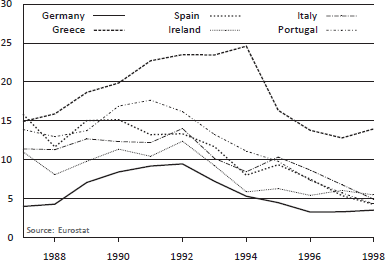
Graph 1: Three month monetary rates of interest in Germany, Greece, Spain, Ireland, Italy, and Portugal (1987–1998)
Rates fell even though real savings had not increased and because the inflation premium was reduced. The lower interest rates caused capital good prices to rise. As a consequence, a housing boom occurred in many Mediterranean countries. Credit was cheap and was used to buy and construct houses. This housing bubble was fed by expansionary monetary policy until 2008, when the global crisis lead to a crash in oversized housing markets.
MORE IMPORTS AND A HIGHER LIVING STANDARD
High inflation states inherited a stronger currency from Germany and, consequently, could enjoy more imports and a higher standard of living. Even though Latin governments did not lower their expenditures significantly, the Euro remained relatively strong in international currency markets during the first years of its existence. The Euro was kept strong due to the prestige of the Bundesbank and the institutional setup of the ECB, as well as due to strong German (and other Northern states) exports that increased the demand for Euros.
Germany has traditionally had current account surpluses, i.e., exports exceeding imports due to high efficiency and competitiveness. Germans saved and invested, improving productivity. At the same time, wage rates increased moderately. The resulting export surplus implied that Germans would travel to and invest in other countries. Germans acquired assets in foreign countries that could be sold in case of emergency. The result was an upwards pressure on the exchange rate.
Over the years, the Deutschmark tended to appreciate due to productivity increases in Germany. The Deutschmark became the symbol of the German economic miracle. The appreciation of the Deutschmark in foreign exchange markets made imports cheaper. Commodities and other inputs for the high quality German production process could be imported at lower prices. Also vacations and investments in foreign countries got cheaper. Living standards went up. This mechanism of increased productivity leading to more exports and tending toward an appreciation of the currency is still in place in the EMU.
But in the Southern EMU we have the opposite image. Production is less efficient there, relatively. Consumption rose in Southern Europe after the introduction of the Euro, and was spurred on by artificially lowered interest rates. Savings and investments have not increased as much as they have in Germany, and productivity increases have lagged behind. Moreover, new money has gone primarily to peripheral countries where it has pushed up wages. These wage increases have been higher than wage increases in Germany, leading to a loss in competitiveness, a surplus of imports over exports, and a tendency toward a depreciation of the currency. In addition, Southern governments were bribed by cash transfer payments in exchange for signing the Maastricht Treaty: “Jacques Delors, the Commission President, all but bribed the finance ministers if Greece, Spain, Portugal, and Ireland, promising large increases in EU structural funds in return for their signatures on the Treaty.”7 (Judt, Postwar, p. 715)
As we can see in Graphs 2 and 3, competitiveness in Mediterranean countries and Ireland has decreased substantially since the introduction of the Euro. At the same time, competitiveness in Germany and even Austria has increased. Since the introduction of the Euro, Germany’s competitiveness, as measured by the indicator based on unit labor costs provided by the ECB, increased 13.7 percent from the time of the Euro’s introduction up until 2010. In the same period, Greece, Ireland, Spain, and Italy lost in competitiveness, 11.3, 9.1, 11.2, and 9.4 percent respectively.8 According to the numbers provided by the ECB, Germany’s competitive indicator of 88.8 in the first quarter of 2010 is substantially more competitive than Ireland with its 118.7, Greece with its 108.8, and Spain and Italy, with 111.6 each.
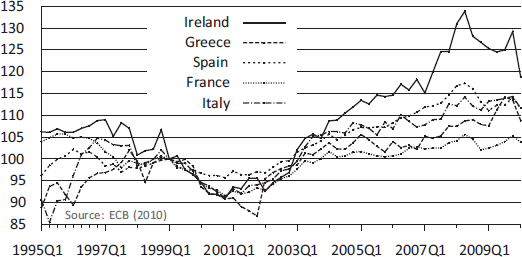
Graph 2: Competitiveness indicators based on unit labor costs, for Mediterranean countries and Ireland 1995–2010 (1999Q1=100)
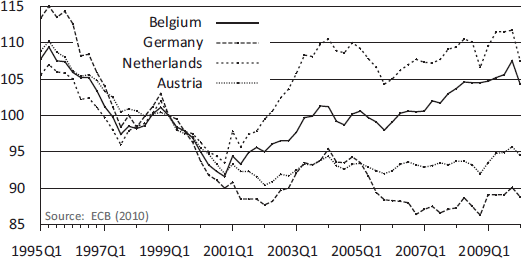
Graph 3: Competitiveness indicators based on unit labor costs, for Belgium, The Netherlands, Austria, and Germany 1995–2010 (1999Q1=100)
Before the introduction of the Euro, Latin countries with increasing wages, strong labor unions, and inflexible labor markets also lost competitiveness relative to Germany. Yet, before the single currency, inflations and devaluations regained competitiveness, lowering real wages. At the same time imports became more expensive.
When the Deutschmark was replaced by the Euro, Germany’s export surplus was partially compensated for by import surpluses of Southern states. Trade surpluses and deficits of Eurozone states can be seen in Graph 4.
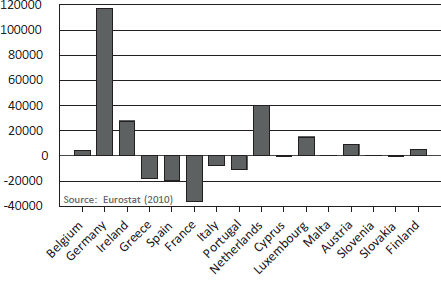
Graph 4: Balance of Trade 2009 (in million Euros)
In Graph 5 we see that Germany’s trade surplus has increased in recent years due to the increase in competitiveness that comes along with an increased trade deficit of other countries. In fact, Germany’s trade surplus more than compensates for the traditional trade deficits of Spain, Portugal, Italy, and Greece.
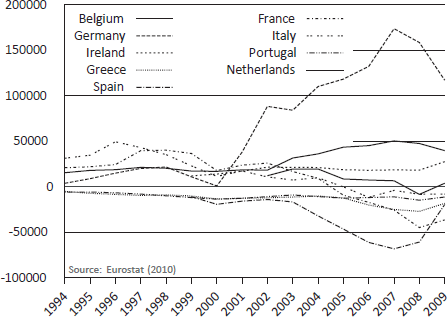
Graph 5: Balance of Trade 1994–2009 (in million Euros)
Long-lasting trade deficits drag negatively on the value of a currency. A trade deficit implies that there is a surplus in other parts of the balance of payments. There can be financial transfers toward the deficit country, or the country may increase its net position of foreign debts. Without sufficient financial transfers, a trade deficit implies that the public and private foreign debts of the country increase.
In this regard, it is not irrelevant if debts are held by a citizen or by a foreigner. Japanese government debts are held to a large extent by Japanese citizens and banks. Greek (or Spanish) government debts are largely held by foreign banks due to their trade deficits. Greeks did not save enough to buy their government debts, but preferred instead to import more goods and services than they exported. Foreign banks financed this consumption by buying Greek debts.
The Japanese government can force its banks to buy its government bonds or keep them from selling because they are within Japanese jurisdiction. The Greek government cannot force foreign banks to hold on to Greek government bonds. Neither can the Greek government force foreign banks to keep buying Greek debts in order to finance its deficit. If foreign banks stop buying or start selling Greek government bonds, the government may have to default. Trade deficits and resulting foreign debts make a currency vulnerable, while trade surpluses and net foreign positions make a currency stronger.
The development of the Euro pales when compared to what would have been the development of the Deutschmark alone. Imports and living standards in Germany did not increase as much as they would have with the Deutschmark. In fact, real retail sales in Germany lagged behind those in other industrial nations, as can be seen in Graph 6.
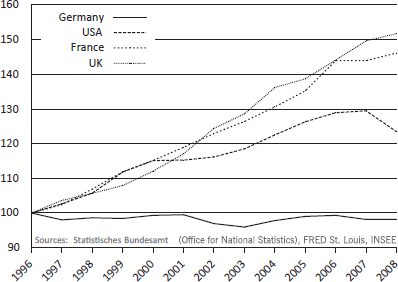
Graph 6: Retail sales in Germany, USA, France, and UK (1996=100)
But retail sales in Mediterranean countries increased and began to fall only with the economic crisis in 2008. From 2000 to 2007, retail sales in Spain increased more than twenty percent (Graph 7).
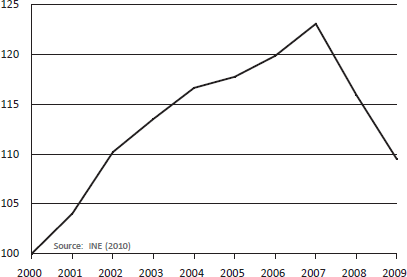
Graph 7: Retail sales in Spain (2000=100)
Imports remained cheaper for Southern Europe than they probably would have without the monetary union. Even though inflationary countries lost competitiveness relative to Germany, imports did not increase in price as much as they would have had these countries relied on their own currencies. The result of combining this with artificially low interest rates was the credit-financed consumption boom, especially in the Southern states.
AN EXCUSE FOR BUDGET CUTS
Southern European politicians used the Maastricht Treaty as an excuse (before a socialist constituency) for deregulation and taking budgetary saving measures necessary to prevent bankruptcy. In order to fulfil the convergence criteria, Southern countries had to reduce their deficits, cut government spending, and sell public companies. For many countries, in fact, the Euro was the only prospect for delaying sovereign default or hyperinflation. Public debts pressed European welfare states severely before the introduction of the Euro. In 1991 Belgium, Ireland and Italy had debts of 132%, 113%, and 103% of the GDP.9 Even the Netherlands had a debt of 83% of the GDP, with Greece not far behind. In the end, the issue of a single currency was about power and money and not about high-minded European thinking.
GAINS THROUGH MONETARY REDISTRIBUTION
When the Euro was introduced, it did not take long for imbalances to develop and accumulate. The current account deficit in Southern states increased in a consumption boom and the German export industry flourished. An appreciation of the Deutschmark would have caused problems for German exporters and reduced the current account surplus of Germany. With the Euro, this was no longer possible.
New Euros flew from the credit induced boom in Southern countries into Germany and pushed up prices there. Redistributions occurred as the ECB continued to finance and accommodate consumption spending in these countries. New money would enter the Southern countries and buy German products.
In Graph 8, we can see the growth of M3 (excluding circulating currency) in Spain, Italy, Greece, Portugal, and Germany. We see that the money supply indeed grew much faster in the Mediterranean countries. Spain and Greece, especially, had faster growth rates than Germany did (thick line) during the boom years of the early 2000s until 2008. For instance, when Germany’s monetary aggregate was falling in 2002, Spain and Italy had double digit increases. In 2004, Germany’s growth of money aggregates was hovering at two percent. Monetary growth was at least double in the Mediterranean countries at the same time. When Spain’s housing boom got out of control in 2007, M3 grew to twenty percent while Germany’s aggregate grew between five and eight percent.
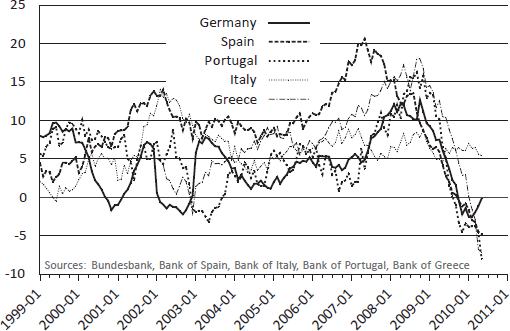
Graph 8: Increase in M3 in percent (without currency in circulation) in Spain, Germany, Italy, Greece, and Portugal (1999–2010)
The redistribution through different rates in money production brought on a culture of decadence. This development resembled the “curse of gold” that Spain experienced after the discovery of the New World, when new money, i.e., gold, would flow in to the country. Spain would then import goods and services (mostly military) from the rest of Europe. As a consequence, European exporters would experience profits and Spanish industry would become ever more inefficient.
The same has happened in the Eurozone. Money was injected at a faster rate in Southern states. After constructing houses, money spread to the rest of the Eurozone as Spain imported goods from Germany and other Northern countries. The Mediterranean current account deficit increased.
If the monetary injection had been a one time event only, the situation would have soon stabilized. Prices would have increased in Germany relative to the Southern countries as Euros bought German goods. Lower prices and wages in the Southern countries would have made these countries more efficient and reduced the current account deficit.
But this readjustment was not allowed to happen. New money continued to flow more quickly into Mediterranean states where it was passed on to Southern consumers and governments, keeping prices from falling (prices that were relatively higher than those in Germany). The flow of goods from Germany to the Southern countries continued. The current account deficit was maintained and Southern countries stayed relatively unproductive while becoming accustomed to a level of consumption that would not have been possible without the money creation in their favor. Southern inflation was exported to Germany while monetary stability was imported. Southern prices did not rise as much as they would have without the imports from Germany. German prices increased more than they would have without the exports to Southern Europe.
In a form of monetary imperialism, banks and governments in Southern countries produced money that Germans had to accept.10 Take an example: the Greek central bank prints money to finance the salary of a Greek politician. The Greek politician buys a Mercedes. (The politician may buy a tank. With a population of eleven million, Greece is the largest importer of conventional weapons in Europe. Military spending in Greece captures the highest percentage of the GDP of all countries in
the EU.)
In a gold standard, gold would leave Greece and flow to Germany in exchange for imported goods. In fluctuating fiat paper currencies, a politician would have to exchange his newly printed Drachma into Deutschmark; the Deutschmark would rise in value and the next vacation of the German automobile worker in Greece would be less expensive. In the case of the Euro, paper money flows into Germany where it is accepted as legal tender and bids up prices.
__________________
11 As Connolly, The Rotten Heart of Europe, p. 4 states in 1995: “For the French élite, money is not the lubricant of the economy but the most important lever of power. Capture of the Bundesbank is thus, for them, the great prize in the European monetary war.”
12 Quoted in Baader, p. 207.
13 Ibid., p. 208. See also Connolly, The Rotten Heart of Europe, p. 386.
14 See Hans-Werner Sinn and Holger Feist, “Eurowinners and Eurolosers: The Distribution of Seignorage Wealth in the EU,” European Journal of Political Economy 13 (1997): pp. 665–689. The socialization of seignorage income in the Eurosystem is laid down in Article 32 of the Protocol No. 18 on the Statute of the European System of Central Banks and of the European Central Banks of the Maastricht Treaty.
15 Wilhelm Hankel, Wilhelm Nölling, Karl A. Schachtschneider and Joachim Starbatty, Die Euro-Illusion. Warum Europa scheitern muß (Hamburg: Rowohlt, 2001), p. 94.
16 Theoretically, countries such as Greece could default without leaving the EMU. Yet, this would be considered a political catastrophe and would probably imply the end for any advancement toward a central European state.
17 See Judt, Postwar, p. 715. Conolly, The Rotten Heart of Europe, p. 198 writes: “On 9 November 1991, the Irish, Spanish, Portuguese and Greek foreign ministers had left a meeting with Jacques Delors in which he had promised fabulous amounts (6 billion ECUs to Ireland) of other people’s money if they pledged to support his federalist, corporatists ambitions in the final Maastricht negotiations.”
18 No data is provided for Portugal. It should be noted that we cannot take these data at face value as it may contain substantial errors. The data represent a very high level of aggregation. Nevertheless, the data may indicate tendencies.
19 Baader, Die Euro-Katastrophe, p. 204. Without the implicit German guarantee the debt situation of Belgium would have been unsustainable. See Connolly, The Rotten Heart of Europe, p. 344.
20 On monetary nationalism see Hans-Hermann Hoppe, “Banking, Nation States, and International Politics: A Sociological Reconstruction of the Present Economic Order,” Review of Austrian Economics 4 (1, 1990): pp. 55–87.
- 1Roughly a year before starting to purchase government bonds, the ECB started to buy covered bonds issued by German banks. The purchases were progressive and reached €60 billion.
- 2Cash-online, “Forsa: Deutsche überwiegend gegen den Euro-Rettungsschirm.” News from June 7, 2010, http://www.cash-online.de.
- 3Shortnews.de, “Umfrage: Mehr als die Hälfte der Deutschen wollen die DM zurück haben.” News from June 29, 2010, http://shortnews.de.
- 4GRReporter, “The Social Tourism of Bankrupt Greece,” July 12, 2010, http://www.grreporter.info. In the summer of 2010, many Greek entrepreneurs did not want to serve clients participating in the state programme. The Greek government pays its bills six months late, if at all.
- 5D. Hoeren and O. Santen, “Griechenland-Pleite: Warum zahlen wir ihre Luxus-Renten mit Milliarden-Hilfe?” bild-online.de, April 27, 2010, http://bild.de.
- 6The European Communities consisted of the European Coal and Steel Community, creating a common market for coal and steel; the European Economic Community (EEC), advancing economic integration; and the European Atomic Energy Community, creating a specialist market for nuclear power and distributing it through the Community. Yet, even at the very beginning of European integration we can already appreciate the “socialist intentions” of Jean Monnet, the French intellectual father of the European Community. Monnet planned the European Community to be a supra-national rather than an inter-governmental organization [Christopher Booker and Richard North, The Great Deception: Can the European Union Survive? (London: Continuum, 2005)]. For Monnet’s tendency toward central planning see also Tony Judt, Postwar: A History of Europe since 1945 (London: Vintage, 2010, p. 70). The French government feared a German revival after World War II. The EEC assured the French privileged access to German resources (Judt, Postwar, p. 117). The integration of Germany into Europe was thought to prevent a German revolt against the conditions imposed upon it after the war. As Judt, Postwar, p. 156, writes: “[The High Authority of the EEC] above all would take control of the Ruhr and other vital German resources out of purely German hands. It represented a European solution to a—the—French problem.” Despite these political intentions behind the EEC, elements of the classical liberal tradition remained strong in the beginning.
- 7The Council of the European Union, often referred to as the “Council” or “Council of Ministers,” is constituted by one minister of each member state and should not be confused with the European Council. The European Council is composed of the President of the “Council of Ministers,” the President of the Commission, and one representative per member state. The European Council gives direction to the EU by defining the policy agenda.
- 8These important birth defects reduce the credit given to the founding fathers such as Schuman, Adenauer and others.
- 9In 1959, for instance, the British government suggested a free trade zone for all of non-communist Europe. The proposal was rejected by Charles de Gaulle.
- 10Larsson, “National Policy in Disguise,” p. 162. As Larsson writes: “The arena, in which France sought to recreate its honor and international influence was that of Western Europe. As the leading country in the EEC, France regained influence to compensate for the loss of its empire, and within an area where France, traditionally and in different ways, had sought to dominate and influence.” As Judt, Postwar, p. 153 writes: “Unhappy and frustrated at being reduced to the least of the great powers, France had embarked upon a novel vocation as the initiator of a new Europe.” “For Charles de Gaulle, the lesson of the twentieth century was that France could only hope to recover its lost glories by investing in the European project and shaping it into the service of French goals.” (p. 292) Already in 1950 the French premier, René Pleven, proposed to create a European Army as part of a European Defence Community (under the leadership of France). Even though the plan ultimately failed, it provides evidence that from the very beginning, French politicians pushed for centralization and the empire vision of Europe. An exception is French President Charles de Gaulle, who opposed a supranational European state. During the “empty chair crisis” France abandoned its seat in the Council of Ministers for six months in June 1965 in protest against an attack on its sovereignty. The Commission had pushed for a centralization of power. Yet, de Gaulle was also trying to improve the French position and leadership in the negotiations over the Common Agricultural Policy. The Commission had proposed majority voting in this area. French farmers were the main beneficiaries of the subsidies while Germany was the main contributor. Majority voting could have deprived French farmers of their privileges. Only when de Gaulle’s agricultural funding demands were accepted the policy of the empty chair ended. Many Germans including Ludwig Erhard opposed the agricultural subsidies and favored a free trade zone. (See Judt, Postwar, p. 304). Adenauer, however, would never break with France. In exchange for subsidies for French farmers, German goods gained free entry into France. It was agricultural subsidies in exchange for free trade.
- 11In reaction to the crisis, the political class has tried desperately to save the socialist project of a common fiat currency for Europe. They have been successful—at least for the time being. After intense negotiations, an unprecedented €750 billion “rescue parachute” has been created to support European governments and banks. At the same time, however, the ECB has started what many had regarded as unthinkable before: the outright purchase of government bonds, an action which undermines its credibility and independence. The public and market perception of the monetary setup of the European Monetary Union (EMU) will never be the same.
- 12Resistance to these unprecedented measures is on the rise, especially in countries with traditionally conservative monetary and budget policies. A poll in Germany showed that fifty-six percent of Germans were against the bailout fund.
- 13It is not surprising that the majority of Germans want to return to the Deutschmark. They seem to understand intuitively that they are at the losing end of a complex system. They see that they are saving and tightening their belts on a regular basis while other countries’ governments embark on wild spending sprees. A prime illustration is the “Tourism for All” programme in Greece: the poor receive government funds toward vacations. Even amid the crisis, the Greek government continues the programme, albeit reducing the number of subsidized vacation nights to two. The Greek government also upholds a more generous public pension system than Germany does. Greek workers get a pension of up to eighty percent of their average wages. German workers get only forty-six percent, a number that will fall to forty-two percent in the future. While Greeks get fourteen pension payments per year, Germans receive twelve.
- 14It is not surprising that the majority of Germans want to return to the Deutschmark. They seem to understand intuitively that they are at the losing end of a complex system. They see that they are saving and tightening their belts on a regular basis while other countries’ governments embark on wild spending sprees. A prime illustration is the “Tourism for All” programme in Greece: the poor receive government funds toward vacations. Even amid the crisis, the Greek government continues the programme, albeit reducing the number of subsidized vacation nights to two. The Greek government also upholds a more generous public pension system than Germany does. Greek workers get a pension of up to eighty percent of their average wages. German workers get only forty-six percent, a number that will fall to forty-two percent in the future. While Greeks get fourteen pension payments per year, Germans receive twelve.
- 15It is not surprising that the majority of Germans want to return to the Deutschmark. They seem to understand intuitively that they are at the losing end of a complex system. They see that they are saving and tightening their belts on a regular basis while other countries’ governments embark on wild spending sprees. A prime illustration is the “Tourism for All” programme in Greece: the poor receive government funds toward vacations. Even amid the crisis, the Greek government continues the programme, albeit reducing the number of subsidized vacation nights to two. The Greek government also upholds a more generous public pension system than Germany does. Greek workers get a pension of up to eighty percent of their average wages. German workers get only forty-six percent, a number that will fall to forty-two percent in the future. While Greeks get fourteen pension payments per year, Germans receive twelve.
- 16The two visions have been struggling with each other since the 1950s. In the beginning, the design for the European Communities adhered more closely to the classical liberal vision. The European Community consisted of sovereign states and guaranteed the four basic liberties. From the point of view of the classical liberals, a main birth defect of the community was the subsidy and intervention in agricultural policy. Also, by construction, the only legislative initiative belongs to the European Commission. Once the Commission has made a proposal for legislation, the Council of the European Union alone, or together with the European Parliament, may approve the proposal. This setup contains the seed of centralization. Consequently, the institutional setup, from the very beginning, was designed to accommodate centralization and dictatorship over minority opinions, as unanimity is not required for all decisions and the areas were unanimity rule is required have been reduced over the years.
- 17The two visions have been struggling with each other since the 1950s. In the beginning, the design for the European Communities adhered more closely to the classical liberal vision. The European Community consisted of sovereign states and guaranteed the four basic liberties. From the point of view of the classical liberals, a main birth defect of the community was the subsidy and intervention in agricultural policy. Also, by construction, the only legislative initiative belongs to the European Commission. Once the Commission has made a proposal for legislation, the Council of the European Union alone, or together with the European Parliament, may approve the proposal. This setup contains the seed of centralization. Consequently, the institutional setup, from the very beginning, was designed to accommodate centralization and dictatorship over minority opinions, as unanimity is not required for all decisions and the areas were unanimity rule is required have been reduced over the years.
- 18The two visions have been struggling with each other since the 1950s. In the beginning, the design for the European Communities adhered more closely to the classical liberal vision. The European Community consisted of sovereign states and guaranteed the four basic liberties. From the point of view of the classical liberals, a main birth defect of the community was the subsidy and intervention in agricultural policy. Also, by construction, the only legislative initiative belongs to the European Commission. Once the Commission has made a proposal for legislation, the Council of the European Union alone, or together with the European Parliament, may approve the proposal. This setup contains the seed of centralization. Consequently, the institutional setup, from the very beginning, was designed to accommodate centralization and dictatorship over minority opinions, as unanimity is not required for all decisions and the areas were unanimity rule is required have been reduced over the years.
- 19The classical liberal model is defended traditionally by Christian democrats and states such as the Netherlands, Germany, and also Great Britain. But social democrats and socialists, usually led by the French government, defend the Empire version of Europe. In fact, in light of its rapid fall in 1940, the years of Nazi occupation, its failures in Indochina, and the loss of its African colonies, the French ruling class used the European Community to regain its influence and pride, and to compensate for the loss of its empire.
- 20The classical liberal model is defended traditionally by Christian democrats and states such as the Netherlands, Germany, and also Great Britain. But social democrats and socialists, usually led by the French government, defend the Empire version of Europe. In fact, in light of its rapid fall in 1940, the years of Nazi occupation, its failures in Indochina, and the loss of its African colonies, the French ruling class used the European Community to regain its influence and pride, and to compensate for the loss of its empire.

