
The Tragedy of the Euro
10. The Ride Toward Collapse
When the financial crisis hit, governments responded with the typical Keynesian recipe: deficit spending. With an accelerating course of events, the EMU drove into the abyss of its breakup. We begin our story a few months after the collapse of Lehman Brothers, when the effects of the crisis on government deficits started affecting sovereign ratings.
At the beginning, Greece was the main focus of attention. In January of 2009, the rating agency S&P cut Greece’s rating to an A–, the same day the government gave in to striking farmers, promising them additional subsidies of €0.5 billion. Problems spread. By the end of April 2009, the EU Commission started investigating excessive deficits in Spain, Ireland, Greece and France. By October, the rating agency, Fitch, reduced Greece’s rating to an A– as well.
At the end of 2009 several European countries acknowledged that they had excessive deficits.
Responses to budgetary problems varied. Ireland announced spending cuts of ten percent of the GDP. The Spanish government did not cut spending at all, nor did Greece.
At the end of 2009, the new government in Greece announced that its deficits would be at a record 12.7 percent—more than three times higher than the 3.7 percent announced earlier in 2009. On December 1, finance ministers of the EMU agreed on harsher action with regard to the Greek government, and on December 8, Fitch lowered its ranking to BBB+. S&P followed suit and downgraded Greece.
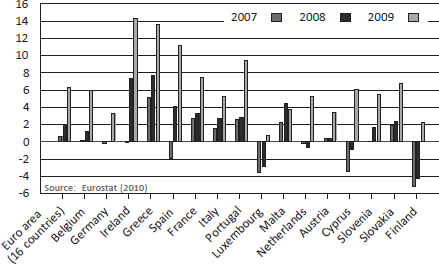
Graph 9: Deficits as a percentage of GDP in Euro area 2007, 2008, and 2009
As a first response, newly elected Prime Minister, Georgios Papandreou, did not increase pensions as promised, but rather increased taxes to reduce the deficit. The interest rates that Greece had to pay on its debts had started to increase in the fall of 2009 and began troubling the markets. German Minister of Finance, Wolfgang Schäuble, stated that Greece had lived beyond its means for years, and that Germans could not pay the price.
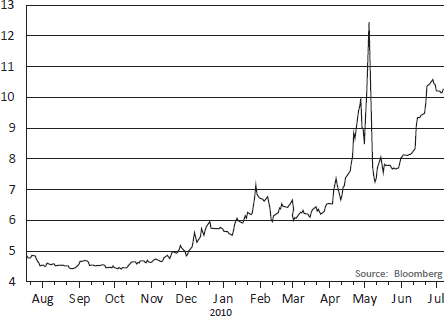
Graph 10: Yield of Greek ten-year bond (August 2009–July 2010)
The market started to have doubts about Greece’s being able to repay its debts. And it was feared that the ECB would stop financing the Greek deficit indirectly. If the ECB would stop accepting Greek bonds as collateral for loans, no one would buy Greek bonds. The government would have to default on its obligations.
The ECB had lowered the required minimum rating for its open market operations from A– to BBB– in response to the financial crisis. The reduction was supposed to be an exception and was to expire at the end of 2010. Due to budgetary problems, Greece was in danger of losing the minimum A– rating. What would happen in 2011 when Greece’s rating would not meet the A– minimum?
On January 12, 2010, the ECB cast doubt on the deficit data provided by the Greek government. Irregularities had made the accuracy of Greek statistics questionable. On January 14, S&P actually cut the long-term rating of Greece to A– and put Spain, Portugal, and Ireland on a negative outlook due to their budgetary problems. On the same day, Greece announced a reduction of its deficit of €10.6 billion. The reduction came from tax increases (€7 billion) and spending cuts (€3.6 billion). The deficit was to be reduced from 12.7 percent to 8.7 percent of the GDP. Papandreou also announced a freeze on salaries for state employees, thereby breaking a promise he had made before his election. The state workers’ union announced strikes on February 10.
On January 15, Jean-Claude Trichet, ECB president, still maintained a hard money rhetoric: “We will not change our collateral framework for the sake of any particular country. Our collateral framework applies to all countries concerned.”1 Market participants interpreted this statement as a pledge that the ECB would not extend the exceptional reduction of the required minimum rating to BBB– just to save the Greek government. Along the same line, chief economist of the ECB, Jürgen Stark, stated in January that markets were wrong in believing that other member states would bail Greece out.
By the end of January, financial markets started selling Greek bonds at a faster pace—after the Deutsche Bank warned that Greece’s default would be more disastrous than the defaults of Argentina in 2001 or Russia in 1998. As the pressure intensified, Papandreou announced additional measures that would, according to an estimate by economists of the bank, HSBC, cut the deficit a further 0.4 percent.2 In addition, Papandreou declared his intention of bringing the Greek deficit back to three percent by 2012. The EU Commission backed his plan. The EU back up was significant: it helped Papandreou internally. Politically, he could shift the blame to the EU and speculators. He could present himself as if he were obliged by the EU to make the unpopular budget cuts. Moreover, he stated that evil speculators had brought this situation upon Greece: “Greece is in the centre of a speculative game aimed at the Euro. It is our national duty to stop the attempts to push our country to the edge of the cliff.”3 Greece, of course, would make sacrifices to save the Euro.
In February of 2010, it became public that the investment bank Goldman Sachs had helped the Greek government mask the true extent of its deficit by using derivatives. The Greek government had never fulfiled the Maastricht rule of sixty percent debt of the GDP, nor had it, starting in 1991, fulfiled the 3% deficit limit. Only balance sheet cosmetics, like leaving out military spending or hospital debts made Greece formally fulfil the limit for a single year. The Goldman Sachs derivatives disguised a loan as a swap. Greece issued bonds in foreign currencies. Goldman sold Greece currency swaps at a fictional exchange rate. Thus Greece received more Euros than the market value of the foreign currencies it had received from the bond sale. Once the bond matured, the Greek government had to pay back the bond with Euros. Goldman Sachs received a generous commission for the deal that concealed the interest rate.4
On February 16, the Economic and Financial Affairs Council (Ecofin), composed of economics and finance ministers of the EU, imposed an adjustment plan on the Greek government in exchange for unspecified support. As the days went by the Greek government became nervous, demanding concrete support by other member states. If no support were offered, Greece would ask the IMF for cheap loans. The engagement of the IMF would have been very embarrassing for the greater Euro project. Would the EMU need the IMF to solve its problems? Confidence in the Euro was further reduced.
On February 24, S&P declared that it might downgrade Greece one or two notches within the month. At this time only Moody’s maintained a rating sufficient to make Greek bonds eligible as collateral under normal conditions.
At the end of February, President Papandreou met with Josef Ackermann, CEO of the Deutsche Bank. Ackermann was interested in solving the Greek problem. The Deutsche Bank owned Greek government debt and a default could bring down the whole European banking system, including the Deutsche Bank. After the meeting, Ackermann proposed to Jens Weidmann, adviser to Angela Merkel, that private banks, Germany and France each lend €7.5 billion to Greece. The proposal was denied. The German government feared a complaint of unconstitutionality. A bailout would violate article 125 of the Treaty on the functioning of the European Union, which states that member states are not responsible for other states’ debts. Most importantly, the German population was against a bailout. Merkel wanted to wait with a solution to the problem until after an important election in the Federal State of North-Rhine Westphalia, which was scheduled for May.
On February 28, Merkel still publicly denied the possibility of a German bailout for Greece: “We have a treaty which rules out the possibility of bailing out other nations.”5 Her ministers, Brüderle and Westerwelle, confirmed this point of view. At the same time, the EU demanded that the Greek government reduce its deficit an extra 4.8 billion Euros. The yield of Greek bonds rose to seven percent.
On March 3, Papandreou agreed to the demanded extra €4.8 billion, or two percent, deficit cuts. He announced higher fuel, tobacco, and sales taxes, as well as a thirty percent cut of the three bonus-salary payments to civil servants. Greek public workers had been better off than their peers in other countries. In Greece, twelve percent of the GDP was paid to public workers in 2009, a figure which was up by two percent from 2000, and two percent higher than the EU’s average. Nevertheless, Greek unions announced new strikes.
In return for the “cuts,” Papandreou demanded “European solidarity,” i.e., money from other states. The Greek “cuts” gave Merkel some of the political capital she needed to sell the bailout to Germans. The situation became more pressing every day: in May, twenty billion of Greek debt would mature, and it was not clear if markets would refinance these debts at acceptable rates.
On March 5 and 7, Papandreou met with Sarkozy and Merkel to rally their support. At the same time, fears were rising that revenues from the Greek tax increases might remain short of projections. S&P dropped its negative outlook of the Greek rating as it became clearer that the EU would finally intervene in favor of the Greek government. To forestall market panics in the future, Axel Weber, a member of the governing council of the ECB, called for an institutionalization of emergency aid.
On March 15, finance ministers from the Euro states met to discuss a possible bailout of the Greek government. Nothing new resulted. Ministers only reiterated that Greek cuts were sufficient to fulfil the 2010 projected aim. Three days later, Merkel confirmed that any bailout plan would have to incorporate a provision for expulsion of states that did not comply with the rules. And she repeated that investors should not expect a Greek aid pact. At the same time, Zapatero and Sarkozy demanded an economic government for the EU.
On March 25, the ECB and EMU nations acted together for the first time: Trichet, in contrast to his January statement, announced that emergency collateral rules would be extended through 2011. Greek bonds regained the potential to serve as collateral. On the same day, EU nations agreed, in cooperation with the IMF, on a bailout for Greece. Germany had demanded IMF involvement. No details of the bailout were made concrete and markets were left in the dark. While the German population was against a bailout, its political class made similar arguments to those it used when arguing in favor of the introduction of the Euro. According to Daniel Hannan, a British member of the European parliament, one German politician had stated that World War II might start again were Greece not bailed out.6
On April 11, two days after Fitch had downgraded Greece to BBB–, the interest rate of Greek bonds rose to eight percent. Finally, the German government agreed to subsidize €30 billion EMU loans to Greece, with an additional €15 billion coming from the IMF. Markets plunged. Resistance to budget cuts in Greece increased.
Civil servants went on strike on April 22. On the same day, the EU announced that the Greek deficit in 2009 was even higher than previously reported. Instead of 12.7 percent, it was 13.6 percent with total debts at 115 percent of the GDP. In response, Moody’s cut Greece’s rating one notch, to A3. Papandreou maintained that the data revision would not affect his plan to reduce the deficit in 2010 to 8.7 percent. Greek, Spanish and Portuguese bonds fell.
The next day, the Greek government was forced to activate the bailout package of €45 billion, the details of which had been worked out in the two days prior. The Greek government got access to €30 billion from Euro-nations in a three year facility at 5 percent, and €15 billion from the IMF at lower rates. Greece had to have access to the facility; on May 19, €8.5 billion came due, and markets would probably not refinance.
On April 27, the National Bank of Greece SA, the country’s largest lender, and EFG Eurobank Ergasias were downgraded to junk status by S&P. On the same day, Greece’s country rating was downgraded to junk status. S&P also downgraded Portugal from A+ to A–. One day later, S&P downgraded Spain from AA+ to AA.
Things accelerated at the beginning of May. It was obvious that the €45 billion bailout of Greece would not be sufficient to avert its default. On May 2, Euro-region ministers agreed to an even greater bailout of loans totaling €110 billion at a rate of around five percent. The second rescue package was supposed to bring the country through the next three years. In line with the capital in the ECB, 27.92 percent of the loans would come from Germany.
| Country | Percentage of bailout |
| Germany | 27.92 |
| France | 20.97 |
| Italy | 18.42 |
| Spain | 12.24 |
| Netherlands | 5.88 |
| Belgium | 3.58 |
| Austria | 2.86 |
| Portugal | 2.58 |
| Finland | 1.85 |
| Ireland | 1.64 |
| Slovakia | 1.02 |
| Slovenia | 0.48 |
| Luxembourg | 0.26 |
| Cyprus | 0.20 |
| Malta | 0.09 |
Table 1: Percentage of bailout per country
Source: ECB 2010
Merkel agreed to the bailout despite the impending election. In return, the Greek government agreed to cut public wages and pensions again and to raise the sales tax to twenty-three percent. Fears began to spread that Spain would need a bailout as well.
A second collaboration between the EMU ministers and the ECB occurred on the same day. The independence of the ECB began evaporating when it announced it would drop all rating requirements for Greek government bonds. The ECB would accept Greek bonds as collateral no matter what. By contradicting its previous approach and becoming an executor of politics, the ECB lost a lot of credibility. The ECB presented itself more and more as the inflationary machine—in service of high politics—that had been intended by French and other Latin politicians. The European stock index, Eurostoxx 50, surged ten percent immediately.
On May 4, the Greek government created a fund to support its tumbling banking system. The word was that Spain was facing an imminent downgrade, but the rumor was denied by Spanish President, José Luis Rodriguez Zapatero. European stock markets plunged. Athens fell 6.7 percent, Madrid 5.4 percent. The following day, Moody’s cut Portugal’s rating two notches to A–. Demonstrators set fire to a bank in Athens, causing the death of three. Financial markets were shocked.
By May 6, Trichet still resisted pressure to buy government bonds of troubled European governments outright. Axel Weber also spoke out against that option. The Dow Jones crashed 1,000 points in a few minutes and recovered half of its losses by the end of the day. The Euro followed suit.
The next day the Eurosystem was on the verge of collapse. Yields on Spanish, Greek, and Portuguese bonds increased sharply. Observers maintain that trading in European bonds came to a hold almost completely in the afternoon. Not even French bonds were liquid.7 In the monthly report of the ECB for June 2010, the central bank admitted the threat of a total collapse on May 6 and 7. The ECB stated that the danger had been greater than after the collapse of Lehman Brothers in September 2008. It admitted a dramatic rise in the bankruptcy probability of two or more major European banking groups.8 Apparently banks that had invested in Mediterranean sovereign debts had severe problems with refinancing. Money markets dried up.
According to the newspaper Welt am Sonntag, German bankers received panic calls from French colleagues asking them to pressure the ECB to buy Greek government bonds.9 Even President Obama called Chancellor Merkel when money flows from the U.S. to Europe dried up. May 7 was a Friday. Politicians and central bankers were able to regroup over the weekend and prevent a total collapse.
On the same day (but ignored by markets), the German parliament passed a law permitting loans in favor of the Greek government. On the weekend, the German Federal Constitutional Court dismissed a claim brought forward by four German professors, the same four who had taken action against the introduction of the Euro (Karl Albrecht Schachtschneider, Wilhelm Hankel, Wilhelm Nölling, and Joachim Starbatty). They argued that the bailout would breach article 125 of the Treaty on the Functioning of the EU, which states that no country is responsible for the debt of other member states.
On Sunday, the coalition forming the German government lost dramatically in the election in the federal state North-Rhine Westphalia. Merkel had wanted to delay the bailout of Greece until after the election. But after the acceleration of events she sacrificed the victory in order to save the Euro. She cancelled her appearances on the campaign to fly to Brussels, where the European Council finance ministers were meeting.
Sarkozy and Berlusconi also found it necessary to attend the meeting of the finance ministers. They maintained that a new rescue fund to bail out more countries would be necessary. Merkel regarded this as a step into a transfer union. The EU Commission would gain power and the Southern states would benefit from subsidized loans from richer nations. She resisted in the beginning. In a dinner on Friday evening, Trichet explained the gloomy severity of the situation.
Merkel succeeded in delaying the final decision until the Sunday after the election. Tellingly, on May 8 she was in Moscow to celebrate 65 years of German defeat against the Soviet Union. Negotiations began again on Sunday afternoon. Trichet attended again, even though he was the President of a supposedly independent ECB. German officials called him an attachment of the French ministry of Finance. The German minister of Finance, Wolfgang Schäuble, did not attend, as he had been taken to a hospital. (The official explanation was an allergic reaction to a drug.) Negotiations were difficult. Even Obama and Bernanke intervened and called Merkel demanding a massive rescue package.
Politicians from Finland, Austria, and the Netherlands took Germany’s side in the negotiations. Interests were clear. Governments with high deficits and spending were rebelling against states with lower deficits and hard money governments that were their potential creditors.
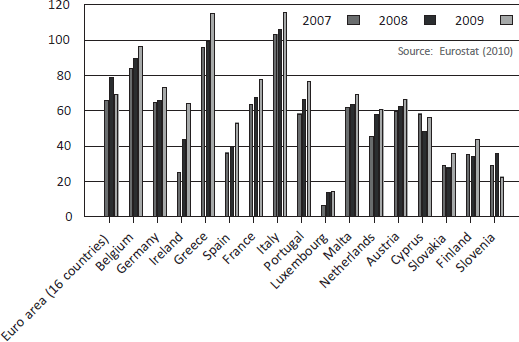
Graph 11: Debts as a percentage of GDP in Euro area 2007, 2008
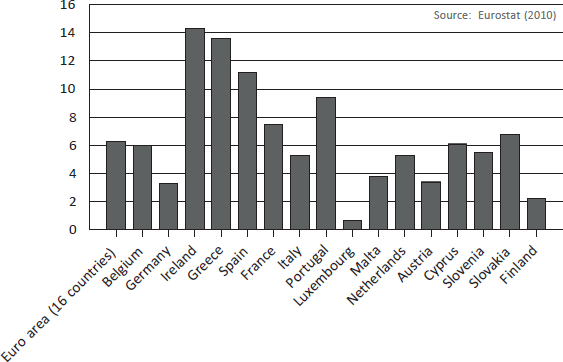
Graph 12: Deficits as a percentage of GDP in Euro area 2009
While Greece was relatively unimportant due to its small size, larger debtors had gotten into severe trouble in May. Banks headquartered in the Eurozone had €144 billion exposure to Greece, but €507 billion to Spain. The new rescue package was instituted in order to prevent a default of Portuguese and Spanish debtors that would have affected German and especially French banks adversely. The French government, however, had more interest in the bailout than the German government.
The direct exposure of French banks to government debts of Portugal, Ireland, Greece and Spain was higher than the exposure of German banks as can be seen in Table 2.
| French banks | German banks | |
| Spain | €33 billion | €23 billion |
| Greece | €22 billion | €16 billion |
| Portugal | €15 billion | €7 billion |
| Ireland | €4 billion | €0.7 billion |
Table 2: Exposure to government debt of French and German banks (as of December 31, 2009)
The total debt that French banks held for Portugal, Ireland, Greece, and Spain at the end of 2009, public and private, was €344 billion. German banks held almost as much: €324 billion. Spain’s share was the majority, with €173 billion in the case of French banks, and €141 billion in the case of German banks. Defaults of Spanish banks or the Spanish government would have had adverse effects on German and French banks. A default of Portuguese banks or its government could, in turn, take down Spanish banks that held €77 billion in Portuguese debt.10
The final agreement, the so-called “emergency parachute,” provided loans of up to €750 billion for troubled governments. The EU Commission provided €60 billion for the package. Once these funds were exhausted, countries could get loans guaranteed by the member states of up to €440 billion. Member states would guarantee loans based on their capital in the ECB. Germany would guarantee up to €123 billion. The IMF also provided loans of up to €250 billion.
In exchange for these guarantees, the socialist governments of Spain and Portugal accepted deficit cuts. The Spanish government announced a cut in civil servant salaries and delayed an increase in pensions. The Portuguese government announced a cut in wages for top government officials and a plan to increase taxes. Presumably pressured by the German government, Italy and even France would announce deficit cuts later in May. The European Commission assessed these cuts and declared them to be steps into the right direction.
As the Spanish newspaper, El País, claimed, Sarkozy had threatened to break the German-French alliance if Merkel would not cooperate with a “parachute” that favored French banks with the biggest part of Mediterranean debt, or to abandon the Euro all together. The French exit from the Eurozone if Germany would not pay, may well be called as one of the greatest bluffs in history.
Merkel herself stated that: “If the Euro fails, the idea of European integration fails.”11 Her argument is a non sequitur. Naturally, one can have open borders, free trade and an integrated Europe without a common central bank. Here Merkel showed herself to be a defender of the socialist version of Europe.
With the new “parachute,” the Eurozone had made it apparent that it was a transfer union. Before the “parachute,” redistribution had been concealed by the complex monetary mechanisms of the Eurosystem. Now outright fiscal support from one country to the other was made more obvious. German taxpayers were suddenly guaranteeing for around €148 billion or more than 60 percent of government revenues. As so often after World War I Germans had to tribute but did not have a say.12
Over the course of these important days, European central bankers cooperated with politicians. Before markets reopened on Monday, May 10, the ECB announced that it would purchase government bonds on the market, thereby crossing a line many thought it would never cross. The decision to buy government bonds was not unanimous. Bundesbankers Axel Weber and Jürgen Stark resisted the decision and were supported by Nout Wellink, President of De Nederlandsche Bank, the traditional ally of the Bundesbank. Trichet, despite his denial the previous week, maintained that the ECB had not been pressured and remained independent. The ECB claimed its measure would not be inflationary; the bank would sterilize the increase in the monetary base by accepting term deposits by banks. The ECB would thereby behave as a typical bank does, by borrowing short and lending long. For private banks this behavior is quite risky as the short term debt must be rolled over.13 For the ECB this risk consists in a failure to attract sufficient deposits which would result in inflationary monetary expansion. Of course, the ECB could attempt to attract deposits by raising rates but then the higher interest rates would pose problems for indebted governments and companies alike. The magazine Spiegel commented later in May on further irritation on the part of Bundesbankers.14 Because of the €750 billion parachute, some Bundesbankers did not see any reason for the purchase of government bonds on the part of the ECB (€40 billion up to this point). They suspected a conspiracy. German banks had promised German finance minister Wolfgang Schäuble that they would hold on to Greek bonds until 2013. French banks and insurances companies, having €70–€80 billion in Greek bonds on their books, were exploiting the occasion to sell Greek, Spanish and Portuguese government bonds as Trichet sustained bond prices via central bank purchases.
The result of the coordinated action of the government of the EMU and the ECB was a de facto coup d’état. The principles of the economic and monetary union as originally established were abolished. A new institution with the name European Financial Stability Facility (EFSF), headquartered in Luxembourg, was granted the possibility of selling debt to bail out member states. The new institution could operate independently. Member states would only be involved in that they would guarantee the debt issued by the EFSF. With its own bureaucracy, the EFSF will probably increase its power in a push for further centralization. The EFSF provokes and provides incentives toward over-indebtedness and the bailouts it was instituted to alleviate.
Moreover, if the EFSF wants to issue more than the agreed upon amount of debt, it needs only the approval of the finance ministers of the Eurozone. The increase in power does not have to pass in parliament. The enabling act of May 9 changed the institutional structure of the EMU forever. A union of stability as imagined by Northern states was substituted by an open transfer union.
As a consequence of both the fiscal and monetary interventions in favor of troubled debtor governments, stock markets around the world rallied. The Eurostoxx 50 climbed 10.4 percent. Spanish, Greek, Portuguese, and Italian bonds climbed while German bonds fell; the German government had effectively guaranteed the debts of Latin countries.
In the weeks that followed, European leaders tried to revamp the Stability and Growth Pact. The SGP provided for fines of as much as 0.5 percent of the GDP if countries did not get their budgets back into compliance with the three percent ceiling. Yet despite several infringements, no country had been fined during the Euro’s eleven year lifespan. After failing to stay within the limit for three years in a row, the governments of Germany and France had teamed up in 2005 to dilute the rules.
Now new penalties were being discussed: sanctions and cutting off EU development-aid funds for exceeding the three percent deficit mark. In June, Merkel proposed also a removal of voting rights as a penalty for infringements, but she was not able to push her proposal through. Another initiative that failed was a proposal made by the EU Commission for more coordination of budgetary plans before they were voted on by national parliaments. Germany, France and Spain objected to this plan as it would reduce their sovereignty.
After the apparent tranquilization of markets, Spain lost its AAA credit grade at Fitch Ratings on May 28. In June, Greece accelerated the privatization process by selling stakes in public companies. Insurance for sovereign debts increased even for Germany, which announced its own measures to reduce its deficits of €80 billion by 2014.
Meanwhile the problems of the banking system grew. The price of government bonds had been falling. Banks were in a dilemma. Selling government bonds would have revealed losses and reduced confidence in governments. The banking system and the government sector were more connected than ever. Defaults in any one of them could cause defaults in the other. If Greece defaulted on its obligations, banks holding Greek government bonds might become insolvent. These insolvent banks could trigger the collapse of other banks or prompt a bailout of their respective governments, pushing their respective governments toward default as well. If, however, banks suffered losses and went bankrupt, they would probably prompt the intervention of their governments to save the national banking system. This bailout would imply more government debt, an acceleration of the sovereign debt crisis, and possibly debt’s being pushed beyond a sustainable level. A panic in sovereign debt markets and government default could be the consequence.
In June, Spain moved into the market’s spotlight. A partial Greek default or debt restructuring was already assumed and discounted by markets. A Spanish default, however, would be a bigger problem. Bad news turned up. Spanish banks, especially the smaller Cajas, could not refinance themselves any more at the interbank market, but were kept afloat by loans from the ECB alone. Their dependence on ECB lending had increased to a record €86 billion in May. Rumors spread that the Spanish government was about to tap the bailout facility. This was promptly denied by Spanish authorities.
On June 14, Moody’s downgraded Greek government bonds to junk status. Greek banks were losing not only credit lines from other banks but also their own deposit base, which had shrunk seven percent in one year as Greeks shifted their funds outside its banking system. Greek banks were taking €85 billion in loans from the ECB, pledging mostly Greek government bonds as collateral.15 At the same time, the ECB kept buying government bonds which already totaled €47 billion.
Things calmed down somewhat in July; there was also some bad news. The Greek government cancelled the scheduled issuance of twelve month government bonds, relying on short maturities (twenty-six weeks) and rescue funds. Strikes in the country did not end, harming the tourism industry. On July 13, Moody’s lowered Portugal’s credit rating by two notches: to A1. But good news prevailed. The announcement of a stress test of European banks calmed markets in the expectation of transparency and the solution of the bank problems. The ECB kept buying government bonds and expressed concern over insufficient savings measures of deficit countries. Spain managed to refinance important amounts on the market. The Greek government voted for moving the retirement age to sixty-five years. Slovakia, the last country resisting the €750 billion parachute, finally approved the plan.
A diagram of the Euro exchange rate maps out our story.
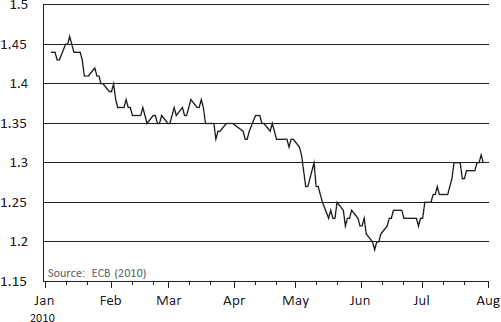
Graph 13: Euro/dollar (January–August 2010)
At the same time, the depreciation of the Euro is an illustration of the importance of the quality of a currency.16 The quantity of the Euro did not change dramatically in relation to the dollar in these months. But its quality deteriorated substantially.
The quality of a currency is its capacity to fulfil the basic functions of money, i.e., to serve as a good medium of exchange, a store of value, and a unit of account. Important factors of the quality of a currency are the institutional setup of the central bank, and its staff and its assets, among others. The assets of a central bank are important because they back up its liabilities, i.e., the currency, and can be used to defend the currency internally, externally, or in a monetary reform.17
During the first half of 2010, the capacity of the Euro to serve as a store of value became more and more dubious. In fact, it was not clear if the Euro would survive the sovereign debt crisis at all. Confidence in the Euro’s capacity to serve as a store of value was shaken. The credibility of the ECB in particular was reduced substantially. Trichet had denied that special collateral rules would be applied to certain countries, or that the ECB would buy outright government bonds. In both cases he had broken his word. This changed the perception of the ECB dramatically.
At the Euro’s birth, the question was if the Euro would be a Germanic-Euro or a Latin-Euro. Would the ECB operate in the tradition of the Bundesbank or of the central banks of Mediterranean Europe? The events of spring 2010 pointed ever more to the second option. The ECB was not primarily focused on the stability of the value of the Euro and resistant to political interests, but rather a loyal servant to politics in a transfer union. The monetary union had become a transfer union where monetary policy backed a transfer of wealth within Europe.
Not only did Trichet’s breaking his word diminish the quality of the Euro, but he crossed the Rubicon in the eyes of many by buying government bonds outright (even though, economically, there is not a substantial difference in accepting government bonds as collateral for lending operations).
Another factor weighing on the quality of the Euro was that the voices of former Bundesbankers lost influence in the council of the ECB. Latin bankers dominated. Axel Weber of Germany protested the decision of the ECB to buy government bonds, but to no avail.
Besides the change of the perception of the ECB toward a more inflationary central bank, another factor affected the quality of the Euro negatively: qualitative easing.18 Qualitative easing describes a monetary policy used by central banks that leads to a reduction of the average quality of the assets backing the monetary base (or the CB’s liabilities). By buying government bonds of troubled countries, the average quality of assets backing the Euro was diminished.
It makes a difference if for €1000 issued by the ECB, it holds on its asset side €1000 worth of gold, €1000 worth of German government bonds, or €1000 Euro worth of Greek government bonds. These assets are of different quality and liquidity, affecting the quality of the Euro.
In the end, the ECB’s balance sheet accumulated more and more problematic government bonds that the ECB had bought from the banking system. The ECB used qualitative easing to prop up the banking system by absorbing its bad assets and the quality of the Euro was reduced. A default of Greece or other countries would consequently imply important losses for the ECB. These would further diminish confidence in the Euro and could make recapitalization necessary.19
At the same time, the economic condition of governments and the quality of their bonds used as collateral for lending operations deteriorated. If a bank were to default on its loans, the ECB would be left with collateral that was falling in value and quality. The Euro only stabilized in July when the Spanish government saw that it would be able to refinance itself on the markets, German industry published excellent results, and the US recovery was slower than had been expected.
Further help was provided by a stress test of the European banking system. Via simulation, the test analysed how European banks would resist a partial sovereign default. Unrealistic assumptions were chosen to provide the desired outcome: the majority of banks passed the test—an important marketing coup. The stress tests only addressed the banks’ trading book positions. The assumption was made that the bonds would not default, and hence there was no need to consider any impact on the hold-to-maturity books of the banks. In addition, the tests assumed very low losses, such as a mere 23% discount for Greek bonds. Moreover, it did not take into account the interconnectivity of events. If Greece would default this could trigger a default of Portugal and then Spain and so on. The assumption that the discount could be contained to 23% on Greek bonds was highly unrealistic. Furthermore, the stress test did not take into account eventually losses from the default of financial institutions or losses suffered in other asset classes such as mortgages. Last but not least, the test was only about solvency but not about liquidity. If some banks have mismatched maturities, i.e. they have borrowed short and lend long, they have to refinance their short term debts. If there are not enough savings available or no one is willing to refinance, illiquidity is the result. The illiquidity may then trigger solvency problems. The degree of maturity mismatch and the danger of illiquidity were, however, not considered in the tests. Thus, the assumptions were very restricted and seem to be chosen to get the desired result: all banks are sound except those that everyone knew before that they are unsound. Curiously, the Irish banks that a few months later were bailed out by the Irish governments passed the test. Yet, for the moment, a total collapse of the system was averted and the Euro recovered some of its losses during the summer.
IRELAND
The sovereign debt crisis returned with full swing after summer vacations. On August 25 Ireland was downgraded by S&P to AA– which was still one level better than Italy. S&P expected Ireland’s debt to rise to 113 percent of GDP in 2012. The estimate for the recapitalization of the banking system was raised from €35 billion to €59 billion. In September, the pressure on the yields of peripheral countries continued to intensify in response to the problems of the Anglo Irish Bank and the costs its recapitalization implied for the Irish government.
Around the same time plans of the German government were published that aimed at strengthening the sanctions of the SGP. Schäuble suggested to withhold EU infrastructure subsidies from countries violating the SGP and to reduce their voting rights. The Spanish government protested against such a reform. The struggle between fiscally more responsible and less responsible government continued.
The European banking system was close to collapse again in mid September 2010 as investors feared that Ireland could not stem the recapitalization of its banking sector. On September 17 the cost of insuring Irish debt rose to record levels and the Irish stock market plunged. The panic was contained only when the ECB bought Irish bonds signaling that it was willing to support the Irish government in the same way it did with Greece and other peripheral governments. In contrast to the spring panic, the crisis was contained because markets knew that the ECB stood there to buy up all bonds necessary and was accompanied by a €750 billion rescue fund.
With peripheral bonds on its balance sheet, the ECB continued to lose its independence. The ECB must help to prevent losses in these bonds through further support to these countries. The ECB becomes hostage of irresponsible politicians to pay their bill. As a consequence to impending losses resulting from its bond purchases, in December 2010 the ECB got a €5 billion capital boost. The increase in capital reduced the profits paid out to the EMU governments.
After pressures had calmed down following the bond purchases of the ECB, a summit in Brussels on October 29 showed again the power of the German government resulting from underwriting the debts of peripheral governments. The rescue fund had a limited term of three years. At the end of October, German chancellor Angela Merkel made it clear that the term would be extended only if there was a reform which would make private holders of government debt participate in the costs of future sovereign bailouts. In other words, Germany threatened to take away part of the explicit bailout guarantee it gave to private investors in government debts. Investors could suffer losses in bailouts after 2013. As a consequence of this move, investors started selling government bonds of PIIGS countries. Yields increased.
The market’s attention focused on Ireland again. The Irish government had an estimated deficit of an unbelievable 32.5 percent of GDP for 2010 and its total government debt stood at 80 percent of GDP after repeated spending to prop up its insolvent banking system.
While the deficit is huge, the Irish problems are somewhat different than the fiscal problems of other PIIGS governments. Other PIIGS governments suffer from high and structural public deficits due to unsustainable welfare spending and uncompetitive factor markets. Governments, most prominently the Greek one, used deficit spending to artificially increase the living standards of their populations. Deficits financed the unemployed, public employees, and pensioners; this served to sustain inflexible labor markets.
In Ireland the problems were somewhat different. While Ireland also had an important and costly welfare state, in some sense Ireland was even too competitive. Ireland has the lowest corporate tax rate in the Economic and Monetary Union (at 12.5 percent). The tax rate attracted banks from all over the world to expand their businesses on the island. As a consequence, Ireland’s banking sector expanded substantially. During the boom years, banks earned immense profits through their privilege of credit expansion and their implicit government backing. As a result of the credit expansion, an Irish housing bubble developed. And its burst caused substantial losses and even insolvency for Irish banks.
While banking profits during the boom were private, its losses were socialized on September 30, 2008, when the Irish government guaranteed all Irish bank liabilities. As of late 2010, Ireland had injected about €50 billion into its banking system. The Irish problems were created, not only by an excessive welfare system, but also by the socialization of the losses of a privileged banking system.
The Irish bailout costs €85 billion at a subsidized 5.8 percent interest rate. Part of it could be used to set up a fund for the Irish banking system. The bailout made ordinary taxpayers responsible for loans that serve to cover bank losses, and the Irish population largely opposed it. The Irish understood that the bailout money will mainly serve, not to sustain the living standards of public employees, the unemployed, or pensioners (as in the Greek case), but rather to sustain the living standards of bankers.
Due to the opposition, the Irish government decided not to have general elections before the budget was passed. The budget included an increase of the sales tax from 21 percent to 23 percent. Effectively, the Irish population was forced to assume the debts of banks and then pay them back over the years. No democratic vote on the bailout was allowed because the Irish would most certainly vote it down.
Why did the Eurozone governments pressure Ireland to ask for the bailout?
First, yields on bonds of PIIGS countries were rising. After the announcement of Merkel’s reform plans, market participants started to fear that they would suffer losses from PIIGS bonds. Eurozone governments believed that by bailing out Ireland and showing determination they would take pressure of Portugal. Portugal—with structural problems similar to those of Greece—is important because Spanish banks have invested important sums in Portugal. If Portugal were to fall, the Spanish banking system would fall along with it. At this point, the rescue fund would have been empty and the situation uncontrollable. In order to stop this chain reaction, Ireland was pressured to accept the bailout.
Second, it was important to bail out Irish banks because English, French, and German banks had invested important sums in Ireland. Irish losses could eat up the capital of European banks and bring down the whole European banking system and its government allies.
But how could the Irish government be “convinced” to accept a bailout even though the Irish population was strongly opposed to it? Why would the Irish government ask for a bailout even though it claimed to be funded until well into 2011? There were two instruments to pressure the Irish government.
The first is the financing that Irish banks receive from the European Central Bank (ECB). Since the financial crisis, Irish banks have depended on loans from the ECB. Without these loans, the Irish banks would go bankrupt, implying tremendous losses for the Irish government, which guaranteed its banks’ loans. Indeed, Trichet mentioned during the days in which the Irish government was still resisting a bailout that the ECB was not willing to extend the emergency loans to Irish banks forever. The second instrument was Germany’s threat of withdrawing from its guarantees. Once Germany takes away its guarantees for overindebted governments in the Eurozone, these governments are sure to fail due to soaring interest rates. Thus Germany can pressure peripheral countries to make reforms or accept bailouts.
The Irish bailout failed to stop the chain reaction. Portuguese and Spanish yields continued to climb. When someone gets bailed out, someone has to pay for it. Governments of the Eurozone have to pay higher interest rates for their own debts due to the additional burden caused by the loans to Ireland. Indeed, the yields of even German government bonds increased after the bailout.
The Irish bailout fastened the trend toward the centralization of power in the European Union. European politicians already indirectly determine the Irish budget. For instance, they repeatedly told the Irish government to increase taxes, such as the sales tax.
They also put tremendous pressure on the Irish government to abandon its policy of a low corporate-tax rate, a policy that many European politicians regard as “fiscal dumping.” Here, at last, the Irish government resisted.
AXEL WEBER
The two most important events of winter and spring 2011 were Merkel’s idea for a Pact for Competitiveness in exchange for an extension of the rescue fund and Axel Weber’s resigning as a candidate for the President of the ECB. In February, Axel Weber announced that he was to step down as President of the Bundesbank on April 30 which would rule him out as the next President of the ECB. Many people had considered the conservative Bundesbanker Weber as the next choice for the ECB’s presidency and put much hope in him. Why did he step down? Weber had criticized the politics of the ECB several times. Starting with his critique of the ECB’s quantitative easing by buying covered bonds, he repeatedly had criticized the purchase of government bonds to prop up insolvent governments. Weber had always pushed for a more restrictive monetary policy without finding a majority for his opinion. He had not been supported strongly as a candidate by Merkel who wanted political concessions from Sarkozy, a strong opponent of Weber.
The most likely explanation for Weber’s exit is that he feared inflation and did not want to be responsible for gigantic bailouts and high inflation. Weber himself spoke of “lacking acceptance” of his anti-inflationary views as a reason for his exit. Possibly Weber was even pressured to resign. The Council of the European Union (the Council of Ministers) decides with a qualified majority on the next president of the ECB. France and Italy can prevent with their votes any candidate. Thus, it is possible that Weber was convinced to resign “voluntarily” to prevent an éclat.20
European monetary policy is no longer made by the Bundesbank. Followers of this tradition are simply outvoted. Thus, the German ex-finance minister Peer Steinbrück said that he did not want to become President of the ECB when he was proposed as a candidate. His explanation was revealing. He stated that he would be in the minority as he had similar policy views as Weber.
THE PACT FOR COMPETITIVENESS AND THE EXTENSION OF THE RESCUE FUND
The Pact for Competitiveness (later renamed into Europlus pact) may stand symbolic for the epic failure of Merkel’s bargaining. The events of May 2010 installed a €750 billion rescue fund with Germany and other solvent countries underwriting it. Yet, the rescue fund was limited for three years, meaning that in 2013 Germany would not have to bailout peripheral governments; an important ace in the hole.
Merkel used the ace to demand automatic sanctions in a reformed SGP, the loss of voting rights for countries violating the SGP and losses for private investors in restructurings of public debts. She and her government opposed an extension of the bailout fund as well as Eurobonds proposed by the President of Luxembourg Jean-Claude Juncker, as well as Italian, Portuguese and Greek politicians. On October 27 2010 Merkel still had pronounced the following about the rescue fund: “It [the fund] ends 2013. This is what we wanted and enacted. There cannot be and will not be a simple extension of the fund, because it does not serve as a long term instrument, because it sends to markets and member governments wrong signals and causes dangerous expectations. It causes the expectation that Germany and other member states and thereby also taxpayers of these countries in the case of a crisis will somehow fill in and could assume the risk of investors.”21
Curiously, and despite Merkel’s position, on December 16, the European Council agreed on a permanent rescue fund. This was a great defeat for the German position, who always insisted and maintained that it would only be until 2013.
As an exchange for the extension of the rescue fund Merkel insisted on a “pact for competitiveness.” Her initial proposal included fiscal harmonization (with a range for tax rates), harmonization of retirement age (70) and wages settings (eliminating inflation-indexed wages), limits for debts and deficits, a debt brake (similar to the German one), ex-ante budget control by Brussels, and sanctions for countries that does not fulfil these rules. While some steps go in the right direction, like the reduction of public pensions, no inflation indexed wages and deficit controls, the plan establishes a dangerous centralization. Sarkozy supported Merkel as her plan was a step toward the economic government that the French government had always wanted. Moreover, in the smaller Euro group as opposed to the EU 27, France and its allies had more weight against Germany. Trichet regarded a United States of Europe as possible, which he saw as “our historical project.”
The events were a total defeat for German taxpayers. Not only did they underwrite a permanent rescue fund, but the French government got also its long desired economic government. Even though in the beginning there may be a strong German influence, in the long term its influence will be reduced, as has been the case of the ECB where Germany gets outvoted. At the same time Merkel gave up her demand for an automatic participation of private investors in bailouts.
In the short run, one may find some positive aspects of the determination of fiscal policies by Brussels or indirectly by Germany. When Germany or Brussels tells Spain, Greece, or Ireland to reduce their deficits or privatize their public pension systems, the result for people living in these countries may be a reduced size of the government in the short run. But such centralization of power in the EU will likely prove to be disastrous for liberty in the long run. One factor that frequently hampers governments’ attempts to increase their power via increases in taxation or regulation is the competition of other governments. If taxes get too high in a country, economic agents will flee to countries with lower tax rates (such as Ireland, with its low corporate tax rate). If economic policy is centralized in the European Union, this limitation on government power is eliminated. European politicians already aim at a harmonization of fiscal policies and talk about benchmarks for tax rates. Once fiscal policies are harmonized, there will be a tendency toward an increase of power in Brussels and then toward an increase of tax rates throughout the Eurozone. The bailouts, the permanent rescue fund, and the economic government may save the Euro in the short run, but at the cost of building a strong, central European state, as national policymaking is transferred to Brussels in exchange for bailouts. The turmoil produced by the Euro will then have served as an instrument for the development of a centralized state in Europe.
On March 11, in an EU summit, the transfer union took further shape. The rescue fund was extended and will allow for primary market purchases of government bonds. Countries like Portugal may issue bonds which are then bought by the rescue fund. The rescue fund issues bonds to finance these purchases; a procedure that amounts to Euro bonds through the back door. Taxpayers from solvent countries purchase the debts of struggling governments. Germany might guarantee for about €200 billion instead for €123 billion before. The EFSF had an amount of €440 billion of which only €250 billion got an AAA rating. The new permanent European Stability Mechanism (ESM) that starts in 2013 will have an effective capacity of €500billion and may purchase bonds directly from governments at their nominal value. The ESM will get €80 billion in cash, €22 billion from Germany. The cash payment imply €600–900 million interest costs for Germany per year. The capital of the ESM is supposed to be €700 billion in order to guarantee the issuance of €500 billion AAA– rated loans. Germany will bear 27.1 percent of the total costs. Hans Werner Sinn estimated the total burden of the bailouts and the rescue fund to be €366 billion for Germany.22
If governments are insolvent, arbitrary distinguished from illiquid, private investors will participate in a haircut and suffer losses. The most probable outcome is that governments will always be considered just to be illiquid and private investors will never suffer losses.
What did Merkel get in return? The Pact for Competitiveness remained vague. Sanctions for violating governments were not mentioned. At least, Merkel maintained a veto for future loans to struggling countries as bailouts must be unanimous, which she tried to sell as a great victory.
The summit brought also a hidden debt restructuring for Greece. It was agreed to lower Greece’s interest rates from 5.2 percent to 4.2 percent. The repayment period of Greek loans was extended to seven and a half years from three years. This implies a partial restructuring and important interest losses for taxpayers from solvent nations. Curiously, the Irish loans at 5.8 percent were not lowered because the new Irish Prime Minister Enda Kenny did not agree to raise corporate taxes in return.
On the next summit on March 24 and 25, the changes from March 11 were finally approved. Even though on March 23 Portuguese President Socrates resigned after his latest austerity package was not approved by the parliament, Portugal still did not want to tap the rescue fund.
PORTUGAL
The collapse of Portuguese public finances were only a matter of time.
In the beginning of January 2011, as pressure mounted, an important Portuguese bonds auction went well. The government paid less than the 7 percent for 10 year bonds deemed unsustainable by several Portuguese parliamentarians.23 Bond purchased of the ECB in the days before supported the auction. The ECB bailed out Portugal. Barclays Capital estimated that the ECB bought €19.5 billion of the €21.7 billion Portuguese bonds sold in 2010. From February 2011 on the bond yield was consistently above 7 percent, rising to 8.5 percent by April. Public debts were at 92 percent of GDP in 2010. The public deficit in 2010 was at 8.6 percent down from 10 percent in 2009. The austerity measures that met strong resistance on the street were only able to lower the deficit by 1.4 percentage points.
Portugal’s case is similar to the Greek one. The economy is uncompetitive, with a huge public sector and inflexible factor markets. The structure of the economy is not aligned with consumer wishes and maintained artificially by government spending.
During the first decade of the twenty-first century, public and private sectors increased their indebtedness. Interest rates were artificially low due to the credit expansion initiated by the Eurosystem and the implicit underwriting of Portuguese debts by Germany. The Iberian country lived beyond its means, increasing its public sector to 50 percent of GDP in 2009 under a huge fiscal pressure. The trade deficit reached 10 percent of GDP.
An artificially high standard of living was made possible by the accumulation of debts at artificially low interest rates. The necessary adjustment of the backward economy was delayed by artificially low credits. Between 2002 and 2007 the Portuguese GDP grew only 6 percent, while Spain grew 22 percent (housing bubble), Ireland 37 percent (banking bubble) and Greece 27 percent (public sector bubble). Portuguese unemployment doubled from 4 percent to 8, percent while the Spanish, Irish or Greek unemployment did not grow or even fell. Tax revenues increased by 35 percent in Portugal, but by 50 percent in Greece and 70 percent in Spain and Ireland.24
While countries such as Germany started structural reforms, reduced public social spending, reduced real wages, Portugal did use cheap credit to delay a reform of its productive model. Other peripheral countries used the cheap credits to build bubbles.
With rising interest rates and rising debts and no serious reforms, the country was going to default sooner or later if it was not bailed out. The Portuguese economy owes €80 billion to Spanish banks. If there is a default of the Portuguese government, many companies depending on the vast public sector will follow suit and be unable to pay their debts to the Spanish banks which in turn triggers a Spanish banking crisis and rising yield for Spanish government bonds. Unsurprisingly, the Portuguese government agreed to a bailout amounting to €78 billion on May 3 2011, after the ECB and the Commission had used similar threats and pressures as they did in the case of Ireland.
Thus, expectations remain grim. The European Union has become a transfer union. Interest rates that most governments have to pay on their debts remain at a high level. Sovereign debt levels are still on the rise. The future will tell us if the situation was sustainable.
_________________
25 See Tobias Bayer, “Hilfen für Hellas: Kehrtwende kratzt an Glaubwürdigkeit der EZB,” Financial Times Deutschland (2010), http://www.ftd.de.
26 See Maria Petrakis and Meera Louis, “EU Backs Greek Deficit Plan: Papandreou Offers Cuts,” Bloomberg (February 3, 2010), http://noir.bloomberg.com.
27 Ibid.
28 See Beat Balzli, “How Goldman Sachs Helped Greece to Mask its True Debt,” Spiegel online (2010), http://www.spiegel.de.
29 See Andreas Illmer, “Merkel Rules Out German Bailout for Greece,” Deutsche Welle (March 1, 2010), http://www.dw-world.de.
30 See Daniel Hannan, “Germans! Stop Being Ripped Off!” Telegraph.co.uk (March 27, 2010), http://blogs.telegraph.co.uk.
31 Telebörse.de, “EZB öffnet Büchse der Pandora,” Dossier (May 10, 2010), http://www.teleboerse.de.
32 See Helga Einecke and Martin Hesse, “Kurz vor der Apokalypse,” Süddeutsche Zeitung (June 16, 2010), http://www.sueddeutsche.de and ECB, Monthly Bulletin: June (2010), http://www.ecb.int, pp. 37–40.
33 Jörg Eigendorf et al., “Chronologie des Scheiterns,” Welt.online (May 16, 2010), http://www.welt.de.
34 See Bank for International Settlements, “International Banking and Financial Markets Development,” BIS Quarterly Report (June, 2010), pp. 18–22.
35 See Spiegel.online, “Deutschland weist Bericht über Sarkozy-Ausraster zurück,” Spiegel.online (May 14, 2010), http://www.spiegel.de.
36 The list of German tributes is long. Only in September 2010 the German government paid the last debts resulting from reparations for World War I. Already before the “parachute,” Germany paid 89 percent more to the EU than it would have to pay considering per capita income. The excess pay amounted to €70 billion in the decade following 1999. See Henkel, Rettet unser Geld!, p. 139.
37 On maturity mismatching, how it is promoted by interventions such as the privilege of fractional reserve banking, central banking and government bailout guarantees, and the resulting distortions in the real economy see Philipp Bagus, “Austrian Business Cycle Theory: Are 100 Percent Reserves Sufficient to Prevent a Business Cycle?” Libertarian Papers, 2 (2, 2010).
38 See Wolfgang Reuter, “German Central Bankers Suspect French Intrigue,” Spiegel.online (May 31, 2010), http://www.spiegel.de.
39 See Ambrose Evans-Pritchard, “Axa Fears ‘Fatal-Flaw’ Will Destroy Eurozone,” Telegraph.co.uk (June 14, 2010), http://www.telegraph.co.uk.
40 Philipp Bagus, “The Fed’s Dilemma,” Mises.org daily (October 8, 2009), http://mises.org.
41 Philipp Bagus and Markus Schiml, “A Cardiograph of the Dollar’s Quality: Qualitative Easing and the Federal Reserve Balance Sheet During the Subprime Crisis,” Prague Economic Papers 19 (3, 2010): pp. 195–217.
42 See Philipp Bagus and Markus Schiml, “New Modes of Monetary Policy: Qualitative Easing by the Fed,” Economic Affairs 29 (2, 2009): pp. 46–49, for more information. For case studies of the balance sheet policies of the FED see Bagus and Schiml, “A Cardiograph of the Dollar’s Quality,” and “New Modes of Monetary Policy”; and for the policies of the ECB, Philipp Bagus and David Howden, “The Federal Reserve and Eurosystem’s Balance Sheet Policies During the Subprime Crisis: A Comparative Analysis,” Romanian Economic and Business Review 4 (3, 2009): pp. 165–185, and Philipp Bagus and David Howden, “Qualitative Easing in Support of a Tumbling Financial System: A Look at the Eurosystem’s Recent Balance Sheet Policies,” Economic Affairs 21 (4, 2009): pp. 283–300.
43 For the recapitalization possibility and possible problems see Bagus and Howden, “The Federal Reserve and Eurosystem’s Balance Sheet Policies,” and “Qualitative Easing in Support of a Tumbling Financial System.”
44 See Roland Vaubel, “Eine andere Interpretation des Weber Rücktritts,” 2011, http://wirtschaftlichefreiheit.de/
45 Quoted in Frank Schäffler, “Europäischer Stabilitätsmechanismus (ESM),” 2011, Schriftliche Erklärung, www.frank-schaeffler.de.
46 Hans Werner Sinn, “Deutschland: Die Lotsen gehen von Board,” 2011, www.mmnews.de.
47 Alexander Liddington-Cox, “THE DAILY CHART: Portugal’s Austerity Impasse,” BusinessSpectator (March 23, 2011), http://www.businessspectator.com.au.
48 See Juan Ramón Rallo, “Portugal: Una decada (mal)viviendo del crédito barato,” juanramonrallo.com (March 23, 2011), http://www.juanramonrallo.com, and Juan Ramón Rallo, “España sí es Portugal,” juanramonrallo.com (March 29, 2011), http://www.juanramonrallo.com.
- 1Roughly a year before starting to purchase government bonds, the ECB started to buy covered bonds issued by German banks. The purchases were progressive and reached €60 billion.
- 2Cash-online, “Forsa: Deutsche überwiegend gegen den Euro-Rettungsschirm.” News from June 7, 2010, http://www.cash-online.de.
- 3Shortnews.de, “Umfrage: Mehr als die Hälfte der Deutschen wollen die DM zurück haben.” News from June 29, 2010, http://shortnews.de.
- 4GRReporter, “The Social Tourism of Bankrupt Greece,” July 12, 2010, http://www.grreporter.info. In the summer of 2010, many Greek entrepreneurs did not want to serve clients participating in the state programme. The Greek government pays its bills six months late, if at all.
- 5D. Hoeren and O. Santen, “Griechenland-Pleite: Warum zahlen wir ihre Luxus-Renten mit Milliarden-Hilfe?” bild-online.de, April 27, 2010, http://bild.de.
- 6The European Communities consisted of the European Coal and Steel Community, creating a common market for coal and steel; the European Economic Community (EEC), advancing economic integration; and the European Atomic Energy Community, creating a specialist market for nuclear power and distributing it through the Community. Yet, even at the very beginning of European integration we can already appreciate the “socialist intentions” of Jean Monnet, the French intellectual father of the European Community. Monnet planned the European Community to be a supra-national rather than an inter-governmental organization [Christopher Booker and Richard North, The Great Deception: Can the European Union Survive? (London: Continuum, 2005)]. For Monnet’s tendency toward central planning see also Tony Judt, Postwar: A History of Europe since 1945 (London: Vintage, 2010, p. 70). The French government feared a German revival after World War II. The EEC assured the French privileged access to German resources (Judt, Postwar, p. 117). The integration of Germany into Europe was thought to prevent a German revolt against the conditions imposed upon it after the war. As Judt, Postwar, p. 156, writes: “[The High Authority of the EEC] above all would take control of the Ruhr and other vital German resources out of purely German hands. It represented a European solution to a—the—French problem.” Despite these political intentions behind the EEC, elements of the classical liberal tradition remained strong in the beginning.
- 7The Council of the European Union, often referred to as the “Council” or “Council of Ministers,” is constituted by one minister of each member state and should not be confused with the European Council. The European Council is composed of the President of the “Council of Ministers,” the President of the Commission, and one representative per member state. The European Council gives direction to the EU by defining the policy agenda.
- 8These important birth defects reduce the credit given to the founding fathers such as Schuman, Adenauer and others.
- 9In 1959, for instance, the British government suggested a free trade zone for all of non-communist Europe. The proposal was rejected by Charles de Gaulle.
- 10Larsson, “National Policy in Disguise,” p. 162. As Larsson writes: “The arena, in which France sought to recreate its honor and international influence was that of Western Europe. As the leading country in the EEC, France regained influence to compensate for the loss of its empire, and within an area where France, traditionally and in different ways, had sought to dominate and influence.” As Judt, Postwar, p. 153 writes: “Unhappy and frustrated at being reduced to the least of the great powers, France had embarked upon a novel vocation as the initiator of a new Europe.” “For Charles de Gaulle, the lesson of the twentieth century was that France could only hope to recover its lost glories by investing in the European project and shaping it into the service of French goals.” (p. 292) Already in 1950 the French premier, René Pleven, proposed to create a European Army as part of a European Defence Community (under the leadership of France). Even though the plan ultimately failed, it provides evidence that from the very beginning, French politicians pushed for centralization and the empire vision of Europe. An exception is French President Charles de Gaulle, who opposed a supranational European state. During the “empty chair crisis” France abandoned its seat in the Council of Ministers for six months in June 1965 in protest against an attack on its sovereignty. The Commission had pushed for a centralization of power. Yet, de Gaulle was also trying to improve the French position and leadership in the negotiations over the Common Agricultural Policy. The Commission had proposed majority voting in this area. French farmers were the main beneficiaries of the subsidies while Germany was the main contributor. Majority voting could have deprived French farmers of their privileges. Only when de Gaulle’s agricultural funding demands were accepted the policy of the empty chair ended. Many Germans including Ludwig Erhard opposed the agricultural subsidies and favored a free trade zone. (See Judt, Postwar, p. 304). Adenauer, however, would never break with France. In exchange for subsidies for French farmers, German goods gained free entry into France. It was agricultural subsidies in exchange for free trade.
- 11Roland Vaubel, “The Political Economy of Centralization and the European Community,” Public Choice 81 (1–2 1994): pp. 151–190, explains the trend toward centralization in Europe with public choice arguments.
- 12Larsson, “National Policy in Disguise,” p. 163.
- 13As Arjen Klamer, “Borders Matter: Why the Euro is a Mistake and Why it will Fail,” in The Price of the Euro, ed. Jonas Ljundberg, (New York: Palgrave MacMillan, 2004), p. 33, writes on the strategy of using the single currency as a vehicle for centralization: “The presumption was that once the monetary union was a fact, a kind of federal construction or at least a closer political union, would have to follow in order to make the monetary union work. Thus, the wagon was put in front of the horse. It was an experiment. No politician dared to face the question of what the consequences would be of failure, or of that would happen if a strong political union did not come about. The train had to go on.”
- 14Frankfurter Allgemeine Zeitung, June 1, 1996. German Foreign Minister Hans-Dietrich Genscher had proposed to absorb the Eastern European countries into the EU as fast as possible. Margaret Thatcher also called for a fast enlargement with the hope that the enlarged EU would turn into a free trade area. Fearing a free trade area and a diminishing influence, the French government opposed the early access of Eastern European countries into the EU. See Judt, Postwar, pp. 716, 719.
- 15Charles Gave, “Was the Demise of the USSR a Negative Event?” in Investors-Insight.com, ed. John Mauldin, (May 5, 2010), http://investorsinsight.com.
- 16Until today, the French government has succeeded in building a disproportionate influence in the EU. Most EU institutions are hosted by France and Belgium and modelled on the French system of governance. French is a working language in the EU, next to English. But not German, even though the Union has far more German-speaking citizens. In the weighted influence of the member states based on their population, France is overrepresented and Germany is underrepresented. In fact, Germany’s weighted influence did not increase at all after reunification. As Larsson (“National Policy in Disguise,” p. 165) writes: “In short, the EU and its predecessors are primarily of French design, which, apart from official declarations, have in many respects served the purpose of using all possible means to enlarge, or at least maintain, French political world influence, particularly in Europe.”
- 17More on the history of the Euro can be found in Chapter 9.
- 18See Roy H. Ginsberg, Demystifying the European Union. The Enduring Logic of Regional Integration (Plymouth, UK: Rowman & Littlefield, 2007), p. 249.
- 19Bandulet, Die letzten Jahre des Euro, p. 97.
- 20Baader, Die Euro-Katastrophe, p. 195.
- 21See Marsh, Der Euro, p. 287.
- 22Thus, Feldstein, “The Political Economy,” p. 38, states: “France recognizes that the institution of the EMU will evolve over time and continually presses for some political body (an ‘economic government’) to exert control over ECB. It has already made significant progress toward that end.” Mitterrrand said literally: “One hears it said that the European Central Bank will be the master of the decisions. It’s not true! Economic policy belongs to the European Council and the application of monetary policy is the task of the [European] Central Bank, in the framework of the decisions of the European Council . . . The people who decide economic policy, of which monetary policy is no more than a means of implementation, are the politicians.” Quoted in Connolly, The Rotten Heart of Europe, p. 142. See also p. 248.
- 23See Stefan Homburg, “Hat die Währungsunion Auswirkungen auf die Finanzpolitik?,” in Franz-Ulrich Willeke, ed., Die Zukunft der D-Mark. Eine Streitschrift zur Europäischen Währungsunion ( München: Olzog, 1997), pp. 93–108.
- 24See Tommaso Padoa-Schioppa, The Euro and its Central Bank (Cambridge: MIT Press, 2004), for more details on the functions and strategies of the ECB.
- 25In reaction to the crisis, the political class has tried desperately to save the socialist project of a common fiat currency for Europe. They have been successful—at least for the time being. After intense negotiations, an unprecedented €750 billion “rescue parachute” has been created to support European governments and banks. At the same time, however, the ECB has started what many had regarded as unthinkable before: the outright purchase of government bonds, an action which undermines its credibility and independence. The public and market perception of the monetary setup of the European Monetary Union (EMU) will never be the same.
- 26Resistance to these unprecedented measures is on the rise, especially in countries with traditionally conservative monetary and budget policies. A poll in Germany showed that fifty-six percent of Germans were against the bailout fund.
- 27It is not surprising that the majority of Germans want to return to the Deutschmark. They seem to understand intuitively that they are at the losing end of a complex system. They see that they are saving and tightening their belts on a regular basis while other countries’ governments embark on wild spending sprees. A prime illustration is the “Tourism for All” programme in Greece: the poor receive government funds toward vacations. Even amid the crisis, the Greek government continues the programme, albeit reducing the number of subsidized vacation nights to two. The Greek government also upholds a more generous public pension system than Germany does. Greek workers get a pension of up to eighty percent of their average wages. German workers get only forty-six percent, a number that will fall to forty-two percent in the future. While Greeks get fourteen pension payments per year, Germans receive twelve.
- 28It is not surprising that the majority of Germans want to return to the Deutschmark. They seem to understand intuitively that they are at the losing end of a complex system. They see that they are saving and tightening their belts on a regular basis while other countries’ governments embark on wild spending sprees. A prime illustration is the “Tourism for All” programme in Greece: the poor receive government funds toward vacations. Even amid the crisis, the Greek government continues the programme, albeit reducing the number of subsidized vacation nights to two. The Greek government also upholds a more generous public pension system than Germany does. Greek workers get a pension of up to eighty percent of their average wages. German workers get only forty-six percent, a number that will fall to forty-two percent in the future. While Greeks get fourteen pension payments per year, Germans receive twelve.
- 29It is not surprising that the majority of Germans want to return to the Deutschmark. They seem to understand intuitively that they are at the losing end of a complex system. They see that they are saving and tightening their belts on a regular basis while other countries’ governments embark on wild spending sprees. A prime illustration is the “Tourism for All” programme in Greece: the poor receive government funds toward vacations. Even amid the crisis, the Greek government continues the programme, albeit reducing the number of subsidized vacation nights to two. The Greek government also upholds a more generous public pension system than Germany does. Greek workers get a pension of up to eighty percent of their average wages. German workers get only forty-six percent, a number that will fall to forty-two percent in the future. While Greeks get fourteen pension payments per year, Germans receive twelve.
- 30The two visions have been struggling with each other since the 1950s. In the beginning, the design for the European Communities adhered more closely to the classical liberal vision. The European Community consisted of sovereign states and guaranteed the four basic liberties. From the point of view of the classical liberals, a main birth defect of the community was the subsidy and intervention in agricultural policy. Also, by construction, the only legislative initiative belongs to the European Commission. Once the Commission has made a proposal for legislation, the Council of the European Union alone, or together with the European Parliament, may approve the proposal. This setup contains the seed of centralization. Consequently, the institutional setup, from the very beginning, was designed to accommodate centralization and dictatorship over minority opinions, as unanimity is not required for all decisions and the areas were unanimity rule is required have been reduced over the years.
- 31The two visions have been struggling with each other since the 1950s. In the beginning, the design for the European Communities adhered more closely to the classical liberal vision. The European Community consisted of sovereign states and guaranteed the four basic liberties. From the point of view of the classical liberals, a main birth defect of the community was the subsidy and intervention in agricultural policy. Also, by construction, the only legislative initiative belongs to the European Commission. Once the Commission has made a proposal for legislation, the Council of the European Union alone, or together with the European Parliament, may approve the proposal. This setup contains the seed of centralization. Consequently, the institutional setup, from the very beginning, was designed to accommodate centralization and dictatorship over minority opinions, as unanimity is not required for all decisions and the areas were unanimity rule is required have been reduced over the years.
- 32The two visions have been struggling with each other since the 1950s. In the beginning, the design for the European Communities adhered more closely to the classical liberal vision. The European Community consisted of sovereign states and guaranteed the four basic liberties. From the point of view of the classical liberals, a main birth defect of the community was the subsidy and intervention in agricultural policy. Also, by construction, the only legislative initiative belongs to the European Commission. Once the Commission has made a proposal for legislation, the Council of the European Union alone, or together with the European Parliament, may approve the proposal. This setup contains the seed of centralization. Consequently, the institutional setup, from the very beginning, was designed to accommodate centralization and dictatorship over minority opinions, as unanimity is not required for all decisions and the areas were unanimity rule is required have been reduced over the years.
- 33The classical liberal model is defended traditionally by Christian democrats and states such as the Netherlands, Germany, and also Great Britain. But social democrats and socialists, usually led by the French government, defend the Empire version of Europe. In fact, in light of its rapid fall in 1940, the years of Nazi occupation, its failures in Indochina, and the loss of its African colonies, the French ruling class used the European Community to regain its influence and pride, and to compensate for the loss of its empire.
- 34The classical liberal model is defended traditionally by Christian democrats and states such as the Netherlands, Germany, and also Great Britain. But social democrats and socialists, usually led by the French government, defend the Empire version of Europe. In fact, in light of its rapid fall in 1940, the years of Nazi occupation, its failures in Indochina, and the loss of its African colonies, the French ruling class used the European Community to regain its influence and pride, and to compensate for the loss of its empire.
- 35Over the years there has been a slow tendency toward the socialist ideal—with increasing budgets for the EU and a new regional policy that effectively redistributes wealth across Europe. Countless regulations and harmonization have pushed in that direction as well.
- 36The influence of the French government was now reduced. The socialist camp saw its defeat coming. A fast enlargement of the EU incorporating the new states in the East had to be prevented. A step toward a central state had to be taken. The single currency was to be the vehicle to achieve this aim. According to the German newspapers, the French government feared that Germany, after its reunification, would create “a DM dominated free trade area from Brest to Brest-Litowsk.” European (French) socialists needed power over the monetary unit urgently.
- 37The influence of the French government was now reduced. The socialist camp saw its defeat coming. A fast enlargement of the EU incorporating the new states in the East had to be prevented. A step toward a central state had to be taken. The single currency was to be the vehicle to achieve this aim. According to the German newspapers, the French government feared that Germany, after its reunification, would create “a DM dominated free trade area from Brest to Brest-Litowsk.” European (French) socialists needed power over the monetary unit urgently.
- 38The influence of the French government was now reduced. The socialist camp saw its defeat coming. A fast enlargement of the EU incorporating the new states in the East had to be prevented. A step toward a central state had to be taken. The single currency was to be the vehicle to achieve this aim. According to the German newspapers, the French government feared that Germany, after its reunification, would create “a DM dominated free trade area from Brest to Brest-Litowsk.” European (French) socialists needed power over the monetary unit urgently.
- 39As Charles Gave argued on the events following the fall of the Berlin wall:
- 40The real reason the German government, traditionally opposed to the socialist vision, finally accepted the Euro, had to do with German reunification. The deal was as follows: France builds its European empire and Germany gets its reunification. It was maintained that Germany would otherwise become too powerful and its sharpest weapon, the Deutschmark, had to be taken away—in other words, disarmament.
- 41The real reason the German government, traditionally opposed to the socialist vision, finally accepted the Euro, had to do with German reunification. The deal was as follows: France builds its European empire and Germany gets its reunification. It was maintained that Germany would otherwise become too powerful and its sharpest weapon, the Deutschmark, had to be taken away—in other words, disarmament.
- 42The Commission of the EU was responsible for monitoring the SGP. But even in the Commission there was no strong backing of the SGP. The Chairman of the European Commission, Romano Prodi, described its provisions as “stupid.” In the case of eventual infringements of the provisions of the pact, the SGP establishes that the Commission is to give recommendations to the Council for Economic and Financial Affairs (EcoFin). EcoFin is comprised of the Economics and Finance Ministers of the EU and must meet once a month. U-pon the recommendation of the Commission, EcoFin decides, with a qualitative majority, if the criteria of the SGP are being fulfiled or not, and is then to issue warnings or announce the existence of excessive deficits. EcoFin offers recommendations to reduce the deficits. If the infringing government does not follow the recommendations and continues to miss the criteria, a majority of two thirds is necessary to establish sanctions. Fines can amount to a half percent of GDP.
- 43In November 2003, EcoFin waived sanctions recommended by the Commission against France and Germany. This triggered a discussion concerning the efficacy of the SGP. The already watered-down SGP met its end on the twentieth of March, 2005. Germany violated the three percent limit on public deficits for the third time in a row in 2005. As a consequence, EcoFin watered down the SGP even more by defining several situations and expenditures that would justify a violation of the three percent limit: natural catastrophes, a falling GDP, recessions, expenditures for innovation and research, public investments, expenditures for international solidarity and European politics, and pension reforms.
- 44Politicians were quite frank about the “independence” of the ECB. François Mitterrand claimed that the ECB would execute the economic decisions of the Council of the European Union. In the conception of French politicians, the Council of the European Union controls the ECB. Fernand Herman, a Belgian member of the European Parliament, demanded that the central bank pursues the ends set by the Council and the Parliament, simultaneously guaranteeing price stability.
- 45From the beginning there were doubts about the independence of the ECB. Its first president, Wim Duisenberg, “voluntarily” stepped down halfway through his term in order to pass the presidency on to his French successor, Jean-Claude Trichet. Before the introduction of the Euro, Trichet, an engineer by training and a statist by mentality had strongly opposed the “independence” of the ECB. From the French government’s point of view, the formal “independence” of the ECB was only the means necessary to get the German government to agree to a monetary union. If necessary, the ECB could be put into the service of politics. In fact, this was the intention of French politicians. Mitterrand announced, before France’s Maastricht referendum, that European monetary policy would not be dictated by the ECB. France imagined the ECB would ultimately be dependent on orders from the political sphere.
- 46From the beginning there were doubts about the independence of the ECB. Its first president, Wim Duisenberg, “voluntarily” stepped down halfway through his term in order to pass the presidency on to his French successor, Jean-Claude Trichet. Before the introduction of the Euro, Trichet, an engineer by training and a statist by mentality had strongly opposed the “independence” of the ECB. From the French government’s point of view, the formal “independence” of the ECB was only the means necessary to get the German government to agree to a monetary union. If necessary, the ECB could be put into the service of politics. In fact, this was the intention of French politicians. Mitterrand announced, before France’s Maastricht referendum, that European monetary policy would not be dictated by the ECB. France imagined the ECB would ultimately be dependent on orders from the political sphere.
- 47An important difference is the accountability of the two institutions. The Bundesbank managed German monetary policy directly. As the German population is very adverse to inflation it was political suicide for politicians to attempt to influence the Bundesbank toward more inflation or to threaten its independence. Higher price inflation would mean that voters punished politicians and withdrew their support for the Bundesbank. It was on the support of the German population that the power of Bundesbankers vis-à-vis politicians was founded. In contrast, if there is price inflation in the Eurozone, both Bundesbankers and German politicians could say that they opposed inflationary monetary measures but that they were just outvoted by their European colleagues. They can blame others for rising prices. And Germans cannot vote the EU Commission out of office since it is not elected by the public.
- 48The difference between the two institutions can be seen in their official functions. The Bundesbankgesetz (Constitution of the Bundesbank, 1957) establishes guaranteeing the security of the currency as the main task of the Bundesbank (Währungssicherheit), i.e., price stability. The task of the ECB is more ambitious. The Treaty of Maastricht states that its primary objective “shall be to maintain price stability.” Yet, “without prejudice of the objective of price stability, the [Eurosystem] shall support the general economic policies in the Community.” This addition is the result of pressure from the French government, which had always wanted direct political control over the printing press. This means that if official price inflation rates are low, the ECB can and actually must print money in order to support economic policies. If price inflation is low and there is unemployment, the ECB must ease its policy stand.

