
The Tragedy of the Euro
6. The Money Monopoly of the ECB
Let us for a moment ponder the sheer power the ECB exerts on the life of the people in the European Monetary Union (EMU). It is a power that no institution would amass in a free society. Even though the immense concentration of power of Soviet times is of the past, the ECB still exerts total control over the monetary sphere; it has the power to create money and to thereby help mould the fate of society.
Imagine you had the power the ECB has. You would be the only person producing money; let us say you could just print it with your PC; or more simply, you could access your bank account online and add any sum to it you want. Everybody would have to accept the money you produce. You would have a power comparable to that of Tolkien’s ring. Would you use this power? The temptation is almost irresistible. You might actually try to use it to do good. But the result of this setup would be a permanent flow of goods and services to you, your family, and friends, in exchange for the newly produced money. This would lead to a tendency for prices to increase. If you wanted to buy a BMW, you would produce new money. Then you would have to overbid the person that would have bought it had you not produced additional money. Prices are bid up. Now you get the BMW and this other person does not. The dealer may now use the additional money and buy a coat for his wife, bidding up prices of coats. The coat producer’s income is higher and he starts spending. Gradually, the new money extends through the economy, increasing prices and changing the stream of goods and services toward the first receivers of the new money.
While the use of the power of the printing press is virtually irresistible, you have to be careful not to overdo it—for several reasons.
People might start to resist the scheme and try to destroy your power. When they see that you just have to print money and you get richer and they get poorer, they may revolt. Before it gets to this point you may want to restrict your money production. But there are other means of diluting this source of unrest and resistance. You could develop a strategy that conceals the money creation and creates diversions. You may transfer the new funds through several steps in an intricate system whose mechanisms are hard to grasp. (We will see shortly how the ECB does it.) You may also try to convince people that the scheme is actually good for them. You may claim that what you are doing will stabilize the price level, or that you are altruistically trying to spur employment. (These are, by the way, the official ends of the ECB.)
People may actually start to like you and claim that without you, the financial system would collapse. Concentrate in your argumentation on an important consequence of your money creation instead of the money creation itself: say that you control interest rates for the best of society. In other words, focus on the effect of your policies (changes in interest rates, for example) and not on what you are doing to manipulate interest rates (producing money). Claim that you are lowering interest rates to make more investments and employment possible. Use metaphors: your money production is the lubricating oil necessary for the smooth functioning of the economy. Develop theories supporting your scheme. Hire economists to support you and develop the corresponding monetary theories, even though their extravagance (flights, cars, and parties) cost you a few (new) bucks (or Euros).1 One of things you may argue is that what you are doing is necessary to prevent the disster of falling prices. Another is that the banking system needs new money and would otherwise collapse—with apocalyptic consequences. You have achieved your end when victims and losers of the scheme actually start to think that you are doing them some good by producing money.
Now you must be careful not to disturb the economy too much by your money production. You do not want too much chaos. You will still want to be able to buy a BMW and enjoy some technological progress. If people stop saving and investing due to inflation, car production will not continue. If uncertainty increases too much, you will have to forgo many advantages. If the newly produced money causes too many disturbances and distortions in the form of business cycles, productivity will be hampered, and this might not be in your best interest. Surely, you want neither hyperinflation nor a collapse of the monetary system. No one would want your newly printed money anymore. Your power would be gone.
As mentioned before, it is also in your interest to cover your tracks. This can be done by erecting a complicated financial system that is hard to understand. You may give privileges to some in exchange for their eternal friendship and help. The privilege consists in letting them participate in your monopoly; giving them some sort of franchise in auxiliary money production. These individuals, we may call them fractional reserve bankers, cannot print money themselves, but if they hold money reserves with you, they will be allowed to produce money substitutes—demand deposits, for example—on top of these reserves. Let us look at a simple example to show how the franchise system works. Let us assume you (the central bank) print €100.000 to buy a BMW. After your purchase, the car dealer deposits the money in bank A. The balance sheet of bank A reads as follows.

The bank holds one hundred percent reserves of the deposit from the BMW dealer who deposited the money with intent of having full availability of the money. According to general legal principles, it is then the obligation of the bank to hold the money in safekeeping, making it at any time available. The money supply in our example is now the cash created by the central bank to which the dealer holds the deposit, a monetary substitute: €100.000. Imagine that we now give our friend, bank A, the privilege of holding only ten percent reserves instead of safekeeping the money. This implies that the bank can buy assets (loans or houses, etc.) and pay with newly created deposits. In other words, the bank can make loans to a person and put new money in the bank account of this person.
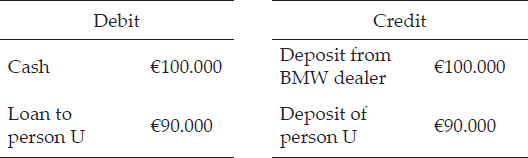
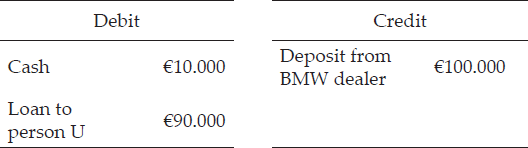
The bank has created €90.000 out of thin air and put it into the bank account of U. When U now uses the money completely, for instance, purchasing a good from person V, the cash reserves of bank A fall to €10.000. The deposit of U disappears. Bank maintains a reserve ratio of 10 percent.
The balance sheet of bank A remains:
Let us now imagine that person V is client of bank B and deposits the €90.000 in this bank. Now, bank B can expand credits. Holding a reserve ratio of 10 percent, bank B may grant a loan of €81.000 to person W.
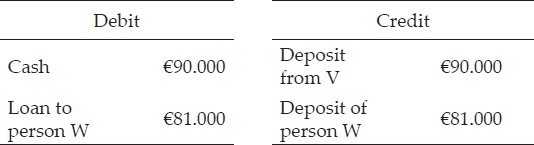
Now, W can use his loan, get the money from his bank account and transfer it to person X for purchasing a good or service. After this operation, the balance sheet of bank B is as follows:
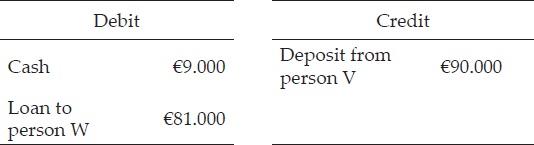
X is client of bank C and puts his money (€81.000) into it. Bank C has now received new cash reserves and can create new money and grant a loan to person Y. Maintaining a reserve ratio of 10 percent, the loan amounts to €72.900. The balance sheet of C is as follows:
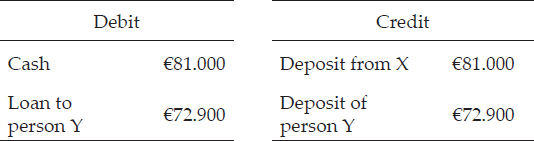
We could now continue the process of money creation further. Under the assumption of no friction or unused loans and a reserve ratio of 10 percent, the banking system can multiply by 10 the originary deposited €100.000.2
In a miraculous way, the banking system has created new money in form of bank accounts. Now, the money supply is €1.000.000. The BMW dealer, person V, X, etc. hold together €1.000.000 in their bank accounts. The banking system holds a cash reserve of ten percent (€100.000). The very profitable business of creating money has only become possible because of the privilege of the government, which in our experiment is you. In some sense, the government is the boss of the banking system and person Y might be the government itself. You gave the banks the privilege of creating money and in exchange, banks finance you by granting you loans or buying bonds issued by you. In fact, when we put aside all of the distracting manoeuvres and intricacies, it is easier to think of the owner of the printing press, you (the government) and the banking system as one institution. The franchise system of fractional reserve banking potentiates the power of the money creation. Out of €100.000 newly printed notes, the system made €1.000.000. By buying your bonds, bond prices are bid up and yields fall. You enjoy lower interest rates.
The connections between central bankers, bankers, and the government are not superficial. They form an elite group that cooperates closely. Bankers and politicians are seldom critical of each other. They frequently dine and chat with each other. The government establishes its own printing press (central bank). The central bank buys, to a large extent, government bonds, financing the government. The government pays interest on these bonds which increase the central bank profits. These central bank profits are then remitted to the government. When the bonds come due, the government does not have to pay the principal either, because the central bank buys a new bond that serves to pay the old one; the debt is rolled-over. On a lower level, the franchise system comes into play. Banks have the privilege of creating money. Banks also buy government bonds, or use them as collateral to obtain loans from the central bank. Banks do not only finance the government with the new money; an important part of their business is to give loans to consumers and entrepreneurs. Nevertheless, the banking system never betrays the government and finances its debts. It is rewarded by the central bank that buys government bonds from the banking system outright, or accepts them as collateral for new loans to the banking system.
At the end of the day, the system is simple. A printing press produces huge temptations: being able to buy votes or fulfil political dreams, for example. By using the printing press, the redistribution favors the government and the first receivers of the new money—to the detriment of the rest. This scheme is providently concealed by the government by separating the money flows institutionally. The central bank is made “independent” but still buys government bonds and remits profits back to the government. Banks, in a franchise system, participate in the advantages of money production and in turn help to finance the government. While the connections are complicated, it boils down to nothing more than one individual having a printing press and using it for his own benefit.
__________________
3 The Fed is quite good at it. As Lawrence White shows, in 2002 some seventy-four percent of all academic writings on monetary theory were published in Fed-published journals or co-authored by Fed staff economists. (Lawrence White, “The Federal Reserve System’s Influence on Research in Monetary Economics,” Econ Journal Watch 2 (2005): pp. 325–354.)
4 Find below a more complete table showing the credit expansion in a system of small banks after Huerta de Soto, Money, Bank Credit, and Economic Cycles, p. 230.
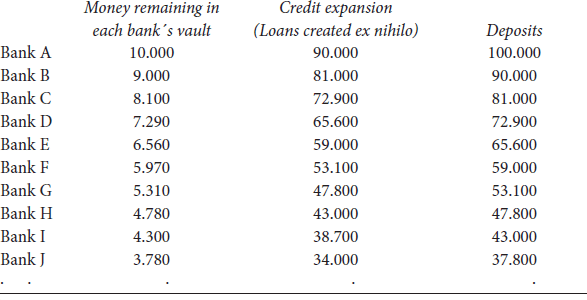
Banking system
Totald=100.000x= d(1-c)/c= 900.000d/c= 1.000.000
[d = originary deposits; x = money created by credit expansion; c = reserve ratio]
Note: The last three digits have been rounded.
- 1Roughly a year before starting to purchase government bonds, the ECB started to buy covered bonds issued by German banks. The purchases were progressive and reached €60 billion.
- 2Cash-online, “Forsa: Deutsche überwiegend gegen den Euro-Rettungsschirm.” News from June 7, 2010, http://www.cash-online.de.
- 3In reaction to the crisis, the political class has tried desperately to save the socialist project of a common fiat currency for Europe. They have been successful—at least for the time being. After intense negotiations, an unprecedented €750 billion “rescue parachute” has been created to support European governments and banks. At the same time, however, the ECB has started what many had regarded as unthinkable before: the outright purchase of government bonds, an action which undermines its credibility and independence. The public and market perception of the monetary setup of the European Monetary Union (EMU) will never be the same.
- 4Resistance to these unprecedented measures is on the rise, especially in countries with traditionally conservative monetary and budget policies. A poll in Germany showed that fifty-six percent of Germans were against the bailout fund.

