
The Stock Market, Credit and Capital Formation
Chapter XIV: The Money Market and the Trade Cycle
CHAPTER XIV
THE MONEY MARKET AND THE TRADE CYCLE
92. Our analysis of the nature of working capital, and of the demand for short-term funds, brought us to a number of conclusions. The original purpose of our investigation was to make it easier for us to make up our minds about the controversy “business credit versus stock exchange credit.” We shall defer the application of our conclusions to this problem until the next chapter. For the present we shall deal with certain by-products of our analysis. These by-products are, in my opinion, relevant to several problems, but especially to the theory of the money market and of the trade cycle.
The supply of money capital on the money market is drawn from a number of different sources. One of them is transfer credit which may take various forms and may originate in various ways: it may come from the short-term postponement of consumption, from long-term savings which are waiting for a suitable investment, from long-term savings whose owners are anxious to keep them in a form such that they can be withdrawn at any moment, from industrial capital which has been withdrawn from one line of production and is awaiting investment in another, from corporation profits which have not yet been distributed as dividends, from depreciation allowances which have not yet been reinvested, from the savings which became the proceeds of flotations of bonds or shares awaiting gradual investment, &c. On the other side the banks provide a considerable amount of “created” credit, that is purchasing power which has been created out of nothing, which means that nobody has given up the use of that buying power which is accruing to the borrower. This type of credit is furnished in just the same forms as transfer credit, through discounting bills, call loans, various forms of advances, overdrafts, security purchases and so on. There is a third source of credit which is intermediate between these two sources, and which we discussed in the last chapter. This is credit which is granted out of liquid surplus cash reserves, either with or without the agency of the banks. So far as concerns the character of this type of credit, its place in the monetary circulation and its inflationary effects, it could be counted as “circulation credit” or created credit, but it has the peculiarity of bearing a deceptive resemblance to transfer credit, with the result not only that it is almost impossible to distinguish in practice but also that it has been fused together with short-term transfer credit in monetary theory.
There are three types of credit: transfer credit,—
—created credit,—
—and credit from surplus cash balances, which has the appearance of the first but the effects of the second type.
It is this type of credit which gives rise to the much discussed seasonal easing and tightening of the money market, and has given the latter the stamp of being the unstable part of the credit market. George Halm, in his discussion of the problem of interest rates on the money market and the capital market, did not concern himself with created credit or with credit granted out of surplus cash balances, and, as he himself admits, this deprived him of the possibility of explaining “the important but difficult problems connected with the seasonal movement of interest rates on the money market.”1 What it also did, and this he failed to see, was to cause him to overlook the influences exerted by the money market on the course of the trade cycle; and all that he perceived therefore were the repercussions of the trade cycle on the money market.
The seasonal and monthly movements on the money market are directly attributable to the practice of lending surplus cash balances, i.e., to the utilization of liquid funds. Transfer credit may in general be looked upon as a stable element in the supply of money capital. Credit which is newly created by the banks for accommodating commercial borrowers may be regarded for the most part as merely supplementing the loans made out of surplus cash balances: it will usually come into play either at periods when these balances are not available (due to seasonal requirements, end-of-the-month and quarterly payments, &c.) or when they have already been exhausted (due to the cyclical movement). Thus the unstable factor on the money market, both on the supply side and on the demand side, is the surplus funds of firms. At those times of the year when commodity stocks are low, the cash balances of firms in a strong capital position flow onto the money market. Since at these times the demand for working capital on the part of firms in a weaker capital position is low, there is no immediate outlet for the increased supply of short-term credit. For reasons that have been explained above, the elasticity of demand for short-term credit, unlike that for long-term credit, is small, and interest rates on the money market consequently fall sharply. Since there is practically no really “temporary” outlet for money capital that is only available for a short time, it is clear that there are no “short-term investments” available for all the cash balances that are offered on the loan market.
Credit from surplus cash balances may make for monthly and seasonal easing and tightening of the money market.
The elasticity of demand for short-term funds is small.
One outlet for the large supply would be in the other interconnected credit market, viz., the capital market, the market for long-term credit. The method of converting “short money” into “long money” which involves least risk for the person wishing to make the transfer, is as a rule provided by the security market. One might suppose that the low call rate would induce bears to “cover” their short sales, and that it would induce bulls to buy for the rise. Professional speculators are, however, more cautious than this. They know that the lowering of the call rate is only seasonal, and that this seasonal movement is a fact of common knowledge. It is therefore easy to see why the seasonal fluctuations in interest rates on the money market do not cause seasonal fluctuations in security prices. For, “if a seasonal variation in stock prices did exist, general knowledge of its existence would put an end to it.”2 Thus the conversion of the seasonal supply of short-term money into investment money through the stock exchange loans will not take place on a large scale before the boom is under way. And the direct utilization of seasonal surpluses of cash for making temporary investments in securities is not attractive before the boom comes, owing to the cost of buying and selling. For these reasons the capital market, where the elasticity of demand for money capital is high, will not reflect (and absorb), the fluctuations in interest rates on the money market.
The monthly and seasonal osciliations of money market rates are not taken out by the securities markets.
If the entrepreneur were unable to find a borrower for his short-term surpluses of cash, and therefore had to resign himself to keeping the funds in his till or on his banking account, there would be no withdrawal of funds from the money market and no increased demand for short-money at certain periods when inventories are high, when the harvest is being moved and so on. If, however, some event or change in psychology in conjunction with the low interest rates on the money market induce entrepreneurs to borrow some more short-term funds, the next date when heavy payments become due or the next time when stocks are being moved, will cause a tightening of the money market. Because the tendency towards tightness at these dates is eased by the banks through the creation of additional credits, entrepreneurs do not feel any anxiety about providing for these heavy payments, and this has led to the lending and borrowing of “liquid” funds on the money market. We might also say then that it is the creation of credit by the banks which is at the root of the fluctuations, because if the entrepreneurs were not confident of obtaining help from the banks in case of need, they would not lend their cash balances to the money market for fear of becoming illiquid.
Bank loans ease the tightness of the money market on critical payments dates;—
Thus, while temporary surpluses of cash are the element in the supply which is the direct source of the monthly and seasonal fluctuations in interest rates on the money market, a necessary condition of these movements is the existing banking system. The apparent effect of the creation of credit by the banks is admittedly to mitigate the fluctuations on the money market, because bank credit fills the gap when the entrepreneurs withdraw their funds. Without the elasticity of bank credit, which is regarded as being so beneficial in this case, the fluctuations would at first be wider: in fact the tightness of the money market at the critical payments dates would become really “critical.” But bad experiences would soon lead entrepreneurs, for the sake of assuring their own liquidity, to refrain from lending out their temporary surpluses of cash, and so the direct cause of fluctuations on the money market would disappear. It is apparent, therefore, that the invisible effect of the elasticity of bank credit is exactly the opposite of the visible effect: mitigating the fluctuations and easing the difficulties arising out of them means enabling the fluctuations or their causes to arise.3
—they mitigate the fluctuations of the rates,—
—but thereby encourage the loans from temporary surplus balances which cause the fluctuations.
93. The classification of credits granted out of surplus cash balances third type of credit, intermediate between transfer credit on the one side and credit created by the banks on the other, has a number of advantages. Lending out of temporary surpluses of cash balances is in principle possible without the agency of the banks. As most people have become accustomed to think of credit creation as being due solely to the banks, credit granted out of surplus cash balances is treated as transfer credit, despite the fact that nobody refrains from buying, as this purchasing power is being transferred, and that this credit has just the same inflationary effects as credit created by the banks.4 The fact that there can be inflationary credits which are not bank credit at all, may have an important bearing on the development of the theory of credit. A not inconsiderable number of students of the theory of banking, especially those who are connected with practical banking, still persist in arguing that the banks have no power to “create” inflationary credit, and deny even more emphatically that this bank credit has the place in the complex of causes of the trade cycle which is assigned to it in monetary theories of the trade cycle. Perhaps this opposition (to what is only a causal explanation but is often taken as an accusation of personal guilt) will decrease once it is realized that credit which is not granted by the banks at all may also have inflationary effects.
The statement that there can be inflationary credit which is not bank credit, may be an eye-opener for those who question the credit, creation theory.
The way in which surpluses of circulating capital can be interchanged between firms, even without the agency of the banks, has been described already in the previous chapter. No long argument is needed to prove that the possibilities of transferring these temporary surpluses of cash between firms are multiplied by the operations of banks acting as intermediaries. What is meant here is not the fact that the substitution of time deposits for circulating media may create increased lending facilities (although this works in the same direction), but the circumstance that the concentration of the supply of temporary surpluses of funds allows them to be utilized more fully. This applies particularly to those countries where the use of cheques is still so undeveloped that the possibilities of credit creation by the commercial banks are very small. The “inflationary” interchange of cash balances between firms remains, from the point of view of the banks, apparently a purely transfer operation, and can, of course, not be treated as the creation of new money.
It is not possible in practice to identify a loan granted by a bank according to its origin. The borrower can never know the source of the purchasing power which he has been lent, and neither can the bank. It was originally believed that a bank could at least distinguish savings deposits from current accounts, and could accordingly lend the funds obtained by the former (time deposits) as transfer credit, and might be conscious of creating new credit on the basis of the funds obtained by the latter (demand deposits). Quite apart from the fact that at the present day the depositor is not guided by the character of his funds in choosing which kind of account to hold, this simple test is rendered useless by the circumstance that a deposit with a bank mostly comes through a transfer from a deposit held in another bank, and it is not possible to determine the origin of this deposit—whether it was a savings deposit or a current account or even an overdraft or new credit created by one of the other banks.
Neither the borrower nor the bank can know whether a loan transfers, activates, or creates purchasing power.
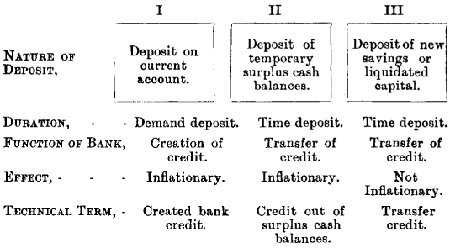
A deposit of funds with a bank may be:
(1) a deposit on current account serving as cash balance to be drawn on currently;
(2) a deposit on current account (or savings account) serving as (an investment for) a temporary surplus cash balance to be drawn on after a certain interval according to regular tides of receipts and expenditures;
(3) a deposit serving as an investment for long-term or short-term savings or for the liquid capital of a firm which is either contracting production or not maintaining its fixed capital.
Theoretically, there are three types of bank deposits,—
And there is no way of telling which of these three purposes the deposit is intended to serve.
—practically, they are indistinguishable.
If each deposit bore an indication of the length of time for which it was going to be held, and these specifications really corresponded to the true nature of the deposit, then a deposit on current account of type (1) would be a typical demand deposit and the other two would be time deposits. New credits which the banks (all taken together) grant on the basis of an inflow of cash due to deposits on current account represent creation of credit. New credits which the banks grant on the basis of an inflow of cash due to deposits on time account represent transfers of credit. The additional credit creation increases the volume of circulating media. The credits which are not newly created by the banks, but only transferred through them, are not however all “pure” transfer-credit: this term properly applies only to funds deriving from new savings or newly disinvested capital, whereas the deposits of type (2) represent what we have called temporary surplus cash balances. Thus, although the credits granted from these deposit funds are not created by the banks, but only transferred by them, they are nevertheless inflationary in their effect.5
The position may be summarized by the following classification:
A monetary system which was intended to avoid any inflationary or deflationary move would have to ward off anything which involved any change in the supply of money—including demand deposits—or any diminution in the demand to hold money on the part of individuals and firms. The already existing volume of credit outstanding, which can no longer exert any kinetic effect on interest rates, would have to be maintained. (This view was put into practice almost a hundred years ago in Peel’s Bank Act with its fixed fiduciary issue, although this was of course confined to bank notes.) Thus, the banks, supposing they had formerly kept an actual cash ratio of 10 per cent. against deposits, would have to consider the absolute figure corresponding to 90 per cent, of their deposits as a fixed volume of fiduciary lending, and keep a 100 per cent. reserve against all additional deposits on current account and all deposits of surplus cash balances, even if these deposits were kept at the bank as time-deposits.6 Savings deposits on the other hand would, in the hypothetical case of congruence with respect to “duration” between the assets and the liabilities, require a cover of zero per cent. If on account of the intermingling of the three kinds of deposits the attempt is made to find some appropriate reserve ratio of between 0 and 100 per cent, for “deposits in general,” the possibility of eliminating inflation or deflation is already gone. Even if only a fraction of the inflow of cash due to a deposit on current account were “lent out,” in a system of many banks this would be capable of producing a progressive expansion of bank lending through the influence of “derivative deposits.”7
Inflation and deflation could be avoided only if the reserve against active demand deposits and temporary surplus balances were 100 per cent,—
—and if the reserve against true savings deposits were zero.
What we know about the existence, the character, and the effects of new lending out of surplus cash balances, brings us to the conclusion that there are funds which do not differ in the least outwardly from credit deriving from the transfer of already existing purchasing power, but which nevertheless, if they are put to some “productive use,” exert the same effect as credit newly created by the banks. Whether this additional supply of credit is utilized through the capital market or through the money market, whether the lenders follow strict rules about liquidity or not, whether they provide loans for stock exchange speculation or for the working capital of industry, a movement away from equilibrium in the economic system is made possible. Even the introduction of “certificates of origin” for deposits—which an ingenious believer in control might suggest—would not enable the banks to keep track of the true nature of their deposits.
But, alas, we cannot identify the nature of deposits.
94. It may seem a little surprising if we attempt to connect the same phenomena as were invoked in explanation of monthly and seasonal fluctuations on the money market with the theory of cyclical fluctuations. Nevertheless I think that it is not unreasonable to assume some such connexion. I am far from believing that it is possible to discover the “germ of the trade cycle” in this phenomenon, but I do think that it is possible to show that credit granted out of surplus cash balances is closely connected with the beginning of the upswing.
The monthly and seasonal money market fluctuations play a significant role in the trade cycle.
The “double utilization” of money capital which is made possible by lending from surplus cash balances, and the extension of roundabout methods of production to which such lending gives rise, would be doomed to a very short existence in the absence of other support: it could not survive the next date when heavy payments became due. What is a surplus balance at certain times is not at all “surplus” at other times, and if they have been put to some “productive use” in the meantime they are now simultaneously indispensable to both the lender and the borrower, or some third person to whom the funds may have passed. Whoever is forced to dispense with them has to go out of production, because he is no longer able to obtain the means of production. His exit from production paves the way towards re-establishing a state of equilibrium in the production structure.
Loaned-out surplus balances are needed back on critical payments dates;—
Disturbances of this kind are, however, still not cyclical movements. The movement away from the (theoretical) equilibrium in the upward direction lasts, as experience shows, for several years, and the movement back from the crisis through the depression to something near a new (theoretical) equilibrium again lasts several years. The movement which has just been described lasted no longer than a season—or even a month—because the tendency towards an extension of production was brought to a swift end by the advent of the next payments date. But what happens if the payments at this date are facilitated, i.e., if the economic system is spared “unnecessary” difficulties, by short-term lending from the banks? The extra heavy demand for money lasts only a short time, and then the harmless credits, having performed their task, will flow back to the banks. There has been fairly general agreement in financial circles, and among students of banking policy, that the economic system ought to be helped over these payments dates, and no small part of the efforts towards working out a scientific monetary policy in the last one hundred and fifty years has been directed towards overcoming or easing the periodic stringency at certain dates when heavy payments fall due. Even the worst enemies of inflationism favoured such a policy.8
—then their double life would be terminated,—
—were it not for the respite given by momentary bank loan expansion,—
When the funds, which were temporarily “superfluous” and were therefore invested, are needed at the payments dates, the utilization of funds “twice over” is bound to be frustrated. If, however, new credit is created by the banks so as to help the economic system over the critical days, then the use of funds twice over in production can be continued. All that is necessary to enable the “upward” movement of the economic system towards disproportionality in production to continue for a longer period of time, is for the banking system to give assistance at certain times of strain. The payments dates might to a certain extent be taken as indicators of the liquidity of the system or as a test of the adequate adjustment of capital supply and production structure. This test loses its meaning of course if bank credit provides the producers for the duration of the “inspection” with the necessary amounts of money capital.
—which helps over the liquidity-tests on the critical dates.
Since the maintenance of the expanded volume of production requires not merely the continued use of the amount of credit once furnished, but the repeated administration of further doses (see the analysis given in Chapter XI), the continuation of the upswing will require increasing loans from surplus cash balances and will involve increasing stringency at the payments dates and increasing intervention from the side of bank credit to overcome it. It is clear, therefore, that the fluctuations in interest rates on the money market will soon become more marked than they had been previously. What Halm took to be the mere influence of the trade cycle on the money market is, as I see it, the reaction of the cycle on the money market, after the latter has furnished the “motive power” to the cyclical movement. The further the use of money market credit has progressed or the more intensively credit is being used in production, the heavier and more urgent will be the demand for credit on the money market at the critical payments dates. Thus Halm is right in saying that “The real shortage of capital at the top of the boom is a shortage of short-term capital disposition.”9
The money market feeds industrial expansion, which in turn makes increasing demands on the money market.
The mere intervention of bank lending at end-of-the-month, quarterly, and other payments dates will of course not be sufficient to develop the upswing into a full-fledged boom. At a certain stage of the upswing it will be necessary for there to be a more vigorous and continuous expansion of bank credit in addition to the loans from surplus cash balances and the occasional intervention of the banks at the payments dates. But lending out of surplus cash balances is sufficient to give the initial motive power for business recovery. It seems to me a not unimportant fact that the starting point of the upswing is to be found not in an expansion of credit newly “produced” by the banks but in a “natural growth” of credit.
The start of the upswing can be financed through loans from surplus balances without bank credit expansion.
95. A theory of the trade cycle which does not explain the continual recurrence of cycles as well as the course of the individual cycle cannot be entirely satisfactory. If we ascribe a rôle in trade-cycle causation to loans and disbursements out of surplus cash balances we must also try to analyse their rôle in causing the cycle to recur.
The turning point in the cycle comes, as we know, not because there is an actual contraction of credit at that point, but when merely a brake is placed on the further expansion of credit. The volume of circulation media which was augmented by the expansion of bank credit need not fall back, in the depression, to the previous level; equilibrium might be established just as well at the higher level of the volume of circulating media with a potentially higher price level. This is what usually happens in the case where the credit inflation derives from increased gold production: a new equilibrium position is eventually found with a larger quantity of money than before. According to many theories of the trade cycle it is necessary for there to be a new inflationary move—a new inflation by the central bank or a new gold-inflation—before a new cycle can begin. The same would be true of cycles which are started off by loans from surplus cash balances where these loans are not of a periodic or seasonal character but are based on a sudden change in the technique of payments. If as a result of a change in the habits of payment (e.g., improvements in collections, and expansion of the clearing system) or in the division of functions in the business structure (e.g., an increase in vertical integration in an industry), the demand to hold cash balances declines, the cash surpluses will not be merely temporary surpluses but permanent ones. Such a rise in the “efficiency of money” or increase in the velocity of circulation does undoubtedly contain the germ of a trade cycle, but the habit of holding reduced cash balances or the increased velocity of circulation will most likely become permanent parameters of the economic system.
If dishoarding takes place only once,—
—it can explain only one cycle but not its recurrence.
None of these “causes” of the trade cycle explains the periodic recurrence of the cycle (at least so far as endogenous factors are concerned) but it is a different matter with temporary surplus balances. These cash balances are superfluous at certain times and not superfluous at others. A rise in the velocity of circulation of money due to the lending out of these balances need not be permanent. After the liquidation of the crisis the firms are likely to hold again those balances which they need at certain moments in their own businesses and which are “superfluous” during other intervals. Whereas in the case of many other factors in the trade cycle, the impetus which contributed to the upswing disappears with the conclusion of one cycle, this does not happen in the case of fluctuations in surplus cash holdings. Assuming that the loans and disbursements out of surplus balances together with bank credit served to finance the over-investment, then, when the depression comes and the undertakings which cannot be maintained are compelled to close down, the surplus cash balances will be set free again. As the process of liquidation progresses, the funds which were previously invested “twice” come back, and the general urge to sell out stocks and to defer all postponable purchases in the expectation of a further fall in prices makes it impossible to find a productive outlet for these free cash balances. It is easy to see then why it is that in times of depression, during the “liquidation of the crisis,” interest rates on the money market hover just above the zero level.
The temporary surplus cash balances, dishoarded at the start of the upswing, are set free again when the crisis is liquidated;—
It takes some time before the economic system gets the crisis and depression “out of its limbs.” It is only after a certain lapse of time that the crippling feeling of uncertainty begins to wear off, and the risk estimates by potential lenders and borrowers gradually fall. When finally confidence has returned and the spirit of enterprise has reawakened, the firms which have accumulated large balances of cash during the period of liquidation find that these liquid funds are superfluous and that there are outlets for them. As soon as the “surplus cash reserves” have found “productive employment” the economic system is moving into the upward phase of the cycle.
—they are then free to finance another upturn.
96. The introduction of surplus balance credit into the analysis of the trade cycle supplements modern monetary theory in two respects, namely, in
(1) that the start of the upswing can be explained without reference to an expansion of bank credit, and
(2) that the upswing can be explained on the basis of an expansion of bank credit of a much smaller magnitude than was previously assumed.1
Both these circumstances go far to meet the favourite objections of those who still reject that theory of the trade cycle which stresses the expansion in the volume of money. Mises’ emphasis on the interest rate policy of the banks as the primary cause of the cycle was attacked by both bankers and theorists. Many people found it difficult to accept a psychological factor on the side of bankers and monetary authorities as a satisfactory explanation of the periodic recurrence of cycles.
Monetary cycle theory first held that inflation resulted from an increased credit supply by banks;—
Hayek was able, without abandoning the main lines of the theory of credit cycles, to show that the money rate of interest may be below the equilibrium rate not because of positive action on the part of the banks but because there is a rise in the natural rate of interest unaccompanied by any rise in the money rate.2 So, for example, technical progress, which creates increased investment opportunities and thus causes a rise in the natural rate of interest, may lead to increased borrowing from the banks. In this case the expansion of bank credit is not the result of active inflationism, as Mises considered it, but of passive inflationism. By a change in data in the economic system but without any action on the part of the banks, a money rate of interest which was previously in harmony with the equilibrium rate may become a rate that is conducive towards expansion.
—later it was held that inflation resulted from an elastic credit supply by banks confronted with increased demand;—
However, Hayek’s theory still treats the financing of the upswing as being exclusively due to an expansion of credit by the banks. The exposition given here on the other hand ascribes an even more passive attitude to the banks in the cycle; in fact, part of the funds used to finance the boom are seen as coming from quite another source of supply, viz., temporary surplus cash balances. Here the passive inflationism of the banks is at the beginning confined to giving assistance, if necessary, by increased lending at the critical payments dates, and does not assume the leading rôle until a more advanced stage of the cycle. The expansion of credit by the banks need enter in only at a later phase and to a smaller extent than was formerly supposed.
—in fact, inflation can result from surplus balance loans with only momentary and slight support by bank credit.
____________________________

