
The Stock Market, Credit and Capital Formation
Appendix B: The Circulation of Brokerage Deposits
APPENDIX B
THE CIRCULATION OF BROKERAGE DEPOSITS
Brokerage deposits are the credit balances held with stockbrokers by customers. These balances constitute a special sort of “money,” the quantity of which increases elastically in times of heavy stock-exchange tradings. Its velocity of circulation is capable of rising extremely high.
This “money” is held by the brokers’ customers chiefly on account of the “transactions motive,” that is to say, the recipients of such money, sellers of securities, are going to disburse it currently as buyers of other securities; this money may be held also on account of the “speculative motive,” that is to say, the recipients of such money may be holding it until security prices have fallen. However, the balances held with the brokers on account of the “speculative motive” are normally not large, because the owners prefer to switch their funds to bank deposits or to claims against call money.
The brokerage deposit may be primary or derivative. From the point of view of the individual broker the customers’ balances come into being, firstly, through deposits of “cash” (in the form of bank cheques) by the customers who have given (or intend to give) orders to buy, or on the customers’ account for dividends received; and, secondly, through a sale of paid-up securities for the customers’ account. For all brokers together, however, customers’ balances come into being, firstly, through deposits of “cash” (as before) and, secondly, through loans to customers.
The “reserves” held against brokerage deposits are the brokers’ bank deposits. The slower is business on the stock exchange, the higher will be the “reserve ratio.” In times of a small volume of stock trading, customers’ brokerage balances are low, while the brokers’ bank balances cannot fall too low; thus the “reserve ratio” may approach 100%. In times of a large volume of stock trading, customers’ balances with brokers are high, while brokers’ balances with banks need not be much increased: thus the “reserve ratio” may fall considerably.
Brokerage deposits do not play the conspicuous role in the brokers’ statements that is played by bank deposits in the banks’ statements. The other liabilities of the brokers (their partners’ capital and loans from banks and others) are usually much higher than the credit balances of their customers: after all, brokers are not bankers. This circumstance does not do away with the significant facts (1) that the brokerage deposits can rise without a corresponding rise in the brokers’ bank deposits, which implies that bank funds are released, and (2) that the brokerage deposits can circulate with high velocity, which implies that they function as circulating media between purchasers and sellers of securities.
HOW BROKERAGE DEPOSITS RISE THROUGH PRIMARY
DEPOSITS
If a customer deposits an amount with his broker, the bank deposit of the customer becomes a bank deposit of a broker. If brokers do not need increased “cash,” they repay part of their indebtedness to the banks. This is illustrated by these accounts—
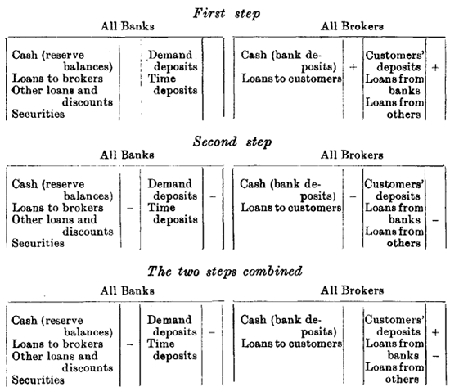
The increase in brokerage deposits was here due to the “primary” deposit by a customer. Brokerage deposits will be maintained at their increased volume as long as the customers who sell do not withdraw funds from the stock market. In the case illustrated above, the increase in brokerage deposits resulted in the liquidation of bank loans and the wiping out of bank deposits. If the lending capacity of the banks is utilized and, therefore, other bank loans or investments are expanded, the volume of bank deposits will rise again. The brokerage deposits are then a net addition to the total supply of “money.”
HOW BROKERAGE DEPOSITS CIRCULATE
This special sort of money circulates, of course, only between the customers of brokers. The customer who buys is debited, the customer who sells is credited on his brokerage account. If these customers keep their accounts with the same broker, no other change in balances occurs. If the customers keep their accounts with different brokers, a corresponding transfer of “loans from banks” will take place between brokers (i.e., one broker borrows, another repays a bank loan). Credit and debit entries in the brokers’ bank accounts will be only a fraction of the entries in the customers’ brokerage accounts, because the “cash” transactions between the brokers are confined to the net clearing balances. The visible turnover of the customers’ brokerage deposits is thus a multiple of the visible turnover of the brokers’ bank deposits.
Apart from clearing balances between brokers, and so long as stock transactions take place between brokers’ customers who do not withdraw their deposits except for the purpose of buying other securities, one can say no other sorts of money than brokerage deposits are involved in the transactions.
The brokerage deposits decline if a depositor, usually a seller of stocks, withdraws from the stock market. In this case the exact contrary of what was illustrated above will take place. The bank loan obtained by the broker will give rise to a bank deposit of the customer who has withdrawn.
HOW BROKERAGE DEPOSITS RISE THROUGH BROKERS’
LENDING
If a customer buys securities on margin and the seller does not withdraw the sales proceeds from the stock market, brokerage deposits are increased without any net change in bank loans and bank deposits. If buyer and seller keep their accounts with different brokers, a transfer of “loans from banks” will accompany the transaction; the broker of the margin buyer will borrow, the broker of the seller will repay a bank loan. The net result is illustrated by these accounts:
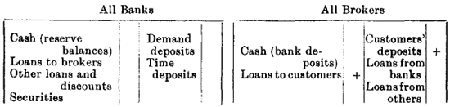
One might say that, in the end, it is the seller who has loaned to the buyer by leaving the sales proceeds on his brokerage deposit. Yet such a statement would be misleading because the seller may have used his brokerage deposit on the very next day to purchase other securities, and likewise each consecutive seller may use his purchasing power for buying other securities: thus no particular depositor may act as “lender.” As long as nobody withdraws from the stock exchange, the brokers’ lending to the margin buyer has “created” brokerage deposits which function as the customers’ money for further transactions.
The brokerage deposits decline if a seller of stocks uses his proceeds to reduce his margin debt to the broker. In this case the contrary of what was shown by the last illustration occurs.
CONCLUSION
Brokerage deposits are circulating media for security transactions between the brokers’ customers. Brokerage deposits come into existence (1) through deposits of bank money and (2) through lending by brokers. In the former case bank funds are released and the lending capacity of banks is increased; in the latter case bank funds are not involved. In neither case, therefore, does an increase in brokerage deposits diminish the lending capacity of the banks; in neither case does it affect the banks’ reserve balances and, thus, the potential volume of bank deposits. An increase in brokerage deposits may, thus, be regarded as a net increase in the supply of money for the specific purpose of securities transactions.

