
The Stock Market, Credit and Capital Formation
Chapter XIII: Working Capital and Short-Term Loans
CHAPTER XIII
WORKING CAPITAL AND SHORT-TERM LOANS
84. The thesis that the distinction made by the individual enterprise between working capital and fixed capital, and more especially the reasoning on which the distinction is based, cannot be directly applied to the sphere of general economic analysis, is not a new discovery. Unfortunately, however, there is a general tendency for concepts relating to the economic practice of individuals and firms to be misapplied to the analysis of the functioning of the economic system as a whole. Almost universally “working capital” is treated as being something fundamentally distinct from fixed capital. This view has had important practical consequences in connexion with banking policy: the credit policy which the banks have been urged to follow on “scientific” grounds has laid great emphasis on the difference between lending for investment in working capital and lending for investment in fixed capital.
The business concepts “working capital” and “fixed capital” cannot be properly applied to general economics.
The individual entrepreneur regards as working capital that part of his capital which is released when he stops producing; fixed capital, in contrast, remains tied up even after he has stopped producing. This aspect is highly significant from the point of view of the individual firm, and a statement of “current” assets and “current” liabilities, revealing the liquidity position of the firm, is also of importance to every individual lender. From the social point of view, however, the liquidity of working capital takes on a different aspect when we consider that the first entrepreneur’s money capital can only be released if his “current assets” are bought by a second entrepreneur, that is if a second entrepreneur invests money capital. Looking at the matter from the standpoint of the system as a whole, then, the so-called working capital also remains “invested” even though it has been “turned over.”1
The working capital of one firm is liquid only through the investment by another firm,—
It will sometimes happen that the partly finished goods turned out by one firm will pass on to another firm, be processed by it within one period, and then pass on again to a third firm, and so on, and thus travel through all the stages of production in the form of working (circulating) capital. It often happens, however, that the products sold by one firm remain for a number of processing periods in the firm which purchases them, thus becoming fixed capital. So, for example, the iron ore and coal, sheet-iron, iron girders, and machines, in possession of the mining industry, iron works, rolling mills, and machine shops respectively, are part of their working capital, whereas in the possession of the buyer, the machine becomes part of his fixed capital which will not be fully amortized until after a considerable number of processing periods. Thus whether the working capital of the producers in the earlier stages can be liquidated, will depend on whether there is an entrepreneur ready to invest money capital for a number of years. It is difficult to see, therefore, what sense there is, from the social viewpoint, in counting the stocks of the iron works as part of “the working capital of the community,” or in the maxim that this working capital should be financed by short-term credit.
—in some cases becoming fixed capital of the buyer.
Thus it is erroneous to say, as Philippovich does, that “short-term credit” serves “to provide circulating capital” and that it “arises from the requirements of the turnover of goods and is self-liquidating through this turnover.”2 The view that fixed capital should be covered by long-term credit, and working capital by short-term credit, is so widely held that anybody who challenges it cannot but feel that he is an isolated objector. The Dutch economist Polak remarks that “a division similar to that made by Philippovich is to be found in practically every discussion of credit problems,”3 and Polak, a man who has a thorough knowledge of business organization as well as of economic theory, is one of the few who really sees the point. He says in this connexion: “Even if we can distinguish between fixed capital and working capital, the distinction has little sense for problems of the credit market.”4 It is true that in the case of fixed capital, when production is continuous and on a paying basis, the money capital invested for a long period returns gradually by way of amortization over a number of processing periods, while in the case of working capital the money capital invested in non-durable goods returns to the individual firm at the end of each period. But this says nothing about the duration of the “circuit flow of circulating capital” from the point of view of the system as a whole, which involves the whole process from the earlier stages of production to the last, right down to the moment when the product becomes ripe for consumption.5
It is widely held that working capital may safely be financed by short-term credit.
The circuit flow of working capital through all stages of the production process may take a long time even if the capital nowhere becomes fixed.
85. In the last analysis a loan for financing working capital in a stage of production that is remote from the finished consumers’ goods end has to be regarded as a long-term investment. From the standpoint of the system as a whole (not of course from the standpoint of the individual firm), the possibility of liquidating in the short run the working capital of producers’ goods industries simply does not exist. Suppose a short-term credit comes from a short postponement of the expenditure of income on consumption. Then the productive factors released by the current curtailment of consumption are free for use in a productive process which will reach the stage of final consumers’ goods not later than the time when the credit is withdrawn in order to be spent on the consumption that was previously postponed. The only appropriate use, then, for money capital which is lent only temporarily would be investment in strictly working capital in a production process which produces “goods of first order” by as direct a method of production as possible, that is to say, investment in consumers’ goods industries which have a ready market and which can be expanded without any increase in the use of producers’ goods. Consumers’ goods industries which are dependent, on the other hand, on a large volume of intermediate products, that is, on products of early stages of production, would not be suitable short-term borrowers because an increase in production in those industries would either result in, or be conditional on, an expansion in industries in the earlier stages of the production structure,6 and production which has to travel through many stages would not have reached the final stage by the time the capital lent at short term is withdrawn.
Even investment in working capital of consumers’ goods industries may give rise to concomitant investment in earlier production stages.
Theoretical analysis seems, then, to furnish the rule that temporary savings should not be used in any branch of production other than consumers’ goods industries which are fairly independent of the output of earlier production stages; and this axiom fits in perfectly with one of the time-honoured maxims of banking policy, i.e., the liquidity rule which says that short-term funds should be invested in raw materials for consumers’ goods. Polak gives a demonstration of this in the following instructive example: “The current production of tailored clothes, for example, requires at any moment a stock of raw cotton in the hands of traders; a stock of cotton, raw and in process, and of yarn, in the spinning mills; a stock of yarn, of semi-manufactured materials, and of cloth, in the weaving factories; and a stock of cloth in the hands of retailers. Capital is invested by the traders in the stock of raw cotton. This capital has been advanced at short-term by a bank which obtained it from new savings. Now when the savers withdraw their money in order to buy cloth, the retailer finds his stocks decreasing and orders new cloth from the weavers, the latter order new yarn from the spinners and the spinners have to replenish their stocks of raw cotton. In this way the demand exercised by the former savers indirectly causes a decrease in the traders’ stocks of raw cotton in which their capital has been invested.”7
Financing inventories of raw material for consumers’ goods industries is the classic example of self-liquidating loans.
In discussing Lederer’s views at the end of the last chapter we explained that it was not permissible to apply this liquidity theory to the investment of newly created bank credit. The theory seems at first glance to apply perfectly well to the investment of short-term savings. New temporary savings would, of course, be used in the first instance to replace old savings that were being withdrawn. But what could the new temporary savings that were in excess of dissaving be used for? It is comforting to be able to think that at least some kind of investment in working capital appears to have been discovered which will serve as an appropriate outlet for a net increase in temporary savings. But even this source of comfort disappears as the result of further considerations (see § § 97 and 98). It has been said that the only “liquid form of investment” is one which finances working capital for an increased output of consumers’ goods industries without the use of increased quantities of goods of much higher order. It will soon become apparent that it is no easier to find such an investment for new short-term net savings than for newly created bank credit.
Whether such investments are available for new short-term funds, requires further consideration.
86. We have pointed to some of the common errors regarding the nature of the short-term credit which is used to finance working capital. If working capital is to be distinguished from fixed capital by the fact that it can be amortized 100 per cent, in every processing period it must be remembered, first, that what is working capital at one stage may easily be transformed into fixed capital at a later stage; secondly, that working capital in the producers’ goods industries has to travel on a long time-consuming journey before it is finally liquidated, even if it proceeds without becoming fixed in any stage; thirdly, that even the working capital in the consumers’ goods industries is not an isolated short-term investment if the industry is concerned with the processing of goods produced in earlier stages. In all cases the increase in short-term credit which is apparently used to finance additional working capital will lead to the starting up of more roundabout production processes.
The question of whether money capital invested will be returned earlier or later, or whether money capital will be released gradually or all in one lump by the partial or complete amortization of durable or nondurable goods respectively, is however an idle one, if we are considering the maintenance of production at an unchanged level. If a firm is to continue producing at an unreduced level, the fixed capital that wears out must be replaced and all the raw materials that have been used up must be replenished, which means of course that the depreciation allowances and the circulating capital must be reinvested. There will, it is true, be a continual release of money capital, but it will be for reinvestment purposes and not for the repayment of loans. In this point both the credit which finances fixed capital and the credit which finances working capital are alike: they will be “turned over” but they cannot be repaid as long as the scale of operations is being maintained, unless the firm is able to provide the necessary money capital out of its own new savings. But this is a factor which is totally unconnected with the character of the loan. The firm could repay only by ploughing back part of its net profits, that is to say, by replacing the borrowed capital by its own capital. The time required for such corporate capital formation to take place will in this case determine whether the borrowed capital has to be short- or long-term; the use to which the loan is put plays a minor rôle.
As long as the volume of output is to be maintained, “liquidated” capital must be reinvested,—
—hence quick repayment of loans depends not on the nature of their use but on the possibilities of corporate saving.
While most writers on banking theory as well as practical bankers still link up the concept of “working capital” with the concept of “short-term credit,” a good many experts in the banking field have come to the conclusion that the portion of the working capital of a firm, which is required permanently, should not be covered by short-term credits, and that only temporary capital requirements are the true domain of short-term lending.
The proper field for short term credit is often said to be the financing of merely temporary capital requirements.
The existence of short-term capital requirements in the economic system as a whole, and the possibility of covering them with short-term credits—frequently newly created by the banks—is taken as a matter of course by practically all students of economic problems. In fact few authors regard the problem of how such short-term capital requirements arise as worthy of consideration, and these few have contented themselves with a summary reference to “seasonal fluctuations.” Almost without exception the literature on this subject has been confined to the periodic fluctuations in capital requirements experienced by the individual firm. The question whether the capital requirements of the system as a whole are subject to such fluctuations is nowhere dealt with systematically, but an affirmative answer is taken for granted without reflection. Examples of this way of treating this part of credit theory could easily be quoted, but they would run into many pages. The concept of “short-term capital requirements” of the economy as a whole has never been seriously challenged.
Do such requirements really exist in the system as a whole?
I found it curiously inconsistent that many theorists accepted the thesis that temporarily increased requirements of working capital ought to be met by an increase in short-term lending by the banks, while at the same time they held that increased bank credits would lead to a lengthening of the production period of the economic system. How could it be possible for the productive process to go through periodic lengthenings and shortenings during the year, and, further, how could it be explained that these periodic fluctuations in the length of the production process fit in with the “supply of waiting,” or the supply of money capital available from “natural” sources? If the length of the production period (the depth of the structure of production) adjusts itself, as most economists believe it does, to the supply of money capital, should we not consider variations in the supply, and not in the demand, as the primary factor? And would it not, indeed, be difficult to claim the existence of exactly corresponding, seasonal short-term fluctuations in the community’s level of saving?
Are there seasonal fluctuations in the length of the production period, or in the demand for, or in the supply of, “waiting”?
87. There seems to be something wrong with the whole argument. Neither the alleged seasonal fluctuations in the community’s supply of capital, through which the appropriate length of the production process is determined, nor the seasonal fluctuations in the length of the process itself, nor the fluctuations in the amount of capital employed, fit in with the traditional propositions of capital theory. I think, however, that it is possible to show just how this notion of fluctuations in capital requirements arose.
In a branch of production where the production process is being continually restarted (let us say daily), and continually concluded, and where products are being continuously sold to consumers, if output always remains at the same level, the demand for capital cannot fluctuate, no matter whether all the stages of production are integrated under one management or whether the production process is split up among numerous concerns. The matter appears to be different in a case where the process is not continuous (but fluctuates seasonally) or where sales are not made continuously (but fluctuate seasonally) or where the intermediate products do not pass continuously (but only at discrete intervals) from one stage to the next. It is here that the fluctuations in capital requirements, which we shall now investigate more closely, are supposed to take place.
Where production or sales are discontinuous, individual firms have fluctuating demand for capital,—
Let us suppose that for technical reasons connected with climatic conditions as in agriculture, entrepreneur A produces in such a way that the product matures not continuously but only once a year. Entrepreneur B takes over the whole of A’s product at once but works it up only little by little; entrepreneur C takes over B’s production for one quarter of a year at each quarter date, works it up, and transfers it in equal monthly instalments to a trader D who sells it continuously to consumers. If we assume in the first place that all sales take place against cash payment, then the money derived from consumers’ purchases will accumulate for a time in the hands of D, the trader, who will transfer it at monthly intervals to C. The latter has to transfer his cash receipts every three months to B, who uses them to pay for A’s product once in the year. If we watch the movement of the cash balances we find that A’s cash holdings are at a maximum immediately after the sale of his annual crop and that he gradually invests these funds in the new crop. B gets paid for one quarter of the year’s production each quarter date and will be able to keep one quarter of the money as cash holdings for nine months, one quarter for six months, and one quarter for three months. C’s cash holdings rise each month and are used by him at the end of each three months. D’s cash holdings rise day by day until he makes his monthly purchase. (In the case of entrepreneurs B, C, and D we have, for simplicity’s sake, left out of account the payments for the cost of processing and handling the original product; these payments are irrelevant to the matter in hand.)
—but where everybody pays cash, large temporarily inactive cash balances accumulate in the hands of the firms;—
The stocks of goods of the individual units will behave in exactly reverse manner to the cash holdings. This follows as a matter of course from our assumption that every sale of goods is accompanied by cash receipts and every purchase of goods by cash expenditure. So that whenever any entrepreneur makes up his balance sheet he will find that aside from profits the capital invested in his business is always at the same figure. He will, of course, calculate his capital as the sum of his cash balance and of the value of his stocks of goods.
— in each firm the sum of inventories plus cash will be constant.
The spirit of every modern business man will revolt at the idea of holding such an “unreasonably” large amount of cash. Why should D hold his money idle in his till for half a month, C a part of his money for one and two months, and B even three, six, and nine months, and A up to a full year, or on the average half a year? Surely these cash balances could be put to some productive use! But could they? Most people answer this question in the affirmative without giving much thought to it.
The high cash balances are regarded as superfluous,—
Money can only be used productively via the employment of productive resources in a roundabout production process. In an economic system which is in equilibrium, all productive forces which can be put to uses whose values will cover costs, are fully employed, and the length of the roundabout process in which they are employed, is determined by the existing stock of capital equipment and the current supply of savings, that is by the proportion of income which is not being used for current consumption. The productive factors might perhaps be “more completely” utilized if they were employed in processes of production which are part of a lengthened investment period. Moreover, it may happen that certain productive factors could not previously be used for productive operations that would cover costs (because the factors’ marginal productivity was smaller than the price demanded for them) and that these unemployed factors can be drawn into the process of production if dishoarding takes place just as if new credit is created by the banks. This likewise involves a lengthening of the period of production.
—but their use involves a lengthened investment period,—
All processes of production can, in the long run, be kept going only to the extent that people are willing to wait for consumption. There is, however, no such willingness to forgo current consumption when firms that are working to full capacity suddenly decide to “utilize” somehow their temporary surpluses of cash. If it had been the habit that the cash balances of certain firms were allowed to accumulate at regular intervals in order to be kept in hand until needed for normal expenditure, and if then this habit were departed from and the temporary “surplus” cash balances were “utilized,” they would have the same effect as an expansion of bank credit: they would lead to the starting up of longer production processes. Thus the allegedly desirable ultilization of surplus cash balances which have previously been left temporarily inactive, is a kind of inflation (we may if we like call it an inflation of the velocity of circulation) and is likely to lead to over-investment. When temporary cash balances come to be regarded as superfluous and available for other uses, and when they can find short-term borrowers, the capital requirements of individual firms appear to be reduced.
—and it constitutes an inflation of the velocity of circulation.
88. The possibility of utilizing temporary surpluses of cash in a way which is presumed to be productive but is in reality inflationary, is, as we shall see later, closely associated with the modern organization of bank lending. It is not, however, essential that the banks themselves should act as intermediaries for loans out of surplus cash reserves. (Indeed, the banks could act as intermediaries only in a cash-paying community but not in a cheque-paying community.) As the modern credit system developed, the amounts of cash (in hand and in the banks) which firms needed to keep, were reduced and the capital requirements of the firms were more and more reduced to stocks of goods. Fluctuations in these working capital requirements of individual firms, which appear to be conditioned by periodic rather than continuous movements of goods in process from one stage to the next, could then be compensated by lending between entrepreneurs in the same branch of industry. To return to our previous example where we supposed that the stocks of goods were moved forward from entrepreneur A via B and C to D; then the money capital necessary to acquire the intermediate products could simply be lent to the various entrepreneurs in rotation. And for this to take place it would not be necessary for the banks to do the lending; it could be done through the channels of trade credit and customers’ advances between the firms concerned. For example, B could make advances to A continually throughout the year and these credits would be settled by the delivery once in the year of A’s product. Further, B could deliver goods to C on credit and accept the latter’s claims against D in payment.
Trade credit and customers’ advances largely reduce cash holding requirements, even without using banking facilities;—
Polak gives concrete examples to illustrate the way in which whole lines of production can be financed by a single entrepreneur (representing one stage in the line of production) who makes advances to his sources of supply and extends trade credit to his customers.8 Polak does not see the inflationary character of the transition to such a situation. But he shows very well how the ups and downs in short-term capital requirements of the single firm (ups and and downs which, as we have seen, owe their existence to the credit system) are compensated for the whole industry, by “passing on” the short-term credits from firm to firm.9 In the example we gave of a system in which all payments were made in cash, the assets in the balance sheet consisted of stocks of goods and cash balances which together made up a constant figure for each individual firm. Under a system of short-term credit, the constancy of the capital position in the balance sheet is effected through stocks of goods plus what is due from debtors minus what is due to creditors. If we look upon the debts and credits as being dependent on physical capital requirements we are easily misled into thinking that the fluctuations in the physical capital requirements of all individual firms are the only important phenomenon even with respect to the capital requirements of the economy as a whole.
—and the constancy of the firms’ net capital is realized by inventories plus accounts receivable minus accounts payable.
The stocks of goods shift forward, in the way described in the previous example, from one stage of production to another; and if they do not move continuously as on a conveyor belt but only at uneven intervals, usually conditioned by technical factors, then the stocks of goods in process can be seen proceeding on their journey with temporary accumulations and decumulations in the individual stages. It is, as we have seen, a result of the system of financing inventories by credit, that the accumulations and decumulations of stocks of physical capital goods, held by individual firms which control discrete phases of the production process, call forth fluctuations in the capital requirements of the individual firms. There need not be equivalent fluctuations in the capital requirements of the industry as a whole. This becomes clear as soon as we analyse the case of an industry with vertical integration. The undertaking which embraces all stages of production will, it is true, experience sometimes a quicker and sometimes a slower movement of intermediate products from one plant or warehouse to another, but it will not experience flutuations in its total capital requirements provided production as a whole runs parallel with sales.
Thus fluctuating physical inventories come to be the cause of fluctuating operating capital requirements of individual firms.
The lack of parallelism, in some lines of production, between production and consumption within the single production period (e.g., production and consumption of agricultural commodities) gave rise to the supposition that the fluctuations of working-capital requirements of individual firms will not necessarily cancel out in the system as a whole. So far, we have assumed that the working-capital requirements of individual firms were rotatory and therefore compensatory, and that their financing had merely the function of assigning a given volume of short-term credit in rotation to the different firms of the non-integrated industry. Polak, however, tries to show that the working-capital requirements of the economy as a whole also may be subject to periodic fluctuations; Polak’s argument is so instructive that it is worth reproducing in full.
The fluctuations in capital requirements of individual firms do not cancel out in industries where production and consumption do not run parallel.
“We will suppose,” he says, “that the sowing of some agricultural product takes place in March and that the harvest is bought by wholesalers in September. The article is processed in two successive factories which require three months each for finishing and marketing the semi-finished or finished product. Both the factories buy three months’ supply of materials at a time. The retailers who sell the finished product to the consumers also buy every three months but they sell continuously. We will assume further that both the harvest and the demand are the same each year and that they exactly balance each other.
An illustration is given—
“Under these assumptions it is evident that in March before the seed is sown the farmers have no stocks, the wholesalers still have half of the harvest of the previous year, each of the two factories has a quarter of that harvest, and the retailers still have a quarter of the harvest of two years ago. Three months later the farmers have the new harvest halfway to maturity, the wholesalers have sold one quarter of the previous harvest and now have one quarter left, the factory which does the first processing holds the quarter that was sold by the wholesalers, and the second factory has the quarter which had been held by the first factory in March, and the shops have that quarter which was then held by the second factory. The old stock of the shops has been sold to the consumers.
—which shows how inventory stocks move from firm to firm;—
“And so the process continues. If we call the successive harvests a, b, and c respectively we can construct the following table:—
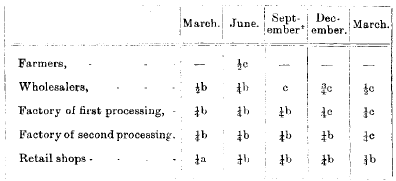
“If we take the amount of capital needed to finance one entire harvest as being equal to n, then we see that the aggregate stocks are never less than 1 n; they rise to 1
 n in September and fall back to 1n in March; the reason for this movement is that production, unlike consumption, is not distributed evenly throughout the year.”1
—an I how total stocks of the industry may fluctuate throughout the year.
It is clear from this example that seasonal deviations from parallelism between production and consumption—because production can only take place at certain times in the year whereas consumption is distributed throughout the year, or because production takes place continuously while consumption is subject to seasonal movements—imply fluctuations in the aggregate stocks of goods in the economic system as a whole. But is it correct to take fluctuations in aggregate commodity stocks, that is stocks of capital goods, as being equivalent to fluctuations in the capital requirements of the whole economic system?
89. There are technical conditions on the production side, and consumers’ habits on the consumption side, which make it evident that even under the assumption of a completely stationary economy, i.e., the continual repetition of the same economic process, the stocks of goods of the system would be subject to fluctuations within the production period. But it is a mistake, in my opinion, to identify these fluctuations in stocks with fluctuations in the capital requirements of the system or in the capital supply of the system.
Fluctuations in stocks of capital goods are not equivalent to fluctuations in the capital requirements or in the capital supply of the whole economy.
The maintenance of a given level of production requires a fixed supply of capital and therefore a fixed distribution of gross income between present consumption and provision for the future. This cannot be affected by the circumstance that many products mature at certain times of the year and are consumed at other times. Why should this circumstance—under the condition that the level of production is being kept constant—cause fluctuations in the aggregate demand for money capital?
If fluctuations of this kind do occur, this only goes to prove that some time in the past there has been dishoarding of cash balances which implies that money capital has been used twice over, so to speak, in order to expand the volume of production. With a given volume of circulating media and given habits of payment, the decision of the income recipient about the way in which he wants to use his gross income will determine the “natural” supply of money capital. If a seasonal decline in stocks of goods causes a seasonal accumulation of (temporarily) inactive cash balances at certain points in the system, this will not signify any change in the supply of money capital. If these cash balances, which previously have had their regularly recurring “rest periods,” are not given their usual rest period and are instead “put to use” by lending, this will mean that they are being used twice over. And this will be equivalent to the creation of an additional supply of money capital by the banks with the familiar consequences leading to a disturbance of equilibrium.
A seasonal decline in stocks would cause a seasonal accumulation of inactive balances; if these are dishoarded, the supply of money capital is inflated, and seasonal fluctuations in capital requirements emerge.
The point may be stated in more concrete terms as follows. Assume that a certain product is produced continuously but is bought by the consumers only in winter. This circumstance causes an accumulation of stocks in the summer and autumn months and a decumulation of stocks in winter. The selling out of these stocks leads every winter to the periodic accumulation of large cash balances in the hands of the seller: the sales proceeds of a few weeks return to the entrepreneur his whole money capital, which he will need for only gradual reinvestment. No productive resources are released anywhere, nobody has refrained from purchasing either consumers’ or producers’ goods. If the entrepreneur now deviates from his previous practice and lends his surplus cash on the credit market, his money capital will be used by another entrepreneur to finance other new productions. This means that this other producer is given command over productive resources which were previously at the disposal of the “liquid” entrepreneur, and the latter (or some other producer in his place) would correspondingly have to contract or stop his production. If, however, the modern credit system supplies this entrepreneur with new “short-term funds” in order to finance his “merely temporary capital requirements” next time they arise, or lends “short-term funds” to the other entrepreneur so that he can repay his loan, the effect is that command over the same productive resources is given twice over. It is obvious that in the long run this situation cannot endure and that equilibrium can be re-established only after the expansion of the more roundabout production processes has been followed by contraction associated with the usual phenomena of the crisis.
The surplus cash balances in times of seasonally low inventories do not imply that productive factors have been released;—
—the lending out of these funds gives command over factors of production;—
—bank loans may take care of temporary shortages of funcs;—
—and the boom goes on until it breaks.
Seasonal increases in the demand for short-term capital in the system as a whole is thus due not merely to seasonal fluctuations in the stocks of goods but to the existence of a credit system which enables entrepreneurs to make do with a smaller amount of business capital than would otherwise be the case. The fact that an industrial expansion goes hand in hand with a “tight” money market is a sign that money capital is already being used twice over and that production processes are already being started up which, most likely, cannot in the long run be maintained. The individual entrepreneur would not, however, undertake the risk of such operations if he could not rely on the banks and their readiness to lend. Entrepreneur M would refrain from lending his temporary surplus cash to N for fear that he might not be able to get his funds back at the right time: similarly entrepreneur N would refrain from borrowing short-term funds from M because he might not be sure of finding a new lender at the time when he had to repay them. Entrepreneur M would have his seasonal surplus of cash which he would be unable to lend out on the credit market because the short-term nature of the credit would make it impossible to use it in production. And funds which could not be put to any productive use would not find borrowers ready to pay interest on them. And vice versa, the fact that short-period surpluses of cash can be lent out at interest may be taken as another proof that they are used in production even if they are by their nature inappropriate for any such use. It is due to the banks that these funds can be so used. Firstly, the banks by concentrating surplus funds are able to widen the market for them, and secondly, they are able to step in by way of an expansion of their own credit when the possibilities of further loans out of commercial surplus cash balances have ceased to exist.
The lending of temporary surplus balances is made safe by the preparedness of banks to substitute their loans on critical days.
90. This rather cursory formulation of my views about short-term capital—views which diverge markedly from the prevailing doctrine—is liable to give rise to misunderstandings. Some readers may have supposed that I look upon the mass of funds which are lent out at short term as liable to generate a crisis. This is not my view.
First of all, it is clear that new credits which merely replace or renew old ones are not disturbing factors: on the contrary, disturbances would result if the old credits were not replaced by new ones. This applies just as well to bank credit as to credits granted out of existing cash balances. Whatever the effect of such credits was when they were created, once the economic system has adapted itself to a given volume of credit created by the banks and credit created out of surplus balances, the maintenance of this volume of credit is necessary in order to keep production at a stable level. It is the creation of new bank credit and the changes in. the habits with respect to the holding of cash balances which are the agents of dynamic change.
It is only the increased lending from temporary surplus balances which is inflationary; the customary volume of such loans is necessary for stability of production.
We must not confuse a discussion of comparisons between various situations with a discussion of the transition from one situation to another. We may compare the situation in which all firms hold surplus cash balances during their seasons of low inventories (e.g., after seasonal sales of their products or before seasonal purchases of their materials), with the situation in which firms make short-term loans to other firms or pay seasonal debts to other firms as their own inventories decline, and with the third situation in which firms borrow short-term bank loans as their inventories rise and repay the loans as inventories decline. In the first of the three situations the quantity of money (including checking deposits) is constant while its velocity of circulation undergoes seasonal fluctuations; in the second situation these seasonal fluctuations in velocity of circulation are diminished and the average velocity is, of course, higher than in the first situation; in the third situation it is the quantity of money which has its seasonal fluctuations. If the stock of goods in the economy as a whole undergoes seasonal fluctuations, there must be either seasonal fluctuations in velocity (through seasonally inactive cash balances) or seasonal fluctuations in the quantity of money (through seasonal repayments of bank loans). The one situation is in principle no worse and no better than the other. The transition, however, from one situation to another will have effects of a “dynamic” nature. In particular, the transition from one situation in which firms hold larger cash balances the lower are their stocks of commodities, to a situation in which they lend out their cash balances on short term, will have the inflationary effects already described.2
If inventories in this economy fluctuate seasonally, either velocity of circulation or quantity of money must fluctuate seasonally.
The two cases are equivalent, but the transition from the former to the latter is inflationary.
But even in the case of new credits granted out of surplus balances3 it is necessary to distinguish whether the liquidity of the firm is merely a function of the normal sales rhythm or whether it is the result of a contraction of production. If the firm with the continuous production and seasonal discontinuities in sales, and the firm with the seasonal discontinuities in production and continuous sales, and all firms which are intermediate between these two types, show periodical fluctuations in the size of their cash balances, then the decision to lend out these funds has an inflationary effect, so long as the firm which owns the funds intends to maintain production at an unreduced level. It is not inflationary, however, if the funds were released because the firm had decided to contract production. In the first case the lender transfers purchasing power without intending to give up its use in his own business; he plans to use it himself within the same period. In the second case the lender gives up purchasing power which he does not intend to use in his own business in the current period. If disturbances are to be avoided, the entrepreneur who is liquidating his working capital either by contracting or by stopping production will, of course, have to put it to some productive use, by lending to some other entrepreneur and so enabling the latter to dispose over the productive resources which have been released from his own business. This, however, is a case of a genuine “transfer credit” no matter for how long a term it is lent.4
If surplus balances accumulate because of contracted production, their lending out is necessary,—
—on deflationary disturbances will ensue.
What has been said here about the cash balances of producers applies in a similar fashion to the cash balances of consumers. Let us assume that consumers have been receiving monthly salaries and have been used to keeping part of the funds destined for their personal use during one, two, or three weeks. They now begin to lend these funds out at interest for the short time before they need them. This represents lending which is by its nature inflationary. For, in this case, the purchasing power which is lent out is part of what the lender intends to spend himself. The circumstance that it was usual previously for the purchasing power to be kept waiting some time before it was used, did not mean that goods or productive resources had been released for use elsewhere. The funds of our salary recipients can, however, be lent without exerting an inflationary effect, if these income recipients have really decided not to spend them in the forthcoming period, perhaps because they want to save up for large items of expenditure at a later date. If consumption is postponed for a period of time suck that goods or productive resources are really released, then the case is one of “transfer credit” notwithstanding the short time for which the credit is available.
Consumers’ surplus balances can like wise be customary or due to postponed consumption: loaning out the former involves inflation, loaning out the latter avoids deflation.
Transfer credit based on a true short-period postponement of consumption is of considerable importance in practice. The fact that from the point of view of the individual saver it is only intended to be a short-term loan does not limit the possible ways of using it as much as one might first think. For even though the individual savings are only saved for a temporary period, collectively they may in large part be looked upon as long-term savings of the economic system. In most cases the temporary saver who withdraws his funds in order to make the purchase that he had previously postponed has a successor who is just saving part of his income for later use. The probability that the new savings will be sufficient to cover withdrawals of old savings is what makes it possible to invest these short-term funds in production. The system whereby this investment is made through the stock exchange has special advantages, for in this case the transformation of what are short-term credits from the private viewpoint into long-term savings from the social viewpoint can take place to the fullest extent, and if, when the temporary savings are withdrawn, there is no new saver to take the place of the old, the withdrawal will usually express itself not in a reduction of the capital supply but in a reduction of the consumption expenditure of the person who sells the securities at reduced prices.
Individual short-term savings may be collectively long-term savings.
The practice of throwing all kinds of short-term funds into the same basket was bound to lead to confusion: it was usual to regard all types, without distinction, as being equally appropriate for lending. The temporary cash surpluses of firms were treated in exactly the same way as the temporary savings of the small saver, regardless of their economic origin and character.5
All these short-term liquid funds were lumped together as the natural supply of credit on the money market, and commentators rejoiced at the abundance of short-term capital. Thus it was argued that “if business men make short-term loans to each other out of their liquid balances and if funds which were being accumulated for spending on consumption are lent out until they are actually needed, there is a fuller utilization of the existing stock of physical goods of the economic system.”6 No qualification was added to such arguments to allow for a difference according to whether the short-term lending represented the continuation of an old practice or whether it came newly out of cash balances which had previously been kept inactive. In fact, it was argued that if these temporary surpluses of cash were not lent out, “large stocks of goods would periodically become idle in consequence of fluctuations in working capital requirements.”7 This view is in harmony with what may be regarded as the accepted doctrine up to the present.8 Against it we may argue that the “fluctuations in working-capital requirements” are a result of the lending of liquid balances and that the introduction or extension of such lending is liable to stimulate the “utilization of existing stocks of physical goods” to such a degree as to start up a boom which will later result in a crisis.
In theoretical analysis, short-term funds must be carefully distinguished as to their sources and nature.
In order to judge whether surplus funds which are lent out at short term for financing working capital have the effect of avoiding deflation or of causing inflation, we must first decide whether they represent a transfer credit, i.e., a credit which is based on purchasing power of which the lender has renounced the use. This is so in the case of cash balances in the hands of business men when the balances have been accumulated as the result of a contraction of production, and in the case of cash balances in the hands of consumers where these balances are based on a definite decision on the part of the consumer to postpone consumption. On the other hand, liquid funds which used to be kept temporarily inactive and are now lent out and invested, must be regarded as inflationary. The expansion of the supply of short-term credit through the utilization of these funds which previously represented only latent purchasing power are bound to have the same inflationary effects as are associated with an expansion of bank credit.
Business surplus balances due to reduced production, and consumers’ surplus balances due to postponed consumption, if loaned out, represent genuine “transfer credit”;—
—whereas surplus balances due to regular pulsations in the money flow, if loaned out, represent “created credit.”
91. Only a few authors have stressed the potentially inflationary character of that easing of the credit market which is brought about by the concentration of cash holdings and similar institutional factors. These few confine their attention to the effects on the value of money and do not consider the repercussions on the production structure. Menger, in his inquiry into the factors which determine price movements, analysed the institutions which tend to diminish the demand for money by individuals and firms.9 Mises went further and analysed the seasonal fluctuations in the supply of money and recognized the “increased demand for money” exercised by individual firms at critical payment dates as a real demand for capital.1 Although Mises drew the consequences of his conclusions as to the effects of bank-credit expansion (and based his theory of the trade cycle on these conclusions), he omitted to consider the analogous effects of credits granted out of existing surplus balances and of a monetary policy which aimed at easing the money market at the dates when there were exceptionally heavy demands for cash.
Some more recent writers have dealt with the problem from the standpoint of the velocity of circulation of money;2 but they analyse it solely from the side of monetary theory and do not inquire into its relation to the theory of capital and interest.
A remarkable flash of insight into the problem of short-term loans is to be found in Carl Menger’s Grundsätze (published in 1871) in his discussion of the nature of capital. He specifically excludes from his capital concept any power of disposal over goods which does not last beyond the time which is necessary to complete the production of finished goods ready for consumption.3
Since there are no criteria in practice for judging the origin and character of any particular unit of money capital, we cannot say which funds represent “genuine” capital and which not. If the total supply of money capital includes funds which, instead of being “genuine” capital, come from some inflationary source, we do not become aware of this fact until a later date when they begin to manifest their effects in the form of maladjustments. The same applies to the utilization of cash balances which had previously been inactive; at the time when they are used they become an indistinguishable part of the supply of money capital.
In actual practice there are no criteria for identifying the various parts of the total supply of money capital.
A favourite approach to this problem is to accept the thesis that temporary surpluses of cash as well as commercial bank credits are not “genuine” capital, but then to justify the utilization of these short-term funds for increasing the supply of credit, by saying that while they should admittedly not be used as “capital,” there is no harm in using them for “financing an increase in turnover.” This position cannot be defended except in cases of an increase in “money work to be done,” due to an increase in industrial differentiation, i.e., decline in vertical integration, or any other increase in the number of “stopping stations” in the circuit flow of money. In all other cases an “increase in turnover” does not call for, but is rendered possible by an increase in the effective money supply. An increased credit supply which “finances turnover” naturally finances the purchase of productive services. The position which postulates new credits for new turnover (over and above mere compensation for new delays in the circuit flow of money) cannot be accepted on these grounds:
The idea of “new short-term credit for financing increased turnover of goods”—
—confuses an increase in transactions with an increase in “stopping stations” in the money flow.
(1) A new supply of active circulating media made available through the credit market constitutes also a new supply of money capital.
(2) What is loosely called “demand for money” of individuals or firms is in reality not a demand for balances to hold but a “demand for capital.”
(3) The money which is supposed to be lacking for financing a seasonal increase in turnover is often lacking only because it has been employed for expanding other production.4
We may sum up by saying that every increase in loans for financing working capital is likely to be used for lengthening the process of production in the system as a whole. The fact that a credit is used for purposes of financing more “working capital” does not give the slightest guarantee that the capital will be liquidated at the end of a short period,5 or that it can be withdrawn without causing disturbances.6
The use of short-term funds for working capital does not assure trouble-free liquidation
____________________________

