
The Stock Market, Credit and Capital Formation
Chapter VIII: The Liquid Funds of Bearish Sellers
CHAPTER VIII
THE LIQUID FUNDS OF BEARISH SELLERS
59. The scare that an enormous volume of funds might be tied up in stock transactions was not taken seriously by many economists of repute. Their chief argument against this fear of absorption was that the “money work to be done” is not increased or not substantially increased by the turnover on the stock market, or that the effect of such an increase is minimized or compensated by the circumstance that the velocity of circulation of the funds used on this market is extremely high and, moreover, elastic. Some authors, however, pointed to another possible source of absorption: the absorption of liquid funds by bearish sellers of shares. The cause of absorption may perhaps be not the stock market turnover but the hoarding of sales proceeds by sellers who have withdrawn from the market.
Absorption of funds in securities transactions is considered negligible—
Thomas Balogh termed the absorption in stock transactions as “technical absorption”1 and contrasted it with the absorption due to the hoarding of sales proceeds. He believed that the first “will never be altogether negligible” but, nevertheless, will be insignificant compared with the second.2
—in comparison to possible absorption through “hoarding” by sellers.
John Maynard Keynes, who is the most prominent of the adherents of the theory of absorption through hoarding, attached little significance to the theory of “technical absorption.” Keynes treats the stock exchange turnover as a part of the “financial circulation”; it is carried out by means of “business deposits B.”3 Their velocity “is so very high . . . that the absolute amount of the variations in the volume of money so employed cannot ordinarily be very great.”4 A rising turnover on the stock exchange may perhaps require more of these “business deposits B,” but “on account of their very high velocity of circulation any necessary increase in them is easily supplied without much effect on the supply of money for other purposes.”5 There is then almost no technical absorption. “The main variation in the total demand for money for financial purposes arises . . . in quite a different way.”6 The important element in Mr. Keynes’ theory is the effect of the stock boom on the liquidity preferences of many holders of money.
60. Whether an individual will want to invest his liquid balances in securities, lend them out, or leave them in his banking account, depends, according to Mr. Keynes’ theory, on the expectations of the owner of funds regarding the future development of security prices and interest rates.7 There are many savers who do not take much account of things of this kind and keep savings deposits no matter what the state of the market. (Keynes calls these people the owners of “savings deposits A.”) There are, however, others who hold sometimes securities and sometimes savings deposits. (These are the owners of “savings deposits B” in Keynes’ treatment.) Anybody from among the latter group who at any time holds a substantial part of his wealth in his banking account, or in other words anybody who holds “savings deposits B,” evidently does so because at current prices securities do not seem attractive to him. The savings deposits B “comprise what . . . we will call the ‘bear’ position.” They are owned by “those who would normally be holders of securities, but prefer for the time being to hold liquid claims on cash in the form of savings deposits,” because they expect “that securities will fall in cash value.”8 There obviously exists therefore a “difference of opinion as to the prospects of securities”9 between people who buy securities at the prevailing prices and the “bears” who expect the prices to fall and therefore prefer to hold savings deposits.
Owners of funds are said to choose between holding securities or bank deposits.
Keynes goes on to describe four phases of the attitude of the market towards securities and savings deposits. In phase I, bull sentiment becomes increasingly general: owners of savings deposits now prefer to buy securities; the sellers are not pessimistic either, but are probably merely more optimistic about other securities or about other outlets for their sales proceeds; the “savings deposits B” become “business deposits” and “income deposits.” Thus “when the bullish sentiment is on the increase, there will be a tendency for the savings deposits to fall.” This is a factor which contributes to the general upswing in economic activity, because the savings deposits were inactive deposits, whereas the business and income deposits are active accounts and consequently effective purchasing power.1 The withdrawal of savings deposits in order to buy securities thus has “the same effect on industry as an increase in the supply of money.”2
When securities are bought with idle savings deposits, active checking deposits increase.
After the rise in security prices has reached a certain point, that is to say, following on the phase in which bull sentiment was fairly general, we come to phase II in which the sentiment is divided. While the boom is still going on, some people begin to think that prices have already risen sufficiently high. This group increases in number the higher the prices rise. Thus vis-à-vis of the “bull” group there is now a “bear” group, that is a group who sell their securities without reinvesting the sales proceeds. “And if security prices go still higher than this, then the volume of savings deposits will be actually increased,” Mr. Keynes concludes.3 Just as the “bull market with a consensus of opinion” turned savings deposits into active demand deposits the “bull market with a division of opinion” causes active demand deposits to become idle savings deposits. And this has “the same effects as a decrease in the supply of money.”4
When market sentiment is divided, bearish sellers, it is said, turn active accounts into idle savings deposits,—
Phases III and IV both relate to a falling market. On a “bear market with a consensus of opinion” there will, according to Keynes, be a general flight of funds into savings deposits. The deflationary effect is obvious. On a “bear market with a division of opinion” the situation reverses itself. Owners of savings deposits begin to think that the fall in prices has been exaggerated, or at least that prices have reached their bottom, and so they start buying and thus utilize their savings deposits again.
The relevant phase for our discussion is phase II. For this relates to the period of advanced boom when security prices have risen so high as “to exceed the expectation of some ‘bull’ and so influence him to sell . . . for cash and join the ‘bear’ brigade.”5 The essential factor, so far as Keynes is concerned, is that this bear position, which gradually gains in strength, finds expression mainly in a rise in savings deposits. Demand deposits which had been created by new bank credit, and demand deposits which had constituted the active cash balances of firms and income recipients, are used by the bulls to make security purchases, and owing to the bear sentiment of the sellers, are transformed into idle savings deposits. It is in this process that Keynes sees the risk “of the Financial Circulation stealing resources from the Industrial Circulation.”6
—thus, a prolonged stock market boom would lead to an increase in idle savings deposits at the expense of business.
61. In the opinion of many practical bankers, and of others, who still hold views that were current fifty years ago (and also according to views set forth in many a textbook) the deposit of sales proceeds on savings account with a bank would not be at all in the nature of a deflationary act. The banks, it is argued, will be enabled to loan out “the funds deposited with them.”
Such views presumably date from times when a deposit with a bank usually took the form of a deposit of coin or notes. The reason why these views still survive in the days of cheque payments is probably that any individual bank that receives the deposit of a cheque drawn on another bank actually does receive additional funds. If we look at the banking system as a whole, however, it is at once clear that when cheque payments are the rule the banks do not receive any additional funds when people “deposit” their receipts with the banks: all that takes place is a transfer of reserve balances and deposits from one bank to another. “Deposits” do not put any funds at the disposal of the banks, if all are taken together.7
It is undeniable therefore that depositing funds in savings account can exert a deflationary effect because of the switch from circulating deposits to idle deposits which is involved. And if “bearish sellers” deposit their sales proceeds on savings account, it may have “the effect of altering the quantity of money available for the Industrial Circulation.”8 But is it very probable that they will do this to any large extent?
It is true, contrary to old fashioned views, that a switch of active funds into savings deposits is deflationary.
There is no direct statistical evidence either for or against this accumulation of savings accounts by bearish sellers. But if an examination were to be made of the origin of all savings deposits, it would, in my opinion, come out very unfavourably for the hypothesis that we are discussing. It would, however, be ungenerous to take the expression “savings” deposits absolutely literally. As is well known, to the chagrin of all those who have occasion to deal with banking statistics, money “saved” is often left on demand deposit, and, on the other hand, firms often hold part of their cash reserves on time deposit. Thus the hypothesis that the proceeds of the sales of shares are deposited on savings account will gain in plausibility if we also count under “savings deposits B” sales proceeds which are left unused on demand deposit. But as we shall attempt to show, there are reasons for thinking that even this interpretation of the hypothesis in question fails to give it the importance that has been attributed to it.
However, it is questionable whether sellers do accumulate savings accounts,—
—or even idle demand deposits.
Yet another extension of Mr. Keynes’ hypothesis has, however, to be made: we ought not to impute the rise in “savings deposits B,” which is assumed to result from high security prices, simply and solely to the sales proceeds of bears. Mr. Keynes included a second source: current new savings which on account of the high prices of securities are put into savings account instead of being used to purchase securities.9 It is, of course, quite impossible to find out whether the savers who have deposited their savings proceeds on savings account would have bought securities instead, if the level of security prices had been lower. Nevertheless, there is one “theoretical” consideration which may give us a clue. So far as small savers in the lower and middle income groups are concerned, it will be nearer the truth to assume the opposite of Mr. Keynes’ hypothesis; it may be assumed that such people, who would normally never have thought of engaging in stock exchange operations, become infected with the general speculative fever and use the funds, which they would otherwise have put in savings account, to buy securities. So far as concerns savings out of larger incomes or corporation surpluses, it is again safe to assume that the available funds will not be put in savings deposit with the banks, when the high money rates prevailing in the advanced stages of the speculative boom make it profitable to loan them out at call.
High stock prices might frighten off current savings from stock purchases and divert them into idle accounts.
This is unlikely because rising stock prices make small savers bullish—
—and large savers call-money lenders.
62. Before presenting the evidence which speaks against Keynes’ hypothesis of the hoarding of sales proceeds, a short summary may be given of such material as there is which might seem to lend support to the hypothesis. Mr. Keynes was confirmed in his opinion by the following facts: In the United States from 1927 to 1929 stock prices rose, and so did brokers’ loans and time deposits. This common movement seemed to Mr. Keynes to represent an unmistakable correlation. He took it as a “perfect statistical test”1 of the proposition that a bear-bull position had developed of the kind in which the bulls borrow funds which the bears deposit on savings account.
The simultaneous rise of stock prices, brokers’ loans, and time deposits, in 1929, misled observers.
Several points may aid in evaluating the correctness of this interpretation. When a bull speculator uses either his own money or money borrowed from existing funds in order to buy shares from a bear, and the bear deposits the proceeds on savings account, demand deposits will fall and time deposits will rise. This is not what happened in the United States in the period in question, for demand deposits rose along with time deposits and both stopped rising at the same time. If a bull speculator borrows money from a bank in order to buy shares from a bear and the bear puts his sales proceeds on savings account with his bank, demand deposits will rise only for a few hours or a day, that is to say, until the time when the sales proceeds are deposited. Thus the volume of demand deposits will remain unchanged while time deposits rise. This does not conform with events in the United States either, for as has already been remarked the volume of demand deposits did not remain constant during the time when time deposits were rising; they rose simultaneously, even if at a slower rate.2
Active demand deposits did not fall but increased too,—
Thus, no existing circulating media were withdrawn from the “industrial circulation” by the piling up of savings deposits, and not all of the new circulating media deriving from bank credit were turned into savings deposits. Since demand deposits also rose, despite the rise in savings deposits, the most that might be said is that only part of the continual expansion of bank credit led to an increase in the active circulation while a large part was placed on savings deposit where it was inactive. But even this cannot be proved. First of all it has to be remembered that in the United States transfers to time deposit, owing to the lower reserve ratio held against the latter, release bank reserves, thus making it possible for the credit expansion to go further than would otherwise be the case. Furthermore, it is very doubtful whether the piling up of savings deposits really did mean that active circulating media became idle. The following consideration is evidence to the contrary.
—and their increase was not even impaired by the growth of time deposits,—
A credit expansion, part of which leads to the piling up of idle savings deposits, must lead to a substantial decrease in the average velocity of circulation of total bank deposits. One of the most important facts in a verification of Keynes’ hypothesis would, therefore, be a fall in the velocity of circulation of bank deposits. In reality, however, their velocity of circulation neither declined nor even remained constant, but rose sharply. The rise was steeper and more general than could be explained perhaps by reference to stock exchange operations and related transactions. What then was the rest of the explanation? Evidently a substantial part of the rise in the velocity of circulation was due to a change, which was observable in that period, in the attitude of firms toward various forms of liquid assets: firms began to hold a smaller part of their liquid funds in the form of demand deposits than had been customary in the past. Many firms lent out their cash balances at call, and others (often upon request of their bankers) held time deposits instead of demand deposits. Both factors led to an increase in the velocity of circulation. In the one case cash balances, which had previously been held as idle reserves, became working balances of other firms, and in the other case idle cash reserves were removed from demand deposit and placed on time deposit. This had the obvious effect of increasing the average velocity of circulation of demand deposits; and, if the increased lending capacity of the banks was used to create new demand deposits, the velocity of circulation of all deposits was bound to be raised.3
—because this growth was due to a switch of idle balances,—
—as can be seen from the increased velocity of circulation.
According to my hypothesis the growth of time deposits and the rise in the velocity of circulation can be explained as interdependent parts of one process. Mr. Keynes’ hypothesis leaves the fact of the rise in the velocity of circulation without explanation; indeed, this rise in the velocity of circulation may be regarded as disproving his hypothesis. In Mr. Keynes’ hypothesis the rise in time deposits represented the transformation of active demand deposits into idle time deposits, hence a hoarding process. In my hypothesis there was a substitution of time deposits for inactive demand deposits with a consequent release of reserves enabling the banks to create active demand deposits, hence a dishoarding process.
The evidence points to dishoarding, not to hoarding.
The suggestion that the bears may have hoarded their sales proceeds in the form of idle demand deposits has no more secure a foundation than the savings deposit hypothesis. For if demand deposits had been kept idle there would have been a diminution of the velocity of circulation. The sensational rise in the velocity of circulation in that period is so notorious that the statistics need not be reproduced here.
No statistics are necessary to prove that there did exist a bear position. We know for a fact that there were many people who sold their shares because they thought the prices had been driven too high. But there is nothing in the available statistics to show that these sellers hoarded a substantial part of their sales proceeds and so took money away from the “industrial circulation.”4
There were bears, but they did not hoard.
63. Statistical proofs are never of any value, and statistical disproofs are seldom so, unless they can be rationalized by theoretical analysis of the causal relationships. We have shown that no statistical evidence could be found for the alleged hoarding by bears who sold out. It remains to give the reasons why it is improbable that sellers of securities, during a stock market boom, will hoard their sales proceeds.
It is no doubt true that anybody who is expecting a break in share prices will prefer to be “liquid.” But it is not true that the only way to procure this liquidity is to hold cash or bank deposits, or that it is in fact procured in this way. Loans which are perfectly secure and can be recovered at any time are as good as cash for satisfying the demand for liquidity.5 Call loans are loans of this kind, and even if they are not defined as money they are often regarded as just as liquid as money. Sellers of shares who want to wait for share prices to fall can satisfy their desire for liquidity perfectly well without cash or bank deposits, by lending their funds at call.
Bearish sellers regard call loans as just as liquid as money,—
Low interest rates encourage the holding of higher reserves of idle cash. A rising stock market means that corporations are able to obtain capital more cheaply. This may have led some people to suppose that corporations, with money so cheap, will most probably hold higher cash reserves. But while it is true that the high stock prices mean cheaper borrowing facilities for corporations, it would be quite wrong to suppose that for this reason the holding of idle funds will not cost much. The cost depends not on the conditions on which one happened to obtain something but on the alternative ways of using it (i.e., “opportunity costs”). Even if the corporations had obtained their new funds almost gratis, they would still consider that it “costs” them 6 or 8 or 10 per cent., according to the prevailing rates on call money, if they refrain from loaning out their funds at call.
—and highly profitable too.
When holders of securities are induced to sell out because they think that share prices have been driven too high, these sellers will at the same time have the incentive to lend out their sales proceeds because of the high interest rates which bulls are prepared to pay for call loans. The bearish seller who operates on a large scale will not leave his sales proceeds on savings deposit, nor will he leave them in his checking account: he will place them at the disposal of the stock market. What this comes to is that the bear who sells lets the bull who buys owe him payment, and he does not therefore receive any funds to hoard.
The bearish seller loans to the bullish buyer, with no funds involved or hoarded.
The concept of “liquidity preference” is confusing unless it is constantly remembered that opinions fluctuate concerning the objects which are suitable for satisfying the desire for liquidity. If liquidity preference is by definition related exclusively to cash and bank deposits, it is wrong to conclude that a strengthening of the bear position will raise liquidity preference in this narrow sense; for the supply of perfect “liquidity substitutes” in the form of sight claims against bulls might at the same time be increased so much as to leave the net demand for cash and bank deposits unchanged. If, however, we define liquidity preference in a wider sense so that it relates to all objects which are considered by individuals and firms to be just as liquid as cash and bank deposits, then it is certainly true that a strengthening of the bear position will involve a raising of liquidity preference in this broad sense; but in this case it is wrong to put the liquidity function against the available quantity of cash and bank deposits since the supply of “objects of liquidity preference” is not an independent variable. If the bear position is described in terms of a demand for liquidity, then it has to be recognized that the bull position, through its borrowing, brings with it a supply of liquid assets: it creates “liquid” sight obligations.6
If the bear position constitutes demand for liquidity,—
—the bull position provides the liquid assets through its borrowing.
64. In short, it is anything but probable that the stock boom will lead to the piling up of idle cash reserves by sellers of securities. It was pointed out in the previous chapter that a substantial part of the rise in brokers’ loans was to be interpreted as lending by the sellers to the buyers. Thus we have no use for Mr. Keynes’ interpretation according to which brokers’ loans were employed to finance the holding of cash by the sellers.
Incidentally, there are passages in Mr. Keynes’ Treatise which fit in with my own explanation. He says for example: “But the fact that the technique of the New York market allows an important proportion of the ‘bear’ position to be lent directly to the ‘bulls’ without the interposition of the banking system . . . facilitated immense fluctuations in the magnitude of this position without the disturbance to the Industrial Circulation.”7 In other words the bear position consisted here not in the piling up of savings deposits or idle cash balances, but in the lending of the purchase price to the buyer. In this case, however, the bear position would not be deflationary: it would involve neither a rise in savings deposits nor an increase in the “financial circulation.” This is equivalent then to Mr. Keynes’ unconcernedly discarding his own hypothesis.8
It would, of course, be possible for both kinds of bear position to exist side by side. Many sellers who think stock prices are going to fall may loan out their money while other sellers may keep it in cash or on savings deposit. The latter possibility becomes more plausible if we assume that many of the sellers who are nervous about the high stock prices are people of small means, who neither have the notion that it is possible to lend money at call nor have the connexions which are necessary for carrying out transactions of that kind. But this would be the exception rather than the rule, as is clear from the fact that it is precisely the small man who holds onto his stocks longest, and that it is the experienced speculator and the capitalist who sell out at high prices. Experienced capitalists, however, have better ways of using their funds than to put them into a savings account (or a “thrift pass book”) at a bank.9
“Small bears” might hoard, while “big bears” loan,—
—but usually the small speculator holds on longest to his stocks.
If a classification were made of the various uses to which people put the sales proceeds from their stocks sold while prices were still rising, the item “deposits on savings account” would probably be almost negligible. Leaving out the item “purchase of other securities” (which is done with the brokerage deposit and, thus, requires neither cash nor credit) the classification would contain the items “purchase of means of production” and “purchase of consumers’ goods,” followed by “short term lending” (loans to brokers), and finally “repayment of debts.” Among the sellers who do not buy anything with their sales proceeds, the most important groups, in the phase of rising stock prices and high call rates, are the capitalists who lend their funds, and speculators who pay back funds which they had borrowed previously. The first group takes advantage of the high interest rates on the money market by lending and is liquid without hoarding; the second group becomes more liquid by paying back debts and has nothing to hoard.
The liquidity preference of most bearish sellers is exercised by making call loans and by repaying debts.
The period of rising stock prices and high call rates is thus, even if there is a division of opinion about the future course of stock prices, not a period of heavy hoarding by those who sell stocks. In the advanced stages of the boom there may perhaps be a few cautious small investors who get out of the market in time and acquire savings deposits, but their action is undoubtedly outweighed by that of other small investors who, as a result of the long lasting rise, succumb to the temptation and use their savings deposits to purchase securities.
When the stock crash finally comes, when bull sentiment has vanished and stock prices fall, there will first of all be sales which again do not lead to the piling up either of idle cash reserves or of savings deposits: the sales which take place at the time of the crash consist predominantly of the selling out of accounts that became undermargined. These unfortunate sellers do not receive any funds that they could hoard. At this stage call rates are still attractive enough to provide a profitable outlet for the funds of those sellers who have any funds to receive. It is not until the bear market has “settled down” to a general pessimistic feeling, a low level of brokers’ loans and low call rates, that the piling up of idle bank deposits described by Mr. Keynes takes place to any considerable extent.
Only after the crash, with margin debts largely repaid and call rates low, will liquid funds of bearish sellers accumulate.
The various considerations advanced in this chapter make it appear improbable that the speculative boom on the stock market will lead in any substantial measure to the absorption of circulating media or bank credits through the induced demand for liquidity on the part of bearish sellers. It is absolutely impossible to ascribe the heavy rise in brokers’ loans during the boom entirely or in large part to the piling up of idle bank deposits by bearish sellers.10
The high brokers’ loans were not due to idle funds.
____________________
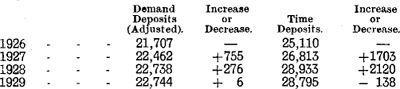
These figures, which are all in millions of dollars and represent the position on 30th June each year, are based on the Reports of the Federal Reserve Board and have been taken from Lauchlin Currie’s The Supply and Control of Money in the United States (pp. 33 and 70). Demand deposits show an increase over the whole period of $1037 million or 4.78 per cent., and time deposits show an increase of $3685 million or 14.67 per cent.

