
The Positive Theory of Capital
Chapter VII. Interest from Durable Goods
CHAPTER VII
INTEREST FROM DURABLE GOODS
MATERIAL goods are of use to mankind through the action of the natural powers that reside in them, or, as I have expressed it in another place, through the rendering of their material services. On the nature and importance of these material services I have said enough in my former work,1 and I shall repeat only a few considerations which seem necessary to connect what was then said with the subject now before us.
Many goods are so constituted technically as to be capable of rendering one single service, and in that service to exhaust the whole of their useful content. These are what we call Perishable goods. In them the good and the service coincide. Many other goods, again, are able to render several successive services. We call these Durable goods: tools, dwellings, clothes, land are instances of such. Here the single service forms a smaller economical unit clearly distinguished from the good itself, and is capable of obtaining a certain economical independence. To afford a single and limited act of satisfaction, a single service may be detached from the useful content of the good. Various services of the same good may be independently and differently disposed of. Single services, or groups of sendees, may be independently transferred, gifted, or sold to different people, as we see every day in the familiar legal contracts of Lease and Hire. Such services may obtain an independent price, and, as this of course presupposes, an independent value.2 It is the value of these material services that now claims our attention.
This value cannot be subject to any other laws than those which regulate the value of goods in general. A service obtains value exactly as a good does—that is, by the satisfaction of some want being dependent upon it—and the amount of its value is measured by the importance of the dependent want—that is, by the amount of the marginal utility which may be obtained from a service of such kind and such extent.
Thus there is, naturally, an intimate relation between the value possessed by the material good itself, and the value possessed by its services. The nature of this relation scarcely requires explanation;—a material good obviously has the same value as the sum of all its services. If a good is capable of rendering ten services, and if the satisfaction of a certain want depends on each of these services, it is obvious that what depends on the possession of the good is the receiving of these satisfactions, and, indeed, of all the ten satisfactions from which the services get their value.
Naturally the case of perishable goods is the simplest. Here the value of the single service coincides purely and simply with the value of the good itself. The value of the service rendered me by a cartridge is identical with the value of the cartridge. The case of durable goods is more complicated. We have always to think of the value of a durable good as a compound amount; as made up of the importance of more or less numerous wants to which it ministers by its successive services; or—to put it another way—as made up of the individual values of the services on which those satisfactions depend. If a farmer is calculating the use value of a threshing-machine with a view to buying it, he will take into account the time the machine will last and the work it is capable of doing, and will calculate from that how many services it will render, and how much each service will be worth to him.3
In this, however, there may be another complication. If the services of the durable good be exhausted in a short space of time, the individual services, provided they are of the same quality—which, for simplicity’s sake, we assume—are, as a rule, equal in value, and the value of the material good itself is obtained by multiplying the value of one service by the number of services of which the good is capable. But in the case of many durable goods, such as ships, machinery, furniture, land, the services rendered extend over long periods, and the result is that the later services cannot be rendered, or at least cannot be rendered in a normal economic way, before a long time has expired.
As consequence, the value of the more distant material services suffers the same fate as the value of future goods. A material service, which, technically, is exactly the same as a service of this year, but which cannot be rendered before next year, is worth a little less than this year’s service; another similar service, but obtainable only after two years, is, again, a little less valuable, and so on; the value of the remote services decreasing with the remoteness of the period at which they can be rendered. Say that this year’s service is worth 100, then next year’s service—assuming a difference of 5% per annum*—is worth in today’s valuation only 95⋅23; the third year’s service is worth only 90⋅70; the fourth year’s service, 86⋅38; the fifth, sixth, seventh year’s services, respectively, worth 82⋅27,78⋅35, 74⋅62 of present money. The value of the durable good in this case is not found by multiplying the value of the current service by the total number of services, but is represented by a sum of services decreasing in value. If the current year’s use of a machine is worth 100, and the machine is capable of doing work of equal quality for five years more, the machine is not worth 6 x 100 = 600, but 100 + 95⋅23 + 90⋅70 + 86⋅38 + 82⋅27 + 78⋅35 = 532⋅934 Now what happens during the working life of this machine?—In the first year of its use the owner realises the “current “service with its value of 100. Naturally this service, thus consumed or rendered, comes off the value of the machine (which we may call the “bearer of the use “), and the good suffers a loss of value. But this loss of value cannot be quite so great as the value of the service rendered and deducted. It is partly compensated by the increased value of the services that still remain embodied in the machine. That particular service which, at the beginning of the year of use, figured as “next year’s,” and had a value of only 95⋅23 in present money, figures by the end of the year as “this year’s use”; it has advanced one year nearer maturity and grown into the full present value of 100. Similarly the former third year’s service has now become next year’s, and its value has grown from 90⋅70 to 95⋅23: the fourth, fifth, and sixth year’s services have passed into the rank and value of third, fourth, and fifth year’s services. Behind each of these latter services there remains another service ready to take its place, and entirely supply it. It is only the last, the sixth year’s service, that is not replaced by any succeeding one. And thus we find that the loss of value which the durable good suffers during the year’s use turns out exactly equal to the initial value of the most remote service inherent in the good. This value, of course, is less than the value of the present service, the service known as the “current return “: and thus it happens again that, to the owner of the durable good, something of the current return always remains over as net profit or net interest, after deducting the loss of value which the good suffers during its year of use (that loss of value familiarly known as “wear and tear “). This “something “amounts exactly to the customary percentage of the total value (the “capital value”) of the parent good, the bearer of the utility—a coincidence which it is the easiest thing in the world to explain. For this “something” is got from the increasing value of the total services of the goods as these services come nearer to the present. Now, naturally, each service increases in value as it comes nearer the time of its realisation in the same ratio as it was underestimated formerly by reason of its remoteness: that is to say, it increases in value by the usual market percentage on its individual value. But since, as we saw, the sum of the individual values of all the services inherent in a good constitutes the value of that good, the increment of value of all the services added together must be exactly equal to the usual market percentage on the total value of the good.
To put all this into figures. At the beginning of the first year of its use the good, as bearer of six annual services, was worth in present value 100 + 95·23 + 90·70 + 86·38 + 82·27 + 78·35; that is, 532·93. At the end of the first year, as now capable of five annual services of the present value of 100 + 95·23 + 90·70 + 86·38 + 82·27, it is worth 454·58. The loss in value is, therefore, 78·35, which is exactly the same as the former most remote service was. But since the sum received from the current year’s service—the value of the service sold and now deducted—amounted to 100, there remains a net gain of 21·65, which is exactly 5% of 432·93, the sum which the good became worth immediately on deduction of the first service realised, as one might say, to account.5
Similarly, in the second year’s use, the owner again realises the service now become present and worth 100. This comes off the value of the parent good. But the succeeding service, which before had become worth 95·23, now arrives at the full value of 100: that succeeding it, becomes worth 95·23, and so on. Only the last service, that originally worth 82·27, finds nothing to replace it. At the end of the second year’s use, then, the good, as capable of four remaining annual services of the individual values of 100 + 95·23 + 90·70 + 86·38, is worth 372·31. As against the value of 454·58 which it had at the beginning of the year, it has suffered a loss of value of 82·27 which is equal to the value of what was the last service; and as against the receipt of 100.it returns 17·53 net, the interest on the somewhat reduced capital6 that remains. And thus it goes on from year to year, the gross return always remaining the same (because by hypothesis the amounts of service remain unchanged in technical quality), the quota for wear and tear always increasing (because the marginal service, that which determines the loss of value, stands nearer to the present, and so to the full present value), and the net interest always decreasing (in correspondence with the decrease of the capital, owing to wear and tear, on which interest has to be paid), till finally the good has entirely given up its useful content and is, as we say, consumed.
Put in general terms, then, we get the following very simple explanation of the phenomenon of interest on durable goods. The owner of a durable good can always realise the full (higher) value of the then present utility, and this represents the “gross return “of the good, its “gross interest.” He loses, on the other hand, on account of the steady advance of the more remote services towards the present, only the smaller value of the last service then inherent in the good. This smaller value determines the amount of the “wear and tear,” and thus there is always a difference between gross interest and the amount of wear and tear, which difference forms his net profit or net interest. The cause, then, to which net interest owes its existence, is nothing else than an increase of value of the future services—services which were previously of less value, but during the period of the good’s use have pressed forward into or towards the present.7
Thus our theory traces back the profit which durable goods yield their owner to the selfsame causes as explain interest on loans and undertakers’ profit on production. I think I am justified in claiming this as the peculiar merit of the theory, and, at the same time, as a strong proof of its correctness. For it was just this interest on durable goods (Nutzungsgüter) that formed the stone of stumbling to all earlier interest theories, and stood, as it were, a standing contradiction of them. Supposing that the other kinds of interest could be explained by the productivity of capital, obviously this was no explanation of the interest yielded by a durable consumption good which produced nothing, such as a dwelling-house, household furniture, a hired piano, the books of a lending library. Or, if undertakers’ profit was traced, with more or less appearance of justification, to an exploitation of the labourers, the question remained: What labourers are exploited by the owner of a house? Suppose he has paid away the whole £2000, the worth of his house, in wages to the labourers who built it, so that in the origin of the house there is not a particle of profit from exploitation: still, the house, year after year, yields him £100 of interest on capital. Where shall we find the worker from whom the £100 could have been taken either by fraud or force?
The “Use theory “appears, at first sight at least, better able to account for this form of interest, since it borrows its special foundation directly from the phenomenon of the durable use of non-perishable goods.8 But neither does it get beyond the mere semblance of an explanation. It gets entangled in subtleties of a “wider “and a “narrower “use, of a “gross “and a “net “utility,—terms, by the way, which may be quite proper as convenient expressions to indicate certain phenomena, but represent anything but clear and definite conceptions—and leaves entirely unexplained the nature of the relations existing between the value of the net and the value of the gross use, between the value of the parent good and the amount of its wear and tear. Whether net interest is high because the value of the capital is high, or whether capital value is high because net interest is high; whether the amount of gross interest is cause or effect of the value of the other two amounts—on these questions we should seek in vain, in the writings of Hermann, Knies, or Schäffle, for anything approaching to clearness of inquiry and for anything like a real explanation. To all these questions our theory gives one concise answer. The value of material services (Gross Use) forms the first link in the causal chain. The value of the “bearer of the use,” the parent good, is the sum of the individual values of its material services. Wear and tear is a result of the diminution of the services which still reside in the good, and is, on account of the progression in time of the later services, neither equal to the value ot the material service detached during the year of use, nor yet corresponding to the degree of physical wear and tear9 (which, if the good last six years, would amount yearly to one-sixth of the whole useful content), but is equal only to the value of that service which is the last, the most remote, at the time of calculation. And it is this same progression in time which causes the increase in value of the later services and from which comes a net gain, the interest on capital.
The same considerations that have elucidated the cause of interest from durable goods throw a strong light on another phenomenon, equally familiar and equally misunderstood,—that of Capitalisation. It is a well-known circumstance that, to such goods as yield us a more or less permanent return, we ascribe a certain “capital value “in consideration of this return. “We estimate them as equal to a money capital which, at the ruling rate of interest in the particular country, would yield a similar amount of return for the same period. Thus a house which returns £500 a year, we value at £10,000 if the usual rate of interest is 5%, or at £12,500 if the rate is 4%; or we value a machine which, for six years, throws off annually a gross amount of £100 and certain net decreasing amounts, at something over £500.
Why do we attach just this value to them? The common explanation is: Because these goods yield a certain net return we must hold them equal in value to a sum of money which yields just the same net return. This, however, is incorrect, or rather it is not an explanation at all but a reasoning in a circle. The existence of a net return is not the primary fact which can be given as cause of the parent good having a definite value, but, conversely, a definite value must already be put on the good if this net return as such is to appear. If, in our example, the machine, which in six years returns in all £600, had been valued at £600, its whole return evidently would have been absorbed by the “wear and tear,” and there would have been nothing left over as net return. It is simply because it was valued at less, at something only a little over £500, that there remains a net interest after deducting the quota for wear and tear. And it is exactly the same, as I shall show farther on in another connection, as regards the return and capital value of houses, lands, etc.
The only correct conception, and the only conception which really gives an explanation of the phenomenon, is the one now stated. The true primary fact is the lower value of future goods and future services: next we have the parent good, as capable of containing future services, estimated at a less amount than the total value which the services successively given off will represent as they are given off: and finally, as consequence, comes the fact that the capitalised sum is less than the sum of the amounts realised by the services in the course of time, and that there is a net surplus from the current return. That, on the one hand, the value of the bearer of the use, and, on the other, its net return, are represented by such figures that the former may be held equivalent to a money capital yielding, at the current rate of interest, exactly the same net return, is a coincidence which I have already explained.10 And, in virtue of this coincidence, it is, finally, as intelligible as it is justifiable that, in practical economic life which finds and adopts, as facts ready to its hand, the things which we try to explain, the net return of goods should be taken as foundation for acts of valuation. It is an abbreviated method which, practically, is quite appropriate, although it turns the relation of cause and effect exactly the other way.11
12 Capital and Interest, p. 219. Also Rechte und Verhältnisse, p. 57.
13 Are Material Services themselves “Goods”?—Many writers will have it so, as Hermann (Staatsurirthschaftliche Untersuchungen, second edition, p. 109), or Menger (Grundsätze, p. 132). Other recent writers, like Sax (Grundlegung, p. 209) and E. Meyer (Das Wesen des Einkommens, pp. 155, 168), emphatically exclude the services themselves from the conception of Goods. (Sax speaks primarily of personal services, but what is true of them must logically be true of material services. ) To my mind the matter appears to stand as follows. First of all, the whole question is not one of scientific knowledge, but simply one of terminology. And provided that the nature and the place of material services in economics were really and properly recognised, in the end it would not much matter whether the name Good was attached to them or not. Those authors who refuse to recognise material services as goods appear to me, however, to have some notions that are not really and properly correct. Thus Meyer (pp. 156, 157, note 4) denies to material services the character of economic means, and explains them rather as “satisfactions of want.” Now the material service, as I understand it, is a real mean towards the satisfaction of want, not that satisfaction of want itself. It stands as independent intermediary between the good from which it comes, and the satisfaction of want which it is intended to cause but does not by any means always cause. If, e.g., I hire an oven for the baking of bread—that is to say, buy its use or its material service—what kind of thing is it I really have bought? Have I directly bought the satisfaction of want, the allaying of hunger?—Certainly not. Or the oven itself?—No. Or, perhaps, the bread that is to be made by the oven?—Again, no. But what I have bought is just one material service, or group of services, of the good called Oven; these services are means to the production of bread, and thus, beyond that, to the satisfaction of one of the needs of subsistence. The material services are, therefore, true and—according to the sense indicated in the text—independent economical instruments and objects.—If now, with the view of settling the terminological question, we inquire as to the position of the material services among the other economical instruments, we seem to arrive at the following. There can be no doubt as to the inventory of the causes of wellbeing,—the causes which we summon to the satisfaction of our wants. Our wellbeing is furthered, on the one side, by persons who are useful to us (such as teachers, guardians, clergymen, artists, workers, domestics, etc.), and, on the other side, by useful things. And the use of both comes to us through the exertion of their useful powers,—that is, through useful services. In the sphere of material instruments of wellbeing we treat both the things and their services as economical objects: in the sphere of personal instruments of wellbeing, since the abolition of slavery, we do not treat the useful persons themselves, but only their services, as economical objects. Thus the scheme of our economical means of satisfaction would receive something like the following shape:
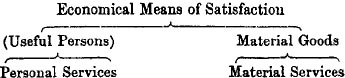
And now it is a question of appropriate terminology to which of these categories the name “Good” should be attached. Personally I believe that the science has great need of one short expression which would embrace all kinds of means of satisfaction. Now, since the word “good” is quite suitable for this purpose, and has already long been used for this purpose, I see no reason why it should now be deposed. Of course there is quite as strong a need to keep the material services in their turn separate from the material goods which bear these services. But this can be done, both simply and sufficiently, by instituting the distinction, inside the universal conception of the “Good,” between “Material Goods” and “Material Services.”—Things like Rights, Relations, Properties, would, for good reasons, find no room even in the widened conception.
14 The perception of the above is made very difficult by the usual method of valuation according to “Costs” which, naturally, is always directed to the unit of goods as a whole (see my Rechte und Verhältnisse, p. 64, note 1). The reader, however, who has followed our conception of what the nature of the law of costs is, and has, consequently, recognised that, even where goods seem to get their value from their costs, the utility of the goods always stands in the background as the true source of value, and that, in any case, the “costs” must always be in harmony with the—independently established—marginal utility of the goods, will not be misled by any appearance to the contrary. Even in the consideration, for instance, of whether a durable good in general is worth its cost, and whether, consequently, we should produce or buy it, we must form an opinion to ourselves as to its utility, and I should be puzzled to know how this opinion is to be formed if not on the basis of the value which the material services of the good—singly and taken together—have for us.—On the whole question treated in the text see also my Rechte und Verhältnisse, pp. 61-68.
15 These figures are based on the assumption that the whole year’s utility is obtained all at once, and, indeed, obtained in anticipation at the beginning of the year; e.g. by hiring the good at a year’s interest of 100 payable on each 1st January. If, on the other hand, the year’s use can only be had at the end of the year, a valuation undertaken at the beginning of the year will show figures not inconsiderably lower. That is to say, on 1st January 1888, the present year’s use which will be obtained only by 31st December,—that is, practically, a whole year later,—will not be valued at the full 100, but at 95 “23 only; and again the “next year’s use,” that obtainable 31st December 1889,—that is, practically, two years later,—will be valued at 90·70, and so on. Now this shows, for the whole good, a sum of value of 95·23 + 90·70 + 86·38 + 82·27 + 78·35 + 74·62 = 507·55. If, finally, the utility were always obtainable in the middle of the year, or, what comes to the same thing, were to be spread equally over the whole year, the figures would be—for a valuation taken on the 1st January—97·56 + 92·85 + 88·38 + 84·12 + 80·07 + 76·21 = 519·19.—That the figures should alter according as the date of the valuation stands nearer or farther from the date of obtaining the utility, is an entirely natural thing, and one quite familiar in financial life. The value of paper—which is just a “durable good” with annual uses—always stands a little higher shortly before the interest or dividend terms than some time before. I may note that the above figures are taken as before from Spitzer’s Tables, and are based on an interest rate of 5%.
16 On the part return of 100, which was separated off from the good on the first day of the year, the good naturally will no longer yield any interest. If, on the other hand, the year’s utility is only obtainable at the end of the year, it must naturally pay interest on the full initial value of the bearer of the utility, as will be brought out somewhat more fully later on.
17 Of 354·58, because again the 100 taken off at the beginning of the year—which may independently obtain interest—need no longer obtain interest through the good.
18 If the year’s service can be obtained only at the year’s end, the figures of the valuation, and with them the figures of the interest, will be altered, but the principle of the process, and, in particular, the reduction of value by the amount of the then last service, remains unchanged. I shall put together in the following tables the course of the value movement for one such case. The initial value of a good which will last six years, and has an annual utility, obtainable at the end of the year, of 100, is, as stated above (p. 343 in note), equal to 95·23 + 90·70 + 86·38 + 82·27 + 78·35 + 74·62 = 507·55.
|
Value on |
Value on |
Gross |
Wear and |
|
Year. |
1st Jan. |
31st Dec |
Int. |
Tear. |
Net Int. |
1888 |
507·55 |
432·93 |
100 |
74·62 |
25·38 |
1889 |
432·93 |
354·58 |
100 |
78·35 |
21·65 |
1890 |
354·58 |
272·31 |
100 |
82·27 |
17·73 |
1891 |
272·31 |
185·93 |
100 |
86·38 |
13·62 |
1892 |
185·93 |
95·23 |
100 |
90·70 |
9·30 |
1893 |
95·23 |
__ |
100 |
95·23 |
4·77 |
19 See Capital and Interest, p. 194, and particularly p. 233.
20 A very noteworthy fact, which theory up till now has left entirely without notice and entirely without explanation. I have already called attention to it in my book Rechte und Verhältnisse, p. 68, note 6. As to the actual fact that the successive diminution of value, which a good suffers in the course of its wear and tear, does not go parallel with the degree of its physical wear and tear, but is slower at the beginning and quicker as time goes on, there can be no doubt. It may be seen in its purest form, because there it is not confused through subjective inexactnesses or caprice, in the rating of valuable paper which brings in a fixed annual amount for a limited number of years. A bond, e.g., which assures its owner the right of drawing ten years’ coupons of £1000, and possesses (on a calculation of 5% compound interest) an initial course value of £7722 (Spitzer’s Tables, p. 274), does not lose £772·2 for each of the ten years which make up its lifetime, although in each of these years it loses exactly one-tenth of its content. In the first year it loses £614, in the second £645, in the third £677, and so on successively £710, £747, £783, £823, £864, £907, and, finally, in the tenth year, £952, the sum it was still worth at the beginning of this latter year. But in all other kinds of durable goods the same course of wear and tear may be observed with sufficient accuracy, although, for obvious reasons, we seldom make so exact and mathematical a calculation. Later on I shall have another occasion to mention cases of this kind. Now in all the literature known to me I have found no attempt to give an explanation of this fact,—which is certainly notable enough to deserve explanation. Indeed, such an explanation is simply not to be got from the machinery of previous theories, particularly the “Use theory,” while it offers itself unsolicited on the lines of my theory.
21 See above, p. 343.
22 In Menger’s 2nost valuable contribution Zur Theorie des Kapitales (Conrad’s Jahrbücher, vol. xvü. p. 47), which appeared while this was passing through the press, the author likewise has urged against the Use theory that, in its conception of capitalisation, it has not solved its problems, but only gone round about them.
- 1See Monger’s Grundsätze der Volkswirthschaftslehre, p. 93.
- 2Generally speaking, there are two occasions on which a man is called on to form a judgment as to value. One is on parting with a good in his possession, e.g. in giving it away, or exchanging, or consuming it; the other, on acquiring a good. In the two cases the form which the valuation assumes in thought is, externally, a little different. A good which a man has he values according to the injury which he would suffer by its loss; he values it, therefore, according to the last satisfaction which is assured him by having it. A good which a man has not he values, on the contrary, according to the increment of utility which its acquisition brings; i.e. according to the most urgent among those satisfactions which, in the conditions of his fortunes up till the present time, he has not been able to obtain. Naturally we get the same result by either method, for the final satis-faction which is assured by a good is always identical with the first which would be lost without the good. In the text I have put the formula in such a way that it will sufficiently embrace either method.
- 3See my Capital and Interest, 1890, p. 111.
- 4P. 219 (German edition, p. 266). See also my Hechte und Verhältnisse, p. 51. Innsbruck, 1881.
- 5See Mill’s Principles, i. 1. 2.
- 6If we were to carry our analysis of what man does in production a step further, we might appropriately distinguish three fundamental ways in which the producing man “moves things.” The first is what, for want of a better name, we may call simple movements or changes of place—where men transport entire objects from one locality to another. Thus the miner brings the ore from the depths of the shaft to the upper air; the merchant takes his goods from the place where they are produced to the place where they are demanded and used. The second embraces those movements of parts of one and the same object whereby it experiences a change of form, as when nails are made from iron, statues from marble, pipes from clay, dials from ivory, combs from caoutchouc, tumblers from glass, furniture from wood. The third, and much the most common way, is where different objects are brought together in space to form combinations of matter. These combinations may be merely temporary, or they may be lasting. Instances of the one are where the stamp falls on the coin, the chisel chips at the marble, the carving tool is applied to the wood, the ore put into the furnace, the yarn into the loom, the paper under the printing press, the stuff under the shears, the plough through the clods. Instances of the other are where we build a house out of wood, stone, lime, iron, etc.; where we put together a watch out of wheels, springs, pendula, weights, stop-action and many other things; in fact in manufacture generally. I must warn the reader that this division into three fundamental forms neither has, nor is meant to have, the character of strict scientific classification. Indeed, these forms merge in many instances into one another. Temporary combinations, for instance, are very often half-way to changes of form, and what I have called a simple change of place is at the same time, in a certain point of view, a material combination, a bringing together of the thing moved and the object (personal or impersonal) to which it is moved. This division, however, will make it easier to find our reckoning, and will prove too, if necessary, the correctness of the general characteristics which I have ascribed in the text to productive processes. I mean to say that it is easy to see that every productive activity which one can think of ranges itself under some one of these three fundamental forms, and to that extent it is proved that such an activity must, a fortiori, range itself also under the general formula given in the text, where we have described the nature and method of the production of material goods as the mastery of natural powers by means of putting objects in motion.
- 7Slaatswirthschafiliche Untersuchungen, Munich, 1832, p. 59, and similarly in the second edition of 1874, p. 111. On p. 56 he expressly calls capital “Wealth which brings in income.”
- 8Grundlagen und Ziele dea sog. wissenschaftlichen Sozialismus, 1885, p. 184.
- 9Theory of Political Economy, second edition, London, 1879, p. 242.
- 10Das Geld, first edition, p. 47. In the second edition (1885) the same conception is on the whole retained, but often formulated in a less exact manner. Accordingly, where I do not explicitly mention the contrary, I quote from the more distinct formulation of the first edition.
- 11Elements d’Economie Politique Pure, Lausanne, 1874, p. 213. Launhardt (Mathematische Begründung der Volksvnrthschaftslehre, Leipsic, 1885, § 2) has closely followed Walras.
- 12If we try to represent the classification of our wants by a typical scheme we must, on the principles just laid down, give it something like the following shape:—
- 13THE cases we have hitherto considered have been comparatively easy of interpretation; but practical economic life brings out a great many complications which the practical man treats with easy assurance, but the theorist finds considerable difficulty in explaining. To understand these everything depends on the correctness of our casuistical decision as to that amount of utility which, in* the given circumstances, is the marginal utility. For this purpose the following general direction may serve as master-key to all the more difficult problems of value. We must look at the economic position of the person who is estimating the value of a good from two points of view. First, we must in thought add the good to his stock, and consider what further and lesser concrete wants can now be satisfied. Second, we must in thought deduct the good from his stock, and consider again what concrete wants will still be satisfied. In the latter case, of course, it becomes manifest that a certain layer of wants, viz. the lowest layer, has lost its former pro-vision; this lowest layer indicates the marginal utility that determines the valuation.
- 14When we are told that capital assists in the production of wealth, and then again that it assists in the obtaining of wealth for its owner, we are apt to jump to the conclusion that the two phenomena are intimately and essentially connected, and that the one is the immediate result of the other—that capital can bring wealth to its owner because capital assists in the production of wealth. As a fact, Political Economy has taken up this idea only too readily and too completely. Captivated by the deceptive symmetry that exists between the three great factors of production—Nature, Labour, Capital—and the three great branches of income—Rent, Wage, and Interest—the science, from Say’s day till the present, has taught that these three branches of income are nothing else than the payment for the three factors of production, and that Interest in particular is nothing else than the compensation which capital receives for its productive services when the product is divided out among society. Propounded by various interest theories in various forms this idea has found its most concise and, at the same time, its most naive expression, in the well-known “Productivity theories”—those theories which explain interest directly as the natural fruit of a productive power peculiar to and resident in capital.
- 15The theory of the use of goods I have already gone into at length in Capital and Interest. I there showed that material goods are nothing else than such distinct forms of matter as admit of the natural powers residing in them being directed to human advantage. I showed how the “use” they afford is realised through concrete activities of these natural powers, and, therefore, by real forth putting of power. I showed how a use (Gebrauch or Nutzung) cannot be made of them otherwise than by taking the peculiar forms of the energy of the good at the proper moment, supplying the conditions necessary to render them available where they previously existed in an unavailable form, and then bringing these forms of energy into proper connection with that object in which the useful effect is to take place. On these considerations I based the conception of the “Material Services” (Nutzleistungen) which I believe to be the only one that corresponds with facts, and rejected certain shadowy ideas which connected the old theory of interest with the word “Uses” of goods. What remains for us here is, on the same lines, to lay down certain fundamental ideas as to the origin of material goods.
- 16If we look more closely at the way in which man assists natural processes, we find that his sole but ample contribution consists in the moving of things. “Putting objects in motion” is the idea which gives the key to all human production and its results;—to all man’s mastery over nature and its powers. And this is so simply because the powers reside in the objects. Now when man by his physical powers—the power of moving things—is able to dictate where the object shall be, he obtains a control over the place at which a natural power may become effective; and this means broadly a control over the way and over the time in which it may become effective.
- 17Again I say a control over the time in which a natural power may become effective. This proposition, also, must not be taken too literally. It must not be imagined that natural powers work intermittently; that man can sometimes bring them to a standstill, sometimes set them working again. On the contrary, natural powers are always at work; a natural power not active would be a contradiction in terms. But it is possible that several powers may be so combined that their activities may for a time mutually balance each other, and the resultant be rest—if not complete rest, still some movement so slight that, as regards human purposes, it may be neglected. When this is the case, before any new resultant can emerge that is of interest to man, there must be an entirely different combination of materials and powers. This suggests how man may get control of the point of time at which a definite resultant emerges. It is only necessary for him, by skilful use of his power to move objects, to provide the causes of the desired effect, all but one. So long as this one is not present the conditions are unfulfilled, and there cannot be the desired result. But when at the proper moment he adds the last condition, the movement hitherto held in leash, as it were, is suddenly set free, and the desired effect is obtained at the opportune time. Thus the sportsman moves powder and lead into the barrel of the gun; he shuts the breech; he raises the cock. Each of these things has for long possessed and expressed its peculiar powers. In the powder are present the molecular powers whose energy later on is to expel the shot from the barrel. The barrel now, as formerly, exerts its forces of cohesion and resistance. The trigger which is to let the cock smash down, strains and presses against the spring. Still the arrangement, the disposition of the collective powers, is such that the resultant of their mutual energies is rest. But the sportsman covers the wild fowl with the barrel: there is a slight pressure on the tongue, a little dislocation of the arrangements, and the shot flies.
- 18The variation which Hermann, however, has given must be considered an independent one, and is the fourth reading in arithmetical order given to the conception. He goes back to capital as the source of income, and makes this the object of his definition: Capital, he says, is “every durable foundation of a utility (Nutzung) which has exchange value.” In opposition to the last definition this one includes under the conception of Capital all land, and besides embraces such consumption goods as are durable, like furniture, houses, etc., even if they are personally used by the owners.
- 19A sixth variation comes from Kleinwächter. He finds it a characteristic mark of capital that it lightens the toil of acquisition or productive labour. Now this characteristic appears to him not to belong to all means of production, but only to one category of these, the tools of production, while the matter or materials of production are absolutely passive during the whole production process; they are worked up or used up but give no assistance in working. “Logically,” therefore, “the conception of capital should be limited to tools of production.”
- 20A seventh interpretation has Jevons for its author. It runs parallel to a certain extent with the foregoing. That is to say, Jevons also considers it proved that by capital is to be understood “wealth employed to facilitate production.” But he finds this characteristic in quite another group of concrete goods from that of Kleinwächter. “The single and all-important function of capital,” he says, “is to enable the labourer to await the result of any long lasting work—to put an interval between the beginning and the end of an enterprise” Capital, then, “consists merely in the aggregate of those commodities which are required for sustaining labourers of any kind or class engaged in work. A stock of food is the main element of capital; but supplies of clothes, furniture, and all the other articles in common daily use are also necessary parts of capital.” The true and only capital thus, according to Jevons, is the sustenance of the labourers.
- 21A ninth variation we owe to the distinguished critic of the theory of capital, Karl Knies. It originates in a well-meant attempt to settle the terribly tangled controversy to the satisfaction of everybody. To this end Knies endeavours to construct a conception of capital which will be so wide that the most important of the contending interpretations may find room in it beside each other. The uniting element in the conception he imagines he finds in the devotion of goods to the service of the future. Accordingly he defines the capital of a community as “its available stock of goods (whether for consumption, acquisition, or production) which may be applied to satisfying wants in the future” This definition does, as a fact, afford room both for Turgot’s “saved stocks of goods” and for the “produced means of production” of Adam Smith’s school, as also for all goods embraced in Hermann’s definition as affording the foundation of a durable—and therefore a con-spicuously future—utility.
- 22Quite by itself stands the tenth interpretation, that of L. Walras. He divides all economic goods into “capital” and “income” (revenu). All kinds of goods, irrespective of their destination, which can be used more than once—that is, all durable goods—he calls capital; while all perishable goods are income. Going into details he mentions the following as capital:—Land (capitaux fonders), persons (capitaux personnels), and movable durable goods (capitava: proprement dits or capitaux mobiliers), while he considers food, the raw materials of in-dustrial production, fuel and the like, as income.

