
The Positive Theory of Capital
Chapter IV. Two-Sided Competition
CHAPTER IV
TWO-SIDED COMPETITION
THE case of two-sided competition is the most common in economic life, as it is the most important in the development of the Law of Price. It demands, therefore, our most careful attention.
The typical situation which the present case assumes may be represented by the following scheme. It shows us ten buyers and eight sellers, each of them wishing to buy or sell a horse, and it tells us at the same time the degree of the subjective valuation put upon the horse by each of the exchangers. It will be seen that the figures which represent these valuations are very different, and this exactly corresponds with facts. Indeed, the individual relations of want and provision for want, which regulate subjective value, are so very various that it would be difficult to find two persons who had an entirely similar opinion about the value of any one thing.
BUYERS. |
SELLERS. |
||||||
A1 values a horse at . . £30
|
B1 values a horse at . . £10 (and will sell at any price over) |
||||||
|
|
||||||
A2 |
” |
” |
£28 |
B2 |
” |
” |
£11 |
A3 |
” |
” |
£26 |
B3 |
” |
” |
£15 |
A4 |
” |
” |
£24 |
B4 |
” |
” |
£17 |
A5 |
” |
” |
£22 |
B5 |
” |
” |
£20 |
A6 |
” |
” |
£21 |
B6 |
” |
” |
£21:10s. |
A7 |
” |
” |
£20 |
B7 |
” |
” |
£25 |
A8 |
” |
” |
£18 |
B8 |
” |
” |
£26 |
A9 |
” |
” |
£17 |
|
|
|
|
A10 |
” |
” |
£15 |
|
|
|
|
To complete the scheme, it must be added that all the competitors appear simultaneously in the one market; that all the horses offered for sale are of equal quality; and, finally, that the buyers and sellers make no mistake about the actual state of the market, such as would prevent them from really pursuing their own egoistic interests.1 We ask now, What will happen in this situation?
The circumstances of A1 are such that he considers a horse to be worth £30 to him; it would therefore be to his advantage to buy even at £29; and it is quite certain that any of the eight sellers would be glad to sell him a horse at a price so advantageous to them. But, evidently, A1 would be a very poor business man if he rashly bought at such a high price. For his self-interest demands from the exchange not merely a profit, but the greatest possible profit. Instead, then, of buying at the highest price—which, all the same, he might do in the worst possible case—he will prefer to begin by offering a price as low as his least capable rivals, and will only raise his offer when, and in the degree that, it is necessary to save himself from being shut out of the market.
In the same way B1, who, economically, could quite well sell at a price of £11, and at that price could very easily find buyers, will carefully hold back from offering his horse at the lowest figure which he would accept, and will not reduce his price below what he must take if he is to keep his place in the competition. It may be assumed, then, that the transaction will begin with the buyers holding back and offering low prices, and with the sellers holding back and asking high prices.2
Suppose the buyers begin with an offer of £13. It is at once clear that—putting aside the case of gross error as to the condition of the market—the buying cannot be concluded at this price. For at £13 all the ten buyers would be willing to buy, since all of them put a greater value on the horse than £13; but, at that price, only two horses, those of B2 and B2, could (economically) be offered for sale. Now evidently B1 and B2 would be very poor sellers if they did not make use of the active competition of buyers to raise their price, and the others would be as poor buyers if they let the best chances of purchasing be snatched away by two of their members without attempting to obtain the preference by bidding a price somewhat higher, but still advantageous to themselves. Exactly, then, as in the case discussed in last chapter, the surplus buyers will be weeded out by means of mutual overbidding. How long will this weeding process go on?
At any price under £15 all ten buyers can compete. From that point the least capable competitors must, one after another, withdraw from the competition. At £15 A10 is knocked out, at £17 A9, at £18 A8, at £20 A7. But as the bids rise on the one side, the number of those sellers who, economically, become capable of selling increases on the other side. At any price above £15 B3 may seriously think about selling, above £17 B4, and above £20 B5. Thus the marked disproportion, which existed at first between the horses demanded and the horses actually offered for sale, is gradually reduced. At £13 there was an effective demand for ten horses, and only two could, economically, be offered; while, at any price over £20, only six horses are demanded and five offered, the majority of buyers over sellers being thus reduced to one. So long, however, as the rival buyers are in the majority, and this fact is accurately known in the market, there can be no final settlement. For, on the one hand, the sellers have always the chance, and the temptation, to take advantage of the excess of buyers and stand out for higher prices; and, on the other hand, the mutually opposed interests of the rival buyers compel them to bid still higher against each other. Obviously, A6 would scarcely consult his own interests if he were calmly to look on while his five rivals went off with the five cheapest horses, and left him no chance of an exchange, and, therefore, no chance of a profit.3 But, at the same time, no one of these rivals would allow A6 to purchase one of the five horses most “strongly “offered for sale. For, if so, the man who withdrew in favour of Ag might indeed purchase a horse, but only under less favourable conditions—the conditions, that is, offered by the most conservative sellers B0, B7, and B8, and at a price which, at least, exceeds the subjective valuation of £21:10s. that B6 puts on his horse. Thus if the buyers know their own interests, the whole body of them will feel impelled to continue their bidding against each above the level of £20.
Finally, the situation becomes essentially different when the rising bids have reached the limit of £21. At that price A6 is compelled to cease bidding, and there are now only five sellers against five buyers. These buyers can all be satisfied simultaneously, and there is no occasion for further com-petition among themselves: on the contrary, as against the sellers, their common interest is to close at the lowest possible price. The bidding of buyers against each other, which hitherto has prevented the final settlement, now comes to an end, and the bargains may be concluded at the price of £21. But they need not be concluded at that price. The sellers may possibly be stiff and refuse £21, in hope of a still higher offer. “What will happen in this case? First of all, the buyers, rather than have a fruitless errand and go away without making any exchange, will bid higher. But their limit is now very near at hand. If the sellers stand out for a price above £22, A5 must give up all idea of purchase, and there will be five sellers against four buyers. One of the sellers, then, will have to fall out, and as no one would care to be that seller there will—from motives quite analogous to those which before prompted the surplus buyers to overbid each other—ensue a mutual underselling among the surplus sellers, till such time as the fifth seller meets a buyer: this will be the case some-where under the limit of £22.4
Indeed, in the present case, the limit must go still lower. So long as a price over £21:10s. was possible, there would be a sixth possible seller in the person of B6; this would give the sellers a majority of one over the five buyers, and compel them to offer under each other, if they are not to be shut out from the exchange. In this competition the weakest must first go to the wall, and this fate will overtake B6 the moment that his rivals are content to take a price below the level of £21: 10s.—at which figure the number of competitors on either side will be equalised, and the level of price found at which the competition may cease. Thus assuming, as we do in this illustration, that each competitor knows what is the condition of the market, and intelligently follows his own interests, the limits within which the price must necessarily be determined are narrowed to £21 and £21:10s.; those being the only limits within which there occurs the relation favourable to the final settlement—that all who are able to take a share in the business find it their advantage to do so, while all who do not find it their advantage, the unsuccessful competitors, have no power to prevent the others from coming to terms.5
Let us try now to apply the results of these lengthy analyses to our theory of price.
We notice, first, that what decides success in two-sided competition is, as in the case of one-sided competition, the degree of “capability “for exchange. On either side it is the most capable competitors who come to terms, namely, those buyers who put the highest value on the commodity (A1 to A5), and those sellers who put the lowest value (B1 to B5), while all less capable competitors are excluded. And, indeed, if we look more closely, we shall find that the series of successful competitors includes all competing pairs, arranged by capability, between whom there exists the relation necessary for exchange, viz. that the buyer considers the commodity worth more than the seller does. In our illustration AB considers B9’s horse worth more than B5 himself does, and, accordingly, they can exchange with each other.6 Ag, on the other hand, values the horse of B6 at £21 only, while B0 values it at £21: 10s., and therefore they cannot come to terms—and still less can those competitors who are less capable.
Very closely related to the grounds on which are decided the successful competitors in the struggle of competition are, secondly, the grounds on which is decided the market price that results from this struggle. This price—to recur to our illustration—cannot, in any case, be higher than the valuation of A5, nor less than that of B5; otherwise the fifth buyer in the one case and the fifth seller in the other would not have come to terms. But, again, the price cannot in any case be higher than the valuation of B6, nor less than that of Ag; otherwise in the former case a sixth buyer would begin competing with the other five buyers, and in the latter case a sixth seller competing with the other five sellers; the equilibrium would thus be destroyed, and the overbidding and under-offering would inevitably be continued till such time as the price was forced within the limits already indicated.
To put these results in general form:—In two-sided competition the market price is determined within a latitude of which the upper limit is constituted by the valuation of the last buyer who actually exchanges (the last buyer) and that of the most capable seller excluded (the first excluded seller), and the lower limit by the valuation of the least capable seller who actually effects a sale (the last seller) and that of the most capable buyer excluded (the first excluded buyer). The meaning of this double limitation is that, in every case, it is the narrower limit that decides.7 If, finally, we substitute the short and significant name of “Marginal Pairs “for the detailed description of the four parties whose competition determines the price, we get this very simple formula: The market price is limited and determined by the subjective valuations of the two Marginal Pairs.
This suggests a number of reflections.
The first thing that strikes us is the analogy between the formation of price and the formation of subjective value. We saw that the subjective value of any good, unaffected by the more important uses to which single members of the same stock might be put, was a “marginal value”—a value determined by the good’s marginal utility, or that utility which stands on the very limit of the economically permissible. Now we see that every market price is a “marginal price”—a price determined by the economical relations of those competing pairs which, also, stand on the very limit of exchangeability It is easy to see that the analogy here is no chance coincidence, but one that results from closely-related and internal causes. In the case of subjective valuation, the motive of economical advantage demanded that the available stock of goods should be employed in satisfying the wants that stood highest on each man’s scale, the last of the wants thus supplied indicating the “marginal utility.” In the case of the formation of price, the motive of the competitors’ economical advantage demands that the pairs which are most capable on the scale of competitors should come to terms, and one of these again is the last, the “marginal pair.” In the former case, the provision for all satisfactions more important than the marginal utility was assured without the particular good whose value was the subject of discussion, and the only utility dependent on this latter good was the last, the marginal utility. In the latter case, all the contracting pairs more capable than the marginal pairs may come to terms at prices higher or lower, and here again it is only the fate of the last, the marginal pair, that depends on the price just reaching a definite height, neither greater nor less. And, finally, as in the former case the importance of the last dependent want, in virtue of its dependent relation, gave the good its value, so, in the latter case, the economical circumstances of the last dependent pair—here also in virtue of their dependent relation—confer on the commodity its price.
But this analogy does not exhaust the connections between price and subjective value. Of still greater consequence is the fact that price, from beginning to end, is the product of subjective valuations. Look back over what we have said. It is the relation of the subjective valuation of commodity and price-equivalent which decides the persons who may consider it worth their while to compete, either as buyers or sellers; that is to say, decides which parties are “capable of exchange.” It is the same relation which decides on the degree of each competitor’s capability of exchange. With perfect exactness it decides for each man the figure at which his advantage calls him to join in the competition, and it decides, at the same time, the limit at which he is beaten and obliged to withdraw from it. As further result, it decides the parties who, among the most capable competitors, actually come to terms; it decides to which pair falls the role of being marginal pair; and, finally, it decide» on the price at which the bargains are concluded in the market. Thus, as a fact, in the whole course of the formation of price—so far as it is conducted on purely egoistic principles—there is not a single phase nor feature which is not traceable, wholly and entirely, to the position of subjective valuations as its cause. And this is at bottom perfectly natural. For, as we know, these subjective valuations point out whether any importance, great or little, attaches to a good as regards our economic wellbeing, and how great the importance is; and, consequently, these valuations, wherever we acquire or part with goods solely with regard to our economic wellbeing, mark out the natural, indeed the only possible compass of our transactions. We are, therefore, fully justified in defining price as the resultant of subjective valuations put upon commodity and price-equivalent within a market.8
Of course it is a resultant of a peculiar kind. The amount of price is not the resultant of the sum, or of the average of all the valuations that come to the surface: in the formation of price these take very different shares. One class of them has no effect on price at all; viz. those valuations made by all the unsuccessful competitors except the most capable pair. It is all the same whether there are no such valuations, or whether there are scores of them in the market: they make not the slightest difference on the resultant price. In our illustration, whether there are unsuccessful buyers A7 to A10 or not, whether the category of the unsuccessful is composed of them alone, or of a hundred others besides,—so long as they cannot bid more than £20, it is easy to show that the resultant price will always run between £21 and £21:10s. The excluded competitors may increase the congestion of the market, but they are not factors in that condition of the market which determines the formation of price.9
A second group plays a very peculiar part in this resultant, viz. that consisting of the valuations of all the contracting parties who actually come to terms, exclusive of the last. What they do is simply to bind and neutralise each other. Recur again to our typical illustration. If we inquire what, for instance, the presence of A1 contributes to the formation of price, we find that he takes up one member of the opposing series, namely, B1 with the result that now the formation of price proceeds exactly as if neither A1 nor B1 were in the market. Similarly it is not difficult to see that the efficiency of A2, A3, and A4 simply consists in cancelling the efficiency of B2, B3, and B4: if they are in the competition the resultant price falls between £21 and £21:10s.; if they were all absent A5 and B5 would still make their exchange at a price between £21 and £21:10s. And it is worth emphasising that the degree of the subjective valuations made in this group is quite indifferent to the result. A^ for instance, whose valuation, in our scheme, is put down at £30, would cancel B1 not less thoroughly if his valuation amounted to only £25 or £22; and, conversely, suppose that his estimate were £200 or £2000, of this enormous amount absolutely nothing would affect the resultant price except the sum, in any case, absorbed in neutralising B1
If, however, the valuations of this group have no direct influence on the formation of price, it cannot be said that they are quite without effect. When the valuations of A1 to A4 cancel those of B1 to B4 they have a twofold result. First, they prevent any stronger seller than B5 getting into the marginal pair which immediately determines the price. And second, they prevent the strongest sellers from cancelling the next strongest buyers—as they might do if not cancelled already—and they thus prevent any weaker member of the buying series than A5 from getting into the marginal pair.10 The part played by all those exchanging pairs who are stronger or more capable than the last may therefore be accurately characterised in the following words: Their valuations con-tribute nothing directly to the formation of the resultant price, but they do indirectly, in so far as they neutralise each other, and thus reserve the role of marginal pair for another couple.
Finally, the real decision of price lies exclusively with a third group, and that a small one—the valuations of the two marginal pairs. All weaker competitors being, absolutely, without influence, and all stronger ones cancelling each other, they and they alone are the directly effective components, and the market price is their resultant.
At first sight it may appear strange that so few persons, and those so little conspicuous, should decide the fate of the whole market, but on closer examination this will be found quite natural. If all are to exchange at one market price, the price must be such as to suit all exchanging parties; and since, naturally, the price which suits the least capable contracting party suits, in a higher degree, all the more capable, it follows, quite naturally, that the relations of the last pair whom the price must suit, or, as the case may be, the first pair whom it cannot suit, afford the standard for the height of price.11
12 If, e.g., a buyer erroneously imagines the number of horses brought to market to be much less than it really is, it may very well happen that he hastily consents to pay a higher price than he would have found necessary if he had given better attention to his own interests. The influence of errors like this on the formation of price must not, of course, be overlooked in a theory of price, but where we are merely trying to bring out the simplest fundamental law it is not necessary to go into such details. See Grundzüge, as before, part ii. p. 486.
13 The more experienced both parties are, and the more familiar with the condition of the market, the shorter will be the time spent in “trying the market “by preliminary offers. In an old and well-organised market competitors will save themselves the trouble of making offers that are not meant to be taken, and will make their first offers at least somewhere near that zone within which the market price will finally be fixed. The extreme limit of this curtailment is given in the “fixed prices “of sellers. In this case, trying the market is entirely dispensed with, and sellers undertake at one throw, as it were, to hit the very zone into which the condition of the market will force the price. They must try to hit this zone quite exactly; for if they put the price lower they lose their profit, while if they put it higher the buyers in the market get supplied by other competitors, and the sellers are left with their commodities. Fixed prices, however, are less common in the open market than in shops, where selling is never conducted under the full pressure of competition, and where, consequently, any mistake in the price asked is not so hazardous.
14 If the horses of B1 to B5 are sold, the most capable seller remaining is B6, who values his horse at £21:10s.—that is, higher than A6. As we know, then, an exchange between A6 and B6 is economically impossible, and the same is true a fortiori of the less capable sellers Bj and B8.
15 It need scarcely be said that the gradual bidding up of buyers, and the gradual under-offering of sellers, do not usually take place in two separate and succeeding stages, but generally occur simultaneously.
16 In the nature of things the result shown in our abstract scheme will be the more exactly realised in practice, the better known the total condition of the market is to all interested; that is to say, the more organic the market, and the more publicly the negotiations are conducted. Where, on the other hand, as is usually the case, transactions are conducted in groups that are, indeed, in communication, but are yet somewhat separated from each other either in space or time, the relations of competition that would prevail over an entire market will, naturally, not be quite active in the single groups, and this has for result that the prices formed in the single groups are frequently only more or less approximate to the ideal market price represented in our scheme, without necessarily exactly coinciding with it.
17 Or with one of the more capable competitors, but in no case with a weaker one. See more exactly on this point in my Orundsuge, p. 499.
18 In our illustration it is the valuation of the excluded parties A6 and B„. If, however, the valuation of A„ instead of being £21, had been £19, and that of B„ instead of £21:10s., had been £23, the limits would have been determined by the valuation of the last pair who actually came to terms: the price would have been fixed between £20 and £22.
19 Sax, who, in his theory of value and price, stands wholly and entirely on the foundation laid by Menger, repeatedly and with emphasis characterises market price as an “average of individual values” (Theoretische Grundlegung der Staats-wirthschaft, p. 276 and passim). This expression, if given without commentary, is exceedingly unfortunate, indeed directly misleading. As may be seen from what follows above (and more exactly from what I wrote in my Grundzüge, pp. 505 and, particularly, 522), the characteristic thing, on the contrary, as regards the resultant price, is that it is not an “average” in the usual sense of the word.
20 At least under the assumption distinctly made in our inquiry, that the competitors who appear in the market have a correct knowledge of the condition of the market. If we depart from this assumption, the appearance of more than a hundred demanders might give rise to the erroneous opinion that there may be among them a great many persons of higher ‘ ‘ capability, “and this might mislead the few capable competitors who are present into rashly making higher offers.
21 To show this, suppose we leave A1 to A4 out of our illustration. The position of the parties, then, is as follows:—
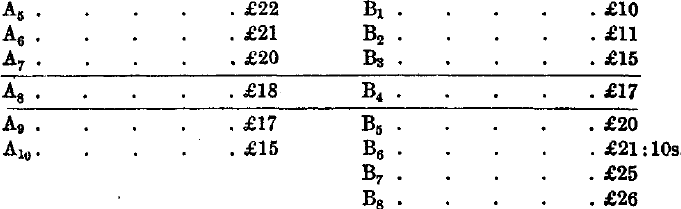
Here we see that the last pair within which the economical conditions of exchange are present consists of A8 and B4. The buyers, therefore, are now represented in the decisive marginal pair by a weaker member, the sellers by a stronger one. Accordingly the limit of price, which in the last case stood between £21 and £21:10s., moves down to between £17 and £18.
22 Students of economic literature will not fail to notice an interesting relation in which the above theory stands to certain doctrines that have for long obtained full recognition. When Thünen—and with him the whole body of economic doctrine—said that the rate of interest was determined by the productivity of the “portion of capital last applied,” and the rate of wage by the return of the “last worker employed in the undertaking”; or when, much earlier, the question as to which, among several costs, regulates market price was decided in favour of the “highest costs of production that were still necessary to provide for the market,” i.e. in favour of the “last seller,”—we recognise in all these, without difficulty, adaptations to special cases of the same principle on which we have built the doctrine of marginal utility and the theory of the formation of price. The only thing is that at that time economists were not yet conscious of the universal importance of these peculiar lines of thought. They meant simply to state a couple of special rules of limited range, while in reality they had hit upon the dominating Leitmotiv, which underlies the entire mechanism of industry carried on under the guidance of self-interest, and which, therefore, runs through the entire formation of value and price.
- 1See Monger’s Grundsätze der Volkswirthschaftslehre, p. 93.
- 2Generally speaking, there are two occasions on which a man is called on to form a judgment as to value. One is on parting with a good in his possession, e.g. in giving it away, or exchanging, or consuming it; the other, on acquiring a good. In the two cases the form which the valuation assumes in thought is, externally, a little different. A good which a man has he values according to the injury which he would suffer by its loss; he values it, therefore, according to the last satisfaction which is assured him by having it. A good which a man has not he values, on the contrary, according to the increment of utility which its acquisition brings; i.e. according to the most urgent among those satisfactions which, in the conditions of his fortunes up till the present time, he has not been able to obtain. Naturally we get the same result by either method, for the final satis-faction which is assured by a good is always identical with the first which would be lost without the good. In the text I have put the formula in such a way that it will sufficiently embrace either method.
- 3See my Capital and Interest, 1890, p. 111.
- 4P. 219 (German edition, p. 266). See also my Hechte und Verhältnisse, p. 51. Innsbruck, 1881.
- 5Cossa [La Nozione del Capitale), Saggi di Ee. Pol., p. 157, has the definition: “Capitale è un prodotto impiegato nella produzione.” Ricca-Salerno (Sulla Teoria del Capitale, 1877, p. 51) says: “Il capitale è ricchezza prodotta applicata alla produzione.” Rodbertus, whose opinion I am inclined to put particularly high, because, although not altogether happy in his solution of the problems of capital, he had an insight into its essence such as scarcely any one before him had, explains (Das Kapital, p. 234, also Zur Beleuchtung der soz. Frage, p. 98) that “Capital (materials and tools) is product which serves for still further production.” A. Wagner, also, who has done good service in the theory of capital (Grundlegung, second edition, p. 38), calls capital a “Stock of economical goods, which serve as instruments to the making or acquiring of new economical goods.” In the most recent Italian monograph on capital, Supino (Il Capitale nell’ Organismo Economico e nell’ Economia Politica, 1886, pp. 9 and 17) defines capital again as “Il prodotto del lavoro passato che serve a produzione successiva,” or as “ricchezza impiegata produttivamente allo scopo di ricavarne un profitto.” Of other prominent modem writers may be mentioned Pierson (Leerboek der Staathuishoudkunde, Haarlem, 1884, p. 157); Schönberg (Handbuch, second edition, p. 209), “Capital is a material means of production, obtained by human labour, which, employed as such, is destined to give a return to its owner”; E. Sax (Grundlegung der theoretischen Staatswirth-schaft, pp. 115, 315, 323, etc.) Of recent French writers on the subject Gide (Principes d’Économie Politique, Paris, 1884) recognises the two varieties in the conception of capital with a clearness rare even in French literature, and distinguishes them as “capitaux simplement lucratifs” and “capitaux productifs.” “Les premiers,” he says, “sont ceux que rapportent un revenu á une personne; les seconds sont ceux qui prodnisent one richesse nouvelle dans le pays” (p. 148). His only failure is that he would recognise productive capitals alone as “true” capitals.In English literature our conception of capital (without, of course, any clear distinction being kept between its two varieties) is almost exclusively the prevailing one; this is so well known that I may spare quotations. Generally speaking, it is very significant of the state of “public opinion” in the matter that not long ago Kleinwächter (Schönberg’s Handbuch, second edition, p. 210) could explain “Common usage in political economy to-day considers it an essential characteristic of capital that it is a material means of production.” The only difference of opinion is as to whether land should be reckoned as capital or not. Finally, I think I may ventare to express the opinion that even the fore-most representative of a rival definition, Knies, is in opposition to us more in form than in matter. It is he at any rate who has, in a masterly manner, developed the idea—the really important one in our statement of the conception—that, in defining capital, we must define that which is the object of those problems that “have appeared on the scene under the name of capital” (Das Odd, p. 19).
- 6See Mill’s Principles, i. 1. 2.
- 7If we were to carry our analysis of what man does in production a step further, we might appropriately distinguish three fundamental ways in which the producing man “moves things.” The first is what, for want of a better name, we may call simple movements or changes of place—where men transport entire objects from one locality to another. Thus the miner brings the ore from the depths of the shaft to the upper air; the merchant takes his goods from the place where they are produced to the place where they are demanded and used. The second embraces those movements of parts of one and the same object whereby it experiences a change of form, as when nails are made from iron, statues from marble, pipes from clay, dials from ivory, combs from caoutchouc, tumblers from glass, furniture from wood. The third, and much the most common way, is where different objects are brought together in space to form combinations of matter. These combinations may be merely temporary, or they may be lasting. Instances of the one are where the stamp falls on the coin, the chisel chips at the marble, the carving tool is applied to the wood, the ore put into the furnace, the yarn into the loom, the paper under the printing press, the stuff under the shears, the plough through the clods. Instances of the other are where we build a house out of wood, stone, lime, iron, etc.; where we put together a watch out of wheels, springs, pendula, weights, stop-action and many other things; in fact in manufacture generally. I must warn the reader that this division into three fundamental forms neither has, nor is meant to have, the character of strict scientific classification. Indeed, these forms merge in many instances into one another. Temporary combinations, for instance, are very often half-way to changes of form, and what I have called a simple change of place is at the same time, in a certain point of view, a material combination, a bringing together of the thing moved and the object (personal or impersonal) to which it is moved. This division, however, will make it easier to find our reckoning, and will prove too, if necessary, the correctness of the general characteristics which I have ascribed in the text to productive processes. I mean to say that it is easy to see that every productive activity which one can think of ranges itself under some one of these three fundamental forms, and to that extent it is proved that such an activity must, a fortiori, range itself also under the general formula given in the text, where we have described the nature and method of the production of material goods as the mastery of natural powers by means of putting objects in motion.
- 8Slaatswirthschafiliche Untersuchungen, Munich, 1832, p. 59, and similarly in the second edition of 1874, p. 111. On p. 56 he expressly calls capital “Wealth which brings in income.”
- 9Grundlagen und Ziele dea sog. wissenschaftlichen Sozialismus, 1885, p. 184.
- 10Das Geld, first edition, p. 47. In the second edition (1885) the same conception is on the whole retained, but often formulated in a less exact manner. Accordingly, where I do not explicitly mention the contrary, I quote from the more distinct formulation of the first edition.
- 11“It does not represent commodities in any way whatever, but only the power its owner has of purchasing what he wants” (Elementi of Political Economy, 1858, pp. 66 and 69).
- 12If we try to represent the classification of our wants by a typical scheme we must, on the principles just laid down, give it something like the following shape:—
- 13THE cases we have hitherto considered have been comparatively easy of interpretation; but practical economic life brings out a great many complications which the practical man treats with easy assurance, but the theorist finds considerable difficulty in explaining. To understand these everything depends on the correctness of our casuistical decision as to that amount of utility which, in* the given circumstances, is the marginal utility. For this purpose the following general direction may serve as master-key to all the more difficult problems of value. We must look at the economic position of the person who is estimating the value of a good from two points of view. First, we must in thought add the good to his stock, and consider what further and lesser concrete wants can now be satisfied. Second, we must in thought deduct the good from his stock, and consider again what concrete wants will still be satisfied. In the latter case, of course, it becomes manifest that a certain layer of wants, viz. the lowest layer, has lost its former pro-vision; this lowest layer indicates the marginal utility that determines the valuation.
- 14When we are told that capital assists in the production of wealth, and then again that it assists in the obtaining of wealth for its owner, we are apt to jump to the conclusion that the two phenomena are intimately and essentially connected, and that the one is the immediate result of the other—that capital can bring wealth to its owner because capital assists in the production of wealth. As a fact, Political Economy has taken up this idea only too readily and too completely. Captivated by the deceptive symmetry that exists between the three great factors of production—Nature, Labour, Capital—and the three great branches of income—Rent, Wage, and Interest—the science, from Say’s day till the present, has taught that these three branches of income are nothing else than the payment for the three factors of production, and that Interest in particular is nothing else than the compensation which capital receives for its productive services when the product is divided out among society. Propounded by various interest theories in various forms this idea has found its most concise and, at the same time, its most naive expression, in the well-known “Productivity theories”—those theories which explain interest directly as the natural fruit of a productive power peculiar to and resident in capital.
- 15The theory of the use of goods I have already gone into at length in Capital and Interest. I there showed that material goods are nothing else than such distinct forms of matter as admit of the natural powers residing in them being directed to human advantage. I showed how the “use” they afford is realised through concrete activities of these natural powers, and, therefore, by real forth putting of power. I showed how a use (Gebrauch or Nutzung) cannot be made of them otherwise than by taking the peculiar forms of the energy of the good at the proper moment, supplying the conditions necessary to render them available where they previously existed in an unavailable form, and then bringing these forms of energy into proper connection with that object in which the useful effect is to take place. On these considerations I based the conception of the “Material Services” (Nutzleistungen) which I believe to be the only one that corresponds with facts, and rejected certain shadowy ideas which connected the old theory of interest with the word “Uses” of goods. What remains for us here is, on the same lines, to lay down certain fundamental ideas as to the origin of material goods.
- 16Again, the solution suggested is the most conservative one. Without laying any particular weight on the fact that the historical origin of the word Capital indicates a relation to an acquisition or a gain, and that our reading remains true to this, it preserves the double relation—the relation to acquisition of interest on the one side, and to production on the other—which was imported into the conception of capital by Adam Smith, and since his time has been adopted in scientific usage. It is no inconsiderable advantage, then, that we do not require to create a majority in its favour by a revolution in terminology; the majority is already with us, and the conception may easily be carried unanimously if we add some new unbiassed members. Here, too, it is worthy of particular attention that those writers who have occupied themselves professedly and most profoundly with the investigation of the conception of capital and its problems, have ended, almost without exception, by adopting exactly the same conception, or at least one which comes very close to it.
- 17If we look more closely at the way in which man assists natural processes, we find that his sole but ample contribution consists in the moving of things. “Putting objects in motion” is the idea which gives the key to all human production and its results;—to all man’s mastery over nature and its powers. And this is so simply because the powers reside in the objects. Now when man by his physical powers—the power of moving things—is able to dictate where the object shall be, he obtains a control over the place at which a natural power may become effective; and this means broadly a control over the way and over the time in which it may become effective.
- 18Again I say a control over the time in which a natural power may become effective. This proposition, also, must not be taken too literally. It must not be imagined that natural powers work intermittently; that man can sometimes bring them to a standstill, sometimes set them working again. On the contrary, natural powers are always at work; a natural power not active would be a contradiction in terms. But it is possible that several powers may be so combined that their activities may for a time mutually balance each other, and the resultant be rest—if not complete rest, still some movement so slight that, as regards human purposes, it may be neglected. When this is the case, before any new resultant can emerge that is of interest to man, there must be an entirely different combination of materials and powers. This suggests how man may get control of the point of time at which a definite resultant emerges. It is only necessary for him, by skilful use of his power to move objects, to provide the causes of the desired effect, all but one. So long as this one is not present the conditions are unfulfilled, and there cannot be the desired result. But when at the proper moment he adds the last condition, the movement hitherto held in leash, as it were, is suddenly set free, and the desired effect is obtained at the opportune time. Thus the sportsman moves powder and lead into the barrel of the gun; he shuts the breech; he raises the cock. Each of these things has for long possessed and expressed its peculiar powers. In the powder are present the molecular powers whose energy later on is to expel the shot from the barrel. The barrel now, as formerly, exerts its forces of cohesion and resistance. The trigger which is to let the cock smash down, strains and presses against the spring. Still the arrangement, the disposition of the collective powers, is such that the resultant of their mutual energies is rest. But the sportsman covers the wild fowl with the barrel: there is a slight pressure on the tongue, a little dislocation of the arrangements, and the shot flies.
- 19The variation which Hermann, however, has given must be considered an independent one, and is the fourth reading in arithmetical order given to the conception. He goes back to capital as the source of income, and makes this the object of his definition: Capital, he says, is “every durable foundation of a utility (Nutzung) which has exchange value.” In opposition to the last definition this one includes under the conception of Capital all land, and besides embraces such consumption goods as are durable, like furniture, houses, etc., even if they are personally used by the owners.
- 20A sixth variation comes from Kleinwächter. He finds it a characteristic mark of capital that it lightens the toil of acquisition or productive labour. Now this characteristic appears to him not to belong to all means of production, but only to one category of these, the tools of production, while the matter or materials of production are absolutely passive during the whole production process; they are worked up or used up but give no assistance in working. “Logically,” therefore, “the conception of capital should be limited to tools of production.”
- 21A ninth variation we owe to the distinguished critic of the theory of capital, Karl Knies. It originates in a well-meant attempt to settle the terribly tangled controversy to the satisfaction of everybody. To this end Knies endeavours to construct a conception of capital which will be so wide that the most important of the contending interpretations may find room in it beside each other. The uniting element in the conception he imagines he finds in the devotion of goods to the service of the future. Accordingly he defines the capital of a community as “its available stock of goods (whether for consumption, acquisition, or production) which may be applied to satisfying wants in the future” This definition does, as a fact, afford room both for Turgot’s “saved stocks of goods” and for the “produced means of production” of Adam Smith’s school, as also for all goods embraced in Hermann’s definition as affording the foundation of a durable—and therefore a con-spicuously future—utility.
- 22If the interpretations just mentioned are divided in opinion as to the goods which should be designated capital, they are, at any rate, all agreed that it is goods that are to bear that name. But, finally, an eleventh reading of the conception calls this in question, and, instead of making capital a real concrete quantity, distils out, as it were, some kind of abstraction as the essence of capital. Thus M’Leod, who sometimes recurs to a favourite metaphor of earlier writers and defines capital as a “stock of accumulated labour,” sometimes goes still deeper in abstraction and defines it as “purchasing power “or” circulating power.” These phrases are not meant as illustrations, but explanations given in full earnest; he gives us to understand this in the most emphatic way by saying, in one place, that the application of the word capital to goods is a simple metaphor, and on another occasion, in so many words, that capital does not represent goods in any way whatever. Quite recently too we have a strikingly similar conception in the suggestive work of a juristic writer, Kühnast. He also tells us emphatically that capital is of an immaterial nature, and does not consist of material objects at all—of goods themselves, that is to say—but only of their value. “Capital is … the value of the productive power contained in material goods … or a complex of productive material values.”

