
The Positive Theory of Capital
Chapter IV. The Market for Capital in its Full Development
CHAPTER IV
THE MARKET FOR CAPITAL IN ITS FULL DEVELOPMENT
UP till this point we have assumed that the annual product of each worker, and also the annual wage, is the same in all branches of employment. Of course, in actual life this is not the case. But that does not in the least disturb the normal connections and relations we have laid down, otherwise than by acting as if there were a somewhat different number of unskilled labourers with ordinary wages and ordinary productivity. For even if the absolute amount of the return to labour on the one hand, and that of the wage of labour on the other, be ever so various in the various branches of employment, still the ratio between these two amounts will, in virtue of the familiar law of equalisation of profits, remain the same all over, and this is the essential matter in the question of Interest. If, for instance, in one branch of production, the wage of unskilled labour be £50, and the product of a year’s labour £65, in another branch, carried on mostly by skilled labour, the worker’s annual product may, perhaps, be double, say £130. But then the wage of such a worker will also rise to double, say to £100. For, if it did not rise, the undertakers in this branch of business would obtain an abnormal surplus; this would attract stronger competition; and competition would either raise wages by creating an active demand for workers, or press down the price of products by increasing supply. But if the wage of the skilled labourer were to rise higher than £100, the undertakers in question would again obtain too small a profit, and the consequent limitation of that branch of production would undoubtedly either press down the wage of workers, who would now have become partly superfluous, or raise the price of the restricted product, till such time as wage and product, here as everywhere, stand in the ratio of £50 to £65, or £100 to £130. But if this ratio between wages and product holds, all the ratios relating to the formation of interest are exactly as they have been assumed to be in our earlier tabular statement, with the single qualification already mentioned, that the existence of better paid skilled labour has exactly the same effect as a somewhat greater number of normally paid unskilled labourers. For, obviously, it is all the same as regards the resultant arrived at in the subsistence market, whether two labourers produce £65 each, and claim £50 each of subsistence, or one labourer produces £130 and claims £100.
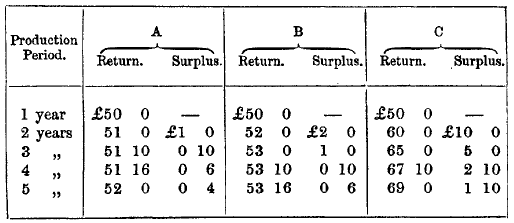
Further, we have assumed up till now that, in all branches of business, the increment of annual return that accompanies the increasing extension of the production period, moves in the same rate of progression. This also is not the case in real life. On the.contrary, each branch of production, in virtue of its technical circumstances, has a different and often, indeed, a very different scale of productivity. It is, for instance, quite possible that three different branches of production—call them A, B, and C—which were each turning out in a one year’s process an annual product of £50, might show an exceedingly divergent return (or surplus return) if the process were extended for two to five years more. We might have something like the following:—
Naturally this has its practical consequences. It is the producers’ interest to obtain the greatest returns or surplus returns. They will, therefore, invest the available capital where they are tempted by the greatest returns. If there is capital over, or if new capital is added, they will look out for the next best paying employments, and so on, in such a way that they will only take a less paying employment when all the more paying chances have been utilised.
Now if, as we have hitherto assumed, the progression of surplus returns obtainable from similar extensions of production were the same in all branches of employment, then, in all branches of employment, the same surplus would be reached by the same length of process, and, consequently, an equally long production period would prevail simultaneously over all employments. As capital increased it would press on, with one united front, from one to two, from two to three years’ production, and so on. But, as we have said, owing to different technical circumstances in the various branches of production, we actually meet the same surplus return in productive periods of different lengths. While, then, in the investing of capital we pursue an isohypse—to borrow a geographical term—of surplus returns, we must diverge from an isohypse of extensions of production. Production in its various branches must be carried on in unequally long processes; and, indeed, in those branches where the surplus return sinks rapidly, it must be carried on in shorter periods.
The above scheme will illustrate this. First of all production is carried on, in all three branches, in a one year’s process with a return of £50 per labour-year. If the subsistence fund increases so much that at least a partial extension over the one year’s period is possible, people will pass first to a two years’ process in branch C, which bears a surplus return of £10 for a half-year’s payment.1 Then the production period will be extended in the same branch C to three years (with a surplus return of £5), and to four years (with a surplus of £2:10s.), while the other two branches of production are all the time persisting in the comparatively unremunerative one year’s process. Only where the subsistence fund increases still further will they pass in branch B to two years’ production (with a surplus return of £2). But in branch A they will not be able to extend the period of their production (which only gives a surplus return of £1), until all opportunities of production have been utilised up to the isohypse of £1. This will only be the case when in branch C the production period has been extended to five years, and in branch B to three years. Production, then, will and must be carried on simultaneously in the three different branches in two, three, and five years’ periods—a conclusion which we see verified in economic practice in the familiar fact that different products are produced with very different degrees of capitalism. Food, for instance, is a much less capitalistic product than metallic goods, or clothing stuffs, or manufacturing products generally.2
How, then, is our law of the rate of interest affected by this complexity of actual circumstances?—It is not disturbed in the least. For all the essential circumstances on which it rests remain unchanged. It is still the case that the existent capital is employed in gradually extending processes till it is fully occupied. It is still the case that there is a certain level of these extensions, yielding a certain surplus return, which is the last economically permissible, and a succeeding level yielding a somewhat less surplus return which is economically not permissible. And, finally, it is still the case that the surplus returns of these “marginal employments” also form the marginal limits of the interest rate. The single difference—and that not an essential one—is that the isohypse of the surplus returns, and with it the line of the last permissible extensions of production, is not a straight line, but runs in an undulatory or zigzag fashion through the different branches of production, according as the same surplus return is reached by them in longer or shorter processes. But this modification gives our law a still sharper power of definition. For as, in consequence of the complexity of actual life, the scale of productivity is much more finely graduated than was our simple typical scheme, the two marginal limits, as a rule, stand much nearer each other, and consequently narrow the zone within which price is determined very much more closely than is shown in our abstract illustration.3
To proceed. Hitherto we have assumed that the demand for present goods comes simply from the wage-earners (either directly or through the mediation of undertakers). But this, again, in actual life is not correct: there are a few other competitors in the market.
There are, first, the suitors for Consumption credit. Their demand is graduated and stratified according to the urgency of their need for present goods.4 One class will be in such pressing need that, in the worst case, they will be glad to offer an agio of 100%: another class will only go the length of 80%: a third will offer 60%: others 50%, and so on down the scale, perhaps, to 2%. Now these suitors join their claims to the demand which comes from the wage-earners, and each class or layer of them is satisfied con-currently with that layer of productive employments yielding a surplus return that represents the same percentage. If, for instance, the investing of capital reaches the isohypse of a surplus of £4 on £21, all those suitors for loans will be satisfied simultaneously who, in the worst circumstances, are able to offer 19·048.% or more: if it reaches the isohypse of a surplus of £2:10s. on £25 all suitors will be served who are willing to offer at least 10%, and so on.
It would be quite erroneous to understand this as meaning that the rate of loan interest is determined simply by the rate of interest obtained in production. It contributes just as much to determine the latter, as it is determined by it. Both classes of demand work in entire co-ordination. The fact that there is a certain class of suitors for consumption loans, and that this class takes a portion of the existent means of subsistence out of the market, involves that there are fewer means at the disposal of productive investors; investment must call a halt at a higher isohypse of surplus returns; and this again involves a higher rate of interest in the sphere of production. Conversely the presence of the productive demand results in a considerable portion of the means of subsistence being claimed for productive purposes, and this again has the result that the wants of consumption credit are not satisfied at such low levels as would otherwise have been the case. In the present day, of course, the productive demand is. so much the more important of the two that one is apt to suppose that it alone rules the rate of interest. But this false impression is now and then sensibly corrected by experience when some great state-loan for consumption purposes—say for a war—makes the general interest rate fly up. But even when the demand for consumption credit is quite insignificant, it does not fail to exert some influence on the rate; it may always be contended that, if it were to disappear, the interest rate would be at least a fraction lower than it is now.
Another competitor in the market for capital is the Landowner. If owners work their own lands, and are content to maintain themselves by the fruits of their labour (whereby they lay past their rent as saving), they are no burden on the subsistence fund of the community. If, however, they live wholly or partially on their rents, their subsistence also must be advanced out of the community’s fund, for a length of time proportional to the production periods in which their land is laid down. Suppose, for instance, that the wealthy cotton planter lives in idleness on his rents, and that the total production process of textiles, including the various stages of spinning, weaving, etc., down to the manufacture of the finished cotton stuffs, takes five years, the maintenance of the planter, just as much as that of his field-worker, must be advanced out of the subsistence fund over five years. The advance will then, of course, be refunded out of that quota of product which—according to the law of complementary goods—is due to the co-operation of the uses of land; but, in the meantime, the landowner lives at the expense of the subsistence fund.
What kind of effect has this on the rate of interest?—Its effect is entirely similar to that of consumption credit. The competition of landowners takes a certain amount of subsistence out of the market; it thus curtails the investment of capital in production, and makes it call a halt at a higher isohypse of surplus returns; and this, finally, keeps up the rate of interest. In doing so, however, the claim-of the landowner on subsistence comes under a reflex influence from the height of the interest rate. This, of course, has no reference to the height of the annual rents—for this is fixed by those circumstances which influence the economic value of uses of land, and need not be mentioned here—but to the number of annual rents for which advances of subsistence are demanded. That is to say; if interest is high, lengthy periods of production are not profitable;5 the uses of land will be invested in comparatively short processes; and, as consequence, the advances made to landowners will only be for short periods. If, however, the interest rate is low, then, concurrently with the increase in production and consumption credit, increases the subsistence advanced to the landowners; it now extends over a greater number of annual rents according as the uses of their land can now be invested in much longer processes.
There is one other competing party in the market, the Capitalists themselves. So far as they live, entirely or partially, on their interest, their maintenance also will be defrayed from the subsistence fund, and, in so far as the fund available for other purposes is thereby contracted, will the interest rate tend to rise. There is, however, one important difference between the claims of the capitalist on subsistence, and those of the wage-earners, the suitors for loans, and the landowners. The claims of the latter are the cause of the agio on present goods: the claims of the former are simply its effect. If the claims on subsistence presented by the wage-earners, borrowers, and landowners did not by themselves alone exceed the existent subsistence fund, there would be no agio on present goods, and, as consequence, the capitalists, as such, could make no valid claim for subsistence on the funds of the community: in default of an income from interest they would have to support themselves by work. It is only because there is an agio, as effect of the other classes of demand, that the capitalists can claim a quota of the product as interest, and claim it indeed in advance. Reflexly, of course, this claim of the capitalists influences the rate of interest. It is exactly as, for instance, in electrical induction. The chief current first calls out the induction current, and then the latter reflexly influences, and indeed strengthens, the chief current. Just in the same way does the demand of the other competing parties in the market, by creating an agio, first call out the claims of the capitalists on subsistence: but, so soon as the agio is a fact, it diverts a portion of the subsistence fund into the income of the capitalists; it thus contracts the disposable remainder; determines the “saturation point,” in the remaining branches, at a higher marginal utility; and so, in the last resort, causes a rise of the agio.
Suppose we try now to unite the scattered features into one picture. In its collective stock of wealth every people possesses a greater or less fund of subsistence. This is consumed definitively by uneconomic persons who waste their parent wealth,6 and by the suitors for consumption credit: it is consumed as an advance by landowners, capitalists, and wage-earners during the social period of production.7 The greater the subsistence fund, the longer can the social period of production be extended, and the more completely can the demands for consumption credit be satisfied. The return of the last extensions of production still possible, and, concurrently, the valuation of the last suitors who obtain loans, determine the height of the agio on present goods.
Consequently, on the basis of our completed inquiries, the following factors emerge as the most important concrete circumstances or “determinants “which influence the rate of interest.
First come the same three factors which from our inquiry into the circumstances of the labour market in its most abstract form we were forced to recognise as decisive:—
1. The amount of the National Subsistence Fund.
2. The number of producers to be provided for out of the same.
3. The position of the scale of surplus returns connected with the increasing extensions of process.
After these come:—
4. The extent and the intensity of the desire for consumption loans.
5. The existence and the height of land rent. The higher that rent is, the more persons there are who can live on their rents without working, and the higher will be the standard of living by which they regulate their maintenance. Naturally, if the amount of subsistence which they take as advances out of the social subsistence fund goes parallel with that standard of comfort, there will be the less for other purposes, and interest will remain at a higher level. The existence of land rent, therefore, tends to enhance the rate of interest.8
6. The existence of a numerous capitalist class living on their interest—for reasons which apply equally to landowners and capitalists.
7. Finally; the economical habits of the population have a great influence directly and indirectly. Indirectly, inas-much as national thrift gathers together a greater stock of wealth: directly, inasmuch as thrifty living diminishes the claims on subsistence, whereby, if subsistence remains constant, the population is maintained for a longer period, and the investment of capital is extended till there is a lower isohypse of surplus returns. If ‘a nation is thrifty, neither landowners nor capitalists will consume all their rents; they will either work as undertakers, and live simply by their own labour, or at least they will save a portion of their income. The portion saved represents, as it were, a certain amount of the subsistence fund allotted but not taken up, and the amount is left free for another employment, particularly for a further extension of the production period. The same is true of savings which the labourers, or such persons as are in possession of a secondary income, are able to make.9
If we pursue this line of thought a little further we shall repair an omission in our former analysis. Hitherto we have considered subsistence fund and subsistence claims as something actually existing and present: we must now consider them in the act of becoming. Hitherto we have looked at the subsistence fund as standing over against, and disputing the claims which the open market made on it: we have still to consider the noiseless but never-ceasing war waged on wealth in each individual economy by the desire of enjoyment. What follows will form both continuation and conclusion of another line of thought on the subject of the formation of capital begun on p. 124.
10 See above, p. 392.
11 See what was said above on p. 334: the two passages mutually supplement each other.
12 See above, p. 394.
13 Sec above, p. 376.
14 Which can be quite easily calculated from our tabular examples. See, too, the close connection of what was said on p. 382.
15 See above, p. 319.
16 Members of the community not here mentioned, as women, children, persons who occupy themselves with the performance of personal services, as artists, officials, domestics, must also, of course, get part of the subsistence fund. But they are not to be counted separately, for the reason that they are not a direct charge on the social subsistence fund, but on the portions secured by the economical classes already mentioned in the text. Violin-players, e.g., receive a portion of the subsistence obtained by concert-goers; the establishment of a rich landowner is supported and paid out of his rent, and so on.
17 I must guard myself against a misunderstanding very apt to occur. What I maintain is that the position of land rent as a form of income—the absorption of a portion of the national product by landowners who live without working,—tends to raise the rate of interest. On the other hand, I do not say that the causes which call forth land rent, and raise it, raise also the rate of interest. On the contrary, the well-known law of Diminishing Returns, according to which (in the absence of technical discoveries or improvements) new additions of capital and labour in agriculture lead to a decreasing surplus return, while it exerts an upward influence on land rent, certainly exerts a depressing influence on interest (see point 3 in the text). The full bearing of my contention is best expressed in this;—that in event of the taking away of private right to land, or heavy and confiscatory taxation of land rent, interest in that community would stand lower than it would otherwise. The causes of land rent, in themselves, would depress interest, but land rent, as one of the shares in the division, through its effects on the division, makes up for a portion of these influences.
18 It may, perhaps, have been noticed that the often-mentioned factor of Insurance or Risk, which plays so great a part in practical life, especially in determining the rate of interest on loans, is missed out in my enumeration. This factor, however, has no place here. For the surplus return which this gives the capitalist, if to all appearance it raises the rate of interest, is in truth no real interest,—no net income accruing from the possession of capital,—but only a replacement for a loss of parent stock which shows itself as unavoidable over a great average of cases.—Finally, from the whole course of my research, it will be self-evident that it was not my intention to introduce exhaustively all the secondary determinants of the rate of interest. I have contented myself intentionally with enumerating the most important of those determinants which come into view as typical if the economical interests of the market are followed without let and hindrance. On the other hand, the influence of motives such as generosity, national prejudice, vanity, etc. (see Conrad’s Jahrbücher, vol. xiii. p. 486) I have purposely left out of account here. See also below.
- 1See Monger’s Grundsätze der Volkswirthschaftslehre, p. 93.
- 2See my Capital and Interest, 1890, p. 111.
- 3The English word “Cattle,” as Knies (p. 7) has rightly remarked, has nothing in common derivatively with our conception.
- 4P. 219 (German edition, p. 266). See also my Hechte und Verhältnisse, p. 51. Innsbruck, 1881.
- 5See Mill’s Principles, i. 1. 2.
- 6If we were to carry our analysis of what man does in production a step further, we might appropriately distinguish three fundamental ways in which the producing man “moves things.” The first is what, for want of a better name, we may call simple movements or changes of place—where men transport entire objects from one locality to another. Thus the miner brings the ore from the depths of the shaft to the upper air; the merchant takes his goods from the place where they are produced to the place where they are demanded and used. The second embraces those movements of parts of one and the same object whereby it experiences a change of form, as when nails are made from iron, statues from marble, pipes from clay, dials from ivory, combs from caoutchouc, tumblers from glass, furniture from wood. The third, and much the most common way, is where different objects are brought together in space to form combinations of matter. These combinations may be merely temporary, or they may be lasting. Instances of the one are where the stamp falls on the coin, the chisel chips at the marble, the carving tool is applied to the wood, the ore put into the furnace, the yarn into the loom, the paper under the printing press, the stuff under the shears, the plough through the clods. Instances of the other are where we build a house out of wood, stone, lime, iron, etc.; where we put together a watch out of wheels, springs, pendula, weights, stop-action and many other things; in fact in manufacture generally. I must warn the reader that this division into three fundamental forms neither has, nor is meant to have, the character of strict scientific classification. Indeed, these forms merge in many instances into one another. Temporary combinations, for instance, are very often half-way to changes of form, and what I have called a simple change of place is at the same time, in a certain point of view, a material combination, a bringing together of the thing moved and the object (personal or impersonal) to which it is moved. This division, however, will make it easier to find our reckoning, and will prove too, if necessary, the correctness of the general characteristics which I have ascribed in the text to productive processes. I mean to say that it is easy to see that every productive activity which one can think of ranges itself under some one of these three fundamental forms, and to that extent it is proved that such an activity must, a fortiori, range itself also under the general formula given in the text, where we have described the nature and method of the production of material goods as the mastery of natural powers by means of putting objects in motion.
- 7Book i. chap. vii. § i.
- 8Slaatswirthschafiliche Untersuchungen, Munich, 1832, p. 59, and similarly in the second edition of 1874, p. 111. On p. 56 he expressly calls capital “Wealth which brings in income.”
- 9Grundlagen und Ziele dea sog. wissenschaftlichen Sozialismus, 1885, p. 184.
- 10If we try to represent the classification of our wants by a typical scheme we must, on the principles just laid down, give it something like the following shape:—
- 11When we are told that capital assists in the production of wealth, and then again that it assists in the obtaining of wealth for its owner, we are apt to jump to the conclusion that the two phenomena are intimately and essentially connected, and that the one is the immediate result of the other—that capital can bring wealth to its owner because capital assists in the production of wealth. As a fact, Political Economy has taken up this idea only too readily and too completely. Captivated by the deceptive symmetry that exists between the three great factors of production—Nature, Labour, Capital—and the three great branches of income—Rent, Wage, and Interest—the science, from Say’s day till the present, has taught that these three branches of income are nothing else than the payment for the three factors of production, and that Interest in particular is nothing else than the compensation which capital receives for its productive services when the product is divided out among society. Propounded by various interest theories in various forms this idea has found its most concise and, at the same time, its most naive expression, in the well-known “Productivity theories”—those theories which explain interest directly as the natural fruit of a productive power peculiar to and resident in capital.
- 12Originally the word Capital (Capitale from Caput) was used to signify the Principal of a money loan (Capitalis pars debiti) in opposition to the Interest. This usage; already foreshadowed in the Greek formation κεϕάλαιον, became firmly established in mediæval Latin, and appears to have remained the prevailing one for a very long time, even pretty far down in the new era. Here, therefore, Capital meant the same thing as “an interest-bearing sum of money.”
- 13The theory of the use of goods I have already gone into at length in Capital and Interest. I there showed that material goods are nothing else than such distinct forms of matter as admit of the natural powers residing in them being directed to human advantage. I showed how the “use” they afford is realised through concrete activities of these natural powers, and, therefore, by real forth putting of power. I showed how a use (Gebrauch or Nutzung) cannot be made of them otherwise than by taking the peculiar forms of the energy of the good at the proper moment, supplying the conditions necessary to render them available where they previously existed in an unavailable form, and then bringing these forms of energy into proper connection with that object in which the useful effect is to take place. On these considerations I based the conception of the “Material Services” (Nutzleistungen) which I believe to be the only one that corresponds with facts, and rejected certain shadowy ideas which connected the old theory of interest with the word “Uses” of goods. What remains for us here is, on the same lines, to lay down certain fundamental ideas as to the origin of material goods.
- 14If we look more closely at the way in which man assists natural processes, we find that his sole but ample contribution consists in the moving of things. “Putting objects in motion” is the idea which gives the key to all human production and its results;—to all man’s mastery over nature and its powers. And this is so simply because the powers reside in the objects. Now when man by his physical powers—the power of moving things—is able to dictate where the object shall be, he obtains a control over the place at which a natural power may become effective; and this means broadly a control over the way and over the time in which it may become effective.
- 15Again I say a control over the time in which a natural power may become effective. This proposition, also, must not be taken too literally. It must not be imagined that natural powers work intermittently; that man can sometimes bring them to a standstill, sometimes set them working again. On the contrary, natural powers are always at work; a natural power not active would be a contradiction in terms. But it is possible that several powers may be so combined that their activities may for a time mutually balance each other, and the resultant be rest—if not complete rest, still some movement so slight that, as regards human purposes, it may be neglected. When this is the case, before any new resultant can emerge that is of interest to man, there must be an entirely different combination of materials and powers. This suggests how man may get control of the point of time at which a definite resultant emerges. It is only necessary for him, by skilful use of his power to move objects, to provide the causes of the desired effect, all but one. So long as this one is not present the conditions are unfulfilled, and there cannot be the desired result. But when at the proper moment he adds the last condition, the movement hitherto held in leash, as it were, is suddenly set free, and the desired effect is obtained at the opportune time. Thus the sportsman moves powder and lead into the barrel of the gun; he shuts the breech; he raises the cock. Each of these things has for long possessed and expressed its peculiar powers. In the powder are present the molecular powers whose energy later on is to expel the shot from the barrel. The barrel now, as formerly, exerts its forces of cohesion and resistance. The trigger which is to let the cock smash down, strains and presses against the spring. Still the arrangement, the disposition of the collective powers, is such that the resultant of their mutual energies is rest. But the sportsman covers the wild fowl with the barrel: there is a slight pressure on the tongue, a little dislocation of the arrangements, and the shot flies.
- 16Facts certainly spoke with perfect distinctness. It was impossible to deny that capital is no element in the proper sense of the word, inasmuch as it itself springs from the co-operation of nature and labour. Not only so, but by a singular irony of fate this had to be expressly proved—as it had been by Adam Smith before them—by those very theorists who maintained its independent productivity. In their theory of price, in having to show how all prices resolve themselves finally into rent, wage, and interest, they were forced to demonstrate in the most minute way that concrete capital is not an element; that, for instance, copper and steel, which serve as capital in the manufacture of watches, originate in the co-operation of the natural mineral deposits, of the work of miners, and of older capitals, which themselves have orignated in similar ways, and so on. In the face of this, to maintain the independent productivity of what they had just demonstrated to be a dependent and intermediate product, they were driven to adopt very singular expedients. The favourite ones were obscurity and brevity. Instead of making an earnest effort to bridge the yawning contradiction, they either did not suggest the doubt at all, or, if a doubt had already been raised, they dismissed it with some laconic phrase or other. A long series of writers make no scruple about expounding capital on one page as a factor of production “derived” from nature and labour, and on the next as a third independent factor of production along with nature and labour. Mill has so far yielded to the pressure of facts as to admit that capital is itself the product of labour, and that its instrumentality in production is therefore in reality that of labour in an indirect shape. But with a quick turn he saves its independence. “Not the less,” he continues,” does it require to be specified separately. A previous application of labour to produce the capital required for consumption during the work is no less essential than the application of labour to the work itself.” Therefore, because labour must be applied twice, in two different stages of production, something else besides labour must be recognised as the independent condition of production!
- 17The variation which Hermann, however, has given must be considered an independent one, and is the fourth reading in arithmetical order given to the conception. He goes back to capital as the source of income, and makes this the object of his definition: Capital, he says, is “every durable foundation of a utility (Nutzung) which has exchange value.” In opposition to the last definition this one includes under the conception of Capital all land, and besides embraces such consumption goods as are durable, like furniture, houses, etc., even if they are personally used by the owners.
- 18A sixth variation comes from Kleinwächter. He finds it a characteristic mark of capital that it lightens the toil of acquisition or productive labour. Now this characteristic appears to him not to belong to all means of production, but only to one category of these, the tools of production, while the matter or materials of production are absolutely passive during the whole production process; they are worked up or used up but give no assistance in working. “Logically,” therefore, “the conception of capital should be limited to tools of production.”

