
The Positive Theory of Capital
Chapter IV. The Technical Superiority of Present Goods
CHAPTER IV
THE TECHNICAL SUPERIORITY OF PRESENT GOODS
THERE is still a third reason why present goods are, as a rule, worth more than future. The fact on which it is based has long been known in a general way, but its essential nature has been thoroughly misunderstood. Hidden in a perfect wilderness of mistakes, economists ever since Say and Lauder-dale have been in the habit of going to it, under the name “productivity of capital,” for their explanation and justification of Interest.1 This name, which has already been the cause of so many errors, and which, besides, does not altogether correspond with what it is intended to convey, I shall lay on one side, and shall confine myself to the facts of the case pure and simple. These facts are as follows:—that, as a rule, present goods are, on technical grounds, preferable instruments for the satisfaction of human want, and assure us, therefore, a higher marginal utility than future goods.
It is an elementary fact of experience that methods of production which take time are more productive. That is to say, given the same quantity of productive instruments, the lengthier the productive method employed the greater the quantity of products that can be obtained. In previous chapters we went very thoroughly into this, showed the reasons of it, and illustrated and confirmed it by many examples.2 I venture to think we may now assume it as proved. If, then, we take an amount of productive instruments available at a certain point of time as given, we have to represent the product, which may be turned out by increasingly lengthy processes, under the picture of a series increasing in a certain ratio, regular or irregular. Suppose that, in the year 1888, we have command of a definite quantity of productive instruments, say, thirty days of labour, we may, in terms of the above proposition, assume something like the following. The month’s labour, employed in methods that give a return immediately, and are, therefore, very unremunerative, will yield only 100 units of product: employed in a one year’s process, it yields 200 units,3 but, of course, yields them only for the year 1889: employed in a two years’ process it yields 280 units—for the year 1890—and so on in increasing progression; say, 350 units for 1891, 400 for 1892, 440 for 1893, 470 for 1894, and 500 for 1895.
Compare with this what we may get from a similar quantity of productive instruments, namely, a month’s labour, under the condition that we do not get possession of the labour till a year later. A month’s labour which falls due in the year 1889 evidently yields nothing for the economic year 188.8. If any result is to be got from it in the year 1889 it can only be by employing it in the most unremunerative (because immediate) production, and that result will be, as above, 100 units. In 1890 it is possible to have a return of 200 units by employing it in a one year’s method of production; in 1891 to have 280 units by employing it in a two years’ process, and so on. In exactly the same way, with a month’s labour falling due two years later, in 1890, nothing can be had to satisfy the wants of the economic years 1888 and 1889, while 100 units may be got for 1890 by an unremunerative immediate. process, 200 for 1891, 280 for 1892, and so on. If we group together in one table the result obtainable for the satisfaction of our wants from a similar amount of present, next year’s, and succeeding years’ productive instruments, we get the following scheme:—
A MONTH’S LABOUR OF THE YEAR
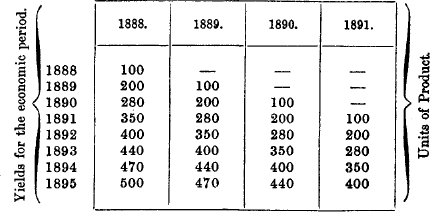
Putting these figures into words, the table shows that, whatever economic period we may fix upon, our economic interests for that period are more advanced by a month’s labour of 1888 than by a month’s labour of 1889, by one of 1889 than by one of 1890, and so on. To meet the wants of 1888, for example, a month’s labour expended in the year 1889 or 1890 gives us nothing, while a month’s labour expended in 1888 places at our command at least 100 units of product. To meet the wants of 1893 a month of 1890 gives us 350 units, a month of 1889 400 units, a month of 1888 440 units. Whatever period of time we take as our standpoint of comparison, the earlier (present) amount of productive instruments is seen to be superior, technically, to the equally great later (future) amount.4
But is it superior also in the height of its marginal utility and value? Certainly it is. For if, in every conceivable department of wants for the supply of which we may or shall employ it, it puts more means of satisfaction at our disposal, it must have a greater importance for our wellbeing. Of course I am aware that the greater amount need not always have the greater value;—a bushel of corn in a year of famine may be worth more than two bushels after a rich harvest; a silver shilling before the discovery of America was worth more than five shillings are now. But for one and the same person, at one and the same point of time, the greater amount has always the greater value; whatever may be the absolute value of the bushel or the shilling, this much is certain, that, for me, two shillings or two bushels which I have to-day are worth more than one shilling or one bushel which I have to-day. And in our comparison of the value of a present and a future amount of productive instruments the case is exactly similar. Possibly the 470 units of product which may be made from a month’s labour in 1889 for the year 1895, are worth less than the 350 units which may be got from the same for the year 1892, and the latter, notwithstanding their numbers, may be the most valuable product which can be made out of a month of 1889 in general. In any ease the 400 units which a man can gain by a month’s labour of the year 1888 for the year 1892 are still more valuable, and therefore the superiority of the earlier (present) amount of productive instruments—here and everywhere, however the illustration may he varied—remains confirmed.
The truth of the proposition, that the technical superiority of present to future means of production must also be associated with a superiority in value, may be made absolutely convincing by mathematical evidence if the tabular comparison, which we have drawn out to show the technical productiveness of different years of productive instruments, be extended to the marginal utility and value of the same. And since we have to deal here with a proposition which will form the chief pillar in my interest theory, I prefer to err on the side of making it too plain rather than risk not making it plain enough, and I shall spare no pains to prove it in the most complete way. In other respects, too, the trouble it costs us will not be altogether lost: as we proceed we shall get an occasional glimpse into certain relations which are seldom or never taken thought of, and yet, none the less, have some importance towards giving us a complete and thorough grasp of the whole.
The marginal utility and value of means of production depend, as we know,5 on the anticipated marginal utility and value of their product. But the means of production of which we have been speaking, the month’s labour, may be invested in a production that yields an immediate return, or in a one, two, three, or ten years’ period of production, and, according as it is so invested, we may obtain the very different product of 100, 200, 280, 350 units, and so on. Which of these products is to be our standard? The foregoing chapters have already given us the answer. In the case of goods which may be employed in different ways yielding different marginal utilities, it is the highest marginal utility that is the standard. Therefore, in our present case, it is that product which produces the greatest amount of value.6 But this need not coincide with the largest product, the product which contains the greatest number of units; on the contrary, it seldom or never coincides with that. We should obtain the greatest number of units by an infinitely long production process, or a process lasting a hundred or two hundred years. But goods which first come into possession in the lifetime of our grand-children or great-grandchildren, have, in our valuation of to-day, little or no value.
In determining which, of various possible products, has the highest value for us, we are guided by the two considerations of which we have just spoken. First, we are guided by the anticipated position of our provision at the various periods of time. If, for instance, a man is ill provided for in the present, or not provided for at all, the unit of product in the present may, on that very account, have so high a marginal utility and value, that the sum of value of 100 present units of product is greater to him than that of 500 units which he might have at his command in 1895. To another man, again, whose present is as well provided for, or nearly as well provided for, as his future, the advantage in numbers may give an advantage in value to the 500 units. The second consideration by which we are guided is, that our present valuation of a future good or product does not depend on its true marginal utility, but on our subjective estimation of the marginal utility. But, in forming this subjective estimate, there takes place, as we have already seen, a kind of perspective diminution; a diminution which is in direct ratio with the futurity of the time to which the good in question belongs. The amount of which we are in search, therefore, the greatest sum of value, will evidently belong to that one, among the various possible products, the number of whose items, multiplied by the value of the unit of product (as that value shows itself with regard to the relation of want and provision for want in the particular economic period, and with regard to the diminution which future goods undergo from perspective), gives the greatest amount of value.
We shall put our illustration in figures chosen at random. I wish to emphasise that the figures can be chosen quite at random and varied by the reader at will, for our proposition maintains its validity in every conceivable position of subjective valuations. Moreover I intentionally take figures varying very greatly and irregularly, it being obvious enough, without any special demonstration, that, if the value of the unit of goods were not to vary for the different periods, or not to vary much, the present means of production, as giving a greater quantity of products, would inevitably give us also a greater sum of value. Assume, then, quite at random, that, for a certain individual, the true marginal utility and value of the unit of product—taking into account his special circumstances of provision, which we shall suppose are, on the whole, gradually improving—are as follows: in 1888, 5 units, of value (pounds, shillings, or units of any ideal standard); in 1889, 4; in 1890, 3-3; in 1891, 2’5; in 1892, 2’2; in 1893, 2’1; in 1894, 2; and in 1895, 1*5. This true marginal utility, then, by reason of perspective, experiences, for the later periods, an irregularly progressive reduction of this kind: for 1888 it is, subjectively estimated, 5 (without reduction); for 1889, instead of 4, it is 38; for 1890, instead of 3-3, it is only 3; for 1891, 2-2; for 1892, 2; for 1893, 1-8; for 1894, 1-5; and for 1895, 1. If, now, on the basis of these figures, we calculate the sums of value represented by the different possible products of a month’s labour falling due in the various years, from 1888 to 1891, we get the following tables:—
For the Economic Period. |
Units of Product. |
True Marginal Utility of Unit. |
Marginal Utility reduced in Perspective. |
Amount of Value of Entire Product. |
1888 |
100 |
5 |
5 |
500 |
1889 |
200 |
4 |
3·8 |
760 |
1890 |
280 |
3·3 |
3 |
840 |
1891 |
350 |
2·5 |
2·2 |
770 |
1892 |
400 |
2·2 |
2 |
800 |
1893 |
440 |
2·1 |
1·8 |
792 |
1894 |
470 |
2 |
1·5 |
705 |
1895 |
500 |
1·5 |
1 |
500 |
A MONTH’S LABOUR AVAILABLE IN 1889 YIELDS
For Economic Period. |
Units. |
True Marginal Utility. |
Reduced Marginal Utility. |
Value. |
1888 |
_ |
5 |
5 |
__ |
1889 |
100 |
4 |
3·8 |
380 |
1890 |
200 |
3·3 |
3 |
600 |
1891 |
280 |
2·5 |
2·2 |
616 |
1892 |
350 |
2·2 |
2 |
700 |
1893 |
400 |
2·1 |
1·8 |
720 |
1894 |
440 |
2 |
1·5 |
660 |
1895 |
470 |
1·5 |
1 |
470 |
A MONTH’S LABOUR AVAILABLE IN 1890 YIELDS
For Economic Period. |
Units. |
True Marginal Utility. |
Seduced Marginal Utility. |
Value. |
1888 |
|
5 |
5 |
_ |
1889 |
— |
4 |
3·8 |
_ |
1890 |
100 |
3· |
3 |
300 |
1891 |
200 |
2·5 |
2·2 |
400 |
1892 |
280 |
2·2 |
2 |
560 |
1893 |
350 |
2·1 |
1·8 |
630 |
1894 |
400 |
2 |
1·5 |
600 |
1895 |
400 |
1·5 |
1 |
400 |
A MONTH’S LABOUR AVAILABLE IN 1891 YIELDS
For Economic Period. |
Units. |
True Marginal Utility. |
Seduced Marginal Utility. |
Value. |
1888 |
|
5 |
5 |
_ |
1889 |
— |
4 |
3·8 |
_ |
1890 |
— |
33 |
3 |
_ |
1891 |
100 |
2·5 |
2·2 |
220 |
1892 |
200 |
2·2 |
2 |
400 |
1893 |
280 |
2·1 |
1·8 |
504 |
1894 |
350 |
2 |
1·5 |
525 |
1895 |
400 |
1·5 |
1 |
400 |
The conclusion we draw from these tables is the following. The highest value of product obtainable by the month’s labour available in 1888—that which determines its own valuation—is 840: the highest value obtainable by a month’s labour available in 1889 is only 720: while the highest value obtainable by a month’s labour available in 1890 and 1891 is 630 and 525 respectively. As a fact, therefore, the present month’s labour is superior to all future ones, not only in technical productiveness, but also in marginal utility and value.
I repeat emphatically that this result is not an accidental one, such as might have made its appearance in consequence of the particular figures used in our hypothesis. On the single assumption that longer methods of production lead generally to a greater product, it is a necessary result; a result which must have occurred, in an exactly similar way, whatever might have been the figures of quantity of product and value of unit in the different years.
I must, further, lay particular weight on the fact, that this result does not make its appearance simply because, in our hypothesis, we have introduced, as already active, those other two circumstances which are fitted to account for a surplus value of present as against future goods—namely, a difference in the circumstances of provision at the various periods of time, and a diminution of the future utility by way of perspective. The superiority in value of present means of production, which is based on their technical superiority, is not one borrowed from these circumstances; it would emerge of its own strength even if these were not active at all. I have introduced the two circumstances into the hypothesis only to make it a little more true to life, or, rather, to keep it from being quite absurd. Take, for instance, the influence of the reduction due to perspective entirely out of the illustration, and we get the following figures:—
A MONTH’S LABOUR OF THE YEAR
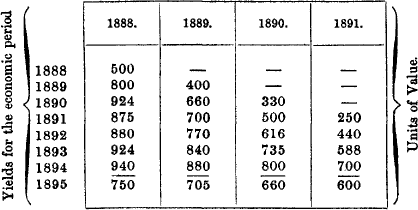
We see that now the absolute figures of the sums of value are increased throughout, and also that the economic centre of gravity is transferred to another year;7 but the thing which concerns us is that the result remains unchanged;—the month’s labour of 1888 shows the highest figure of value, and all the others a decreasingly smaller one.
But if we were also to abstract the difference in the circumstances of provision in different periods of time, the situation would receive the stamp of extreme improbability, even of self-contradiction. If the value of the unit of product were to be the same in all periods of time, however remote, the most abundant product would, naturally, at the same time be the most valuable. But since the most abundant product is obtained by the most lengthy and roundabout methods of production,—perhaps extending over decades of years,—the economic centre of gravity, for all present means of production, would, on this assumption, be found at extremely remote periods of time8—which is entirely contrary to all experience. And, besides, if such a state of things were to emerge at any particular point of time, it would immedi-ately bring its own correction. For if every employment of goods for future periods is, not only technically, but economically, more remunerative than the employment of them for the present or near future, of course men would withdraw their stocks of goods, to a great extent, from the service of the present, and direct them to the more remunerative service of the future. But this would immediately cause an ebbtide in the provision for the present, and a flood in the provision for the future, for the future would then have the double advantage of having a greater amount of productive instruments directed to its service, and those instruments employed in more fruitful methods of production. Thus the difference in the circumstances of provision, which might have disappeared for the moment, would recur of its own accord.
But it is just at this point that we get the best proof that the superiority in question is independent of differences in the circumstances of provision: so far from being obliged to borrow its strength and activity from any such difference, it is, on the contrary, able, if need be, to call forth this very difference.—Thus we get, as result of our digression, the assured conviction of two things;—first, that the productive superiority of present goods assures them, not only a surplus in product, but a surplus in value, and, second, that, in this superiority, we have to deal with a third cause of the surplus value, and one which is independent of any of the two already mentioned.9
We have now to ask: To what extent is this third cause active? Of this our former analyses give a poor and inadequate picture. What has been said is only sufficient to explain how present Means of Production are worth more than future means of production. But, from the same cause, as we have now to show, present consumption goods also obtain a preference over future consumption goods, so that, in this third cause, we have a quite universally valid reason for present goods having a greater value than future.
The connection is as follows. Command over a sum of present consumption goods provides us with the means of subsistence during the current economic period. This leaves the means of production, which we may have at our disposal during this period (Labour, Uses of Land, Capital), free for the technically more productive service of the future, and gives us the more abundant product attainable by them in longer methods of production. On the other hand, command over a sum of future consumption goods leaves, of course, the present unprovided for, and, consequently, leaves us under the necessity of directing the means of production that are at our command in the present, wholly or partially, to the service of the present. But this involves curtailment of the production process, and, as consequence, a diminished product. The difference of the two products is the advantage connected with the possession of present consumption goods.
To illustrate this by an example as simple as it is well-worn. Imagine, with Roscher,10 a tribe of fisher-folk without capital, subsisting on fish left in pools on the shore by the ebb-tide and caught with the bare hand. Here a labourer may catch and eat three fish a day. If he had a boat and net he could catch thirty fish a day, instead of three. But he cannot have these tools, for their making would cost him a month’s time and labour, and, in the meantime, he would have nothing to live upon. To save himself from starvation he must continue his wretched and costly fishing by hand. But now some one cleverer than the rest borrows ninety fish, promising, against the loan, to give back a hundred and eighty fish after one month. With the borrowed fish he supports himself during a month, makes a boat and net, and, during the next month, catches nine hundred fish instead of ninety. From this take, not only can he make the stipulated payment of a hundred and eighty fish, but he retains a considerable net gain to himself, and thereby affords a striking proof that the ninety (present) fish he borrowed were worth to him, not only much more than the ninety, but even more than the hundred and eighty (future) fish he paid for them.
Now, of course, the differences in value are not always so great as in this example. They are greatest among people who live from hand to mouth. For them to get command over present consumption goods means the transition to capitalist production. Less striking, but always present, is the difference where people already possess a certain stock of goods. If, for example, their stock of goods is sufficient for three years, they may realise their means of production in an average three years’ production process. If, now, by some means or other, they obtain another year’s supply of present means of subsistence, they may extend their average production period from three to four years, and obtain thereby an increment of product which, absolutely, is always important, but, relatively, will be much less than in the first case.
We can see that here, again, the matter of fact, on which I base my conclusions, is an old and well-known one: even in the time of Adam Smith and Turgot, it was notorious that the possession of present consumption goods confers certain advantages. But as the older theory of capital was, generally speaking, a nest of warped conceptions and incorrect explanations, this fact also was put down in a form as singular as it was inappropriate. Consumption goods—goods for immediate consumption—were looked on as productive goods or means of production; as such they were counted capital; and then all the advantages inherent in them were explained by the pro-ductivity of capital. Indeed, a writer of the standing of Jevons, simply through dwelling on the great importance which attaches to the command over present goods, was misled into ascribing to consumption goods the high position of being the only capital! In face of such misinterpretations our business now is to get at the truth of facts. And the facts are very simple. Consumption goods are not means of production: they are, therefore, not capital; and the advantages which they confer do not proceed from any productive power they possess. Everything turns on the simple fact that, according to the quite familiar laws of value, present goods, in virtue of the above stated casuistical connection of circumstances, are, normally, the means of obtaining a higher marginal utility, and receive thereby a higher value, than future goods.
11 See Capital and Interest, p. 111.
12 See above, pp. 18, 84.
13 Naturally, in the case of lengthier processes, the labour first expended requires that the production should be continued by the addition of new labour. By the figures given in the text is always meant that share in the product which, of the total product, falls to the productive unit—in this case the thirty days’ labour. If, e.g., in the case of a one year’s process, other eleven months of labour follow the one first expended, this would involve, in terms of our illustration, that a total product of 2400 units was obtained in the twelve months taken together, and thus, to the one month, would be ascribed a product of 200 units.
14 On the same analogy, as a present month of labour is technically superior to a future, so is a past month to a present. According to our scheme a month of the period 1883, e.g., would give for 1888, in a 5 years’ process, 440 units, while a month of the year 1888 would give only 100 units. But, naturally, the past years would realise their technical superiority, as against the present, only under the condition that they also were actually invested in correspondingly lengthy and roundabout processes. But this is seldom the case as regards long past years. And, therefore, one need not be frightened at the consequences which, of course, the above theory involves; that, for instance, a month’s labour of the fifteenth century is, perhaps, a hundred times, and a month’s labour of the year of our Lord, perhaps, a thousand times more fruitful than a month’s labour of the present year; that, accordingly, to a certain extent, the- productive powers of the past were gigantic beside those of to-day, and to-day’s productive powers gigantic compared to those of future centuries—a view which would seem to give us but a dreary outlook to a continuous degeneracy of our productive powers. Certainly, if any one in the year 1 had expended a month of labour with a view to the marginal utility of the year 1888, and had arranged for the systematic continuation of the work during all the 1888 years intervening, in that case, thanks to the natural powers impressed into the service in the course of such a roundabout journey, the product of that long past month would be mountains high beside the product of a month of the present year. But, as things are, trees do not grow up till they meet the sky. The productive powers are too necessary for the wants of the living, to let us employ them in advance for the behoof of future centuries or future thousands of years. And thus the year of those future wants to which we look forward and work, and by which we get the measure of the productiveness of the powers, moves forward very much parallel with the year when the productive powers are exerted. It is quite certain that our productive powers of 1888 do for the wants, say, of the year 1898, as much as and more than the productive powers of the year 1 A.D. did for the wants of the year 11 A.D. And thus the productive powers of giants do not degenerate into those of pigmies, as a sophistical dialectic might easily delude us into believing: in all ages, the productive powers, according to the advance of technique, do as much or, rather, increasingly more for the wants of their own circle of provision.
15 See above, p. 179.
16 See above, p. 163. To prevent a mistake which is very apt to arise through the similarity of the words, I again emphasise here that the proposition in the text is not in contradiction with the fundamental proposition on p. 186, that, for productive goods, the value of the least valuable of their products, the value of the “marginal product,” is the standard. The marginal product, that is to say, is the last of several products which may all be made from the available means of production; but, in the case we are now considering, it is not a matter of employing a month’s labour in one and more years’ production, but in one or more years’ production. And of these alternative employments, naturally, the most important has the preference.
17 e.g. the economic centre of gravity for the month’s labour of 1888 in the former case lay in the product attainable for the year 1890; it now lies in that attainable for 1891.
18 But here, all the same, the month’s labour of 1888 remains superior to that of 1889. For, as regards any one remote period, say, the year 1988, the former, as employed in a process longer by one year, could produce a somewhat greater product than the latter.
19 Those who prefer somewhat more venturous generalisations might, perhaps, be inclined to put the first and the third cause together under one common category, that of the “technical superiority” of present goods. For the preference given to present goods in virtue of the different relations of provision also rests peculiarly on a technical circumstance; namely, that they allow of a greater choice of employments, both as regards present and future wants, while future goods, naturally, are adapted to serve future wants only. At all events, this technical superiority is so essentially distinct from the other, of the greater technical productivity, that the two elements would require again to be kept separate from each other. It appears to me, therefore, in the interests of clearness that they should be kept entirely distinct from the first.
20 Grundlagen, § 189.
- 1See Monger’s Grundsätze der Volkswirthschaftslehre, p. 93.
- 2Generally speaking, there are two occasions on which a man is called on to form a judgment as to value. One is on parting with a good in his possession, e.g. in giving it away, or exchanging, or consuming it; the other, on acquiring a good. In the two cases the form which the valuation assumes in thought is, externally, a little different. A good which a man has he values according to the injury which he would suffer by its loss; he values it, therefore, according to the last satisfaction which is assured him by having it. A good which a man has not he values, on the contrary, according to the increment of utility which its acquisition brings; i.e. according to the most urgent among those satisfactions which, in the conditions of his fortunes up till the present time, he has not been able to obtain. Naturally we get the same result by either method, for the final satis-faction which is assured by a good is always identical with the first which would be lost without the good. In the text I have put the formula in such a way that it will sufficiently embrace either method.
- 3See my Capital and Interest, 1890, p. 111.
- 4P. 219 (German edition, p. 266). See also my Hechte und Verhältnisse, p. 51. Innsbruck, 1881.
- 5See Mill’s Principles, i. 1. 2.
- 6Das Geld, pp. 83 and 92.
- 7If we were to carry our analysis of what man does in production a step further, we might appropriately distinguish three fundamental ways in which the producing man “moves things.” The first is what, for want of a better name, we may call simple movements or changes of place—where men transport entire objects from one locality to another. Thus the miner brings the ore from the depths of the shaft to the upper air; the merchant takes his goods from the place where they are produced to the place where they are demanded and used. The second embraces those movements of parts of one and the same object whereby it experiences a change of form, as when nails are made from iron, statues from marble, pipes from clay, dials from ivory, combs from caoutchouc, tumblers from glass, furniture from wood. The third, and much the most common way, is where different objects are brought together in space to form combinations of matter. These combinations may be merely temporary, or they may be lasting. Instances of the one are where the stamp falls on the coin, the chisel chips at the marble, the carving tool is applied to the wood, the ore put into the furnace, the yarn into the loom, the paper under the printing press, the stuff under the shears, the plough through the clods. Instances of the other are where we build a house out of wood, stone, lime, iron, etc.; where we put together a watch out of wheels, springs, pendula, weights, stop-action and many other things; in fact in manufacture generally. I must warn the reader that this division into three fundamental forms neither has, nor is meant to have, the character of strict scientific classification. Indeed, these forms merge in many instances into one another. Temporary combinations, for instance, are very often half-way to changes of form, and what I have called a simple change of place is at the same time, in a certain point of view, a material combination, a bringing together of the thing moved and the object (personal or impersonal) to which it is moved. This division, however, will make it easier to find our reckoning, and will prove too, if necessary, the correctness of the general characteristics which I have ascribed in the text to productive processes. I mean to say that it is easy to see that every productive activity which one can think of ranges itself under some one of these three fundamental forms, and to that extent it is proved that such an activity must, a fortiori, range itself also under the general formula given in the text, where we have described the nature and method of the production of material goods as the mastery of natural powers by means of putting objects in motion.
- 8Book i. chap. vii. § i.
- 9Slaatswirthschafiliche Untersuchungen, Munich, 1832, p. 59, and similarly in the second edition of 1874, p. 111. On p. 56 he expressly calls capital “Wealth which brings in income.”
- 10Grundlagen und Ziele dea sog. wissenschaftlichen Sozialismus, 1885, p. 184.
- 11If we try to represent the classification of our wants by a typical scheme we must, on the principles just laid down, give it something like the following shape:—
- 12THE cases we have hitherto considered have been comparatively easy of interpretation; but practical economic life brings out a great many complications which the practical man treats with easy assurance, but the theorist finds considerable difficulty in explaining. To understand these everything depends on the correctness of our casuistical decision as to that amount of utility which, in* the given circumstances, is the marginal utility. For this purpose the following general direction may serve as master-key to all the more difficult problems of value. We must look at the economic position of the person who is estimating the value of a good from two points of view. First, we must in thought add the good to his stock, and consider what further and lesser concrete wants can now be satisfied. Second, we must in thought deduct the good from his stock, and consider again what concrete wants will still be satisfied. In the latter case, of course, it becomes manifest that a certain layer of wants, viz. the lowest layer, has lost its former pro-vision; this lowest layer indicates the marginal utility that determines the valuation.
- 13When we are told that capital assists in the production of wealth, and then again that it assists in the obtaining of wealth for its owner, we are apt to jump to the conclusion that the two phenomena are intimately and essentially connected, and that the one is the immediate result of the other—that capital can bring wealth to its owner because capital assists in the production of wealth. As a fact, Political Economy has taken up this idea only too readily and too completely. Captivated by the deceptive symmetry that exists between the three great factors of production—Nature, Labour, Capital—and the three great branches of income—Rent, Wage, and Interest—the science, from Say’s day till the present, has taught that these three branches of income are nothing else than the payment for the three factors of production, and that Interest in particular is nothing else than the compensation which capital receives for its productive services when the product is divided out among society. Propounded by various interest theories in various forms this idea has found its most concise and, at the same time, its most naive expression, in the well-known “Productivity theories”—those theories which explain interest directly as the natural fruit of a productive power peculiar to and resident in capital.
- 14The theory of the use of goods I have already gone into at length in Capital and Interest. I there showed that material goods are nothing else than such distinct forms of matter as admit of the natural powers residing in them being directed to human advantage. I showed how the “use” they afford is realised through concrete activities of these natural powers, and, therefore, by real forth putting of power. I showed how a use (Gebrauch or Nutzung) cannot be made of them otherwise than by taking the peculiar forms of the energy of the good at the proper moment, supplying the conditions necessary to render them available where they previously existed in an unavailable form, and then bringing these forms of energy into proper connection with that object in which the useful effect is to take place. On these considerations I based the conception of the “Material Services” (Nutzleistungen) which I believe to be the only one that corresponds with facts, and rejected certain shadowy ideas which connected the old theory of interest with the word “Uses” of goods. What remains for us here is, on the same lines, to lay down certain fundamental ideas as to the origin of material goods.
- 15If we look more closely at the way in which man assists natural processes, we find that his sole but ample contribution consists in the moving of things. “Putting objects in motion” is the idea which gives the key to all human production and its results;—to all man’s mastery over nature and its powers. And this is so simply because the powers reside in the objects. Now when man by his physical powers—the power of moving things—is able to dictate where the object shall be, he obtains a control over the place at which a natural power may become effective; and this means broadly a control over the way and over the time in which it may become effective.
- 16Knies defines as capital “that complex of goods available to a community which may be applied to the satisfaction of want in the future.” This definition, as we can easily see, agrees almost word for word with that of another conspicuously important and fundamental conception. If we leave out the words “in the future,’ it takes in all the goods in a community available for the satisfaction of want, and that is an amount which most writers are in the habit of calling the “wealth” ( Vermögen) of the community. If, like Knies, we emphasise the fact that wealth embraces only the net amount of goods after deduction of debts, we may perhaps call that amount the community’s “gross property” (Guterbesitz). In any case we have in this to deal with an independent amount bearing an independent name, with which “capital” neither coincides nor should coincide.
- 17Again I say a control over the time in which a natural power may become effective. This proposition, also, must not be taken too literally. It must not be imagined that natural powers work intermittently; that man can sometimes bring them to a standstill, sometimes set them working again. On the contrary, natural powers are always at work; a natural power not active would be a contradiction in terms. But it is possible that several powers may be so combined that their activities may for a time mutually balance each other, and the resultant be rest—if not complete rest, still some movement so slight that, as regards human purposes, it may be neglected. When this is the case, before any new resultant can emerge that is of interest to man, there must be an entirely different combination of materials and powers. This suggests how man may get control of the point of time at which a definite resultant emerges. It is only necessary for him, by skilful use of his power to move objects, to provide the causes of the desired effect, all but one. So long as this one is not present the conditions are unfulfilled, and there cannot be the desired result. But when at the proper moment he adds the last condition, the movement hitherto held in leash, as it were, is suddenly set free, and the desired effect is obtained at the opportune time. Thus the sportsman moves powder and lead into the barrel of the gun; he shuts the breech; he raises the cock. Each of these things has for long possessed and expressed its peculiar powers. In the powder are present the molecular powers whose energy later on is to expel the shot from the barrel. The barrel now, as formerly, exerts its forces of cohesion and resistance. The trigger which is to let the cock smash down, strains and presses against the spring. Still the arrangement, the disposition of the collective powers, is such that the resultant of their mutual energies is rest. But the sportsman covers the wild fowl with the barrel: there is a slight pressure on the tongue, a little dislocation of the arrangements, and the shot flies.
- 18Facts certainly spoke with perfect distinctness. It was impossible to deny that capital is no element in the proper sense of the word, inasmuch as it itself springs from the co-operation of nature and labour. Not only so, but by a singular irony of fate this had to be expressly proved—as it had been by Adam Smith before them—by those very theorists who maintained its independent productivity. In their theory of price, in having to show how all prices resolve themselves finally into rent, wage, and interest, they were forced to demonstrate in the most minute way that concrete capital is not an element; that, for instance, copper and steel, which serve as capital in the manufacture of watches, originate in the co-operation of the natural mineral deposits, of the work of miners, and of older capitals, which themselves have orignated in similar ways, and so on. In the face of this, to maintain the independent productivity of what they had just demonstrated to be a dependent and intermediate product, they were driven to adopt very singular expedients. The favourite ones were obscurity and brevity. Instead of making an earnest effort to bridge the yawning contradiction, they either did not suggest the doubt at all, or, if a doubt had already been raised, they dismissed it with some laconic phrase or other. A long series of writers make no scruple about expounding capital on one page as a factor of production “derived” from nature and labour, and on the next as a third independent factor of production along with nature and labour. Mill has so far yielded to the pressure of facts as to admit that capital is itself the product of labour, and that its instrumentality in production is therefore in reality that of labour in an indirect shape. But with a quick turn he saves its independence. “Not the less,” he continues,” does it require to be specified separately. A previous application of labour to produce the capital required for consumption during the work is no less essential than the application of labour to the work itself.” Therefore, because labour must be applied twice, in two different stages of production, something else besides labour must be recognised as the independent condition of production!
- 19The variation which Hermann, however, has given must be considered an independent one, and is the fourth reading in arithmetical order given to the conception. He goes back to capital as the source of income, and makes this the object of his definition: Capital, he says, is “every durable foundation of a utility (Nutzung) which has exchange value.” In opposition to the last definition this one includes under the conception of Capital all land, and besides embraces such consumption goods as are durable, like furniture, houses, etc., even if they are personally used by the owners.
- 20A sixth variation comes from Kleinwächter. He finds it a characteristic mark of capital that it lightens the toil of acquisition or productive labour. Now this characteristic appears to him not to belong to all means of production, but only to one category of these, the tools of production, while the matter or materials of production are absolutely passive during the whole production process; they are worked up or used up but give no assistance in working. “Logically,” therefore, “the conception of capital should be limited to tools of production.”

