
The Influence and Significance of Human Action after 75 Years
13. Human Action: The Antidote to Progressivism Joseph T. Salerno
13
Human Action: The Antidote to Progressivism
JOSEPH T. SALERNO
Human Action (Mises 1998) is the foundational work of modern Austrian economics, and that is reason enough for reading it. But there is an equally compelling reason for carefully studying Mises’s great treatise. For it is the antidote to the real and immediate threat to human liberty and society posed by the ideology of progressivism. After the collapse of the Soviet Union and other Communist regimes, almost all variants of leftism abandoned conventional Marxism and gathered under the banner of progressivism. This was especially true in Western countries, where the Left achieved a powerful influence on policy via democratic elections. Indeed, progressivism is far more insidious than Marxism precisely because it rejects class conflict and violent revolution and fervently embraces democracy as the true path to the perfection of humanity. Progressives view history as an onward and upward march to a utopian future, an egalitarian socialist state efficiently run by disinterested bureaucrats, intellectuals, and technocrats (Salerno 2023).
Despite their fervent desire for egalitarian socialism, however, contemporary progressives have learned from the collapse of communism that trying to substitute central planning for the market economy leads to poverty, famine, and economic collapse. They therefore propose to retain a truncated market economy that is heavily taxed, regulated, and controlled. Capitalists and entrepreneurs will be subject to a blizzard of orders, decrees, and prohibitions and forced to work to support the state apparatus and its financial cronies and official victims’ groups. In other words, interventionism, not socialism, is the political economy of progressivism.
1. The Marxist Basis of Interventionism
Mises was one of the first to recognize that the economic program of progressivism was interventionism, as laid out by Karl Marx and Friedrich Engels in the Communist Manifesto, published in 1848. As Mises (1974, 99) states, “It is impossible to understand the mentality and the policy of the Progressives if one does not take into account that the Communist Manifesto is for them both manual and holy writ, the only reliable source of information about mankind’s future as well as the ultimate code of political conduct” (see also Mises 1990b, 179–86). According to the Communist Manifesto the most effective means for achieving the socialist economic utopia is through democracy. As Marx and Engels (1971, 30) proclaim, “The first step in the revolution . . . is . . . to establish democracy.” Once established, democracy would “raise the proletariat to the position of ruling class.” Political conditions would then be ripe for imposing interventionist measures or what Marx and Engels call “despotic inroads on rights of property.” In their own words (Marx and Engels 1971, 30–31), these measures included the following, among others:
• A heavy progressive or graduated income tax.
• Abolition of all right of inheritance.
• Centralization of credit in the hands of the state by means of a national bank with state capital and an exclusive monopoly.
• Centralization of the means of communication and transport in the hands of the state.
• Free education for all children in public schools.
It was not until a decade later that Marx would adopt the contrary view that socialism would inevitably supersede capitalism without the need for mass democracy and interventionist measures. Indeed, the later Marx in 1859 condemned interventionism as “reactionary.” Capitalism, he declared, would collapse from its own inner contradictions, culminating in violent revolution and the dictatorship of the proletariat (Marx 1970; see also Cole 1930, xi–xxix). Any attempts to speed up the coming of socialism by undermining capitalism were, therefore, both unnecessary and counterproductive. So almost from the beginning, there were two contradictory variants of Marxist doctrine. Almost all contemporary progressives have embraced interventionism as the true path to socialist bliss (e.g., Stiglitz 2015, 215–32).
2. Mises’s Early Work on Comparative Economic Systems
Human Action is indispensable for comprehending the operation and consequences of interventionism, which is the least understood economic system. The treatise is the culmination of Mises’s long-standing research program, which was to analyze and compare the three possible economic systems—capitalism, socialism, and interventionism—from the viewpoint of which best promotes social cooperation under the division of labor. During the 1920s, Mises published three books: Socialism (1922), Liberalism (1927), and Critique of Interventionism (1929). As Mises points out: “Altogether these books offer a comprehensive analysis of the problems of social cooperation. They investigate all conceivable systems of cooperation and examine their feasibility. These studies found their completion in my Nationalökonomie” (Mises 1978, 113).
Mises dealt with capitalism in Liberalism. Ironically, because Socialism was written before Liberalism, Mises was forced to analyze the operation of the market economy in Socialism to develop the concept of economic calculation, which requires the existence of actual market prices. The concept of economic calculation is essential to evaluating the ability of any economic system to rationally allocate resources. Mises (1978, 111) explains, “When I set out to work further on the ideas in my book, Socialism, I felt compelled to develop especially the fundamentals of catallactics. Any theory of socialism that does not have at its very foundation a consideration of the problem of economic calculation, is simply absurd.”
In fact, in his earlier treatise, published in 1912 and translated into English in 1934 as The Theory of Money and Credit, Mises (1971) was already preparing the way for a comparative analysis of capitalism, socialism, and interventionism. Indeed, the primary purpose of his monetary treatise was to integrate the theory of money into general economic theory in order to fully explain the determination of money prices, which are the data of economic calculation. Prior to Mises’s work, almost all economists, including Mises’s Austrian mentors Carl Menger and Eugen von Böhm-Bawerk, analyzed the formation of prices within the framework of a fictional barter economy in which the exchange ratios between commodities are determined without the intermediation of money. The absence under barter of a common objective unit in which prices are expressed implies that economic calculation can take place directly in terms of values. But values, Mises argues, are the product of a single individual’s mental operation, or “valuation,” which consists of subjectively ranking different goods according to their (anticipated) satisfaction. As such, values cannot be added up or compared between different individuals (Mises 1978, 56–57, 59–60). Mises reveals that his theory of money was thus the foundation for his later argument that, without market prices, socialism lacked the means of economic calculation: “The basic thought already appeared in the book on money: there are values and valuations, but no measurements of value and no value calculations; the market economy calculates with money prices” (Mises 1978, 111).
After the completion of his trilogy of works on capitalism, socialism, and interventionism, there was still a crucial element missing from Mises’s project to develop an integrated theory of human action encompassing all thinkable economic systems. Mises had not yet fully worked out the theory of economic calculation. He turned to this task in Nationalökonomie (Mises 1940), the German language predecessor of Human Action. Reflecting later on the main goal of the treatise, Mises (1978, 111–12) writes, “My Nationalökonomie finally afforded me the opportunity to present the problems of economic calculation in their full significance. . . . Only in the explanations offered in the third part of my Nationalökonomie did my theory of money achieve completion. Thus I had accomplished the project that had presented itself to me thirty-five years earlier. I had merged the theory of indirect exchange with that of direct exchange into a coherent system of human action.”
3. The Structure of Human Action
In framing economic theory as “a coherent system of human action,” Mises demonstrates that research in pure economic theory is indissolubly linked with analysis of alternative economic systems. This insight sheds new light on Human Action: it is both a treatise on economic theory and a discourse on comparative economic systems. This becomes clear when we examine the organization of the book. (For the structure and page ranges of the various parts of Human Action, see figure 1.) Human Action begins with an exposition of praxeology and its unique theoretical research method. Mises uses the “praxeological method” to deduce a system of economic theory grounded in the self-evident truth that every person acts—that is, behaves purposefully in using scarce means to achieve his or her most highly valued ends. Furthermore, the being whose action is the subject of economic analysis is not the fictional “economic man” of neoclassical economics possessing perfect knowledge and the other attributes of a dubious economic rationality but “man with all his weaknesses and limitations, every man as he lives and acts” (Mises 1998, 646–47).
By anchoring the deductive method in the undeniable fact that real people act, plus a few subsidiary facts about the real world, Mises establishes that whenever the conditions of action assumed by an abstract economic theorem exist in concrete reality, the economist will be able to accurately predict the qualitative effects of any economic policy. Rent controls below market rents will cause a shortage of rental housing; price inflation will be reduced by reining in the growth of the money supply; if central banks tamper with the market interest rate by expanding bank credit, they will cause financial bubbles and a real investment boom followed by a wholesale collapse of asset prices and a recession. The praxeological method thus contrasts sharply with the positivist method, which vainly seeks to derive “tentatively valid” economic theories by constructing and testing static mathematical models disconnected from each other and reality.
After a thorough analysis of the concept of action and its immediate implications in parts 1 and 2 of Human Action, part 3 is devoted to a comprehensive discussion of economic calculation, which Mises considers the logical prerequisite of theoretical research in economics. Despite its indispensability for the derivation of economic theory, however, economic calculation is not part of economic theory proper, which Mises refers to as “catallactics” or “the theory of indirect exchange.” As Mises (395n1) emphasizes, “The theory of monetary calculation does not belong to the theory of indirect exchange. It is part of the general theory of praxeology.” Praxeological reasoning is necessary to identify the special historical conditions required for calculable action—that is, the “application of cardinal numbers . . . for computation and calculation in the planning of future action and in establishing the effects achieved by past action.” Indeed, “the elaboration of the sciences of praxeology and economics” can only occur “within a world in which action is computable and calculable” (200).
In other words, the typical puzzles and problems whose investigation initiated economic science could only emerge historically in a calculating market economy. Examples are the tendency to equality between price and costs of production, the fact that capital investment tends to earn a permanent interest return, and the observation that an increase in the money supply generally coincides with a rise in general prices. All these striking regularities could become visible only in a market economy because prices and production costs, capital and interest, and a general medium of exchange do not exist in systems that cannot calculate. It is for this reason that economics began as a science narrowly focused on an artificially delimited field of action that focused on the objective calculations of the businessman and neglected the subjective wants and desires of consumers.
As Mises (232) points out, “The science of human action was at the beginning merely a discipline dealing with those actions which can be tested by monetary calculation. It dealt exclusively with what we may call the orbit of economics in the narrower sense, that is, with those actions which in a market society are transacted by the intermediary of money.” Thus, the theoretical system of the Classical School “was essentially a theory of calculated action.” Starting from the classical theory, later economists expanded “step by step the field of their studies until they finally developed a system dealing with all human choices, a general theory of action” (232).
Mises’s discussion of economic calculation is therefore presented immediately after his general treatment of praxeology but prior to his elaboration of economic theory proper. The stage is thus set for part 4, titled “Catallactics or Economics of the Market Society.” Here Mises provides an exhaustive analysis of the operation of a market economy. Using what he calls the “imaginary construction of the pure market economy,” Mises deploys the praxeological method to deduce the core theorems of economics (238). This procedure of developing economic theory by first analyzing a free-market economy in which economic calculation is unimpaired by coercion before examining socialism and interventionism is not a matter of heuristic convenience or ideological bias; it is dictated by “requirements of logical and systematic rigor” (200). For as Mises explains: “The analysis of the problems of the market society, the only pattern of human action in which calculation can be applied in planning action, opens access to all thinkable modes of action. . . . All noncapitalistic methods of economic management can be studied only under the hypothetical assumption that in them too cardinal numbers can be used in recording past action and planning future action. This is why economists place the study of the pure market economy in the center of their investigations” (267). Thus, Mises concludes, “economic calculation is the fundamental issue in the comprehension of all problems commonly called economic” (200).
Part 5 discusses social cooperation without a market. In this part, Mises analyzes the “imaginary construction of a socialist society” in which private ownership, free exchange, and market prices of the means of production are all absent. Using the mighty theoretical system he previously deduced by analyzing the pure market economy, Mises demonstrates in five pages that, in a perfect socialist society, economic calculation and, therefore, the economizing of the scarce factors of production—even from the standpoint of the central planner’s own value scale—is “impossible.” Under these conditions, production becomes chaotic and social cooperation quickly disintegrates. The rest of the discussion of socialism involves Mises’s refutation of the counterarguments to his position put forward by socialist and neoclassical economists.
Figure 1. The structure of Human Action
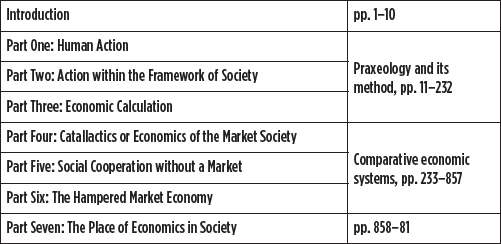
Part 6 deals with the hampered market economy. Here Mises expounds his unique conception of interventionism, which utterly rejects the conventional view that it constitutes a “mixed economy” or a “third system” existing somewhere between capitalism and socialism. Mises denies the possibility of intermixing elements of these two systems: there is either capitalism or socialism, and never the twain shall meet. Either consumers or government planners exercise sovereignty over the use of scarce resources. Any attempt to divide control of production between the two groups inevitably leads to an unstable regime of systemic conflict and crisis because the market economy is a vast and intricate system of interrelated activities. An isolated government decree or “intervention” aimed at altering a particular market outcome inevitably changes the data of economic calculation (prices, profits, revenues, costs, wealth, capital values, etc.) throughout the entire system. This provokes a reaction by consumers and entrepreneurs which changes the data yet again. What emerges is a third set of market conditions that is less preferred and may even be positively undesirable from the government’s viewpoint, inviting further interventions. For Mises, interventionism, therefore, is not a third economic system but a market economy in which monetary calculation is repeatedly distorted and elements of economic discoordination and chaos introduced from outside the system.
In an unpublished manuscript written after Human Action, Mises ([ca. 1958], 7) identifies the inherent problem of interventionism as “the problem of divided supremacy” and argues that interventionism is self-contradictory: “The concept of supremacy logically implies indivisibility. Either A is called upon to decide or B. If both A and B are supposed to be supreme, an insoluble conflict emerges as soon as they do not agree with one another. In the market economy the consumers ultimately determine the course of production; in a socialist system it is . . . the government. Interventionism acquiesces in the spurious expedient of assigning supremacy to both the consumers and the government.”
4. Interventionism and Economic Prediction
Ironically, economics renders its practical service as a predictive science under the regime of interventionism. In the case of pure socialism, all an economist can do is to explain why the system is utterly incapable of allocating resources to their most valuable uses. He can make no predictions about the pattern of operation of socialism because, lacking the means of economic calculation, the system is foredoomed to a rapid descent into “planned chaos.” Nor can economics be of much service in predicting the concrete pattern of resource use and pricing that will emerge in an unhampered market economy, because these depend on subjective and changeable consumer value scales and the ever-varying technical conditions of production, neither of which can be known by the economist with certainty. Put differently, when considering the pure market economy, the economist cannot ascertain the data of the system or their configuration at any moment in the future. For example, the economist knows with absolute certainty that an increase in the supply of wheat will cause a lowering of its price and other effects but does not know if or when this event will occur. Entrepreneurs are far more astute than economists in forecasting such occurrences, and even their forecasts often go awry.
Matters are wholly different with respect to a regime of interventionism because economists start with the knowledge of the specific economic policy to be imposed. They can then trace out the consequences using the applicable economic theorems yielded by the praxeological method. They can, therefore, predict the pattern—although not the temporal or quantitative dimensions—of future economic activities that will result, say, from the minimum wage or bank credit expansion. In the last book he wrote, Mises forcefully states the claim for the predictive power of economic theory with respect to interventionism: “Economics can predict the effects to be expected from resorting to definite measures of economic policies. It can answer the question of whether a definite policy is able to attain the ends aimed at and, if the answer is in the negative, what its real effects will be. But, of course, this prediction can only be ‘qualitative.’ It cannot be quantitative because there are no constant relations between the factors and effects concerned. The practical value of economics is to be seen in this neatly circumscribed power of predicting the outcome of definite measures” (Mises 2002, 68–69; emphasis added).
In his volume on epistemological problems of economics, Mises boldly places praxeological economics on a par with the natural sciences in its predictive power: “Economics too can make predictions in the sense in which this ability is attributed to the natural sciences. The economist can and does know in advance what effect an increase in the quantity of money will have upon its purchasing power or what consequences price controls must have. Therefore, the inflations of the age of war and revolution, and the controls enacted in connection with them, brought about no results unforeseen by economics” (Mises 2003, 129).
Mises’s theory of interventionism predicts with certainty that the market economy hampered by an ever-increasing array of mandates, controls, taxes, and regulations will be an economy afflicted by continual and deepening crises. Crumbling and simultaneously overbuilt infrastructure, financial crises, inflationary redistributions of wealth to megabillionaire financiers, trillion-dollar deficits, capital consumption, and the erosion of labor productivity and real wages—all are crises caused by interventions, one piled atop another. If the progressive Left succeeds in imposing on society its crazed utopian vision of an egalitarian social democracy, humanity faces the gruesome reality of a perpetual crisis economy.
5. Conclusion
There is, however, a powerful reason for libertarians to take heart from Mises’s analysis. For interventionism is an unstable regime which lurches erratically to and fro between full socialism and the pure market economy. Precisely because it contains the inherent contradiction of divided sovereignty, we can predict that it will be battered by endless crises. These crises will undermine the plans and morale of the ruling elites while impoverishing, frustrating, and embittering the productive classes. This will foster an “us against them” mentality among the exploited and present an opportunity that can be seized by libertarian thought leaders and opinion molders. These men and women, armed with the lessons of Human Action and imbued with the Misesian spirit of human liberty, would be well equipped to mobilize and lead a militant, mass reaction that ousts the progressive elites from their positions of power and influence and propels society and the economy toward “a system of totally voluntary exchange.”
References
Cole, G. D. H. 1930. Introduction to Capital, by Karl Marx, edited by Ernest Rhys, translated by Eden and Cedar Paul. New York: E. P. Dutton.
Marx, Karl. 1970. Preface to A Contribution to the Critique of Political Economy, edited by Maurice Dobb, translated by S. W. Ryanzanskaya, 19–23. Moscow: Progress. https://archive.org/details/marxcontributioncritpolecon/page/n1/mode/2up.
Marx, Karl, and Frederick Engels. 1971. Manifesto of the Communist Party. New York: International.
Mises, Ludwig von. 1940. Nationalökonomie: Theorie des Handelns und Wirtschaftens [National economics: Theory of action and economics]. Geneva: Éditions Union. https://mises.org/library/book/nationalokonomie-theorie-des-handelns-und-wirtschaftens.
———. [ca. 1958]. “Interventionism Reconsidered, and Other Essays.” Unpublished manuscript. Series 4: Manuscript File, Subseries 1: Letter Size, box 43, no. 6. Ludwig von Mises Collection. Grove City College Archives, Grove City, PA.
———. 1971. The Theory of Money and Credit. 2nd ed. Translated by H. E. Batson. Irvington-on-Hudson, NY: Foundation for Economic Education.
———. 1974. “Benjamin M. Anderson Challenges the Philosophy of the Pseudo-Progressives.” In Planning for Freedom, and Twelve Other Essays and Addresses, 3rd (memorial) ed., 94–107. South Holland, IL: Libertarian Press. https://cdn.mises.org/Planning%20for%20Freedom%20and%20Twelve%20other%20Essays%20and%20Addresses_2.pdf.
———. 1978. Ludwig von Mises, Notes and Recollections. Translated by Hans F. Sennholz. South Holland, IL: Libertarian Press.
———. 1990a. Economic Calculation in the Socialist Commonwealth. Translated by S. Adler. Auburn, AL: Mises Institute. https://mises.org/library/book/economic-calculation-socialist-commonwealth.
———. 1990b. “The Objectives of Economic Education.” In Economic Freedom and Interventionism: An Anthology of Articles and Essays, edited and compiled by Bettina Bien Greaves, 203–11. Irvington-on-Hudson, NY: Foundation for Economic Education. https://oll.libertyfund.org/titles/greaves-economic-freedom-and-interventionism.
———. 1998. Human Action: A Treatise on Economics. Scholar’s ed. Auburn, AL: Ludwig von Mises Institute.
———. 2002. The Ultimate Foundation of Economic Science: An Essay on Method. 2nd ed. Irvington-on-Hudson, NY: Foundation for Economic Education.
———. 2003. Epistemological Problems of Economics. Translated by George Reisman. 3rd ed. Auburn, AL: Ludwig von Mises Institute. https://mises.org/library/book/epistemological-problems-economics.
Salerno, Joseph T. 2023. The Progressive Road to Socialism. Auburn, AL: Mises Institute. https://cdn.mises.org/the_progressive_road_to_socialism.pdf.
Stiglitz, Joseph E. 2015. “A Progressive Agenda for the Twenty-First Century.” In Progressivism in America Past, Present, and Future, edited by David B. Woolner and John M. Thompson, 215–32. New York: Oxford University Press.
________________
I have shamelessly appropriated this term from the late, great scholar and libertarian Ralph Raico, who coined it as a euphemism for anarcho-capitalism.

