
The Influence and Significance of Human Action after 75 Years
11. Mises and Rothbard on Credit Contraction during a Downturn Patrick Newman
11
Mises and Rothbard on Credit Contraction during a Downturn
PATRICK NEWMAN
The seventy-fifth anniversary of Ludwig von Mises’s Human Action, published in 1949, is an important milestone. Very few economics books are remembered, let alone read, after three-quarters of a century. Human Action is one of those rare exceptions, as Mises’s ideas and theories continue to resonate with each new generation of thinkers interested in how the market economy works. The praxeological edifice laid out in Human Action has been modified and refined by subsequent generations of Austrian economists, but there is no question that as a foundation it has stood the test of time. All successful improvements in Austrian economics since Mises have come from building upon something written in Human Action.
In this essay I will highlight one such scientific development in Austrian economics by first explaining Mises’s theory of credit contraction during the business cycle and then explaining how his foremost follower, Murray Rothbard, improved it. Mises was criticized by his contemporaries for opposing the prevailing economic orthodoxy by arguing that credit contraction during a downturn is less harmful than the credit expansion that caused the boom. Then Rothbard refined his mentor’s theory by showing that credit contraction can actually provide economic benefits by speeding up the recovery process. It does so by encouraging the correction of relative prices and the reallocation of resources away from unprofitable malinvestments. Rothbard’s theory of credit contraction, though different from what Mises wrote, should be viewed as a complement that advanced Austrian business cycle theory (ABCT).
The structure of this essay is as follows. The first section outlines the theories of time preference–induced growth and credit-induced boom and bust insofar as is necessary to explain Mises’s views on credit contraction during the depression phase. The second section then explains Mises’s theory of credit contraction, and the third section shows how Rothbard built upon Mises’s theory and improved it. The final section concludes by summarizing the significance of Human Action and the process by which improvements have been made upon it.
The Austrian Theory of the Business Cycle
Mises’s business cycle theory is arguably the distinguishing feature of Austrian economics. ABCT integrates the theories of entrepreneurial market adjustment, nonneutral money, the structure of production, and the deleterious consequences of government intervention into a coherent explanation of how a central bank’s expansionary monetary policy causes an unsustainable boom that leads to an inevitable bust. Mises provided his most in-depth exposition of ABCT in chapter 20 of Human Action (Mises 1998, 535–83). Before doing so, however, he outlined his capital and interest theory to explain how an economy could grow in the absence of credit expansion.
According to Mises, an individual’s time preference is the premium they put on satisfying a given end in the present over satisfying that same end in the future, which means that “present goods are more valuable than future goods” (481). Time preference also means that there is a premium on present money that can be spent on consumption over future money that will be earned from investing. Individuals will save and forgo present consumption only if they expect to earn a greater amount of money in the future. When an individual chooses to “invest a sum of 100 dollars available today,” he requires a greater amount of money, say “104 dollars a year later.” The 4 percent interest rate is proof of “the higher valuation of present satisfaction as compared with later satisfaction” (483).
Individuals’ time preferences determine the societal rate of interest, which Mises calls the “originary interest” rate. Originary interest is the underlying difference between “the prices of consumers’ goods [and the money] apportioned to the various complementary factors cooperating in their production” (521). Originary interest, in other words, is the “margin between the prices of present goods and those of future goods,” or the spread in their prices (533). The rate of the price spread at every stage of production is the originary interest rate. The rate of interest found in the loanable funds market, or what Mises later calls the “gross market rate of interest,” is commonly believed to be the fundamental interest rate (538). But the loanable funds market only “adjusts the rate of interest on loans to the rate of originary interest” (524).
According to Mises, “Changes in the originary [rate] of interest and in the amount of saving are . . . two aspects of the same phenomenon” (530). Lower time preferences are expressed through a decrease in consumption spending, an increase in savings and investment, and a decline in the originary interest rate, while higher time preferences cause the opposite. The consumption-to-investment ratio and in turn the originary interest rate direct “the investment activities of the entrepreneurs [and] the length of waiting time and of the period of production in every branch of industry” (529). Due to the nature of present value discounting, lower originary interest rates increase the relative profitability of long-term production processes, while higher originary interest rates reduce their profitability.
Mises’s analysis is depicted graphically in figure 1. While Mises himself eschewed graphical analysis, F. A. Hayek (2008, 223–52), writing in 1935, and Murray Rothbard (2009, 367–451, 509–55), writing in 1962, greatly improved the exposition of capital and interest theory through their structure-of-production diagrams. In figure 1, the horizontal axis shows the stages of production and the process of entrepreneurs transforming capital goods as they move from the higher-order stages (i.e., those production processes temporally remote from consumption) through the lower orders until they are sold as consumer goods. The shaded bars represent the money spent on factors of production, and the diagonal lines connecting them represent the originary interest rate. This diagram can be simplified in the trapezoid shown on the right, with the area equal to total nominal spending.
Figure 1. The structure of production
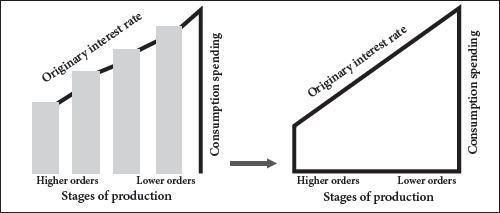
If societal time preferences decrease, economic growth and rising living standards follow. When individuals save, they either directly invest in a business or lend money on the loanable funds market. Funds saved through the second method are borrowed by entrepreneurs at a lower loan rate and invested in production processes that were not profitable at the previous loan rate. Although nominal spending remains constant, the decrease in the proportion of consumption-to-investment spending reduces the demand for factors of production in the lower orders and increases the demand for factors in the higher orders. This spurs entrepreneurs to reallocate factors. Factor prices fall in the lower orders and rise in the newly-embarked-upon long-term production processes, decreasing the price spreads and the originary rate of interest. The lower originary interest rate is then transmitted back to financial markets. As the changes in spending streams filter down to the incomes of capitalists, landowners, and workers, these individuals continue to spend according to their lower time preference ratios, which sustains the reconfiguration in the production structure. In the end, the increased supply of “capital goods accumulated by new savings . . . increase[s] the . . . supply of consumers’ goods,” causing a fall in their prices and thereby raising real wages and living standards (Mises 1998, 292).
Figure 2. Time preference–induced growth
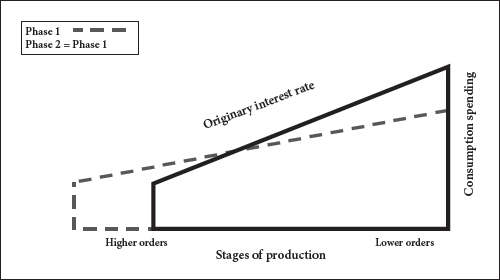
Figure 2 shows the effects of decreasing time preferences. In phase 1, time preferences fall, which decreases consumption spending and flattens the production structure as less money is spent in the lower orders. In turn, the increase in investment spending raises spending in the higher orders, which lengthens and further flattens the structure of production. The result is smaller price spreads in the stages and a lower originary interest rate. The total area of the new production structure is the same as the old, to reflect the constant amount of nominal spending. In phase 2, because time preferences remain permanently lower, the consumption-to-investment proportion remains the same and the structure of production continues along its current growth path.
The situation, as Mises explains, is very different in the case of credit expansion caused by a central bank’s expansionary monetary policy. This is inflation, defined here as a “monetary expansion,” and it leads to a nonneutral adjustment process that raises prices in a step-bystep fashion according to how the new money is spent (410).In one of his more memorable passages, Mises emphasizes how “credit expansion is the government’s foremost tool in their struggle against the market economy. . . . It is the magic wand designed to conjure away the scarcity of capital goods [and] to lower the rate of interest” (788). But credit expansion cannot eliminate scarcity; it only “temporarily disarranges the congruity between the gross market rates of interest and the rate of originary interest.” It sets in motion a modification of the production structure that reverses when “forces come into operation which tend to adjust [the loan rate] to the ratio which corresponds to that of originary interest” (548). Credit expansion does not increase the public’s savings.
Under a one-shot credit expansion, the supply of loanable funds increases even though time preferences and savings remain the same. The resultant drop in the loan rate “falsifies the businessman’s calculation [because it] make[s] some projects appear profitable and realizable which a correct calculation, based on an interest rate not manipulated by credit expansion, would have shown as unrealizable” (550). As entrepreneurs are misled into embarking upon new long-term production processes in the higher orders, the structure of production artificially lengthens and the increased investment spending distorts the price spreads downward. Economic growth is stimulated.
However, the inflationary boom cannot continue, because the “consequence of credit expansion is a rise in consumption on the part of those wage earners whose wages have risen on account of the intensified demand for labor” (553). The increased money supply increases nominal spending and incomes, and the higher wages, profits, and salaries are spent according to the public’s unchanged time preference ratios. In fact, as Mises explains, time preferences may have risen in the interim because the rising prices can produce “the phenomenon of imaginary or apparent profits” (546). If entrepreneurs use traditional methods of bookkeeping that record factor prices at their historical costs, they will tend to think that their increased revenue from the monetary expansion represents genuine profits, when it will merely cover the increased prices of factors. This causes them to increase their consumption, which ultimately consumes their capital.
In either case—of unchanged or of rising time preferences—consumption spending and consumer prices rise while investment spending falls. This leads to a higher loan rate as entrepreneurs increase their borrowing to pay for the higher costs. “If the credit expansion consists merely in a single, not repeated injection of a definite amount of fiduciary media into the loan market and then ceases altogether, the boom must very soon stop” and lead to a bust “because the increased demand for loans is not counterpoised by a corresponding increase in the quantity of money available for lending” (551). The higher loan rate has revealed the unprofitability of the bad investments in the higher orders, known as malinvestments, and there are not enough savings and capital goods to complete the projects.
During the readjustment period, “which everyday speech calls the depression,” entrepreneurs must reallocate factors to shorter production processes that actual time preferences can sustain and cut factor prices in the higher-order stages to make the price spreads accurately reflect the originary interest rate (560). Economic growth declines, resources are wasted or temporarily unemployed, and “the immense majority must foot the bill for the malinvestments and the overconsumption of the boom episode” (562). The government, in its efforts to increase prosperity, has instead delivered relative impoverishment.
Figure 3. The Austrian theory of the business cycle
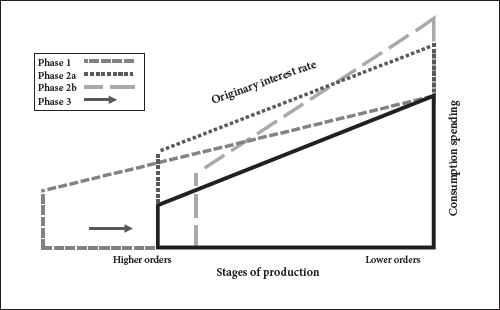
Figure 3 shows Mises’s theory of the business cycle. In phase 1, the credit expansion increases nominal spending through new investment in higher-order production processes. This lengthens the structure of production without decreasing consumer spending and narrows the rate of price spread below the originary rate, as demonstrated by the less steep slope. Phase 2 shows the reversal of this process as the public spends their increased incomes according to their actual consumption-to-investment patterns. If time preferences remain the same, then the economy adjusts back to the originary rate of interest and the former production structure at higher spending, as shown in phase 2a. If time preferences increase from capital consumption, then the economy adjusts to phase 2b to reflect an even higher consumption-to-investment ratio and rate of originary interest at the elevated expenditure level. Phase 3 is the depression, when entrepreneurs must abandon the higherorder stages, raise price spreads, reallocate factors, and reconfigure the production structure to either phase 2a or phase 2b.
Mises on Credit Contraction during the Bust
During the downturn, the mainstream neoclassical prescription is for the central bank to reopen the monetary spigots to resuscitate economic activity. Mises, in contrast, argues that “there is no use in interfering by means of a new credit expansion with the process of readjustment. This would at best only interrupt, disturb, and prolong the curative process of the depression, if not bring about a new boom with all its inevitable consequences” (Mises 1998, 576). The new credit will keep interest rates artificially low, prop up the failing investments, and prevent prices and production from adjusting downward in the higher orders.
Mises’s analysis is more complex in the case of credit contraction, when bank runs cause financial institutions to fail and pessimism causes surviving banks to curtail their loans. This decreases the money supply, also known as deflation, which lowers nominal spending and prices. Mises believed that credit contraction and deflation would cause only a temporary shortening of the structure of production that was inherently less harmful than the artificial lengthening caused by the prior credit expansion and inflation.
Mises’s scenario is as follows. The decrease in the supply of loanable funds causes “a temporary tendency toward a rise in the gross market rate of interest. . . . Projects which would have appeared profitable before appear so no longer” because of the higher loan rate. Moreover, the decline in spending sets in motion the step-by-step non-neutral adjustment process, and “a tendency develops toward a fall in the prices of factors of production” as entrepreneurs in the higher-order stages cut down on investment and decrease their demand for factors, thereby raising price spreads and shortening the structure of production. The credit contraction has overshot the originary rate of interest because it caused the rate of price spread and the loan rate to be higher than what time preferences determine. “Thus,” Mises concludes, “a cash-induced rise in the gross market rate of interest produces a temporary stagnation of business. Deflation and credit contraction no less than inflation and credit expansion are elements disarranging the smooth course of economic activities, and sources of disturbance” (564).
If the scenario ended there, one might think that Mises was in line with consensus thinking. But he then states that “it is a blunder to look upon deflation and contraction as if they were simply counterparts of inflation and expansion” (564). Not only are they less politically popular, “they are less disastrous also on account of their inherent effects.” Credit expansion artificially lengthens the structure of production and misallocates factors to the higher orders while individuals are consuming relatively more. The boom requires a “tedious process of recovery” where the economy must abandon long-term investments and accept a shorter structure of production and slower growth (565). Credit contraction, on the other hand, only temporarily reduces growth in the interim before relengthening the production structure. This is because time preferences are actually lower than what is implied by the current rate of price spread and the loan rate.
As Mises explains, “The temporary restriction in business activities that [credit contraction] engenders may by and large be offset by the drop in consumption on the part of the discharged wage earners and the owners of the material factors of production the sales of which drop.” As “prices and wage rates are by and large adjusted to the” decline in nominal spending, entrepreneurs decrease their demand for loanable funds and “the loan market too adapts itself to the new state of affairs.” Whereas the ultimate result of credit expansion is a wastage of savings, credit contraction leads only to their temporary nonuse. Overall, then, credit “contraction produces neither malinvestment nor overconsumption” (564–65).
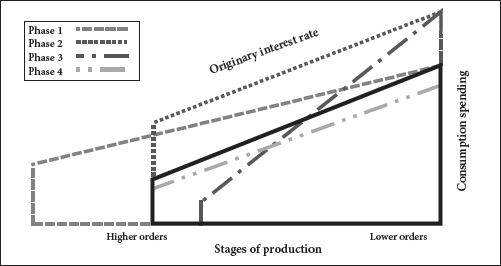
Figure 4 illustrates Mises’s analysis and superimposes the effects of deflation on the prior inflation that was shown in figure 3. Suppose that after the public reasserts its time preference spending patterns in phase 2, a credit contraction occurs. In phase 3, the deflation will lower investment, causing the production structure and spending stream to shrink and the price spreads to increase. The production structure is shorter and the rate of price spread is higher than what time preferences would determine. However, once the reduced nominal spending filters down into lower nominal incomes, the public reasserts their actual and lower time preference ratios. The result, phase 4, is that consumption spending drops, investment increases relative to phase 3, and the production structure relengthens. The rate of price spread declines back to the originary rate at the reduced level of nominal spending.
Figure 4. Mises’s theory of credit contraction
Mises’s remarks on the inappropriateness of governments expanding credit during the recovery process and the less harmful nature of credit contraction were considered backward by contemporary economists. Seymour Harris, a prominent Keynesian professor at Harvard University, commented in a review of Human Action that “deflation, the declining phase of economic activity[,] has no terror for our author. . . . Mises welcomes the deflation or bloodletting stage of business activity” (Harris 1949, 31). Mises had, however, not advocated credit contraction during the downturn. It was one of his students who would do that.
Rothbard on Credit Contraction during the Bust
In the 1950s, Murray Rothbard was working on two projects related to Misesian economics and ABCT. The first, Man, Economy, and State (Rothbard 2009), published in 1962, was a systematic treatise on economic theory along the lines of Human Action. One of Rothbard’s most important accomplishments was to develop a unified capital and interest theory that integrated Mises’s time preference theory of interest with F. A. Hayek’s structure of production framework (Salerno 2009, xxvii). The second, America’s Great Depression (Rothbard 2000), published in 1963, was a book on that downturn between the years 1929 and 1933. Rothbard was enormously influenced by Mises, whom he considered “one of the great teachers of economics, as well as one of the great economists,” and acknowledged a “supreme debt” to Mises’s “monumental theory of business cycles” (Rothbard 1962, xiii; 2000, v). Mises in turn thought very highly of his young pupil. In a letter of recommendation for Rothbard to receive a research grant to write America’s Great Depression, Mises said he was “fully convinced that [Rothbard] will one day be counted among the foremost economists. . . . I fully endorse what he says about these matters and I want merely to add that in my opinion nobody is better qualified to perform this job than Rothbard” (Mises 1956, 1).
Yet Rothbard did not confine himself to repeating the words of his mentor. When setting out to write his treatise, Rothbard envisioned that it would contain “considerable elaborations in those areas not developed by Mises [and include] differences from Mises in such areas as monopoly, banking ethics, and government” (Rothbard 1954, 4). In other words, he sought to advance Misesian economics by elaborating on the parts of economic theory Mises did not discuss and revising the theories where he thought they strayed from the correct chain of praxeological reasoning and resulted in error.
Rothbard’s goal extended to modifying Mises’s theory of credit contraction. In a private review of a manuscript by Hans Sennholz, Rothbard believed that one of its flaws was something “Sennholz shares with Mises: and that is, to regard deflation as just as much of an evil as inflation. I believe that it can be shown that deflation has a great deal of merit” (Rothbard 1960, 2). In truth, as shown above, Mises did not think deflation was as bad as inflation, having written that “deflation and contraction are less likely to spread havoc than inflation and expansion not merely because they are only rarely resorted to. They are less disastrous also on account of their inherent effects” (Mises 1998, 565). Furthermore, Rothbard developed not an entirely new theory of credit contraction but one that built upon Mises’s analysis.
In Man, Economy, and State and America’s Great Depression Rothbard showed that Mises’s scenario only held some of the time and that in other instances a credit contraction could actually be beneficial by hastening the reallocation process. When Mises’s scenario occurs and deflation “overshoot[s] the free-market equilibrium point,” it “raise[s] price differentials and the interest rate above” what is consonant with time preferences. But credit contraction “create[s] no malinvestments and therefore does not generate another boom-bust cycle” that requires a painful period of readjustment. There is only a cut “down on higher-order investment [and] a shorter structure than would otherwise be the case.” This continues until “owners of original factors, receiving lower incomes . . . spend less on consumption [and] price differentials and the interest rate will again be lowered” (Rothbard 2009, 1006). His exposition of why this kind of credit contraction is less harmful than the credit expansion that preceded it is very similar to what Mises wrote and what is depicted in figure 3.
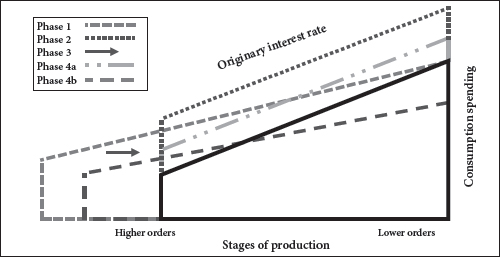
According to Rothbard, Mises’s scenario is not the only one, or even the most likely. Although “the Misesian theorists deplore deflation and have seen no benefits accruing from it[,] . . . deflationary credit contraction greatly helps to speed up the adjustment process . . . in ways as yet unrecognized” (Rothbard 2000, 17; emphasis in original). First, Rothbard applied Mises’s theory of accounting distortions caused by changes in overall prices. In Human Action, after describing capital consumption induced by inflation, Mises briefly mentions that “the same is valid with the necessary changes with regard to the analogous consequences and effects of a deflationist or restrictionist movement” (Mises 1998, 547; emphasis added). As these “necessary changes” were left unexplained by Mises, it was up to Rothbard to spell them out and show how credit contraction could increase savings when entrepreneurs see their selling prices and revenue fall while the accounting records fail to show that their costs are also declining. What appears to be a loss may actually be a profit because “assets now cost much less to be replaced. This overstatement of losses, however, restricts consumption and encourages savings; a man may merely think he is replacing capital, when he is actually making an added investment in the business” (Rothbard 2000, 18). Thus, with deflation-induced capital accumulation during the recovery process, the public will lower their consumption-to-investment spending proportion, meaning that the production structure will not need to contract as much.
More fundamentally, credit contraction, by decreasing investment spending in the higher orders, can adjust the distorted price spreads to the originary rate of interest and not always overshoot it, as assumed by Mises. Decreasing the supply of loanable funds “reduces the demand for factors in the higher stages, lowers factor prices and incomes, and increases price differentials and the interest rate. It spurs the shift of factors, in short, from the higher to the lower stages” (Rothbard 2000, 18). If the contraction does not overshoot the public’s time preferences, then it hastens the liquidation of malinvestments and correction of the price spreads as workers and other factors in the higher stages accept lower price bids and entrepreneurs reallocate them to production processes that the existing supply of savings makes feasible. This “returns the economy to free-market proportions much sooner than otherwise” (18). Thus, by reasoning through Mises’s theory and making slight changes to it, Rothbard strengthened the Austrian analysis of the depression phase of the business cycle.
Figure 5 illustrates Rothbard’s reasoning. After the public reasserts its time preference spending patterns in phase 2, credit contraction occurs. As shown in phase 3, the deflation begins to correct the economy by decreasing investment. This reduces relative prices and production in those higher-order stages that need to be downsized or abandoned and raises price spreads toward the originary rate. In phase 4a the correction finishes when the public proceeds to spend their lower nominal incomes according to their time preference ratios and the price spreads accurately reflect the originary rate at a lower level of nominal spending. If the credit contraction causes an increase in savings from the accounting illusion, from phase 3 to phase 4b, the structure of production slightly lengthens and the rate of price spread falls further, meaning that less of the reallocation process and abandonment of the highest-order stages is required. The result in either phase 4a or phase 4b is an economy that has recovered from the depression at a lower level of spending.
Figure 5. Rothbard’s theory of credit contraction
It is not known what Mises thought of Rothbard’s theory. In later editions of Human Action Mises referenced America’s Great Depression for its analysis of the 1920s boom “in which the upward movement of prices was only slight” (Mises 1966, 561). In a review of America’s Great Depression, Percy Greaves, a student of Mises, did criticize “Rothbard’s predilection for deflation as an antidote for prior politically created inflation” (Greaves 1963, 63), and it was perhaps for this reason that Rothbard considered his theory controversial among Austrians (Rothbard 2006, 252; 2016, 177; see also Ebeling 2006, 585–87; Greaves 1978, xxxiii, xli).
However, Greaves never actually refuted Rothbard’s argument that credit contraction could move the economy closer to, and not merely overshoot, the underlying price spreads, as Mises had assumed, and that Rothbard was filling in a gap in Mises’s analysis. Regardless of his argument’s impact among other Austrian economists, therefore, Rothbard had succeeded in presenting a more comprehensive view of credit contraction in a downturn that was grounded in the Austrian theory of capital and interest.
Conclusion
Economics books come and go; very few stand the test of time. Ludwig von Mises’s Human Action is one of the exceptions that prove the rule. The economic theories it describes are pathbreaking for their insights into the crucial mechanisms of the capitalist system. Despite many attempts to take it down, the general edifice of Human Action remains impregnable. This does not mean that Human Action is the last word in economics or is perfect. But improvements to the praxeological edifice have come from building upon what Mises wrote and not around it.
This is what Murray Rothbard did for Mises’s theory of credit contraction during the depression. Mises had stated that even though credit contraction raises the loan rate above the originary rate, it is less damaging than credit expansion because it does not lead to the boom-bust cycle. What Rothbard showed was that this was only one possible scenario and that credit contraction could improve the adjustment process by reducing prices in the higher orders and encouraging the reallocation of factors of production. This is how economic theory progresses, however rare genuine improvements are: through slight changes to what some prior thinker wrote rather than a wholesale reinventing of the wheel. May we all keep this in mind as we reflect on the timeless importance of Human Action.
References
Bagus, Philipp. 2003. “Deflation: When Austrians Become Interventionists.” Quarterly Journal of Austrian Economics. 6, no. 4 (Winter): 19–35. https://mises.org/quarterly-journal-austrian-economics/deflation-when-austrians-become-interventionists.
Ebeling, Richard. 2006. “The Second Austrian Conference.” In The Complete Libertarian Forum, 1969–1984, edited by Murray N. Rothbard, vol. 1, 1969–1975, 584–88. Auburn, AL: Ludwig von Mises Institute. https://mises.org/libertarian-forum-1969-1984/complete-libertarian-forum-1969-1984.
Greaves, Percy L., Jr. 1963. Review of America’s Great Depression, by Murray N. Rothbard. The Freeman, November 1963, 60–64.
———. 1978. Introduction to On the Manipulation of Money and Credit, by Ludwig von Mises, xvii–xxxvii. New York: Free Market Books.
Harris, Seymour E. 1949. “Capitalist Manifesto.” Saturday Review, September 24, 1949, 31–32.
Hayek, F. A. 2008. Prices and Production. In “Prices and Production” and Other Works: F. A. Hayek on Money, the Business Cycle, and the Gold Standard, edited by Joseph Salerno, 189–329. Auburn, AL: Ludwig von Mises Institute.
Horwitz, Steven. 2006. “Monetary Disequilibrium Theory and Austrian Macroeconomics: Further Thoughts on a Synthesis.” In Money and Markets: Essays in Honor of Leland B. Yeager, edited by Roger Koppl, 166–85. London: Routledge.
———. 2010. “Reply to Salerno’s Four Propositions on Mises and the Free Banking School.” CoordinationProblem.org. May 17, 2010. https://www.coordinationproblem.org/2010/05/reply-to-salernos-four-propositions-onmises-and-the-free-banking-school.html.
———. 2014. “The Dangers of Deflation.” Atlantic Economic Journal 42 (2): 143–51.
Huerta de Soto, Jesús. 2009. Money, Bank Credit, and Economic Cycles. Translated by Melinda A. Stroup. Auburn, AL: Mises Institute. https://mises.org/library/book/money-bank-credit-and-economic-cycles.
Mises, Ludwig von. 1956. Ludwig von Mises to James A. Kennedy, April 5, 1956. Ludwig von Mises Collection, 1934–74. Grove City College Archives, Grove City College, Grove City, PA.
———. 1966. Human Action: A Treatise on Economics. 3rd rev. ed. Chicago: Henry Regnery.
———. 1998. Human Action: A Treatise on Economics. Scholar’s ed. Auburn, AL: Ludwig von Mises Institute. https://mises.org/library/book/human-action.
Newman, Patrick. 2014. “The Depression of 1873–1879: An Austrian Perspective.” Quarterly Journal of Austrian Economics 17, no. 4 (Winter): 474–509. https://mises.org/quarterly-journal-austrian-economics/depression-1873-1879-austrian-perspective.
———. 2016. “The Depression of 1920–21: A Credit Induced Boom and a Market Based Recovery?” Review of Austrian Economics 29, no. 4 (December): 387–414. https://doi.org/10.1007/s11138-015-0337-5.
Rothbard, Murray N. 1954. Letter to Richard C. Cornuelle titled “Textbook or Treatise?,” February 1954. Rothbard Papers. Mises Institute, Auburn, AL.
———. 1960. “Confidential Memorandum to William Volker Fund on Hans Sennholz’ A History of the Federal Reserve System,” April 3, 1960. Rothbard Papers, at the Mises Institute.
———. 1962. Preface to Man, Economy, and State: A Treatise on Economic Principles, vol. 1, vii–xiv. Princeton, NJ: D. Van Nostrand. https://archive.org/details/maneconomystatev0001murr/mode/2up.
———. 2000. America’s Great Depression. 5th ed. Auburn, AL: Mises Institute. https://mises.org/library/book/americas-great-depression.
———. 2006. “Deflation, Free and Compulsory.” In Making Economic Sense, 2nd ed, 250–53. Auburn, AL: Ludwig von Mises Institute. https://mises.org/library/book/making-economic-sense.
———. 2009. Man, Economy, and State with Power and Market. 2nd scholar’s ed. Auburn, AL: Ludwig von Mises Institute. https://mises.org/library/book/man-economy-and-state-power-and-market.
———. 2016. “Deflation Reconsidered.” In The Rothbard Reader, edited by Joseph T. Salerno and Matthew McCaffrey, 173–80. Auburn, AL: Mises Institute. https://mises.org/library/book/rothbard-reader.
Salerno, Joseph T. 2010. “An Austrian Taxonomy of Deflation—with Applications to the U.S.” In Money: Sound and Unsound, 267–314. Auburn, AL: Ludwig von Mises Institute. https://mises.org/library/book/money-sound-and-unsound.
———. 2009. “Introduction to the Second Edition.” In Man, Economy, and State with Power and Market, by Murray N. Rothbard, 2nd scholar’s ed., xix–l. Auburn, AL: Ludwig von Mises Institute. https://mises.org/library/book/man-economy-and-state-power-and-market.
________________
For previous analyses of Mises’s and Rothbard’s theories of credit contraction, see Bagus (2003, 20–21, 24–25), Horwitz (2010), Huerta de Soto (2009, 450–52), Newman (2014, 478–79; 2016, 390), and Salerno (2010, 278–94).
In the real world a price spread always includes profit or loss, meaning that “originary interest can therefore in the changing economy never appear in a pure unalloyed form” (Mises 1998, 531). But if the economic data (preferences, resources, and technology) remained constant, entrepreneurial arbitrage would eliminate profits and losses, thereby equalizing all price spreads and establishing the originary interest rate in every production process.
Each bar includes the money spent to purchase the capital goods produced in the previous stage and the new expenses made on land and labor to further transform the capital goods. As the price spreads are the difference between the total sum spent on factors of production and the revenue earned from selling the produced capital goods, the lines do not connect to the top of each bar.
This is because, before the increase in the supply of loanable funds, the loan rate was higher than the rate of return that could be earned by investing in said production processes.
The short-run and long-run nonneutral adjustment process caused by changes in the money supply is not due to sticky prices. Even if prices flexibly adjust to the new market-clearing levels when the demands for various goods increase, not all prices will increase at the same time, because the monetary expansion initially increases spending only in certain sectors of the economy and then radiates outward. This, not the apparent rigidity of prices, is what causes the crucial disarrangements in relative prices and production.
For graphical clarity, the potential outcome of phase 2b from figure 3 is not shown in figure 4; phase 2 is only phase 2a.
For a very different view of deflation from an Austrian perspective that uses the structure-of-production framework, see Horwitz (2006, 177–81; 2014, 147–50).
His remarks in Rothbard (2009, 1005–7) and Rothbard (2000, 17–19) are very similar, and the following discussion draws from both.

