
The Influence and Significance of Human Action after 75 Years
1. The Law of Association: Foundation of Human Society Paul F. Cwik
1
The Law of Association: Foundation of Human Society
PAUL F. CWIK
The 1980s were a time when Alex P. Keaton,conservatism, and free trade were cool. The vision of a smaller government was so strong that it spilled into the 1990s, when the “era of big government” was declared “over.” Unfortunately, the reality of free trade never actually materialized. Beginning in 1981, the Reagan administration negotiated a “voluntary export restraint” agreement that limited the volume of Japanese cars exported to the United States. The North American Free Trade Agreement (NAFTA), negotiated under President George H. W. Bush and signed into law by President Clinton in 1993, was hundreds of pages long, containing twenty-two chapters and seven annexes. However, while it does not take hundreds of pages to say “We will not tax, regulate, or restrict trade with you,” at least there was lip service promoting the idea of free trade.
The pendulum has swung far away from the rhetoric of the 1980s and ’90s. Today, there is open hostility toward free trade. Oren Cass, writing in the Liberty Fund’s publication Law and Liberty, stated in January 2024, “Comparative Advantage rose phoenix-like from the ashes of World War II, as American economists sought to claim for themselves a leading role in rebuilding a peaceful, US-led world order.” Cass does not simply hold contempt for the idea of free trade and the reasoning supporting it (the law of comparative advantage). He actively promotes protectionism: “Behind some of the world’s highest tariff barriers, the United States transformed from colonial backwater to continent-spanning industrial colossus. From 1870 to the eve of the Great Depression in 1929, US GDP per capita grew at more than twice the rate in the United Kingdom. Most of the great success stories in modern development—countries like Japan, South Korea, and Israel—likewise hinge on aggressive trade barriers erected to develop domestic industry” (Cass 2024). The champions of free trade have receded into the background. In this election year (2024), no leading presidential candidate advocates for free trade.
What happened to the ideal of free trade? The answer to why politicians support regulated trade and negotiated treaties is that most voters simply do not support free trade. The problem is deeper than the lack of public interest in international, multilateral agreements. The root of the problem extends to a misunderstanding of the basic goodness of a simple market exchange. The rot of poor economic theory stretches to its foundations. Modern economic theory has failed, at the most basic level, to teach the majority of people the benefits of free trade.
Foundation: Why We Trade
At the heart of every trade lies “the double coincidence of wants.” This principle is the basis of why two people trade. When people exchange, they trade because their valuations are unequal. Imagine two individuals: Mises and Hayek. Suppose that Mises has apples and Hayek has blueberries. Each subjectively values the object in his possession and appraises the expected value of the other’s. If Mises values the apples more than the blueberries, then he will not be willing to trade. Likewise, if Hayek values the blueberries more than the apples, then he, too, will be unwilling to trade. They will only be willing to complete the exchange if they expect to gain more than they trade away. The double coincidence of wants refers to the situation where the valuations (of the wants) of the two parties coincide (with each other) so that their valuations have opposite inequalities. In other words, for Mises and Hayek to trade, Mises must value the blueberries (which he is gaining) more than his apples (which he is trading away). At the same time, Hayek must have the reverse valuations, whereby he values the apples more than his blueberries. When the double coincidence of wants condition is met, there will be an exchange that makes both parties psychologically happier. Additionally, voluntary exchange is morally good because there is no coercion, each party serves the other so that both sides gain, and no one loses.
However, despite the psychological benefit of voluntary exchange, the quantity of goods remains the same. In other words, while Mises and Hayek are happier after they trade, there still exists the same total amount of apples and blueberries. No additional products have been created. To explain how a society can grow through exchange, it is necessary to extend the analysis of trade to include specialization and the division of labor.
In his 1776 book An Inquiry into the Nature and Causes of the Wealth of Nations, Adam Smith (1982) presents a theory of “absolute advantage.” Absolute advantage is a situation where one economic entity (individual, company, state, or nation) is better than another at making a good. When two parties each have an absolute advantage, the benefits from specializing and trading according to their absolute advantage are clear. However, what happens if one side is better at producing everything? Is there still a reason to specialize and exchange? The answer is yes, but the reason is found in the law of comparative advantage, not in absolute advantage.
The Law of Comparative Advantage
The law of comparative advantage for international trade was first formalized a generation after Adam Smith. Normally, David Ricardo’s (1973) The Principles of Political Economy and Taxation (1817) is credited with the introduction of this law. However, Lionel Robbins (1998, 211) argues that Col. Robert Torrens’s (1815) work An Essay on the External Corn Trade first formulated it. Murray Rothbard (2006a, 96–98) digs deeper and argues that it was actually James Mill, friend and mentor to Ricardo, who first correctly articulated the law of comparative advantage. Regardless of who first formalized the law, the important point is that it shows that when economic entities specialize according to their comparative advantage and trade, not only will both parties become psychologically happier, but there will also be a physical increase in the number of goods produced.
In Human Action, Ludwig von Mises transforms the law of comparative advantage from a tool used to analyze international trade questions to a tool used at every level of trade. He renames it the “law of association.” By applying the law of association to trade at every level (from individuals to general markets to international markets), Mises shows the necessity of free markets for human flourishing.
The law of association may be the most difficult economic law to understand because sometimes it leads to counterintuitive conclusions. For example, if a person wants bread, it might be economically better for him to specialize in something else and trade for bread even if he is better at making bread than everyone else (i.e., he has an absolute advantage).
Despite the difficulty in understanding the law, following the law is often instinctual. Suppose a major league baseball pitcher who earns $43 million per year is also a very good baker. Imagine that he is so good at making cakes he could sell each for the extremely high price of $430. At this price, to match his baseball income, the pitcher would have to sell 100,000 cakes per year, or 274 per day! Clearly, the pitcher should specialize in pitching and buy cakes. Alternatively, imagine a doctor who could either cut his lawn or outsource this task to his grandson. If the doctor spends his time cutting his grass, then he is not doing what he does best, which is serving his patients. Again, the solution is almost instinctual. He should hire his grandson to cut his lawn.
The key to the law of association is uncovering what one does best. Specifically, the key is determining the decision-maker’s opportunity cost. An actor’s opportunity cost is the next best, forgone alternative. In other words, when a person makes a decision there are many possible choices to consider; the decision-maker chooses the alternative that yields the highest expected value and sets aside the rest. Of the choices that are not selected, the next best alternative is the opportunity cost. Suppose that a person is deciding upon lunch. He is confronted with many alternatives. He could have, for example, a sandwich, a hot dog, or soup. If his first choice is the sandwich, his second the hot dog, and his third the soup, then as he selects the sandwich, the hot dog (and only the hot dog) becomes his opportunity cost. For the pitcher, the opportunity cost of baking cakes is pitching, and for the doctor, seeing patients is the opportunity cost of cutting his lawn.
A Numerical Example
Economic theory can help craft better public policy positions by understanding economic relationships. Economists have observed market choices and have clarified exactly how the law of association works. Economic analysis works by stripping away the nonessential elements so that only the crucial relationships remain. To accomplish this thought experiment, it is necessary to construct an economic model using the following assumptions. Suppose that in this model there are only two people (Rothbard and Keynes) and they produce two goods (bread [B] and garments [G]). Labor hours are the only resource (input), and everything else is held constant. Furthermore, suppose that Rothbard is better than Keynes in everything, but not equally better in everything. Accordingly, we assume that Rothbard can make bread twice as fast as Keynes and make garments three times faster. In other words, it takes Rothbard one hour to produce one loaf of bread, while it takes Keynes two hours. And two hours are required for Rothbard to make one garment, while Keynes requires six. Finally, we also assume that the productive capabilities of each remain constant—that is, they do not learn from specialization or repetition. Placing twenty-four hours on the clock and evenly dividing their time between the two activities, we see the initial results in table 1. The total amount produced is eighteen loaves of bread and eight garments.
Table 1. Respective outputs

Now suppose that Rothbard says he would like more bread. One might leap to the erroneous conclusion that since he is better at making bread than Keynes, he should make the additional bread himself. While it might have been clear in the previous examples that the pitcher and doctor should specialize in what they do best, this example’s solution is not quite as clear. Nevertheless, the principle remains the same: each should specialize in what they “do best.” In other words, they should specialize in the activity that yields the lowest relative opportunity cost.
Finding the lowest relative opportunity cost cannot be done in isolation. In the lunch example, determining the opportunity cost was simple because it only involved one individual’s subjective consumption preferences. However, when it comes to production and exchange, the opportunity cost depends on the productive capabilities of others. The law of association means that it is necessary to compare the productive capabilities of the two parties. In this example, when Rothbard commits two hours to produce one garment, he sacrifices the production of two loaves of bread. And when he produces one loaf of bread, he could have alternately used that time to finish half a garment. Keynes’s opportunity cost for one garment is three loaves of bread, and that for making one loaf of bread is a third of a garment. These relations are illustrated in table 2.
Table 2. Respective opportunity costs

To find the lowest relative opportunity cost, we compare the rows of the table. Reading across the first row, we see that the cost of producing one loaf of bread is higher for Rothbard (0.5G) than it is for Keynes (0.33G). In other words, Keynes has a comparative advantage in bread making even though Rothbard is better at making bread. Continuing this analysis, we see that Rothbard has a lower relative opportunity cost for producing garments than Keynes (2B for Rothbard versus 3B for Keynes). The conclusion is that they should each shift their production into the area in which they have a comparative advantage. Rothbard should shift his production into garment making, and Keynes should shift his production into bread making.
As this is a highly stylized example and to make the numbers come out in nice whole numbers, suppose that Keynes shifts his entire production to bread making while Rothbard only shifts four hours toward garment making. Table 3 shows the results of this change.
Table 3. Output after shifting production time

The total amount produced is twenty loaves of bread and eight garments. By simply shifting labor hours into the areas of comparative advantage, we see that two additional loaves of bread are created. These additional loaves are produced despite no additional time added, no new resources discovered, no extra labor imported, no new tools or technology developed, nor any new skills learned by Rothbard and Keynes. This result is amazing. It is almost like magic, but it is not magic. The additional production comes about because each has reduced his cost of production by specializing in his comparative advantage. In table 4, we see the results of allowing Rothbard and Keynes to trade at the ratio of two garments for five loaves of bread.
Table 4. Final gains after trade

After the trade is complete, one might wonder which side benefited the most. The reality is that this question is nonsensical. There is no such thing as a “fair” way to measure relative gains. There are three perspectives by which we can compare the outcome of this specialization and exchange. If we examine the outcome in terms of bread, then we can see that Rothbard and Keynes equally gained one loaf of bread. However, if one measures the gains in terms of time saved, then Keynes gained more than Rothbard. For Keynes, one loaf of bread represents two hours of labor, while for Rothbard one loaf represents one hour. Finally, from the perspective of garments, Rothbard gains more, for one bread loaf represents half a garment to him, while one bread loaf represents only a third of a garment for Keynes. The idea that the United States should not trade with China because China has a greater benefit than the US is equally nonsensical. The only truth that can be deduced from this analysis is that total production has increased, whereby both parties are made better off.
Following the Law
The real world is much more complex than our simple two-party/twogood model. There are hundreds of millions of people in the US and uncountably many capital and consumer goods. Fortunately, to follow the law of association in the real world, we do not need an economist with an extremely large spreadsheet to determine where one’s comparative advantage lies. To find a person’s comparative advantage, all that is needed is to allow him to minimize his opportunity cost. Again, in a free market, this solution is not hard to find. To demonstrate how simple it is, suppose you are asked to choose between three jobs that are identical in every way except for the salary. Job A’s salary is $55,000 per year, B’s is $45,000 per year, and C’s is $35,000 per year. To find your comparative advantage, you need to minimize your opportunity cost. When presented with the choice between these three jobs, you obviously choose Job A. The opportunity cost—the next best, forgone alternative—is the $45,000 that could have been earned from Job B. If for some reason you chose Job B, then the opportunity cost would be the $55,000 that could have been earned from Job A. The opportunity cost of selecting Job C is also $55,000. These results are summarized in table 5.
Table 5. Job salaries and opportunity costs
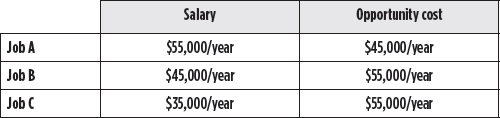
As previously mentioned, finding one’s comparative advantage is the same as minimizing one’s opportunity cost. As we can easily see in table 5, minimizing one’s opportunity cost is the same as maximizing one’s revenue. The conclusion is that to follow the law of association, one only needs to take the job that benefits oneself the most. People naturally take the jobs that benefit themselves the most, and therefore, in a free market, people naturally tend to follow the law of association. Economic analysis is not necessary to make the law of association work. Instead, economic analysis helps to differentiate good public policy from bad.
From the analysis of comparative advantage, the principle which emerges is that minimizing opportunity costs is the key to gaining benefits from specialization and exchange. While the example in table 5 uses dollars, opportunity cost is a broader concept. In the real world, a person might reject a higher-paying position for many reasons, such as the impact on his quality of life, the impact on time spent with family, or the necessity of relocating to another area. Thus, if, for nonpecuniary reasons, one picks a job with a lower salary, it does not violate the law of association because that person is still selecting the most favored alternative, thereby minimizing his opportunity cost. Making a choice based on directly valuing the alternatives is called “economic calculation.” When the choice is based upon objective prices, this decision uses “monetary calculation.” Mises determined that while monetary calculation is not perfect, it aligns with economic calculation to such an extent that “were we to dispense with [monetary calculation], any economic system of calculation would become absolutely impossible” (Mises 1990, 25; see Mises 2024, chap. 13). In a market system, prices are guides that provide information to allow people to reasonably follow the law of association, minimize their opportunity costs, and expand production.
An Optimal System
To follow the law of association, the best policy a society can adopt is a system of true free-market prices. Market prices are packets of information that contain everyone’s subjective valuations. They carry the subjective valuations of the consumers who think the price is too high, too low, and just right. They also contain the subjective valuations of the producers who think the price is too high, too low, and just right. They are the result of everyone’s input. Market prices are paramount because they allow decision-makers to engage in monetary calculation. As Mises notes, “Monetary calculation is the main vehicle of planning and acting in the social setting of a society of free enterprise directed and controlled by the market and its prices” (Mises 2024, 231). Without true market prices, monetary calculations would be distorted, resources would be misdirected, and capital would be malinvested. Thus, to avoid waste, public policy should steer clear of interventionism. A corollary conclusion is that the government should eschew inflation, monetary expansion, and all other forms of intervention that distort prices.
The Building Block of Society and Civilization
The placement of the law of association in Human Action might seem odd. It is in “Part Two: Action within the Framework of Society,” which is before the introduction of economic calculation, exchange (catallactics), and the market. One might think that since the law explains the benefits of exchange, it should come after the analysis of the market. Mises, however, is correct in placing this law before any analysis of trade. The law of association explains why people do not live in isolation.
The law of association is essential for the existence of society. If the law were not true, then there would be no reason for communities to coalesce. The law shows that when people indirectly cooperate through specialization and exchange, they increase the quantity of economic goods at their disposal. When people do not specialize and trade, the combined output is merely the summation of their autarkic production (A + B = 2). However, when people specialize and exchange, costs are reduced, and society’s total output is greater than before (A + B > 2). Society exists because we can indirectly cooperate. Because I can gain when I trade my produce for my neighbor’s, I have the incentive to be a part of a community. When people specialize according to their comparative advantage and exchange, this indirect cooperation results in human flourishing.
The implications of the law of association are greater than a simple materialistic gain. The differences in our opportunity costs are the sources of our comparative advantages; if everyone were identical, then there would be no gains to be made. The implication is that a diverse society is needed. Moreover, gains are made by indirect cooperation. Indirect cooperation means that each person specializes in a particular area of production. By specializing in one area, each person becomes dependent on everyone else to provide all other goods and services. For example, a baker depends on others to grow wheat and mill it into flour. The baker also depends on countless other individuals for all the other ingredients to make a cake. Still further, the baker requires the assistance of more individuals to make the oven and supply the energy to operate it. The baker makes more cakes than he could possibly use. He makes this excess amount for the market because he wants more than cakes. He wants clothes, shelter, transportation, entertainment, and so forth. He relies on society for all his other noncake needs. Thus, he produces cakes for others. To entice people to trade with him, he must serve his customers—he must envision what their wants and desires are and place them above his own preferences. By catering to strangers, he can gain the wherewithal (money) to then go into the market and obtain what he desires. The virtue is that he must serve strangers before he can take for himself. In this extended market order, we see the realization of the ideal for society—a peaceful, voluntary pluralism.
To conclude with a note from Mises (2024, 160), “Praxeology solves the problem. If and as far as labor under the division of labor is more productive than isolated labor, and if and as far as man is able to realize this fact, human action itself tends toward cooperation and association; man becomes a social being not in sacrificing his own concerns for the sake of a mythical Moloch, society, but in aiming at an improvement in his own welfare. [Since] this condition . . . is real . . . we are in a position to comprehend the course of social evolution.”
References
Ayau, Manuel F. 2007. Not a Zero-Sum Game: The Paradox of Exchange. Edited by Giancarlo Ibárgüen S. Guatemala City: Universidad Francisco Marroquín. https://mises.org/library/book/not-zero-sum-game-paradox-exchange.
Cass, Oren. 2024. “Free Trade’s Origin Myth.” Law and Liberty, January 2, 2024. https://lawliberty.org/forum/free-trades-origin-myth/.
Mises, Ludwig von. 1990. Economic Calculation in the Socialist Commonwealth. Translated by S. Adler. Auburn, AL: Mises Institute. https://mises.org/library/book/economic-calculation-socialist-commonwealth.
———. 2024. Human Action: A Treatise on Economics. 75th anniversary ed. Auburn, AL: Mises Institute.
Ricardo, David. 1973. The Principles of Political Economy and Taxation. London: Guernsey Press.
Robbins, Lionel. 1998. A History of Economic Thought: The LSE Lectures. Edited by Steven G. Medema and Warren J. Samuels. Princeton, NJ: Princeton University Press.
Rothbard, Murray N. 2006a. Classical Economics. Vol. 2 of An Austrian Perspective on the History of Economic Thought. Auburn, AL: Ludwig von Mises Institute. https://mises.org/library/book/austrian-perspective-history-economic-thought.
———. 2006b. “The Nafta Myth.” In Making Economic Sense, 2nd ed., 370–75. Auburn, AL: Ludwig von Mises Institute. https://mises.org/library/book/making-economic-sense.
Smith, Adam. 1982. An Inquiry into the Nature and Causes of the Wealth of Nations. Edited by R. H. Campbell, and A. S. Skinner. 2 vols. Indianapolis: Liberty Fund.
Torrens, R. 1815. An Essay on the External Corn Trade. London.
________________
Alex P. Keaton was a fictional character played by Michael J. Fox on the television show Family Ties.
Bill Clinton made this famous pronouncement in his State of the Union address on January 23, 1996.
For an overview of how NAFTA was not a free trade agreement, see Rothbard (2006b).
This example is based upon Ayau (2007).

