
The Influence and Significance of Human Action after 75 Years
10. There’s Many a Slip ’twixt Cup and Lip Jonathan Newman
10
There’s Many a Slip ’twixt Cup and Lip
JONATHAN NEWMAN
Ludwig von Mises was a true genius, and we can certainly see that on display in his magnum opus, Human Action. The book is cohesive, thorough, and systematic, and yet every page is pregnant with opportunities for scholars to expand and clarify. One of the dominant themes of Human Action is Mises’s careful delineation of the proper method of economics. The subject matter of economics is purposeful human action, not the unmotivated behavior of atoms, rocks, and stars, and this distinction has important implications for the ways we can make sense of the world. In Human Action’s chapter 6, titled “Uncertainty,” Mises applies this distinction to the ways we deal with the future.
While it does not appear in this chapter, Mises (1998, 254) uses the phrase “There’s many a slip ’twixt cup and lip” at one point in Human Action to refer to the inherent uncertainty in all action. Since all action aims at the attainment of an end in the future, all action is inherently speculative. Even actions that are the most immediately realizable, like bringing a cup to one’s lip for the sake of quenching thirst, involve some amount of hazard that the desired end will not be attained. Moreover, he says, the uncertainty of the future is a praxeological category—it is impossible to conceive of action in a world of perfect certainty: “If man knew the future, he would not have to choose and would not act. He would be like an automaton, reacting to stimuli without any will of his own” (105).
Methodological Dualism and Class versus Case Probability
Mises explains that there are two reasons why the future is inherently unpredictable: (1) we do not have complete knowledge of the natural realm, and (2) we cannot predict with certainty what humans will choose (105). The subject matter of these two “spheres” is categorically different, which implies that different methods are suitable for understanding them. We can use repeated experiments to discover regularities in natural phenomena, but the lack of any constant relations in human action renders this method inappropriate for economics and the social sciences. Purposeful human action—that is, the use of means to attain ends—may be studied using the logic and categories of action, but the lack of any purpose within the elements of the natural world renders praxeology unsuitable as a method for studying atoms, rocks, and stars. This methodological dualism, according to Mises, extends to the very nature of probability: “There are two entirely different instances of probability; we may call them class probability (or frequency probability) and case probability (or the specific understanding of the sciences of human action). The field for the application of the former is the field of the natural sciences, entirely ruled by causality; the field for the application of the latter is the field of the sciences of human action, entirely ruled by teleology” (107).
Class probability involves extensive knowledge about a class of events but virtually no knowledge about the particular events except that they belong to the class (107). Mises has in mind the problems of the natural sciences or of games of chance involving physical objects like dice. In these arenas, what we know about the outcome depends on the behavior and interaction of physical objects and materials. With a certain arrangement of gears of different sizes, the engineer can know with practical certainty how many times one gear will turn given the number of turns of another gear. Or a gambler can know with practical and quantifiable certainty the probability that a particular number will be rolled in a game involving dice. The gears and the dice behave according to the laws of physics, but the engineer and the gambler exert different levels of control over the outcome. Class probability applies to both, even though the engineer designs the mechanisms in such a way as to achieve an outcome with virtually 100 percent certainty.
“The gambler,” according to Mises, “knows nothing about the event on which the outcome of his gambling depends. All that he knows is the frequency of a favorable outcome of a series of such events, knowledge which is useless for his undertaking. He trusts to good luck, that is his only plan” (112). While still operating in the realm of class probability, “the engineer, on the other hand, knows everything that is needed for a technologically satisfactory solution of his problem, the construction of a machine” (112). The engineer, however, cannot escape “the element of gambling present in human life” (112). Even so, “as far as some fringes of uncertainty are left in his power to control, he tries to eliminate them by taking safety margins. The engineer knows only soluble problems and problems which cannot be solved under the present state of knowledge” (112). The engineer’s knowledge is made up of technological relationships that may be explained in terms of class probability. The expectation of the regular behavior of his materials is based on his past observations or on the laws of physics, which were discovered by repeated experimentation. He knows how to apply the appropriate forces to his materials in the appropriate directions to achieve the desired outcome. The gambler, on the other hand, is not allowed to exert such control over the outcome in a fair game. The probability of the desired outcome approaches 100 percent for the engineer, but not for the gambler.
Regarding “the element of gambling present in human life,” Mises provides some interesting examples: lightning strikes and viper bites. Mises says, “Life itself is exposed to many risks. At any moment it is endangered by disastrous accidents which cannot be controlled, or at least not sufficiently. Every man banks on good luck. He counts upon not being struck by lightning and not being bitten by a viper” (112). The behavior of the weather and animals is not determined by human action (usually), and so the extent that humans are exposed to such events constitutes gambling. Even taking out insurance policies is a gamble, because the insured “banks upon the opposite chances” (112).
Case probability is very different. When actors deal with a unique event that is determined by many variables (some of which are unknown to the actor) and cannot be put into a class except by itself, then the probabilities cannot be quantified except by recourse to metaphorical language. Actors must speculate about these outcomes using their own judgment, but there are still varying levels of control that actors may attempt to exert on the outcome. Case probability especially applies to events that are determined by human action.
Mises offers social engineering as an example of high (attempted) control over the actions of individuals:
Like planning, this term [“social engineering”] is a synonym for dictatorship and totalitarian tyranny. The idea is to treat human beings in the same way in which the engineer treats the stuff out of which he builds bridges, roads, and machines. The social engineer’s will is to be substituted for the will of the various people he plans to use for the construction of his utopia. . . . If this were feasible, then of course the social engineer would not have to bother about understanding other people’s actions. He would be free to deal with them as technology deals with lumber and iron. (113)
The social engineer attempts to bring about a desired outcome by forcing people to behave in a certain way. Mises sees the engineer and the social engineer as having parallel tasks: one manipulates mindless materials, and the other manipulates human persons.
When actors do not attempt to exert such control over other individuals, they are in the position of the pure entrepreneur: “In the real world acting man is faced with the fact that there are fellow men acting on their own behalf as he himself acts” (113). Mises refers to this activity as “speculation”: “The necessity to adjust his actions to other people’s actions makes him a speculator for whom success and failure depend on his greater or lesser ability to understand the future. Every action is speculation. There is in the course of human events no stability and consequently no safety” (113).
“Modes of Dealing with the Future”
While Mises lists gambling, engineering, and speculating as “three different modes of dealing with the future” (112), his inclusion of a discussion of the social engineer implies four modes of dealing with the future. We may depict these modes in the 2 × 2 typology shown in table 1.
Table 1. Mises’s four modes of dealing with the future
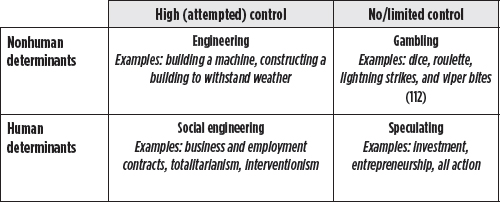
Dealing with the future involves varying levels of control over two categories of things that determine the outcome of human activity. When we “operate only within an orbit of certainty,” making use of known technological relationships, we are Mises’s engineer. When we subject ourselves to an outcome determined by “noncontrollable natural events” or to the roll of the dice, we are gambling. We are speculators when we subject the success or failure of our actions to other people’s actions, which we do not control. Finally, when we do attempt to control other people’s actions, we are Mises’s social engineer.
Mises’s discussion of the social engineer is undoubtedly negative, especially from the viewpoint of a reader who, like Mises, holds to classical liberalism. But we can extend this mode of dealing with the future on purely descriptive grounds, in the same way Mises described the intentions and activities of the engineer, gambler, and speculator. We can include more inoffensive examples of exercising influence over what other people do, such as persuasion, marketing, and designing contracts.
Interestingly, Mises discusses situations in which these modes of dealing with the future overlap. For example, someone who bets on the outcome of a horse race incorporates his understanding of both human and nonhuman factors:
Sometimes betting and gambling are combined. The outcome of horse racing depends both on human action—on the part of the owner of the horse, the trainer, and the jockey—and on nonhuman factors—the qualities of the horse. Most of those risking money on the turf are simply gamblers. But the experts believe they know something by understanding the people involved; as far as this factor influences their decision they are betters. Furthermore they pretend to know the horses; they make a prognosis on the ground of their knowledge about the behavior of the classes of horses to which they assign the various competing horses. So far they are gamblers. (116)
Thus, betting on a horse race and similar endeavors that involve the actor exercising no control over an outcome that is codetermined by human and nonhuman factors would fit between the two right quadrants in table 1.
This opens the door for us to consider other areas of overlap. Of course, the level of attempted control over the outcome can vary, whether the objects of control are human or not. Consider an inventor in his laboratory trying different combinations of chemicals or mechanisms without knowing exactly what the outcome will be or even what the practical use of his project will be once he does complete it. Many technological innovations, like pacemakers, superglue, and penicillin, were developed by accident. These situations would fit between the two upper quadrants.
In the realm of human action (the two bottom quadrants), there is also a spectrum of attempted control between pure speculation without any effort to influence others and violent totalitarianism. Persuasion and marketing are in this middle area. When dealing with the anticapitalist critics of advertising, Mises notes, “It is a widespread fallacy that skillful advertising can talk the consumers into buying everything that the advertiser wants them to buy” (317). Advertising, therefore, does not exert total control over the buying decisions of consumers. Much more control, but still not to the extreme of unilateral threats of violence, is exercised in contracts, when two or more parties stipulate obligations for each other and provide for consequences if those obligations are not met.
A little creativity is required when considering examples that represent overlap between the two left quadrants. Here, the actor would be exercising a high level of control over an outcome that is codetermined by human and nonhuman factors. One possibility is project management, in which the manager seeks to combine land, labor, and capital to achieve a certain production objective. Other examples may include military strategy, theater or live music productions, or sports. In these examples, the person designing, conducting, or coaching the activity attempts to control both human and nonhuman factors to achieve a desired outcome.
How Do We Deal with How We Deal with the Future?
The reader might wonder about the relevance of this categorization for economics. What do we gain by categorizing human activity into these four modes and their overlapping areas? I offer two points: (1) it helps us identify the proper method for making sense of the world, and (2) it helps us parse entrepreneurial functions (i.e., the “pure entrepreneur” versus the “entrepreneur-promoter”).
Methodological Implications
This fourfold categorization of human activity helps us identify which method is most appropriate for understanding a particular activity. When human action is a determinant of a future outcome, class probability and the laws of nature will have limited application. As such, quantitative methods are ill suited for economics, analyzing the entrepreneur, or predicting human behavior with certainty. This realization immediately casts into doubt the modus operandi of mainstream economics.
Consider, for example, the way Paul Samuelson (1983, 504) approaches the topic of “probabilistic choice”: “If you use probabilities in an optimizing procedure, these are your personal or subjective probability concepts. (Of course, you may think that they really have an ‘objective’ basis. Maybe you’re even right in this thought.) Once you embrace more-probable and less-probable qualitative concepts—it’s ‘more likely’ to rain in April and in June—if you go on to commit yourself to various ‘consistency’ axioms, you will find that your qualitative personal probabilities begin to combine in exactly the same manner that the mathematicians’ deductive combinatorials and measure-theoretic magnitudes do.”
While Samuelson uses the example of the likelihood of rain in April and June, which can be expressed in terms of class probability according to Mises, Samuelson goes on to treat all probabilistic choice in this way. There is no room for case probability in Samuelson’s exclusively mathematical treatment of all economic problems.
Samuelson proceeds by taking “as a given of the problem your probability distribution for the different outcomes” (504) and then provides a litany of mathematical expressions to summarize the whole of probabilistic choice. For Samuelson, all uncertainty regarding the future can be modeled in this way.
However, such quantitative methods are appropriate only for the natural sciences, engineering, calculating probabilities for games of chance, and some aspects of the business of insurance. In these realms, classes of events can be identified and controlled experiments can be repeated. The elements are merely reactive and, given the forces that determine their behavior, cannot choose to behave in a different way.
Mises’s categorization allows us to select the appropriate method for making sense of different human activities. The engineer employs the laws of physics to his task—there is no room for teleology to inform his expectation regarding gear ratios, for example. It would be absurd for him to think in these terms: “This gear wants to turn the other gear.” The gambler would commit a similar error in thinking the dice intend to yield a certain probability density function over a large number of rolls. However, when other people’s choices are a determinant of an outcome, then teleological explanations are appropriate. Praxeology is teleological, but only encompasses action as such, in a universal and time-invariant way. If the observing social scientist wants to make sense of a particular action, then understanding is required.
In our day-to-day lives we often take actions that do not fit squarely into one of the four “pure” categories. This is why Mises allows for a variety of methods of making sense of the world: “The scope of understanding is the mental grasp of phenomena which cannot be totally elucidated by logic, mathematics, praxeology, and the natural sciences to the extent that they cannot be cleared up by all these sciences” (50). Understanding, in the Misesian sense, involves “filling in the gaps” regarding definite actions, including the means employed and the ends sought by the actor. Praxeology encompasses human action per se, and so cannot be used exclusively by the historian to make sense of past actions or by the entrepreneur to speculate about future market conditions. To do those things, we must make use of our own experience and intuition to form opinions about what people desire, what people know and expect, and what resources people have at their disposal.
Entrepreneurial Functions
Mises’s modes of dealing with the future also shed light on the functions of the entrepreneur. The “pure entrepreneur,” which only exists as an imaginary construct, is in the bottom right quadrant in table 1. Salerno (2018) summarizes Mises’s view of the pure entrepreneur:
[The pure entrepreneur], according to Mises (1998, pp. 253– 254) is not a human actor but a single “definite function” that is embodied in “an imaginary figure” who is “propertyless” and whose only function is to bear risk. As such, for Mises the pure entrepreneur is a “methodological makeshift” designed to enable the economist to analytically isolate profit (and loss) from the interest earned on capital, both of which are inextricably bound together in the net income received by business owners and investors in the real world. . . . Indeed, Mises (pp. 254, 302) pointed out that it is not possible to think through the concept of a pure entrepreneur who owns no capital to a logical conclusion and he explicitly warned against the “error” of confusing the pure entrepreneur with the entrepreneur “in a living and operating market economy.” (Salerno 2018, 195)
The pure entrepreneur does not own, arrange, advertise, manage, or design anything. He merely subjects himself to uncertain future market conditions, but due to the contrived nature of the construct, he can only earn profits and never suffer losses. The sole purpose of the construct, much like the evenly rotating economy, is to help economists separate, conceptually, profit from interest.
In the real world, entrepreneurs own, arrange, advertise, manage, and design, while also bearing the uncertainty of the future. Mises used the term “entrepreneur-promoter,” though readers may also be familiar with Murray Rothbard’s (2009, 509 et passim) similar “capitalist-entrepreneur” in Man, Economy, and State. Salerno (2018, 194) describes this real-world actor: “In sharp contrast, Mises’s entrepreneur-promoter is a real actor who owns capital and puts it at risk by purchasing factors of production that he judges are undervalued relative to the prospective value of the future product they will yield. He is then obliged to efficiently combine these factors according to a technical plan in a time-consuming productive venture that he must oversee to completion.”
Thus, entrepreneurial activities that extend beyond the lower right quadrant are the basis for “ownership rents,” or income attributable to the “choosing and combining [of] the concrete elements of their property into an integrated structure of means in order to achieve their ends” (Salerno 2018, 198). Rothbard (2009, 602–3) dubs this income the “rent of decision-making ability” and explained that it stems from the owner’s “ultimate responsibility and control of production.” Hired managers cannot relieve the capitalist-entrepreneur from this function because it is the capitalist-entrepreneur who selects the managers, which means the hiring decision itself represents a part of the entrepreneur’s decision-making function.
When the entrepreneur hires laborers, the labor contracts are designed in such a way to influence the behavior of the laborers, and this belongs to the overlapping area between the two bottom quadrants. When the entrepreneur incorporates the probability of natural events and their influence on revenues and costs, this belongs to the overlapping area between the two right quadrants. When the entrepreneur engages in pure project management or hires managers to oversee the productive resources of the firm in order to achieve certain production objectives, this represents the overlap between the two left quadrants. Entrepreneurs may also hire pure engineers or scientists in research and development, who engage in activities in or near the top left quadrant. All of these activities require skills that go beyond the mere bearing of uncertainty and therefore result in income for the real-world entrepreneur beyond pure profit and loss.
Kirzner’s Pure Entrepreneur
Israel Kirzner, one of Mises’s students at New York University, offers an alternative theory of entrepreneurship that has proven influential in Austrian literature. Kirzner (1973, 85–86) holds up Mises’s ideas as an inspiration for his own theorizing but acknowledges some important differences. While contrasting his view of the entrepreneur with Mises’s, Kirzner states, “My discussion of entrepreneurial alertness has deliberately avoided emphasizing its speculative character. I have of course recognized that in a world of uncertainty every entrepreneurial decision, no matter how much alertness it reflects, must to some extent constitute a gamble. But it has been my purpose to point out that the entrepreneur’s decision—despite its unavoidably speculative character—represents his judgment that an opportunity for profit does exist” (86). For Kirzner, the pure entrepreneurial function is alertness to profit opportunities. It is noticing a discrepancy between buying prices and selling prices. The time between these two actions (buying and selling) and the inherent uncertainty of future market conditions are not important for the Kirznerian pure entrepreneur.
Kirzner’s entrepreneur does not fit into the 2 × 2 typology of modes of dealing with the future, and one important reason for this is that, for Kirzner, entrepreneurship is not a mode of dealing with the future (in fact, it is not a mode of action, nor does it involve future events). Mises described different activities from the perspective of the human actor and his position regarding a future outcome. The modes are differentiated by the actor’s attempted level of control over the future outcome (high or low) and by the nature of the determinants of the future outcome (nonhuman or human). Kirzner’s entrepreneur, however, is alert to a present and known profit opportunity, and any time-consuming aspect of harnessing that known profit opportunity is production, not entrepreneurship. His ten-dollar bill example puts this in high relief: “Entrepreneurship does not consist of grasping a free ten-dollar bill which one has already discovered to be resting in one’s hand; it consists in realizing that it is in one’s hand and that it is available for the grasping” (47).
It is true that one can find certain quotes in Mises’s Human Action that correspond to Kirzner’s view. For example, Mises (1998, 325) says, “Certainly the market that catallactics deals with is filled with people who are to different degrees aware of the changes in data and who, even if they have the same information, appraise it differently. The operation of the market reflects the fact that changes in the data are first perceived only by a few people and that different men draw different conclusions appraising their effects.” Even here, however, we see that Mises has coupled awareness (Kirzner’s “alertness”) with appraisement or judgment as inextricable components of entrepreneurial action. And Mises begins the next paragraph emphasizing the inherently speculative character of entrepreneurship: “The driving force of the market process is provided . . . by the promoting and speculating entrepreneurs” (325).
There are a few shortcomings that arise from narrowly focusing on the mere perception of a profit opportunity and neglecting the appraising and speculating aspects of entrepreneurship. For example, it is difficult to explain entrepreneurial losses in the Kirznerian framework (Klein 2010, 29–30). If entrepreneurship is in essence being alert to profit opportunities, then what explains entrepreneurial losses? In the Misesian view, losses are explained by the fact that entrepreneurs must speculate about uncertain future outcomes. Realizing profits also requires action and investment, not just noticing an arbitrage opportunity, but Kirzner’s pure entrepreneur does not act or invest. In Kirzner’s defense, Klein (2010) notes that Kirzner’s goal was not necessarily “to characterize entrepreneurship per se, but to explain the tendency for markets to clear” (102). Finally, it should be noted that Kirzner identifies alertness as the essential characteristic of the pure entrepreneur—he acknowledges that real-world entrepreneurs differ from this “ideal type” (Klein 2010, 105n5).
Both Mises and Kirzner attempt to conceptually isolate the pure entrepreneurial function for the sake of economic analysis, and in the process Kirzner distills a much narrower ideal type than Mises does. Mises’s pure entrepreneur is in the lower right quadrant of table 1, speculating about future market conditions. Kirzner’s pure entrepreneur is not a mode of dealing with the future, and so is not represented in the 2 × 2 typology or in the overlapping scenarios. Mises, moreover, acknowledges that certain absurdities follow when tracing out “the imaginary construction of a pure entrepreneur to its ultimate logical consequences” (254). Immediately preceding this warning is Mises’s clear definition of the essence of entrepreneurship and our titular phrase: “The term entrepreneur as used by catallactic theory means: acting man exclusively seen from the aspect of the uncertainty inherent in every action. In using this term one must never forget that every action is embedded in the flux of time and therefore involves a speculation. The capitalists, the landowners, and the laborers are by necessity speculators. So is the consumer in providing for anticipated future needs. There’s many a slip ’twixt cup and lip” (254).
Thus, there are inherent, but not insurmountable, difficulties in the economist’s task. As a branch of praxeology, economics seeks to explain the real world using the logic of action, but praxeological categories like time, causality, uncertainty, and perception are bound up in all action. Isolating the praxeological source of entrepreneurial profit and then relating it to real-world phenomena requires care and humility. There are dangers in overapplying probabilistic risk, as Samuelson attempted, and there are shortcomings in restricting the entrepreneur to the point where he is no longer an actor, as Kirzner’s treatment has revealed.
The Lasting Fruitfulness of Human Action
In these few pages of Human Action, Mises carefully categorizes the modes of dealing with the future. These categories involve a distinction between phenomena that are determined by physical laws and phenomena that are determined by human action. Mises also comments on the level of control the actor believes he has over the outcome. These distinctions have important methodological implications and help us conceptually disentangle the pure entrepreneur from other entrepreneurial functions.
Unlike the economists devoted to quantitative methods and mathematical models of human action, Mises had humility about what economics and praxeology can say with certainty and what other methods can allow us to say about how the world works. Mises’s humility and careful observance of the boundaries of economics, however, did not handicap his project. It allowed him to construct a powerful and epistemologically sound system—a system that has proven to be amazingly fruitful not just for Mises, but for other scholars in Mises’s time and for those who continue to build on this foundation even today. For that reason, Human Action is an incredible gift for which we should be grateful.
References
Kirzner, Israel M. 1973. Competition and Entrepreneurship. Chicago: University of Chicago Press.
Klein, Peter G. 2010. The Capitalist and the Entrepreneur: Essays on Organizations and Markets. Auburn, AL: Ludwig von Mises Institute. https://mises.org/library/book/capitalist-and-entrepreneur-essays-organizations-and-markets.
Mises, Ludwig von. 1998. Human Action: A Treatise on Economics. Scholar’s ed. Auburn, AL: Ludwig von Mises Institute. https://mises.org/library/book/human-action.
Rothbard, Murray N. 2009. Man, Economy, and State with Power and Market. 2nd scholar’s ed. Auburn, AL: Ludwig von Mises Institute. https://mises.org/library/book/man-economy-and-state-power-and-market.
Salerno, Joseph T. 2018. “Are Ownership Rent and Pure Profit Separate Returns to the Entrepreneur?” Quarterly Journal of Austrian Economics 21, no. 3 (Fall): 193–208. https://mises.org/quarterly-journal-austrian-economics/are-ownership-rent-and-pure-profit-separate-returns-entrepreneur.
Samuelson, Paul A. 1983. Foundations of Economic Analysis. Enlarged ed. Cambridge, MA: Harvard University Press.
________________
Humans may train animals to behave in a certain way, as Mises acknowledges in his discussion of betting on a horse race, which he considers a hybrid case of gambling and speculating since the outcome is determined by both human and nonhuman factors. I suspect that Mises would provide a similar caveat for human attempts at controlling the weather, such as “cloud seeding.” The best evidence for this is that Mises included as examples of purposeful action “magical rites” (37) that primitive men performed in attempt to cause rain or increase the fertility of the soil and therefore increase their harvest.
I am indebted to Professor Hülsmann for this point.
While Samuelson uses the example of the likelihood of rain in April and June, which can be expressed in terms of class probability according to Mises, Samuelson goes on to treat all probabilistic choice in this way. There is no room for case probability in Samuelson’s exclusively mathematical treatment of all economic problems.
“Such an entrepreneur would, in fact, be an employee of the capitalists who speculates on their account and takes a 100 per cent share in the net profits without being concerned about the losses” (Mises 1998, 254).
It seems, however, that annihilating arbitrage opportunities requires action, not merely noticing their existence.

