
Common Sense Economics
Part V. Price Formation on Stock Markets
Significance of the Problem
The study of price formation on security markets, and particularly common stock markets, is as interesting and important for the economist as for bankers or investors. The study of the stock market more than that of any other market can help the theoretician to understand the interrelation between the world of facts and the world of expectations—so much discussed just now. The business man, on the other hand, may learn through such study some useful rules which, otherwise, he might have to acquire by lengthy and possibly costly experience.
Much of what I have to say here is concerned with the laws of mass psychology influencing the formation of stock market prices. Although my exposition may help the business man to a clearer understanding of what, in the past, he may have realized instinctively and indeed used profitably in business nothing I say is really new. It would, therefore, perhaps hardly be worthwhile to return to these problems were it not for the fact that most people are impressed by studies in the field of mass psychology only in an abstract and, so to speak, theoretical way. Everyone knows that mass errors exist, yet there are few who seem able to apply this knowledge to practical situations. This is so not by accident, but as it were by definition. The majority of people are identical with the erring mass and, therefore, not able to recognize their own errors. This is why each generation seems to repeat at least some of the errors of its predecessor.
Shares as a Source of Long-Term Income
Most of those contemplating the purchase of common shares look to the regular and permanent income from dividend payments. Consequently, it has been concluded that share prices must, in principle, be such that dividends guarantee a yield, i.e. a ratio between income and price, which equals the yield on long-term bonds. This also means, roughly, that the yield on shares must equal the long-term interest rate on loans. Given full confidence in the maintenance of the dividends, there would at this price, be no reason for switching from stock to loans or bonds, or vice versa, and thus for stock market transactions which would lower or raise prices. Share prices would, therefore, be bound to fluctuate with dividends, provided no changes in the long-term interest rate influenced share prices from the money side.
How far is this conclusion confirmed by actual price movements on stock markets? A glance at two charts from Moody’s Investment Service representing developments on the New York Stock Exchange from 1929 to the spring of 19562 shows that the thesis of a close correlation between share prices and dividends is valid only with severe restrictions.
Let us compare—in Figure 23a—the development of dividends and share prices. We immediately see that the broad upward and downward movements on the stock market, the so-called bull markets and bear markets, do indeed correspond with the upward and downward movements of dividends in many, though not in all, cases. The great bear market of 1929-32 was accompanied by a strong fall in dividends, the bull market of 1932-37 by a substantial recovery of dividends. The subsequent pre-war bear market of 1937-42 coincided, paradoxically, almost all the time with rising dividends. Again, paradoxically, the strong war bull market from 1942 to 1946 coincided with relatively stable dividends. Still paradoxically, the post-war bear market of 1946-49 experienced a significant rise of dividends. The post-war bull market from 1949 to the end of 1952, on the other hand, returned to the normal pattern of simultaneously rising share prices and dividends. The short bear market which lasted from the beginning of 1953 to September 1953 saw falling share prices with more or less stable dividends. During the subsequent bull market, since September 1953, both share prices and dividends have been rising.
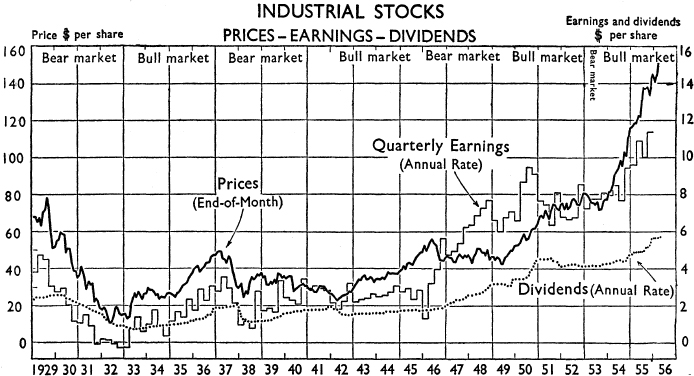
FIG. 23a
Something else can be seen from the chart. Though dividends and prices often moved in the same direction, the movement was by no means parallel. The curve of share prices regularly rises and falls much more than the curve of dividends. The yields, i.e. the dividends expressed as a percentage of price, rise in a bear market because share prices fall more than dividends, so that the latter represent a higher percentage of prices. In a bull market the yields decline because share prices rise more than dividends, so that the latter represent a smaller percentage of prices.
Figure 23b provides an even better illustration of the development of the yields. The dotted line represents the — development of yields from 1929 to spring 1956.3 Note that the curve is inverted, so that high yields are represented by a lower point on the curve than low yields. We see that by and large the lowest yields (about 3 per cent) coincide with the highest share prices in 1929, 1937 and 1946, whereas the highest yields (mostly 7-8 per cent) coincide with the lowest prices in 1932, 1942 and 1949.
Incidentally, Figure 23b shows also that changes in yields were hardly ever influenced from the money side. Only the rise in yields in the bear market of 1929-32 and the fall in yields in the bull market of 1932-37 correspond to similar developments of bond yields, and may therefore have been influenced—at least partly—by the latter. Since 1937 the yield on bonds did not change significantly, thanks to a deliberate easy money policy. The strong ups and downs of share yields can, therefore, not have originated from the money side. The 1953 bear market and the subsequent recovery are, however, again clearly connected with the yields on bonds, which first rose and later declined. Since 1955 bond yields have increased whereas stock yields continued their downward movement as the bull market proceeded.
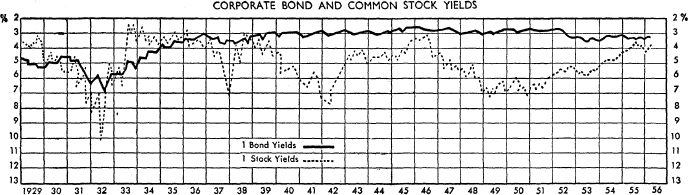
FIG. 23b
Corrected Price Curves
Thus the correlation between actual price movements and dividends is in reality only very loose. We gain an entirely different picture, however, if we compare dividend curves with price curves from which the exaggerations of boom and depression have been eliminated by some statistical methods—in other words with curves of intertemporal price averages. Such corrected curves run almost completely parallel with the dividend curves.
Thus results so far may perhaps be formulated as follows. Share prices are not just dividends capitalized at current interest rates, but they do fluctuate around a level determined by capitalization of current dividends at the current interest rate. Share prices may at any particular moment be higher or lower. But share prices coincide with dividends capitalized at the prevailing interest rates every time the market capitalizes dividends at an average yield rate.
Dividends, Net Earnings and Share Prices
A third curve in Figure 23a represents net earnings of corporations. We immediately see that net earnings and dividends move generally in the same direction, but that the former fluctuate over a much wider range. This is simply an expression of the fact that managements, aware of the temporary character of exceptionally high or low net earnings, pursue a policy of more or less stable dividends and distribute during prosperity a smaller—during depression a higher—percentage of earnings as dividends. As share prices, too, generally fluctuate more than dividends, they must move more with net earnings than with dividends. This is so although only dividends create income for the shareholder, and the undistributed part of earnings is important to him only in so far at it improves the quality of the dividends and the ability to produce future dividends.
Figure 23a shows that until about 1938 share prices and net earnings did, indeed, move in a fairly parallel way. However, between 1939 and 1942 the development of prices corresponded as little to net earnings as it did to dividends. From 1942 to 1944 prices and net earnings corresponded somewhat. From 1946 to the end of 1950 earnings rose much more than prices; instead of running below the price curve as usual, the earnings curve ran considerably above the price curve. A very much smaller part of total earnings was then distributed, expressing. In the general sentiment that earnings were abnormally high. In 1951 no parallelism between net earnings and share prices is observable. Since then, earnings and prices have risen, but the latter much more steeply than the former.
The generally greater stability of the price-earning ratio as against the price-dividend ratio explains a peculiarity of stock market literature. If future prices are to be forecast on the estimate of future earnings, the previous price-earning ratio, i.e. the relation of share prices to earnings, is taken into consideration. If, for instance, net earnings of a share are expected to be $10.00, and if the average price-earning ratio of the share has so far been 12:1, then the future average price of the share is believed to be $120.
The Significance of the Past for the Future
If share prices at a given time are identical with dividends capitalized at a certain yield rate, then stock market forecasts must obviously include prediction of future dividends as well as of future yield rates. Can such forecasts be made on the basis of past dividends and past yield rates?
Any forecast of the future must always start from a study of past developments of the market as a whole as well as of individual corporations. However, the experienced investor will always keep in mind that analogy conclusions from the past are permissible only within narrow limits. Dividends fluctuate not only within each business cycle, but also from one cycle to another. As regards yields, the year 1952 afforded a splendid example of how one can be mistaken. According to all precedent, average yields after three years of bull market should not have been higher than 4 per cent. Instead they were almost 6 per cent. The Dow Jones Index should have stood at about 375, rather than at about 275 as it actually did—a difference by no means unimportant for investment and speculation.
Yields were exceptionally high, nearly 8 per cent, at the beginning of the bull market in 1942, and exceptionally low, around 3 per cent, at its end in 1946. In such cases some reversal of price trends is indeed very probable—toward a bull market in the first case, toward a bear market in the second. However, such extreme cases do not often occur. And then there is always the possibility that high yields may be corrected by lower dividends rather than by higher prices, just as low yields may be corrected by higher dividends rather than by lower prices. Unfortunately, neither future fluctuations of the economy nor the extent to which the stock markets will overor under-discount these fluctuations can be scientifically or objectively determined in advance.
If this is true of the stock market as a whole, the subject of so-called market analysis, it is even more true of prices of individual shares, the subject of so-called securities analysis. The dividends of individual corporations fluctuate quite differently in each business cycle. Whole industries, moreover, may profit or lose from one cycle to another. Different industries may also show quite different secular developments. Some become important and prosperous, others wither away as time goes on. To anybody who has doubts in this respect, perusal of the well-known work by Mead and Grodzinsky, The Ebb and Flow of Investment, is strongly recommended.
Expectations as the Cause of Market Distortions
The fluctuations of share prices are essentially due to two causes: the fluctuations in dividends and net earnings, and the fluctuations in the rate of interest at which the fluctuating dividends are capitalized. We have, in earlier sections, discussed the reasons for fluctuations in earnings and resulting dividends within a cycle and in the long run. Here we shall deal with the distortion of share prices by fluctuations in yield. Every investor and speculator knows that a correct forecast of the rate at which dividends will be capitalized is decisive for the success or failure of almost any transaction. It is extraordinarily difficult to act against the general market tendency resulting from changes in yield.
Why does the stock market capitalize dividends sometimes at an excessively high, sometimes at an excessively low rate? It is because the stock market always discounts the future dividends and never the present.
It is not easy to answer the question of how long in advance the stock market discounts future developments and changes. It has been maintained that the usual advance is about twelve months. This is a fairly reasonable assumption. It must be borne in mind, however, that if any future change is to lead to changes in the valuation of a share—or of all shares—it must be expected to be permanent. Increases or reductions in the dividends of highly cyclical shares which are expected to be only temporary, do not influence the price level. The prices of such shares generally fluctuate less than their dividends. Any actual rise or fall in the prices of such shares is due to an expectation of a long-term rise or fall of their average dividends.
Model of a Typical Stock Market Movement
All stock market movements known from historical observation differ, particularly with respect to the margin between current and expected dividends. Some correlations do, none the less, return with such regularity that we may speak of typical stock market movements.
Such a typical movement may concern one particular share, and may perhaps be due to the expectation of a new invention. Or it may concern the market in general, in which case the movement is usually called a bull or a bear market.
Any typical bull market starts with dividends being low and yields high. Yields are high because even lower dividends are expected in the future.
The reasons for such pessimism have often been discussed. We wish here to point to only two facts. First, in mass psychology, a sort of law of inertia seems to prevail; if the economic situation has deteriorated and dividends have fallen for a long time, then people expect this downward movement to continue until they are proved wrong by very drastic contrary experiences. Second, the very fact that share prices fail to move upward in spite of high yields seems in itself to create a mass suggestion that prevents objective judgment and reinforces the prevailing pessimism. Each individual investor is led to conclude that if share prices are low, they are so because there are good reasons why they should be.
The bull market starts with a phase which we may call the adjustment phase. Dividends rise; in addition, future expectations improve as a result of the rising dividends. General pessimism vanishes as the public begins to react to the slowly improving situation. As share prices rise more than dividends, yields fall. Share prices become adjusted to dividends.
The next phase may be called the normal phase. The future is expected to be neither better nor worse than the present. It is generally believed that current dividends will by and large neither rise nor fall. Share prices move up with dividends. Yields remain stable at levels neither excessively high nor excessively low.
The exaggeration phase follows. The rise in dividends and prices for a protracted period leads to general optimism regarding future dividends. The market discounts not only the current high level of dividends, but a still higher level in the future. Once more the law of inertia in mass psychology is at work. Rising dividends create expectation of further rising dividends. The fact that prices continue to rise in spite of continuously falling yields reinforces this expectation. More and more people begin to buy just because others buy—although some of them may do so against their own better judgment. All this ends in the well-known vicious circle of rising prices and further willingness to buy. We again recall the French saying: La hausse amène la hausse.
Eventually share prices reach a level entirely out of line with the dividends, which may already have started to fall. The situation begins to look unsound—first to a few, eventually to more and more people. No new buyers turn up, and some of the former buyers become sellers. Quotations weaken. The infection of mass optimism no longer spreads. Expectations which but yesterday appeared irrefutably correct, now seem fantastic. The reaction phase follows the former upward movement. This phase is, at the same time, the adjustment phase of the beginning bear market. Share prices, too high compared to dividends, now adjust to the latter.
The adjustment phase is followed by its normal phase and finally by its bearish exaggeration phase. Later, the adjustment phase of a new bull market starts.
Figure 24 schematically illustrates what we have said.
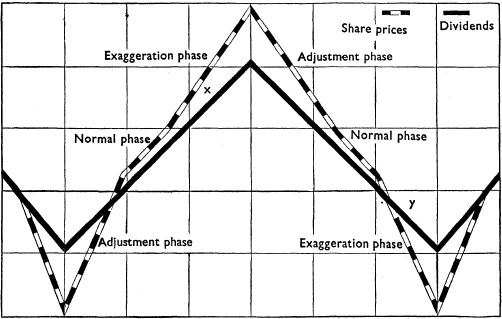
FIG. 24
Our description of a typical stock market cycle, incidentally, agrees with the widespread opinion that any upward or downward movement on the stock market is divided into three distinct parts: one in which shares are under-valued, one in which they are correctly valued, and one in which they are over-valued.
Are the Market Expectations Correct or Wrong?
Our graph shows that expectations coincide with the current situation only during the relatively short normal phase. At the same time it provides an approximate answer to the question whether and when current prices correctly discount the future, and when and to what extent the stock market makes mistakes. Let us assume that investors and speculators really discount the future about twelve months in advance. Let us assume further that each of the phases we have described lasts one year. Paradoxically, share prices anticipate correctly the factual situation a year later only at points X and Y. At all other times the market is mistaken. Up to point X the bull market takes too unfavorable a view of the future, beyond point X too favorable a view. Up to point Y the bear market takes too favorable a view of the future, beyond point Y too unfavorable a view. There is nothing to the alleged prophetic gifts of the stock market. The stock market does, indeed, try to guess the future, but it usually fails.
Uncertainty and Error as Price-Forming Factors
In the last analysis the stock markets err simply because the future differs from the present—a stationary state exists only in theory—and because human beings have no knowledge of the future in this or any other field. Future developments may be expected as more or less probable; they can never be recognized as certain. If it were possible to foresee the future correctly, say one year in advance, then the movements in share prices would simply precede the actual changes by one year. And if we had the perfect foresight of which theoreticians speak, that is to say, if we could correctly foresee an indefinite future, then all future changes would be discounted by present prices. Prices would never change again. This is, however, clearly an unrealistic assumption. The distant future cannot even be assessed by probability judgments; it lies, shrouded in mist, beyond the horizon of time. The nearer future may, however, be gauged by probability judgments. As time goes on, the near future becomes the present and can be recognized as certain. At the same time, however, a new segment of the future rises above the horizon of time. Men wishing to make decisions involving the future, must again try to guess its probable course. There is no point in deferring economic decisions “until the future is clear”. The future is never clear.
Single features of the future may be visible with certainty in the present. But only isolated events are thus visible, and never the whole complex future upon which earnings of any security depend. In these cases the margin between probability judgments and actual knowledge becomes small, and share prices reflect the objective situation more correctly. No event, however, is ever fully discounted as long as it is not recognizable with absolute certainty.
Purchases of Stocks are Purchases of Chances
All this leads to a conclusion which may seem awkward but is nevertheless indisputable. Purchases on the stock markets, as indeed on any other markets dealing with commodities of uncertain future value, are purchases of chances. In buying the share, the buyer really buys the chance of rising coupled with the risk of declining prices. All stock market transactions are thus based on probability judgments.
About the nature and the subject of such probability judgments much has been thought and written during the past few years. Much ingenuity, indeed perhaps too much ingenuity and certainly too much mathematics, has been deployed to reach, in the end, results by and large long known to any business man endowed with a reasonable measure of common sense.
Mathematical Probabilities?
The following paradox is responsible for the extraordinary difficulty in forming an opinion on the nature of probability judgments in business. On the one hand, the law of large numbers undoubtedly does not apply to forecasts of individual market situations. The probabilities entering, for instance, into judgments about the future course of an individual business cycle are not, strictly speaking, probabilities in the mathematical sense. Cycles are never completely uniform phenomena, and only few of them happen during a man’s lifetime. One can never reckon with a mathematical probability of 1:1 that the market will go up rather than down. The case is comparable not to that of the bank in Monte Carlo, which can and does rely on red and black turning up equally often in the long run, but rather to that of the individual player, who cannot know whether the ball will stop on red or on black. He has to take his chance. He may be playing red ten times in succession, although black may win ten times.
On the other hand, each player, and each stock exchange “player” as well, behaves as if he were faced with mathematical chances. He may speak of a 10:1 chance that General Motors will double its dividend, although he knows perfectly well that he is faced with an individual situation and not with a large number of interchangeable cases.
David Hume has already discussed this paradox. He held that such judgments were not really probability judgments proper, but a kind of feeling representing a purely subjective assessment of the chances of success, based, it is true, on experience in numerous similar cases. A roulette player considers quite subjectively the chances for red to win as being very good—1:1; and the chances of a particular number to win as being very poor—1:32. As a result he will be content with a much smaller gain when playing a color—yet the very next turn of the wheel may throw up the individual number he had in mind.
It seems to me that since Hume nothing much has been said or written which transcends his explanation of the paradox. I am afraid we shall have to accept it, although it is admittedly not quite satisfactory. We would add only that a player, as well as a stock market speculator, will often play the chance of doubling his stake not only when he considers the odds as 1:1 but also when he considers them to be poorer. This is due to the gambling spirit of man. Without it, there could be no games of chance or lotteries whose total prizes are smaller than corresponds to mathematical probability.
Weighing the Chances
Offer and demand prices on stock markets may perhaps be explained fairly realistically by the following example. Suppose someone believes the chance that the shares of General Motors may rise to $70 is 1:4, and the risk of their falling to $30 is 3:4. Now, according to a widely held view, the value of a chance is equal to the expected profit multiplied by its probability. Provided our buyer’s judgment is distorted neither by a passion for gambling nor by unusual anxiety, his purchase limit will not exceed $40, because at this price the chance of profit and the risk of loss will appear equivalent. A 1:4 chance of gaining $30 is worth 7:5 as is the 3:4 risk of losing $10.
We must, of course, always keep in mind that the underlying probability judgments are highly subjective. An optimistic buyer will over-estimate the chances of gain and under-estimate the risks of loss. A pessimistic buyer will do the contrary.
Finally, in the real world, people normally do not envisage only two probabilities. Expectations of the future are usually concerned with several favorable or unfavorable possibilities. The question, of how these different chances are weighed against each other and what the economic consequences will be, is highly controversial. In our example the buyer may believe that, besides the probabilities mentioned, there is a further 1:8 chance that the shares of General Motors will move up to $80, and a 3:8 risk that they will drop to $20. What, then, will be the upper limit for his buying order? It would seem realistic to assume that he will value the share at a price at which all the chances toward the up side together, and all the risks toward the down side together, appear to him equivalent.
Facts or Expectations as the Basis of Stock Price Formation
We can now give a more detailed reply to another question. Are stock prices—and indeed all prices depending upon expectations—ultimately determined by objective facts or merely by subjective opinions, however fantastic?
Many theoreticians have justly pointed out that if prices were dependent only on subjective considerations and no longer on objective facts, equal for all men, total anarchy of the markets and chaos in the economy must ensue. The very existence of the economy would be endangered, and with it economics as a science.
On the other hand, Keynes has clearly stated in his General Theory that stock market prices are essentially the result of purely subjective anticipations. Indeed he went so far as to assert that these anticipations are not concerned with the objective facts themselves, but with the anticipation of the facts. This would be subjectivity squared. Stock price formation would appear to be the result of the general opinion on what the general opinion is going to be.
It is interesting to note that in practice business men, too, partly adopt the one and partly the other view. We find stock market forecasts based entirely on the prediction of facts. We find others exclusively concerned with whether and how the public will react to coming events. This latter attitude explains the behavior of many speculators who carefully watch how the market reacts to any given event and then quickly jump on the band wagon—a dangerous procedure—since the band wagon often stops or even reverses soon after. Market opinion is not reliable.
Figure 24 shows that neither of the two extreme views, but a compromise between the two, is correct. The objective situation is as important for price formation on the stock market as is the running hare for the hunter. At the same time, subjective distortions cannot be denied any more than the fact that marksmen often miss their targets. The hare exercises a sort of attractive power on the marksman; it does not prevent a lot of shots from going astray but it focuses the hunter’s eye. In the same manner prices are shown in our chart to differ frequently and widely from the situation determined by objective facts. The latter, however, always pull prices back from their extremes. The normal phases, it is true, tend to be short because new events rising above the horizon of time always create new errors. But the duration of the phases of error, too, is limited.
Is the Economy a By-product of a Gambling Casino?
In a widely known passage of his General Theory, Keynes has drawn from the undoubted dependence of stock market prices upon subjective factors, moods and errors the conclusion that the flow of savings into investments is no longer dictated by long-run expectations of yield, but rather by short-run expectations of stock market gains, particularly in the United States. Thus, he thinks, investment has become the by-product of a gambling casino! Foolish investments were made or reasonable ones omitted depending on whether speculators were pushing up or depressing prices. Keynes recommends as a remedy that the bonds between investor and investment be made as indissoluble as those of marriage, which can be separated only by death or for very important reasons. In other words, Keynes opposes negotiability of investments in securities so as to prevent short-term speculation.
Once again Keynes, the brilliant generalizer of half-truths, has succumbed to the temptation of expressing a paradox at the cost of stating untrue facts and of giving dangerous advice.
Keynes’ reasoning confuses two different things: short-term investment or speculation in investments planned for the long run, and short-term investment or speculation in investments planned for the short run. It is simply not true that an investor, or even a speculator, is not interested in the long-term prospects of, say, a new plant to be installed. On the contrary, any calculation of earnings submitted to investors is based on very long-term estimates indeed. The fact that the more distant future cannot be assessed so clearly never leads to its being neglected. It only results in the attempt to reduce risks by providing for rapid amortization. However much anyone may invest for capital appreciation, he still invests with a view to the long-term earnings. Capital appreciation can ultimately be realized only by sale to an investor who, in his turn, buys the security for the sake of its long-term return.
It is true that during a bull market long-term prospects are, for a more or less limited period, considered more favorable than during a bear market. Some of the investments made during a bull market, therefore, turn out to be faulty investments in the long run. During a bear market, on the other hand, some investments fail to be made which would have been profitable in the long run. But none of this is due specifically to the fact that securities represent liquid assets. It is the expression and the result of the cyclical fluctuations in a free economy. In the last analysis the stock market is neither the heating nor the refrigerating installation of the economy but its thermometer.
It is also true that there are always some people whose decisions are not based on present or future yields, but simply on the hope that prices will rise during the boom. These so-called camp followers hope to unload the “black Peter” onto another buyer before the prices break. Now it is by no means certain whether speculation by camp followers always reinforces the prevailing tendency, i.e. that it raises prices in a bull market and depresses prices in a bear market. Those who buy at low and sell at high prices mitigate rather than reinforce the price fluctuations. This is precisely what so-called professional speculators do. They buy when the public dumps its shares on the markets in a state of exaggerated pessimism, and they sell when the public, in equally exaggerated optimism, scrambles to buy.
Were the link between investor and investment to be made as indissoluble as marriage, fluctuations of prices would indeed be reduced. But the cost of such reduction would be a contraction of investment to the small volume of early capitalism and an obstruction of economic progress, which is decisively dependent upon the free flow of venture capital from the saver to the entrepreneur. Stricter divorce laws, too, would not only protect some existing marriages from dissolution, but also deter people from new marriages.
It should, however, hardly be necessary to dwell on anti-stock-exchange arguments, often disproved, just because an influential author has revived them in an admittedly entertaining manner.
Interpersonal Differences of Expectations
Booms are due to a raising of the prices at which stocks are demanded and offered by individual buyers and sellers, depressions to a reduction of these prices. These changes in price limits are the result of changes in expectations.
If the expectations of all parties to the markets changed simultaneously and to the same extent, prices would rise in the boom and decline in the depression without any turnover. Any buyer’s higher or lower limit would be matched by a seller’s higher or lower limit. The quotations would change; but no transactions would take place.
As is well known, neither booms nor depressions proceed without large, though fluctuating, turnover. It follows that the upward or downward adjustment of limits by buyers and sellers must vary from one person to another.
This is indeed what happens, and it is easy to explain. Both the subjective and the objective conditions for rising or decreasing prices are continuously assessed differently by the different groups of investors and speculators.
The result is, in any case, that during every boom and depression the distribution of securities between individuals, and groups of individuals, changes continuously.
Shifts in the Distribution of Securities
Shifts in the distribution of securities are hard to trace. We can, however, gain a general if simplified idea of what is happening if we consider that in every bull or bear market there must obviously be two groups of investors and speculators: the successful and the unsuccessful. The successful will buy near the trough of the price curve and sell near its peak; during most of the bull market they will hold shares, and during most of the bear market they will hold cash. They will make considerable profits. The unsuccessful, on the other hand, will sell somewhere near the lowest price and buy somewhere near the highest; they will hold cash during most of the bull market, and shares during most of the bear market. They will suffer considerable losses. In between there must be, and indeed are, innumerable mixed groups—for instance the half successful who hold shares during only half the bull market and cash during the other half, because they either bought too late or sold too early or both; and their counterpart, the half unsuccessful, who hold shares during half the bear market and cash during the other half, because they either sold their shares too late or re-purchased them too early or both. Most of the in-and-out traders who buy and sell continuously during any stock exchange movement belong to these groups. We shall ignore these groups, since they are not homogeneous in respect to the special qualities leading to success or failure.
The successful groups are distinguished first by being better informed, second by having the ability to resist the forces of mass opinion so that they manage to buy when the majority is deeply pessimistic and to sell when the majority indulges in exuberant optimism. At the same time, they do not underrate the power of mass opinion, so that they neither sell too early, i.e. long before mass optimism ends, nor buy too early, i.e. long before mass pessimism has run its course.
The unsuccessful do just the opposite. They succumb to mass pessimism when prices are lowest and sell; they succumb to mass optimism and buy when prices are at their peak. At the same time, they underrate the force of mass error. If, exceptionally, they have bought in good time during the bull market they get out too early; if, exceptionally, they have sold in good time during the bear market they get in again too early.
The qualities leading to success are rare. The majority simply cannot place itself outside the forces of mass psychology which condition its behavior. It cannot observe and judge them coolly from without. Neither the strength nor the weakness of mass opinion will be recognized in time by the majority. Regularly the majority fails to buy, or even goes on selling, at low prices because prices are expected to fall still further. Similarly the majority will not sell, or will even go on buying, at high prices because prices are expected to rise yet further. Therefore, when prices are low, stocks and shares must move out of the hands of the many into the hands of the few, and when prices are high, they must move out of the hands of the few into the hands of the many. This is indeed what happens in reality. At the end of a bear market and the beginning of a bull market the number of share owners is usually small and the average holdings of each owner large. This situation persists throughout the bull market when shifts occur mostly within the various groups of half successful and half unsuccessful. Toward the end of the bull market the number of share owners grows and the average holdings decline. Cash, on the other hand, is held during the bull market by the many who have sold out at low prices, and during the bear market by the few who have sold out at high prices. One speaks of accumulation in the case of the shares being bought by few, and of distribution in the case of the shares being bought by many. The smaller speculators are in the habit of closely watching whether shares are accumulated or distributed on the market. Correctly so, because there is a strong presumption that the mass is wrong and that the few are right. Moreover, a bear market rarely comes to an end as long as the securities are in so-called weak hands, that is to say in the hands of people financially and temperamentally ill-equipped to sustain further price declines.
Emancipation from Mass Opinion
As every experienced market operator knows, success on the stock market depends decisively on the ability to go against the prevailing tendency, i.e. against mass opinion, at the very moment when its correctness is least in doubt. The ability to go against the prevailing tendency, however, presupposes in the first instance that the individual remains conscious of the persuasive influence of mass opinion on his own opinion. This, in turn, presupposes a correct assessment of its force.
Everyday observation shows the strength of mass opinion to be very great indeed. It engulfs not only those who easily succumb to foreign influences but even those with normally detached views and sober judgment. An almost superhuman effort is needed to evade the influence of mass opinion—particularly in the United States, where price movements and thus the opinions of others are continuously reported to the farthest corners of the country by the ticker. The ticker assembles, as it were, all the buyers and sellers in one room. The ticker influences speculation as the flag influences troops. As long as the flag is carried forward, every single man knows that the others still have the courage and strength to go on, and this knowledge sustains his own courage and strength. Once the flag retreats, every man concludes that the others’ courage and strength is waning. As he knows that he cannot advance alone he, too, retreats, even though he would not himself be forced to.
There is, of course, no general rule on how to counteract the influence of foreign opinion on one’s own opinion. One of the most important aids for emancipation from mass opinion and its influence is to bear in mind that all prices are almost always necessarily wrong. It is further important to remember that mass suggestion wields its strongest influence when only one opinion is stated and discussion is prohibited. An experienced stock market operator will always listen with special attention to any arguments in opposition to the prevailing opinion.
Mass Opinion as an Objective Datum
It would be wrong to reach the conclusion that one should always follow one’s own judgment against mass opinion. We have seen that mass opinion does sometimes, and for certain periods, constitute a force operating either with or against objective data and whose great strength must be taken into account. Faith displaces not only mountains but also price levels. It does so at times—although usually not for long-contrary to the objective situation. Woe to those who always mean to be right in opposition to mass opinion! They may be right in the long run, but may lose their money and their nerves in the meantime.
From the point of view of each individual mass opinion is indeed a datum until it collapses or reverses itself. He has to make guesses and forecasts about it just as if it were an objective datum.
This, incidentally, is the reason why some economists have recently compared economic decisions to gambling decisions, where much depends on the unforeseen action of others and on sheer chance. I believe that this approach constitutes an altogether unjustified exaggeration of a correct idea. I doubt whether it will prove to mean a real progress in economics. The actions of economic subjects are hardly ever accidental and arbitrary. They are fashioned by definite psychological laws even in the short run. This is especially true of economic subjects on the average.
The Basic Principle of Successful Investment
With the help of our model it should, in theory, be quite easy for investors or speculators to time their purchases and sales correctly. They have to go against mass opinion and buy toward the end of the exaggeration phase of the bear market and at the beginning of the adaptation phase of the bull market. They should then follow mass opinion and hold their securities through most of the bull market. Toward the end of its exaggeration phase they should again go against mass opinion and sell. Thus it is as wrong always to oppose the prevailing tendency as it is always to follow it. In a nutshell, the right rule is: first against the tendency, then with it, and finally against it.
The difficulty in practice is, of course, to feel exactly when the forces of mass opinion run out at the end of every exaggeration phase. Is there any way of determining this moment objectively?
The truth is that there is no scientific way of predicting how far psychological waves will carry. Stock market forecasts will therefore always be an art, never a science. And those who pretend to be able to calculate in advance, in a scientific and objective way, the length of a bull or bear movement are guilty, consciously or unconsciously, of charlatanry.
Only Minority Forecasts are Useful
It is too often and too easily overlooked that stock market forecasts can lead to gains only when they are minority forecasts.
As soon as any opinion about future developments and their effect on the behavior of investors and speculators becomes general, both factors are discounted in the price. The margin between present and future prices, the basis of any stock market gain, vanishes.
There is another interesting phenomenon. A forecast may become wrong by being generally accepted as being right. Suppose, for instance, that economists calculate that capital investment will be higher next year than this year and that the general price level will therefore rise. This may lead entrepreneurs to invest more this year than next, in an attempt to benefit by the prevailing lower price level. As a result, this year’s price level will turn out to have been higher than next year’s. The world simply does not consist of knowing economists and ignorant business men.
The beginning of the Korean war in 1950 provided a good example of the way the general expectation of certain events can alter the course of events. At that time everybody expected prices to rise and bought in advance. As a result, inventories were too large in 1951 and prices tended to fall. Any information which becomes accessible to everybody kills itself, so to speak. Since most information nowadays is accessible to the public, it fails to be useful to any individual. Only really secret and personal information is of value. However, nine-tenths of all strictly confidential information is, in fact, accessible to all and sundry.
Forecasts are Always Highly Subjective
Many mistakes are made by overrating the importance of historical analogies. Just because event A led in the past to effect B, A will by no means need to have the same effect today. Conclusions by analogy may at best indicate probabilities; they can never guarantee certainty. The future always remains uncertain, because we are unable to survey all the links which connect the past with the future. Things always turn out just a little different—the more so when, exceptionally, all the causal relations have for once been recognized. For it is just then that people take counteraction to protect themselves against repetition.
Some people think they can enhance the objectivity of their conceptions by consulting a great number of experts and then taking an average of all they have heard. One investment service in the United States, in fact, systematically collects the views of all the other investment services and combines them in a united opinion. To consult many is no worse and no better than to consult none. Those who consult many merely ascertain the average opinion, as it is reflected in prevailing prices. To ascertain a united opinion is useful only for the purpose of acting against rather than in agreement with it.
Investors often consult their broker. He, too, is no more than one unit of the mass. Moreover, brokers and bankers always tend to be unilaterally bullish—if for no other reason than because they regard pessimistic utterances as unpatriotic.
Others consult the so-called business leaders among their acquaintances. They forget that business leaders, with few exceptions, are always surprised by any reversal of tendency. And this not accidentally but inevitably. If business leaders in general were able to recognize coming cyclical changes, the business cycle could not develop. Nobody would buy at high prices and sell at low prices. Uncertainty regarding strength and duration of cyclical movements is their necessary precondition.
Some investors follow certain systems, for instance the so-called Daw theory. This theory has many adherents and as a result it often proves right, if only for a short time. If many believe in a rising market their purchases will bring it about. Many thorough investigations have shown the practical value of this theory to be very limited. The same is true, in my opinion, of the innumerable other systems. The Daw theory, in particular, does no more than register the existence of a bull or bear market—it does not predict them.
Every investor or speculator believes, as the result of his experiences, in certain rules. If he succumbs to the temptation of publicizing them in writing or speech, they will lose the little value they might possess.

