
Common Sense Economics
Part IV. The Business Cycle
Business Cycles are Alternating Inflations and Deflations
Since the beginning of the nineteenth century the economies of industrial countries have experienced peculiar fluctuations at more or less regular intervals. Although showing many differences in detail, they had so many features in common that they are regarded as homogeneous phenomena. They are called business cycles.
Generally speaking, these common features are exactly those produced by money inflations and deflations. For this reason so-called monetary business cycle theories regard the business cycle as a monetary phenomenon, expressing the idea that the prosperity phase of the cycle is caused, or at least necessarily accompanied, by expansion, and the depression phase by contraction, of money circulation.
Inflation and deflation result from changes in credit demand and supply, as described above in detail. The inflationary prosperity phase and the deflationary depression phase of the cycle result from the same changes.
However, cyclical inflations and deflations have some peculiar features. In the first place, cyclical deflation brings the economy back to, or very near to, where it was before inflation started. The movement closes like a circle. Second, the individual cycles exhibit if not the same then at least similar wavelengths; this fact is generally referred to as periodicity. Third, as soon as one cycle is completed, a new one begins. The individual cycles follow each other in certain rhythms like measures in a musical score; cycles are, therefore, also called rhythmical phenomena.
Changes in the economy generally lead after a certain time—just as in nature—to adjustments and thus to new equilibria. Contrarily the changes creating business cycle fluctuations do not lead to new equilibria. For endogenous reasons prosperity creates depression, and depression creates prosperity in eternal sequence. The pendulum of economic activity does not come to rest but continues to swing, like a perpetuum mobile—or at least it has done so until now.
Why is the business cycle self-perpetuating? Many economists have tried to solve this so-called riddle of the cycle, but no one answer has so far found general acceptance.
Maldistribution of Monetary Demand over Time
During the prosperity phase demand for goods and services is far above and during the depression phase far below the intracyclical average level. But over the whole of the cycle monetary demand does not dwindle and money does not disappear into death traps. For the business cycle as a whole, therefore, Say’s law remains valid. The income of all factors of production is always sufficient—and is used—to buy all goods produced. The cycle is characterized by a maldistribution of demand over the various phases of a cycle rather than deficiency of demand during the whole cycle.
What are the reasons for this maldistribution of monetary demand over time?
Under-consumption Theories
The most popular answer to the question of why demand suddenly falls off at the end of a prosperity phase and remains low during depressions, is provided by the so-called under-consumption theories. They are as old as the business cycles themselves. They were considered as definitely refuted until Keynes’ unemployment theory—which is at least partly an under-consumption theory—made them fashionable again.
Under-consumption theories have been presented in the most various forms. Their basic idea, however, is always the same. People in upper income brackets have a higher propensity to save and a lower propensity to consume than people in low income brackets. Therefore, the increase in incomes during the boom prevents investment from keeping up with growing saving; “over-saving” develops and deflation ensues. Under-consumption theoreticians consequently see the most important remedy against depressions in a redistribution of income in favor of lower brackets. One economist, the “free money” man Silvio Gesell, even went so far as to propose the creation of a money with melting value, so as to discourage saving and thereby prevent an interruption of the money flow.
It may be conceded that under-consumption might in certain conditions create deflation. But under-consumption, or over-saving, can never lead to those phenomena which have been characteristic of business cycles in the past. Nor can they above all explain cyclicity.
If increased savings were responsible for the end of a boom, obviously interest rates would be low at that juncture. In reality the upper turning point is marked by high and even rising interest rates. Furthermore, changes in saving are usually slow processes, whereas at the onset of a typical depression demand falls off abruptly and, so to speak, out of a clear sky.
Over-investment Theories
The so-called over-investment theories try to explain depressions as a lack of new investment opportunities. Their argument runs as follows. During the prosperity phase entrepreneurs expand their plants because they expect higher demand for their products. But once the plants are constructed, the additional demand for goods and services created by their construction disappears. Deflation must ensue. Spiethoff explained the end of a boom in this manner long before the Keynesians developed their types of over-investment and stagnation theories. He gave, incidentally, an additional reason for the break. Once the new capital goods—especially new industrial plants and equipment, and all installations for a long-term use, such as railways and electricity and water works—are operating, the production of consumer goods increases suddenly and excessively; demand can no longer absorb the supply of goods at prevailing prices. The ensuing price fall forces entrepreneurs to restrictions.
Many objections can be raised against this line of reasoning. It is, for instance, as we shall see later, by no means self evident that the production of capital goods should expand by jerks rather than be spread evenly over time. But more important: if additional capital is applied in an economy, the structure of the economy changes once and for all. It becomes more capitalistic. A new equilibrium with longer roundabout ways of production is established, provided no credit contraction is enforced by new developments. At the beginning of every new production period entrepreneurs spend the same, now increased, amount of money on capital goods. Therefore the demand for capital goods cannot suddenly fall off. The funds required by entrepreneurs to maintain such demand are provided by the proceeds of the consumption goods sold, into which the capital goods of earlier period are, so to speak, amortized. There is no reason why amortization and new production of capital goods should not balance.
The Theory of Unnatural Interest Rates
The over-investment theories being entirely unsatisfactory, the Swedish economist, K. Wicksell, developed a theory according to which cyclical inflations and deflations are due to, or at least made possible by, fluctuations in credit supply. For Wicksell and his followers the credit policy of the banks and Central Banks is primarily responsible for the business cycle. Their theory runs roughly as follows. If demand for credits picks up for one reason or another, the interest rates on the free markets—which appear as the natural rates to Wicksell—have a tendency to move up. If the Central Banks, and with their support also the commercial banks, fail to adjust their interest rates and keep them unnaturally low, the increased demand for credit will partly be satisfied by the banks’ inflationary credit expansion. Later on, but too late, the Central Banks and consequently also the commercial banks raise their interest rates—either because they are losing gold or foreign exchange, or for other reasons. Now demand for new credits is discouraged, and at the same time the credits granted earlier appear less profitable and are repaid. Deflation ensues. In other words: delay in adjustment of the bank rate to the increased credit demand opens the death trap for money with the result that the volume of money grows; the subsequent belated adjustment forces the money back into the death trap so that the volume of money shrinks.
The Wicksellian argument is basically correct. His theory should be regarded as the most decisive progress in the field of economics. Much of what has been taught later appears retrogressive in comparison.
Wicksell’s reasoning might be contested for not stressing enough the importance of changes in credit demand. In times of permanent cheap money policy, interest rates obviously cannot rise at the end of a boom, and therefore cannot be responsible for the turning of the tide. The short but steep American depression of 1937 happened with interest rates moving hardly at all. It was an “easy money depression.” But Wicksellian reasoning remains valid in so far as even the strongest demand for credits cannot lead to inflation if it is checked in time by a restrictive interest and credit policy, i.e. by raising discount rates so high as to counteract even the most optimistic profit expectations of entrepreneurs.
Psychological Business Cycle Theories
Every business cycle consists of two distinct parts—an upswing and a downswing. Each of these parts, in turn, is divided in two sections: during the latter section of the upswing and the first section of the downswing production exceeds, and during the latter section of the downswing and the first section of the upswing, production falls short of the intracyclical average. Thus there must be forces at work which prevent an equilibrium at the average level. If this were not so, any increase in credit demand or supply, for instance, would lead to a single and lasting credit and monetary expansion, but not first to inflation and then, as a reaction, to deflation. Such forces, first strengthening the effects of certain changes only to damp them after a certain time, exist in economic and social life. They are of a psychological nature. When prices rise, people expect further rises. They go on paying and demanding higher prices, until one day the exaggerated price expectations break down. Over-speculation must then be liquidated. The price level falls.
Psychological business cycle theories, for which the cycle is essentially the result of uncertainty, error and psychological epidemics, are not new. Almost all contemporary descriptions of the cycles in the nineteenth century treat crises as the results of over-speculation of producers and consumers. Mass optimism is regarded as responsible for the boom, mass pessimism for the depression.
After a lifetime of practical experience I am inclined to consider the psychological business cycle theories in combination with Wicksell’s credit supply theory necessary as well as sufficient to solve the riddle of the cycle. I am strengthened in my opinion by the observation of the so-called secondary stock exchange movements, where prices fluctuate in waves around a trend line without any change in objective data. I do not, of course, deny that changes in objective data may start a cyclical movement. But why is this movement first exaggerated, only to be reversed later? Why does it lead to maldistribution over time rather than to a single and lasting change in the volume of consumption and production? These facts can be explained naturally only by a psychological theory. A brilliant exposition of such a psychological business cycle theory can be found in Professor A. C. Pigou’s famous book, Industrial Fluctuations.1
Psychological Cycle Theories are Realistic
If business cycles are the result of a maldistribution of monetary demand over time—and there can be no doubt that they are—then they are in the last analysis nothing else than the expression of hurrying and waiting on a gigantic scale, embracing the whole economy. Whatever may induce the upward movement, producers and consumers hurry to buy goods and services. And whatever may induce the downward movement, producers and consumers wait with buying.
Later, when dealing with stock market phenomena, we shall examine in detail the mass psychological reasons for such hurrying and waiting. Here it suffices to point out that the psychological theories are identical with the explanation of the cycle given by business men. They know from practical experience how decisively their own, their fellow entrepreneurs’, and their clients’ decisions are determined by moods, i.e. by optimism or pessimism; they also know how strongly their own decisions are influenced by the decisions of others.
As far as I can see, only psychological theories can explain the suddenness and abruptness with which the boom ends in most cases. Only they offer an explanation for what is really the riddle of the cycle: why the movements do not peter out but continue like a perpetuum mobile.
Error about the Reversibility of Price Movements a Necessary Condition for the Cycle
Even those who do not consider the fluctuations of the cycle as caused mass psychologically must admit that a certain mental attitude of the people, and especially of entrepreneurs, is a necessary condition for their happening. Aberrations could not develop if people regarded the occurring changes in prices and demand as only temporary. Nobody will invest, or even consume, beyond his most urgent needs at rising prices if he expects prices to collapse during the period for which he is planning. Nor will anybody sell at falling prices, except under compulsion, if he expects prices to recover later. One of the main shortcomings of all non-psychological explanations of the cycle is not taking into account that maldistribution of demand over time cannot develop unless people are unaware of it. A mass error concerning the character of the market movements has to prevail. Otherwise single erratic changes could develop, but never those periodical reversible and cyclical phenomena which have characterized the economies of industrial countries, at least until now. These presuppose error.
Economists who believe they can forecast and calculate in advance the end of investment demand, and thus of the boom, must turn out to be false prophets, and most of them have indeed done so. If economists can recognize the temporary character of high demand, business men can, too. For the world does not consist of economists who know and business men who err. It is rather the other way round. But when business men cease erring, they alter their plans. They postpone certain investments and the calculated depression does not happen.
Some people, of course, speculate on the short run. They buy at rising and sell at falling prices, although they realize the price movements to be short-term. They hope to be able to unload on to others before the prices break, or to re-purchase from others before they recover. But then they err in believing that the others will err in believing that the price movement will continue rather than be reversed. Their belief in the errors of others is a necessary condition for their short-term speculation.
Liquidity Preference not a Helpful Concept
Since the appearance of Keynes’ General Theory some economists have tried to explain the cycle through so-called liquidity preference. However, this concept confuses rather than explains the issue.2
It is true that business men at times refrain from spending and keep their money at home or in banks. They also prefer short-term to long-term money claims. According to the liquidity preference theory this is due to the business men’s wish for protection against the uncertainty of the future. It could be added that for this reason they also prefer to repay debts.
However, business men in particular and the public in general preferring at times to be liquid, i.e. to own money and short-term claims rather than capital or consumer goods or long-term claims, are not seeking special protection against the uncertainty of the future. The future is always uncertain and not only at times. Their behavior is simply the result of their being bearish at that particular moment, i.e. expecting prices—possibly also of bonds—to decline, and their liquidity preference will be the greater, the greater they judge the probability and extent of the price fall.
If this is so, then it is unnecessary, misleading and alien to the whole system of our economic thinking to introduce the preference for liquidity, i.e. for cash and short-term money claims, as a new and special reason why producers and consumers abstain at times from purchase. Those who consider a preference for cash the reason for depressions are, therefore, guilty of a sort of double accounting. The disinclination to own goods and the preference to own cash are taken as two separate phenomena, whereas they are really two sides of the same phenomenon: people prefer not to own goods because they fear the exchange rate of goods and money will move to the advantage of the latter.
Multiplier Theory, Acceleration Principle and Business Cycles
Some economists believe that the riddle of the business cycle can be solved in terms of the acceleration principle and/or the multiplier theory. We have already dealt with the objections to these concepts. Here we wish to add a few words on the weaknesses of the so-called oscillation models.
The explanation of the business cycle in terms of the acceleration principle runs somewhat as follows. If consumption increases by an amount x, a multiple of x of capital goods must be produced, because production detours are, on the average, very long in a highly capitalistic economy. The consumption induces investment. In order to carry out these investments credits must be sought. A credit inflation will ensue. But once the new capital goods are produced, the additional credit demand falls off. There will be credit deflation.
As mentioned above, these arguments have to be refuted because they presuppose a highly elastic credit supply and a world in which the interest rate has lost its function to control the distribution of capital over time. And, furthermore, because they presuppose as certain an inducement which really has first to be explained and proved. As an independent explanation for reversibility they are without value. An acceleration boom could come about only if entrepreneurs failed to realize that they were faced with just such a boom, i.e. a reversible phenomenon. In other words, entrepreneurs must not be acquainted with the acceleration principle. If the entrepreneurs recognize the working of the accelerating mechanism, they will not trust the boom and will abstain from investing at rising prices. If they know that an increase in the annual production of automobiles requires only a single increase in automobile factories, they will certainly not construct steel mills with a capacity for an annually recurring increase in automobile factories. Capacities are never calculated on the basis of a single non-recurring use. Only in so far as entrepreneurs believe the rise in prices and demand of steel to be lasting will they act as assumed by the acceleration principle. The investment boom which later collapses is thus not caused by the increase in consumption, which, as such, never leads to a reversible phenomenon. It is rather caused by entrepreneurs’ faulty judgments about the duration of the price and the demand increases for capital goods. Many cycles of individual goods, such as the pig cycle, the construction cycle, and others, are caused simply by errors.
As regards the multiplier theory, a credit expansion for investment purposes results indeed in higher incomes of those contributing to the production of capital goods. But it does not follow that these incomes are really spent. The problem of the cycle is just why at times these incomes are spent and why at other times they are withheld from the markets. Allusion to the power of additional investment to create additional consumer income only re-formulates, but does not solve, this problem. But let us not go further into the dreamland of the acceleration and multiplier theoreticians and their abstruse models. Their unrealistic speculations of how a boom must—or should—collapse for purely mechanical reasons are too far away from our way of thinking.
Responsibility of Money-Issuing Institutions
Unnaturally low or high interest rates may often not be sufficient causes for inflation and deflation, but they are certainly always necessary conditions. Unless the money-creating institutions supply money at inflationary low interest rates no credit demand, however strong, could lead to inflationary booms. Similarly, unless these institutions enforce repayment of credits by deflationary high interest rates, deflationary depressions could not normally develop.
Central Banks are responsible for every inflation, but not for every deflation. If the demand for credits weakens to such an extent that interest rates on the free market sink to near zero without the credit supply being absorbed by demand, then deflation develops, even if Central Banks and banks pursue an extremely easy money policy. They cannot lower their rates below zero.
We have already treated this case of death traps opening in detail (pp. 111–112). We recall that outside of typically cyclical movements it can happen only under very exceptional conditions, such as prohibitive taxation of production. A structural decline in the propensity to consume due to changing saving habits will, as a rule, lead only to an insignificant, gradual decline in interest rates, as will a structural decline in the propensity to invest due to changing productivity of capital. Only the combination of a simultaneous decline in the propensity to consume and to invest, such as occurs in cyclical depressions as a result of general pessimism on prices and demand, can lead to such abundance of credit supply and such scarcity of credit demand that deflation ensues.
Keynesians are apt to lump together genuine saving and waiting due to pessimism on demand; they speak of both as a declining propensity to consume. This can lead only to general confusion, since it obscures the necessary distinction between structural and cyclical phenomena.
The Start of an Upswing
A cyclical upward movement can start theoretically and, as historical observation has shown, also practically in totally different ways.
Recovery can start from an easing of the money situation. When the investment excesses of the previous boom have been liquidated and the interest rates have fallen, certain projects, unprofitable so far, can be carried out. The volume of credit and money begins to rise.
Recovery may also start from changed conditions on the side of demand for credits. A new invention enhancing the productivity of capital will increase the demand for credits and hence the volume of credit and money. This happened, for instance, when the railroads and later the automobile were invented and taken into use. War booms, too, are started by high credit demand—for destructive rather than for productive purposes.
Recovery can, of course, also start from a combination of changes on the supply and the demand side for credits.
By far the most important cause of recovery, which has at least reinforced all upswings of the past, is of a psychological nature. After depressions have run their course for a certain time, pessimism some day reaches proportions which cannot be surpassed. Deflation ceases to be cumulative. Prices no longer fall. Certain entrepreneurs, therefore, now hope to produce again at a profit, or at least without loss. They may wish, furthermore, to replenish their excessively run-down inventories. Consumers, in turn, no longer hope to buy cheaper later on. Their waiting ends also because their stock of non-durable consumer goods dwindles and their durables are worn out.
The result will be inflation—or, as it is sometimes called in this case, reflation.
According to Keynes depression comes to an end when an under-employment equilibrium is reached, i.e. when a fall in employment reduces incomes and thereby savings to the point where they can be absorbed by investment demand. An upswing is not necessarily supposed to follow. This whole idea is unrealistic. Depressions are neither reinforced by over-saving nor halted by under-saving. Depressions end when, for the above-mentioned reasons, people no longer wait with spending. And every depression has so far been followed by an upswing.
From Recovery to Boom
What forces lead an economy from recovery to boom, and finally to that state of hypertension which ends in crises or depression?
The answer is given by what we have said above in connection with psychological business cycle theories. It can be summed up in the French saying: “la hausse amène la hausse” (the boom creates the boom). For reasons of mass psychology an inflation once begun does not—except in very special circumstances—lead to a new equilibrium but to ever stronger inflation and finally to deflation.
We have already spoken of this self-intensifying mechanism of inflation. Here we just want to recapitulate. When the prices for finished products increase under the impact of inflation—while production costs, especially wages, lag behind—entrepreneurs will strive to expand production because such expansion will now appear profitable. Credit demand rises. This demand will be satisfied by the banks granting inflationary credits. The new money reaches the markets directly or via wage earners. The price level will be lifted anew, with the result that in the next production period expansion is further stimulated—provided that at least some of the costs remain stable.
As long as costs rise proportionately, the price rise as such will not lead to increased credit demand. A new equilibrium is established. But when prices have risen for some time more and more people will expect the upward movement to continue. These people, too, now wish to buy—not for immediate consumption or use but for re-sale at a later time. Additional credit demand now emanates from these speculators. If not deterred by higher interest, the speculators will now, too, enter the markets as buyers and join in bidding up prices, thus further reinforcing the stimulus to yet greater credit and production expansion in the next period. The process continues as long as the boom can intoxicate ever new parts of the population.
The End of the Boom
Recovery, as we have seen, can start from changes in demand for credits as well as in the supply of credits. So can prosperity end.
The supply of credits is curtailed when Central Banks raise their discount rates. They may do so because they lose gold or foreign exchange to other countries, or just because they finally recognize the inflationary consequences of unnaturally low interest rates. Discount rates are hardly ever sufficiently raised to check a credit demand fanned by optimistic price and profit expectations of entrepreneurs and speculators. Therefore the effects of tighter money are generally not felt until somewhat later, when the demand for credit, in its turn, collapses.
The demand for credits breaks down when the optimism of entrepreneurs and speculators has become so universal that the fever cannot spread to new layers of the population. From this moment on credit no longer expands. Prices no longer rise. As the calculations of many speculators and entrepreneurs were consciously or unconsciously based on the expectation of ever increasing prices, the former credit expansion will now turn out to be unprofitable—especially if the costs of credit, the interest rates, increase. Total demand for productive and speculative credits will contract. All production—and also all inventory accumulation—profitable only in inflationary conditions have to be liquidated. Over-speculation ends in deflation.
Some depressions clearly begin with a collapse of consumption—buyers’ resistance, or buyers’ strike. Prices appear suddenly to have risen too high. Or stocks of goods in the hands of consumers begin to be excessive. Money which would normally have been spent flows back to the banks. Unless the banks are able and willing to expand immediately their credits according to this increased credit supply, deflation must ensue.
Such changes on the demand and supply side of credit are able to break the boom quite independently of any tightening of credit supply by Central Banks. In times of permanent easy money the interest policy of the banks does not change anyway. None the less, even then the boom must collapse sooner or later—contrary to the expectations of certain easy money enthusiasts.
It has become fashionable nowadays to predict the end of booms on the basis of so-called objective data. An attempt is made to determine, for instance, when a new plant to meet a certain demand will be completed, or when government rearmament expenditure will terminate. As already explained changes in demand calculable or calculated in advance cannot cause cyclical fluctuations, since adjustments will be made in the meantime. The erroneous belief that the boom is there to stay, coupled with a lax credit supply policy, causes the economic activity to expand above average during prosperity. The end of the boom will, therefore, generally coincide not with changes in objective data but with the collapse of the inflation mentality or with changes in credit policy. But the end of an optimistic mass psychology or of a lax monetary policy can never be calculated in advance.
A war boom is only partly a cyclical, i.e. reversible, phenomenon. When the government stops spending for war purposes, not a deflation but a post-war boom generally follows. Pre-war prices seldom return. War booms are erratic, inflationary phenomena caused in the last instance by lax taxation policy.
Delayed Deflation
In most of the historically known depressions starting with a buyers’ strike, deflation did not set in immediately. Just as inflation does not “catch on” fully as long as many still do not believe in the upturn, so does deflation not fully operate as long as many entrepreneurs and speculators do not believe in the recession.
Additional credits are needed to carry inventories growing through unsold production. Later, when the hope of price recovery and of avoiding inventory losses vanishes, these additional credits are liquidated. The credit volume contracts, deflation sets in with full force. Prices fall.
Interest Rates during the Cycle
Generally speaking interest rates tend to rise during the upswing and to fall during the downswing. However, cyclical interest movements have some peculiarities which we have to mention—repeating partly what we have said in Part III.
At the beginning of recovery interest rates rise less than would correspond to the increased demand for credits. During the depression part of the money no longer needed disappeared into private hoards, the small death traps. This money is now dishoarded and returns to circulation. Thus a part of the new credits is financed by the money coming out of the death traps.
Free money market rates are, during the recovery phase, generally lower than the discount rates of Central Banks. Later, interest rates stiffen. For those debtors having direct or indirect access to the Central Banks interest rates never rise much above discount rates. Other debtors may have to pay higher rates.
When Central Banks eventually raise discount rates to the level of the natural rate, the whole interest structure stiffens, sometimes very substantially.
Toward the end of the boom interest rates are very high unless Central Banks have maintained their unnaturally low rates. The beginning of the depression is usually accompanied by a further rise in interest rates. In spite of the declining credit demand, money stringency can reach the proportions of a real money crisis. Lack of confidence in the banking system can induce people to withdraw banknotes from the banks. Lack of confidence in the currency can induce people to convert, in turn, banknotes into foreign exchange or gold. Money crises from such causes will hardly be tolerated in the future. As soon as lack of confidence involves many or all the banks of the country the government is likely to step in and provide the banks with all the banknotes needed. The conversion of banknotes into foreign exchange or gold will be forbidden, if it is not already forbidden as it is nowadays in most countries.
When the money crisis subsides and carry-over credits are liquidated, interest rates decline. But again they decline less than would correspond to the decreased credit demand. Part of the money disappears in the small death traps, so that the credit supply decreases.
Thus, due to the small death traps, the volume of credit fluctuates during the cycle more than the interest rates.
Not all interest rates fluctuate to the same extent and simultaneously. As a rule, long-term rates (capital market rates) fluctuate less than short-term rates (money market rates), because people generally do not expect extreme tightness or extreme easiness to last. During prosperity capital market rates go up later than do money market rates. During depression they fall later. The reason is, again, that the tightness and easiness of money are at first regarded as only temporary.
Rates for loans to debtors of lower quality are always higher than for those to debtors of higher quality, because the former include risk premiums. They do not decline as quickly during depression as do the rates for first-class risks. The memory of losses suffered during the depression leaves risk premiums very—sometimes even prohibitively—high. At the end of a depression the money market is characterized by extreme easiness, while many debtors still have to pay high rates for their credits.
Money Circulation during the Cycle
Another phenomenon which we have already discussed in general terms in Part III, when describing inflation and deflation, can be observed very clearly during the cycle. Prices and production fluctuate more than the quantity of money, or conversely the quantity of money is more stable than prices and production.
This phenomenon, too, is due to the decrease in private hoarding during recovery, and to its increase in depression. Because of this so-called change in the velocity of circulation, prices and production may increase in the first case and decrease in the second even when the amount of money issued by the money-creating institutions—the official inflation, as we have called it—does not increase or decrease correspondingly.
Toward the end of the last war increase in the amount of banknotes issued by the Federal Reserve system was far in excess of increase in production and prices. This phenomenon was, however, only partly due to an increase in private hoarding owing to waiting. It was essentially the result of a change in paying habits. Black market operators and tax evaders, for obvious reasons, preferred cash to checking accounts.
Cyclical Phenomena are Results of Maladjustments
Prosperity differs in nearly every respect from depression. The most important and most conspicuous differences concern the general price level, employment and the capital structure of the economy.
All these differences are the results of changes in credit supply and demand. They develop only under one further condition, namely, if at least part of the population fails to react—or to react at once—to these changes in credit supply and demand. If, for instance, labor immediately adjusted its wage demands to higher prices, employment could not fluctuate.
Business cycles with all their sweeping changes can thus also be defined as changes in credit demand or supply, to which at least a part of the population does not adjust—or does so only belatedly. They are maladjustment phenomena.
Changes in the Capital Structure
During the upswing the capital structure of the economy deepens, the roundabout ways of production lengthen. The contrary happens during depression. For during upswings the use of capital is—or appears—more profitable. A new invention may have raised the productivity of capital. Or the expectation of higher prices creates hopes for inventory profits. Unless the cost of capital is adjusted to the higher profit expectations, increased amounts of capital will be used per unit of finished goods, or increased inventories will be carried.
During the downswing the use of capital is—or appears—less profitable. Unless interest rates are adjusted to the lower profit expectations, the capital structure flattens.
In the special case of a war boom the capital structure does not deepen as a rule. The proceeds of genuine saving, as well as of inflationary credit expansion, are made available to the government against war bonds. The government uses the amounts received mostly for war purposes, i.e. unproductively. As a further peculiarity of war booms commodity prices—and thus rents on land—rise much higher than prices in general, whereas during every post-war period raw commodity prices fall much lower than those of industrial products. The reason for this phenomenon is that, on the one hand, a great waste of agricultural products takes place during wars, and, on the other hand, production of raw materials is much less elastic than industrial production, so that the prices of the former are much more sensitive to changes in the demand.
Changes in Employment
The most characteristic phenomenon of the cycle is the fluctuation in employment. It is, as explained above, due to margins between costs—especially of labor—and prices. When, during the upswing, money wages lag behind rising prices, thus lowering real wages, entrepreneurs are able to employ workers so far unemployable because insufficiently productive. When, during depression, wages decrease more slowly than prices, entrepreneurs must dismiss workers. The tendency of real wages to decrease during upswings has been weakened during the last twenty years through union action. The fact that the United States, at the peak of the boom in 1936, still had several million unemployed can be explained only by excessive real wages. The tendency of real wages to rise during depression, on the other hand, has been reinforced by union resistance against any lowering of money wages. The result must be an increase in cyclical unemployment during depression.
Significance of the Elasticity of Labor Supply
As already mentioned, any increase in employment through inflation largely depends upon the elasticity of labor supply. The less elastic the labor supply, the less inflation increases employment—even though wage demands may lag behind price rises.
During recovery, labor supply is apt to be very elastic. Additional labor is available at the same wage rates. The supply curve of labor runs horizontally, because unions strive to maintain a uniform wage level during depression. While under such conditions employment is strongly curtailed during depression, it increases significantly during recovery, even if the demand for labor grows only slightly. Through the increase in employment, and hence in output, during the early stages of the upswing, the price-raising effects of increased demand are at least partly compensated by an increased supply of goods. This, and not the alleged Keynesian real wage unconsciousness of labor, is the reason for what is called in German Mengenkonjunktur (volume prosperity). It is a purely cyclical phenomenon and cannot be made the basis of a general theory—not even of a general inflation theory, as already explained in p. 94.
Unliquidated Inventories and Idle Fixed Capital
In the early stages of recovery, prices generally increase rather slowly for a further reason. The increased monetary demand meets the products not only of the immediately preceding production period, but also of earlier periods. There are always some inventories of finished or semi-finished goods which have not been “liquidated at any price” but held in the expectation of better times. Similarly, some capital goods—fixed capital—have not as yet been amortized into consumer goods. Thus, products of earlier periods are in supply during the first stages of recovery. The new workers’ additional demand for consumption goods, and the new entrepreneurs’ additional demand for capital goods, are at least partly satisfied by this supply.
Decreasing Unit Costs
The relative price stability during recovery is often attributed to the simultaneous decrease in unit costs, which results from fixed costs being spread over a larger output. Unit costs, it is true, decrease in many enterprises during recovery, until the best combination of fixed and variable costs—the combination for which the plant had been planned—is re-established. But in the short run (and the cycle is a short-run phenomenon) unit costs are no more decisive for pricing than are total costs—the variable costs plus fixed costs. Even if fixed costs are not covered by revenue, entrepreneurs continue to produce as long as variable costs are covered, for they have to pay the fixed charges in any case. Therefore the increasing marginal variable costs, and not the decreasing unit costs, determine the supply price of goods. The decrease of unit costs during recovery only diminishes the losses of the enterprise but does not lower the supply price of goods.
Profits and Losses during the Cycle
Since cycles are essentially alternating inflations and deflations, entrepreneurs reap inflation profits during prosperity and suffer deflation losses during depression. As we have seen such profits and losses are due to three reasons: the increase (or decrease) of prices; the lag of production costs such as wages, interest rates and rents behind rising (or falling) prices; and the increase (or decrease) of real debts through inflation or deflation.
The lag of production costs behind rising or falling prices is greatest at the beginning and smallest at the end of boom and depression. The psychological and institutional obstacles to adjustment weaken in the course of the movements. Therefore inflation profits and deflation losses are larger at the beginning than later on. Inflation and deflation, nonetheless, continue because subjective factors now gain strength. The hope of ever higher prices and the fear of ever lower prices lead to cumulative increases or decreases in credit demand, as long as credit supply is not tightened or eased correspondingly.
As recovery proceeds, unutilized or under-utilized equipment is put into use. As soon as industrial plants produce the output for which they were originally built variable and fixed capital are again employed in optimum combination. Marginal enterprises now produce without loss. Intra-marginal enterprises make profits or higher profits. The extraordinarily strong fluctuations of profits during the cycle are in all probability caused chiefly by fluctuations in the utilization of fixed capital.
Most entrepreneurs complain, except at the height of the boom, that their equipment is not fully utilized. The question of why industrial equipment is, on the average, seldom used to capacity has been discussed quite often lately. The only satisfactory answer seems to be that entrepreneurs tend to plan for maximum rather than for average output.
Is There Still a Cycle?
Many economists believe that the traditional cycle is a thing of the past. They maintain that the fluctuations of economic activity have, during the last two decades or so, been erratic rather than periodic and rhythmic. They contend that the forces causing periodicity and rhythm are no longer working. It is correct that in this age of armament races and other government interventions, fluctuations in demand emanating from the private sector of the economy can no longer affect the overall situation as they used to. Nevertheless, some features of the cycle are still likely in the future. The maldistribution of demand over time, even when emanating from exogenous, erratic factors, will still be exaggerated by mass psychological reactions of the people, both upward and downward. Human beings are still human beings. Otherwise, for instance, the post-war boom in the United States would not have been interrupted by the recession of 1949. The demand pent up during the war would have been spread much more evenly over the entire period from 1945 to 1953.
The study of the nineteenth- and twentieth-century cycles therefore remains of more than merely historical interest: the good old business cycle is still with us.
Stabilizing the Business Cycle
As a means for the stabilization of the business cycle, American literature stresses the importance of what is called functional finance. Functional finance is nothing else than a new version of the old prescription that governments should increase their expenditures during depressions and diminish them during booms. I have elsewhere dealt extensively with the problem of business cycle stabilization by deficit spending.3 Here I would only like to repeat that, in my opinion, most advocates of functional finance are guilty of gross oversimplification of the business cycle problems. Every boom witnesses cost-price relationships appearing normal and bearable only during general optimism. This condemns every boom to death sooner or later. It is, therefore, naïve to suppose that the boom can be kept alive indefinitely by compensatory government spending, unless this is done on a scale that would transform the free into an entirely socialized economy.
Effective counter-cyclical interventions must set in before extreme situations have developed. They, therefore, presuppose early prediction of future developments. The exaggerations of an inflationary boom, for instance, can only be prevented if its coming is recognized well in advance. Otherwise the counter-inflationary measures will work only post festum. The early recognition of a boom presupposes all those qualities which are required for correct business or stock market forecasting. In particular, it presupposes independence from mass opinion which, at this juncture, does not yet expect extreme developments. Are the economic advisers of governments on the average particularly well qualified in this respect? It is not very probable. People with the rare gift of being able to recognize coming economic developments at an early stage will hardly enter government service. Nor does there seem to be any reason why government advisors should be less susceptible to mass opinion than private business men and investors.
Governmental economic forecasts are, on the average, just as mistaken as those of the business world. During the war government experts in the United States predicted post-war deflation—incidentally with complete disregard of historical precedent. Instead, a strong post-war inflation developed. In the spring of 1949 the government warned against impending runaway inflation, at the very moment when the commodity markets broke. The inflation predicted for 1951 failed to materialize. Raw material prices fell continuously from the spring of 1951 to the end of 1952. On the other hand, the end of the so-called second post-war boom which began in 1949 had been forecast ever since 1951 but did not actually occur until mid-1953 and then for other reasons than had been anticipated. Nor has the reaction been as strong as predicted.
In matters of business cycle stabilization, the spirit may be willing but the flesh tends to be weak. Strong political resistance regularly develops against any anti-inflationary fiscal policy. As to an anti-inflationary credit policy, the political resistances seem to be insurmountable.
Breaking a boom is always unpopular. Politicians will not seek to end a situation which can develop precisely because the business world regards it as normal and harmless. The year-long fight of conservative economists against the permanent easy money policy was, therefore, bound to be unsuccessful. The strong post-war inflation of 1945–51 could easily have been prevented by a restrictive credit policy.4
Attempts to shorten a deflationary depression are, of course, always popular. Deficit spending by governments, after the misinvestments of the preceding boom have been largely liquidated, may have very beneficial effects. It may change the psychological attitude of the people and thus prevent a secondary deflation. But the effects of such government spending begun too soon will be practically nil. The additional money immediately flows back into the banks. In any case, no deficit spending can have a lasting success as long as costs have not been adjusted to lowered prices. To combat wage rigidity, however, is the most unpopular of all measures.
Business Cycle Consciousness as a Stabilizing Factor
Certain stabilizing forces in the private sector of the economy may prove more important than governmental efforts.
It is a well-known fact that in economic and social life a phenomenon caused or reinforced by mass error has a tendency to disappear, or at least to weaken, once it has been observed for some time and begins to be understood. It would seem as if something of this kind has happened in the field of business and stock market cycles. Consumers and entrepreneurs have become business cycle conscious. They expect a depression long before it is actually due. Stock market speculators have learnt that no bull market and no bear market lasts forever and that both are reversible. People look, so to speak, through the mountain of the bull market into the next bear market valley; exaggerated movements in both directions are thereby avoided.
Much of what happened during the past few years is easily explicable by the public’s greater business cycle consciousness. On the New York Stock Exchange prices fell from 1946 to 1949, although the first post-war prosperity phase continued until 1949. It was, no doubt, greater business cycle consciousness which prompted the stock market to discount the 1949 recession two-and-a-half years in advance. The bull market which started in mid-1949 and lasted to the end of 1952 never gave rise to prices out of proportion with yield in spite of a lax credit and monetary policy, the reason being that many stock exchange operators had been expecting a new depression ever since the beginning of 1951. Whether in the easy money boom that has been going on since September 1953 the lessons of the past will be heeded or forgotten remains to be seen.
Does Economic Growth Guarantee Lasting Prosperity?
It is often maintained that the growth of an economy, i.e. in the first instance the population growth, protects against depression.
During the war most American experts predicted a post-war depression. Then the growing population argument was used to support pessimistic forecasts. It would be impossible after the war to integrate fully into the productive process the discharged soldiers as well as a growing population. After ten years of almost uninterrupted prosperity the same argument is now, paradoxically, used to support optimistic forecasts. Growth of population is supposed to lead to increased demand and thus to guarantee a market for expanded production.
Population growth, as such, leads neither to excessive labor supply nor to a particularly strong demand for goods. If the latter were the case, the under-developed countries with their large birth rate would be the soundest economically because least subject to crises.
Population growth, as such, is neutral for an economy. Every producer is a consumer and every consumer a producer. Population growth appears important only under certain assumptions concerning the simultaneous growth of capital. In countries with slow capital formation, population growth lowers the standard of living, or, if wages are rigid, causes unemployment. In countries with strong capital formation, population growth increases the demand for capital. The expected decrease in population growth was, in fact, one of the main arguments of the stagnation theory. However, it seems very doubtful whether such structural support of the demand for capital could compensate for a cyclical deficiency of demand at the onset of the depression. That population growth guarantees prosperity is probably no more than one of those pseudo-arguments regularly appearing after a few years of good business in order to rationalize the prevailing confidence in the future.
In the same way it appears doubtful that a necessarily slowly proceeding development such as an increase in population can play a decisive role at the beginning of an upswing.
The contrary statement that a stationary population leads necessarily to a cyclical depression seems equally of doubtful value. A slow lowering of the demand for capital will lower the interest rates but will never lead to the sudden deflations which are characteristic of the upper turning points.
It follows, from what we have said above (p. 112) about secular deflations (stagnations) in general, that a stationary population can never lead to long-term deflations.
Easy Money Policy and the Cycle
It may be appropriate to add a few remarks about the influence of easy money policy on the course of the business cycle.
Before deliberate adoption of easy money policy, discount rates failed to be adjusted to free market rates because of institutional rigidities and misjudgments. The theoretical aim of discount policy remained the stabilization of the internal and/or external value of the currency through anti-inflationary or anti-deflationary measures. Since 1932, however, and even more since the appearance of Keynes’ General Theory in 1936, discount policy—at least in Great Britain and the United States—has been influenced by a belief in the beneficial effects of easy money on employment and public finance. This belief was strongest in the United States when Secretary of the Treasury Morgenthau directed war financing, and in Great Britain under the Labor Government after the war. Lately the enthusiasm for easy money policy seems to have waned somewhat. A return to common sense in theory and practice has taken place. I doubt whether the return has been decisive enough.5
Easy money policy is a combination of two different policies: a policy of stabilizing interest rates, and a policy of stabilizing them at very low levels. There are various reasons for the popularity of the latter policy—among them the naïve belief that easy money guarantees full employment, the equally naïve belief that the burden of the public debt could with impunity be alleviated by artificially low interest rates, and last but not least resentment against unearned income, in general.
Stabilizing Interest Rates
Stability of interest rates always means instability of the economy. Stability of interest rates causes the death traps for money to remain open much too long. Fluctuations in the demand for credit are no longer checked by compensating movements of interest rates, so that money can freely flow into and out of banks and Central Banks. Thus, the introduction of stable interest rates has led to the paradoxical result that a generation speaking and writing continuously about stabilizing the economy has destroyed, or at least weakened, the most important weapon in the fight against inflation and deflation—namely, interest rate policy.
Stabilizing Low Interest Rates
Interest rates could be stabilized at a level where credit demand and supply would balance at least over the average of a cycle. Such stabilization would be neutral in the long run. But if stabilization is achieved at a much lower level, the result will obviously be a long-term trend towards inflation.
The post-war inflation in the United States and in Great Britain was chiefly the result of a totally unjustified maintenance of low interest rates.
It is not astonishing that permanent easy money policy should have created inflation. Once easy money is considered legitimate and eternal, it is inflationary not only because it lowers the cost of credits, but also because confidence in permanently cheap money leads to belief in permanently rising prices.
In these circumstances it is, on the contrary, astonishing that price increases during the period of extreme easy money were not even greater and sharper. The reason may have been that people in their historical subconsciousness still reckoned with the possibility of reversals. This historical subconsciousness would eventually be destroyed if—as is often recommended—even “light” inflation became the object of deliberate government policy.
Securities during the Cycle
Quite generally speaking, common share prices depend on the one hand upon the dividends paid or expected, and on the other upon the prevailing yield of long-term bonds, i.e. the interest rates of the capital market. The prices and yields of long-term bonds depend in the last instance upon interest rates for short-term credits, i.e. money market rates, and—indirectly—upon discount rates.
Money Market Rates during the Cycle
Short-term interest rates as a rule rise with the upswing and fall with the downswing. But they do not rise and fall immediately after the turning point. We have already mentioned the reasons for this lag: the relative stickiness of the discount rates of Central Banks and the existence of private hoards, out of which and into which money flows at first.
Bond Prices and Capital Market Rates
During depression long-term interest rates decline and bond prices rise, but not immediately after the easing of money markets. The lag has psychological reasons. Investors having witnessed declining bond prices for a protracted period of time, remain at first bearish on bonds, i.e. bullish on long-term interest rates. They do not yet believe that the easier money is there to stay. A considerable margin between long-term and short-term interest rates therefore persists until investors gain confidence in the easing of the money markets and begin to switch from short-term to long-term investments.
In the later stages of prosperity money market rates rise considerably. Again bond prices do not decline until some time later. Investors who have seen rising, or at least stable, bond prices for a long time do not believe that tight money is there to stay. Later they begin to realize that the easy money period is over. Only then bond prices decline.
Common Share Prices
We shall discuss the laws governing share prices in detail in Part V. Here we may anticipate that share prices, quite generally speaking, equal dividends capitalized at the prevailing long-term interest rate. Share prices are pushed up by rising dividends or declining interest rates. They are depressed by declining dividends or rising interest rates. The forces pushing share prices upward and downward sometimes work in the same direction, thus strengthening each other; and sometimes in opposite directions thus weakening each other. They sometimes do not work immediately but with a psychological lag. The picture of stock price movements during the cycle is therefore a complex one.
Although individual cycles differ from each other in share price movements more than in any other respect, we may perhaps venture to formulate the following general rule.
Toward the end of depression long-term interest rates decline, i.e. bond prices rise. Share prices are not as yet affected. As long as business stagnates and profit expectations are bad, people have no confidence in the maintenance of dividends at even a low level.
Once business recovers, share prices move up vigorously under the double impact of higher profit expectations and lower and sometimes still declining interest rates. In the course of prosperity long-term interest rates tighten, bond prices begin to decline. But share prices still remain high because higher dividends, and expectations of still higher dividends, compensate the higher rate at which they are capitalized. Finally dividends decline, and now share prices, too, decline under the double impact of lower dividends and higher capital market rates.
Sequence of Interest Rate, Bond and Share Price Movements
The sequence of the changes in short-term interest rates, bond and share prices, and in economic activity may be illustrated by Figure 22. The curves roughly correspond to the old so-called Harvard business barometer. They do not, of course, give a picture of what really happened during the historically known cycles, nor even of what happened “averagely” or generally. They do show, however, what would happen if the forces responsible for cyclical movements were allowed to work unhampered. Nor is the graph purely speculative, for every cycle observed during history showed at least some of the sequences represented. But whatever the theoretical objections to the graph, it has often proved useful for practical investment decisions. Although one can never rely on events following each other as shown, the graph helps to bring home the forces at work, and the delays with which they may become operative.
The curves of business activity and of share prices coincide in our graph. Contrary to a widely held opinion, it was not typical of most past business cycles for share price movements to precede business activity movements.
In our graph money market rates begin to fall about the middle of the depression, and the inverse curve of interest rises. When money market rates have fallen to a certain extent, bond prices begin to move up. Economic activity and share prices begin to pick up when the inverse curve of money market rates has reached its peak, i.e. when interest rates are at their lowest.
When business is at its peak, short-term interest rates harden. The inverse curve of interest rates goes down. Later, long-term interest rates join the movement and bond prices begin to decline. Business activity and share prices remain high in spite of hardening short-term and long-term interest rates. This is due to the fact that profits are still increasing and compensate for the higher rates of capitalization. Later, when depression sets in, business and share prices fall and bonds decline even further. Business activity and share prices remain low during the further course of depression, although interest rates soon decline and bond prices later begin to rise. This is because still declining earnings counteract the lower rates of capitalization.
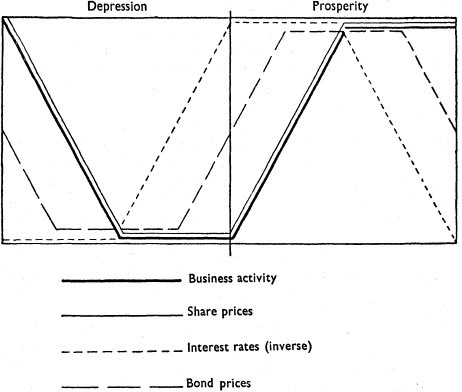
FIG. 22
Fluctuation in the Yield of Common Shares
Theoretically and a priori prices of common stock should always stabilize at a level where their yield exactly equals the yield of long-term bonds. This, however, is not what happens in reality. Share prices are generally lower. Their yields are normally higher than the yields on long-term bonds. In recent decades, yield differentials have been substantial in the United States, for a variety of reasons such as high income taxes, fear of labor unrest and other troubles.
Share yields fluctuate over the course of the cycle. At the depth of depressions they are usually high, and share prices therefore relatively low, because investors fear dividends will fall further. At the height of the boom yields are usually low and prices relatively high because investors hope that dividends will increase further. At such moments it may happen that share yields drop below the yields of long-term bonds.
Share prices do, in fact, fluctuate over a much wider range than indicated by our curve—and over a much wider range than’ interest rates. This is by no means self-evident. Theoretically, earnings on invested capital cannot exceed the interest rate at which new credits are demanded. However, for the above-mentioned psychological reasons, the supply price of equity capital may differ from that of loans. At the height of a boom, funds for bonds may be provided at 5 per cent, whereas shares may be bought on a 4 per cent yield basis. In a depression, funds for bonds may be provided say at 3 per cent, whereas shares are bought only on a higher than 7 per cent yield basis.
Earnings, Dividends and Share Prices
Companies generally pay out only part of their earnings as dividends. They use the rest to create or increase reserve funds, or they plough it back into the business in order to increase their fixed and variable capital. In recent years, and especially under the impact of high personal income taxes, the percentage of earnings distributed to shareholders in the United States has diminished so that undistributed earnings are now often greater than dividends.
Generally speaking, earnings fluctuate much more than dividends because the managements of companies with cyclically fluctuating earnings wish to stabilize their dividend payments in the interest of their stockholders. On the other hand, share prices fluctuate less than earnings though more than dividends. The least volatile of the three are the dividends, the most volatile are the earnings, whereas share prices move somewhere in between.
Independent Share Price Cycles
The correlation of stock market movements and changes in business activity has become less close in the past two decades than it used to be. According to some writers such a correlation no longer exists at all. This would not be astonishing. Net earnings are nowadays affected by corporation taxes and other burdens imposed on business much more than by purely economic changes in gross earnings. The New York bear market of 1939-42, for instance, was created through feár of impending war taxation rather than fear of bad business. The bear market of 1946-49 preceded the 1949 recession by more than two years; the bull market since September 1953 began a full year in advance of recovery. Only the future will tell whether and to what extent stock exchange bull and bear markets will continue to occur independently of business cycles.

