
Common Sense Economics
Part II. The Changing Economy
J. B. Say’s Law
In the real world the economy changes continuously. Neither what is produced, and by whom and by what methods, nor what is consumed, and by whom and by what methods, remains the same.
What are the causes and effects of the more important changes? These questions will be examined in this section under a specific assumption, namely that the quantity of money present in the economy and the velocity of its turnover do not change.
On the assumption of constant circulation of money, all the money paid out during a production period to the factors of production must be spent on the resulting products. Total monetary demand remains constant. To the extent to which demand for consumer goods falls owing to saving there will be a rise in the demand for capital goods and intermediate goods on the part of entrepreneurs, who get as credits such amounts as have been saved.
Our assumption coincides roughly with that of the famous Law of Markets of J. B. Say. This law states that all that is produced is also consumed because the factors of production spend all the money they get on the results of their production.
We shall see later that the assumption of Say’s law is by no means correct in every case. The circulation of money can increase and decrease. In other words, there can be inflation and deflation of money. One can even go so far as to say that stability of money circulation is the exception.
It remains nevertheless important to examine the changing economy under the assumption of an inelastic money circulation. Inflations and deflations are in most cases short-term, reversible phenomena. They carry within themselves the seeds of self-destruction. Prosperity follows depression. But the fate of an economy in the long run, in the aggregate over time, must be the concern of the economist at least as much as short-run situations. Only an analysis which abstracts from inflation and deflation can explain by what forces the economy is influenced in the long run. Only such an analysis can show how the economy would develop if the traditional mistakes in monetary and credit policy were avoided—a possibility which many contemporary economists, accustomed as they are to completely elastic supply of money, no longer seem to envisage at all. Even where inflation is not reversible—as it fails to be in the case of governmental mismanagement of the currency, particularly during war-time—analysis on the assumption of inelastic money supply remains of interest. It shows what happens when, in the further course of an inflation, all members of the community have become fully aware of what is going on and have adjusted their supply and demand for goods and services to the diminishing value of money.
Twenty years ago it would not have been necessary to stress the importance of a non-inflation-non-deflation analysis. Every economics textbook started with the analysis of an economy exposed to no changes from the money side. Money was considered only a veil, behind which were hidden real economic processes, but which did not cause these processes. This has changed radically under the influence of Keynes’ General Theory of Employment, Interest and Money. Newer textbooks seem no longer to know a world in which money is inelastic. In their world inflation increases and deflation decreases not only the nominal, but also the real income of nations in the long run, as well as in the short run. As a result a whole generation of economists seems to believe that the wealth of nations is dependent upon the willingness to develop effective demand, rather than upon the willingness to work. And it can be said without exaggeration that no single fact has done modern economic analysis so much harm as the assumption of a very elastic money supply.
A description of an economy without inflation or deflation therefore appears indeed timely. None of Keynes’ thesis is appropriate to such an economy. This proves—as cannot be stressed too often—that Keynes’ theory belongs to the realm of inflation and deflation and business cycle theory and not to that of a general theory.
We shall begin by examining changes in production and consumption. Our results immediately proceed from, and in part repeat, the findings of our examination of the stationary economy in Part I.
Changes in Consumption
If all the money earned by the factors of production is spent on consumption goods, total consumption remains constant. It can never change autonomously. Only if production expands or contracts can total consumption expand or contract. The consumption of individual products can, of course, fluctuate. The consumption of apples may increase, but only if the consumption of other goods—say pears—declines.
Changes in the composition of consumption goods are in the first place due to changes in the taste of consumers. They can also be due to changes in the distribution of income among the factors of production. If income shifts to higher brackets the consumption of luxury goods, if it shifts to lower brackets the consumption of mass consumer goods, will increase relatively.
As in the case of all changes short-run effects have to be distinguished from long-run effects. In the short run an increase in demand causes prices to rise substantially above production costs. But after some time the productive resources of the economy are again directed toward the production of various goods according to the new wishes of the consumers. A new equilibrium is established. Prices again stabilize at the marginal cost level. The production of all goods expands up to the point at which the consumers are prepared to pay a price covering the cost of the last unit produced.
Changes in consumption can also be due to changes in production costs and resulting changes in prices. If production of apples becomes cheaper, whereas the production of pears becomes more expensive, the consumption of apples will increase while the consumption of pears will decline.
Changes in Production
In contrast to consumption, there can be changes in production not only of a qualitative but also of a quantitative nature. In other words, the total amount of goods available for direct or indirect consumption, or the gross national product as it is called somewhat equivocally, may change.
Given a certain productivity of, and the resulting demand for labor, and given a certain supply of capital, the volume of total production is a function of the supply of labor. This means that the volume of production depends on the extent to which people are willing to work. This fact has to be emphasized over and over again. Our view is in flat contradiction to the prevailing demand theory of employment and production, according to which it is the demand for, rather than the supply of, labor that fundamentally determines employment and production. In an economy without inflation and deflation the changes from the side of the supply of labor are obviously more important than those from the demand side. This implies that this is also the case in reality in the long run, and in the aggregate over time. So-called structural unemployment—as distinct from cyclical and frictional unemployment—is always due to excessive wages, i.e. to an over-expensive labor supply.
Unemployment, a Vague Concept1
Labor is not offered at any price except under very special conditions. The quantities offered vary with the wages demanded. Against a high compensation more labor is offered as a rule than against a low compensation, exactly as in the case of the isolated producer which we examined at the outset. The elasticity of labor supply will, of course, be different in various countries and at various times. But according to all experience it is safe to say that labor supply is never entirely inelastic, that it always depends to some extent on the wage level.
Therefore the concept of full employment, as used in political discussions and also in various full-employment laws all over the world, is a somewhat vague one. Those who consider the product of their work insufficient compensation for sacrificing their rest or recreation will remain unemployed even in a boom.
Unemployment is thus not an absolute but a relative concept. One can only speak of unemployment at a certain—say at the prevailing—wage level. From the point of view of policy, employment should be guaranteed only to those who are willing to work at wages fixed by the government. Those not willing to work at these wages should be considered as voluntary unemployed, and excluded from any unemployment benefits.
But must the prevailing wage level always be maintained in all circumstances? And at what level should a government, obliged by law to maintain full employment, fix wages? Some say wages should be fair, obviously meaning sufficient for a decent standard of living. This is a purely political and not a scientific point of view. In a free economy there is in the long run and after adjustment to all disturbances only one fair level of wages—the level at which the labor supply is absorbed by the demand for labor. In practice this is the wage level which corresponds to the product of the marginal worker, i.e. the least productive worker still employed at given demand.
The Basic Law of Employment
Given a certain demand for labor, the degree of employment is a function of the supply price of labor, of wage demands. This is true in spite of the fact that labor unions, which minimize the importance of the wage level for the level of unemployment, generally do not admit it and in spite of the fact that this importance, unbelievable as it may appear, was hardly ever mentioned in the vast literature on post-war unemployment. It is true even where the elasticity of the demand for labor is small. There must always be a wage level that is sufficiently low to guarantee the absorption of supply by demand. The wage level would be indifferent for employment only under the unrealistic assumption that the demand for labor was entirely inelastic, i.e. that labor could be employed regardless of its price. This is in contradiction not only to practical experience but also to the laws governing all markets. On the labor market, as on every other market, supply can never exceed demand provided no obstacles are put in the way of price formation.
Growth, as well as cheapening, of labor supply expands the total production of the country. This is often forgotten, notably by those who oppose immigration of labor. Whether such an expansion of total production benefits or damages the community as a whole is another question to be discussed later.
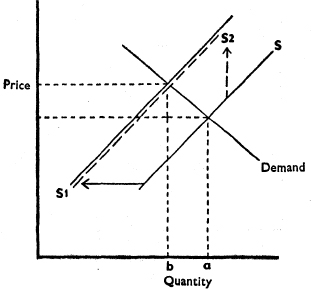
FIG. 13
Changes in the Supply of Labor
Changes in the supply of labor, as of all other goods, can take either of two forms: either the price for the same quantity changes, or the quantity offered for the same price.
Both changes operate in the same direction, as is evident from Figure 13. Whether the labor supply curve (S) moves to the left to S1, indicating that smaller quantities are offered at given price levels, or whether the supply curve moves up to S2, indicating that the given quantities are offered at higher prices, the quantity of labor actually done is reduced by ab.
There remains, however, the question whether, for instance, a 10 per cent rise in wage demands always has the same restricting effect as a 10 per cent reduction of work-hours offered. This depends on the slope of the supply curve. A steep supply curve indicates that price has a relatively small influence on the amount of supply. If, therefore, the labor supply curve is steep, as in Figure 14, the demand of a wage rise of 10 per cent will restrict employment less than a 10 per cent reduction in the work-hours offered at various wage levels. The rise in wage demands, expressed by an upward shift of the supply curve to S2, will restrict employment only by ac; an equivalent reduction in work offered, expressed by a shift to the left of the supply curve to S1, will restrict employment by the much larger amount ab.
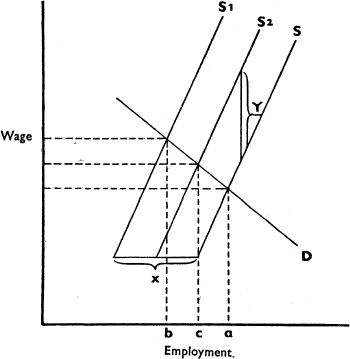
FIG. 14
Changes in the supply of labor may, but need not, lead to changes in the number of workers employed. A smaller or costlier supply of labor causes less work to be done per unit of time—say per week. This can happen through all workers working fewer hours each week, or through some workers not working at all. Whether the higher cost or the reduction of the supply of labor will actually lead to unemployment or not depends on the manner in which either the offer of weekly work-hours at prevailing wages is reduced or the wage demands raised. The weekly work-hours offered may be reduced (a) by all workers being unwilling to work more than a certain time each week, or (b) by some workers being unwilling to work at all. The supply price of labor may rise (c) by wage demands being raised for all weekly work-hours, or (d) by wage demands being raised only for the later hours of weekly work, i.e. by demands for earlier operation of overtime pay. There may also be various combinations. In particular, it is not unusual for a claim for shorter weekly work to be combined with a demand for unchanged weekly wages (combination of a and c), which means higher hourly wages. The labor supply curve then moves upwards as well as to the left, and the curtailing effect on production is cumulative.
The effect on employment of each of cases (a) to (d) will be different. A reduction of the working week for all workers (case a) while reducing the total of hours worked creates no unemployment. The reduced work is spread among the existing number of workers. If the demand for labor is inelastic it may even happen that the total of hours worked declines less than the hours worked each week by the individual workers. In this case employment increases.
A reduction of weekly work-hours, through some workers being entirely unwilling to work at the prevailing wage level (case b), creates voluntary unemployment.
A raising of wage demands for all hours (case c) will reduce the number of workers employed. Entrepreneurs, having to curtail production, will generally prefer to dismiss workers rather than curtail weekly working hours.
A raising of wage demands for the later daily or weekly hours, i.e. the claim for earlier overtime pay (case d), reduces the weekly work done by those employed. To make up for the reduced working time entrepreneurs may employ new workers. In this case the work is spread among more workers, the number of workers employed increases.
Reasons for Scarcer and Costlier Labor Supply
The supply of labor becomes scarcer or costlier when the workers’ valuation of the wages offered decreases in relation to their valuation of leisure.
A priori it is to be expected that such a change in relative valuation should find expression both in higher wage claims and in a diminution of labor supply, whether through certain parts of the population not working at all or through a shortening of the working week. Indeed, economic history shows examples both of higher wages and of reductions in the weekly working time, as well as of curtailment of the degree of activity of the population (elimination of child labor, to a large extent of women’s labor).
It is to be noted, however, that the workers’ claims for shorter working time are apt to meet with obstacles of tradition. An eight-hour day introduced in a certain factory or in the whole country generally remains unaltered until strong forces of a technical or social character enforce changes.
It is hard to predict whether the workers’ claims will in the future concentrate more on higher wages or on shorter working time. All that can perhaps be said is that with a rising standard of living labor will prefer more extended leisure to increased consumption. Technical progress and increased capital equipment may one day lead to a state of affairs where men will be willing to work only a very few hours each week. A very few hours, spent in supervising highly productive machines, may guarantee such a high standard of living that its further improvement is of little interest. An ever-growing increase in leisure, rather than, as some fear, over-production of consumption of goods no longer in demand, may turn out to be the end of a development which would leave a rational use of leisure as the only problem.
Note that a withdrawal from the labor market may, in our time of labor monopolies, not be caused at all by a changed valuation of leisure or of compensation for work. Labor may strike not because workers wish to be unemployed rather than work at the prevailing wage rate, but because they try by means of the strike to obtain wages which they believe entrepreneurs could pay without resulting unemployment.
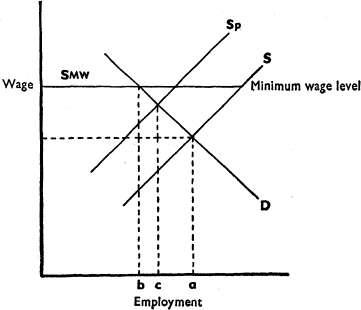
FIG. 15
Minimum Wage Laws. Laws Limiting Labor Supply. Union Action
The effects of minimum wage laws and of laws limiting the supply of labor, such as laws forbidding the occupation of minors, are demonstrated in Figure 15.
Minimum wage laws create, as it were, an artificial labor supply curve running horizontally at the minimum wage level. The supply curve S is replaced by the line SMW. All those whose services are no longer demanded at this wage level become unemployed; the amount of unemployment so created is ab. Laws prohibiting the employment of minors create a new supply curve (Sp) to the left of the original supply curve. The interval ac represents the production-curtailing effect.
This does not, of course, imply that minimum wage laws or laws against the work of minors are not warranted. It only shows the curtailing effect of such laws on production, against which have to be weighed the favorable effects on the health and the general well-being of those remaining in employment and of those now unemployed.
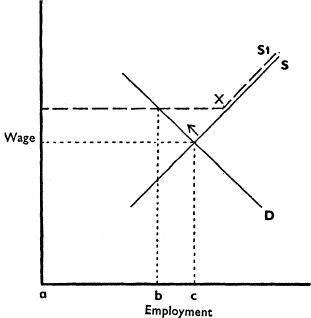
FIG. 16
Apart from the case where labor is faced with monopolies, it is the task and the justification of labor unions to fight, on behalf of their members, for wages higher than those that would come about on a free market. The effect of union action is highly complicated. In principle, its effect is a general increase in the price of too cheap labor, and therefore an upward bending of the left side of the supply curve (S) in Figure 16 to, say, a point X which is higher than the free market price of labor. The result is a raising of the wage level, i.e. an improvement in the situation of those employed (ab) to the detriment of those who become unemployed (bc) because their services are no longer demanded at the new, higher, wage level. The least skilled and least productive workers are the chief sufferers.
The Demand Curve for Labor
The effects of changes in labor supply are, of course, largely dependent upon how much of the labor offered at various prices entrepreneurs are able to employ, or, in the language of curve analysis, on the shape of the demand curve for labor.
The question is a complicated one. We have in principle to start from the fact mentioned in Part I that, according to the law of diminishing marginal returns, the productivity of the individual worker—given a certain amount of capital—is reduced through the employment of new workers, because the capital equipment per worker becomes scantier. It follows that entrepreneurs disposing of a given amount of credit will, in principle, employ new workers only at lower wages corresponding to their lower productivity. The demand curve for labor will thus in fact run downward to the right.
Whether its slope will be more or less steep depends, of course, on the degree to which a diminution of capital equipment per worker reduces the productivity of labor. We must assume that the reduction in productivity is a significant one, i.e. that the demand curve has a steep slope. Under modern conditions a newly employed worker can have the same productivity as those already employed only if an equal amount of capital is invested for him. Where this is impossible, because the amount of capital is given, the productivity per worker must fall sharply when the number of workers grows.
All this rests on the assumption that entrepreneurs neither do nor need to reckon with changes in the price level for finished goods. We shall see later that this assumption, which we make here for purposes of exposition, is not entirely correct.
Effects of Changes in Labor Supply
Assuming, then, a demand curve running steeply downward to the right, what will be the effects of changes in labor supply? The answer can be found in Figure 17.
In the first instance it will be seen that if the labor supply curve S moves downward to S1, employment increases by ab.
The increase in employment causes an increase in the product, but this increase in the product is smaller than the one resulting from the preceding additions to employment because the new workers, as explained above, have a lower productivity. The increase in the product is represented by the area AabB; the total product is now efBb, as against efAa before.
Hourly wages fall by AC. If the demand curve D had a horizontal course, total wages would not fall. The decreased wage demands would spend themselves in an increase of employment. If the demand curve were vertical, i.e. if no capital at all were available for the purpose of employing additional workers, total wages would fall by the whole amount of the reduction in wage demands (AE). That wages fall by less than AE is due to the fact that the demand curve is not completely inelastic.
Where does the capital come from which entrepreneurs need for the employment of new workers, since we have assumed that the total amount of available credit is given? The answer is this: employment of new workers not only leads to a fall in the marginal productivity of labor; it leads at the same time to an increase in the marginal productivity of capital, since the demand for capital per worker becomes more urgent. As a result, capital will be withdrawn from the most labor-saving enterprises. The credits saved in long production detours can, by widening the capital structure, be used in shorter production detours. This saving of credits in the longer production detours is the reversal of the phenomenon discussed in Part I in connection with the need for larger credits for longer production detours.
If the supply of labor becomes scarcer or costlier, an opposite effect will take place. Employment will fall, the volume of production will shrink and wages will rise. Capital will be re-directed from the shortest to the longest production detours. This is an expression of the fact that capital no longer needed for the payment of the marginal workers and their equipment with capital can now be used to increase the productivity of the workers still employed, by transition to more capitalistic methods of production.
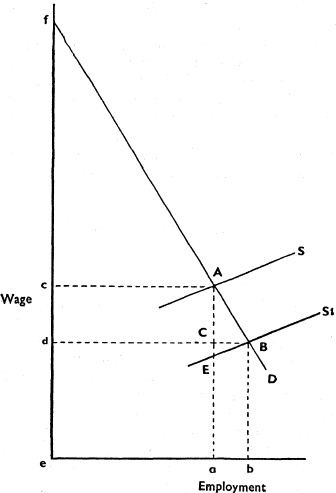
FIG. 17
Reaction on Profits and Interest
Figure 17 shows that a reduction in wage demands decreases the wages of all workers to the level of productivity of the “new” marginal worker. Owing to this general fall in wages entrepreneurs make extra profits. A share in the total product corresponding to the area cABd accrues to them. These extra profits will induce entrepreneurs to compete for the given amount of capital and to bid up interest rates. As a result, capitalists will receive higher interest, an expression of the fact that the productivity of capital has risen through the increase in labor employment.
But this is not the end of the story. When the factors of production later spend their income, they will realize that interest rates have risen. They will tend to spend less and to save more. Their savings may go to entrepreneurs in the form of larger credits. Entrepreneurs will thus be enabled to increase the capital equipment per worker, and the productivity of labor will rise. The demand curve D in Figure 17 will become less steep. The product increases, wages rise and interest per unit of capital remains lower than assumed above.
If labor supply becomes dearer, the effects will be opposite to those described.
Changes in the Demand for Labor
We have so far examined the effects of changes in the supply of labor at a given demand for labor. We shall now examine the effects of changes in the demand for labor. The demand for labor may change for a variety of reasons.
One reason is to be found in the changes of capital supply, to be discussed later. The main reason, however, is a change in the productivity of labor.
An important distinction has to be made here. A change in the productivity of labor is not identical with a change in the productivity of capital applied to labor, although this is assumed in most wage negotiations. The productivity of labor increases when technical improvements enable savings of labor in proportion to the amount of labor applied; the productivity of capital increases when such improvements enable savings of labor in proportion to the amount of capital applied. When the productivity of capital is increased labor saving will therefore be negligible in industries using little capital, but very important in industries with large capital investments per unit of product.
Changes in the Productivity of Labor
A change in the productivity of labor creates a whole chain of reactions. Workers are set free in those enterprises in which the increase in the productivity of labor makes workers redundant. On the other hand, in other enterprises hitherto unemployable labor can be set to work, because the higher output per work-hour allows the employment of labor previously too expensive or of too low productivity.
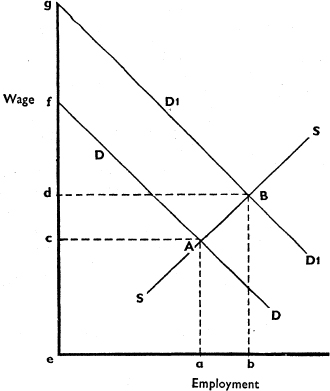
FIG. 18
After completion of all the transition stages a new equilibrium will emerge. Since the productivity of the individual worker has increased, entrepreneurs will be prepared to pay higher wages according to the higher productivity. Figure 18 shows the resulting changes. The demand curve D will move up to D1. This has, in the first place, the result that employment increases by ab. The increase in employment causes an increase in output. Since, at the same time, the productivity of the workers has risen, the increase is this time greater than that due to cheaper labor supply. The increase corresponds to the area aAfgBb. The total product is represented by the area egBb. Wages increase by cd. This increase is smaller than would correspond to the increase in productivity because the wages of all workers are in accordance with the productivity of the marginal worker. Entrepreneurs make an extra profit, represented by the difference between the triangle dgB and the triangle cAf. These extra profits induce entrepreneurs to compete for the given amount of capital. The interest rate rises.
Again we are faced with the question of how entrepreneurs pay the more numerous and more costly labor. Again the answer is that they pay their workers with capital hitherto used in the longest production detours. The higher productivity of labor makes it profitable to withdraw capital from the longest production detours and to use it for paying labor, even though the latter has become more expensive.
A decrease in the productivity of labor has opposite effects. Employment contracts, total output diminishes, wages fall. The marginal productivity of the capital distributed among fewer and less productive workers falls, and with it the interest rate.
In our days, with free market conditions, except in time of war or other catastrophes, it is hardly likely that the productivity of labor will fall. New methods of production are permanently at work to raise, not to lower, the productivity of labor. However, the productivity of labor is sometimes lowered artificially. So-called feather bedding, as practised in the American railway industry, and similar restrictive devices are examples.
Changes in the Productivity of Capital
As we have stated earlier, changes in the productivity of capital are not to be confused with changes in the productivity of labor. Increased productivity of capital normally causes entrepreneurs to raise their offers of interest and thereby leads to higher income for the capitalists. In a free competitive economy the workers can benefit from an increase in the productivity of capital only when the supply of capital grows at the same rate as the demand for capital and when, therefore, interest rates do not change. In this case, competition among the entrepreneurs leads them to bid up wages according to their own higher profits.
Trade unions often consciously or unconsciously claim for their members wage increases corresponding to the increased productivity of capital. Unless the supply of capital has risen to the extent of the increased demand for capital, the enforcement of higher wages is bound to give rise to unemployment. But even when interest rates do not go up, because capital supply has increased and entrepreneurs are therefore in a position to grant wage increases—even then higher wages must lead to temporary unemployment in some enterprises. The benefits of increased productivity of capital are obviously much higher in enterprises needing much capital than in those needing less capital. Given a more or less uniform wage level, labor will have to shift from less capitalistic to more capitalistic enterprises, so that the latter can absorb the workers dismissed by the former.
It is often maintained that the productivity of labor as well as that of capital increases when wages are forced up by trade unions. In fact, this argument is used in favor of wages increasing ahead of an increase in the productivity of labor and capital. The truth is, however, that entrepreneurs are permanently at work to lower costs by new production methods and thus to maximize profits. Wage increases ahead of productivity increases as such do not accelerate this process. What wage increases are doing is to increase the productivity of labor, because they make labor scarce and cause capital equipment per remaining worker to increase. In the last resort this means substitution of capital for labor. Under our assumption of a given capital supply (in fact always except under the assumption of a very elastic capital supply—a very unrealistic assumption in a non-inflation economy) the substituting capital will never be sufficient to replace all workers dismissed. Nor will the new capital installations provide employment opportunities for the workers dismissed as too expensive. The capital structure has deepened but also narrowed, with the result that the total product of the economy does not grow but diminishes.
Changes in Production Coupled to Changes in Income Distribution
We can now formulate a law that we have already briefly mentioned. Every change in the supply of or the demand for one factor of production, e.g. labor, does more than just lead to a change in the employment of that factor and thus to a change in the total product. Unless other factors, e.g. capital, change to the same extent, any such change in the total product is always accompanied by a change in the distribution of the product among the factors of production. Production and income distribution are linked in such a way that an increase in output by the increased employment of one factor goes along with a decrease in the share of the total product accruing to this factor per unit of contribution. And every decrease in output by decreased employment of one factor goes along with an increase of his share per unit of contribution. If, for instance, total output increases because labor supply has grown, wages go down and interest rates up. If the increase in total output is due to an increase in the productivity of labor, wages go up, but less than would correspond to the increase in productivity.
This result follows, of course, from the law of diminishing returns. If more labor is combined with the same amount of capital, the marginal productivity of labor and the wage level decrease. Since to apply more labor to the same amount of capital means, by implication, less capital in relation to the previous amount of labor, the marginal productivity of capital and the interest rate increase. If the greater employment of labor is due to an increase in the productivity of labor, the wage level does not fall absolutely, but only in relation to the higher productivity.
Changes in the wages of individual workers per unit of their contribution, say one work-hour, have to be distinguished strictly from changes in the total wage bill accruing to labor as a whole. If more work is done and the total product thereby increased, the total income of the working class as a whole, i.e. the workers formerly employed and those newly employed, will increase both absolutely and relatively. The total wage bill paid out to the increased labor force always increases more than the interest paid to the capitalists for the same capital. Yet the share of the individual worker in the proceeds of one hour’s work will have decreased. If, on the contrary, less work is done and the total product thereby decreased, the working class as a whole will be hurt. Yet the hourly wage of the individual worker will have increased. The question whether a decrease in total product is not too high a price to pay for a higher wage level is a political one. The answer depends on many considerations. The elasticity of the demand for labor is of decisive importance here, because it determines the extent to which higher wages are accompanied by a large or small decline of the total product.
Changes in Supply of Capital
The supply of capital can change in two ways. Either the savers—the people who refrain from consumption—offer the same amounts of capital at higher or lower interest rates, or they offer bigger or smaller amounts at given interest rates. Normally both cases have the same result: the amount of capital used in the economy increases or decreases.
This increase or decrease comes about as described in Part I. If the factors of production save part of their income and put it at the disposal of entrepreneurs, purchases of products for more or less rapid consumption are replaced by entrepreneurs’ purchases of capital goods or intermediate products. After a transition period, which we shall describe later, this will result in a lengthening of the production detours by adding, as it were, a lengthening piece to all production detours. Whereas formerly, for instance, hammers were produced to be consumed ultimately in the form of nails produced with their help, now a steam hammer may be produced. It may not actually cost more than the former hand tools, but its installation requires more credit, since the capital invested does not reach the consumption stage until much later and the credits, therefore, cannot be repaid until then.
If former savings are withdrawn in order to be consumed the contrary happens. The production detours are shortened. And instead of machinery, to be consumed only later, consumption goods to be consumed immediately are delivered to the markets. Hammers are replaced by nails.
Increase of capital results, of course, in higher productivity of the labor now used in more capitalistic production methods. More finished goods can be produced with the same amount of labor. Decrease of capital, on the other hand, results in lower productivity of labor. The same amount of labor produces fewer finished goods.
The Reasons for Saving
The amount saved at various interest rates depends primarily on the savings habits of the community. On this there seems to be general agreement.
But is more saved at higher interest rates than at lower ones—in other words, is the supply of savings elastic or inelastic? This question has already been touched on in Part I; we must now discuss it in more detail. It is an axiom of classical economics that on every market the supply increases with higher prices, except under very special conditions. As regards the supply of capital, it has been pointed out that those wishing to provide for old age through saving might save less, rather than more, when the interest rate is higher because the accumulated interest would then contribute more to the sum desired as provision for old age. This kind of reaction is certainly possible, but will be limited to only a very small part of the saving public. The overwhelming part of savers do not have in mind some fixed amount which they would wish to provide for their old age. They simply compare the utility of present consumption with the utility of future consumption. And as higher interest rates increase the sum available for future consumption, because the accumulation of interest at the future date becomes greater, the propensity to save will, other things being equal, increase as interest rates rise. Although the matter is highly complicated, as will be evident later on, we can start from the assumption that as a rule the supply of capital is a positive function of the interest rate. If interest rates rise, for instance, because of higher demand for capital, more will be saved per unit of time.
This is true even in times of slow inflation, when a further decline of purchasing power is not generally expected. Therefore a rise in interest rates will in such times, too, induce people to shift their present consumption to the future. If inflation progresses quickly or over long periods, the population becomes inflation-conscious and apprehensive of further inflation. In this case interest rates lose their power to check present consumption.
What amounts are people prepared to save at given interest rates?
Here, under the influence of Keynes, a whole set of opinions has developed which has no foundation in reality. Savings are supposed to depend on the size of incomes in such a way that higher incomes lead not only to absolutely but also to relatively higher savings, i.e. the rate of saving increases. A so-called psychological law allegedly induces people to set aside a higher percentage of their income for future consumption, the more the necessities of the present are covered. This assertion often leads to far-reaching conclusions, especially to the so-called stagnation theory to which we shall return later.
We encounter here one of the half-truths so frequent in Keynes’ teachings. No distinction is made between increases in the income of individuals compared to the income of other individuals, and increases in the income of the whole community; nor is one made in the latter between short-run, especially cyclical, and long-run changes.
It has long been established that the rich save more than the poor. When an individual’s income increases, his savings rate will as a rule increase. But so long as the income of the whole community remains the same, the incomes of other individuals must obviously decline, as must their savings rates. Unless, then, the whole community becomes richer, the average savings rate, and thus aggregate saving per unit of time, cannot increase through some individuals becoming richer.
If, on the other hand, a whole community’s income increases—and the only way this can happen in real terms is through increased work or increased productivity of labor—the total amount of saving generally grows, but the savings rates do not increase. They remain stable over time. At least for many modern industrial countries this is a statistically established fact. It is quite easy to understand. An individual becoming rich acquires the traditional consumption habits of the higher income brackets, where indeed larger parts of income are saved. If, on the other hand, a whole community becomes richer all people, including those of higher incomes, adjust their spending habits to this increased income. There is no reason why their propensity for future spending should increase more than their propensity for present spending. The community’s traditional standard of living, which puts a brake on the present consumption of the newly rich, does not operate when the standard of living and, with it, consumption habits of the whole community change. Newer developments in the United States seem to suggest that with increasing wealth the savings rate even declines. A sort of inverse psychological law seems to induce at least Americans of today to spend more in the present, once a certain provision for the future has been secured.
In the short run, especially during a business cycle, savings rates indeed do fluctuate with income. If incomes increase during the upswing, saving increases over-proportionally, at least at the beginning and in the middle of the phase. But this has nothing to do with the psychological law establishing a growing preference for future consumption. Something quite different is at work: during an upswing prices rise because of credit and monetary expansion; people, not accustomed to the new prices, decide to wait with spending until prices come down again. For this reason savings increase more than incomes. We shall examine such prosperity saving later on in detail.
There is no doubt that total savings increase absolutely when total income increases. But this again does not follow from any psychological law but from the simple arithmetical fact that if the savings rate is stable, higher total income brings about correspondingly higher total savings. But as higher real incomes are chiefly the result of higher productivity through increased use of capital, such higher incomes will not change the relative strength of demand for and supply of capital. The higher savings are the result as well as the prerequisite of higher income. The fears of the so-called stagnation school, which since the publication of Keynes’ General Theory has been alarming the world with the assertion that savings will outrun investment opportunities, are obviously unfounded both when based on an increase in the savings rate and on an absolute increase in savings.
Changes in Demand for Capital
We have seen that increased supply of capital leads to a lengthening, and a decreased supply leads to a shortening of the roundabout methods of production.
Increased demand for capital leads to exactly the same result as increased supply, namely to an increased use of capital and thus to a lengthening of the roundabout ways. Decreased demand for capital leads to the same result as decreased supply, namely to decreased use of capital and a shortening of production detours.
The effects of changes in demand for capital on interest rates, however, are opposite to those resulting from changes in supply. Whereas increased supply leads to lower interest rates, increased demand leads to higher ones. And whereas decreased supply leads to higher interest rates, decreased demand leads to lower ones.
The effects of changes in supply of and demand for capital on the amounts of capital used and on interest rates are demonstrated in Figure 19.
When supply of capital moves from S to S1 (representing a decline in supply) the amount of capital used declines by de, just as it does if demand moves from D to D1 (representing a decline in demand). Interest rates, however, rise by ab in the first case, but fall by ac in the latter case.
When the supply of capital moves from S to S2 (indicating an increase in supply), the amount of capital used increases by df, just at it does when demand moves from D to D2 (indicating an increase in demand). Interest rates fall by ac in the first case, but rise by ab in the latter.
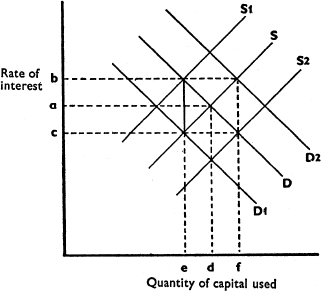
FIG. 19
We have already mentioned one of the reasons for increase and decrease in the demand for capital. We have described how an increase or decrease in the number of workers alters the marginal productivity of capital and thus causes demand for capital to increase or decrease. We have seen that, for instance, an enlarged labor supply as a rule increases the demand for capital because it encourages entrepreneurs to compete for the existing capital and to bid up interest rates.
Besides such induced increases and decreases in demand for capital, there are also autonomous increases and decreases. The chief reason for autonomous increase is to be found in new inventions enhancing productivity, i.e. the labor-saving effect of capital. If, by applying x units of capital, one can save not y but 2y workers, one will be able to pay 2z instead of only z as interest on these capital units. Autonomous decreases in the demand for capital never happen for economic reasons, since technical development always progresses and never regresses. But such decreases can happen for political reasons. Any threats—such as political unrest or widespread strikes—to the continued use of the plant to be built, or the machines to be installed, lower the demand for capital.
Changes in Capital Supply and Demand Influence Demand for Labor
We have described above how changes in the demand for and supply of labor give rise to induced changes in the demand for capital. We have seen that when, for instance, the supply of or the demand for labor grows, the latter because of an increase in the productivity of labor, the demand for capital rises. The same is true for the converse case. If the supply of or the demand for capital rises, the latter because the productivity of capital has gone up, there is an induced demand for labor. Through the use of cheaper or more productive capital the entrepreneurs reap extra profits, enabling them to compete for the existing labor and to bid up wages. Workers who have hitherto been too expensive or not productive enough to be employed can now be set to work. This is the explanation of the well-known fact—which, however, cannot be stressed too often—that, other things being equal, higher savings raise employment as well as the wage level. Should the supply of or the demand for capital fall, which is unlikely to happen in the long run, the result would be a reduction in employment and a fall in wages.
Personal and Corporation Taxes Influence Capital Supply and Demand
Taxes exercise a decisive influence on the demand for and the supply of capital and thus on the volume of production. This is a fact often mentioned but seldom sufficiently heeded in political discussions. Without going in detail into the complicated questions arising in this connection, we wish to present a few basic considerations.
Income taxes affect the borrowers as well as the lenders of capital. Borrowers of capital—in the wider sense comprising financing through the issue of shares, etc.—include in the first place corporations but also single entrepreneurs working with other people’s money. The lenders include the capitalists proper but also the entrepreneur-capitalists, i.e. entrepreneurs substantially working with their own capital. In so far as the income of the first group is derived from the use of capital, an income tax is bound to reduce the demand for capital. If, for instance, a corporation has to pay taxes in the amount of 50 per cent of its revenue from capital, it will obviously be able to offer only half the compensation for the use of capital—at least against common and preferred shares—that it could offer without the tax. Higher income taxes for the second group, the capitalists and entrepreneur-capitalists, on the other hand, result in a reduction of supply. In the case of a 50 per cent income tax the capitalist will, in principle, offer the entrepreneur the same amount of capital, and the entrepreneur-capitalist will employ his own capital, only at twice the interest. It is always the net amount to be earned which counts for those who demand, and the net amount received which counts for those who supply capital.
It follows that in so far as the supply of capital is not completely inelastic, i.e. in so far as capitalists are unwilling to supply the same amounts of capital at lower interest rates, both corporation taxes and personal taxes are bound to have a restricting effect on the use of capital. This effect, in turn, can lead to the shifting of such taxes on to the workers or consumers. To the extent to which wages fall as a result of smaller capital equipment, or fail to rise as much as they would have done otherwise, the burden of the tax is shifted on to the workers. To the extent to which smaller capital equipment causes production costs to rise, the burden may be shifted on to the consumers. There are good reasons for believing that such shifts have, indeed, taken place in the past. For the gross earnings of corporations have, on the average, risen to such an extent that their net earnings after deduction of tax have not fallen but risen in spite of continuous tax increases. By pressing, in all countries, for ever higher corporation taxes labor appears therefore somewhat shortsighted.
It should also be mentioned that a strongly progressive income tax not only tends to reduce the supply of capital in general but brings about a relative scarcity of venture capital, i.e. capital prepared to take risks. For the capitalists’ profits are taxed away to a greater or lesser degree, while they are left with the losses. A relative scarcity of risk capital is bound to reinforce the tendency towards curtailment of production. It follows that the view, upheld chiefly by labor leaders, that there are no limits to height and progressivity of income taxes is not correct. Very high income taxes must have serious consequences for production and employment, unless the State were to take over the role of the private investor, in one form or another, in accordance with the predictions of Keynes and the wishes of socialists and communists.
Changes in Use of Capital Coupled to Changes in Income Distribution
We again encounter the law mentioned above, according to which the use of a factor of production—and thus the total output—and the distribution of income are linked to each other. If more capital is used (capital being in cheaper supply or more productive), the whole output increases, but the compensation of the capitalist per unit of capital employed decreases. When the use of capital increases owing to cheaper or increased supply of capital this is self-evident, because in this case the interest rate falls. When the use of capital increases owing to higher productivity of, and hence higher demand for, capital the interest rate rises, but the compensation per unit of capital nevertheless decreases relatively to the compensation of labor because for a given labor force wages rise more than interest per unit of capital. If less capital is used, the opposite development takes place. The compensation of the capitalist per unit of capital increases. The amount saved per unit of capital, because of lower interest rates, accrues to labor in the form of higher wages. This is why labor is so interested in strong capital formation.
Whereas the compensation of the capitalist per unit of capital employed declines with greater use of capital, the compensation for the whole of the, now, larger capital employed nevertheless increases, although not proportionally to the increase in the capital employed. Therefore the share of the total product going to the capitalists as a class also increases both absolutely and relatively. But the increase in the share of capital is smaller than the increase in the use of capital. The margin accrues to labor.
Changes in Consumption and Investment do not Affect Aggregate Demand
Our argument so far has been based on the assumption that everything saved is invested by entrepreneurs, and that everything invested by entrepreneurs must be saved. On this assumption total demand cannot be affected by fluctuations either in consumption or in investment. When more is consumed, for instance, less will be invested, and when more is invested less will be consumed.
This statement differs substantially from the currently prevailing view of the situation. It is now held by most economists that if the population consumes more, i.e. saves less, aggregate demand increases because investment does not fall off. This increase in demand is even said to be cumulative, because, according to the so-called acceleration principle, increased consumption causes increased investment expenditure.
On the other hand, it is also said that aggregate demand rises when more is invested. This increase, too, is said to be cumulative, because, according to the so-called multiplier theory, increased investment causes increased consumption expenditure.
Our assertions are diametrically opposed to this view. To a certain extent, of course, they simply follow from the assumption underlying this part of our analysis, namely that inflation and deflation of purchasing power are absent from the economy. On this assumption investment and saving must always balance without the aid of the phenomena resulting from inflation or deflation. Any minus or plus in purchasing power spent by consumers must, in this case, be counterbalanced by a plus or minus in purchasing power spent by entrepreneurs on investment. There can be neither a deficit nor a surplus of savings.
Our assumption of an economy without inflation and deflation is in contrast with the method of exposition prevailing today, which makes the opposite assumption—namely that inflationary and deflationary gaps continuously develop in the economy. In such an economy saving and investment are, of course, never in equilibrium without the aid of inflation and deflation. Surpluses can push money out of circulation and deficits can draw money into circulation. When examining the phenomena of inflation and deflation we shall, later, have to deal extensively with the disappearance of money into “death traps,” as this process has been called, and its reappearance from them. Here it suffices to state that except under special conditions involving certain rigidities money does not in the long run disappear in death traps. Hence there can, in the long run, be neither too much nor too little saving and investment. If this is true, then the volume of production does not, in principle, depend upon fluctuations in expenditure but upon the people’s willingness to work. The description of an economy without inflation and deflation shows this with complete clarity, and this is why such a description is of great importance.
Under-employment as such does not Invalidate this Statement
The description is also important for the following reason. Keynesians generally concede that increased investment implies decreased consumption and increased consumption implies decreased investment in a fully employed economy, but maintain that as long as unemployment prevails increased consumption leads indeed to increased investment and increased investment to increased consumption. Our description puts this under-employment argument—with which, incidentally, the most paradoxical statements are sometimes justified—in its right place. First, no degree of under-employment whatever-accepting for once this vague notion—can have the result that more investment creates more consumption, or more consumption more investment as long as inflation is prevented. In an economy exposed to inflation, the latter can produce additional investment and additional consumption. But these additions, the result not of consumption or investment but of inflation, will as a rule be only nominal, not real. In real terms what is more consumed under inflation is less invested, and what is more invested is less consumed.
Nor does the presence of unemployment as such change the situation. It does not protect money inflation from resulting in pure price inflation, contrary to what is so often assumed. It will lead to increased production—and thus to increased real investment or real consumption—only under one of the two conditions: Either the labor supply curve must remain stable in spite of rising prices—for any length of time an entirely unrealistic assumption of Keynes who maintains that the supply of labor is not a function of real wages (General Theory, p. 8); or labor supply must be perfectly elastic for a certain time, as in the special situation of the recovery phase of the business cycle. We will treat these matters when dealing with effects of inflation (pp. 117 and 176) and the business cycle (pp. 177 and 178). To treat business cycle phenomena as general cases and to build on them a general theory can only lead to general confusion.
Deflationary Effect of Increased Employment
Our analysis so far was implicitly based on the assumption that, so long as the circulation of money is inelastic, the general level of prices and wages is not subject to any changes. Any purchasing power not spent by consumers, for instance, would go to the entrepreneurs, who would replace the savers as buyers on the markets. As a result, the general price level would not change.
The assumption of an unchanging price level needs to be qualified when more labor is employed owing to an increased supply of labor or capital, i.e. when the stream of goods in the economy is widened. Whether the money needed for the payment of the workers is withdrawn from longer production detours, or whether it is made available by new saving, the fact remains that this money now has to be turned over twice during the same period. It is now no longer spent by the consumer or entrepreneur himself for the products of the past period, but is in the first place used for wage payments. It is only the wage earners who then perform the “saved” act of purchase.
Unless, then, the money simultaneously present in the economy is increased, or unless its velocity of circulation increases, the money will not be sufficient to pay out all the credits which ought to be available according to the savings situation. The resulting situation will be exactly the same as if a Central Bank reduced the circulating issue. We shall discuss in Part III the consequences of such monetary deflation on prices, wages, and possibly employment.
It is often said that a growing economy, which means in essence one in which employment rises, requires money circulation to be increased. This is a justified claim, but it is justified not because the economy could not otherwise grow, but because its wage and price system would be subject to considerable deflationary pressure even if enough new savings to pay the new workers were forthcoming.2
Wage and Price Level and Increase in Productivity
Further difficulties are involved when there is an increase of the productivity of labor, which we discussed above. Here an additional need for money arises from the increase in wages due to higher productivity of labor. At a given circulation of money this increased need for money must again lead to a deflationary situation such as that described above.
In this connection, too, an increase of money is often demanded; the volume of money should be adjusted to the increase in the volume of goods due to the higher productivity.
We are here faced with a dilemma: to satisfy this claim would mean withholding the benefits of the higher productivity from the general public, in particular from those employed at fixed rates, instead of channeling those benefits to them by means of a general fall in prices. The other alternative, namely deflation of the price level at constant wages, meets with the resistance particularly of the debtor class, which incurs losses if the prices of its inventories fall while its monetary debts remain the same. We shall deal with other aspects of this dilemma below.3
Changes in Consumption and Investment do not Change Employment
Unless changes in consumption and investment lead to inflation or deflation, they cannot have any influence on aggregate employment. If less is consumed, for instance—which means that more is saved—more will be invested, there will be more employment in capital goods industries and less in consumption goods industries. The aggregate demand for labor remains unchanged. There is only a shift in demand as between industries.
But even where changes in saving or investment do lead to inflation or deflation, because money disappears in death traps or reappears from them, they can lead to fluctuations in employment only under the special conditions already mentioned. Employment never fluctuates if labor demands higher money wages when prices rise through inflation and is content with lower money wages when prices fall through deflation.
We shall later come back again to the problem of non-adjustment of nominal wage demands to a rising price level. Here it suffices to state that as long as wage demands are fully adjusted to changes in the value of money inflation and deflation simply lead to, or are identical with, changes in the level of wages and prices but do not alter the employment level.
If unemployment prevails in an economy which is not deflationary but even inflationary this cannot be due to a deflation effect, but the reason can be only a decision by labor to restrict its supply or make it more expensive. At the peak of the boom in 1937 about nine million were still unemployed in the United States, in contrast to the countries of Europe which enjoyed full employment. The prevailing unemployment can only have been voluntary unemployment, i.e. caused by the autonomous decisions of labor, supported by the government, to maintain a wage level which prevented employment of the unemployed. Unemployment had nothing to do with deficient demand, whether due to excessive saving, low investment or any other reasons. This is denied by New Dealers and trade unions. They maintain that many other reasons could have been causal—for instance the pessimistic expectations of business men, the scarcities in construction credits, and so on. These factors, however, could have created unemployment only via a reduction in aggregate demand, i.e. deflation. But a look at the charts of the pertinent data (investments, money circulation, bank credits, etc.) shows clearly that the economy was by no means deflationary. Credits were ample, and expectations in spite of the New Deal atmosphere not such that deflation followed. What happened was simply that labor had priced itself out of employment by autonomous decision favored by the New Deal administration. It was replaced by capital that had become cheaper. Exactly the same happened in Germany during the years 1926 and 1929, when in an inflationary environment—created by cheap foreign loans—many millions became unemployed as much as two years before the deflation of 1929.4
Many New Dealers and Keynesians believe, in accordance with certain theses in Keynes’ General Theory, that too high wages not only do not prevent full employment but actually raise the level of employment by increasing demand for goods and thus for labor. We shall deal with the fallacies of this so-called purchasing power theory later on.
Facts and Expectations
At this point we must, at least briefly, touch upon a problem that is widely and extensively discussed among economists just now—the problem of how far actual changes, and how far the correct or incorrect expectation or anticipation of future changes determine the decisions of the economic subjects.
Everything we have said so far was based on the assumption that demand and supply decisions of factors of production, and more particularly of entrepreneurs, are influenced by the changes actually taking place. This is the assumption regularly made by the classical economists.
But this way of presentation does not take into account that entrepreneurs cannot sell at once what is produced in the current production period, for the simple reason that production takes time. Therefore, entrepreneurs must always try to visualize what changes may take place in the future. Knowledge of the present is of little help to them, since every economy is subject to continuous change.
Unfortunately the future can never be anticipated with certainty. It is open to only probability judgments. Were this otherwise, were the future recognizable with certainty by everyone, all future changes would be discounted in advance as if the future were the present. No price changes could happen any more between the present and the future.
In fact, it is a prerequisite of market changes that future changes in data are not, or not sufficiently, recognized by all the parties on the market, i.e. that at least some believe, wrongly, in the continuation of the status quo. In a certain sense the prices of the present always rest on errors.
These errors have far-reaching consequences for the structure of the economy as a whole, as well as for the profit and loss situation of individual entrepreneurs.
Often errors in one direction will be compensated by errors in another. This suggests that the classical procedure of bagatellizing in general the problems of anticipations remains correct within wide limits.
Maladjustments to Future Changes
Most entrepreneurs make their decisions on the basis of the data of the present. Misdirection of production must ensue. If consumer tastes change, for instance, it may happen that too many apples and not enough pears will be produced. This is misdirection of production within the group of consumption goods. More important is the misdirection of production in respect of whole groups of goods. When savings increase, the demand for capital goods rises while the demand for consumption goods contracts. For a time too much of the latter and too little of the former will be produced.
Most entrepreneurs adjust their production to changed demand only when the change in the latter has actually taken place. In many cases adjustment to the new demand pattern takes place even later, when the machines serving only the production of goods now in reduced demand have been used up. Only then can entrepreneurs recover the capital they need for starting up new production. In the meantime a complicated pattern of intermediate situations will develop which cannot be described here in detail. The prices of some goods fall, and the prices of others rise. But these price changes normally do not exceed certain limits. Price increases above production cost will be considered as temporary by buyers, price declines below production cost as temporary by sellers. Apart from exceptional cases the former prefer to wait with their purchases and the latter with their sales, until production has adjusted itself to the new demand pattern.
Profits Result from Correct Anticipations
Without errors about the future there could be no profits. Profits, as defined by us, disappear as soon as the supply and demand of all producers have been adjusted to changes. In fact, however, entrepreneurs do not at once bid up the prices of the factors of production to the point where future price rises can no longer yield profits. The reason is that not all entrepreneurs anticipate higher prices. Some entrepreneurs do, while others expect prices to remain stable or even to decline. Those entrepreneurs who have anticipated higher prices and have therefore enlisted factors of production at the ruling, lower, prices make profits; those who have not anticipated higher prices and have wholly or partly abstained from enlisting factors of production fail to make profits or even suffer losses.
Do Profits Disappear in the Long Run?
As the future approaches and becomes the present, everybody recognizes the changes. More and more entrepreneurs raise their bids for factors of production—when there is a rise in the price of goods. Finally, there is no further possibility of making profits through correct anticipation of this particular segment of the future. At the same time, however, a new segment of the future appears on the horizon of time. Again, guesses about the future have to be made; again there are possibilities of error, and again possibilities of making profits by avoiding errors.
Each new segment of the future is as uncertain as the one before. The changes taking place in one period can never do more than indicate a tendency of price movements—they can never definitely determine future prices, since, as the future approaches, prices begin to feel the influence of the expectations of a more distant future.
In statistical works on the distribution of income the statement is often found that profits are stable in the long run, in the sense that the percentage of national income distributed as profits does not change over long periods. These statements are, however, not concerned with profits as defined by us above, but rather with the incomes of corporations and individual business men from interest and rents of all kinds.
Security Prices and Changes in Demand for and Supply of Capital
Let us briefly examine some consequences of what we have said for the stock markets.
If interest rates decline owing to declining demand for or rising supply of capital, or if interest rates rise for the opposite reasons, this must have decisive effects on the prices of shares and bonds.
These effects are of a somewhat complex nature. Shares, common as well as preferred, and bonds represent capital invested in an enterprise. We may start from the simplest case that, as time goes on, this capital is always set to work again—reinvested—by the enterprise. The earnings on these investments must obviously be identical with the benefits derived from the marginal unit of capital to be used, i.e. with the general interest rate.
If now these benefits decline, e.g. because of labor becoming more demanding, then the earnings of the companies will decline and so will interest rates. It follows that, in this case, the price of common shares will on the average remain unchanged. For earnings decline neither more nor less than the interest rates at which these earnings are capitalized. But where the securities bear fixed dividends or interests, as in the case of preferred shares and bonds, their prices must go up. For the payments received remain the same—whereas the capitalization factor, the interest rate, has declined. The prices of common shares of companies with bond or preferred issues ahead must decline, because the earnings of these companies have to cover fixed bond interests and preferred dividends
If, on the other hand, capital invested in enterprises yields more than previously, for instance because the productivity of capital has increased, then the earnings of the companies will rise and so will the interest rate. Therefore there will again be no changes in the prices for shares with variable dividend rates because the higher dividends are now capitalized at a higher interest rate. But where the dividends or interests are fixed for long periods, as with preferred shares and bonds, prices will decline. For the fixed dividends or interests are now capitalized at a higher interest rate. Prices of common shares of companies with preferred shares and bonds ahead will rise.
All this supposes, however, that all the capital invested in an enterprise can, in fact, always be reinvested whenever a change occurs. This is, however, only correct from the moment when capital, frozen in production detours of a certain length, can be replaced. Until then, the old capital may yield less than the new capital.
If, for instance, interest rates decline under the impact of increased savings, enterprises beginning at that moment to build their plant can invest in a more capitalistic way. They save labor and can therefore pay higher wages. The old enterprises will be forced through competition to pay the same higher wages, but can profit from the advantages of the longer production detours only after the old plant is amortized and replaced. The earnings of enterprises with old plants will, therefore, be lower than the earnings of those with new ones. The prices of shares of the former enterprises will for a certain time remain below the prices of shares of the latter.
If, on the other hand, interest rates rise under the impact of contracting savings, enterprises then beginning to build their plant can invest in a less capitalistic manner. They need less capital and thereby save interest. The old enterprises will be able to save interest only after the old plant is amortized and replaced. The earnings of such enterprises will be lower than earnings of enterprises with new plants. The prices of shares of the former enterprises will for a certain time remain below the prices of shares of the latter, except if they have covered their long term capital needs at the previous, lower, rates of interest.
Rents and monopoly profits are, in general, not affected by changes in demand for and supply of capital. Therefore, a fall in interest rates will raise the prices of shares with earnings coming largely from rents and monopoly profits, and a rise in interest rates will depress the prices of such shares. The fact that the revenues of most enterprises include strong elements of rents and monopoly profits explains why, in contrast to what we said above, lower interest rates generally lead to higher, and higher interest rates to lower, stock prices.
Corporation Taxes and Share Prices
Corporation taxes are taxes on the earnings of corporations. They tend, as demonstrated above (p. 90), to lower the demand for capital.
The effects on share prices of such a reduction in demand for capital will, however, be somewhat different from those of declining demand for capital in general. For corporation taxes lower the earnings only of corporations, not of other entrepreneurs whose business is not incorporated. Therefore, earnings of corporations will decline more than the interest rates. Investors, however, will compare the reduced earnings of corporations with other, not reduced, earnings on capital. They will buy shares only at prices taking the lower net yield of corporations into account. For it is only the net earnings—earnings after taxes—not the gross earnings that count for the investors.
A capitalist who newly invests in shares does not suffer through the introduction or raising of a corporation tax. He buys the reduced earnings at a correspondingly lower price, so that the net yield of his capital is not impaired. The old shareholders, however, suffer through the introduction or increase of corporation taxes. They had invested at prices corresponding to earnings not reduced by the tax. The introduction of the tax depresses share prices to a level corresponding to the new net earnings. The introduction of a 50 per cent corporation tax threatens the old shareholders theoretically with a loss of 50 per cent of their capital.
Personal Income Taxes and Share Prices
Personal income taxes on earnings from capital reduce the supply of capital, as explained above.
The effects on share prices of such a reduction in the supply of capital will, again, be somewhat different from those of a reduction in the supply of capital in general. Progressive income taxes, such as are usual nowadays, do not affect all kinds of investment in the same manner. An investor has the choice of investing in bonds involving low yields and lower risks or in shares involving high yields and higher risks. If the yield of shares exceeds bond yields by a certain amount, he will choose investment in shares in spite of the higher risk. Under a system of highly progressive income taxes the lower income on bonds is less affected than the higher income on shares. The investor might decide that the net earnings of common shares, which are significantly reduced by the progressive taxes, are no longer a sufficient compensation for the higher risk. For, again, it is only the net earnings, the earnings remaining after payment of taxes, that enter into his calculations. He will invest in shares only at a higher gross yield, i.e. at lower prices.
A capitalist who newly invests in shares after the introduction or raising of a progressive income tax will not be affected by the fall in share prices. He buys the shares at a price which already reflects the reduction of its net earnings as compared with the yield of bonds. The old investor, however, again suffers losses.
It is a well-known fact that during the 1940s the yields of common stocks in the U.S. increased on the average, whereas the yields on bonds declined: the margin between bond and share yields widened substantially. It can be assumed that the progressivity of the income tax was largely responsible for this development. Investment in common shares with its much greater risk seems to have appealed to capitalists in high income brackets only at yields compensating at least partly for the higher income taxes. During the last years the spread has narrowed considerably. The experiences of the war and post-war inflation seem to have resulted in investors becoming less income conscious and more substance conscious. It is, however, too early to judge whether a structural change in the attitude of investors has taken place or whether only the well-known phenomenon of boom periods is repeating itself.

