
Common Sense Economics
Part III. The Economy In Inflation and Deflation
The Preconditions of Inflation and Deflation
So far we have examined the working of an economy in which the volume of money and its velocity of circulation remain unchanged. In the real world both change continuously. They increase in the case of inflation and decrease in the case of deflation. This is why the study of preconditions and the effects of inflation and deflation are of such paramount importance. Many, one can almost say most, seemingly very complicated questions—also in the field of the theory of foreign trade, as for instance regarding the foreign trade multiplier—become easily solvable when analyzed in terms of inflation and deflation theory.
Much has been written about the circumstances in which inflation and deflation of the circulation of money should be tolerated or avoided. It is generally held that the circulation of money should be neutral, i.e. should be regulated in such a manner that the price level is not influenced from the “money side.” But what if there are influences tending to change the value of money, originating on the “goods side”? Should such influences be compensated from the money side? If, for instance, productivity of labor rises, as discussed earlier, should a deflation of the price level be tolerated or prevented? If in the latter case monetary circulation is inflated, the general price level, however defined, does indeed remain stable and to this extent inflation is neutral. But it is neutral only to this extent because other effects of inflation—such as inflation profits due to price support in spite of lower costs and a resulting inducement to expand production—are by no means ruled out. Such inflation would not be entirely neutral. We need only recall the undoubtedly inflationary boom of the twenties, when the price level had, if any, a falling tendency. Whereas the question of “inflation without inflation,” i.e. without inflation of the price level, is highly controversial it seems to be generally agreed that inflation and deflation involving changes in the price level represent a degree of unneutrality that should, in principle, be avoided.
It is generally assumed nowadays that a stronger propensity to save or a weaker propensity to invest leads to deflation, and that a weaker propensity to save or a stronger propensity to invest leads to inflation. But obviously neither inflation nor deflation can occur unless money is somehow able to disappear from circulation into death traps. Otherwise higher savings, for instance, would lead not to deflation but, via lowered interest rates, to higher investment; and lower savings would lead not to inflation but via higher interest rates to lower investment. The question of which conditions lead to inflation and deflation is, therefore, identical with the question of which conditions force money out of or into these death traps.
Two sorts of death traps have to be distinguished in a modern economy—the cash hoards of private individuals and the cash reserves of the Central Banks. The first we shall call the small, the latter the big death traps.
The role played by money substitutes, chiefly demand deposits with banks, will be discussed later.
The Myth of the Small Death Traps
The appearance and disappearance of money out of and into private hoards can also be regarded as a change in the velocity of money turnover.
The reason for private hoarding—or for a decrease in the velocity of monetary circulation—is nowadays mostly explained in terms of the liquidity preference theory, as developed by Keynes. According to Keynes, people have a tendency to hoard cash. This tendency decreases when interest rates rise. Interest is, indeed, regarded as compensation for parting with cash, i.e. with liquidity, rather than as compensation for abstaining from consumption and thereby making credits available. Money disappears into hoards with falling and reappears with rising interest rates.
The factual assumptions underlying this reasoning are, like so many others in modern theory, entirely unrealistic.1 Interest rates on the one hand, and investment and consumption decisions on the other, influence each other, but they by no means determine the amount of cash the business community and private individuals keep in their office safes or at home. Decisive are the payment habits of the community, and as long as these do not change, cash holdings can be regarded as stable. Changes in these payment habits occur from time to time—for instance when black markets develop. For obvious reasons many people will then increase their cash holdings rather than pay them into the banks, whence they could re-enter circulation.
Nor do cash holdings increase if interest rates fall to zero or near zero because of very low credit demand. Very low interest rates, or even no interest at all, do not seem to induce people to keep their money at home. For reasons of convenience and security, they continue to pay their excess cash into the banks so that private hoards do not increase. Some people, of course, have no bank accounts, and others may, in special circumstances, prefer to keep some of their unspent and uninvested money in their own pockets or desk drawers. To this extent private hoards can increase. Such an increase can, in fact, be observed in times of depression.
As a rule, however, there is no such thing as a general tendency to hoard cash. Any theory of inflationary and deflationary gaps, if resting on the existence of the small death traps, is therefore untenable. And interest is not a compensation for not hoarding but for saving and lending—according to the pre-Keynesian view which, while less original, remains correct.
The Large Death Traps
Much more important nowadays than the small death traps are the large death traps: the Central Banks into which money disappears and out of which it reappears, and which have the power to destroy and to create money.
These death traps open whenever there is a significant difference between interest rates prevailing on the money and capital markets on the one hand; and on the other hand the Central Banks’ discount rate for commercial bills—the bank rate—which also determines the price at which Central Banks buy and sell government bonds by so-called open market operations. When, for instance, the interest rates on the credit markets are higher than the bank rate, individuals and banks will sell bills and bonds to the Central Banks. The cash paid out by the latter for the bills and bonds swells the circulation of money and thereby creates money inflation. In the contrary case when the bank rate is higher than the market rate, individuals and banks will redeem bills and bonds from the Central Banks. Cash will flow from circulation into the Central Banks’ cash reserves, and money deflation will ensue.
In a world with changing rates the large death traps are, therefore, opened by the unwillingness or inability of the Central Banks to adjust their rates to the market rates so quickly that neither purchases from nor sales to the Central Banks are made. The relative stability and rigidity of the bank rate is, therefore, in the last instance the cause of the instability and flexibility of the monetary system.
Involuntary Rigidities
Failure to adjust the bank rate to the rates of the free credit markets may be due to deliberate policy or happen, as it were, by mistake.
The latter sort of non-adjustment is a typical feature of business cycles. During the upswing the demand for credit increases. Interest rates have a rising tendency. If the bank rate moved up accordingly, the large death traps would remain closed because, however strong the demand for credits, there is always an interest rate high enough to prevent a further expansion of the circulation—even without applying such crude means as credit restrictions. During a depression, on the other hand, the demand for credit declines and interest rates have a falling tendency. If bank rates were lowered accordingly, no deflation would occur, provided the demand for credit did not become so abnormally low as to force interest rates on the market down to, or nearly down to, zero. This is a special case which we shall discuss presently, and which accounts for the asymmetry in the power of Central Banks in booms and depressions. A boom can always be broken by purely monetary means; a depression might need other measures.
As a rule Central Banks follow the changes in the market rates only with a substantial lag. This lag is mainly caused by the inability of Central Banks to recognize the inflationary or deflationary character of the economic situation in time, and—in the case of inflation—also by the unpopularity of restrictive monetary policies.
This, by the way, is in essence the idea underlying the business cycle theory of the great Swedish economist, K. Wicksell. His “natural” interest rate was, basically, the rate at which demand for and supply of credit are in balance without any interference from money-creating or money-destroying Central Banks. According to his view, boom and inflation, depression and deflation, are caused—or at least made possible—by time lags in the adjustment of market rates to rising or declining natural rates. The adjustment lag of market rates in its turn is due to the adjustment lag of the bank rate. Wicksell took it for granted that differences between market rates and natural rates were pathological exceptions to be avoided. He never went so far as to maintain that credit demand and credit supply balance only by chance without money deflation or inflation. In short, Wicksell considered the so-called deflationary gaps, the interruption of the money flow from saver to borrower, as altogether abnormal. To Wicksell, in contrast to Keynes, Say’s law appeared valid in the general case and not only by accident.
Deliberate Maladjustments
In some cases Central Banks deliberately fail to adjust the bank rate to the natural interest rate.
Most important nowadays is the case of the permanent cheap money policy, such as was practiced until very recently in the United States and Great Britain. This policy is advocated for various reasons. One such reason is the erroneous, Keynesian, belief that low interest rates are a sort of insurance against unemployment; another, the equally erroneous belief that they reduce the cost of government debts to the taxpayer. However, the cheap money policy as practiced for the last two decades was, if not the cause, then certainly the necessary condition for the strong inflations during that period, and thus much more costly than higher interest rates—at least for all those taxpayers who did not make inflation profits.
Budgetary Deficits and Surpluses, as such, do not Create Inflation or Deflation
Many people believe that budget deficits lead to inflation, budget surpluses to deflation. This view, however, is correct only in certain circumstances. A budget deficit creates credit demand on the part of the government, and thereby raises interest rates. But inflation follows only if the Central Banks fail to raise the bank rate accordingly. Thus, whether a budget deficit creates inflation or not depends entirely on the supply price for credits determined by the Central Banks, which, it is true, is often dictated by the governments wishing to raise funds.
Likewise, a budget surplus need not necessarily lead to deflation. If the government uses the surplus to repay its debts, supply on the credit markets increases and interest rates fall. But deflation need follow only if the bank rate is not reduced correspondingly. It may, of course, be technically impossible to reduce the bank rate—namely when it is already very near zero. Otherwise the increased credit supply is absorbed by credit demand without deflationary consequences.
Budget surpluses may even coincide with inflation, when the increase in credit demand from the private sector of the economy exceeds the increase in credit supply due to the repayment of government debts. Unless the Central Bank then raises its discount rate and lowers the price at which it is prepared to buy government bonds inflation will ensue. This is why, in the United States, 1947 with its budget surplus was not a year of deflation but of inflation.
Death Traps Open when the Credit Demand is Extremely Weak
Even if the Central Banks do keep the discount rates adjusted to the market rate, the large death traps will open whenever credit demand declines to such an extent that even at extremely low interest rates part of the credit supply is no longer absorbed by demand. If credit cannot be cheapened any further, it is clearly impossible to bring about inflation, or, as it is often said, reflation, by means of discount policy. All that can be done then is to unbalance the budget and thereby create credit demand by the government. This process is known as deficit spending.
Cyclical Deflation
Deflation due to deficient credit demand is characteristic of the depression phase of the business cycle. This kind of deflation alternates with the inflation of the prosperity phase.
The cause of excess supply on credit markets during depressions is a combination of strongly declining demand for investable funds, due to entrepreneurs’ reluctance to invest, and of strongly increasing supply of such funds, due to consumers’ reluctance to spend. This is why Keynesians—and many economists before them—try to explain crises and depressions by over-saving. But this explanation cannot be satisfactory, at least not when saving is understood in the usual sense of the word as the expression of the wish to provide for the future by curtailing present consumption. If it were true that saving in this sense is responsible for depressions, interest rates would begin to fall slowly at the end of the boom, for saving habits do not change suddenly at the upper turning point of the business cycle. In fact, interest rates do not fall at all during a crisis; on the contrary, as we shall see, they even rise. They decline only later on, and then abruptly.
What creates excess supply and deficient demand on credit markets is something else: it is the more or less simultaneous reluctance of consumers to consume and of entrepreneurs to invest. This double reluctance is essentially due to waning confidence in the demand and price structure. Keynes and many of his followers lump both kinds of abstinence from consumption together under the expression “lacking propensity to consume.” They fail to distinguish between a long-run, on the one hand, and on the other a short-run cyclical phenomenon. This is the main reason why I cannot share the opinion, held also by many non-Keynesians, that Keynes’ abstract conceptual apparatus represents significant progress.
We shall deal with the phenomenon of cycles later in detail. It suffices here to emphasize that the existence of cyclical depressions does not invalidate our basic proposition that changes in the propensity to save do not lead to inflation or deflation, to the appearance and disappearance of money in and out of circulation.
Secular Deflation (Stagnation)
Our proposition that in the long run a disproportion between credit supply and credit demand leading to deflation is impossible, is contrary to the so-called stagnation theory of Keynes and certain of his followers. According to that theory permanent, non-reversible, deflation is not only possible but indeed probable in the not too distant future. The argument runs roughly along these lines: while the communities become richer, both the amount of annual saving and the saturation of the economy with capital are bound to reach a point where there is no further investment opportunity for additional savings. From this point on it is said, a so-called investment gap will lead to permanent and even progressive deflation.
We do not know what will happen in a hundred years. For the present the whole approach of the “stagnationists” appears highly unrealistic. Every entrepreneur knows that he would be able to improve the productivity of his enterprise by using ever more capital. Most entrepreneurs have plans for such improvements, and abstain from carrying them out only because the great majority of them cannot obtain the required credits for sufficiently long terms or on profitable conditions.
During the past few years it has, incidentally, become quiet on the stagnation front—perhaps owing to developments in the atomic and related fields. Stagnation theorists seem even to have switched to the idea that we are living in an age of permanent inflation—an idea that will not fail, in its turn, to be discredited by events. So far as Europe with its lack of capital is concerned, the idea that unemployment should essentially be due to investment lagging behind saving seems—in Professor Adolf Weber’s words—just a bad joke. This idea is simply the typical product of the Great Depression which has misled some authors to regard as secular a phenomenon which was no more than cyclical. Like bad stock exchange speculators they could not grasp the reversibility of a trend.
This does not mean that credit demand can never be deficient in the long run. Wages and taxes may be raised to such a high level that additional investment might, indeed, appear unprofitable. Then the demand curve may reach such a low point that part of the supply of credit is no longer absorbed. Many Keynesians advocate ever higher wages and ever more progressive income taxes with a view of redistributing income to the advantage of those with a higher propensity to consume. To the extent that this advice is followed, stagnation may indeed take place—but only because Keynesians have themselves created the conditions in which their theory, as such incorrect, would become valid.
Checking Accounts and Cash
So far, we have dealt only with money, in the sense mainly of banknotes and currency. We now turn to the so-called money substitutes—mainly demand deposits with banks, from which payments are ordinarily made by check. Undoubtedly the overwhelming part of all payments in a modern economy are made by check or other transfers. Nevertheless it is, for analytical purposes, correct to describe and examine in the first place the inflation and deflation of the circulating cash.
Checking accounts may simply be created because the owners of funds consider an account more convenient than cash and, therefore, pay their money into checking accounts. Checking or other deposit accounts may also be created by banks through crediting the amounts to their clients.
Such granting of credits is inflationary, i.e. increases the quantity of money, unless other checking or deposit accounts are simultaneously immobilized—consolidated—by repayment of credits or by abstinence from spending, i.e. saving. The granting of credits in cash, too, is inflationary to the extent that corresponding amounts are not paid into the banks as repayment of credits or saving.
In all these cases the creation of bank money for the purpose of granting credits obviously involves inflation just as does the issue of money by the Central Banks; inversely, the destruction of bank money through repayment of credits involves deflation just as does the retirement of banknotes by the Central Banks.
Economic literature has extensively dealt with the question whether, for these reasons, the power of Central Banks in preventing inflation and deflation is not a very limited one. Are not, in reality, the private banks responsible for inflation and deflation? Some writers have answered this question in the affirmative. They advocate, therefore, a hundred per cent coverage of demand deposits with the banks by deposits of the bank with Central Banks, in order to strengthen the control of the Central Banks over the money circulation. Notwithstanding the propaganda made in its favor by enemies of banks this claim is not justified. Whether payments are made by check, banknotes or paper money, the responsibility of Central Banks for the volume of money circulation remains the same. This is undeniable for the simple reason that some—even if only a small—part of the aggregate payments in the economy is always made by cash. By supplying the necessary amounts of cash the Central Banks govern, so to speak, the whole pyramid of credit erected by the banks. In order that the banks can grant credits in the amount of x, Central Banks have to issue a certain fraction of x in banknotes. Nor are the Central Banks powerless with respect to an increase in the velocity of the circulation of bank money following changes in the spending policy of consumers, described later, pp. 130-131.
In order that the velocity of circulation of bank money can increase by x per cent, Central Banks have to issue a certain fraction of x in new banknotes, to allow for a greater turnover per unit of time. It is true that this does not hold when the velocity of circulation of banknotes, too, increases. But the protection against this contingency is not a full coverage of bank money through deposits with Central Banks, but a reduction of the note issue.
In these circumstances we can state that so long as the payment habits of the community, i.e. the ratio of cash payments to non-cash payments, do not change—and they normally change only very slowly—the credit policy of private banks is rigidly tied to the credit policy of the Central Banks. Only in times of transition—when, for instance, cash payments decline as against non-cash payments—are banks and owners of checking accounts independent of the Central Banks in their credit and spending policy.
This situation may be compared with the situation of a dog which is kept on a leash. Whether the leash is long or short, he cannot get away. Only when the leash is loosened can the dog move freely—and then only within certain limits.
Where, as in the United States, commercial banks have to cover a certain percentage of their demand deposits by accounts with the Central Banks, these have—by raising the so-called reserve requirements and hardening the conditions under which they can be acquired—a direct and immediate influence on the creation of bank money.
Circular Flow and Sequence Analysis of the Effects of Inflation and Deflation
The effects of inflation and deflation are not easily described. Not only are they manifold, interdependent and different according to various causes—they also change over time. A single dose of inflation has effects in the current production period quite different from those in more distant periods. Its as it were, retroactive effects on the products of past periods, namely on their prices, are again quite different.
This is why the so-called circular analysis, preferred nowadays by many economists under the influence of Keynes’ General Theory which mostly uses this method, can only lead to unrealistic results. If we assume that everything in an economy happens at the same time, a complete confusion of cause and effect must ensue. What happens on Saturday—for instance saving—must indeed then be considered to have influenced retroactively what has happened the previous Monday in the sphere of production and employment. As a result, neither the real causes of unemployment nor the real effects of insufficient consumption are correctly described or explained and one forgets that, in order to spend, one has first to earn.
Only the so-called sequence or chain analysis, which clearly distinguishes what happens in the past, in the present and in later acts of the drama of inflation, can correctly describe and explain the causal connections.
Effects of Inflation and Deflation on the Capital Structure
The effects of inflationary credits are, in many respects, different from those of non-inflationary credits. But the consequences on the capital structure are the same. What is decisive for the effects on the capital structure is not the nature of the supply, but the nature of the demand for credits.
If the additional purchasing power created by inflationary credits is directed towards consumption goods, as happens in war-time, production or consumption detours become shorter on the average. If, on the other hand, the additional credits are used for purposes of production—as they are in times of normal cyclical prosperity—all those effects will be created which have been described in Part II as the effects of increased use of capital. Production will be directed into longer production detours, the capitalistic structure of the economy will be deepened. It makes no difference whether the credits are granted with money created ad hoc by Central Banks or private banks, or with money reaching the banks through genuine saving.
Effects of Inflation and Deflation on Employment
The effects of inflationary credits are not limited to lengthening production detours. Since the additional supply of inflationary credits lowers interest rates not only more capital but also more labor can be used. Employment increases because the lower loan costs of capital allow the employment of sub-marginal workers. As the supply curve of capital moves downward, so the demand curve for labor moves upward. And higher employment means ceteris paribus a greater product.
Inflationary credit expansion, as well as credit expansion due to higher genuine saving, indeed increases employment. Deflationary credit contraction, as well as credit contraction due to lower genuine saving, decreases employment. And lower employment means ceteris paribus a smaller product.
Are these Effects Lasting?
It is important to note that if—but only if—no changes in the supply price of factors of production, especially labor and capital, occur simultaneously with credit inflation the latter’s effects on capital structure as well as on employment are lasting. The inflationary credit expansion can then, in fact, have results which seem quite miraculous. Nor need the situation deteriorate again in the next production period, always assuming the supply prices of production factors remain unchanged. But, as we shall see, this can never be the case for any length of time. Generally, by the next production period, the factors of production will react to the higher price level—which is the main consequence of inflation—by raising their supply prices. This is the chief reason why the Keynesian demand theory of employment, according to which employment is a function of monetary demand, is unacceptable to neo-classical economists.
Does Saving Equal Investment?
If entrepreneurs borrow money, there must be people who save money. Savings must therefore equal investments, as surely as a liability in the balance sheet of one member of the economy must correspond to an asset in the balance sheet of another. On the other hand, we have seen that saving and investment may not balance at “unnatural” interest rates, so that inflationary and deflationary gaps develop.
The problem of how saving and investment can at the same time balance and not balance has been discussed at great length in literature. The problem, like so many in modern economics, is, however, only an apparent one. The real problem is not whether but in which way—with or without inflation and deflation—they balance.
Obviously saving and investment are not equal in so far as they balance only if and when the banks have expanded or contracted their credits by inflation or deflation. But once this is done, saving equals investment. When the banks grant credits having no counterpart in simultaneous saving, they simply create new savings, as surely as the new debtors in the balance sheets of banks must be matched by new creditors, and the new bills in the balance sheet of Central Banks by new banknote liabilities.
The Banks and the Central Banks are the Savers
Who are the new savers? If the banknotes issued by the Central Banks and the checking accounts created by the private banks were real liabilities, the answer would be somewhat complicated. But they are not. As long as the banknotes circulate and the checking accounts are used for payments, they are liabilities of the banks only in a formal sense, but in reality capital the banks created, so to speak, out of nothing. They could figure on the right-hand side of the banks’ balance sheets as capital rather than as debts, as long as the above conditions are fulfilled. If this is correct, then the money-creating institutions themselves can be considered as the savers of the money that has been lent to entrepreneurs.
Inflation is often supposed to cause or work through forced saving. By this is meant that the consumption of the holders of old money is curtailed through rising prices, in favor of those competing on the markets with new money. While such a curtailment of consumption by holders of old money happens, indeed, it is entirely misleading to describe this process as forced saving. It would be more correctly described as forced restriction of consumption, for the holders of old money do not emerge with more money or other assets, as they should do if they had saved.
If saving exceeds investment, entrepreneurs are able to satisfy their need for credits on the open markets in one way or another and to repay bank loans. Money in the wider sense will disappear from circulation, but at the same time the quasi-capital of the banks and of the Central Banks, which was created by the earlier granting of credits, will be destroyed.
Forced restrictions of consumption are the reasons why inflation can have a lasting effect on the capital structure. But it is a regrettable and undeniable fact that inflations generally lead to the dynamic processes which we shall examine later and not to stable equilibria situations.
Inflation and Deflation and the General Price Level
The increased purchasing power created by credit expansion never buys the goods produced in the same period. It is important to keep in mind that it buys the products of a former period, when production cannot yet have been influenced by inflation and when output can, therefore, not yet have increased. Production cannot yet have caught up with the new, greater, purchasing power. The result is an increase in the prices of the products of the past period. A further result is the general expectation that this new price level will remain or even rise. This expectation, in turn, is responsible for most dynamic phenomena of inflation.
Why the general price level rises when new money is introduced into the economy is easy to understand. Entrepreneurs use this money either directly for the purchase of capital goods and intermediate products, or to pay workers’ wages. In the latter case the money increases the demand on the markets for consumption goods. In both cases the average demand curve for goods shifts to the right and cuts the supply curve at a higher point.
The function of the higher price level is, of course, to curtail the demand until supply again equals demand. The demand of the buyers owning the new, additional, money can only be satisfied at the expense of the old buyers’ demand. To use a simile often quoted in this connection: if, unexpectedly, fifteen guests sit down to dinner at a table prepared for only ten, then obviously “old” guests can eat only two-thirds of the meal originally intended for them.
This is a correct description of the effects of money and credit inflation of the current period (Period II) on the prices of goods produced in the past production period (Period I), in which inflation could not yet influence the volume of output.
In practice, under certain exceptional circumstances, the current period’s new money does not raise the price level of both capital and consumer goods produced in the past period. When inventories have accumulated during a depression because of the sellers’ unwillingness to sell at the market (at any price), the higher demand can for some time be met out of stock. To this extent the higher demand leads to increased sales rather than to higher prices. We shall deal with such cases of price rigidity later, when describing the mechanism of the business cycle. For the moment we are dealing with a perfectly competitive economy, with no interruption of the continuous flow of goods from producer to consumer.
The Demand for Products of the Current Production Period
The effect of inflation on the prices of goods produced in the current production period (Period II) is much more complicated, because now not only the demand for, but also the supply of goods increases.
Demand is obviously dependent on the amounts entrepreneurs will be prepared to spend on production in the next, the future, production period (Period III)—just as the demand for the goods produced in the past period (Period I) was dependent on the amounts entrepreneurs were prepared to spend in the current production period (Period II). The demand for the goods produced in the present thus depends on how much entrepreneurs decide to spend in the future on capital goods, intermediate goods and wages.
These decisions are to a large extent determined by the prices entrepreneurs expect to get for the products of Period III. By and large we can assume as a first approximation that entrepreneurs will expect prices to remain as they developed when the inflation of Period II met the goods produced in Period I. Some entrepreneurs will, of course, assume that prices will rise still higher, some that they will fall again. But, on the average, the price expectations of entrepreneurs will be higher than at the time of the production decisions for Period II. As long as entrepreneurs have to pay only the former wages and interest, the margin between outlays and expected revenues—and thereby their profit expectations—will increase.
This, again, means that the demand for credits with which to pay for capital goods, intermediate goods and wages rises in Period III, just as in the case of an increase in the productivity of capital for reasons of new inventions (treated above on p. 81). Unless the additional credit demand is checked at this stage by a rise in discount and interest rates, there will be a second inflation in Period III. The demand for the products of the current Period (II) during Period III will therefore be higher than the demand for the products of Period I during Period II.
The Supply of Products of the Current Period
However, the supply of goods produced in the current Period (II), too, is higher than it was at the end of Period I. Supply adjusts to demand even though with a time lag, provided the supply schedule of labor remains stable, as we assume as a first approximation to reality.
The mechanism through which a first dose of inflation increases supplies works as follows. Greater supply of credit at the old rates, or the same supply at lower interest rates, improves profit expectations of entrepreneurs. They will decide to expand their enterprises. To do so they will compete for labor with the result that wages go up. The higher wages draw more workers into production. Production increases. The extent of the increase clearly depends on how many additional workers are available at higher wages—in other words, on the elasticity of the labor supply. If the labor supply is elastic, the increase in employment and production is substantial. If it is inelastic, meaning that hardly any additional workers are available at the higher wage level, the increase in employment and production will be negligible. This happens regularly when the economy is anywhere near what is traditionally felt to be full employment. In this case the additional credits will increase only the use of capital but no longer the employment of labor.
The Price Level for Products of the Current Period
The price level for products of the current Period (II) is determined by the demand emanating from the purchasing power created in Period III, and by the supply of goods produced in the current Period (II). Both have increased: the future demand through the second injection of inflationary money, and the supply—with a time lag—because depending on the elasticity of the labor supply entrepreneurs produce more in the current Period (II) than they did in Period I.
At the end of the current period the price level will receive a further lift through the inflation of Period III. However, the lift will not be as great as the one resulting from the first inflation. For meanwhile the lagging effects of the first inflation on the production of Period II are felt—the more so the more elastic the labor supply has proved. If, and as long as, labor supply is perfectly elastic the lift will be negligible, because the additional increase in demand will be matched by higher supply; if it is quite inelastic the lift will be strong, because supply fails to increase. If the elasticity of labor supply is somewhere in between, the new money will—as is often said—be spent partly on higher prices and partly on a larger product.
Production can be increased in the current period only when it starts from scratch in that period. A steam hammer cannot be produced in the current period to be sold at its end, because it takes many periods to build it. This does not mean, however, that the prices of capital goods taking time to construct must at the end of the current period rise far above their production costs. Plans for the use of such capital goods reckon generally with long construction periods. Therefore, people will not, generally, be prepared to pay more for those immediately available. This fact slows the effect of inflation on prices. The immediate adjustment of the economy to inflation is also often prevented by the fact that the amount of fixed capital cannot be increased as quickly as the amount of variable capital. For this reason the optimum combination of fixed and variable capital can only be restored after some time. In the transition period the amount of variable capital, especially the capital used for payment of wages and thus leading to increased employment, will only be increased to the extent to which the production advantages due to inflation outweigh the disadvantages caused by the unfavorable combination of fixed and variable capital.
It is often said that inflation has no effect on the price level as long as there is a reserve of unemployed labor. But, as already mentioned, what mitigates the inflationary effects in this case is not the prevailing unemployment as such; it is the fact that in such a situation additional labor is generally, though not necessarily, available at the old wage level, i.e. that the supply curve of labor runs horizontally at this wage level for a certain time.
Must or Should Growth be Financed by Inflation?
Most of the so-called growth theories, so popular nowadays, try to demonstrate—with the help of innumerable and mostly entirely speculative models—that a population growth, if not accompanied by a proportionate increase in the capital supply, is bound to lead to all sorts of difficulties in the economic development, both short and long run. In general, an increase of the capital supply by the banks is, therefore, considered a necessary and innoxious condition for unhampered growth, for no general price rises are anticipated from such an increase.
To prevent misunderstanding we wish first to emphasize that the problem of providing an adequate capital supply by inflationary credit expansion must not be confused with the question dealt with earlier (pp. 94-95). There we dealt with capital—also capital supplied by genuine saving—that is newly used for paying the wages of an increased labor force. Here new money must indeed be introduced into the system in order to avoid deflation of the whole price and wage structure. In this case—which corresponds somewhat to the case of changing payment habits—an increase of the quantity of money by inflationary credit expansion has no influence on the general price level since the quantity of money appearing on the markets for goods in a certain period is not increased. The satisfaction of a genuine “need for money”—to employ this so-often misused term—is at stake.
Growth theories, however, are not—at least not in the first place—concerned with this more or less technical problem. They are concerned with the lack—or sometimes abundance—of capital necessary to absorb the new labor force into the productive process, the problem of need for capital as distinct from the problem of need for money from which it has to be—but seldom is—clearly distinguished.
Without penetrating too far into the thicket of the growth theories the following might be remarked:
Growth theories, mostly concerned with the consequences of a lack of capital offered, are the exact counterpart of the stagnation theories, concerned with the consequences of an excess of capital offered. The former theories are nowadays, during the boom, as eagerly discussed as the latter were in the 1930s, after the great depression—a new proof of how quickly fashions in economics change and how economists are prone to overestimate the importance, in the long run, of a momentary situation. Growth theories may turn out to be just as devoid of practical significance as the stagnation theories.
Most growth theories suffer from the fact that they assume certain data, for example wages, as fixed, whereas they should, for the purpose of analysis, be considered as flexible. The assumption of inflexibility of wages diverts attention from the fact that the supply of labor is, via the price mechanism, adjustable to every capital supply situation, at least for the longer run. It misleads furthermore to the idea of so to speak “natural” or “warranted” relationships between capital and labor, assumptions which render the resulting theories useless for economic theory and policies in a world in which most data of an objective as well as of a psychological nature are exposed to permanent changes. We shall have to raise the same objection when dealing with multiplicator and accelerator theories and their mechanistic assumptions.
As soon as one concedes that the rigidity of wages is not godsent, one recognizes that inflationary credit expansion is not the necessary and indisputable remedy for discrepancies between labor and capital supply, but that one is dealing with a genuine dilemma: the pros and cons of an entirely inelastic money supply—and therefore the absence of any inflationary credit expansion—have to be set against the pros and cons of filling the alleged capital gap by inflationary credit expansion.
In order to come to a decision in this dilemma no special growth theories are needed. The principles developed in Part II, in which an economy with an inelastic money supply, and in the present one, in which an economy in inflation and deflation is examined, are completely sufficient.
We have shown earlier (pp. 75–77) that, given a certain capital, the effects of an increased labor supply are: increased production as a result of increased employment, declining wages and increasing interest rates as a result of the distribution of the given capital to equip an increased number of workers, and the consequent increased marginal productivity of capital. The general price level remains stable, provided the deflationary effects of increased employment are counter-acted through satisfying the money need just described.
The difficulties of overcoming in this way the discrepancies between growth of population and a fixed capital supply arise of course, in practice, from the rigidity of wages on the downside that is enforced by unions and is now already traditional. If wages are not allowed to decline under the impact of increased labor supply, the increment in population will remain unemployed instead of being absorbed in the productive process.
If one wishes to avoid these consequences, wages must be supported by applying more capital, and this can ceteris paribus be achieved only by inflationary credit expansion (going beyond the satisfaction of the technical money need mentioned).
In defense of such credit expansion, use is often made of the argument that it would have no inflationary effects on prices. More workers being employed, the increased amount of money would meet an increased quantity of products so that the new money, while not neutral in absolute terms, would at least be price neutral.
This argumentation is the result partly of confusing the problem of capital need with the problem of money need, and partly of thinking along the lines of a very rough form of quantity theory. It contains a circular analytical error in that it forgets that the new money does not buy what will be produced by the newly engaged workers, but the products of the smaller labor force of a past period. It forgets, furthermore, that to maintain the economy in its previous equilibrium not only the consumer goods for the newly employed but also all the equipment necessary to produce them have to be provided by an increased credit supply.
This can, of course, be achieved by preventing the rise of the interest rates in spite of the increased demand for capital, i.e. by supplying the needed capital at the old rates by inflationary credit expansion. But the result, as described above (pp. 119–121) must inevitably be a rise of the price level with all its dynamic and cumulative consequences. Thus the wage level is, in the last analysis, held up by those sections of the population who are forced by inflation to curtail their expenditures in real terms. They supply the capital needed to pay and equip the increased labor force and maintain its marginal productivity.
Economic policy has thus, obviously, to choose between the advantages of stabilizing wages and thus preventing unemployment, and stabilizing prices, thus preventing a rising price level and the originating of cumulative processes. According to the economic and political situation of the moment, a middle-of-the-road policy may be advisable which tries to keep unemployment as well as price rises within limits. It is, in any case, entirely erroneous to assume, as is so often done, that a credit expansion sufficient to employ the growing labor force at the prevailing wage level is always warranted and innoxious.
Should Increased Productivity he Met by Inflationary Credit Expansion?
We have already touched this question (see: Wage and Price Level and Increase in Productivity—pp. 95 and 96) and would add here the following:
If productivity increases—following technical progress or increased capital investments—within the framework of a totally inelastic money circulation, as presupposed in Part II, prices will of course sink because an increased production meets an unchanged monetary demand. Wages remain stable. In this case the advantages of increased productivity are shared by all sections of the population, including recipients of rents and fixed salaries, and owners of monetary claims.
This method of coping with the problem of increased productivity has the disadvantage, as already mentioned, of inflicting losses on those who hold inventories and durable capital goods. The consequences of such losses on the anticipations of entrepreneurs should not be overrated, however. Entrepreneurs are influenced in their decisions less by losses in the past than by anticipation of profits in the future. As prices have not fallen more than costs they won’t curtail production, except if they assume that productivity increase—and thus falling prices—are a permanently repeating phenomenon.
A much more important difficulty follows from the fact that labor leaders prefer to fight for a raising of money wages in accordance with increased productivity rather than for a lowering of consumer prices. This is quite understandable, first, because when money wages are raised the increased productivity benefits only labor; second, because the success of unions appears much more impressive if wages are raised in monetary rather than in real terms.
If entrepreneurs are induced to pay higher wages in accordance with increased productivity, the prices of the increased products have to be prevented from sinking, for if wages are pushed up in the face of sinking prices, unemployment must ensue.
The only way of supporting the price level is by increasing monetary demand through inflationary credit expansion. This inflationary credit expansion, while supporting the price level, will, however, not raise it because the increased money circulation meets a supply of goods that has been increased through the higher productivity.
Such an “inflation without inflation”—which, incidentally, should not be confused with the “volume prosperity” which develops in the first phase of a business cycle, as described later (pp. 177–178)—is in general considered harmless in every respect. The question whether this is correct is of the highest importance at present.2
Those who consider an “inflation without inflation” to be harmless overlook the fact that productivity increases mean profit increases for the entrepreneurs as long as costs—for labor as well as for capital—are not fully raised accordingly. It does not make any difference whether profits rise because prices rise or because costs decline by increase of productivity. The result is, or can be, in both cases the beginning of a cumulative process. Cumulative processes to the upside break down sooner or later and are followed by depressions—as we shall see later when the business cycle is described—if only because every stimulus finally exhausts itself. Through an energetic raising of discount rates such cumulative processes can be prevented. But by preventing them one will meet all the difficulties connected with a sinking price level and the drive for higher wages mentioned above.
Again the decision on the policy to be followed must take into account all the pros and cons of both possibilities. In any case, the usual attitude which, relying on its price neutrality, overlooks entirely the dangers of credit expansion is not warranted.
Cumulative Effect of the Original Inflation
The second money inflation (in Period III) is caused, as we have seen, by the fact that the first inflation (in the current Period II) lifted the prices of goods produced in the past (Period I). Now the second inflation, in turn, lifts the prices for the goods produced in the current period, except in the case of completely elastic labor supply. This new price level again induces entrepreneurs to expand production in Period IV and to seek additional credits for this purpose, provided the supply schedules of the production factors remain unchanged as we assume for the time being. Thus inflation leads to higher prices, and higher prices lead again to new inflation. Therefore, inflation does not lead to new equilibrium but to a dynamic upward movement.
This cumulative effect of inflation often results in what may be characterized as an accelerated cumulative effect. Entrepreneurs, experiencing for a protracted time that prices are higher at the end of each production period than they were at its beginning, will expect prices to rise again during the current period and will base their production decisions on these expectations. Thereby the cumulative process started by inflation will be reinforced or accelerated.
The process comes to a stop only when either the credit supply is curtailed or the confidence in the permanency or further rise of the price level is shattered. In the latter case credit demand collapses, as we shall describe later in detail.
Inflation Profits are Mostly Apparent Profits
Entrepreneurs selling at prices increased through inflation reap profits, so-called inflation profits. These profits are generally unexpected and thus windfall profits. Had these profits been expected by all entrepreneurs, the effects of future inflation would already show up in the current period. Prices could no longer rise between the present and the future. The future inflation would be discounted in present markets.
Inflation profits need not be real profits. They usually are apparent profits—Scheingewinne, as they were called during the great German inflation. The entrepreneur receives a greater amount of money for his products than he expected and than he spent on factors of production. But he usually needs this greater amount if he wants to re-purchase the same quantity of goods or services. In fact he may need even more, namely if inflation has made further progress between the receipt and the spending of the money. The fact that most inflation profits are not real but only apparent is usually not recognized by tax and other laws until the depreciation of money has gone very far.
If the supply of labor is extremely elastic, it can happen that inflation profits do increase the wealth of the entrepreneur class not only in nominal but also in real terms. In such a case it may be possible to buy an even greater amount of labor with the higher receipts. This can happen particularly at the beginning of the recovery phase of a typical business cycle.
Prices and Production in Deflation
We need not describe in detail the effects of deflation on prices, employment and production, as they are exactly opposite to the effects of inflation. It suffices to recall that deflation, too, is cumulative. The deflated purchasing power of the current production period meets the, as yet, undiminished product of the past period. The prices decline. The lower prices induce the entrepreneurs to curtail their credit demands, with the result that the prices for the products of the current period drop still lower. These low prices, in turn, influence the decisions of entrepreneurs in the next period, and so on.
Waiting and Hurrying
A human factor tends to complicate the effects of money and credit inflation on the price level even more. The effects of money inflation on the price level are generally mild at the beginning, even if the labor supply is not very elastic, but become much stronger as inflation proceeds. At the beginning of a war, for instance, governments spend huge amounts of money newly created by banks and Central Banks, yet prices remain fairly stable for quite a while.
There are good reasons for this peculiar behavior of prices. Human beings have a natural inclination to consider the purchasing power of money as stable until they finally awaken from this money illusion, as it has been called, and then consider rising prices (or falling prices, in the case of deflation) as normal. When prices begin to rise under the impact of credits granted to some groups of entrepreneurs—or in wartime to the government—other buyers will for the time being withdraw from the markets for consumer as well as capital goods. They will wait with their purchases, hoping that they will be able to buy again at the old prices later on. This happened regularly at the beginning of all the great European inflations. The strong American inflation after the outbreak of the Korean war in 1951 constitutes an exception to the rule. This exception was due to the inflation-consciousness of the public that had just experienced the inflation of the second world war.
As inflation progresses, even the least inflation-conscious groups slowly realize that their hopes of the old prices returning are futile. Now the pent-up demand of those who have waited will come to the markets and lift prices substantially. This price rise will convince more and more people that it is better to buy now than later. The markets experience what has been called anticipatory buying. People now hurry, in contrast to their former waiting. The result will, of course, be that prices go up more than if only the current and the pent-up demand had to be satisfied.
As the entrepreneurs base their price expectations for the future in general on the prices of the products of the past, such hurrying must render them even more optimistic. Their demand for credits will become still stronger. This stronger demand will result in still higher prices, and these, in turn, in still higher credit demand. In other words, the phenomenon of hurrying reinforces the cumulative effects of inflation. The stage is set for a so-called runaway inflation.
Unless checked in time by counter-measures, runaway inflation must end in the total destruction of the function of money to serve as means of payment. Once people begin to understand the vicious circle of inflation, they will anticipate infinitely high prices for the future. Nobody will any longer sell goods or services against money. Money loses its function as general means of payment. Exchange stops or has recourse to foreign currencies.
Credit Supply in Inflation is Enhanced by Waiting and Curtailed by Hurrying of Buyers
Inflationary credits are, as we have seen, financed by the banks and the Central Banks, with newly created checking accounts and banknotes. Waiting, in its turn, increases non-inflationary credit supply; hurrying diminishes it. When consumers and producers hoping for lower prices delay the purchase of consumer goods and capital goods, they deposit the money earmarked for these purposes with their banks, thus creating an additional, if usually only temporary, supply on the credit markets. This quasi-saving, as we might call it, explains a well-known feature of the early phases of most inflations: the abundant supply on the free capital markets, which although itself due to inflation in turn curbs inflation.
Figure 20 shows what happens. If the credit supply curve is S(n) and the demand curve D, supply and demand for credits balance at an interest rate of 5 per cent without the help of inflationary credits. The amount of credits granted and used will be ox. Suppose now the banks lower their interest rates to 3 per cent, i.e. are prepared to satisfy all credit demand at 3 per cent. The supply curve for credits will no longer be S(n) but will run horizontally as S(i). The amount of credits granted increases by xa, and is now altogether oa. Since, with the original supply curve S(n), the amount of non-inflationary credit offered at 3 per cent would be only od, da would be inflationary credits. However, as we have seen, inflation creates quasi-savings, and these increase the supply of non-inflationary credit. The supply curve S(n) moves to the right to S(nl). The result is that only the amount of credit da minus db, i.e. ba, is inflationary. The inflationary credit supply has created a non-inflationary credit supply.
The same happens if the inflation is not due to greater or cheaper supply of credits by banks, but to a stronger demand for credits. Suppose entrepreneurs are expecting higher productivity of capital, or governments with unbalanced budgets require credits. The higher demand is satisfied by inflationary credits, unless banks raise their discount rates with increasing demand. But as the inflation again creates new quasi-savings, the higher demand is ultimately at least partly satisfied by the public’s quasi-savings rather than by inflationary bank credits.
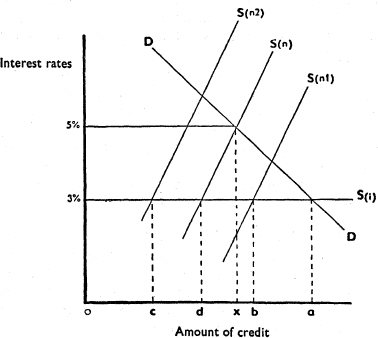
FIG. 20
As the result of the formation of such quasi-savings, huge amounts of bonds and other securities can regularly be placed with the public. As another result, the interest rates for some kinds of credit tend to fall below the discount rates. These phenomena never fail to amaze financial writers who, particularly when a war is financed by inflationary means, are apt to praise the strength of the national economy. In reality the phenomenon is simply the result of the power of inflation to create savings, because of people’s inability to grasp quickly the full implications of inflation.
Incidentally, quasi-savings will in the main not be accomplished by depositing new cash with banks, but through the immobilization of checking accounts, which later are used to pay for the securities.
When waiting turns into hurrying, the opposite phenomena take place. People now mobilize checking accounts or withdraw from the banks cash formerly deposited. They spend their quasi-savings, once hope for lower prices has given way to fear of higher prices. Graphically, curve S(nl) moves to the left to S(n2). As a result, the inflationary credits are increased by ca, instead of by only ab.
Following such quasi-dissaving, by which funds are withdrawn from capital and money markets, interest rates go up—as can indeed be observed in the latter phases of inflation, particularly of inflationary booms. The end of a boom is therefore not marked by over-saving, which would necessarily be accompanied by low interest rates. Contrary to Keynesian views, over-saving can therefore not explain why prosperity turns into depression.
Velocity of Money Turnover during Inflation
The initial waiting and later hurrying of buyers are reflected in people’s bank accounts by the later or earlier withdrawal of cash and the later or earlier disposal by check. The resulting monetary changes are often referred to as changes in the velocity of the money turnover. Many controversies created by this interpretation could be avoided by speaking—much more realistically—of changes in the quantity of money rather than in its velocity of turnover. If people withdraw cash from bank accounts in January which formerly was withdrawn only in February, then the quantity of money in the hands of the public in January is increased, but the individual banknote need not change hands more often than previously—say once a month. If, in January, people draw checks on accounts which formerly were immobilized until February as quasi-savings, the quantity of bank money is increased in January and that of quasi-savings accounts diminished; the checking accounts as such need not necessarily be turned over any quicker than previously. We can therefore interpret a premature turnover of cash or checking accounts as an increase, and a delayed turnover as a decrease, in the volume of money.
As mentioned earlier (p. 107), some people do not deposit with their banks the money not needed for the time being. If these people begin to wait, or indeed to save genuinely, the quantity of money in the hands of the public does not decrease, though it is temporarily withdrawn from circulation. Money does not disappear into the big death traps, the banks, but goes into the small death traps, the private hoards. And if these people hurry or dissave, the quantity of money in the hands of the public does not increase. It simply comes out of the private hoards. In these cases, therefore, one is justified in speaking of an increase and decrease in the velocity of money turnover. The single banknote if spent after one month instead of, as previously, two months, indeed changes hands twice as quickly as before. At the same time, the quantity of money remains the same. Inflation is as it were unofficial.
While the effects of unofficial and official inflation on the price level are the same, the effects on the supply of credit are quite different. If money is paid into the banks or checking accounts immobilized through quasi-saving, the lending capacity of the banks is increased, at least temporarily. If the money disappears into private hoards, no such effect follows. In the opposite case, if money is withdrawn from the banks through quasi-dissaving, the credit supply is curtailed. No such effect follows the reappearance of money out of private hoards.
In so far as waiting and hurrying alter the velocity of money turnover, they also account for a further well-known phenomenon observed during all great inflations: at first the price level increases more slowly than the quantity of money issued by the Central Banks—the official money inflation; in the later phases the price level increases more quickly.
Whereas money is in general dishoarded—and the velocity of money turnover thereby increased—in the later stages of inflation, the contrary may happen in the special cases of money and credit crises. If people begin to lose confidence in the banks, they fail to deposit the money temporarily not needed and keep it in their own safe instead. The creation of such private hoards has in the past often led to deflation. But this kind of deflation is most unlikely to occur again in the future. Governments, anxious to avoid money crises, are sure to replace the hoarded money in one way or the other.
Inventories during Waiting and Hurrying
Another feature of waiting is the decrease of inventories in the hands of consumers and some entrepreneurs. Consumers waiting with further buying must obviously continue to live, and to this end draw on their stocks. Some entrepreneurs waiting to replenish their inventories of raw materials and semi-finished goods may nevertheless continue to produce if they expect to sell their products; in order to do so, they must draw upon their inventories. Deposits with banks, shares and particularly government bonds will replace the former inventories among the assets of consumers and entrepreneurs.
In the subsequent hurrying period of inflation, the inventory situation is, of course, reversed. Inventories increase with the expectation of higher prices, until finally they are so swollen that they alone can account for the ensuing slump.
Credit Demand in Deflation is Enhanced by Waiting and Curtailed by Hurrying of Sellers
We speak of money deflation if banks and Central Banks restrict their lending so that bank money and currency are destroyed or withdrawn from circulation.
Deflation can be due either to reduced credit demand of entrepreneurs, or to a reduced or dearer credit supply by banks. In both cases demand and supply on the credit markets will balance with less than—or altogether without—the credits formerly created by banks.
The first stages of deflation may be characterized by a peculiar behavior of sellers—the counterpart to the behavior of many buyers observed during the early stages of inflation. Whereas, at the beginning of inflation, many buyers wait because they do not as yet believe in the permanency of the price rise, many sellers now wait because they are as yet not convinced that the lower prices are there to stay, or because they want to avoid deflation losses at all cost. At the same time, however, production in many fields continues as before—partly because producers, too, consider the price fall as only temporary or because they cannot or do not want to close down and dismiss their workers. This circumstance creates an additional demand for credits to carry inventories over to the next recovery period; in the German literature these were called Durchhaltekredite. This demand for carry-over credits counteracts the contraction of the volume of money and of credit.
The result for the price level will be that prices at first hardly fall at all, in spite of the contraction of regular credits. The latter are to some extent replaced by carry-over credits—the difference being that now goods no longer pass into the hands of those who in the normal course of events would have bought them for further processing, or as distributors and consumers, but remain in the hands of entrepreneurs at earlier production and trading stages.
On the credit markets interest rates hardly recede in spite of a decrease in the demand for regular credits. If deflation is due to dearer credit supply, interest rates will even go up. Should the banks, in order to protect their own liquidity, be unable or unwilling to grant carry-over credits, i.e. to replace regular by carry-over credits, supply on the credit markets may become so scarce as to give rise to a real credit crisis.
As deflation proceeds, entrepreneurs lose hope for a return of the old boom prices. They no longer wait with selling, they even begin to hurry—especially if high interest rates deter from carrying swollen inventories indefinitely. The demand for carry-over credits dwindles, interest rates fall, and so do prices on the commodity markets.
The tightness of credit at the beginning of deflation, due to the sellers waiting, may be accentuated by some buyers hurrying with their purchases for fear of rising prices. In the later stages of deflation, the waiting of buyers expecting a price fall may accentuate the easing of the credit situation brought about by the liquidation of carry-over credits.
The whole deflationary process may even start with a buyers’ strike. The ensuing demand for carry-over credits may be so strong that interest rates rise in spite of higher credit supply from quasi-saving.
Genuine Saving in Times of Inflation
Inflation causes not only quasi-saving through waiting, but also genuine saving.
To the extent to which inflation leads to higher employment and thereby higher aggregate income, savings obviously increase in absolute terms. From a higher national income more is saved, ceteris paribus.
But the savings rate, too, rises. It is true that in normal times an increase in total income does not increase society’s average savings rate. However, in times of inflation this happens—not because of the Keynesian psychological law, according to which an increase in the living standard leads to an increase in the savings rate, but because inflation leads to a redistribution of income in favor of higher, and at the expense of lower income groups.
The lower incomes of workers and employees are reduced in real terms because they rise slower than prices. The higher incomes of entrepreneurs remain unchanged in real terms because they sell their products at inflated prices. Similarly the owners of bonds and savings accounts, pensioners and so on, on the average less wealthy, suffer losses through inflation—whereas entrepreneurs, on the average richer, make profits if they have contracted debts in good money. Thus the poor become poorer, the rich richer. Since the rich generally save more than the poor, the result of the redistribution of income must be an increase in the savings rate—at least as long as the public’s inflation-consciousness does not destroy its propensity to save.
During deflation income is redistributed in favor of the lower, at the expense of the higher income groups. Falling prices mean that the real incomes of workers and employees—as long as they are still employed—grow; at the same time entrepreneurs generally suffer heavily. The savings rate falls.
But the spending habits of the population during inflation and deflation are probably much more affected by waiting and hurrying than by redistribution of income.
Multiplier Theory and Acceleration Principle
It has become customary to indulge in calculations of how much consumption expenditures will be induced by investment expenditures, and how much investment expenditures by consumption expenditures.
The effects of investment on consumption are dealt with by the multiplier theory, the effects of consumption on investments by the acceleration principle. In view of the great importance for theory and practice generally attributed to these concepts we shall examine them a little closer.
It is, of course, undeniable that investment and consumption are related. Every investment is so to speak eventually amortized into consumption, and every consumption is in the last instance the end product of investment. Nevertheless, the ratio of investment to consumption can vary, because it clearly depends on the length of the production detours. In an economy with longer average production detours a greater part of the product will, at any one moment, consist of capital goods than in an economy with shorter average production detours. Accordingly the amounts spent at the beginning of any production period on capital goods will be greater in the former than in the latter. This is illustrated by Figure 21.
The lengths of production detours are, however, not fixed once and for all. They are determined by the productivity of capital and the interest rate. These, therefore, determine in the last instance the ratio of investment expenditure to consumption expenditure.
If more is spent on consumption, entrepreneurs wishing to produce more consumer goods will, it is true, wish to acquire the capital goods necessary to produce the consumer goods in the same capitalistic way. Consumption induces investment, to use the customary expression. But the inducement can succeed only to the extent to which credit supply is elastic. If it is not elastic, entrepreneurs will have to produce the greater amount of consumer goods in a less capitalistic way. More consumption will not lead to more investment—contrary to the reasoning of the acceleration principle.
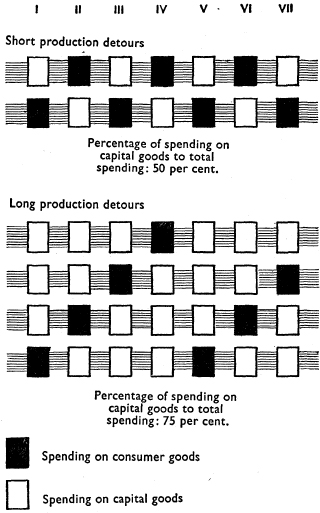
FIG. 21
If more is spent on investment, the incomes of those who have contributed to the production of the investment goods will rise. They will wish to spend more on consumption. But, again, they will be able to do so only if credit supply is elastic. Otherwise interest rates will rise until more is saved or less invested. More investment, so far as it can take place at all, will not lead to more but to less simultaneous consumption—contrary to the reasoning of the multiplier theory.
Thus the multiplying and accelerating effects—the stimulating effect of investment on consumption and of consumption on investment—can at best take place only to the extent that Central Banks fail to defend the monetary system against inflation and deflation.
Multiplier and acceleration theories appear, therefore, to be valid only in an economy in which credit supply is highly elastic owing to easy money policy. For an economy which avoids inflation and deflation it remains true that more spending on investment leads not to more, but to less spending on consumption; and that more spending on consumption leads not to more, but to less spending on investment.
Even for an economy with elastic money supply the concepts of multiplier and accelerator are subject to considerable objections, theoretical as well as practical.
The very designations of both theories are misleading. The acceleration principle expresses nothing the old term induced investment did not express better. Furthermore, an increase in consumption would involve accelerated, i.e. over-proportional, increase in the aggregate expenditure of one period only if all the required intermediate products were produced in that same production period. Not only the production marked black in Figure 21, but all preceding intermediate productions too, marked white, must take place simultaneously. Such an assumption is technically and analytically inadmissible. For both technical and logical reasons we must assume that, when consumption increases, production of capital goods starts in the first production period, but reaches later stages of maturity only in later periods. Tools can be produced only after steel is produced. Investments are, therefore, not accelerated, i.e. do not increase over-proportionately but only proportionately. The accelerator is really an additioner. Correct and self-evident is that the expectation of higher demand or prices for consumer goods will spread to intermediate goods. The accelerator is thus at best a generalizator of improved price or demand expectations. But whether these improvements lead via higher credits to a concentrated higher effective demand for labor, raw materials and intermediate goods depends—quite apart from the technical consideration mentioned—as with every expansion of production, on price-cost relationships and thus especially on the elasticities of capital and labor supply. If price-cost relationships have become favorable, production expands, but this is not achieved through the working of an accelerator; it is in accordance with the general principle that production expands if expected prices go up more than costs.
The designation multiplier theory would be correct only if investment expenditures multiplied consumption expenditure in the same production period—as indeed circular flow analysis sometimes seems to suggest. But the idea of a timeless multiplier working instantaneously is nonsensical, as is increasingly acknowledged. The further effects of increased investment spending can at best be felt in subsequent periods. But the combined increase of incomes of later, future periods cannot be regarded as the multiplication result of the increased income of one period, just as the combined income of several periods together cannot be regarded as the multiplication result of the income of one period. A single dose of investment, expenditure can, at best, add once for all a certain amount to the income of each period. It is not a multiplier but, again, an additioner—and an unreliable one at that. For practical purposes the designation multiplier has to be rejected because it leads to an enormous overrating of the beneficial effects of public investment. It may consciously or unconsciously have been chosen for this reason.
But there are more substantial objections. According to the older theories the amounts spent on investments and consumption in any future production period are dependent on all the data of the future, as well as on the psychological reactions of people to these data. Multiplier and acceleration types of analysis treat all these other data—under the heading propensity to consume or to invest—as given and constant or decreasing in the same proportion, and the amounts of original spending on investment and consumption as the variables of the system. This method concentrates attention quite unduly on these latter. In the dyanmic reality with which we are dealing when concerned with inflation and deflation problems, all propensities can have almost any strength or weakness. They change, furthermore, continually over time, in particular from one cyclical phase to another. And if, as a concession to reality, this is conceded then only the self-evident trivial statement remains that money received is sometimes spent and sometimes not.
Consumer and investment spending depend on many considerations other than whether entrepreneurs, through the additional spending of consumers, and consumers, through the additional spending of entrepreneurs, have received money. Life in an economy begins, so to speak, every day anew. If the price-cost relationships do not appear favorable, entrepreneurs will desist from buying services and capital goods regardless of whether consumers have previously spent money on consumer goods. And if consumers expect prices to fall, they will desist from buying consumer goods regardless of whether their incomes have risen or not. The correctness of this view was amply proved when in the first New Deal period the money spent by the government failed to create any additional demand, but simply disappeared in the banks.
It is the propensity to consume or to invest which in reality is the important variable of the system. The proper task for theory is to examine the changes and their reasons in this propensity rather than to treat it as given and constant, as the multiplier and acceleration theories do. Theory has to investigate whether and to what extent consumers spend in subsequent periods the purchasing power they have received through previous investment expenditure; and whether and to what extent entrepreneurs invest in subsequent periods what they have received through previous consumption spending.
Analytical work resting on multiplier and acceleration theories is guilty of a petitio principii. It presupposes precisely what really is in question: the spending in the future of money spent in the present. Such work is fundamentally no more than intellectual toying, neither necessary nor sufficient to solve the problems of a dynamic economy.
It is unnecessary to stress again that any accelerating or multiplying effects will be real only under the assumptions to be mentioned immediately. Under other conditions they will exhaust themselves in changes of the price level.
Compensating Reactions of Factors of Production
In everything said so far about the effects of inflation and deflation we have assumed that neither capitalists nor workers react by raising their demands correspondingly to the higher prices caused by inflation.
An analysis starting from this assumption is useful to clarify basic relationships. It also provides a correct description of what can happen during short transition periods. However, it is entirely misleading if used to describe the lasting effects of inflation and deflation. It is the chief mistake of the Keynesians to have taken the short-term transitory effects of inflation and deflation as basis for a general equilibrium theory.
The assumption that the demands of production factors remain stable in monetary terms even when the purchasing power of money alters, is unrealistic. It is hard to see why entrepreneurs, when engaging new workers, should take the changing price level into account, whereas on the other side the workers should not do likewise when offering their services. According to Keynes, it is just such a divergence that enables new workers to be employed. But labor leaders and their economic advisers are not as stupid as Keynes believes when he states that “the supply of labor is not a function of real wages.” It is difficult to understand why this statement, instead of being greeted with deserved derision, was until recently accepted as gospel truth.
What happens when the factors of production, by compensating reactions, adjust their monetary demands to the real changes in the value of money?
Compensating Reactions of Creditors
Suppose prices have risen by 2 per cent during the last period. As soon as creditors no longer expect a reaction of prices but rather a continuation of their upward trend, they will raise their demands for interest on capital by 2 per cent, so as to be compensated for the loss of purchasing power expected during the lending period. The supply curve of credits will move upward.
If Central Banks, too, now raise the discount rates by 2 per cent, further inflation will be prevented. Although entrepreneurs may still expect higher prices and thus additional profits, credits will have become more expensive to the extent of these expectations. The demand curve for credits moves up, but so will the supply curve, and credits will not increase.
But if, as usual, the Central Banks do not raise their discount rate in spite of mounting demand for credits, the money-creating banks will expand their lending to meet the increased inflationary demand. At the same time those private creditors who are inflation-conscious will recall outstanding loans in order to invest their money themselves in goods expected to protect against inflation losses. The supply of non-inflationary credit is thus curtailed and demand has to be increasingly satisfied through inflationary credits. Thus the compensating reactions of private capitalists lend new impetus to the inflation. Such was the situation, for instance, during the last phase of the great German inflation from about 1922 onward. Private creditors either went on strike or demanded exorbitant interest rates, whereas the Reichsbank, failing to grasp what was happening, stuck to its low discount rates. The runaway inflation of that period was chiefly the result of these circumstances.
Compensating Reactions of Labor
By far the most important compensating reactions are those of labor. They are apt to happen very fast. The supply schedule of labor generally rises immediately after any increase in the cost of living.
As a rule, therefore, the margin between costs and prices described above3 will fail to materialize. There will be no inducement to employ more labor. Employment and production will not increase, and inflation will spend itself entirely on higher prices and not on higher employment and production. This agrees exactly with the opinion of classical economists. According to their so-called quantity theory of money, after a brief transition period during which supply prices are adjusted to the increased monetary demand, a greater volume of money simply raises prices correspondingly.
These facts were quite clearly illustrated during the last phases of the German inflation in 1922–23. Labor and management agreed on sliding wage scales. Wages were automatically adjusted to any increase in the prices of goods. As a result employment no longer increased, even though prices rose faster and faster. Employment even decreased when labor finally succeeded in raising real wages, which had lagged behind the depreciation of money during the whole inflation period.
The so-called escalator clauses, common in many labor contracts nowadays in the United States, practically rule out any employment-increasing effects of inflation. Thus the Keynesian employment theory is no longer valid even in transition periods.
When dealing in Part IV with the special case of inflation and deflation called the business cycle, we shall encounter exceptions from the rules just exposed. In the early stages of recovery, for instance, prices hardly move up, and even if they do, wages often lag behind rising prices. But there is nothing more unrealistic than the Keynesian statement that, as a general rule, “labor acquiesces in a diminishing real wage.” Every union leader must consider such a statement as quite ridiculous.
Do Wage Increases Lead to Inflation?
It is often stated that higher wages enforced by trade unions lead to higher prices, and that this effect is cumulative when higher prices, in turn, lead to yet higher wages. If this were correct, union leaders rather than the Central Banks would indeed be responsible for the value of the currency. It is, however, correct only in very special conditions.
In general, wage increases lower the marginal productivity and yield of capital. They have, therefore, a deflationary effect—unless we assume that cost increases cause price increases.
Cost increases, as such, do not raise the prices of the products, because the increasing costs can be shifted on to the consumers only if money inflation has meanwhile progressed further. If entrepreneurs—though perhaps mistakenly—expect the higher costs to be shiftable on to the consumers, they will indeed anticipate higher prices for the future. But then it is this belief, and not the wage increase as such, that prevents deflation or even leads to further inflation.
Wage Rigidities Downward
Whereas wages are generally immediately, or at least quickly, adjusted upward, they are these days indeed very rigid downward. In times of depressions, therefore, the Keynesian thesis according to which labor sticks to its money wages in spite of a changing price level does hold. Wage rigidities downward explain why unemployment increases in times of deflation and why it was so persistent during the Great Depression.
Wage Increases during Deflation Increase Unemployment. The Purchasing Power Theory
If wage rigidity downward during deflation creates unemployment, wage increases must do so even more. The contention of many labor leaders and their economic advisers that in depressions, when costs are in any case too high in terms of prices, wages should be raised in order to sustain demand is, therefore, nonsensical. It is nothing else but a replica of the often refuted purchasing power theory of which Professor Hansen, before he became a Hansenian, stated:
It is, therefore, not surprising that the theory should become widespread that higher wages are the cure for the restricted market and declining price level of the last decade. This theory is accepted, one might almost say, by nearly every one in the United States, not only by trade union leaders but also by leading business men, politicians, and journalistic economists. During the 1930 depression leaders of American public opinion in all walks of life were constantly urging that the surest basis for a revival of prosperity was a maintenance of wages or even an increase in wages. This state of affairs indicates a confusion of thought for which, it must be admitted, professional economists are in part to blame.4
You cannot raise the general level of prices by the simple process of raising wages. And it is an amazing fact that professional American economists have not come forward to point out the fallacy that lurks here.5
We shall not succeed in solving the depression through the soothing and agreeable device of inflation. We shall come out of it only through hard work, and readjustments that are painful. There is no other alternative.6
As the purchasing power theory has again come to be honored, although under another heading and in somewhat refined form, the following may be said.
It can be conceded that wage increases can, but do not necessarily, increase aggregate demand by shifting income from those of low propensity to consume (entrepreneurs, capitalists) to those of high propensity to consume. This is why the purchasing power theory—by which, incidentally, every wage increase could be rationalized—has always been popular with laymen, and not only with those of socialist leaning. The argument overlooks, however, the elementary fact—a typically circular analytical error—that income must be earned before it is either spent or saved. First comes the entrepreneur’s decision to create income by engaging production factors, then comes the spending or saving. Now entrepreneurs as a rule expect the prevailing price level to stay. And under the prevailing price level wage increases must seem intolerable and lead to curtailing production. For the assumption of a perfectly or almost perfectly inelastic demand curve for labor is entirely unrealistic. Entrepreneurs will not pay any price for a given amount of work. Only for additional work are additional payments offered, even if only on a decreasing scale. This is, incidentally, why the recipe of the purchasing power theoreticians to raise wages during depressions—if not enforced by governments—is never carried out in practice. The individual entrepreneur does not feel able to grant higher wages and just does not do it.
But suppose, for argument’s sake, the entrepreneurs were Keynesians and would anticipate that products of the past period—and also of the current period—would meet a demand or price increase resulting from the shift of income from the savers to the spenders. Even then they would curtail and not expand production. For the increase in demand or prices must always be smaller than the increase in costs. This follows from the simple fact that not all the additional costs become additional spent income. Even entrepreneurs and capitalists—whose income declines through the wage increases—had spent a part of what is now taken away from them.
Only if we assume that entrepreneurs pay higher wages immediately but curtail production only after some time could prices of or a demand for the products of the last period increase. But quite apart from the fact that it seems quite arbitrary to assume that entrepreneurs would react promptly to price increases but not to cost increases, entrepreneurs would shortly after realize that price increases are not sufficient to cover cost increases and would curtail production.
The same argumentation leads, incidentally, to the conclusion that even wage lowering in order to adjust costs to sunken prices would not be so self-defeating as Keynes expressly states and his followers repeat. With the prevailing price level in mind, entrepreneurs will expand production because of the cost saving through wage lowering. But let us again assume they were Keynesians and would expect the aggregate demand to sink under the impact of the shift of income from the spenders to the savers. Again they would have to realize, too, that aggregate demand would sink less than aggregate costs. For at least a part of the new income of the savers would surely be spent. Thus entrepreneurs would expand production.
Again, only if we assume, as is often done, that entrepreneurs would immediately lower wages but expand production only with substantial lags, could a deflationary effect on prices and demand for the products of the last period be expected. But again, quite apart from the arbitrariness of the assumption, entrepreneurs would react shortly after to the still-improved price-cost relation and expand production.
But this whole reasoning, assuming that entrepreneurs have either perfect foresight or react to price movements which are necessarily transitory, is of course entirely unrealistic. All depends on what the entrepreneurs expect the effect of wage lowering to be on the demand and price situation—which again depends on whether they believe that production in further production periods, which produces the income to buy the products of the current period, will increase sufficiently so that the addition to total income will at least compensate the demand deficit resulting from the income shifts from the spenders to the savers. Whether entrepreneurs on the average understand the economics involved or not, they will undoubtedly take an optimistic view so that even the transitory effects on entrepreneur psychology envisaged by Keynesians will not materialize. If tomorrow the rumor were spread at the United States stock and commodity markets that unions had agreed to a general lowering of wages by 10 or 20 per cent, a huge buying spree on all markets and a rush to invest would set in, in which everybody would participate except inveterate Keynesians. And buyers and investors, contrary to Keynes’ contention, would not be disappointed. Nor would even the expectation of repeated wage lowering necessarily shake the optimism of entrepreneurs, contrary to a widely held belief. Wage decreases are by no means identical with price decreases. As a rule wage decreases are inflationary, not deflationary.
It is correct that, under certain conditions, the price level should be supported during depressions. But wage support is not only price support but also—and even more—cost support, and is therefore entirely contra-indicated as a means of price support.
The End of Inflation
Inflation stops when the Central Banks raise their discount rate to a level at which the inflation profits expected by entrepreneurs appear compensated by the higher cost of credit.
Inflation generally ends not with stabilization but with deflation of the monetary system. The so-called stabilization crises are really deflation crises. When prices no longer rise, hopes for higher prices, the characteristics of the later stages of inflation, dwindle and the demand for credit declines. If Central Banks were smart enough to lower their discount rates at once and to such an extent that the decrease in expected profits appeared to be immediately compensated, deflation would not be induced from the money side. The problem of swollen inventories would, however, still remain. As they can be liquidated only at lower prices a deflationary process must start. Therefore, monetary and credit policy does not, in practice, lead to stabilization of the economy. It can, at best, mitigate fluctuations.
Inflations can end for other reasons, too. The granting of inflationary credits to a government, for instance for war financing, will obviously stop when—but only when—the government succeeds in balancing the budget. If it does not succeed, this kind of inflation often ends with the public no longer accepting money as payment. Such repudiation of money leads to total destruction of the value of money.
A private inflation, i.e. an inflation to finance credits to private entrepreneurs, will one day stop even if the supply of credits is not curtailed or made more expensive by the banks. Demand for private credits is never unlimited. One day inflation loses its stimulating effects. Credit demand no longer expands, and the vicious circle of inflation is interrupted.
Every deflation, too, will end at some moment for similar reasons. We shall later deal in detail with the mechanism of the so-called upper and lower turning points of business cycles.
Who Gains and Who Loses by Inflation?
Inflation is in the last analysis a sort of tax—and the most unjust of all—on income and capital, levied on some members of the economy in order to shift purchasing power to others. In the case of inflation for governmental purposes purchasing power is shifted to the government, in the case of private inflation to some entrepreneurs.
These shifts in purchasing power succeed because, owing to the money illusion, some members of the community fail to recognize the change in the real value of money or cannot defend themselves against such a change. Therefore, inflation ends when the money illusion ceases to work. When all the creditors—including the Central Banks—raise their demands for interest, when all wage earners raise their demands for wages, and when all owners of real estate raise their demands for rent in accordance with the existing or expected inflation, then there is no further inducement for additional credit demand.
Whether an individual or a group profits or loses by inflation depends on the relative ability of individuals and groups to defend themselves against the inflation tax. This can never be determined in advance, nor once and for all. The following will, however, be the rule.
The Banks
At first sight, banks and Central Banks would appear as the inflation profiteers par excellence. They receive interest for loans granted to new debtors with bank money created by themselves and on which they pay no, or only very little, interest.
These profits are, however, nominal rather than real. They merely compensate for the money depreciation that is taking place. The assets of the banks grow roughly in proportion to the money and credit inflation, but so does the price level.
In real terms, banks not only fail to profit but even generally lose. Investment of the banks’ own capital is generally not inflation-proof. It consists in the main of loans to clients, who pay interest and repay capital in depreciated money. In cases of governmental inflations the banks are, moreover, generally loaded with government bonds, so that they can lose also through bankruptcy of the government. The Hitler inflation, for instance, ended with the currency reform of 1948, which treated banks so badly that many of them suffered considerable capital losses.
Earners of Wages, Salaries and Fixed Incomes
All those receiving money incomes suffer from inflation. However, the losses of the various groups and individuals differ widely. Those able to make compensating reactions quickly will be hurt least, those able to react only with a substantial lag or not at all will be hurt most. At one end of the scale is organized labor; at the other end the rentiers, whose income derives from pensions, fixed interest securities, especially government bonds, savings accounts and insurances.
Let us suppose that these groups finally succeed in adjusting their incomes to the money depreciation. If, in this case, the banks continued to grant credits at the same low interest rates, inflation would proceed but employment would no longer increase. The inflation tax would still be levied, for prices continue to rise between the receipt and the spending of incomes.
During the last stages of the great German inflation (1922–23) entrepreneurs sometimes supplemented wages already paid with payments compensating the loss in purchasing power between receipt and spending of the wage. Such procedure, if carried through generally, must lead to complete disruption of the currency. If everybody insists on being compensated through new inflation for the effects of simultaneous inflation, then obviously a vicious circle is set in motion which soon raises prices infinitely high.
Entrepreneurs
Entrepreneurs having paid their production costs with uninflated money, but selling their products for inflated money, reap inflation profits. These are windfall profits (see p. 129 above) as the new prices were not, on the average, expected by entrepreneurs. Had the higher prices been generally expected, prices would have risen earlier, and not only following the money and credit expansion of the next period.
These windfall profits, however, are not necessarily profits in real terms. They may even represent real losses—namely if inflation makes further progress between receipt and respending of the money.
As long as labor does not achieve compensations for the fall of real wages, entrepreneurs profit from the increased margin between costs and present prices. Strictly speaking, these are not really profits; rather they represent additional earnings on capital due to the increased employment of “really” cheaper labor and the resulting higher marginal productivity of capital.
Monopolists will generally be able to adjust their monopoly rents sooner or later—mostly very soon—to the decreasing purchasing power of money. Enterprises of monopolistic or quasi-monopolistic character as a rule enjoy perfect protection from inflation losses, at least as long as price controls or other regulations do not establish ceiling prices for their products or services.
Debtors and Creditors
The situation becomes even more complicated by the fact that most entrepreneurs do not employ only their own capital, but also loan capital or credits. Unless the loan contracts provide for changes in the value of money during the lending period—and this is hardly ever the case—inflation creates real profits for the debtors and real losses for the creditors. If loans are repaid with depreciated money, less real purchasing power is returned to the creditor than he lent. The debtor, on the other hand, needs to sell less products in order to repay debts remaining nominally unchanged.
Such a redistribution of wealth through inflation can, of course, only happen to the extent that creditors are unable or unwilling to protect themselves. Inability to do so is mostly due to long-term contracts; unwillingness often to ignorance.
In the last phase of the great German inflation many creditors sought protection through so-called constant-value clauses (Wertbeständigkeits-Klauseln) in loan contracts. They stipulated that interest should be paid and capital repaid according to the diminished purchasing power of money as measured by some price index.
Deflation Profits and Losses
Deflation creates exactly opposite results. Stable money incomes grow in real terms. Debtors suffer losses while money creditors make profits at the expense of the former. The effects need not be described in detail. They follow from what has been said about inflation profits and losses.
Share Prices in Inflation
Share prices fluctuate around a level determined by dividends on the one hand, and by interest rates on the other. In the short run they are determined not so much by current as by expectations of future dividends. We shall return to this in Part V. Here we are concerned with the development of share prices in the long run.
Inflation must strongly influence share prices, since it influences both earnings and interest rates.
Profits due to Lagging Production Costs
We have just mentioned the profits of entrepreneurs through lagging production costs, particularly wages. Such profits are temporary by nature and can, therefore, influence share prices only temporarily.
Companies which are prevented by law or regulation from adjusting the prices of their products to monetary changes, can reap higher earnings only if and when the price ceilings are abolished. Therefore, the shares of public utilities with fixed tariffs do not rise during inflation except in special circumstances, and then often very late.
Windfall Profits and Share Prices
The windfall profits mentioned above are much more important for share price formation.
These windfall profits protect capital in times of inflation. They result in shares of many companies becoming perfect inflation hedges.
The rise in share prices due to windfall profits is not expected by the average investor, just as the windfall profits themselves are not expected. Otherwise share prices would be the same at the beginning and at the end of inflation.
Corporate earnings consist at least partly of monopoly rents, in general quickly adjustable to the declining purchasing power of money. This is another reason for stock market booms during inflation.
As a general rule, shares will protect the better against inflation the more the flexibility of prices of the products exceeds the flexibility of the compensation of the production factors.
The behavior of common shares depends, of course, also on whether and to what extent the individual companies are indebted to banks or have issued bonds or preferred shares. Since debtors benefit by inflation, bonds, bank credits, and preferred shares give so-called leverage to earnings and thus also to the price of the common shares.
Interest Rates and Share Prices
If the inflation is due to a fall in discount and interest rates, the rates at which dividends and the interests on long-term bonds are capitalized are altered. The prices of shares and bonds will move up accordingly.
However, even if inflation is due to increased credit demand, and interest rates therefore do not fall, inflation influences stock prices decisively for the following reason.
Part of the quasi-savings accumulating at the beginning of inflation are used to replace the inflationary credits granted by the banks. This not only dampens inflation, as described above, but creates also the phenomenon that at the beginning of inflationary war financing only a small part of government bonds remains in the hands of the banks while the greater part is taken up by the public.
However, only part of the quasi-savings are invested in government bonds. As the public is used to keeping a certain percentage of its funds liquid, interest rates on the free money markets begin to decline.
Soon the market for bonds becomes extremely firm. First-class corporate bonds, in less ample supply than governmental issues, sometimes rise above government bonds.
As the public usually wishes to invest part of its funds, increased through inflation, in shares, the demand for them increases. The interest rates at which dividends are capitalized decline. Share prices go up. Thus an extremely high demand for capital by the government is paradoxically accompanied by a stock market boom, and this even if earnings do not increase—for instance because of high war taxation.
Idle Money Boom
In times of inflation governments often resort to rationing of goods or to maximum prices. If this happens, the effects of voluntary waiting are reinforced by involuntary waiting. Rationing and price ceilings prevent part of the money in the hands of the public from reaching the markets. The funds so saved are spent by the public on the remaining free markets, mostly the security markets. A strong stock exchange boom, which can be called the idle money boom, develops.
When price ceilings and rationing are abolished, the public withdraws the funds invested on the stock markets. Although the pent-up demand for goods stimulates the economy, the stock exchange experiences what we could call an active money depression. The end of the war boom on the New York Stock Exchange in 1946 characteristically coincided with the end of rationing and price controls.
Hurrying and the Stock Market
But even when price ceilings and rationing are not first introduced and later abolished, stock markets are strongly influenced by the behavior of buyers. As soon as waiting turns into hurrying in the further course of inflation, the quasi-savings created through waiting are withdrawn from the capital markets in order to be spent on the commodity markets. Interest rates on the free market must, therefore, have a tendency to rise, bond and share prices to fall.
If now the Central Banks maintain their discount rate—as they regularly do if the government needs inflationary credits—treasury and commercial bills formerly bought by the banks and the public are offered to the Central Banks; as they have to buy them with newly created money, inflation is further stimulated. Money markets become easier again and stock prices rise sharply, unless capital flight is legal or possible. In this case, share prices lag behind prices of foreign currencies.
The third phase of the great German inflation—from about 1922 on—clearly showed the combined effect of buyers’ hurrying and low discount rates maintained in flagrant misjudgment of the situation. The stock market soared in what was called at that time a catastrophe boom, and exchange rates reached astronomic heights.
Stock Prices in Deflation
Declining corporate earnings during deflation depress stock prices, just as their rising during inflation pushed them up.
But deflation influences stock markets also from the money side. If deflation is induced by higher discount rates, the capitalization factor for dividends and interests on bonds alters; bond and stock prices fall further. If deflation is induced by a diminishing credit demand, interest rates decline, thus supporting bond and share prices. Should a demand for carry-over credits develop, interest rates will rise more in the first case, and decline less in the second.
Money and capital markets can become so tight through entrepreneurs’ demand for carry-over credits that a real stock exchange crash may ensue. Bonds and shares are dumped on the market to satisfy their urgent credit demand.
Later the demand for these credits dwindles because entrepreneurs begin to hurry with the liquidation of inventories. This, together with the quasi-savings of consumers, alleviates the situation on the credit markets. Money becomes easy. First-class bonds and sometimes also certain shares begin to move up under the impact of accumulating idle funds and low interest rates—much to the astonishment of the public expecting still lower prices because “business is still so bad.”

