
The Case For Gold: A Minority Report of the U.S. Gold Commission
V. Real Money: The Case for the Gold Standard
V. Real Money: The Case For the Gold Standard
In chapters two and three, it was made clear that the economic shortcomings of the past were due to abuse of the gold standard, not to the standard itself. Men and governments have failed in the past; gold has not. The rule of law has been challenged by the rule of men throughout history, and this will continue. But the rule of law and the sovereignty of the people are much more likely to prevail with gold than with paper. For many economic reasons it is critical that the rule of law and gold win the great debate on monetary policy.
Low Interest Rates
The most pressing problem today for consumers and businessmen is high interest rates. Even those who do not understand the process of inflation easily recognize the great harm brought to an economy through high interest rates. The real interest rate, usually three percent to 5 percent, the cost of using another’s capital, remains relatively stable. The inflationary premium charged in an age of inflation changes inversely to the confidence the market places in the monetary authorities and the spending habits of Congress. Contrary to popular belief, this premium is not equivalent to the current rate of price increases. This is certainly a factor, but only one of many in determining the anticipation of the future purchasing power of the currency. If prices are accelerating at an annual rate of 10 percent, the inflation premium can still be 15 percent if the market anticipates a more rapid rate of currency depreciation in the future. The further a nation is down the road of inflationary policies the more difficult it is to reverse the expectations of more inflation by the people. In the early stages of inflation, more people are deceived and interest rates are actually lower than one would project if only computer analysis were used. In the later stages the rates, some claim, “are higher than they should be.” This is what we are hearing today.
The inflationary premium is completely removed if a true gold standard exists. There would be no need to anticipate a depreciation of the currency, for the record is clear that gold maintains or increases its purchasing power. This ought not to be confused with sharp fluctuations in dollar-denominated prices of gold in a period of dollar speculation. The problem under those circumstances is the inflationary policies of the government, not the natural variation in the purchasing power of gold. Dr. Roy Jastram, in his book The Golden Constant, has demonstrated quite clearly that gold maintains its value over both long and short periods of time.
With the classical gold standard, long-term interest rates were in the range of three to four percent. There is no reason to believe that these same rates or lower rates would not occur with a modern gold standard. The economic benefit of low rates of interest is obvious to every American citizen. Accelerated real economic growth would result from such interest rates, and it cannot be achieved apart from these low rates.
Increased Savings
When a currency sustains steady and prolonged depreciation, as the dollar has for decades, the incentive to save is logically decreased. Savings by American citizens have been one of the lowest in the world. If the dollar were guaranteed not to lose any value, and three percent interest were paid on savings, as under a gold standard, a high savings rate would be quickly achieved. Getting $1.03 of purchasing power after one year for every dollar saved is much better than getting 94 cents, as happens if $1 is saved in a conventional savings account today. A nine-percent differential provides a real incentive to save under a gold standard and a strong disincentive under an irredeemable paper standard. The benefits of a gold standard for savings—the source of capital in a growing economy—should be obvious to all doubters. One reason it is hard to accept is that the marketplace—the people and voluntary exchange—is compatible with the gold standard, while government management and coercion are relied on with a paper standard. We as a nation have grown to mistrust and misunderstand a free system and have become dependent upon and misled by the money managers and central planners found in all interventionistic economies.
Revival of Long-Term Financing
Under the gold standard, bonds were sold for 100 years at four to five percent interest. Today the long-term bond market is moribund. Mortgages for houses are so costly that few Americans can qualify. With lower interest rates, increased savings, and trust that the money will maintain its value, the long-term financial markets will be revitalized—all without government subsidies or temporary government programs. Reviving the economy without restoring a sound currency is a dream. Only with a currency that is guaranteed not to depreciate will we ever be able to have once again low long-term rates of interest.
Debt Held in Check
During the time we were on a gold standard federal deficits were very small or nonexistent. Money that the government did not have, it could not spend nor could it create. Taxing the people the full amount for extravagant expenditures would prove too unpopular and a liability in the next election.
Justifiably, the people would rebel against such an outrage. Under the gold standard, inflation for the purpose of monetizing debt is prohibited, thus holding government size and power in check and preventing significant deficits from occurring. The gold standard is the enemy of big government. In time of war, in particular those wars unpopular with the people, governments suspend the beneficial restraints placed on the politicians in order to inflate the currency to finance the deficit. Strict adherence to the gold standard would prompt a balanced budget, yet it would still allow for “legitimate” borrowing when the people were willing to loan to the government for popular struggles. This would be a good test of the wisdom of the government’s policy.
Finally, the inflationary climate has encouraged huge deficits to be run up by governments at all levels, as well as by consumers and corporations. The unbelievably large federal contingent liabilities of over $11 trillion are a result of inflationary policies, pervasive government planning, and unwise tax policies.
Full Employment
In a growing economy, labor is in demand. In a recession or depression, unemployment apparently beyond everyone’s control plagues the nation. The unemployment is caused by the correction that the market must make for the misdirection of investment brought on by government inflation and artificial wage levels mandated by “full employment” policies. Full employment occurs when maximum economic growth is achieved with a sound monetary system and wages are allowed to be determined by the marketplace.
Some would suggest that at times those rates are too low and must be raised by law. This can be done only at the expense of someone else losing a job to pay another a higher wage than deserved. The forced increases in wage benefits increase corporate debt and contribute to their need for more inflationary credit to help keep them afloat. Although only government can literally inflate, higher-than-market wages in certain businesses prompt the accommodation of monetary policy to keep these companies going, Chrysler Corporation being a prime example. High wages contributed to Chrysler’s financial plight and government-guaranteed loans (inflation) were used to “solve” the problem. It’s well to remember that working for $8 an hour is superior to having a wage of $16 an hour but no job. For awhile the artificially high wage seems to be beneficial, but the unemployment and the recession that eventually come make the program a dangerous one. For years it was believed that “inflation” stimulated the economy and lowered unemployment rates. But in the later stages of inflation its ill effects are felt, and unemployment increases while real wages fall. More inflation and wage controls to keep wages high will make the problem significantly worse and only raise the unemployment rates. Only a sound currency and a market determination of wages can solve this most explosive social problem of ever-increasing unemployment.
Economic Growth Enhanced
The record for real economic growth while we were on a gold standard surpasses the growth we have experienced during the past 10 years. Current economic statistics show the conditions worsening with no end to the crisis in sight. Only with a gold standard will we see revitalization of a productive economic activity.
The “Austrian” economists, and in particular Ludwig von Mises, have demonstrated clearly that the business cycle is a result of unwise monetary policy (frequently compounded by other unwise government policies such as wage controls and protectionist legislation). The business boom results from periods of monetary growth; the recession results from the restraints that are eventually placed on this money growth, either by the government or the market. As government increases the money supply, false signals are sent to the market, causing lower than market interest rates, easy access to investment funds and, therefore, a misdirection of investment. This misdirection must later be corrected by market forces. This whole process is aggravated by massive disruption in the market direction of investment by government guaranteeing hundreds of billions of dollars of loans, which prompts more monetary growth. Government becomes a direct participant in credit allocation in an inflationary economy. Although during all stages and in isolated cases “benefits” are demonstrated, the overall economic harm done by inflation and malinvestment is overwhelming. We are seeing those results all around us today.
Money Growth Not Necessary
Advocates of discretionary and monetarist monetary policies claim that money growth is needed to “accommodate” economic growth.Economic growth is not dependent on money growth. Economic growth comes from productive efforts which are encouraged by savings, low interest rates, reliable currency, and minimal taxes. Attempting to control and stimulate economic growth with monetary growth does the opposite; it destroys the environment required for real growth to occur.
With the gold standard and the free market, investments are strictly made by enterprising individuals eager to make a profit. Those done carefully and prudently are encouraged. Successful investments bring rewards, and mistakes bring penalties to the investors. In contrast, a government-directed economy, backed up by unlimited supplies of paper money and fabricated credit, prompts the bailing out of unsuccessful enterprises and promotes investments for political, not economic, reasons. It is inevitable that the system of inflation and government-directed investment will fail.
With a gold standard the money supply would probably increase on an average of two percent per year. If the growth is smaller or larger, prices will adjust, posing no limitation on economic growth due to a “shortage” of capital. With the gold standard, confidence in the monetary unit would exist, and credit extended from one business to another, to consumers and purchasers, would be greatly encouraged. Information on the credit needs of the market would be available immediately, in contrast to the late information the Federal Reserve always receives. (The Federal Reserve never planned to increase the money supply at a rate of 19 percent in January 1982—it was only able to react to it after the fact.) Under a real gold standard, “controlling” the money supply is irrelevant as long as the market—an absolutely free pricing mechanism—is allowed to adjust the perceived value of gold, with no wage or price controls of any sort instituted.
Price “Stability”
Prices are never rigid in a free market. A gold standard permits price adjustments to accommodate the flow of gold into and out of a country as well as to regulate new production of gold. In contrast to popular belief, the goal of stable—that is, rigid—price levels as proclaimed by paper money managers is not the goal of the gold standard. The irony, however, is that the goal of rigid prices set by the paper money managers is completely elusive, but a gold standard, in which the goal is honesty and freedom and flexibility of prices, achieves significant price “stability.”
Economic Calculation
A precisely defined unit of account by weight, an ounce of gold for instance, provides a needed objective measurement to allow reasonable economic calculations. Under socialism, economic calculation is impossible. Without a gold standard, economic calculation is extremely difficult. Without a precise unit of account, sound economic planning becomes practically impossible, resulting in only speculative ventures and barter. Having a unit of account that has no definition or one that changes continually produces a situation equivalent to a carpenter using a yardstick that on an hourly basis changes the number of inches it contains. It is easy to see how foolish it would be to have any other unit of measurement changing in definition on a constant basis, yet many believe that a whole nation’s economy can operate with a monetary system in which the “dollar” has no definition and its measurement and value depend on politicians and bureaucrats.
Trade is enhanced domestically and internationally when a precise unit of account is used. The failure of the Confederation was due principally to the absence of a unit of account that all the colonies could use to facilitate exchange. This problem was solved when the Constitutional Convention precisely defined the dollar. The chaotic conditions that are developing today will only be solved when we once again accept a sound monetary system.
Internationally, all payments with the gold standard could be made by the actual transferring of gold. Such a policy would limit the ability of nations to export their inflation. The decrease in the gold supply of an importing nation would prompt prices to drop, allowing for more competitive prices and more competition in world markets. The key to Third World economic success is not their gold supply (or imported inflation in terms of Eurodollars) but whether or not they can work and produce a product that is exportable. This is dependent on the degree of economic freedom that the people have and their right to own property. The policy that guarantees a continuation of Third-World starvation and poverty is the present policy of continued worldwide inflation and centrally controlled economies.
Economic Limitations of Gold
The economic advantages of the gold standard are many and compelling. However, it is important that one does not expect from the gold standard something that cannot be achieved. The errors of a government-planned economy cannot be cancelled out by instituting a gold standard alone. Abusive tax policies must be changed to allow an economy to thrive. And although sound money goes a long way toward protecting a worker’s real income, it will not overcome bad labor laws.
Gold is used as money in a free market because the people throughout history have chosen gold. Although historically a free market means a gold standard, a gold standard by itself will not ensure a free market. When a market economy is in place, a gold standard holds in check the ability of the government officials to expand their power.
Some claim that a gold standard cannot be put into place until big government is brought under control and the budget is balanced; they further claim that it then becomes unnecessary. It is necessary to balance the budget and institute a gold standard together. The discipline and determination required for one mandates the other. If government is to be limited in size, the budget balanced and the market free, gold will be a necessary adjunct. It will give assurance that the size and scope of government will be held in check. If government is to continue running the economy and accumulating massive deficits, inflationary monetary policy will persist. A gold standard cannot exist in a vacuum; it must be part of a broader freedom philosophy. When we as a nation reject political control of the economy and the money, the gold standard will return in a modern version—far surpassing all previous attempts at establishing sound money. Until then, as we opt for more and more ad hoc “solutions” to the government-created problems, freedom will be further diminished, the economy will deteriorate further, and inflation will accelerate. Gold must be allowed to perform its vital service in building a healthy economy and restraining the tendency of all governments to become large and oppressive.
Common Objections to Gold
In any debate about the gold standard, certain objections are repeatedly raised by opponents of monetary freedom, even though those objections have been refuted many times before. Some of these objections are:
- There is not enough gold;
- The Soviet Union and South Africa, since they are the principal producers of gold, would benefit from our creation of a gold standard;
- The gold standard causes panics and crashes;
- The gold standard causes inflation;
- Gold is subject to undesirable speculative influences.
The first objection, there isn’t enough gold, is based upon a misunderstanding of a gold standard. It assumes that the present exchange ratio (or a lower ratio) between a weight of gold and a greenback is the exchange ratio that must prevail in a gold standard. Such obviously is not the case. Doubling the exchange ratio, for example, doubles the money supply. Lower prices under a gold standard eliminate the necessity for such large sums. One can buy a suit that costs 400 paper dollars with 20 gold dollars.
In 1979, there were a total of 35,000 metric tons of gold in central banks and non-Communist government treasuries alone. The United States government, officially holding 264 million ounces (8,227 tons), owns about one-fourth of that total. The best estimate on the total amount of gold in the world is three billion ounces, meaning that about one-third of the world’s gold is held by governments and central banks, and two-thirds by private persons. Far from being a dearth of gold, there are enormous amounts in existence. Gold, unlike most commodities, remains in existence. It is not burned or consumed, and the amounts actually lost are insignificant when compared to the amounts now in public and private possession.
The second objection, concerning the Soviet Union and South Africa, is equally groundless. These nations, as the world’s largest producers of gold, have profited handsomely from the massive increase in gold prices in the past 10 years. Such increases do not occur under a gold standard.
Recently a newsmagazine reported that “the Soviet Union holds an estimated 60 million ounces of gold and has unmined reserves of perhaps 250 million ounces more. At today’s prices that would give the Soviets a $146 billion stranglehold on western economies.” But let us put these figures in perspective. Below is a table showing the gold holdings of major central banks.
Official Gold Holdings
September 30, 1979
(tons)
| United States | 8,227 |
| Canada | 657 |
| Austria | 657 |
| Belgium | 1,063 |
| France | 2,546 |
| German Federal Republic | 2,961 |
| Italy | 2,074 |
| Japan | 754 |
| Netherlands | 1,367 |
| Portugal | 689 |
| South Africa | 374 |
| Switzerland | 2,590 |
| U.K. | 584 |
| OPEC | 1,207 |
| Other Asia | 607 |
| Other Europe | 1,209 |
| Other Middle East | 461 |
| Other Western Hemisphere | 654 |
| Rest of World | 320 |
| Unspecified | 113 |
| Total | 29,110 |
| IMF | 3,217 |
| European Monetary | |
| Cooperation Fund | 2,664 |
This table, taken from the Annual Bullion Review 1980 of Samuel Montagu & Co., is based on IMF statistics.
The Soviet Union’s alleged 60 million ounces is less than 1,900 tons, less than one-fourth of the U.S. official gold holdings. Even the alleged 250 million ounces of “unmined reserves” are less than the United States has in Fort Knox and our other bullion depositories.
Consolidated Gold Fields Ltd. of London has estimated the net outflow of gold from the Communist empire:
| Year | Net Outflow (tons) | |
| 1970 | –3 | |
| 1971 | 54 | |
| 1972 | 213 | |
| 1973 | 275 | |
| 1974 | 220 | |
| 1975 | 149 | |
| 1976 | 412 | |
| 1977 | 401 | |
| 1978 | 410 | |
| 1979 | 199 | |
| 1980 | 90 |
In 1976, the Soviets exported 412 tons, 1.2 percent of the governmental holdings of the non-Communist world. Assuming they could export at this rate continuously—a very doubtful assumption—it would take them almost a century just to match current official holdings. If one includes private holdings, the percentage drops to about one-half of one percent, and the time required extends to more than two centuries. The fear of the Soviet Union and South Africa either dumping or withholding gold and thereby wrecking a gold standard by altering significantly the purchasing power of gold is baseless. The only reasons sales by such governments now influence the market is that official holdings are immobilized and the value of the paper dollar fluctuates violently. Were we to institute a gold standard, those holdings would once again enter the market. We should stop giving such windfalls to the Soviets and South Africans as they have enjoyed during the last 10 years. The real fear should be the massive increase in the money supply caused by the Federal Reserve in the last 10 years and the probability of still further massive inflation. The red herring of external shock destroying a gold standard is designed to distract one’s attention from the threat of internal shock caused by the Federal Reserve.
The third objection, that the gold standard causes panics and crashes, is also false. The extensive examination of the monetary history of the United States during the 19th century demonstrated that it was not the gold standard, but government intervention in the banking systems, that caused the problems. The legal prohibition of branch and interstate banking prevented the prompt and convenient clearing of notes issued by those banks. Frequent suspensions of specie payments were special privileges extended to the banks by the government. Fractional reserves, wildcat banking, the National Banking System, and the issuance of greenbacks all contributed to the instability experienced during the 19th century.
But even with these interventions, as long as the dollar was defined as a weight of gold, the benevolent influences of the gold standard were felt. Chapter two of the Commission’s report indicates that the problems of the 19th century were due to abuses and lapses of the gold standard, not the standard itself. Victor Zarnowitz has found evidence that the so-called recessions of 1845, 1869, 1887, and 1899 were mere pauses in growth.1 Jeffrey Sachs categorized recessions since 1893 by their severity. He found only one strong and one moderate contraction in the period of 1893-1913. Since the institution of the Federal Reserve, however, we have had three strong contractions and three—now four—moderate contractions.2
Economist Alan Reynolds has pointed out:
Michael Parly found that unemployment rates in the 1930’s had been exaggerated by failure to count those on government work programs... as employed. When the adjusted unemployment rate is added to the consumer inflation rate to arrive at Art Okun’s “discomfort index,” the last two administrations experienced the worst combination of inflation and unemployment (16 per cent) of any in this century except for Franklin Roosevelt’s first term (15.7 per cent) and President Wilson’s second (19.6 per cent). Unemployment averaged more than 7 per cent from 1975 to date. From 1899 to 1929, unemployment reached 7 per cent in only two years. We are in no position to be smug about the relative performance of a seemingly old-fashioned monetary standard. The fact is that it worked very well under conditions more difficult than those we face today.3
In a report prepared by EMB Ltd. and submitted to the Commission, it was stated that “in the United States there were 12 panics and crises between 1815 and 1914.” Dr. Roy Jastram’s testimony to the Commission demolished that popular myth:
This draws upon a book by Willard Thorp, Business Annals, published by the National Bureau of Economic Research in 1926. Year-by-year Thorp gleaned his characterization of the year stated from the contemporary press and writers of the day. When I was at the National Bureau we considered Professor Wesley C. Mitchell as the patron saint of objectivity. Mitchell wrote in the Introduction to Thorp’s book: “‘Crisis,’ then, is a poor term to use... But sad experience shows how much misunderstanding comes from the effort to use familiar words in new technical senses.”
Both the Commission Staff and I agree that the true gold standard ran between 1834-1861 and 1879-1914. Even with Professor Mitchell’s admonition about the use of the terms, this leaves us with 8 instead of EMB’s 12 “crises” or “panics” associated with a real gold standard. A consultation of the original Thorp volume shows that EMB is simply wrong about 1882 and 1890—Thorp does not label either of them as “crisis” or “panic.” So the count is reduced to 6. In 4 of these 6, part of the year is called by Thorp “prosperity.” Hence we have only 2 out of the EMB’s original 12 that were labeled in the original source as being unmitigated crises or panics during an actual gold standard. This kind of misinformation cannot go unchallenged.
And I might close with a thought of my own: if we were to use today these terms in their archaic sense, every week of the past two years could have been labeled a “panic.”4
The fourth objection, that the gold standard causes inflation, can also easily be disposed of. Dr. Reynolds, in his appearance before the Commission, did so:
When the 1968-1980 period is compared with the “purest” gold standard, 1879-1914, it is not at all clear that even short-term price stability was superior in recent years. Average changes in consumer prices were zero under gold, over 7% under paper; the standard deviation of those prices was 2.2% under gold, 3.1% under paper. Annual variations appear slightly wider under the old wholesale price index for 1879-1914 than under the recent producer price index for finished goods, but that is probably due to the greater importance of volatile farm commodities and crude materials a century ago. As Sachs points out, farm prices were 43% of the wholesale index as late as 1926, but only 21% in 1970.
Perfect short-term price stability has never been achieved anywhere, so the issue is relative stability and predictability. By comparing unusual peak years to recession lows, as Professor Allan Meltzer does, it is possible to show annual rates of inflation or deflation of 2-3% in wholesale prices under the gold standard. Exaggerated as that is, it still doesn’t sound too bad for price indexes dominated by farm products. The most persistent inflation under a gold standard was from 1902-07, when Gallman’s estimate of the price deflator rose by 2.4% a year.
Long-term interest rates were much lower and more stable under any form of gold standard than in recent years, and annual price changes were typically smaller. James Hoehn of the Federal Reserve Bank of Dallas concludes that, “Short-run monetary stability is no better today than it was in the gold standard period. This result is surprising and difficult to explain in view of the greater present day stability of the banking system.”
One indication of the loss of long-term stability was provided by Benjamin Klein, who found that the average maturity of new corporate debt fell from over 37 years in 1900-04 to 20 years in 1968-72.5
Now that the market for long-term bonds has been destroyed by 10 years of paper money and the United States has experienced its worst price inflation in its national history, it is difficult to take seriously the charge that the gold standard causes inflation.
Dr. Roy Jastram, in his seminal work The Golden Constant, presents the statistical evidence that gold provides protection against inflation and actually results in gently falling prices. Such gentle falls in turn cause increases in the real wages of workers. Below is a table showing the index of whole commodity prices for the United States from 1800–1981. The figures are quite surprising to anyone who has come to regard continual price inflation as a fact of life to which we all must adjust.
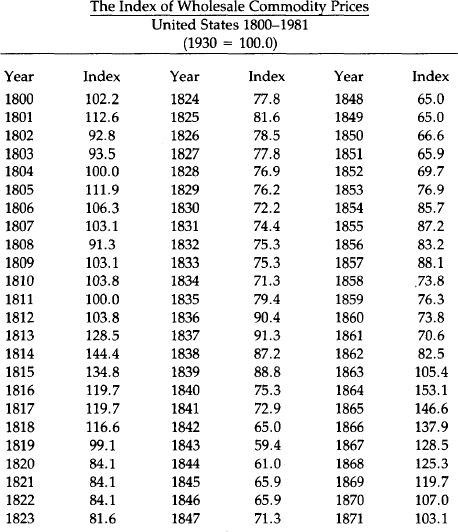
In the 67 years prior to the beginning of the Federal Reserve system in 1913 the consumer price index in this country increased by 10 percent, and in the 67 years subsequent to 1913 the Consumer Price Index increased 625 percent. This growth has accelerated since 1971 when President Nixon cut our last link to gold by closing the gold window.
In 1833, the index of wholesale commodity prices in the U.S. was 75.3. In 1933, just prior to our going off the domestic gold standard, the index of wholesale commodity prices in the U.S. was 76.2: a change in 100 years of nine-tenths of one percent. The index of wholesale commodity prices in 1971 was 255.4. Today, the index is 657.8. For 100 years on the gold standard wholesale prices rose only nine-tenths of one percent. In the last 10 years of paper money they have gone up 259 percent.
The final objection to the gold standard, that gold is subject to speculative influence and therefore too unstable to be used as a standard for anything, is also spurious. During the past decade, gold has become a major hedge against inflation. The run-up in gold prices from $35 to $850 per ounce came as a result of fears about the value of paper currencies and developing international crises. This speculation—actually a seeking of protection from the continual devaluation of paper currencies—has markedly accelerated in recent years. Not only is the decline of the paper dollar causing larger investments in gold coins, but also in real estate, collectibles of all types, and any other good that promises to retain its value. The Commodity Exchange reports that there are now over 100 different futures contracts offered by the nation’s 11 exchanges. Since 1975, 42 new futures contracts have been introduced, and 37 proposed contracts are currently pending government approval. This enormous growth in speculation has occurred during the last 10 years. People who object to gold because it is speculative confuse cause and effect. Were we on a gold standard, there would be no speculation in gold at all. Gold is currently an object of “speculation” precisely because we have an irredeemable paper money system and people are trying to protect themselves from it. The real speculation is in the anticipation of the further depreciation of the dollar.
All these objections to gold cannot shake the overwhelming historical and theoretical arguments for a gold standard. But there are other arguments for gold as well. We will now take them up in turn.
Money and the Constitution
In addition to the compelling economic case for the gold standard, a case buttressed by both historical and theoretical arguments, there is a compelling argument based on the Constitution. The present monetary arrangements of the United States are unconstitutional—even anticonstitutional—from top to bottom.
The Constitution actually says very little about what sort of monetary system the United States ought to have, but what it does say is unmistakably clear. Article I, section 8, clause 2 provides: “The Congress shall have power... to borrow money on the credit of the United States... [clause 5:] to coin money, regulate the value thereof, and of foreign coin, and fix the standards of weights and measures... [and clause 6:] to provide for the punishment of counterfeiting the securities and current coin of the United States....” Further, Article I, section 10, clause 1 provides: “No state shall... coin money; emit bills of credit; [or] make anything but gold and silver coin a tender in payment of debts....”
When the Founding Fathers wrote the Constitution in the summer of 1787, they had fresh in their minds the debacle of the paper money printed and issued by the Continental Congress during the Revolutionary War. The paper notes, “Continentals” as they were called, eventually fell to virtually zero percent of their original value because they were not redeemed in either silver or gold. They were “greenbacks,” and were the first of three major experiments with “greenbacks” that this nation has conducted.6 The Continental greenback failed miserably, giving rise to the popular phrase “not worth a Continental.”
Consequently, when the Constitutional Convention met in 1787, the opposition to paper money was strong. George Mason, a delegate from Virginia, stated that he had a “mortal hatred to paper money.” Delegate Oliver Ellsworth from Connecticut thought the Convention “a favorable moment to shut and bar the door against paper money.” James Wilson, a delegate from Pennsylvania, argued: “It will have a more salutary influence on the credit of the United States to remove the possibility of paper money.” Delegate Pierce Butler from South Carolina pointed out that paper was not a legal tender in any country of Europe and that it ought not be made one in the United States. John Langdon of New Hampshire said that he would rather reject the whole Constitution than allow the federal government the power to issue paper money. On the final vote on the issue, nine states opposed granting the federal government power to issue paper money, and only two favored granting such power.
The framers of the Constitution made their intention clear by the use of the word “coin” rather than the word “print,” or the phrase “emit bills of credit.” Thomas M. Cooley’s Principles of Constitutional Law elaborates on this point: “To coin money is to stamp pieces of metal for use as a medium of exchange in commerce according to fixed standards of value.”
Congress was given the exclusive power (as far as governments are concerned) to coin money; the states were explicitly prohibited from doing so. Furthermore, the states were explicitly forbidden from making anything but gold and silver coin a tender in payment of debt, while the federal government was not granted the power of making anything legal tender.
In his explanation of the Constitutional provisions on money, James Madison, in Federalist No. 44, referred to the “pestilent effects of paper money on the necessary confidence between man and man, on the necessary confidence in the public councils, on the industry and morals of the people, and on the character of republican government.” His intention, and the intention of the other founders, was to avoid precisely the sort of paper money system that has prevailed for the past 10 years.
This intention was well understood throughout the 19th century, and was denied only when the Supreme Court found it expedient to do so. For example, Daniel Webster wrote:
If we understand, by currency, the legal money of the country, and that which constitutes a lawful tender for debts, and is the statute measure of value, then undoubtedly, nothing is included but gold and silver. Most unquestionably, there is no legal tender, and there can be no legal tender in this country under the authority of this government or any other, but gold and silver, either the coinage of our mints or foreign coins at rates regulated by Congress. This is a constitutional principle, perfectly plain and of the very highest importance. The states are expressly prohibited from making anything but gold and silver a tender in payment of debts, and although no such expressed prohibition is applied to Congress, yet as Congress has no power granted to it in this respect but to coin money and to regulate the value of foreign coins, it clearly has no power to substitute paper or anything else for coin as a tender in payment of debts in a discharge of contracts....
The legal tender, therefore, the constitutional standard of value, is established and cannot be overthrown. To overthrow it would shake the whole system. (Emphasis added.)
In 1832, the Select Committee on Coins of the House of Representatives reported to the Congress that “the enlightened founders of our Constitution obviously contemplated that our currency should be composed of gold and silver coin.... The obvious intent and meaning of these special grants and restrictions [in the Constitution] was to secure permanently to the people of the United States a gold or silver currency, and to delegate to Congress every necessary authority to accomplish or perpetuate that beneficial institution.”
The Select Committee stated its conclusion that “the losses and deprivation inflicted by experiments with paper currency, especially during the Revolution; the knowledge that similar attempts in other countries... were equally delusive, unsuccessful, and injurious; had likely produced the conviction [in the minds of the framers of the Constitution] that gold and silver alone could be relied upon as safe and effective money.”
Twelve years later, in 1844, the House Committee on Ways and Means concluded:
The framers of the Constitution intended to avoid the paper money system. Especially did they intend to prevent Government paper from circulating as money, as had been practised during the Revolutionary War. The mischiefs of the various expedients that had been made were fresh in the public mind, and were said to have disgusted the respectable part of America.... The framers [of the Constitution]... designed to prevent the adoption of the paper system under any pretext or for any purpose whatsoever; and if it had not been supposed that such object was effectively secured, in all probability the rejection of the Constitution might have followed.
Later in the century, Justice Stephen Field presciently wrote in the case Julliard v. Greenman (1884):
There have been times within the memory of all of us when the legal tender notes of the United States were not exchangeable for more than half of their nominal value. The possibility of such depreciation will always attend paper money. This inborn infirmity, no mere legislative declaration can cure. If Congress has the power to make the [paper] notes legal tender and to pass as money or its equivalent, why should not a sufficient amount be issued to pay the bonds of the United States as they mature? Why pay interest on the millions of dollars of bonds now due when Congress can in one day make the money to pay the principal; and why should there be any restraint upon unlimited appropriations by the government for all imaginary schemes of public improvement if the printing press can furnish the money that is needed for them?
Justice Field foresaw exactly what would happen in the 20th century when the federal government has used the printing press—and the computer—as the means of financing all sorts of “imaginary schemes of public improvement.”
Under the Constitution, Congress has power to coin money, not print money substitutes. Such money is to be gold and silver coin, nothing else. It is significant that this power of coining money is mentioned in the same sentence in the Constitution as the power to “fix the standards of weights and measures,” for the framers regarded money as a weight of metal and a measure of value. Roger Sherman, a delegate to the Constitutional Convention, wrote that “if what is used as a medium of exchange is fluctuating in its value, it is no better than unjust weights and measures... which are condemned by the Laws of God and man....”
The founders were greatly influenced by both the English common law and biblical law. Sherman’s comment about unjust weights and measures and the juxtaposition of the powers to coin money and fix the standards of weights and measures in the Constitution are examples of that influence.
For the framers of the Constitution, money was a weight of precious metal, not a weightless piece of paper with green ink printed on it. The value of the money was its weight and fineness, and its value could be accurately determined.
Today’s paper money system, issued by a coercive banking monopoly, has no basis in the Constitution. It is precisely the sort of government institution—one far more clever than the bumbling efforts of Charles I to confiscate wealth—that can forcibly exact financial support from the people without their consent. As such, it is a form of taxation without representation, and a denial of the hard fought and won principle of consent before payment of taxes.
Remarkably enough, the Supreme Court has not decided any cases challenging the constitutionality of the present irredeemable paper money system; in fact such a case has not yet been adjudicated before the Court or at the federal appellate level.
It is to be hoped that this will soon change, and the Court forced to recognize, as was recognized throughout history, that the states may make only “gold and silver coin a tender in payment of debt.” Anything else is unconstitutional. As for the Congress, we strongly recommend that the Congress abide by the supreme law of the land by repealing those laws that contravene it.
The Moral Argument for Gold
A monetary standard based on sound moral principles is one in which the monetary unit is precisely defined in something of real value such as a precious metal. Money that obtains its status from government decree alone is arbitrary, undefinable, and is destined to fail, for it will eventually be rejected by the people. Since today’s paper money achieves its status by government declaration and not by its value in itself, eventually total power over the economy must be granted to the monopolists who manage the monetary system. Even with men of good will, this power is immoral, for men make mistakes, and mistakes should never have such awesome consequences as they do when made in the management of money. Through the well-intentioned mismanagement of money, inflation and depression are created. Political control of a monetary system is a power bad men should not have and good men would not want.
Inflation, being the increase in the supply of money and credit, can only be brought about in an irredeemable paper system by money managers who create money through fractional reserve banking, computer entries, or the printing press. Inflation bestows no benefits on society, makes no new wealth, and creates great harm; and the instigators, whether acting deliberately or not, perform an immoral act. The general welfare of the nation is not promoted by inflation, and great suffering results.
Gold is honest money because it is impossible for governments to create it. New money can only come about by productive effort and not by political and financial chicanery. Inflation is theft and literally steals wealth from one group for the benefit of another. It is possible to have an increase in the supply of gold, but the historical record is clear that all great inflations occur with paper currency. But an increase in the supply of gold—presuming that it is not accomplished through theft—is quite different from an increase in the supply of irredeemable paper currency. The latter is a creature of politics; the former is a result of productive labor, both mental and physical. Gold is wealth; it is not just exchangeable for wealth. Today’s notes are not wealth. They are claims on wealth that the owners of wealth must accept as payment.
No wealth is created by paper money creation; only shifts of wealth occur, and these shifts, although significant and anticipated by some, cannot always be foreseen. They are tantamount to theft in that the assets gained are unearned. The victims of inflation suffer through no fault of their own. The beneficiaries of the inflation are not necessarily the culprits in the transfer of wealth; the policymakers who cause the inflation are.
Legally increasing the money supply is just as immoral as the counterfeiter who illegally prints money. The new paper money has value only because it steals its “value” from the existing stock of paper money. (This is not true of gold, however. New issues of paper money are necessarily parasitic; they depend on their similarity to existing money for their worth. But gold does not. It carries its own credentials.) Inflation of paper money is one way wealth can be taken against another’s wishes without an obvious confrontation; it is a form of embezzlement. After a while, the theft will be reflected in the depreciation of money and the higher prices that must be paid. The guilty are difficult to identify due to the cleverness of the theft. They are never punished because of the legality of their actions. Eventually, though, as the paper money becomes more and more worthless, the “legalized counterfeiting” becomes obvious to everyone. Anger and frustration over the theft results and is justified, but it is frequently misdirected and may even lead to a further aggrandizement of governmental power.
Ideally, the role of government in a sound monetary system is minimal. Its purpose should be to guarantee a currency and assure that it cannot be debased. The role would be similar whether it is protecting a government gold standard or private monies. Neither the government nor private issuers of money can be permitted to defraud the people by depreciating the currency. The honesty and integrity of the money should be based on a contract; the government’s only role should be to see that violators of the contract are punished. Depreciating the currency by increasing the supply and diluting its value is comparable to the farmer who dilutes his milk with water yet sells it for whole milk. We prosecute the farmer, but not the Federal Reserve Open Market Committee. Those who must pay the high prices from the inflation are like those who must drink the diluted milk and suffer from its “debased” content.
The Coinage Act of 1792 recognized the importance of not debasing the currency and prescribed the death penalty for anyone who would steal by debasing the metal coins. Yet today the Treasury is closing the very office set up to assure honest money, the New York Assay Office. Though largely symbolic since 1933, this office is the most important office of the federal government if we are ever again to commit ourselves to money that cannot be arbitrarily destroyed by the politicians in office.
Throughout history, rulers have used inflation to steal from the people and pursue unpopular policies, welfarism, and foreign military adventurism. Likewise throughout history the authorities who have inflated have resorted to blaming innocent citizens, who try to protect themselves from the government-caused inflation. Such citizens are castigated as “speculators” out of ignorance, as well as from a deliberate desire to escape deserved blame.
Gold money is always rejected by those who advocate significant government intervention in the economy. Gold holds in check the government’s tendency to accumulate power over the economy. Paper money is a device by which the unpopular programs of government intervention, whether civilian or military, foreign or domestic, can be financed without the tax increases that would surely precipitate massive resistance by the people. Monetizing massive debt is more complex and therefore more politically acceptable, but it is just as harmful, in fact more harmful, than if the people were taxed directly.
This monetizing of debt is literally a hidden tax. It is unevenly distributed throughout the population, one segment paying much more than another. It is equivalent to a regressive tax, forcing the working poor to suffer more than the speculating rich.
Deliberately debasing the currency for political reasons, that is, paying for programs that the politicians need in order to be reelected, is the most immoral act of government short of deliberate war. The tragedy is that the programs that many believe helpful to the poor usually end up making the poor poorer, destroying the middle class, and enriching the wealthy. Sincere persons vote for programs for the poor not fully understanding the way in which the inflation used to finance the programs brings economic devastation to those intended to be the beneficiaries.
Great power is granted to the politicians and the monetary managers with this authority to create money. Bankers, through fractional reserve banking laws, can create new money. Those who receive the newly created money first benefit the most and have a vested interest in continuing the process of inflation. These are generally the government, large corporations, large banks, and welfare recipients. Paper money is political money with the politician in charge; gold is freemarket money with the people in charge.
John Locke argued for the gold standard the same way he argued for the moral right to own property. To him the right to own and exchange gold was a civil liberty equal in importance to the liberty to speak, write, and practice one’s own religion. Free people always choose to trade their goods or services for a marketable commodity. Money is the most marketable of all commodities, and gold the best of all money. Gold has become money by a moral commitment to free choice and honest trade, not by government edict. Locke claimed the right to own property was never given to the individual by society, but that government was established to ensure integrity in contracts and honest money, not to be the principal source of broken contracts or the instigators of a depreciating currency. Gold is not money because government says it is: It is money because the people have chosen to use it in a free country.
Eliminating honest money—commodity money defined precisely by weight—is a threat to freedom itself. It sets the stage for serious economic difficulties and interferes with the humanitarian goal of a high standard of living for everyone, a standard which results from a free market and a sound monetary standard. For centuries kings have used the debasement of coins to raise funds for foreign and aggressive wars that otherwise would not have been supported by people voluntarily loaning money to the government or paying taxes. Even recently, inflation has been resorted to in order to finance wars about which the people were less than enthusiastic. Inflation is related to preventable wars in another way. As the economy deteriorates in countries that have inflated and forced to go through recession and depressions, international tensions build. Protectionism (tariffs) and militant nationalism generally develop and contribute to conditions that precipitate armed conflict. The immorality of inflation is closely linked to the immorality of preventable and aggressive wars.
Money, when it is a result of moral commitment to honesty and integrity, will be trusted. Trustworthy money is required in a moral society. This requires all paper money and paper certificates to be convertible into something of real worth. Throughout history, money has repeatedly failed to maintain trust due to unwise actions of governments whose responsibility was to protect that trust, not destroy it. Without trust in money gained by a moral commitment to integrity, a productive economy is impossible. Inflation premiums built into the interest rates cannot be significantly altered by minor manipulations in the growth rate of the supply of money, nor by the painful decreases in the demand for money brought on by a weak economy. Only trust in the money can remove the inflation premium from our current financial transactions.
Trust is only restored when every citizen is guaranteed convertibility of money substitutes into tangible money at will. False promises and hopes cannot substitute for a moral commitment of society to honest money—ingrained in the law and not alterable by the whims of any man. The rule of moral law must replace the power of man in order for sound money to circulate once again. Ignoring morality in attempts to stop inflation and restore the country’s economic health guarantees failure. A moral commitment to honest money guarantees success.
In the 7th century B.C., the Greeks began the first coinage, striking silver into pieces of uniform weight. Greek mints were located in temples. The Athens mint was either in or adjacent to the temple of Athene. This was done for a purpose, for the temple marks were designed—and accepted—as evidence of the honesty of the coins. In Rome, the coinage began in the temple of Juno Monere, from which we get our word “money.”
Biblical law, which informs the common law and has shaped the legal institutions of Western Europe and North America, regards money as a weight, either of silver or gold, and stern commands against dishonest weights and measures were enforced with severe punishments. The prophet Isaiah condemned Israel because “your silver is become your dross, wine mixed with water.” Debasement of the money was very severely condemned. In his Commentary on the Epistle to the Romans, Martin Luther wrote, “Today we may apply the Apostle’s words [Romans 2:2-3] first to those [rulers] who without cogent cause inflict exorbitant taxes upon the people, or by changing and devaluating the currency, rob them, while at the same time they accuse their subjects of being greedy and avaricious.”
It is not surprising, then, given this background, that the Congress of 1792 imposed the death penalty on anyone convicted of debasing the coinage. Debasement, depreciation, devaluation, inflation—all stand condemned by the moral law. The present economic crisis we face is a direct consequence of our violations of that law.
- 1“Business Cycles and Growth: Some Reflections and Measures,” NBER Working Paper #665, April 1981.
- 2“The Changing Cyclical Behavior of Wages and Prices: 1890-1975,” NBER Working Paper #304, December 1978.
- 3Testimony before the United States Gold Policy Commission, Washington, D.C., November 13, 1981.
- 4Ibid.
- 5Ibid.
- 6The other two experiments were during the Civil War, 1862-1879, and the present period from 1971. The second experiment had a happy conclusion because the Civil War greenbacks were paid off dollar for dollar in gold. As chapter two shows, the colonies also frequently experimented with paper money.

