
The Case For Gold: A Minority Report of the U.S. Gold Commission
III. Money and Banking in the United States in the 20th Century
III. Money and Banking in the United States in the 20th Century
After 1896 and 1900, then, America entered a progressive and predominantly Republican era. Compulsory cartellization in the name of “progressivism” began to invade every aspect of American economic life. The railroads had begun the parade with the formation of the ICC in the 1880s, but now field after field was being centralized and cartellized in the name of “efficiency,” “stability,” “progress,” and the general welfare. Theodore Roosevelt, Taft, and Wilson were each in his way progressives, and each advanced the cause of cartellization, with the process culminating in the Presidency of Woodrow Wilson. In particular, various big business groups, led by the J. P. Morgan interests often gathered in the National Civic Federation and other think tanks and pressure organizations, saw that the voluntary cartels and the industrial merger movements of the late 1890s had failed to achieve monopoly prices in industry. Therefore, they decided to turn to governments, state and federal, to curb the winds of competition and to establish forms of compulsory cartels, in the name, of course, of “curbing big business monopoly” and advancing the general welfare. 1
America’s bankers had long chafed to cartellize the banking industry still further. The National Banking System was a long step forward, from their point of view, but it was still only quasi-centralized. Bank credit and money pyramided on top of New York (and after 1887, also Chicago and St. Louis) banks. But this system was, to use a universally adopted term, “inelastic”—that is, it could not assure the pumping in of more money during contractions or runs on banks. “Inelastic” was a code word for not enough assured inflation of the money supply.2 The growing consensus, then, was to redirect the banking system by establishing, at long last, a central bank. The central bank would have an absolute monopoly of the note issue, and reserve requirements would then ensure a multilayered pyramiding on top of these central bank notes, which could bail out banks in trouble, and, moreover, could inflate the currency in a smooth, controlled, and uniform manner throughout the nation.
In addition to this chronic problem, the large banks, particularly on Wall Street, saw financial control slipping away from them. The state banks and other non-national banks began to grow instead and outstrip the nationals. Thus, while in the 1870s and the 1880s, most banks were national, by 1896 non-national banks comprised 61 percent of the total number of banks, and by 1913, 71 percent. By 1896, these non-national banks had 54 percent of the total banking resources of the country, and 57 percent in 1913. The inclusion of Chicago and St. Louis as central reserve city banks after 1887 diluted Wall Street’s power. With Wall Street no longer able to cope, it was time to turn to the United States government to do the centralizing, cartellizing, and controlling instead.3
It often takes a crisis to focus one’s mind, and it takes a financial crisis or notable event to move men to institutional reform. The Civil War was the previous occasion for overhaul of the nation’s money and banking system. The Panic of 1907 provided the spark for a return to central banking.
The Republicans fulfilled their promise, and, in March 1900, finally placed the United States officially on a monometallic gold standard. All paper was to be redeemable in gold, and silver continued as a subsidiary metal.
An unusual increase in gold production from discoveries in South Africa and Alaska doubled the world’s gold stock from 1890 to 1914, causing a rise of U.S. prices of nearly 50 percent from 1897 to 1914, or two and one-half percent per year. Until after World War II, this was the largest sustained rise in prices in peacetime, but still the rise only returned to approximately 1882 levels. In the United States, the gold supply rose at a rate of seven and one-half percent per year in this period. But despite this impact, the bulk of the increase in the supply of money in the period came from bank deposits pyramiding on top of the increase in gold. Thus, from June 1896 to June 1914, total bank deposits rose from $3.43 billion to $14.32 billion, or an increase of 317.5 percent or an annual rise of 17.6 percent—a substantially greater percentage than the seven and one-half percent per year increase of the gold stock. Once again, fractional reserve banking under the National Banking System was far more to blame for price rises than international movements in gold.
There were several mini-panics, averted or stopped by infusions of Treasury money, after 1900; but the Panic of 1907 frightened the banks into calling for a new central banking system. Wall Street and the Morgans could not save the New York banks themselves. There was general speculation of specie payment throughout the country, and premiums of currency over deposits. Again, the Treasury was called upon to intervene. The Wall Street banks now knew that they could not cope, and federal government cartellization and support for fractional reserve banking would be necessary.4
All banks, and both parties, now agreed on some form of central banking, and the rest of the story is jockeying for minor advantage. The Wilson administration finally established central banking with the creation of the Federal Reserve System in 1913—the symbolic end of the Jacksonian hard-money heritage in the Democratic Party. From 1913 until 1933, the United States would be formally under a gold standard, but actually governed by a Federal Reserve System designed to inflate uniformly and bail out banks in trouble. The banking systems would now be pyramiding on the U.S. issue of paper money.
By establishing the Federal Reserve System, the federal government changed the base of the banking pyramid to the Federal Reserve Banks. Only the Federal Reserve could now print cash, and all member banks could now multiply their deposits on top of Federal Reserve deposits. All national banks were required to join the Federal Reserve, and their gold and other lawful money reserves had to be transferred to the Federal Reserve. The Federal Reserve, in turn, could pyramid its deposits by three-to-one on top of gold. This centralization created an enormous potential for inflationary expansion of bank deposits. Not only that, reserve requirements for the nation’s’banks were deliberately cut in half in the course of establishing the Federal Reserve System, thereby inviting the rapid doubling of the money supply. Average reserve requirements for all banks prior to the Federal Reserve Act is estimated to be 21 percent. In the original Act of 1913, these were cut to 11.6 percent and three years later to 9.8 percent. It is clear then that the Federal Reserve was designed from the very beginning to be an instrument for a uniform and coordinated inflation of bank money.5
Indeed, total bank deposits were $14.0 billion at the beginning of the Federal Reserve System in January 1914; after six years, in January 1920, total bank deposits had reached $29.4 billion, an enormous increase of 110 percent or 18.3 percent per year. The creation of the Federal Reserve had made that expansion possible.
The Gold-Exchange Standard
Faced with a global inflation of unprecedented volume and destruction both during World War I and immediately after it, the world attempted to restore monetary stability. But while most officials wanted gold to re-appear as the monetary anchor, they also wanted to be able to keep inflating. Put another way, they wanted to have their cake and eat it too.
Preeminent victims of this delusion were the British; with a burgeoning welfare state in the early 1920s, and especially with rigid wage rates, it was difficult politically to end inflation. Further, Britain wanted to return to gold, but for reasons of national “prestige” she wanted to go back at the pre-war, pre-inflation rate of $4.86 per pound. In effect, she wanted to pretend that the inflation had never happened. There was only one way Britain could get away with enthroning an artificially overvalued pound: by making other countries play along. Other nations had to be persuaded (or forced) into either likewise returning to gold at an unrealistic rate or inflating their monies so as not to cripple Britain’s exports (also priced artificially high).
Britain accomplished this at the Genoa Conference of 1922. Emerging from that first post-war economic meeting was not a gold standard, but a more slippery “gold-exchange” standard. Here’s how it worked: Only the United States stayed on the old gold-coin standard, where anyone could present notes totalling $20.67 to the Treasury and receive an ounce of gold in return. But Britain began redeeming pounds not just in gold, but in Federal Reserve notes or dollars. Further, the other nations began predominantly using British pounds as their backing. And importantly, when they did pay gold they only paid in large bullion bars, not coins, so the average citizen was not able to redeem his currency. The Genoa Accord made the pound as well as the dollar as good as gold, even though sterling was not in fact a sound currency. Britain now printed its “gold” with American support—the U.S. agreed to inflate enough to keep Britain’s reserves of dollars or gold from flowing to America.
This inflationary charade was played to buttress Britain’s fading dreams as an imperialist world power. But also involved was the rise of the new doctrines of John Maynard Keynes, who by the early 1920s had become a foe of the “barbarous relic” gold and extolled instead the alleged virtues of a politically managed paper currency. That these ideas became so influential so fast in London banking circles was due in no small part to the catastrophic loss suffered during World War I of truly the finest minds of a generation. These would have normally become leaders during the 1920s. This left a gap which affected Britain as it did few other countries. For at the risk of broad-brush painting, the British are a people that have always put more stock in practical knowledge than the more philosophical French or Germans. But pragmatism depends less on book knowledge than on skills handed down orally. The annihilation of a generation thus created a gap in the continuity of knowledge those more bookish nations escaped. So as one contemporary observer of London financial circles perceptively explained, by the mid-1920s, there would be few remaining grandfathers who remembered the virtues of sound money. And there would be their grandsons “miseducated by Keynes.” Between them was a gap, which created such “a barrier in ideas that it was not easy for tradition and practical knowledge to pass.”6
American Inflation 1922-28
With the “discovery” of open-market operations around 1922, the Federal Reserve thought it had found a way to smooth out business cycles. In practice, it caused a substantial six-year bank credit inflation by buying securities on the open market and printing the money to pay for them. This money—bank reserves—was pyramided severalfold by means of the fractional reserve banking system. This policy of stabilizing the price level was deliberately engineered by the leader of the Federal Reserve System, Benjamin Strong, to follow the protomonetarist theory of Yale economist Irving Fisher.
The 1920s are not often seen as an inflationary period because prices did not rise. But the money supply can rise even without prices rising in absolute terms. The 1920s saw such a burst of American technological advancement and cheaper ways of producing things that the natural tendency was for prices to fall (i.e., more goods chasing the same number of dollars). But the inflation caused prices to rise relative to what they would have done. So a “stable” price level was masking the fact that inflation was going on and creating distortions throughout the economy.
Between mid-1922 and April 1928, bank credit expanded by over twice as much as it did to help finance World War I. As with all inflations, this caused speculative excess; in this case, new money poured into the stock market and real estate. The cooling of this speculative fever in 1928 by officials who tightened the money supply because they were finally afraid of the overheated economy led to the Depression, which in turn led to the world’s abandonment of the gold standard. We would do well to examine this period closer.
Bailing Out Britain
Britain during this time used her power to treat the pound like gold, as one might expect, keeping interest rates artificially low and inflating recklessly, thus piling up billions of pounds at the Bank of France, which finally began asking for gold. Panicked, the Bank of England in mid-1927 induced the New York Federal Reserve Bank to lower its interest rates and step up open-market purchases of securities, thus fueling inflation further. (This move to make unnecessary the payment of British gold obligations to France and to keep England inflating by causing America to inflate was disguised as “helping the farmer.” It was the Kansas City Federal Reserve Bank which first lowered its discount rate, the others following.)
A major reason for the inflationary pro-British policies of the 1920s was the close personal connection formed between Benjamin Strong, the dominant leader of the Federal Reserve System, and Montagu Norman, head of the Bank of England. In several secret conferences with Norman, unknown to the rest of the Federal Reserve or the American government, Strong agreed to inflate money and credit in order to bail out England. The ties between Norman and Strong were not only personal; both were intimately allied with the House of Morgan. Before he became the first leader of the Federal Reserve, Strong was head of the Morgan-created Bankers Trust Company in New York. He was urged to accept the post by his two closest personal friends, Henry P. Davison and Dwight Morrow, both partners at the Morgan Bank. The Morgan connection with Britain was very close; J. P. Morgan and Company was the fiscal agent for the Bank of England and underwrote the massive sale of British bonds in the United States during World War I. Montagu Norman himself had close personal connections with the United States investment banks and had worked in the offices of Brown Brothers in New York. Only the death of Strong in 1928 ended the inflationary Federal Reserve policy designed to help Britain.
By April of 1928, the new Governors of both the Federal Reserve Board and the New York Federal Reserve Bank, made an effort to hold down bank credit expansion. But those efforts were stymied by following two conflicting goals. Federal Reserve officials wanted both to reduce credit going into stock market speculation yet at the same time not to tighten money either at home or abroad (this latter for fear of pulling gold out of Britain).
And while the anti-inflationist policy predominated, it is not easy to reduce inflation in an economy grown accustomed to it, which by 1928 America had. Further, 1928 was a presidential election year, with great pressure to inflate. It therefore took about a year before the money supply was under control. But as the tables below show, the long money-supply inflation was over by the end of 1928. At mid-1929 money-supply growth was creeping at an annual rate of only 0.7 percent, a marked deceleration from previous years. The depression caused by years of inflation was about to begin, and with it would come the end of the American gold standard.
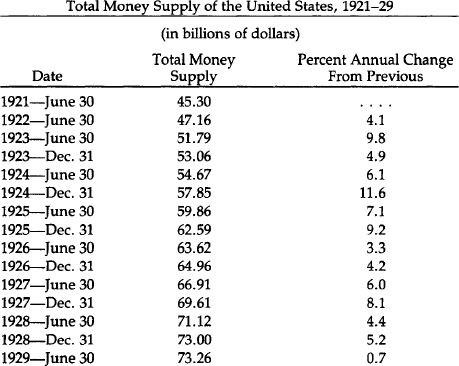
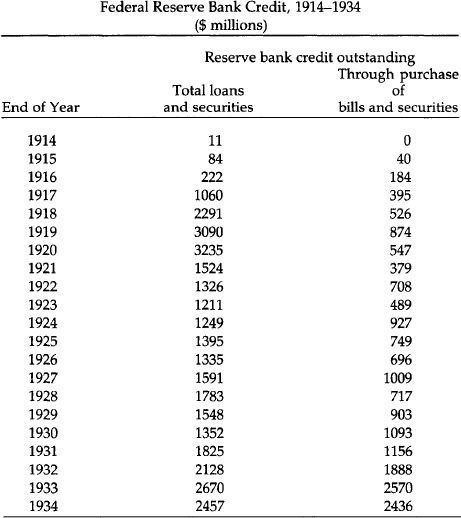
Source: U.S. Department of Commerce, Historical Statistics of the United States, Colonial Times to 1957, series X 245-254 (1961), p. 642.
The International Crisis: 1931
The stock market collapse in late 1929 was only a harbinger of things to come. It was not until 1931 that international bank collapses caused abandonment of gold. The first to go was Austria.
Kredit-Anstalt, Austria’s largest bank, supported by the Austrian government, had for years been making bad loans on a meager reserve base. Austria had been part of the “sterling bloc,” buttressed by Britain—a development resented by France, heavy with gold claims on Britain. The formation of an Austrian customs union with Germany in late March 1931 was feared by France, who saw it as a step to political union. The French central bank now insisted upon immediate repayment of her short-term debts from Austria and Germany. Austrian banks clearly could not meet their liabilities, and in late May, Kredit-Anstalt went bankrupt, taking Austria off the gold standard. A run on German banks now started. That country had been quickly affected by the tightened American credit conditions in mid-1928 and was quite vulnerable. Runs continued, and even though President Hoover declared on June 20 a moratorium on German debt, France was not immediately inclined to go along. She delayed too long; and on July 15 Germany declared national bankruptcy by going off the gold standard.
It must be said that both these nations fought desperately to maintain gold redemption, and when the end came, each regarded the act with shame. Not so with Britain. The country that had caused the others to inflate for her and did more than any other to bring on the crisis went off the gold standard without a fight.
As runs on British gold increased through the summer, Britain refused to defend the pound by raising interest rates. Instead, as gold flowed out of the banks, the Bank of England created new money to replenish the banks’ reserves. The Bank of France cooperated loyally and didn’t present many claims. The French bank held sterling claims worth fully seven times its capital, and thus feared for a Britain off the gold standard. Indeed, France joined America in offering massive loans to Britain. But the Bank of England didn’t even take full advantage of these credit lines, and two days after assuring the Netherlands Bank (with all its capital in sterling) that England would not go off the gold standard, that is exactly what happened. The announcement was made on September 20, 1931, thus capping 17 years of gradual monetary disintegration.
Britain had for centuries been the world’s premier financial power, so that announcement left the world stunned. Moreover, other governments had been deliberately deceived. The capital of the central banks of France and Holland had been made worthless in one day. Governments could no longer trust each other’s financial promises, and the stage was set for perhaps the most treacherous decade in international economic relations, a decade from which we have not yet recovered. As Chase economist and contemporary eyewitness Benjamin Anderson recalled, “An immense world asset was destroyed when the Bank of England and the British government broke faith with the world. Years later after we in the United States had also broken faith with the world, the head of the national bank of one of the Scandinavian countries said, ‘I have lost money in sterling. I have lost money in dollars. I have never lost money by holding gold.’”7
America Breaks Faith
If sterling was not good, the world asked itself, what was? It looked nervously at America, and had presented claims for $728 million of our gold by the end of October 1931. But Americans thought any such fears were silly. After all, we had continued to pay gold to foreigners even in the crisis of 1895, with a low point of only $41 million of gold in the Treasury. Alone among belligerents, we had not gone off gold in World War I, although we had stopped the export of gold. Certainly few Americans cashed in notes for gold in late 1931. They may have doubted the solvency of some banks, but few if any doubted the good faith of the American government’s promise to redeem notes for gold. The platforms of both parties in 1932 contained vows that the gold standard would be maintained. The Democratic platform was largely written by Sen. Carter Glass of Virginia and Cordell Hull, later secretary of state. As events proved, both these men were sincere.
The first sign of shakiness in the American position was a foolish and false statement by President Hoover one month before the November election. He charged that the Federal Reserve had been within two weeks of going off the gold standard earlier that year. The statement was soon proved untrue, but it aroused doubts for the first time in people’s minds.
These grew into rumors beginning in late December that President elect Roosevelt was going to take the country off the gold standard. Roosevelt would not deny them, and American hoarding of gold started for the first time on a grand scale.
The feelings of disquietude were made worse by a paralyzed government. The new President was not to take office until March 4 (the old Inauguration date) and a lame-duck Congress had many members due to retire. In the cabinet departments, anyone whose job was not protected by civil-service rules was preparing to find a new job in the midst of a terrible depression.
Runs on banks by depositors anxious to get cash, and runs on the Federal Reserve Banks by cash holders eager to tum their paper into gold, accelerated. It should not have come as a surprise when on February 14 Michigan became the first state to declare a bank “holiday,” i.e., to dose the banks to depositors. Michigan had been the home of some of the more reckless lending by banks during the boom. Nine days later Indiana followed, and then a score of states in a cluster. Late on the night of March 3, the big New York banks reluctantly agreed to close; though they were not in trouble, smaller upstate banks were. Roosevelt became President the next day with almost every bank in America closed. He kept them all closed until March 13, when the Federal Reserve banks opened, with others a day or two later. The public, assuaged by FOR’s promise that the reopened banks would be good, poured both gold and cash back into the banks. But on March 9 Congress passed, at Roosevelt’s request, a bill “to provide relief in the existing national emergency in banking, and other purposes.” It gave him the power to do all he pleased regarding money and banking, including authority to seize the American people’s gold coins, bullion, and gold certificates.
America Off the Gold Standard
Within a month this power was used. On April 5, it became illegal to own or hold any form of monetary gold, either coins, bullion, or certificates. (Industrial users of gold were not affected.) The banking crisis had been brought on by past inflation. But that crisis, ironically, was made the excuse to abandon the gold standard.
At first, it was stressed that these measures were temporary, only to be used as long as the crisis lasted. But on May 12 a law was passed (the Thomas Amendment to the Agriculture Adjustment Act) which gave the President the ability to increase vastly the money supply and to reduce by up to half the weight of gold dollar. Democratic Senator Glass called it “dishonor.... This great government, strong in gold, is breaking its promises to pay gold to widows and orphans to whom it has sold government bonds with a pledge to pay gold coin of the present standard value. It is breaking its promise to redeem its paper money in gold coin of the present standard of value. It’s dishonor, sir.”8 Another Democratic Senator, Thomas Gore of Oklahoma, was asked by the President for his opinion about another law (signed on June 5) abolishing the gold clause in all past debt obligations: “Why, that’s just plain stealing, isn’t it, Mr. President?” Later in Senate debate, Gore also added that “Henry VIII approached total depravity but the vilest thing he ever did was to debase the coin of the realm.”9
One final step remained. Using the Gold Reserve Act of January 30, 1934, President Roosevelt arbitrarily reduced the weight of gold that would define each dollar. The “old” dollar had been defined as 25.8 grains of gold, nine-tenths fine. The new devalued dollar would only be worth 15 grains, nine-tenths fine. So even the act of abandoning gold was done with the implicit admission that the dollar was still defined in terms of it.
The London Conference
Just as he had taken America off gold, Roosevelt took steps to ensure that there would be no international return to gold. The Gold Bloc of remaining gold standard nations, France, Belgium, Switzerland, Holland, and Italy, had called the London Conference for June 1933 to persuade Great Britain and the United States that “gold should be reestablished as the international measure of exchange value”—and that non-gold countries should agree that their ultimate objective was to restore the gold standard. Even the official American delegation, which included Secretary of State Cordell Hull, approved this declaration, and all were shocked when Roosevelt’s reply rejected the proposals. Said he, “The sound internal economic system of a nation is a greater factor in its prosperity than the price of its currency in changing terms of other nations.” He thus missed the point of a gold standard, which defines all currencies as an unchanging weight of gold. Incredibly, the President stated that the new order would mean currency stability: “Let me be frank in saying that the United States seeks the kind of dollar which a generation hence will have the same purchasing and debt-paying power as the dollar value we hope to maintain in the near future.” Seven months later, the dollar was devalued by 40.9 percent. And we of “a generation hence” know what has happened to the purchase power of the dollar.
Gold Remains the World’s Money
Finding no support, all the remaining Gold Block countries stopped redeeming their paper for gold, Holland and Switzerland being the last in 1936. But gold was far from banished. The deteriorating European political situation after 1936 caused everyone from homeless Jews to central bankers to trust gold over any paper currency and to transfer gold to the United States, the safest haven. Further, the stabilization funds set up by governments to stabilize now floating currencies settled their differences in gold. Remembering British and American actions to change arbitrarily the value of their currencies, no one would trust anything else.
Nor was there reason to. Beggar-thy-neighbor policies were the order of the day. International economic peace was shattered during the 1930s by economic nationalism, competitive devaluation, high tariffs, and exchange controls. Moreover, this poisoned atmosphere played its part in causing World War II.
The Coming of Bretton Woods
Try as they might, countries just before World War II were unable to carry on unsound currency and fiscal policies without seeing their currencies depreciate in terms of gold, their capital flee, or their credit markets crippled. The only pre-war exception was Nazi Germany, which achieved those goals at the cost of a complete and unprecedented economic regimentation. With the coming of war, other nations as well achieved far-reaching control over internal and foreign exchange. The end of war found government officials wishing they could retain those controls, which allowed them to inflate and run budget deficits as they pleased while still having access to easy credit, stable foreign exchange rates, and an absence of international “flight capital.”
This was the root idea behind the international monetary conference in mid-1944 at Bretton Woods, New Hampshire, which set up the monetary order that would break down 25 years later. For while the new Bretton Woods system was supposed to restore the currency stability of the gold standard, it was designed to do so without gold. The system placed its trust, not in the workings of the marketplace, but in the judicious restraint of the American government. It therefore contained within itself the seeds of its own destruction.
The Rules of the Game
While the dollar would be convertible into gold at $35 an ounce, it would be so only to foreigners, and after 1962 only to foreign governments. All other currencies were defined in terms of the dollar, which itself was defined as  of an ounce of gold. But the upshot of the arrangement gave America the power to have the dollar treated as gold. The Bretton Woods rules called for stable currency values: No currency was allowed to either rise or fall more than one percent. The Swiss franc, for example, was, at the time of the agreement (1944), fixed at 22.9 cents; it could go no lower than 22.7 cents and no higher than 23.1 cents. If the franc threatened to break these limits, the Swiss central bank was obliged to enter the exchange market and either buy or sell francs to hold its currency within the narrow margin. As the franc was usually bumping against the upper limits of this margin, Swiss authorities were usually selling francs and buying dollars. Most other governments were doing the same, especially those whose currencies were not inflating as much as the dollar was. But all of these nations were soothed with the promise that the dollar was indeed “as good as gold,” and that any foreign holder of dollars, individual or government, could present American currency to the U.S. Treasury at any time to collect one ounce of gold for 35 of their paper dollars. Many, of course, took advantage of this opportunity. The U.S. government continued inflating the dollar, and our gold supply plummeted from a peak of 701 million ounces in 1949 to 296 million ounces in March 1968.
No government in history had held the kind of power handed to the United States in 1944: having its paper money treated like gold. But this action overlooked the stark reality that paper is not gold, that gold cannot be printed wildly, as paper can. Another effect of the Bretton Woods regime was to subsidize American consumers at the expense of foreigners. For a long time, America prospered at the expense of her trading partners. For years, the dollar’s value was artificially high, and therefor actually bought more than it should have been able to buy. This meant that foreign products were available to Americans at bargain prices. This left foreign consumers less to enjoy. Moreover, the foreigners had to pay more for their own goods, thanks to American “exporting” of inflation by, in effect, forcing foreign central banks to print more of their own currency to absorb the unwanted, overvalued dollars they accepted.
Predictably, those nations who had managed their own monetary affairs most conservatively were the ones hardest hit by the American action. Switzerland, that paragon of monetary restraint, now madly printed francs to pay for all dollars shunned by Swiss commercial banks. Switzerland’s money supply soared 22 percent in 1971 alone. (Ironically, Switzerland had never signed the Bretton Woods agreement, but chose nevertheless to continue to adhere to the strictures—to its own great detriment—long after the system’s founder and chief beneficiary, the United States, had broken its commitment.) Switzerland could not be expected to continue this suicidal policy forever; as we will see later, it was Swiss action which finally brought the injustice of the post-war system to an abrupt end.
The London Gold Pool
Dollars flooded the world through the 1950s, and few worried about the gold reserves leaving the U.S. Treasury. But sometime in the early 1960s the market price of gold threatened to rise above the official $35 per ounce figure. For many years, the $35 figure was above the market price, making holding dollars attractive. In response to this rise in gold’s price, the West’s major central banks in 1961 established the London Gold Pool. With the U.S. in the lead, the banks agreed to sell gold whenever the price threatened to rise above $35. But this was successful only as long as world inflation fears abated. However, by the late 1960s the world had paused to assess the effects of a massive dollar inflation to pay for both the Great Society programs and the Vietnam War. The U.S. dollar had now clearly become overvalued, gold’s price undervalued.
Britain was the first major nation to violate the fixed-exchange regime by devaluing in November of 1967. This caused a massive flight into gold, the first of the post-war era. Billions of dollars were spent by central banks in the next four months trying to force the market gold price down. Finally in March, governments threw in the towel and gave up suppressing the market’s wishes.
The Approaching Crisis
From March 1968 to August 1971, during the period of the “twotier’ gold market, the political world pretended that the dollar was still convertible, and for most of that time, the monetary scene was placid. This was due in part to the moderate lessening of American inflation during the recession of 1969-1970. But after that brief respite, the printing presses again went into high gear. The results were predictable. By early 1971, astute financial observers began to sense the imminent collapse of the dollar. One of the signs they saw was the lowering of American interest rates compared with European ones. When any nation inflates, money usually becomes cheaper, if only in the beginning, and therefore easier to borrow. The interest rate charged by banks to borrowers of money declines, and the interest rate paid by banks to depositors of money also declines. Money then flows out of those lowinterest rate countries into countries where it can enjoy higher returns. During the beginning months of 1971, the outflow of funds from New York to European money markets accelerated. This forced most European currencies hard against their upper ceiling. Because Germany in particular had maintained a very tight credit stance—a low inflation rate—the mark was besieged with an unprecedented flood of buyers. Events now began to move swiftly.
In early May, on the heels of a joint report by major German economic institutes that the mark should be inflated or revalued upward, massive speculation hit that currency. Dollars poured into Germany and the Bundesbank was forced to buy them in mounting volume—more than $1billion on May 3—4 and a further $1 billion during the first 40 minutes of trading on May 5. At that point, the German central bank gave up the struggle, withdrew from the market, and let the mark float. Neighboring countries, afraid of seeing now-homeless dollars careen across their own borders, were quick to join Germany.
The following weekend the central banks of the Netherlands, Switzerland, Belgium, and Austria likewise ceased support operations and set their currencies afloat. In the cases of Austria and Switzerland, revaluations of 5 to 7 percent were also realized. Not surprisingly, the newly-floated currencies continued appreciating, most of them rather sharply. There were rumblings inside the Nixon administration—especially in the Treasury Department—that the gold “window” ought to be slammed unequivocally shut.
It is important to realize that while other governments theoretically could redeem their dollars for gold, most handled the U.S. Treasury with kid gloves: Only a golden trickle left Washington. Some nations, such as Germany, did this because they were obliquely threatened with U.S. troop pullbacks, but there were others who sincerely believed that their sacrifices were going toward the maintenance of the world monetary order.
As in any unnatural economic imbalance, speculators had jumped into the fray and began betting against the dollar. The reasons for their position were justified by every piece of economic news emerging from the United States by mid-1971. Each monthly figure was worse than its predecessor; the nation had slipped into severe trade and payments deficits. But the allies were patient; only a relatively paltry $300 million in gold left the U.S. from January to early August 1971. Rumors spread among foreign central banks that the gold window was about to be shut. Rumblings from the Bank of England suggested that they were preparing to turn in dollars for gold in huge amounts. As Treasury Secretary Connally said (privately) at the time, “We’re completely exposed. Anybody can topple us anytime they want to.”
On August 6, a congressional subcommittee report concluded that the dollar had become overvalued and called outright for an exchange rate realignment. That same day more than $1 billion in gold or other reserve assets were drained from the Treasury, and over that next week almost $4 billion fled the country.
During the week ending Friday, August 13, the U.S. Treasury borrowed almost $3 billion in foreign currency to try to halt the dollar’s decline (by buying dollars with that currency). But it soon became obvious that the anti-dollar forces had too much strength.
President Nixon responded by declaring international bankruptcy. In a televised address on Sunday, August 15, 1971, he announced that no more gold would be given in exchange for dollars. There were now absolutely no checks on the ability of the United States to inflate.
Nixon’s speech to the world that night was a cunning attempt to lay the burden of guilt for this assault upon the shoulders of America’s trading partners, who had maintained, Nixon astonishingly asserted, “unfair exchange rates.” The cause of the problem had indeed been inequitable exchange rates, but not in the way that Nixon meant. The injustice of this statement is unsettling even 10 years after it was made.
“Unfair” Japan
It is interesting to trace the immediate reactions of one of those “unfair” partners, Japan. Unlike Western Europe, whose exchanges were closed when news of the announcement came, it was Monday morning in the Far East. Trading was already underway when Nixon stepped before the cameras. Paralyzed by the news, the Japanese nevertheless kept their foreign exchange market open—not only for the rest of the day, but for two weeks afterward. As the European markets had sensibly remained closed, Tokyo became the dumping ground for anyone who wanted to get rid of dollars. During those two weeks the Bank of Japan absorbed $4.5 billion. Finally, on August 28, they threw in the towel and joined the other currencies in floating.
The European markets had remained closed, stunned and confused by the president’s action. But they could not remain shut forever, and after efforts to decide upon a common course of action failed, they opened on August 23 on an uncoordinated basis. Even though they all continued to adhere officially to their pre-August 15 parities with the dollar, virtually all of them stopped defending the upper limits of their exchange rates.
In the months that followed, the spotlight turned on the United States as other nations waited for an American move. Their view was the understandable one that since the United States had thrown the monetary system out of kilter, it was up to America to make the first move.
American officials finally revealed a plan whereby most other currencies would be revalued upward against the dollar; no mention at all was made of the United States devaluing its dollar by raising the official price of gold. This overture naturally struck America’s trading partners as still one more affront. When the director of the IMF, Pierre-Paul Scheitzer, suggested that the United States might share in this realignment by a minor increase in the gold price, he was immediately moved onto the “most wanted” column of the Nixon administration’s enemy list. But the Europeans were intransigent; the American plan made no headway.
The “Greatest Agreement”
Massive runs continued on the dollar, belying Nixon’s August 15 claim that a dollar cut from gold would “never again be subject to international speculation.” By mid-December—four months later—the dollar had declined by 12.5 percent against the mark, 12.3 percent against the yen, and had even lost ground to the lire and the pound, falling by 5.4 percent and 4.1 percent respectively. The world monetary situation not only continued in disarray, it seemed to be getting worse.
On December 18, 1971, the Smithsonian agreement was announced. For the first time in the post-war era, the dollar was devalued by raising the official gold price from $35 to $38 an ounce (8.6 percent). But gold convertibility was not restored, so the devaluation meant little.
Nixon’s aim was to recreate an international order with fixed exchange rates—but without gold. He referred to this as “the greatest monetary agreement in the history of the world,” but it was clear that no system would break down faster than a system of fixed rates fixed to nothing, neither to gold nor to anything else.
Nixon’s “greatest monetary agreement” was smashed on the shoals of economic reality barely 14 months later, because the dollar and pound sterling continued to be drastically overvalued in terms of the other industrialized nations’ currencies and, most importantly, in terms of gold. The lack of confidence in the dollar sent gold prices soaring to $90 an ounce, almost tripling the formerly sacred $35 figure. There continued to be periodic flights from the dollar.
Finally, on January 24, 1973, the Swiss government stopped supporting the dollar. Other governments quickly followed: They had all had enough. One month later, the entire fixed-rate order collapsed. The actual story of how it happened would be a dreary repetition of the tales recounted about billions of unwanted dollars reluctantly bought; another frantic but fundamentally ineffective dollar devaluation in an unsuccessful attempt to restore tranquility and, ultimately, a closure of the world exchange markets. When those markets reopened, they did so without fixed rates. And the absence of fixed rates meant, logically, de facto floating rates. Floating rates had not really been adopted; rather, fixed rates had been abandoned.
Floating and Sinking
Since 1973 we haven’t had the former condition of “public crises” where inflationist governments would be forced to spend millions in the foreign exchange markets defending their currencies until finally giving up and devaluing their currencies. For all its messiness, that system at least called people’s attention to the fact that offending governments were in effect publicly confessing their sins. What we have had since is rather a quiet but constant withering away of values of those currencies, which are inflated more than others, and a large drop in the value of all currencies in terms of gold. While the dollar—and even the Swiss franc—is not today what it was in 1973, an ounce of gold remains an ounce of gold.
Even under the flawed Bretton Woods fixed rates, there were limits to how far governments could inflate. Granted, it took a quarter-century, but the United States eventually inflated to such a degree it lost too much gold.
The floating rate system has given, however, complete control of the value of each currency to the respective governments. They need not worry about gold flowing into other central banks. There are thus no institutional limits to inflate, and it should come as no surprise that the past decade has seen a marked jumped in average annual world inflation.
The only effect of internal inflation now is a drop in the currency exchange rate, a currency falling in value. But in each country there are special interests who desire just that. These include domestic businessmen who can’t compete with the better-made or lower-cost products of other lands. If these inefficient firms’ goods are priced in a currency becoming cheaper, consumers of stronger-currency countries can more easily buy those goods. But the reverse of this is that goods from those stronger currency countries, priced as they are in currencies rising in value, become more expensive for the consumers of the nation whose currency is falling. Their living standards thus fall as they are in effect forced to subsidize inefficient domestic producers. Also, gainers in a depreciating currency country are all export firms, inefficient or otherwise. They can exert powerful pressure in favor of international inflation.
But as one can guess, this system does not exactly promote international harmony. Temptations are great for the “competitive” devaluations which so upset world economic peace in the 1930s. As we enter the 1980s, unpleasant rumblings in favor of protectionism and high tariff barriers are being heard on a grand scale for the first time in half a century. The world economy is being pulled apart. It is no coincidence that world trade wars are threatened more now than at any time since the last regime of floating exchange rates, during the depression-ridden 1930s.
Islands of Calm in a Churning Sea
There have been attempts to operate localized fixed rate systems amidst the generalized floating. Foremost among these attempts have been the two efforts of that most cohesive and interdependent group of countries, the European Common Market.
Being linked by culture, geography, and the need for trade, they realize more than America does what havoc floating rates have wreaked, and it is a hopeful sign that these nations are more and more including gold in their dealings.
The first of these stabilizing attempts was the Common Market “snake,” so-called because all the currencies moving up or down within predetermined limits called to mind the undulations of a moving snake. Begun in 1972, it was over by 1976 simply because several different governments, each with its own inflation rate, from the start moved away from each other, flinging accusations of bad faith at each other while they did.
Having more flexible limits, Western Europe tried again and in March 1979 inaugurated the European Monetary System (EMS). While the EMS enables countries to revalue more easily, each time a member does, it strains the very cohesion the system was meant to foster. It was nonetheless successful during its first two and a half years of operation. Traditionally strong currencies like the German mark weakened while perpetually weak ones like the French franc and Italian lira were strong.
There was therefore only one major realignment until October 1981. Since then, though, there have been two (the most recent on February 21, 1982) and signs point to European currencies falling back into their usual patterns. But while EMS is likely in for a hard time, in the background of this latest attempt at monetary union has been a gradual but clear remonetization of gold, the only stable unifying force among currencies.
Even before EMS’s 1979 birth, both Italy and Portugal borrowed billions of dollars from other European nations and used as collateral part of their gold holdings. But in those cases in the mid-’70s, the gold was valued at around 20 percent below the prevailing free-market price.
With EMS’s founding, things took a turn. In exchange for member gold deposits, nations received a new currency called the European Currency Unit (ECU). The hope is that one day ECU will be the European currency. This currency not only represents deposits in gold, but the gold is valued at the free-market rate. Further, under EMS rules, gold can act as a means of settlement between members. So gold now fulfills in the EMS two of three functions of money: It is both a reserve instrument and an instrument of payment. Gold only lacks the final prerequisite for money, a standard of value. This is so because current IMF rules (effective April 1, 1978) forbid all reference to gold in defining currency values. This has led to the absurd situation where currency A is defined in terms of B, C, and D; B in terms of A, C, and D, and so on. Each currency is thus defined in terms of others which themselves depend for definition upon it.
The market has not been fooled by any of this. It knows how to value currencies—in terms of gold. And that valuation has been since 1971 embarrassing for every currency. One-tenth of an ounce of gold will today buy as many dollars as one ounce did 10 years ago.
The market has delivered its verdict on the battle between gold and the dollar waged throughout the 1970s by the American government; first the 1971 suspension of any remaining convertibility, and then two devaluations in rapid succession. At the Jamaica Conference of 1976, the IMF approved the U.S. wish to demonetize gold by abolishing the official price and selling over 600 tons, one-sixth of all IMF holdings (returning another one-sixth to member nations). The U.S. Treasury itself announced in January 1978 that it would sell gold beginning that May. But all during the time of the sales (which totalled about 500 tons) gold’s price rose. Finally realizing it was throwing away a precious resource, Treasury ceased its gold sales after November 1979. The Treasury thus implicitly backed up the enhanced roles which Europeans had given gold earlier that year.
Indeed, as pointed out by Yves Laulan, chief economist of Societe Generale (one of France’s largest banks), the U.S. Treasury, in an attempt to demonetize gold, authorized its sale to end circulation among individual Americans. Paradoxically, that act caused people to value it even more.
This subjective revaluation of gold has since spread to the Treasury, which now realizes that it holds far more gold reserves than any other country. Those who wish to reestablish American dominance in the world are not blind to the fact that gold is a powerful weapon. It is thus unlikely that Washington will wage last decade’s war on gold again.
Conclusion
Our historical experience illustrates the overwhelmingly superior case for the gold standard as against any form of paper standard. There has never, in peacetime American history, been any sustained rate of inflation to match the inflation since 1941. The same, in fact, is true of wartime, which at least has never lasted more than a few years. And it is not an accident that the highest, most accelerated rate of inflation has taken place since 1971, when the United States went off the international aspects of the gold standard and went over completely to fiat paper.
The same conclusion is true if we consider price stability. Even deflation has been more acute under the fiat standard than under gold, as happened in the fiat standard war of 1873-79 as contrasted to the gold standard period from 1879-1896.
Bimetallism doesn’t work either, as America learned painfully from a century’s experience. Gresham’s Law, driving out undervalued moneys, works there as it does whenever the government overvalues one money and undervalues another. The dollar must be defined once again as a fixed weight of gold, with coinage and paper dollars always redeemable one into another at that weight. Ideally, full-bodied silver would fluctuate freely alongside the gold dollar; short of that, fractional, subsidiary silver, as well as other metals such as copper, would circulate in minor capacity along with gold.
The dollar must be redefined as a unit of weight of gold again, and gold coins should be encouraged to actually circulate among the public, to be used not simply as long-range investment but as a medium of exchange functioning as money. As Mises’ “regression theorem” showed in 1912, new currency units cannot be imposed de novo from above, by politicians or economists. 10 They must emerge out of the experience and the valuations of the public on the market. The public is now long used to the “dollar” as the money unit, and therefore the “gold gram” or “gold ounce” cannot be simply adopted by the public as a money out of the clear blue sky. The eventual adoption of a gold gram or gold ounce is basically a two-phase process: First, the “dollar,” now of course the common currency unit, must be firmly and permanently tied to gold at a fixed weight; the public must become accustomed to this concept; and then finally, the currency unit can become that fixed weight directly.
What weight we choose to define the dollar is a matter of convenience, since any initial definition is arbitrary, and we can pick the most useful one. This is no more “fixing the price of gold” and violating the free market than defining that two nickels as equal to one dime “fixes the prices” of these two entities, or any more than defining that one pound as equal to 16 ounces “fixes the price” of ounces and pounds. What the definition should be depends on the preferred use and what the remainder of the monetary and banking system will look like.
Eventually, too, we must abolish the central government’s monopoly of the minting business. Surely the idea that the sovereignty of the king must be expressed through stamping his face on a coin can now be discarded as a relic of a bygone age. There is no reason why private firms cannot mint coins as well, or better, than the national mint. Free competition should come, at long last, to the minting business. The cost would be far cheaper and the quality of the coins much improved.
From our historical analysis, it becomes clear that the problems of money and the business cycle under the gold standard, of inflation and contraction in the 1818-36 era, of World War I inflation, of the boom of the 1920s and the disasters of the Great Depression of 1929-33, stemmed not from the gold standard but from the inflationary fractional-reserve banking system within it. This inflationary banking system was made possible by the government’s imposition of a central bank: the Federal Reserve, the Bank of the United States, or by the quasi-centralized system of the national banking era after the Civil War. These booms and busts would not have occurred under “free banking,” i.e., the system in which banks are decentralized, able to issue either notes or deposits, cannot be bailed out by a leader of last resort, and are forced to close their doors permanently if they fail to redeem their liabilities in specie. The quasi-free banking period from the 1830s to the Civil War was far sounder and more stable than any period before or since in American history—as historians are now coming to recognize. It would have been far better but for the periodic suspensions of specie payment that governments continued to permit. The legalization of branch banking would have made it far easier to call upon banks for redemption.
Once again, it was the intervention of government that caused the difficulty, not the market. Laissez faire has not been consistently applied to banking. The historical evidence shows that monetary freedom does not fail, intervention by the government does.
- 1See in particular, Gabriel Kolko, The Triumph of Conservatism: A Reinterpretation of American History, 1900-1916 (Glencoe, III.: The Free Press, 1963.) While in less harsh a form, variants of this interpretation have now swept the field in Progressive Era historiography. Thus, see the works of Samuel Hays, James Weinstein, Arthur Ekrich, Louis Galambos, William Graebner, Jordan Schwarz, Ellis Hawley, Joan Hoff Wilson, and many others.
- 2National banks also had a particular form of “inelasticity.” Their issue of notes was limited by their deposit of government bonds at the Treasury. Yet government bonds were generally 40 percent over par, which imposed a penalty on further issue. See Robert Craig West, Banking Reform and the Federal Reserve, 1863-1923. (Ithaca: Cornell University Press, 1977).
- 3See Kolko, Triumph, p. 140.
- 4See Kolko, Triumph, pp. 153-158; Friedman and Schwartz, Monetary History, pp. 156ff.
- 5See the illuminating discussion in C. A. Phillips, T. F. McManus, and R. W. Nelson, Banking and the Business Cycle (New York: Macmillan, 1937), pp. 23-29.
- 6Benjamin Anderson, Economics and the Public Welfare (Indianapolis: Liberty Press, 1979), p. 174.
- 7Anderson, Economics and the Public Welfare, p. 254.
- 8Ibid., p. 315.
- 9Ibid., p. 317.
- 10See Ludwig Mises, The Theory of Money and Credit (Irvington-on-Hudson, New York: The Foundation for Economic Education, 1971).

