
The Case For Gold: A Minority Report of the U.S. Gold Commission
I. The Present Monetary Crisis
I. The Present Monetary Crisis
In 1784 in the debate over the money issue, Thomas Jefferson said: “If we determine that a dollar shall be our unit, we must then say with precision what a dollar is.” Our Founding Fathers followed that advice and in 1792 the dollar was defined as 371 grains of silver. From 1792 until August 15, 1971 the dollar was defined as a precise weight of either silver or gold. Since 1971, the dollar has had no definition (officially the definition was not legally rejected until 1976); the advice of Thomas Jefferson has been rejected entirely. For more than 10 years the dollar has been nothing more than a piece of paper with government ink on it.
More and more Americans have come to recognize this, and a loss of confidence in the currency has paralleled this recognition. The monetary authorities say it is unnecessary to have a precise definition of the dollar, claiming: “A dollar is whatever it will buy.” This being the case, and the fact that the dollar buys less every day, and approximately one-third of what it bought in 1971, the dollar today is undefinable, and its value is relative. It should be obvious that this loss of definition of what the monetary unit is, is directly related to the financial and economic problems we face today.
If the dollar served as the unit of account for a single South American nation, such as Chile or Brazil, the significance of this change from a precise definition to no definition would be less. However, since World War II the dollar has been the international currency of account, used throughout the world, and held as a reserve currency by most major western nations. Even though this was done unwisely, it worked temporarily up until 1971 when the definition of the dollar was changed.
Until 1971 a dollar was  of an ounce of gold, and all nations that held the dollar as a reserve were assured that their dollars could be redeemed for of an ounce of gold—even if American citizens were denied that same right. However, the failure of the U.S. government over many decades (Congress, the Federal Reserve, and the administration) to issue only dollars that could be redeemed led to a massive inflation of the money supply for various political reasons. This forced the United States to default on its convertibility pledge and the dollar became only something the government claimed it was. Residual trust and blind faith have allowed the dollar to serve since 1971 as money, but with ever increasing difficulty. Understanding Jefferson’s advice about a precise definition of the dollar, and analyzing the problems of the last decade, during which time we have had no definition of the dollar, are crucial in our attempt to pave the way for a sound, honest, and reliable monetary system.
From 1792 to 1971 we had an imperfect money and banking system, as will be shown in chapters two and three. But during that time the dollar was always related to gold in one way or another. (It may be argued that the exception was the greenback era during the Civil War, but even then gold circulated and was used to some degree.) Even with its obvious imperfections, the gold dollar worked rather well compared with the past 10 years. Though the Depression of the 1930s was ushered in by government meddling in the economy and irresponsible money management, the gold dollar per se survived, even though debased by 41 percent. Today the dollar is troubled by a general lack of confidence. The market is anticipating that a steady depreciation will continue, thus prompting high interest rates. The purchasing power of the dollar as compared with gold has dramatically decreased over the past decade. By historic analysis, it is clear that 1971 was a significant and unique year in American monetary history.
This being the case, what in particular occurred on August 15, 1971? It was on this day President Nixon “closed the gold window,” which meant that officially the American government would no longer honor its promise to foreign holders of dollars to redeem those dollars in gold. It became policy what was already known through the world, that the American government had created many more dollars—promises to pay—than it should have and no longer could live up to its monetary commitments by redeeming them in gold. A new agreement, the Smithsonian agreement, which lasted only 14 months, was claimed by President Nixon to be “the most significant monetary agreement in the history of the world,” promising it would create jobs, restore financial stability, help the farmers, stimulate exports, and bring prosperity to all. “Significant” it was, but in an entirely different way, for it was this agreement that ushered in the present period of fiat paper money and monetary chaos. It has brought us the exact opposite of what was intended.
In his statement in 1971 President Nixon, as many uninformed individuals do today, blamed “speculation” for our problems and not the real culprit—government inflation. He further stated on that fateful day “that the effect of this action, in other words, will be to stabilize the dollar.” How can we expect those who claimed that rejecting a gold-related dollar would “stabilize the dollar” to advise us now on solving our current financial and monetary crisis? We cannot, because they are not capable. It is necessary to look elsewhere for the solution.
Even though the declaration made in August 1971 was of great significance, overall monetary policy did not change at that particular time. This was essentially an admission of the failure of the Federal Reserve’s discretionary monetary policy it had followed in various forms since 1914. Although previous deflations (particularly 1929 and 1932), and the fact we were spared from the physical destruction of World War II, prolonged the life of the dollar, the inevitable failure of discretionary policy was known by many for a long time.
When the record of the past 10 years is examined, it is clear that indicting the monetary arrangements of the past decade is justified. It is clear that discretionary monetary policy, without any assistance from gold, leads to serious economic instability, lack of capital formation, high interest rates, high price inflation, and intolerably high levels of unemployment. The climax of this policy came in October 1979 when the Federal Reserve was forced to change some of its management techniques. Due to international pressure, weakness of the dollar, gold at $600 an ounce, and silver over $25 an ounce, the Federal Reserve adopted a policy directed toward concentrating more on money supply than on interest rates. Monetarism was to be given a chance at solving the problems of inflation. The record from 1979 to the present offers no real hope and in many ways confirms the contention by many that the only solution will come when we have a redeemable currency.
The money supply since 1971 has been growing at unprecedented rates. Since inflation is an increase in the supply of money and credit, this is of critical importance. It tells us what many economic historians knew even before 1971, that when government is granted an unlimited power to create money out of thin air as the Federal Reserve has, that power is always abused. For various political reasons, excessive money is always created, bringing only trouble to the innocent citizens not receiving the “benefits” of inflation. It is tempting to pursue inflationary policies, since during all stages of inflation special interest groups benefit at the expense of others. History shows this temptation has never been resisted and the record of the money growth of the past decade confirms this to still be the case.
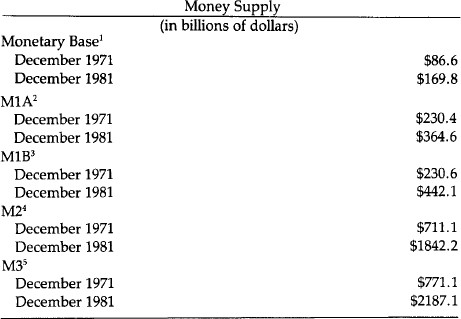
All these figures indicate that the money supply in the space of 10 years has more than doubled, as measured by three of the five standard statistical series produced by the Federal Reserve. This is all the more significant, for neither the population nor American productivity increased by anything approaching that rate over the same period. Since increases in productivity and population are traditionally mentioned as reasons for increasing the money supply, neither of these factors can be used as the excuse for the massive creation of new money and credit of the Federal Reserve over the past decade. In April 1970, our population was approximately 203,000,000. By April 1980, it was 226,500,000, a 12 percent increase. Using the lowest of the money supply statistics, our money supply increased by 58 percent over the same period. Using the largest of the money supply money figures, the money supply increased by 184 percent. Neither figure is commensurate with a 12 percent increase in population over the decade.
As for the real growth of the Gross National Product, in 1979, GNP was $1,107.5 billion; during 1981, it was $1,509.06 billion, an increase of 36 percent. Again that figure does not even remotely approach the growth of the money supply over the same decade.
It is safe to say the money supply is growing three to four times faster than the real economy. Professor Milton Friedman argues that economic growth is not always related to monetary growth and that some of the best periods of economic growth in our history were associated with minimal money growth. This fact is one of the hardest to grasp by sincere economists and politicians, and yet it is most important in order to understand why commodity money is superior to paper money. Duplicating money substitutes can never replace the benefits of a trustworthy unit of account, one that encourages saving and prompts low interest rates. The duplication process does the opposite: It destroys trust, discourages savings, raises interest rates, slows economic growth, and does not create wealth.
Prices
The record for prices since 1971 is not very encouraging. The standard measures of price growth are the consumer price index, the producer price index, and the implicit price deflator prepared by the Departments of Labor and Commerce. Although price increases are the consequences of the government’s increasing the supply of money and credit, most people still refer to these increases as inflation per se rather than the result of the inflation. Nevertheless, price increases are measurements of the harm done and are a reflection of the dollar’s depreciation. Since prices are never uniform some segments of the society suffer from them more than others.
The following price statistics dramatize vividly the sharp depreciation of the currency over the past ten years.
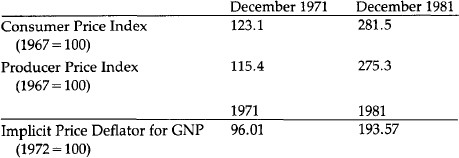
Retail prices, as measured by the best statistics that the government has produced, have more than doubled during the decade of inconvertible paper money. What one Federal Reserve note purchased in 1971, it now requires approximately two and one-half Federal Reserve notes to purchase. This depreciation in the value of our inconvertible paper currency is characteristic of all such currencies throughout history. As long as the currency remains a fiat currency, one not redeemable in something of real value, we can expect the money supply to increase at unreasonable rates, depreciating the currency’s value and resulting in persistent price increases of all goods and services. There is no question whatsoever that the problem of rising prices, although existing before 1971, has been made significantly worse since the closing of the gold window.
Interest Rates
Interest rates since 1971 tell the same story. They have reached heights never seen before in our history, including the greenback era of the Civil War. The prime rate soared to over 21 percent during the past decade, and higher rates are bound to occur if sound money is not restored. The supply and demand for money certainly plays a part in establishing the rate of interest, but today the inflation premium the premium charged for the anticipation of further dollar devaluation—is the principal cause of fluctuating high interest rates. Since paper money is always depreciated by politicians, it should be expected that unless a redeemable dollar is once again established, the problem of high interest rates will not only continue but get worse. Unfortunately, high interest rates are frequently seen as a cause of inflation rather than as a result, which prompts many sincere individuals who have been victimized by these high rates to call for controls on the rates (usury laws) or for credit allocation. These policies can only make the problem worse, since they do not get to the root cause of the high interest rate: the inflation of the money supply and depreciation of the currency. Interest rates are inversely proportional to the trust the people have in the money. Until the trust is restored in the money (and in the government which has destroyed the money), high interest rates will continue. The record for interest rates for the past 10 years is a poor one and must be seen as a reflection of monetary policy.
Interest Rates Since 1971
Conventional Home Mortgage Rate
December 1971 7.67%
December 1981 15.98%
Low for decade 7.44% (April 1972)
High for decade 15.98% (December 1981)
Prime Lending Rate
December 1971 5.25%
December 1981 15.75%
Low for decade 4.75% (February 1972)
High for decade 21.75% (August 1981)
91-Day Treasury Bill Rate
December 1971 4.02%
December 1981 10.93%
Low for decade 3.18% (February 1972)
High for decade 16.03% (May 1981)
Bond Rates AAA Corporate Bonds
December 1971 7.25%
December 1981 14.23%
Low for decade 7.08% (December 1979)
High for decade 15.49% (September 1981)
Public Utilities
November 1971 7.96%
November 1981 15.05%
Low for decade 7.48% (December 1972)
High for decade 16.48% (September 1981)
State and Local Tax-Exempt Bonds
December 1971 5.02%
December 1981 12.91%
Low for decade 4.99% (November 1972)
High for decade 12.92% (September 1981)
U.S. Government Marketable Securities (All Maturities)
November 1971 5.37%
November 1981 12.401%
Low for decade 5.051% (March 1972)
High for decade 15.83% (October 1981)
Even with a reduction in the rate of price inflation, interest rates have remained high. This reflects the lost confidence in the currency and in the Congress’s ability to deal with the problem. With deficits soaring and the Federal Reserve able to create new money at will, the lack of confidence is justified and understandable.
Bankruptcy Since 1971
Whenever a businessman complains about the economy and the difficulties he faces in maintaining a profitable business, he speaks mainly of the burden of high interest rates. Currently he sees this expense as the crippling blow to maintaining a successful business. It is practically impossible to maintain a profitable business on borrowed capital costing more than 20 percent. The interest burden has in turn led to an enormous growth in the number of personal and business bankruptcies in the past decade. Many financial institutions—in particular the savings and loans—are facing bankruptcy and are currently being absorbed by larger institutions with the assistance of tax dollars. The estimate of the number of savings and loans in danger of failing is well over 1,500. However, the proposal in Washington to “save” these institutions involves the same procedure used to “save” New York City and Chrysler—more inflation associated with a frantic effort to avoid debt liquidation by deflation.
Although bankruptcies do liquidate debt in a conventional way, large corporations, cities, states, and financial institutions are “bailed out.” Financial institutions are bailed out by government-mandated and regulated takeovers by “stronger” institutions.
Those allowed to fail have been and will continue to be the smaller companies and individuals. The statistics show a rapid increase in personal and business bankruptcies since 1971—evidence of unmanageable debt service associated with high interest rates.
Business and Personal Bankruptcies and Failures
Since 1971
1971 201,352
1981 519,063
These figures can be expected to increase, and they would be even worse if no firms were “bailed out” by government programs granting loans and guaranteeing loans (greater than $800 billion). These programs may keep the figures artificially low for a time, but they will obviously contribute to more inflation at a later day, a weaker economy, and the threat of even more bankruptcies later on.
Bonds and Mortgages
In the 1970s we have seen the virtual destruction of long-term financing in the United States. A key to a capitalistic economy is availability of long-term borrowing, and without its reestablishment, economic stagnation can be expected. Long-term markets cannot be restored without restoring the belief that the dollar will no longer be depreciated.
Home mortgage rates of 17 and 18 percent guarantee that a very few people will qualify for the purchase of a new home. This is destroying the housing industry and is a prime contributor to the high unemployment rate we are now experiencing.
Bonds are no longer the investment of widows and orphans, but have joined the ranks of speculative investments with investors hoping to catch minor price swings, make a profit, and then quickly sell. This is no way to build a healthy market economy. In 1945, the Standard and Poor’s Index of bond prices was 121.6 for current 1945 and gold dollars. By 1981 in current dollars, it was 38, in 1945 dollars it was 9 and in gold dollars it was 2.4. It took 3.2 ounces of gold in 1945 to buy the index and .09 ounces in 1981. The bond market in Britain, which leads us by a few years in such matters, has already been destroyed.
An investment in 1971 in gold would have yielded a 17.8 percent annual return. A similar investment in a U.S. bond would have declined 5.2 percent annually in real terms.
The message of the dollar’s illness came sooner in the bond market than any place else. It has moved downward since 1945, but the precipitous drop occurred in the decade since 1971. Without the reversal of long-term bond markets, true capital formation is impossible. True savings of the future will not occur under the conditions existing today, and the only credible reassurance is a precisely defined and guaranteed monetary unit.
Employment and Real Income
As one would expect when a nation’s currency is depreciated by creating an excessive amount of it, the real wage of the working man is bound to go down. Even though in the early, less detectable, and more modest stages of inflation, increases in productivity can stay ahead of the depreciation and give the impression that inflation is, beneficial, the results noted in the 1970s were inevitable and predictable. Real income suffered more than at any other time in American history. There was a 13 percent drop over a 10-year period.
Spendable Average Weekly Earnings
(1967 dollars)
December 1971 $95.04
December 1981 83.19
The recession or depression that follows periods of monetary inflation is the correction that comes as a result of malinvestment due to the false information of distorted interest rates. During a correction, as the economy tries to right itself, a period of unemployment results. If the correction is aborted and “corrected” by resumption of more inflation, each cycle will give us more unemployment. Since 1945, we can see that each cycle has gotten worse: higher interest rates, higher prices, and higher unemployment. Today, we see the unemployment levels higher than any since the Great Depression.
Unemployment
December 1971 4.695 million (5.5%)
December 1981 9.462 million (8.9%)
Unemployment is now at a critical stage, and even if another cycle is entered and this rate is temporarily reduced, it is to be expected that without the adoption of a sound monetary system, unemployment rates will continually get worse.
Personal Savings Rate
When a currency loses its value by deliberate and steady inflation, the tendency, as more and more citizens become knowledgeable, is for a lowered savings rate. Since the exact rate of depreciation-actual price increase of goods and service—is unpredictable, it becomes impossible to anticipate and fully protect the purchasing power of savings by correctly establishing the inflationary premium on interest rates. There is a disincentive to save since price inflation is usually greater than the extra interest earned. But more importantly, it is unpredictable. Many figure it is better to buy something this year rather than next (when they will actually need it) when the price will be much higher.
Personal Savings Rate
1971 8.1%
1981 5.3%
Savings are discouraged even further if interest rates paid are artificially controlled by government regulations. The shift of funds from the savings and loans to the money market mutual funds is not much of a mystery. Even though savings and loans are starved for savings, they have championed the continued fixing of low interest rates on savings accounts, hoping that this special benefit will continue. Although this did help in the early stages of inflation, now when the spread is 7 percent to 12 percent between what savings and loans will pay and the market rate, we cannot expect that resumption of savings in the conventional manner will come quickly. Without true savings, capital formation is impossible. And without adequate savings, government officials are pressured to try to create “capital” by money creation, a policy that will only make the problem worse. There will be further depreciation of the currency, with more monetary inflation, thus increasing even further the disincentive to save. Only with the cessation of inflation through reinstitution of a hard currency will we see a significant increase in true savings. Economic growth depends on savings (and other things like low taxes and minimal regulations), not on the growth of the money supply as so many believe today.
Monetarism—Not the Answer
The obvious failure of the discretionary monetary system has prompted the popularization of monetarism in recent years. This is the view that the federal government should manage the nation’s money system and supply, increasing the number of dollars each year by between 3 percent and 5 percent. The monetarists share our view that the Federal Reserve’s discretionary policy of the last several decades has been the cause of our inflation. However, we are confident that the monetarist solution is unworkable. Since October of 1979, the Federal Reserve has directed its attention to regulating the money supply and has abandoned its traditional intense concentration on manipulation of interest rates. Yet we now are witnessing more erratic movement in the money supply (and interest rates) then ever before.
The excuses given are: “The monetary technicians are at fault”; “The wrong parameters are being used”; “The wrong M is being watched”; “The wrong people are in charge.” The excuses are unlimited as to why monetarism is failing. The explanations are always given by those monetarists who do not assume the responsibility for making monetarism work. It is certainly true that neither here in the United States nor in England has monetarist policy followed the textbook description of how monetarism should be implemented. What the monetarists will not admit nor even consider, however, is that it is not being followed because it cannot be followed. They prefer to believe that it is the shortcomings of the technicians rather than of the monetary system itself.
The notion that deficits do not matter so long as they are a certain percent of the gross national product, as claimed by some of the monetarists, is not acceptable. It ignores the fact that total annual borrowing of the federal government exceeds the annual deficit as the total debt is turned over more and more rapidly. A sound monetary system works hand in hand with a balanced budget, giving the citizens assurance of no possible future plans to “break the rules” and start inflating again. Many who downplay the deficit (some supply-siders, Keynesians, and monetarists) emphasize correctly that it is not inflationary if the debt is not monetized. But they fail to consider the inflationary pressures created by the real debt—the on-budget deficit, the off-budget deficit, the guaranteed loans, and the direct loans—a much larger problem than the conventionally accepted annual federal deficit. The political pressures to monetize the debt are inexorable.
Monetarism ignores man’s nature and assumes that if money managers and politicians are given the power to increase the money supply at a 5 percent annual rate, they will not abuse that power. History shows that governments and the people in charge will always abuse the “right” to create money if it is granted to them.
Monetarists cannot agree on the precise definition of money. Some prefer the monetary base (bank reserves plus circulating cash); others prefer M1B (cash plus checking and transfer accounts). Since M1B is no longer satisfactory, M1A and M1B have now been dropped and M1 is presently the key M to watch, according to some. Still others believe M2 is the key M to watch. Nothing guarantees that if M1 or M2 become difficult to control, a new M will not be created. A sound monetary system cannot be this arbitrary.
The theory of monetarism advocates a deliberate and controlled monetary inflation of 3–5 percent per year to coincide with economic growth so as to produce price stability. If we don’t know what the economic growth will be in the year to come—2 percent or 6 percent—we cannot know how much money to create in order to produce price stability. We cannot wait until after the growth occurs, for it serves no purpose—the money then comes into the economy too late. The monetarists fully recognize that money growth as we have had it in the past decade is injurious to economic growth, but claim that a 5 percent growth in the money supply would not be. The truth is that any inflation-even monetarist inflation—is harmful, and that a 4 percent growth of the money supply cannot produce economic growth of 4 percent. The two are unrelated.
The central purpose of a monetary standard is trust and honesty, not stable prices. The reason gold is superior to all forms of paper is that it provides this truth and honesty, permits and encourages savings, enhances economic growth, and as a secondary benefit allows prices to adjust freely in the marketplace (yet long-term price stability is achieved more with gold than with any other standard). “Stable” prices cannot be achieved any more easily through monetary policy than they can through wage and price controls; that is, they cannot be achieved at all.
Both monetarists and gold standard advocates want to stop the present inflation. Monetarism claims that a gradual reduction in the rate of money growth can get us to where we want to be. Gradualism has not worked in England nor in the United States so far, and there is no indication that it will. Gradualism does not ensure credibility. Restoring convertibility and defining the dollar as a precise weight of gold is the only way the psychology of inflation can be broken. Although the money supply is very important, an absolute relationship of money supply to prices does not exist. Ultimately, all prices (and the value of the dollar) are set by the market, not by the monetary authorities.
Monetarism is similar to a discretionary inflationary policy in that the government remains as the monopolist fully in charge. In contrast, with a fully convertible gold standard, the people are in charge and can call the government’s bluff anytime they choose by turning in their paper certificates for gold. The unit of account, as Jefferson stated, must be defined “with precision.” A gold standard does this by defining the unit in a weight of gold—a paper standard provides no definition, and the unit of account is arbitrary and is inevitably depreciated by the money managers. Trust can never be restored with a paper currency.
A New Attitude
The final severance of our currency’s link to gold in 1971 ushered in a new attitude among Americans unknown previously in our history. Even though there were short periods during wartime when an inflationary psychology existed, it never persisted for an indefinite period and it has never been as pervasive as we are experiencing now. Associated with this inflationary psychology is a general attitude toward government and life in general. Pessimism has replaced our traditional optimism. Scheming, speculation, and sophisticated tax avoidance have replaced productive efforts, savings, and planning for the future.
Trading in currencies can now be more rewarding to banks than the conventional business of brokering loans from savings. The futures and options market has turned into a giant gambling game. The new markets that have developed since the dollar lost its precise definition reflect the ingenuity of man. Now we see futures sold in currencies, betting on the monetary inflation of various governments. Instead of buying a bond or treasury bill and holding it, we now can speculate on a daily and massive basis.
Just this winter, futures and options began to be sold on stock indexes. One is able to buy futures on large CD’s as well. Outstanding European rate futures and GNMA options (GNMA futures started in 1975) will be offered also. Billions of dollars are now used in industry for the purpose of “takeovers” of other industries with no real signs of developing new industries or re-capitalizing old industries. The dollar amount involved in the speculation is into the trillions of dollars from these various ventures. All this is a result of unsound money. Ten years ago, most of the futures and options markets did not exist.
With a sound currency there would be no speculation and trading in U.S. government bonds. Speculation would be minimal as compared with today. Their value would be predictable and betting on their day-to-day value would be meaningless. Yet in 1980, on the Chicago Board of Trade, far more U.S. Treasury Bond futures contracts than cattle contracts were traded. The options market is also growing by leaps and bounds and becoming more sophisticated and more complex every day. The frenzy with which the speculation is growing is literally incomprehensible and immeasureable. This tendency will continue so long as we are operating with an unsound currency that is being deliberately depreciated on a regular basis.
The speculation has spilled over into the fiscal arena as well. In 1980, $2,107,325,000 was collected by state-run lotteries. It is illegal for most citizens to gamble, but it is legal for governments to operate lotteries to raise revenues.
In the past decade the definition of money has undergone continuous change, reflecting the new rules of a fiat monetary system. In 1970 the Federal Reserve had a single monetary aggregate. In 1971 the concepts of M1, M2, and M3 were introduced. By 1975 it became necessary to define two new aggregates, M4 and M5. The more chaotic money management became after the dollar-gold linkage broke down, the more the definition of money was changed. After the mid-1970s “demand” deposits were virtually impossible to calculate due to interest-bearing transaction accounts. This prompted the temporary use of a measurement called M1+ in 1978.
By 1980 a major redefinition of all the monetary aggregates was required. The turbulent international monetary crisis of 1979 convinced many that current definitions and money management were totally inadequate. Five new definitions were introduced: M1-A, M1-B, M2, M3, and L. Even these did not suffice. In 1981 the Fed started publishing a “shift-adjusted” measure of M1B to account for the new nationwide NOW accounts. By 1982, this adjusted measure of M1B was dropped, and M1A and M1B became M1.
It’s probably safe to predict that new definitions will be invented in hopes that the impossible task of managing a fiat monetary system will be miraculously achieved by new measurements. This problem of measuring monetary aggregates would not exist under a gold standard, for there would be no purpose in it.
This decade has taught Americans to accept for the first time that their standard of living, over a period of years, is more likely to go down than up. It is also recognized by many Americans that conditions caused by inflation and the tax code are achieving a transfer of wealth from the large middle class and the working poor to both the rich and the welfare poor. Average people can no longer buy houses, cars are smaller for the shrinking number who are still able to buy one, most people pump their own gas, and household help and other services are on the wane. These have all led to a sense of frustration and anger.
More and more Americans have resorted to the underground economy to compensate for losses they see as unfair. Lawbreakers have replaced lawabiders. Fear of the unknown has prompted a whole subculture of survivalists—convinced by their own analysis that the government in the foreseeable future will not adopt a sound monetary system. This group no longer depends on conventional news services for their information and relies on expensive newsletters for what is considered accurate information regarding what is happening to the monetary system. It is easy to write them off as speculators, but compared with “speculating” in five percent-per-year losses with a government bond, it seems that their existence and their success are a reflection of our inflationary monetary policy. There is a sincere attempt by a growing number of Americans to preserve assets that have been earned over a period of time and whose value is threatened by inflation. For this reason, tens of thousands have attended hard money conferences in the past 10 years in the hope that they can learn how to protect themselves from the destructiveness of a government-caused inflation. This is a new phenomenon and is directly related to the breakdown of the Bretton Woods and Smithsonian Agreements. Prior to 1974, the conferences were virtually unheard of.
In 1968 and 1971 a vocal minority decried the abandonment of gold convertibility and predicted the subsequent events of the 1970s. A remnant throughout the period of the dissolution of the gold standard (1913 to 1971) steadfastly proclaimed that one day a gold standard would be required to stop inflation and restore order to monetary policy and to the financial markets. The number of Americans insisting on a sound currency is multiplying rapidly. Today’s events dramatize the urgent need to lay plans for establishing a modern gold standard. A growing number of free-market economists defend the wisdom of the gold standard. Their voices may not have been heard by the officials, but their impact has been felt.
The need for something better than we have today is conceded by almost everyone. The past 10 years have taken a heavy toll with general confidence shattered. Most agree that this country and the Western nations appear hopelessly enmeshed in the problems of persistent inflation, high interest rates, weak economies, and high unemployment. No one expects these conditions to improve without a significant change in monetary policy. It is our purpose in this report to offer and to lay out the plans for a sound monetary system.
1Bank reserves plus currency held by the public.
2Currency plus demand deposits at commercial banks.
3M1A plus checkable deposits at all depository institutions.
4M1B plus savings accounts and small denomination time deposits at all depository institutions and money market mutual funds.
5M2 plus large denomination time deposits and repurchase agreements at all depository institutions.

