
The Case For Gold: A Minority Report of the U.S. Gold Commission
IV. The Case for Monetary Freedom
IV. The Case For Monetary Freedom
America’s First Free Market Gold Coins
Most people assume that governments must be the only parties allowed to mint money. Private minters, the argument goes, will put out coins of uncertain quality and take advantage of people. But not only have privately minted coins flourished; in at least one instance admitted by the U.S. Treasury’s mintmaster, the private minter had the edge over the government.
The first coiners of American copper and silver money were private citizens. Copper coins were minted by one John Higley of Granby, Connecticut. From 1737 to 1739 he issued coins that first were marked with a three pence value. But as he minted more of them, and used them mostly to buy drinks at the neighborhood bar, objections were raised to valuing them at his “high” rate. So he “lowered” his price, and the legend was changed to read “VALUE ME AS YOU PLEASE—I AM GOOD COPPER.”1 Actually, after he stopped minting them, they came to be valued by the market at two shillings, six pence—or 30 pence.
The first American silver was coined after the Revolution in 1783 by I. Chalmers, an Annapolis goldsmith. There had been a shortage of silver, with Spanish silver circulating by being cut into “pieces of eight,” that is into eight “eights.” But unscrupulous cutters were cutting the coin into nine or ten “eights,” and Chalmers’ idea of minting American shillings and pence was well-received. Unfortunately, Chalmers succumbed to the same temptation that has afflicted national money issuers: He started putting in less silver for the same face value.
Coin shortages plagued early America, with all the minor inconveniences associated with that condition. People responded by making their own money. As William Wooldridge wrote, in his fine chapter on private coinage in Uncle Sam the Monopoly Man, people made money “in whatever quantity suited the need or the impulse of the moment, out of whatever medium they found most convenient, and emblazoned it with whatever device, portrait or motto they fancied. They passed it on to whoever would take it and then made some more. Not only did the United States have a private coinage, it had dozens, at one point hundreds, of private coinages simultaneously.”
Many of these have survived. One particularly affecting copper coin has on its obverse a kneeling slave woman in chains with the legend, “AM I NOT A WOMAN AND A SISTER[?].” On the reverse is “UNITED STATES OF AMERICA,” and “LIBERTY/1838” within an olive wreath. Some copper coins cleverly skirted the counterfeit laws, rarely enforced in times of shortage. One penny-size coin says “NOT ONE CENT, BUT JUST AS GOOD.” At least some of these coins, minted before 1840, were still found in circulation as late as 1879.
Gold Coins
By their nature, gold coins don’t usually serve as small change. Therefore, we find private gold much less frequently than silver and copper. And their issuance was local, only in places where the U.S. Mint had not provided adequate assaying or coining facilities. Further, because gold is much more valuable, any private mintmaster would have to build up his reputation for integrity over many years. This also limited the number of minters.
There were some private gold coins, however. The first were minted by Templeton Reid in Lumpkin County, Georgia. He produced $10, $5, and $2.50 gold pieces roughly the same in weight and fineness as “official coins” of like value. Although all his coins are dated 1830, he minted after that, but no one knows for how long. It is known that he was doing business in California in 1849.
The brightest name in American private gold coinage is Christopher Bechtler, a German immigrant who arrived in Rutherfordton, in western North Carolina in 1830, then the premier gold-producing area in America. He began minting coins one year later and continued until he died in 1842. There was a crying need: The nearest federal mint was in Philadelphia, too far to provide much circulating gold or to enable miners to travel there easily and have their gold coined.
Bechtler minted, along with $2.50 and $5 coins, the first American gold one dollar, 18 years before the United States did. By 1840 he had minted $2,241,840.50 worth of gold—roughly one-fourth of the total North Carolina coin values from the first mint record in 1804 through 1839. He coined for a profit of two and one-half percent of the bullion he handled. But he never accumulated great wealth, and his integrity became legendary. A book published in London in 1847 by G. W. Featherstonebaugh (A Canoe Voyage Up the Minnay Sotor) related how impressed people were with his honesty in making his coins the same value as official U.S. coins.
Both Bechtler’s coins and his reputation were known far and wide. The emigrations of the 1850s brought many of his coins out west. And in Massachusetts constitutional lawyer Lysander Spooner argued that if Bechtler was allowed to coin money constitutionally then surely Spooner’s private American Letter Mail Company (which made him a folk hero for carrying mail faster and cheaper than the post office) should be allowed to carry mail privately.
In fact, only a legislative oversight long since changed kept Bechtler out of jail. While private coinage of copper was considered counterfeiting, there was at that time no similar prohibition on silver and gold coinage.
So highly regarded was the Bechtler dollar that even when the United States Mint opened an office in Charlotte, North Carolina in 1838, Bechtler successfully competed with it. His equipment is now in museums: his dies at the North Carolina Hall of History at Raleigh, and his press at the American Numismatic Society in New York. They act as proof that someone once successfully competed with the government in money, the service which “everyone knows” only the government can provide.
Other Gold Coins
During the California gold rush government minting offices were sometimes slow in appearing and private firms filled the breach. By 1852, 14 companies had sprung up. While the absolute amount coined by these firms ($4,240,000) was larger than by Bechtler, they handled a much smaller percentage share of the roughly $260,000,000 worth of gold coined by 1854.
But though the general appearance of these $5, $10, $20, and $50 coins resembled each other, their value was not uniform, and some of the firms were not completely honest in their minting. In any case, in 1854 the San Francisco mint was established, and private coinage was discouraged. But at least $2 million worth of these coins circulated for years to come.
Other Western states were host to private gold coinage. The Orange Exchange Company in Oregon City, Oregon, issued $5 and $10 coins in 1842. The Mormons struck $2.50, $5, $10, and $20 coins in 1849 and 1860. They bore the legend “HOLINESS TO THE LORD” on one side, and the letters “G.S.L.C.P.G.” (Great Salt Lake City Pure Gold) on the other. In discussing one assay of these coins, Bankers’ Magazine (vol. 4, 1849-50, p. 669) opined, “If this assay at the mint be a fair test of the value of the whole of the Great Salt Lake manufacture of coin—the Mormons seem to know what they are about, and to be determined to make the best of their gold mines.”
Three Colorado companies minted $2.50, $5, and $10 coins in 1860- 61. They made quite a bit of the coins, which had circulation all over the West. They were larger than “official” gold coins, but had more of a silver alloy in them, making them paler in color than other gold coins. Of the three minters, only those coins of Clark, Gruber and Company tested out well against government coins. The others presumably traded at discount. The desire for these coins continued until the Denver mint was established in 1863. Finally, a Leavenworth, Kansas, mint issued in 1871 a half-dollar gold piece (which must have been very small). But it tested out at only 17 cents, and its creators were prosecuted—not for fraud, as they should have been, but for counterfeit. The state of Kansas had passed in June 1864 the first act prohibiting private gold coinage.
Altogether, then, we find private gold coins minted in seven states and territories. In 1851, when the Philadelphia mint assayed 27 different kinds of gold coins, no less than 15 private mints were represented. That was the peak of private gold activity because with the Civil War the nation went off the gold standard, though in the West gold continued to circulate. And by 1879, when gold redemption was restored, non-governmental minting of gold coins was generally illegal.
Granted, the short history of private gold contains instances of dishonest minters. Gold Rush California in particular was the site of flyby-night operations. And yet the example of Bechtler hints to us that if the government would have gotten out of the way, and private minters given more time to establish their reputations, a sturdy system of private coins of sound repute and wide circulation would have arisen. They could have done so either by weight or stamped-dollar value. Without a doubt, not all of them would have kept honest. The temptation to debase coins has always been strong. And yet the firms doing so would have lost business to the Bechtlers of the trade. In a system of competing private money, when one goes bad, consumers can always turn to another. But today, when only Washington has the monopoly on money, what protects us when the government debases its currency?
Free Banking in Scotland (1714-1844)2
Not only does economic freedom work with regard to coinage, it has had spectacular results when applied to banking. As shown in chapter two, one of the prime causes of economic instability in the 19th century was the special privilege conferred on banks by either the state or federal governments. These privileges, which protected the banks from their creditors and allowed them to pyramid money supplies, caused the banking panics of the last century. But if one were to eliminate those privileges, the resulting instability would also disappear.
There once was a country with a stable banking system the envy of the rest of the world. While there’s nothing so extraordinary in that, it was a system with aspects almost everyone would call—were it proposed to them—unworkable. Not only was there no central bank, there were no legal tender laws, no political banking regulations, no monetary policy, and no restrictions on the right of anyone to form a bank and issue his own money. The country was Scotland from 1714-1844. When English law put an effective end to this “free banking” regime, there were 19 different banks issuing their own notes.
The Bank of England, the first central bank, was founded in 1694. A year later, a Bank of Scotland was founded by the Scottish Parliament. (They were still technically two different countries.) The Bank was given a monopoly of issuing paper money for 21 years. This expired in 1716, and no effort was made to renew it. All apparently thought that there would never be any other note issuers.
It’s important to realize that despite its official-sounding name, the Bank of Scotland was a completely private institution, with no governmental connection. Indeed, the act creating the Bank prohibited it from lending to the Scottish government. But after 1707, there was no more sovereign Scottish government, as the two parliaments merged into one, in London. This was in the reign of Queen Anne, a (Scottish) Stuart. When she died a few years later, the German Hanovers acceded to the throne, and their descendants still sit upon it. But this did not sit well with many Scots, who longed for a Stuart king. Their men were called Jacobites, and England would wage war upon them until “Bonnie Prince Charlie” was finally defeated in 1745.
All this is important to our story. In 1727, the Bank of Scotland’s first real rival in note issuance was formed, the Royal Bank of Scotland. The Bank of Scotland petitioned the English king for monopoly status, but the English ignored the request, aware of the Bank’s Jacobite sympathies.
There now began something unprecedented: a “note duel” whereby each bank would send large quantities of the other’s bank notes back to it and demand specie redemption. The old Bank, having less silver, lost the duel and for several months in 1728 suspended silver payments. It intended to reopen, though, and it did. All the while it paid a 5 percent interest rate to its note holders to keep demand from collapsing. The Bank’s notes traded at par all this time. The Royal Bank soon began paying interest rates on deposits; this, long before English banks did. It was an obvious benefit of competition in banking.
The two banks remained the only rivals until 1750. Each were Edinburgh banks and each sponsored a Glasgow bank to act as its note “salesman” in that city. To the surprise of each, both banks soon began issuing their own money. Neither note-dueling nor a cartellization attempt to divide the nation into two “districts” worked, and a proliferation of “banks of issue” occurred. There were a few who issued far more paper than they had silver to back it, and they soon went bankrupt. But most were successful. One of these newcomers, the British Linen Company (later Bank), became the world’s first innovator in branch banking, having 12 branches by 1793.
During this time, there were sporadic attempts by the first two or three banks to obtain a money-issuing monopoly for themselves, but these failed. What laws did pass left the system largely intact. The Act of 1765 outlawed notes in smaller denominations than one pound and insured that all notes were to be redeemable in gold on demand. The total number of Scottish banks (issuing money or otherwise) climbed from five in 1740 to 32 in 1769. In that year the Ayr Bank was founded on the inflationist schemes which the Scotsman John Law had tried unsuccessfully to get the Bank of Scotland to adopt in 1705. (He later got the French government to listen to him and caused the first nationwide paper money inflation.) Law’s idea was for a bank to issue notes not backed by gold or silver, but on the reputation of the issuer and “backed” by land.
In a mere three years, the Ayr Bank managed to create a tremendous amount of unbacked paper, and when it finally collapsed in 1772 losses amounted to two-thirds of a million pounds, a staggering amount for those days.
But the intriguing thing is that the Ayr Bank’s collapse had limited repercussions. It took with it only eight small private banks in Edinburgh. This is largely because of a well-developed clearinghouse mechanism that the large Scottish banks employed. They accepted each others’ notes and returned those notes to the issuing bank. Suspicious of the Ayr Bank’s issue, other banks made a practice of quickly returning Ayr’s notes to it. When the collapse came, they were not affected.
Nevertheless, to insure public confidence (and get their own notes into wider circulation) the two largest banks, the Royal Bank and the Bank of Scotland, announced that they would accept the bankrupt bank’s notes. This was not as mad as it may appear. The collapse had few rippling effects because of Scotland’s extraordinary practice of unlimited liability on the part of the bank’s shareholders. So Ayr’s loss was borne completely by the 241 shareholders, who paid all creditors in full.
Scottish banking grew apace, and around 1810 a new development occurred. This was the founding of the Commercial Bank of Scotland on joint-stock principles. Joint-stock banks, unlike private banks, raise their capital by selling shares of stock. This development grew and with it branch banking. By 1845, there were 19 banks of issue with a total of 363 branches across Scotland, or one branch for every 6,600 Scots. This compares with one for every 9,405 Englishmen and one for every 16,000 Americans at that time.
This was the heyday of Scottish free banking. The arrangement approached the ideal: many competing banks with none disproportionately large; their notes circulating throughout the country (and even in northern England) being exchanged effectively by the banks themselves through a clearinghouse; and competition keeping profits down, with small spreads between the interest they paid depositors and the interest they charged borrowers.
These banks were the envy of thoughtful Englishmen. Scottish banks consistently proved themselves more stable than their English counterparts. While English provincial, or “country,” banks were able to issue their own notes until 1845, there were many differences. The Bank of England (a state institution) limited their size and refused to accept their notes. Further, the Bank did not branch out of London until an 1826 law encouraged it to do so. So for years, England was bedevilled with small, unstable country banks and an uncompetitive Bank of England (which unlike Scottish banks paid no interest not only on demand deposits, but even on six-month certificates).
During the financial panics of 1793, 1797, 1815, 1825-26, and 1837, English country banks collapsed right and left, while the record for Scotland was always far better. When in trouble, Scottish banks could always turn to each other for help, which the stronger banks would give for reasons of self-interest as we saw in the extreme case of the Ayr Bank. English country banks had no one to turn to.
From 1797 to 1821, England suspended gold payments. Scotland went along not because it had to but because it realized that its gold would be drained if it didn’t. And there is evidence that Scottish banks quietly continued gold payments to their best customers.
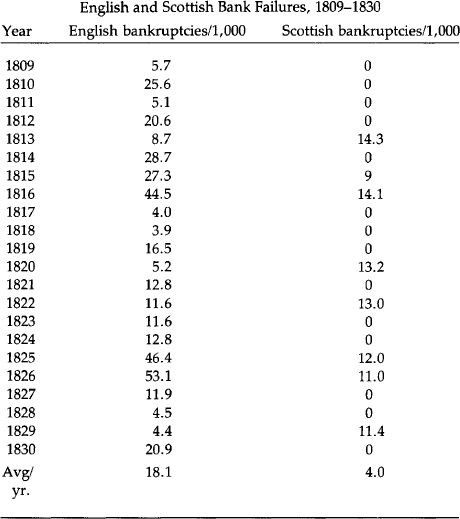
In computing the Scottish bank failure rate, up to three branches of a bank were similarly included in the computation, while non-issuing banks were excluded. The number of branches was estimated by interpolation where figures for a particular year were not available. No more than one Scottish bank failed during any year in the sample.
This difference between the two nations is graphically illustrated by a cartoon published in the Northern Looking Glass in 1825, a year of severe panic in Britain. (This is reproduced in Checkland’s Scottish Banking, A History: 1695-1973 (Collins, 1975), p. 407.) Entitled “State of the Money Market,” it shows two scenes: “England” with a fat banker in the midst of banks and paper crashing down around him and “Scotland,” where two tartaned Scots are happily dealing in coin, with bags more of it visible across the banker’s desk. While 60 English banks collapsed in 1825-26, none in Scotland did, although some partners sustained severe losses.
As an interesting aside, counterfeiting was never a problem for Scottish banks, a situation unlike the Bank of England, especially during the latter’s suspension of gold payments. Perhaps this is due to the much shorter average life of Scottish notes. Turnover was heavy and the issuing bank quick to catch on. Even so, Scotch banks would honor counterfeits if turned in by innocent parties. To do anyting else would have been bad business in a truly businesslike atmosphere.
The first editor of the London Economist, James Wilson, wrote in 1847 that “we have only to look at Scotland to see what has been the effect of a long career of perfect freedom and competition upon the character and credit of the banking establishment of that country.” Yet two years before those words were written, legal action finally brought the “career of perfect freedom” to an end. Peel’s Act of 1844 and the Scottish Banking Act of 1845 abolished freedom of entry into banking and the right of those remaining banks of freedom of note issue. However, Bank of England notes were not forced upon Scotland as legal tender; only gold was so established.
Abolition of free entry caused a gradual reduction in banks issuing notes, and Scottish pound notes today have long since become like those of any other part of Great Britain. That is, with one exception. If you go to Scotland today, you will see pound notes issued by the three remaining banks of issue in business before 1845: the Bank of Scotland, the Royal Bank of Scotland, and Clydesdale Bank. These are actually as good—or as bad—as the Bank of England’s notes circulating throughout the rest of the United Kingdom because everything else about them is dictated by the Bank of England. But they provide daily proof that once there was a free market in money issuance with no legal tender laws and that the system worked very well.

