

The Supreme Court’s 6–3 decision invalidating Donald Trump’s emergency tariffs, followed almost immediately by the President’s response reinstating and increasing them, reminds us once again how rapidly American politics evolves. Yet, in some cases, it pays to recognize that certain underlying threads in government policy remain constant, regardless of the period or the leaders in charge.
Too often, so-called “experts” weigh in on current events without any real command of economic history. Consider the outrage among prominent Republicans over Trump’s bombastic campaign promises and what his detractors see as troubling moves after returning to office.
In a December 2025 op-ed for The New York Times, former presidential candidate Mitt Romney contended that tariffs “burden lower- and middle-income families,” pointing to analyses showing they act as a regressive tax that hits the poorest Americans hardest. Still, in the same piece, he echoed progressive rhetoric by calling for higher taxes on the rich, himself included. We have no intention of defending Trump here, but one neglected aspect deserves attention.
For decades, a persistent myth has held that the Reagan-era GOP heralded an age of unfettered laissez-faire capitalism, nudging the entire ideological spectrum toward pro-free trade, business-friendly positions. It thus became natural to portray Trump as an outlier in the Republican fold—an irritating, heterodox chapter in the story of a party that, on the surface at least, has long championed individual liberty and small government. The truth, however, is far more nuanced than the dominant narrative would have us believe.
To debunk this simplistic notion, we must dissect the most salient aspects of Trump’s platform and compare them with the GOP’s historical record.
Protectionism
Protectionism stands as the policy Trump touts most proudly, so much so that he has proclaimed himself “Tariff Man.” He went further still, calling “tariff” the most beautiful word in the English language.
Contrary to conventional wisdom, the Republican Party emerged in the mid-1850s by inheriting Henry Clay’s “American System,” which formed the cornerstone of the Whigs’ agenda: leveraging the federal government to stabilize finance, protect and foster domestic industry, and build national infrastructure.
Whigs and early Republicans both favored higher tariffs not only to generate federal revenue, but also to safeguard and promote US manufacturers, with the goal of developing a more diversified, industrializing economy. As Lew Rockwell aptly noted in the introduction to Murray Rothbard’s For a New Liberty: The Libertarian Manifesto:
The Civil War, in addition to its unprecedented bloodshed and devastation, was used by the triumphal and virtually one–party Republican regime to drive through its statist, formerly Whig, program: national governmental power, protective tariff, subsidies to big business, inflationary paper money, resumed control of the federal government over banking, large–scale internal improvements, high excise taxes, and, during the war, conscription and an income tax.
The US House of Representatives passed the Morrill Tariff on the eve of Lincoln’s presidency. The measure sharply raised tariff rates on dutiable imports and widened the protectionist scope of federal policy. A subsequent adjustment soon pushed rates even higher.
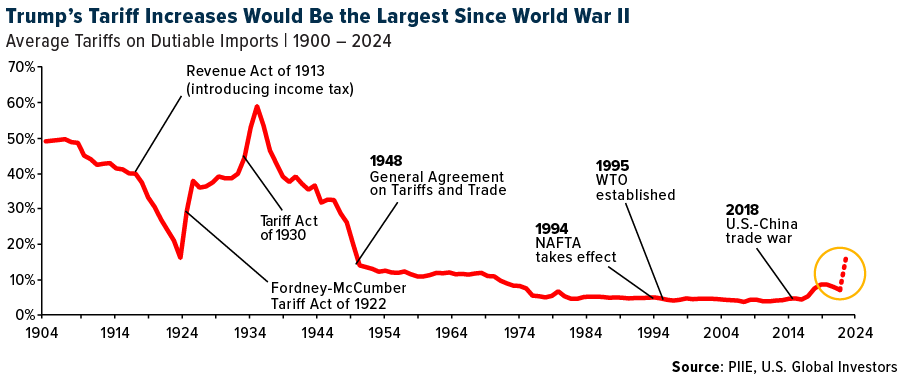
The 1890 McKinley Tariff, named after then-Representative William McKinley, established the highest average tariff level in US history up to that time, with some rates surpassing 100 percent. The Fordney-McCumber Tariff of 1922, enacted under Warren Harding, produced substantial increases in a decade defined by isolationism and protectionist sentiment.
Yet it was the Smoot–Hawley Tariff Act of 1930, signed into law by Herbert Hoover, that delivered the most dramatic escalation of duties in American history to that point. This infamous measure lifted average tariff rates to approximately 60 percent—up from the Fordney-McCumber level of 38 percent—in an effort to shield domestic employment. The result was a cascade of retaliatory tariffs from trading partners around the world.
The Smoot-Hawley Act was a classic example of beggar-thy-neighbor policy, in which one country pursues its own national advantage at the direct expense of others. This zero-sum logic parallels the rationale behind Trump’s tariffs, as the following chart illustrates:
Source: PIIE, US Global Investors
Price Controls
On December 19, 2025, Trump announced nine new agreements with major pharmaceutical companies to lower prescription drug prices for American patients, bringing them in line with the lowest prices paid in other developed countries (known as most-favored-nation, or MFN, pricing). These voluntary deals lower costs for Medicaid programs and certain direct-to-consumer sales, building on earlier MFN efforts from his administration.
The best-known historical precedent came on August 15, 1971, when Richard Nixon declared a 90-day freeze on wages and prices as part of his New Economic Policy. That move aimed to combat runaway inflation and avert a currency crisis amid the collapse of the Bretton Woods system.
It was the first peacetime imposition of mandatory wage and price controls in US history, initially winning broad public support but then proving disastrous. Driven by stagflation and fears of a gold drain after the dollar’s convertibility ended, the inflation rate had climbed above 12 percent by 1974.
The program evolved through multiple phases, including the establishment of the Pay Board and Price Commission to oversee allowable increases. Artificially-suppressed prices quickly led to widespread shortages, most notably in gasoline and steel, with long lines at pumps and rationing conditions. Businesses, unable to cover costs, reduced output, cut quality, or were forced to shut down.
The controls disrupted market signals, prevented economic calculation, and failed to curb long-term inflation, contributing to distortions that lingered for years. Why should we believe similar interventions today would produce different results?
Tax Cuts
Through the 2017 Tax Cuts and Jobs Act (TCJA), Trump’s first term delivered the most significant federal tax overhaul since the 1980s.
This mirrors Ronald Reagan’s 1981 Economic Recovery Tax Act—which phased in a 25 percent across-the-board cut in individual rates (top marginal from 70 percent to 50 percent), accelerated depreciation, and inflation indexing—and the 1986 Tax Reform Act, which simplified brackets and dropped the top rate to 28 percent, but left overall revenue roughly intact due to offsets.
As Rothbard asserted in his critique of Reaganomics, these cuts were illusory and temporary in practice, offset by bracket creep, rising payroll taxes, stealth increases, and massive spending growth that ballooned the federal deficit without structural restraint. Although any tax cut should be welcome, in both cases, these were easily reversible measures that drove deficits higher because they were not accompanied by cuts to public spending and government departments.
Government Spending
The Republican embrace of expansive government spending under the banner of “compassionate conservatism” reached new heights during George W. Bush’s presidency.
In 2003, Bush signed Medicare Part D—a massive new entitlement program providing prescription drug benefits to seniors—with initial costs estimated at $400 billion over ten years, later revised upward to $534 billion. The voluntary benefit, administered through private insurers, represented a major expansion of federal involvement in healthcare, adding trillions to long-term liabilities without corresponding offsets.
Similarly, in October 2008, Bush enacted the Troubled Asset Relief Program (TARP) as part of the Emergency Economic Stabilization Act, authorizing $700 billion (then capped at $475 billion) to bail out financial institutions by purchasing troubled assets, ultimately disbursing $443 billion with a net cost of $31 billion after recoveries.
These interventions underscored the GOP’s willingness to deploy federal resources during crises and foreshadow Trump’s own big-spending tendencies. Bush’s 2008 Economic Stimulus Act also provided $152 billion in rebate checks to over 130 million households, aimed at boosting spending amid the financial crisis.
That approach finds a counterpart in Trump’s 2020 CARES Act—a $2 trillion package that included $1,200 direct payments per adult as part of broader relief, though on a vastly larger scale (12 percent of GDP in 2020 versus 1 percent in 2008). Both initiatives sought rapid economic stimulus but prioritized short-term aid over fiscal restraint.
Conclusion
Trump’s policies are not guided by a coherent philosophy; they form a transactional strategy that draws on tactics employed by earlier Republican leaders. They are best understood as a somewhat disorganized, contradictory blend of neo-mercantilism, national populism, and old-school protectionism, rooted in the Whig program and traditional Republicanism.
Trumpism combines higher tariffs abroad with “fewer regulations” at home, folding in Nixon’s price controls, Reagan’s tax cuts, and Bush’s expansionary policies. All this makes clear that such interventionism is a legacy of the GOP itself—rather than an aberration within the American right—as many analysts wrongly claim.

