

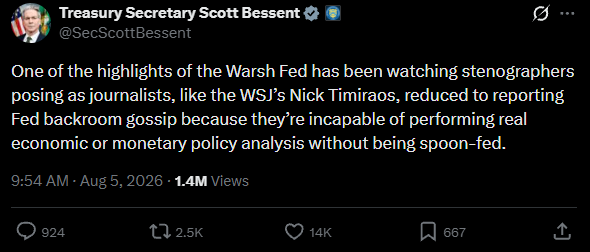
Treasury Secretary Scott Bessent recently took to X to celebrate what he called one of the “highlights of the Warsh Fed.” His post didn’t have anything to do with what kind of monetary policy a Warsh-chaired Fed will do. It was about the humiliation of mainstream financial journalists—which is fine by me, but let me digress on “Fed independence” between mouthfuls of popcorn.
According to Bessent, Fed reporters such as the Wall Street Journal’s Nick Timiraos have been “reduced to reporting Fed backroom gossip because they’re incapable of performing real economic or monetary policy analysis without being spoon-fed.”
Timiraos had reported on Bessent’s attempt to persuade the Federal Reserve to expand its Foreign and International Monetary Authorities Repo Facility (FIMA), so that Japan could obtain more dollars against its holdings of US Treasury securities. Japan could then sell those dollars for yen, boosting demand for its own currency without having to sell Treasurys.
The FIMA repo facility allows approved foreign official institutions to temporarily exchange Treasury securities for dollars. Japan wants to use the facility to get dollars to purchase yen and reverse its recent sharp decline against the dollar. The problem is that the Fed facility has a $60 billion per-counterparty borrowing cap. Bessent wants the Fed to raise that limit.
Japan could finance an intervention by selling some of its Treasury securities. But this would cause US Treasury yields to increase, and they are already too high in the Treasury’s view. By borrowing from the Fed instead, Japan can get the dollars it wants without selling Treasurys. This explains Bessent’s actions.
Timiraos described Bessent’s request as an early test of how Fed chairman Kevin Warsh would draw the line between the central bank and the administration that appointed him. That is a reasonable question. An expansion of the facility would require Fed approval, but the policy objective is clearly a part of the administration’s foreign-exchange and debt-management goals.
Instead of doing the predictable thing by ignoring Timiraos or diplomatically responding to him with a platitudinous non-answer, Bessent attacked the reporter for raising the question.
“Cooperation” and “Coordination”
The conventional story is that the Federal Reserve is independent of the Treasury and that the decisive break came with the Treasury-Fed Accord of 1951. Before the accord, the Fed held interest rates down to facilitate government borrowing. Afterward, it was supposedly liberated to pursue monetary policy without regard to the government’s financing needs.
That history is a myth.
The accord did not establish a boundary between the Fed and the Treasury. The officials involved repeatedly described their relationship in terms of “cooperation” and “coordination.” Treasury secretary John Snyder would not even concede that the Fed has ultimate authority over interest rates. When pressed by Senator Paul Douglas, Snyder said that the final decision on interest rates could only be made by the Treasury. Fed and Treasury officials would, he assured Congress, “work out cooperation.”
As Douglas replied, “Cooperation is a beautiful word, but it is like an overcoat, it covers quite a range of reality.”
That remains a good description of the present arrangement.
Rothbard on the Myth of Fed Independence
Murray Rothbard pointed out that “independence” is a weird virtue to claim for a government agency. Private organizations are independent of politics because they are accountable to owners and customers. A government agency, however, cannot become independent of political control without also becoming less accountable to the public.
To say that the Fed should be independent is the same as saying that an extraordinarily powerful government institution should be “an absolute self-perpetuating oligarchy, accountable to no one and never subject to the public’s ability to change its personnel or to ‘throw the rascals out.’”
Rothbard referred to the Fed independence propaganda as a “deceptive shell game” in which the blame for inflation can be shifted around and deflected. The same blame game occurs between the Treasury and the Fed on more issues than just inflation.
For example, if the Fed goes along with Bessent’s request, defenders of Fed independence can still say that it reached its own independent decision. If the Fed refuses, Bessent can blame any failure on the lack of Fed cooperation. If the yen intervention succeeds, the Treasury and the Fed can both claim credit.
The rhetoric of independence allows the Treasury and the Fed to cooperate when convenient and deflect blame when something goes wrong. This is the central political function of the independence myth, and it’s why I referred to the occasional public feuds between the Fed and the administration as “kayfabe.”
The Government’s Money Printer
The other issue here is that the government knows that it can use the Fed to disguise the cost of its actions.
The Treasury possesses its own means for foreign-exchange operations. It can issue Treasury bills and direct funds through the Exchange Stabilization Fund. But that method is more visible and requires overt government financing.
The FIMA facility offers a more subtle alternative. Japan pledges Treasurys to the Federal Reserve, receives dollars, and uses those dollars to buy yen. The Fed thereby allows Japan to borrow against its Treasury portfolio without selling big chunks of it. The central bank supplies easy financing outside the ordinary appropriations process and, importantly, without immediate increases in Treasury yields.
This is why central banks are so useful to governments. They allow the costs of government spending (or, in this case, government lending to other governments) to be obscured. The government could tax or borrow from the public. It could spend through an appropriated program. Or it could use the central bank and characterize the operation as a sophisticated liquidity measure. The latter option is “invisible” compared to the taxing, appropriated spending, and debt accumulation of the Treasury.
Selective Independence
Kevin Warsh has described the Fed as independent in some areas and less independent in other areas. On matters of international finance, he has said that the central bank should work with the administration and Congress. At another hearing, however, he characterized the Fed’s international dollar facilities as part of independent monetary policy.
The implication is that the Fed can be independent when it suits the government and cooperative when it suits the government.
The truth is that Fed independence has always been a canard. The Fed is part of the federal government. Its leaders are appointed through a political process. Its revenues in excess of operating costs flow to the Treasury (when it has them). It props up demand for government debt and owns trillions in government debt. Its policies influence the government’s borrowing costs, and in every major crisis it has accommodated enormous expansions of federal spending and debt.
Often, the meaning of “independence” is distorted to mean “independence from partisan politics.” When members of Congress or reporters talk about the importance of Fed independence, they mean that monetary policy shouldn’t be used to help one party over the other. Monetary policy has been and will be used to help certain candidates get elected, but that’s a sideshow compared to the main political purpose of the Fed: financing the government.
Schadenfreude
The public feuds are entertaining even if they stir up further confusion about whether the Fed is independent and what Fed independence means. It was fun to watch Trump put Powell on blast. It’s fun to watch Bessent attack a Fed reporter. It’s fun to watch the Fed reporters and other financial journalists scramble to figure out whether the US government’s yen intervention, with the Fed’s potential help, belongs to monetary policy, fiscal policy, foreign policy, or debt management.
It’s funny especially because no one can identify a real boundary between them.
Image Credit: Image of Treasury Secretary Scott Bessent (center), the White House, via Wikimedia.


.jpg)