

For the Austrian School of economic thought, the methodological foundation is unshakable: the praxeology of Ludwig von Mises is based on an a priori logic of human activity, which fundamentally does not need statistical models or empirics for its justification. A person acts purposefully, seeking to remove “felt uneasiness.” And this deductive law is universal, indisputable. However, it is this methodological purity that often becomes the object of skepticism on the part of positivists and mainstream economists (usually the same people), who demand empirical evidence of the viability of libertarian concepts. Why not give them what they want?
Agorism as a Praxeological Action
One of these concepts is the agorism of Samuel Konkin. In the New Libertarian Manifesto (1980), he writes,
We find larger sectors of society under Statism and smaller ones living as agorically as possible. However, there is one visible difference: the agorists need not be territorially contiguous.
They [agorists] can live anywhere, though they will tend to associate with their fellow agorists not only for social reinforcement but for ease and profitability of trade. It’s always safer and more profitable to deal with more trustworthy customers and suppliers. The tendency is for greater association among more agorist individuals and for dissociation with more statist elements. (This tendency is not only theoretically strong; it already exists in embryonic practice today.)
If in the West, agorism often remains, almost exclusively, an intellectual model for discussions, then the social environment of Eastern Europe created unique historical cases. Local “domestic agorism” has amply demonstrated that, since the state machine is by its nature an apparatus of systemic coercion and looting, any increase in its regulatory pressure only accelerates the natural response of rejection. When this pressure becomes incompatible with survival, society spontaneously and without any textbooks implements praxeological forecasts in practice, banally erasing the state from economic relations.
From the Soviet Shadow Economy to “Goulash Communism”
To understand the logic of the modern Eastern European market, it is necessary to refer to its institutional memory. The Soviet totalitarian experiment, which covered the entire socialist camp, became the largest practical illustration of Mises’s calculation argument in history. An attempt to de facto and de jure eliminate private property and replace the price mechanism with centralized planning resulted in chronic shortages and the suppression of the decentralized knowledge necessary for economic calculation—from Warsaw to Kyiv.
In such conditions, literally the survival of millions of people became possible solely thanks to the emergence of a colossal parallel market.
In Hungary, the regime was forced to turn a blind eye to the “second economy” where private contracting and informal agriculture were actually saving the country from poverty. In the post-Soviet space, cross-border barter became those capitalist rails, thanks to which people could survive even in very difficult times. This historical experience formed stable mental immunity among the peoples of Eastern Europe. The current Eastern European propensity for the informal economy is a generational instinct for self-defense of capital against destructive state intervention.
Shadow Economy as a Market Adjustment Mechanism
According to the research of Professor Friedrich Schneider, a leading independent expert on the shadow economy, Eastern European countries (in particular, Bulgaria, Romania, Croatia) consistently show a high percentage of the informal sector:
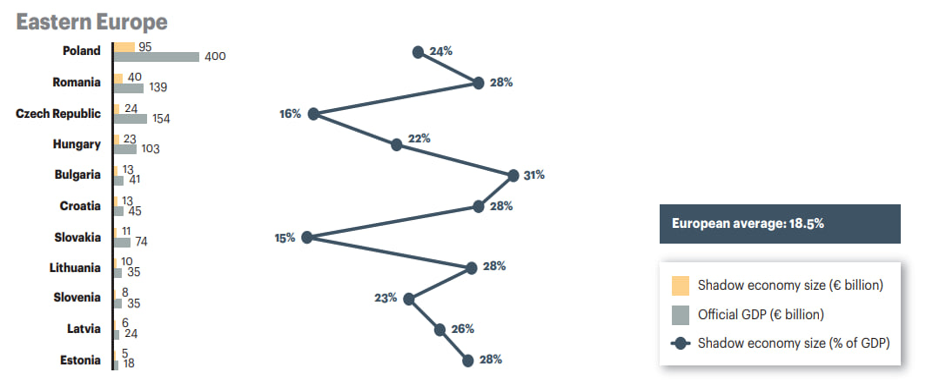
These numbers are not an indicator of backwardness, but an indicator of excessive pressure by governments on people.
When researching this issue, one cannot fail to mention the distrust of “legal” institutions in Eastern Europe. According to given statistics, this is the extent to which there is distrust for legal institutions:
- Ukraine: ~70 percent
- Croatia: ~70 percent
- Bulgaria: ~55 percent
- Poland: ~54 percent
- Montenegro: ~50 percent
- Serbia: ~50 percent
- Latvia: ~49 percent
- Slovenia: ~40 percent
- Slovakia: ~40 percent
But despite this, business works: instead of ineffective state institutions, private reputational mechanisms operate here. Business frequently succeeds despite state interference, not thanks to it. Working without licenses and informal contracts—is a market survival mechanism. Reputation here is more expensive than any license or seal, because it is it, and not some piece of paper from an official, that really determines whether you will return to this supplier, whether you will entrust the money to this partner tomorrow, whether this or that entrepreneur will be able to satisfy, in theory, your desire.
The Triumph of Austrian Methodology
Empirical evidence from Eastern Europe brings us back to the absolute methodological correctness of Ludwig von Mises, described in detail in his Human Action: A Treatise on Economics (1949). This suggests that the laws of economics have the same objective nature as the laws of physics, they cannot be repealed by government decrees.
In the context of libertarian theory, the experience of Eastern Europe also allows a new look at the famous discussion between Murray Rothbard and Samuel Konkin on the strategy of agorism. In his criticism, Rothbard quite rightly noted that Konkin’s excessive optimism about the ability of the counter-economy to independently and consciously eliminate the state is rather a utopian ideal. The Eastern European experience confirms Rothbard’s skepticism: millions of people in the shadow sector are not ideological revolutionaries and do not aim to overthrow governments.
However, the same empiricism triumphantly proves Konkin right in another aspect: the counter-economy is an inevitable, spontaneous and most viable form of free market protection against government intervention. Society may not share the revolutionary goals of agorism, but it flawlessly uses its multifaceted tools to individually save freedom. Shadow economy or counter-economy—is a free market that adapts to an aggressive (state) environment.
Conclusion
The experience of Eastern Europe is invaluable to world libertarian thought. He removes from libertarianism and, in particular, from the Austrian School of the brand “of speculative utopia,” which various critics so often try to stick in the face of the above-mentioned positivists, mainstream economists and statist ideologues of every kind.
Here we do not have a theoretical model and not a thought model from a textbook. We have living, decades-tested empirical evidence. Millions of people in the harshest conditions under the pressure of a totalitarian state, and then its corrupt heir—spontaneously, without any ideological background, recreated exactly the institutions that Rothbard and Konkin wrote about: voluntary exchange, private property outside the formal recognition of the state, reputational mechanisms instead of centralized coercion, spontaneous order instead of planned. No one taught the old women at the bazaar of the treatise Human Action, they simply acted as a free person acts when the state cannot be ignored, but can be bypassed.

