

On Wednesday, the Bureau of Labor Statistics released its September CPI inflation report. The report showed multi-month highs in price inflation, and showed, yet again that price inflation is destroying wage growth, with real wages falling year over year, for six months in a row. The Fed’s arbitrary two-percent inflation goal has proved unreachable for Federal Reserve bureaucrats, with the Fed missing its target now for 66 months in a row. Even the Fed’s preferred inflation measure, the PCE (personal consumption expenditure) metric showing five years of above-target price inflation growth.
Today, the BLS has now released its latest producer price index (PPI) measure of price inflation. This is a measure prices paid by producers who use goods and services to create consumer goods. Put another way, the PPI is intended to measure wholesale prices.
The new report shows that prices are surging at the wholesale level, and even more dramatically than consumer prices. During September, the PPI rose by 6.3 percent, year over year. That’s the largest annual increase since December of 2022, back when the Federal Reserve was facing 40-year highs in consumer price growth, and claiming that price inflation was “transitory.” The year-over-year PP measure has now growth for three months in a row. September’s increase was well above August’s increase of 5.6 percent, and also up from September 2025’s rate of 3.04 percent.
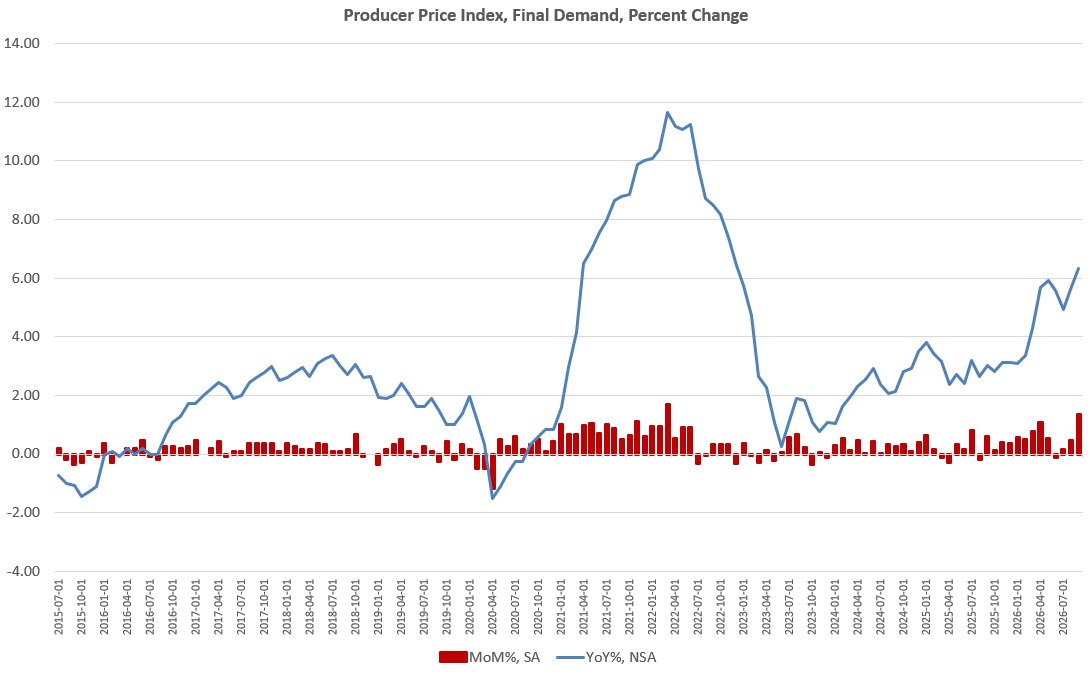
Meanwhile, measured month-to-month, the PPI is now at 1.3 percent, the highest level since March of 2022, 54 months ago. The month-to-month PPI has also grown for three months in a row. September’s growth rate was well above August’s rate of 0.4 percent, and double September 2025’s growth rate of 0.6 percent.
As the graph shows, wholesale prices have been steadily increasing since early 2023, with multiple new highs being reached over the past six months.
This is a reflection of the federal government continual meddling in supply chains in recent years through tariffs, wars, and a variety of policies that function to limit supply and drive up costs. The realities of PPI growth are also a helpful reminder that restricting access to foreign goods is much more than a matter of consumer goods. Many Americans wrongly believe that foreign goods enter the country only as finished consumer goods, and that limiting these goods will drive consumers to purchase domestically made goods and services. Many Americans think imports are all about televisions and cars.
In reality, when governments intervene to limit access to foreign goods, government are greatly restricting the ability of Americans and American firms to produce things here in America. Almost no manufactured item can be created with 100% domestically produced goods. Nor should it be, as it would be absurd to pursue a policy of forcing American factories and firms to devote time and energy to creating everything from locally sourced raw materials from scratch.
Some have argued for this in the past. They were mostly third-world socialists who subscribed to so-called “development theory.” Modern-day MAGA tariff enthusiasts are simply the modern heirs of that backward third-world ideology.
A free and advanced economy would encourage domestic firms, large and small, to make things using goods where they are most economical. Unfortunately, to oppose this is support punishing American producers who try to import foreign services in an effort to make things and employ Americans here at home. To go astray of federal agents— who are micromanaging everything every business owner is allowed to buy form foreigner—is to side with the bureaucrats against productive business owners.
Naturally, this sort of thinking is often very popular with mediocre wage-earners who have never actually founded a business or provided jobs to others. In this way of thinking, cutting off producers from foreign goods somehow “creates jobs” when, in reality, trade controls only make it more difficult for American business owners and entrepreneurs to actually make things.
We see this all taking place now with Donald Trump’s repeated efforts to cut off American business owners—many of them small business owners in American communities—from what is needed to keep people employed and keep the business profitable.
As the PPI measure now shows, prices are soaring as Trump’s anti-trade policies further strangle local businesses and business owners.
Moreover, these price increases on production are likely to filter down to consumer prices in the future. PPI is often a good indication of where consumer prices are headed. Just as September’s CPI data showed solidly growing prices—and much more broadly than just energy prices—the surging PPI suggests we can expect more of this.

