

In February 1976, more than 70 petty criminals in Washington, D.C., donned their best clothes—some even rented tuxedoes—to attend a lavish party thrown by the Italian mafia. For months, these men had been robbing homes and business for goods they could fence. The gangsters who ran the fencing ring had names like “Angelo Lasagna” and “Rico Rigatone,” and they paid out $67,000 dollars over the course of five months for more than $2.4 million worth of stolen goods.
The party was a celebration of all the great work the criminals had done. The mafia promised alcohol, women, and door prizes, and attendees would finally get to meet the “Big Boss,” Don Corleone, who let his guests kiss the rings on his hand. After the Don was done greeting the attendees, he made an announcement. “Before you go into the party, I have a really funny thing to tell you,” he said. “You’re under arrest.”
The gangsters were really a group of (non-Italian) police officers participating in an experimental strategy for fighting crime, known as “Operation Sting.” Using a fake business entity known as PFF, Inc. (short for “Police-FBI Fencing, Incognito”), they promoted their fencing operation to the criminal underworld, encouraging them to bring stolen items to them for cash. Rather than arresting them right away, they paid the criminals for the goods while secretly recording them. These crooks became regular clients, encouraged to bring more stolen goods to fence during the five-month operation. When they could not get their hands on merchandise, they would steal welfare checks and credit cards from the mail, which they could also turn in for cash.
The police and FBI still boast about the success of Operation Sting, but it seems hard to ignore the moral hazards involved. By creating an underground market for stolen good, the federal government created a strong incentive for these criminals to steal more than they otherwise would have. Crime data for Washington, D.C. shows that reported robberies declined throughout the 1970s, except for a significant spike upward when Operation Sting was underway.
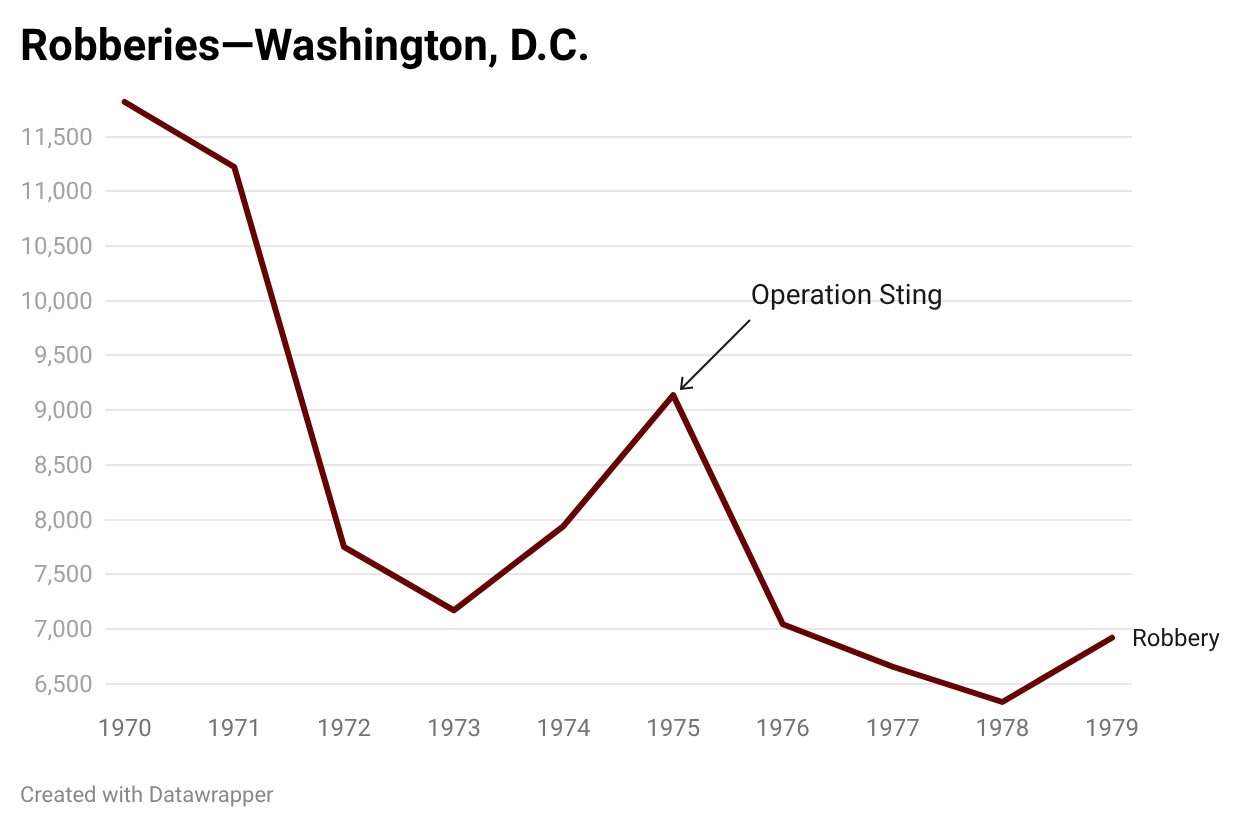
Yet Operation Sting was hailed as a smashing success—based on arrests made, rather than crime reported—so the federal government distributed millions of dollars in grant money to dozens of local police and sheriff’s departments across the country to create their own fencing companies. These operations would run for months or even years before any arrests were made.
The Los Angeles County Sheriff’s Department, for example, received the largest federal grant and conducted the most extravagant operation, known as “Operation Tarpit.” They established fake storefronts at seven different locations, through which they purchased more than $42 million worth of stolen goods over the course of two years before making any arrests.
The police forces involved in the stings—both local and federal—pat themselves on the back for the thousands of arrests they made, as well as the massive quantity of stolen goods they “recovered,” though this meant little to the victims who typically had no way of reclaiming their property. But the general consensus was that these sting operations were wildly successful. The New York Times even reported on how significantly theft had declined in cities that conducted these operations in the year after these operations took place—a drop that predictably followed the spike in robberies that occurred while the government was actively subsidizing theft.
Just like the federal government’s ill-conceived wars on drugs and poverty, its war on crime produced more of the very problem it was designed to combat.

