

I was very new to Austrian economics when I came to Mises University in 2009. Ron Paul had inspired me to read works like Economics in One Lesson and a few other beginner-level books. The ideas were intriguing, so I attended Mises University to get a deeper understanding.
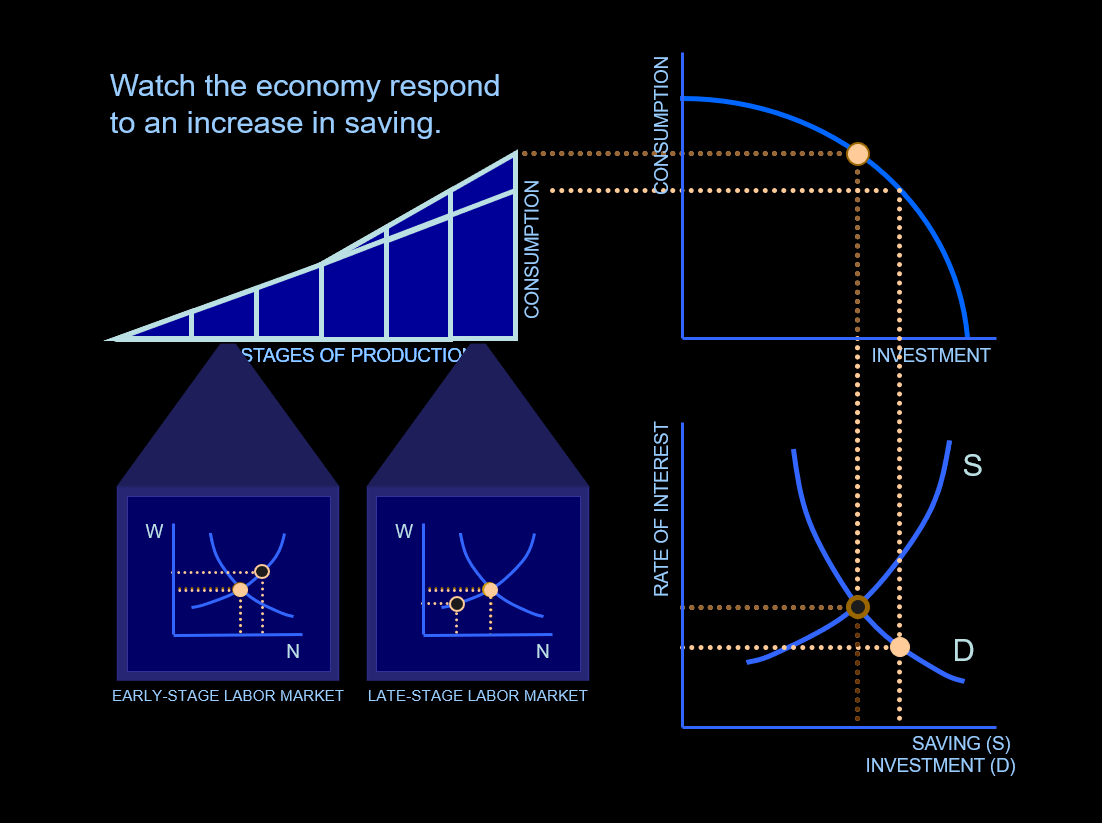
Near the end of the first day of the conference, this unassuming man stood in front of a PowerPoint slide with the title “Capital-Based Macroeconomics.” He introduced a few different graphs: a loanable funds market, a graph depicting the trade-off between consumption and investment, a Hayekian triangle, and some labor markets for specific stages of production.
Then he put them all together. And animated them.
He explained what was happening in plain English and sprinkled in some humor along the way: “I use the term ‘capital-based macro,’ although for this crowd it’s Austrian economics. . . . it keeps people from asking about Australia.”
He showed exactly what happens when there is an increase in savings—how interest rates fall, consumption decreases, investment increases, entrepreneurs begin longer lines of production, and employment shifts away from the stages of production closest to the consumer and toward the earlier stages. The capital accumulation results in increased productivity and sustainable economic growth.
Next, he showed exactly what happens when there is an increase in the supply of loanable funds that comes from artificial credit expansion rather than savings. The interest rate decreases, as with the increase in savings scenario, but consumption and investment spending increase too. The Hayekian triangle elongates as entrepreneurs choose longer lines of production, but there is also increased activity on the consumption end of the triangle. Wages also go up as the demand for labor increases, in both the early and late stages of production.
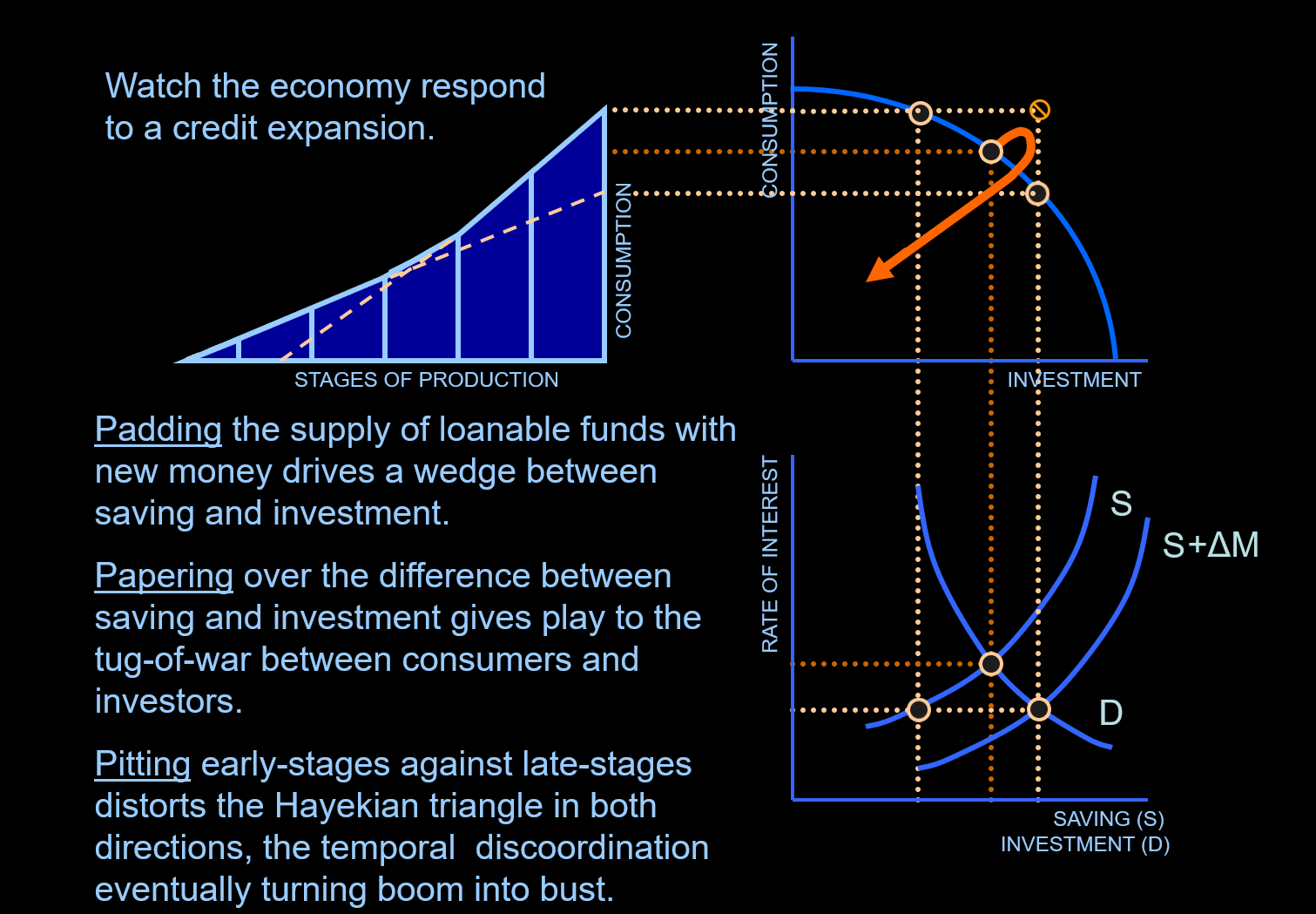
In this beautiful way, Roger Garrison explained how artificial credit expansion gives the illusion of prosperity. He showed how unsustainable booms arise, and how the lack of real savings results in an inevitable bust. All of it was contrasted with the Keynesian framework: Keynesians miss the structure of production, an essential part of any explanation of economic growth or business cycles, and so misdiagnose the problem as insufficient aggregate demand and prescribe the very policies that hinder recovery and instigate the cycle in the first place.
I was amazed. By the end of his lecture, I was determined to go to Auburn to pursue a PhD in economics and learn as much as I could about Austrian economics.
At Auburn, I had the pleasure of taking two courses with Dr. Garrison: one on macroeconomics and the other on the history of economic thought. His courses featured the same excellent instruction, subtle humor, and well-designed PowerPoints as his Mises University lecture.
I hope I wasn’t the annoying student, but I would often come to Dr. Garrison’s office hours and ask him about Austrian economics, classical liberal ideas, and the history of economic thought. The guy was a treasure trove.
After graduating, I continued to learn from Dr. Garrison through his writing. His book Time and Money expanded on the graphs he presented in his “Capital-Based Macroeconomics” lecture. I read many of his articles and book chapters, which he kindly made available for free on his website. (His website also contains his famous PowerPoints!)
When it was my turn to teach students about macroeconomics and the history of economic thought, it was heavily inspired by what I learned from Roger Garrison. I had the pleasure of seeing students’ eyes light up when Austrian business cycle theory “clicked” for them.
It was a great honor to finally stand where Dr. Garrison had at Mises University, lecturing students on business cycles and other topics. As a member of a younger generation of scholars, I don’t pretend to have the same wisdom and influence as Dr. Garrison, but I hope all of us who learned from him and were inspired by him will carry the torch.
In his history of economic thought course, I learned that many economic schools of thought have died out. Some completely erroneous schools of thought that ought to have died out persist because they give the state grounds to spend, regulate, tax, and inflate. They march on like zombies. Their growth is unsustainable because it is based on parasitism—errors and lies that help the government expropriate as much as possible from the market economy.
But other schools of thought latch on to the truth. They critically assess what previous economists wrote and they develop it, refining and expanding on what is true and discarding what isn’t. Generations of scholars come and go; a few, including Roger Garrison, make their mark on the field and inspire future generations to do the same. This growth is sustainable.

