

The New York Knicks are in the NBA Finals for the first time in 27 years, playing the San Antonio Spurs, with their last Finals appearance coming in 1999. They are also up 2-1 in the best-of-seven series, meaning they are only two wins away from their first title since 1973. Knicks fans are so rabid for a title and the chance to see their hometown team compete for one that 33 percent of buyers for Game 2 in San Antonio came from New York and New Jersey zip codes.
Predictably, their appearance in the NBA Finals has resulted in much hoopla over ticket prices on the resale market, something this summer’s upcoming FIFA World Cup has constantly drawn headlines for the entire calendar year. The lowest-priced tickets for Game 3 in New York were listed at roughly $4K, with many going for more than $10K. StubHub even said the demand for Game 3 tickets at MSG was analogous to the Super Bowl. As one might expect, this has caused quite a stir in the media, with President Trump being asked about it over the weekend. He was quoted as saying:
They can watch it on television, it’s sorta semi-free to watch it on television. That’s the way life goes. Now, if the team wasn’t a big success, you could go very easily. That’s just the way life is.
If the firestorm that’s brewed around President Trump’s frank remarks was not enough for irking some of the media’s (and some of the public’s) sensibilities, he will also be attending Game 3 at Madison Square Garden. Putting that aside, including the TSA-style screening procedures which will come with his attendance, there’s a basic economics lesson at the heart of the ticket price hoopla. Specifically, the law of supply and demand and the subjective theory of value.
To quote from the great Murray Rothbard’s work, The Mystery of Banking:
Any given price is always determined by two fundamental, underlying forces: supply and demand, or the supply of that product and the intensity of demand to purchase it. . . Supply, for any good, is the objective fact of how many goods are available to the consumer. Demand is the result of the subjective values and demands of the individual buyers or consumers.
In order to see why resale ticket prices have increased as they have, let’s first examine the supply. When it comes to seating capacity, Madison Square Garden is still roughly the same as it was in 1973, about 19.8K seats. Thus, the supply of seats (i.e., tickets) has remained unchanged for half a century and is extremely small relative to the millions of Knicks fans living in the New York City area and beyond.
This means the price increase must be determined by examining demand. I asked ChatGPT to give me—adjusted for 2026 dollars—the 1973 and 1999 NBA Finals resale ticket prices plus the reachable buyer market. The average 2026 Finals ticket is about 30–50× more expensive than in 1973, and about 6–12× more expensive than in 1999. The reachable buyer market, however, is a whopping 1,000–100,000x larger than what an ordinary seller could access in 1973, and 100–1,000× larger than what an ordinary seller could access in 1999.
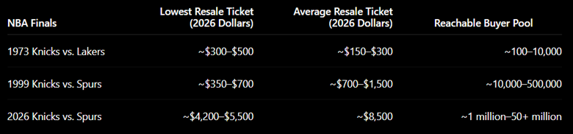
Therefore, what was once largely a regional market in 1973 and a national market in 1999 is now a global market in 2026, thanks to technological innovations. Today, there are online ticket resale marketplaces that offer instant mobile ticket transfers with a single click. Now, anyone, living anywhere, at any time, can both sell and purchase an NBA Finals ticket.
This has created a demand unlike ever before, one that is orders of magnitude larger today than the pre-internet and pre-smart phone eras, even if the average TV Ratings were in fact higher for the NBA Finals in the 1990s than today (although it is a challenge to know the exact viewership numbers in today’s age due to the rise and prevalence of streaming platforms plus highlights versus traditional TV).
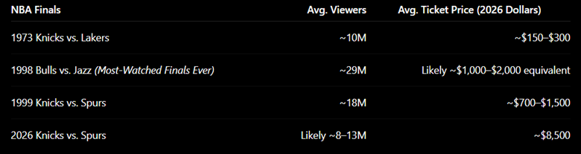
Expanding upon this, recall that Rothbard stated that demand results from the subjective values and demands of individual buyers or consumers. The subjective theory of value is the idea that the value of a good is not determined by any inherent property of the good, nor by the amount of labor required to produce the good, but instead value is determined by the importance an acting individual places on a good for the achievement of their desired ends.
The old adage goes, “One man’s trash is another man’s treasure,” implying that people value things differently based on personal preferences. For some, a ticket to watch the Knicks in the NBA Finals may be their ticket to a temporary state of bliss plus a joyful memory for life, whereas for others, that same ticket may mean absolutely nothing and be of no real value to them. Value is indeed subjective.
To close, in this article from The Athletic, NBA business reporter Mike Vorkunov writes on the buzz surrounding the resale ticket prices:
The crazy part might be that it’s not the top of the market either. Imagine if Game 4 becomes a closeout game. Or if that’s Game 6, also at MSG. What amount of money would a wealthy diehard Knicks fan pay to see their team win the title on their home floor? There might not be a theoretical limit.
For a fanbase that hasn’t won a title since 1973, there’s no price for being there in person, cheering on their team, and celebrating the pinnacle of professional basketball achievement. And, largely for that reason, paired with a global buyer’s market today in the tens of millions, who knows just how high the average Knicks resale ticket will go? It’s truly whatever these passionate fans are willing to pay for, and for them, it’s a magical, once-in-a-lifetime opportunity, one they may never have the chance to experience ever again.
Cheers to the law of supply and demand. Cheers to the subjective theory of value. Cheers to the New York Knicks. Go New York, Go New York, Go.

