

The recent lurch to the left in Democratic primaries has raised the issue of extending Medicare to all Americans. Nobel laureate Paul Krugman has weighed in on this issue. As is often the case, Krugman demonstrates detailed knowledge of individual facts concerning the issue at hand, yet manages to arrive at false conclusions.
Krugman admits to several pertinent facts. First, the establishment of Medicare and Medicaid did effectively socialize the bulk of the US healthcare industry.
“the government’s role is so large that U.S. healthcare is better described as partially privatized socialism than as anything resembling a free market… Don’t tell anyone, but the way Medicare operates — it covers every senior’s medical expenses, whatever they turn out to be, while being funded by taxes that depend on one’s income — could be summarized by the old Marxist slogan “From each according to his ability, to each according to his need.”” P.K. August 2026
Second, income taxes apply only to money income, not to benefits. Hence, medical benefits are a tax dodge. Third, citizens/voters view Medicare favorably, private insurers unfavorably. Krugman claims that private insurers are parasitic1, a view that already fits with what many Americans want to believe.
In order to make his case seem true, Krugman mixes an old lie in with these truths. Krugman claims that “private insurers have substantially higher administrative costs than Medicare does”. Medicare regulations and procedures created much paperwork. If Medicare had been set up to do its own paperwork, the administrative cost of this agency would be harder to hide. Instead, Medicare forces private health care providers to hire people to process Medicare generated paperwork. This creates the illusion of high administrative costs in what is left of private sector healthcare financing.
Krugman ignores an obvious reason for the unpopularity of private insurance. Private insurers make decisions based on actual costs. This focus on true costs in the private sector stands in stark contrast to socialistic guarantees offered by Medicare, which obfuscate real costs. Of course, we do not want to idealize private insurance. Private insurance is good at pooling risks regarding major medical expenses. Use of private insurance also comes with potential problems - moral hazard and adverse selection. However, actuaries at private insurance companies know how to write contracts to minimize these costs.
Krugman veers towards the truth a third time, when he admits to the inadequacies of Barack Obama’s Affordable Care Act. Bureau of Labor Statistics data suggests that the ACA increased costs.
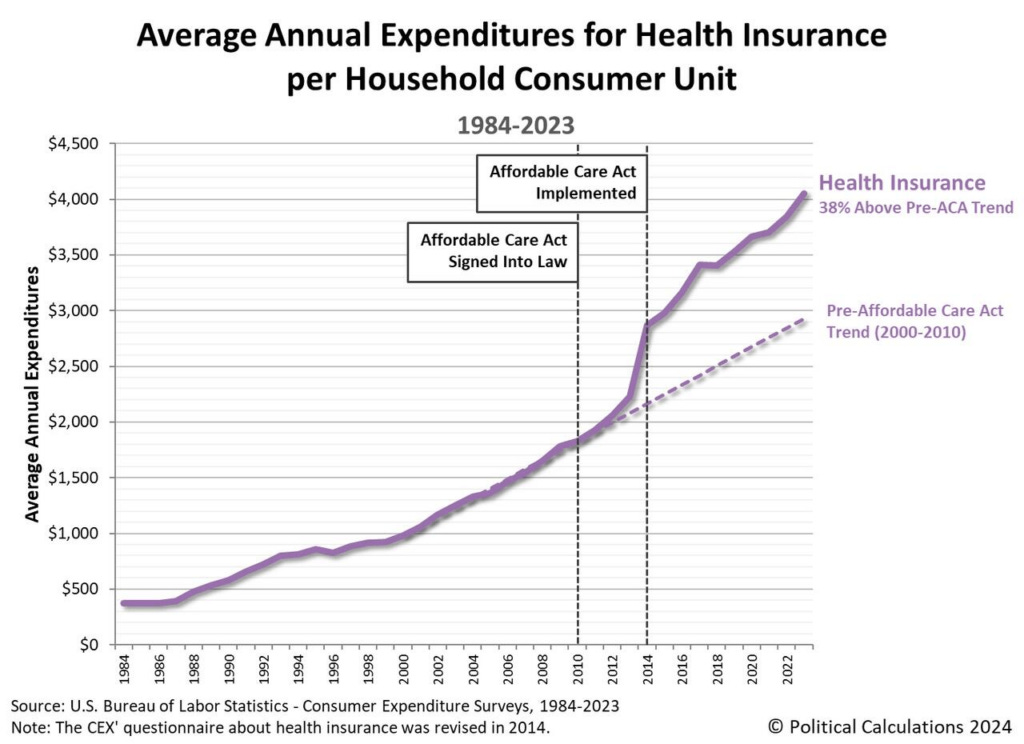
Krugman fails to see that Medicare extension would increase medical financing costs. Krugman also ignores a wave of egregious cases of fraud in many Federal programs, including Medicare. Of course, fraud exists in any system. But, prominent Democrat politicians (e.g. Governor Waltz) seem to have been either asleep at the switch, or complicit in these schemes.
Our current health care system is, as Krugman notes, mostly socialist. Our current socialist system of health financing is also burdened with needless bureaucratic costs, and is corrupt. Excessive bureaucratic costs and weak oversight in US health care financing are not the result of either the remaining fragment of private insurance or of bad luck. This is how socialism functions both in theory and in all past experience. Krugman’s claim that private insurers are to blame for high healthcare costs may fit with what many people feel is true, but this assertion does not hold up to scrutiny.
- 1
“Do private insurers add anything positive? Or are they simply parasites, skimming off money that could have been paying for care?”

