

The increase in the Federal debt beyond $40 trillion triggered a chorus of false claims regarding fiscal policy and Federal debt sustainability. This morning on CSPAN, Josh Bivens echoed recent remarks From Paul Krugman and Jared Bernstein.
According to Bivens, the deficit is too high today, but there is nothing to worry about. Says Bivens:
I don’t see any signs of a debt crisis coming our way, a crisis and sort of a short-term catastrophic event. If you look at interest rates today, which people have rightly pointed to, they’re higher than they should be, given the strength of the economy… I think we all got used to incredibly low interest rates starting in the 2010’s and they were not good. They were a function they a deeply distressed economy and so I think that they were always going to be a little higher than that... There’s nothing that says crisis level of interest rates today
The general increase in interest rates is irrelevant to the issues at hand. What really matters is the risk premium in Federal Treasury bills. The interest rates on Treasury bills are generally lower than even AAA corporate bonds. Why? Historically, Federal Treasury bills have been perceived as having lower default risk. We can gain some insight into the relative risk of corporate and treasury bonds by simply subtracting T bill rates from AAA corporate bond rates.
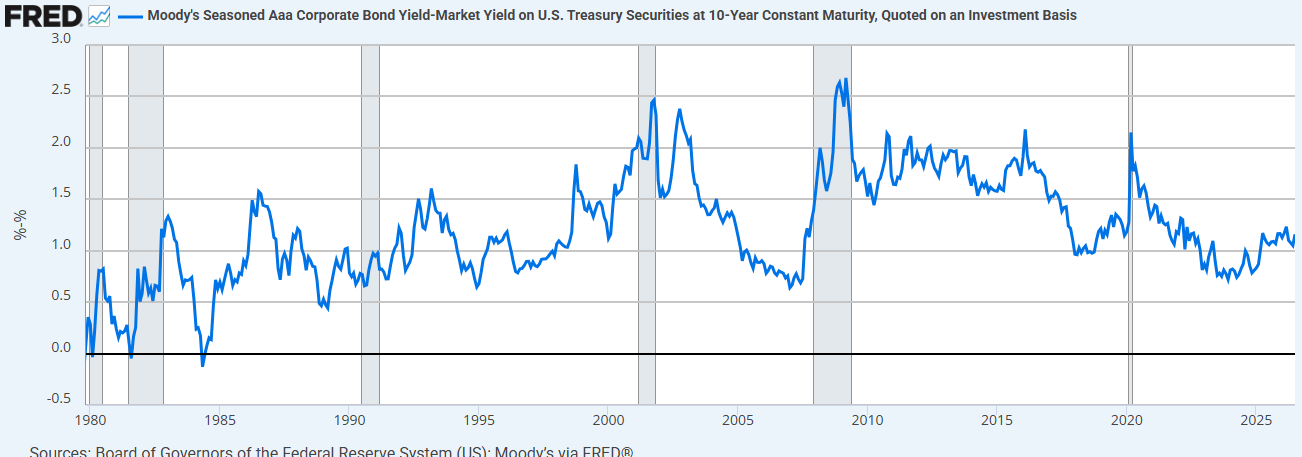
The gap between high quality corporate bonds and Treasury bills widened during the 80sand 90s- this was a period where Reagan’s administration and the 1994 Republican Congress managed to impose some spending discipline (See the graph below). George W Bush’s betrayal of his own party’s fiscal beliefs narrowed the gap between AAA bonds and T-bills (except for the financial crisis associated with the Enron failure).
The subprime crisis enlarged the gap between AAA Bonds and T-Bills temporarily, as people worried about corporations defaulting on their debt. The policies of Obama, Trump I, and Biden caused the gap between AAA bonds and T- bills to narrow until November 2024. Based on the above data, it seems that Biden’s spending policies did almost as much damage to confidence in T-Bills as did George W Bush’s policies.
There appears to be a modest improvement in confidence regarding T bills during 2025. This renewed confidence in Treasury bills coincided with DOGE spending cuts. I don’t think this is merely coincidental. DOGE cuts lessened fears of Federal default.
Bivens doesn’t understand these issues. AAA bond rates rose from 2020 to November 2024, but yields on Treasury securities rose faster. The likely explanation for this shift in interest rates is that Biden’s reckless spending cause investors to worry more about default on the national debt.
What can be done to rectify the current fiscal situation? First, most of us need to be better educated on the urgency of the Federal debt issue, including alleged experts. Second, We must determine whether our fiscal imbalances are best rectified through revenue increases or spending decreases. Bivens and his comrades insist that Federal spending hasn’t changed since the 1950s, we just haven’t been taxing the rich enough. Bivens says:
If you look at Federal spending as a share of GDP, it’s about the same today as it was in the 1950s, the idea that there’s been a spending explosion doesn’t fit the facts... absent the effect of Republican tax cuts, we would not have budget deficits today.
Bivens attributes the budget surpluses that emerged at the end of the 1990s solely to the Clinton tax increase. This is simply untrue.
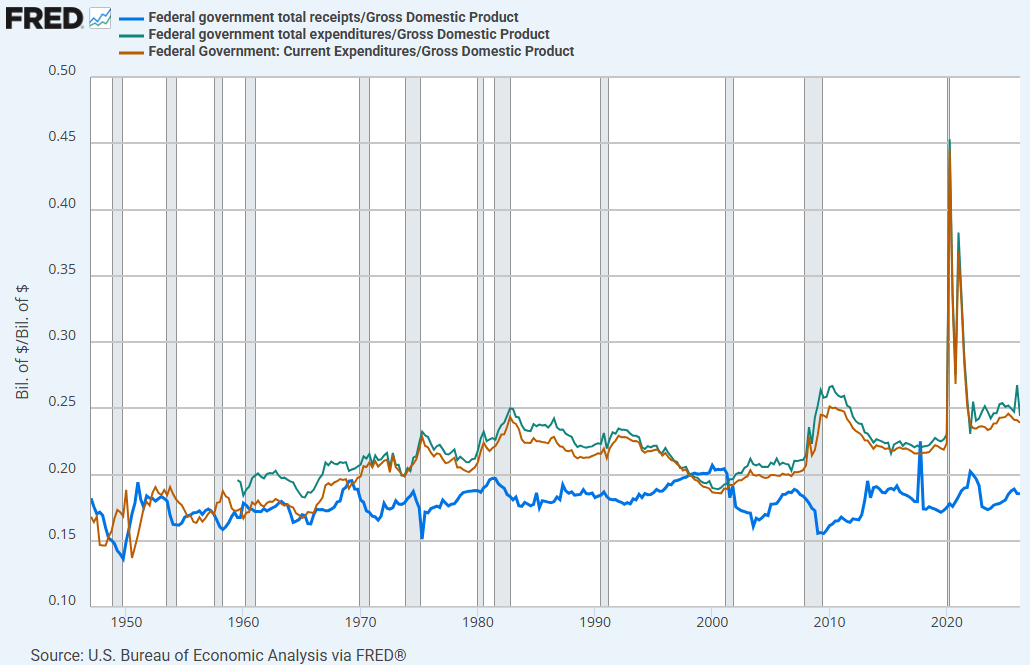
Federal spending trended upwards after the 1950s, as measured either by current or total expenditures, and fell during the 80s and 90s. The surpluses that emerged at the end of 1990s were the result of both increased revenue and a temporary departure from the upward trend in spending during that decade.1
The case for maintaining or increasing Federal spending ultimately comes down to ideological assertions by a few pseudointellectuals. According to Bivens: “I think the spending that we do is incredibly valuable and necessary for both the functioning of society and so that the most vulnerable people can carve out a decent life.”
Bivens and his comrades cling to the notion that deficit spending can improve the “functioning of society” (e.g. counteract recessions) via a fiscal multiplier effect. The peculiar part of this is that economists generally agree that the fiscal multiplier effect is small and inconsistent, at best, and perhaps nonexistent. Krugman admits to real problems with fiscal stimulus. Furthermore, we all know that poverty rates declined prior to Johnson’s War on Poverty, but not since then. Is this a problem with stubborn refusal by some to face up to known historical facts?
There is a history lesson that needs to be more widely understood in economic terms. Johnson’s Great Society programs (and FDR’s New Deal programs) shifted the economy away from creating wealth and towards redistributing wealth. Wealth redistribution does not simply happen, interest groups compete to acquire benefits and avoid costs. The more that we invest in “rent-seeking” wealth redistribution, the less we have to redistribute. The theory of Rent-Seeking investments to redistribute wealth explains why the welfare-redistributive state should not have been created in the first place.2 The Rent-Seeking concept also explains the futility of all future efforts to make any redistributive state work. Those who fail to use the correct economic concepts to understand history are doomed to repeat past mistakes over and over again.
- 1
Several factors made both budget and entitlement spending easier to finance during the 1990s. First, the military spending could be cut, thanks to the fall of the USSR. Second, fewer people were entering the Social Security system, due to low birth rates during the Depression and during World War Two. Third, the Republican Congress had political support to impose a modest degree of spending control in the budget, despite President Clinton’s efforts to the contrary. Welfare reform also helped to raise revenues, and reduce expenditures, by increasing the ratio of taxpayers to tax consumers.
- 2
Gordon Tullock published his seminal article on rent-seeking in 1967. Hence, this critical concept did not arrive in time to stop Johnson from creating his Great Society programs.

